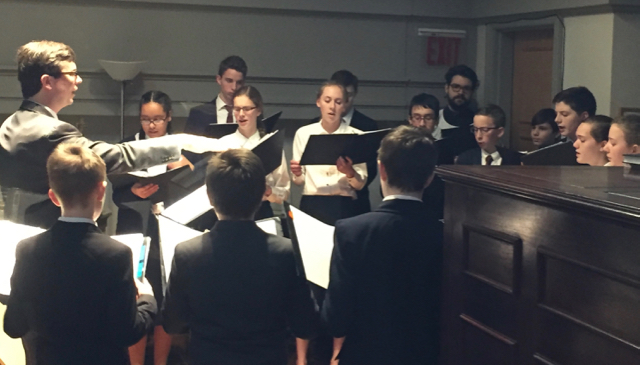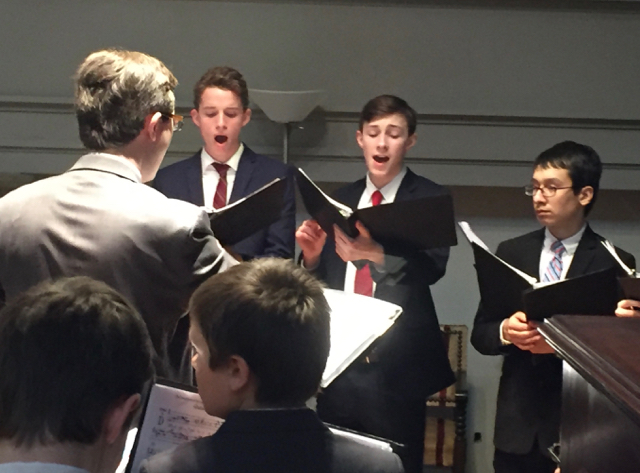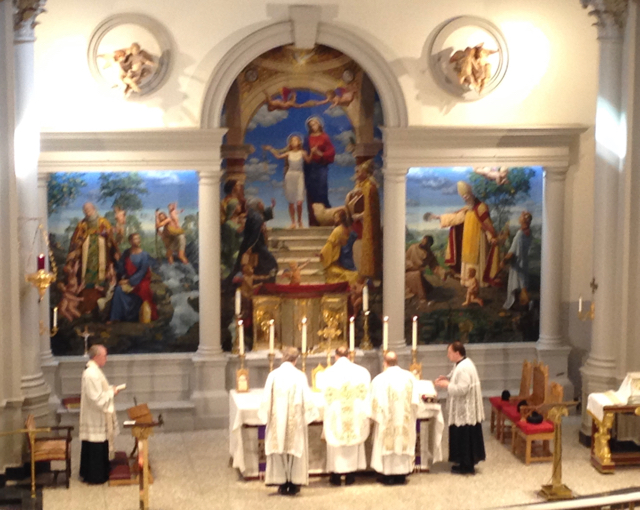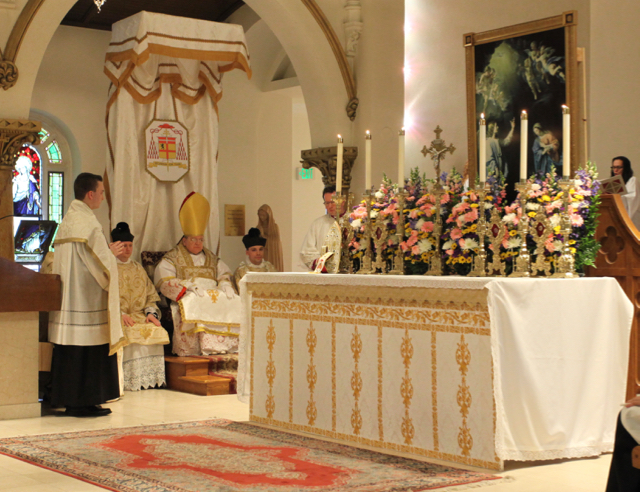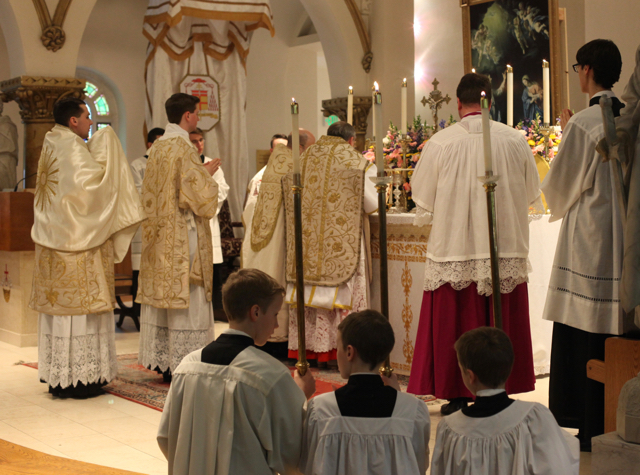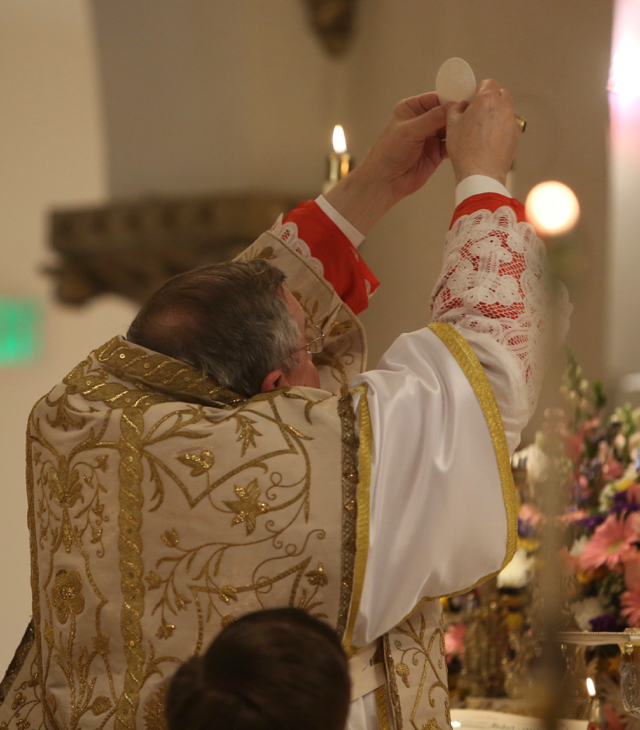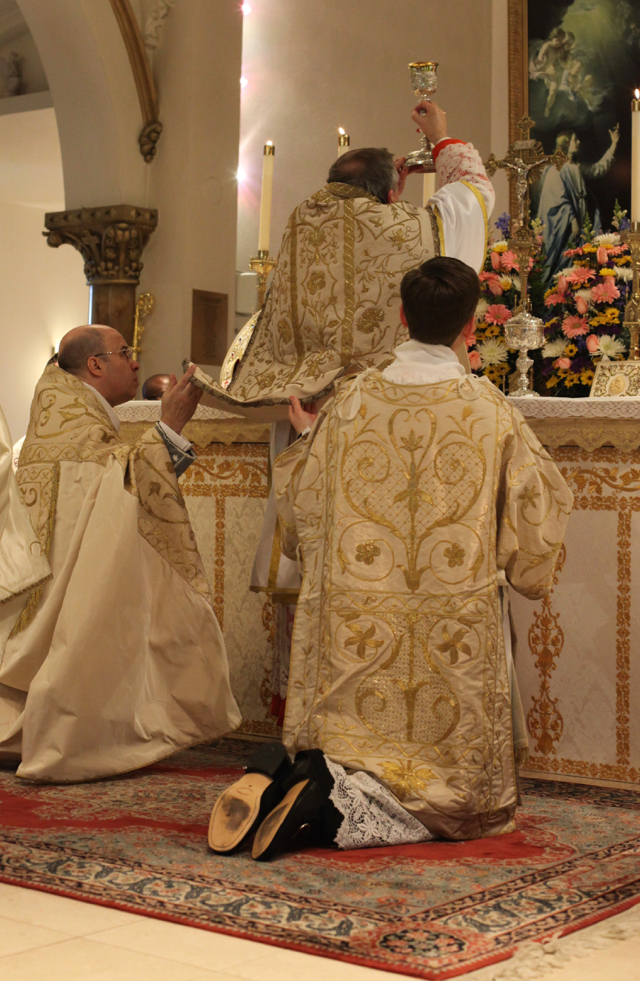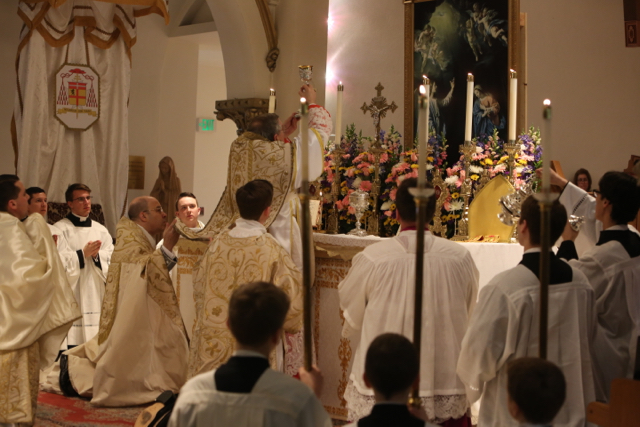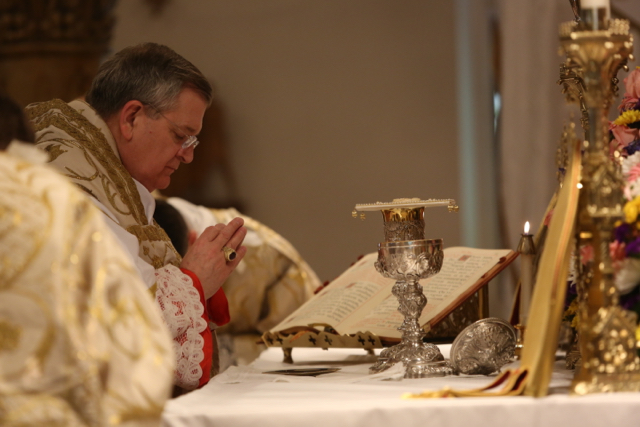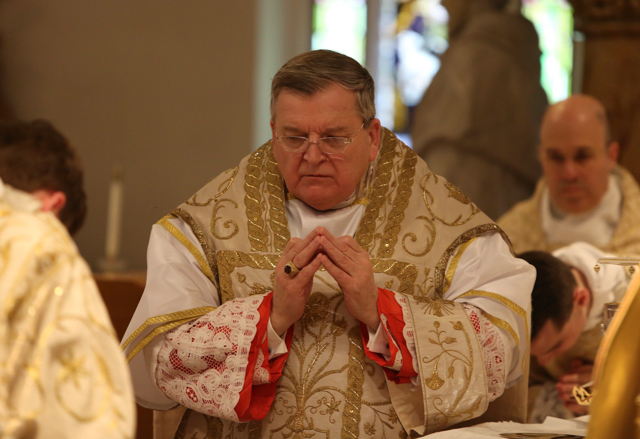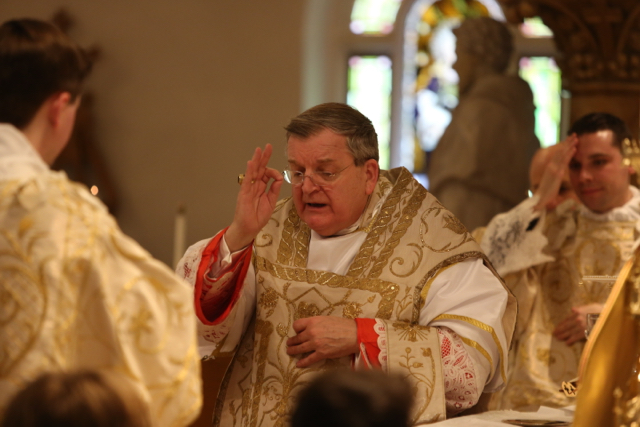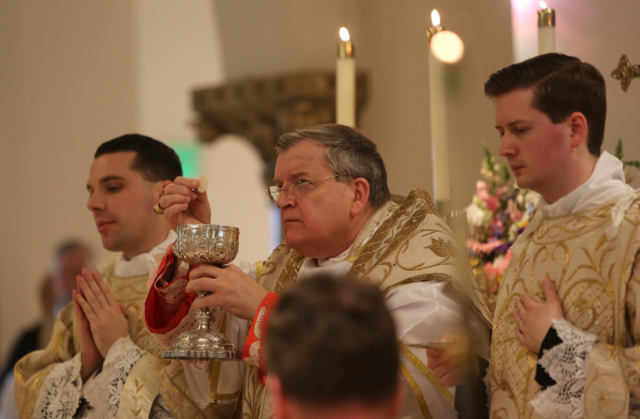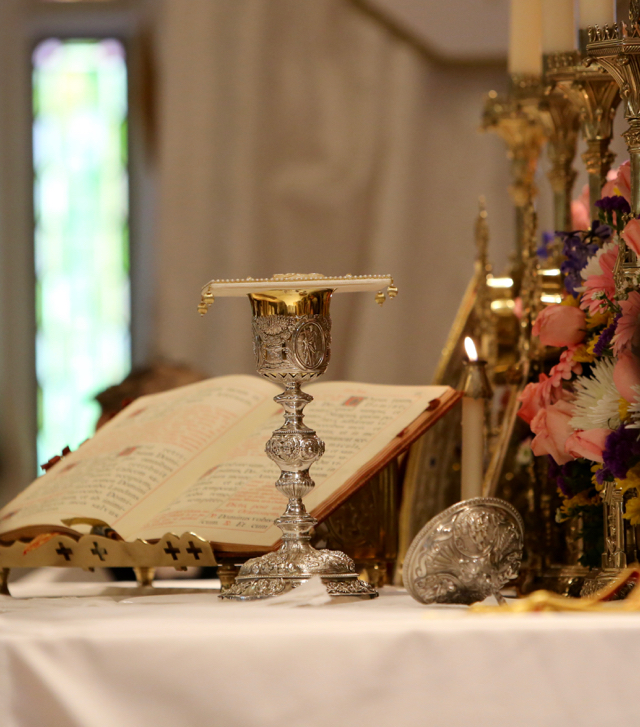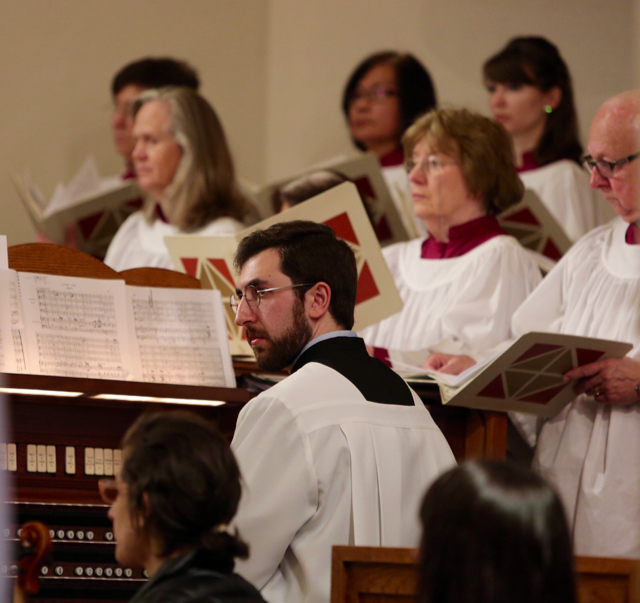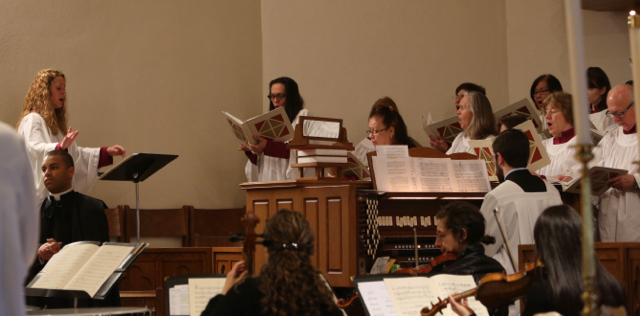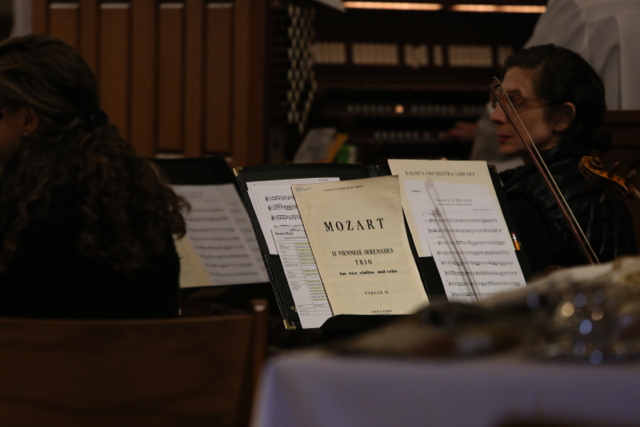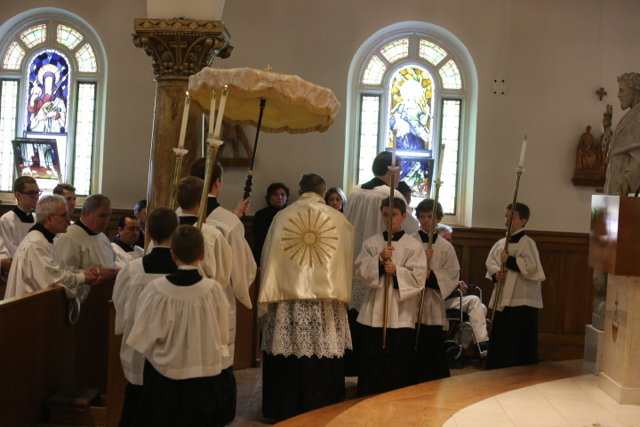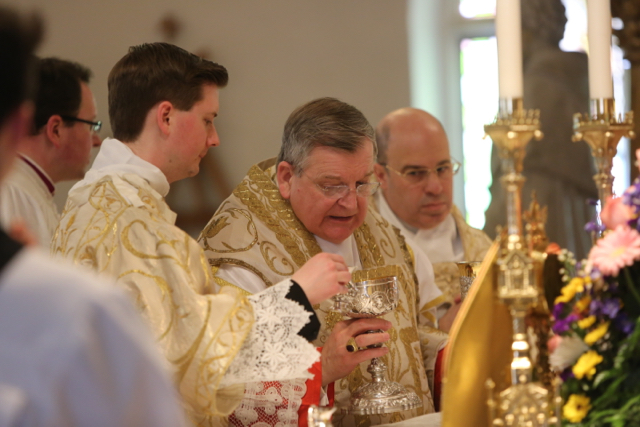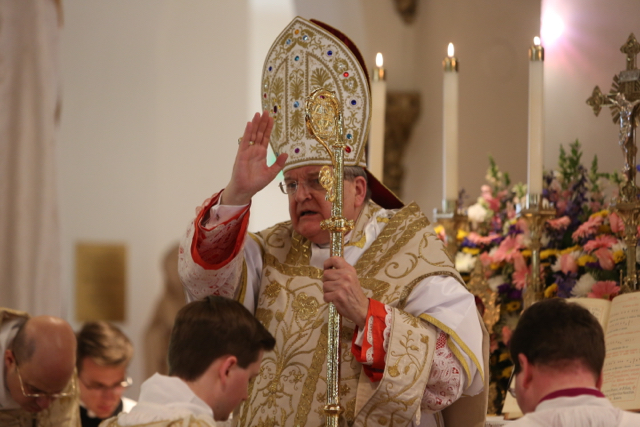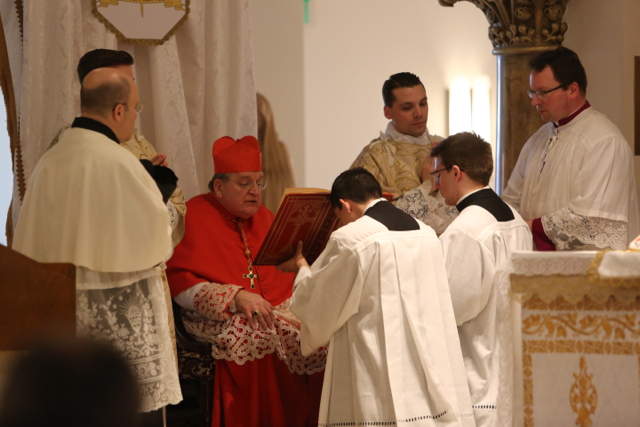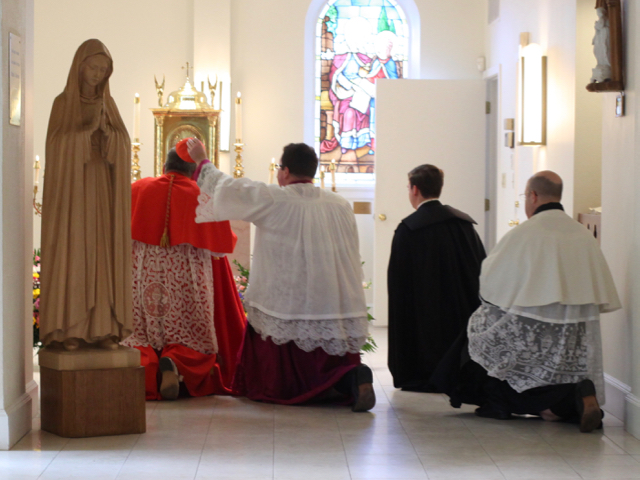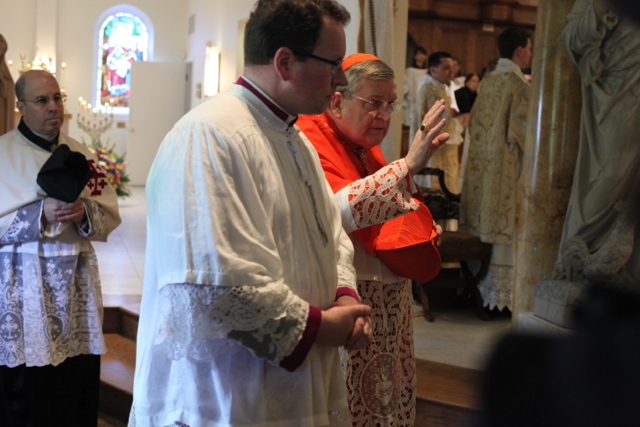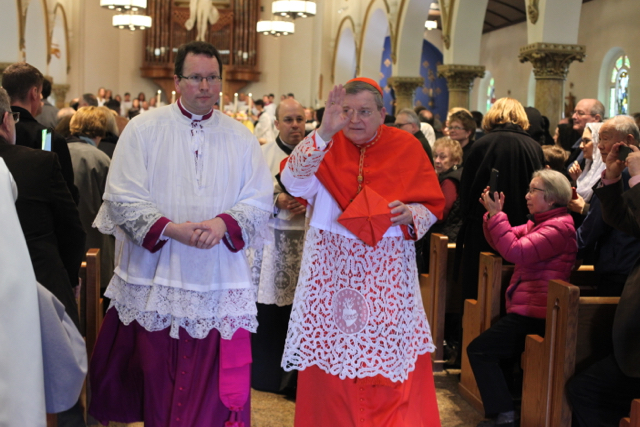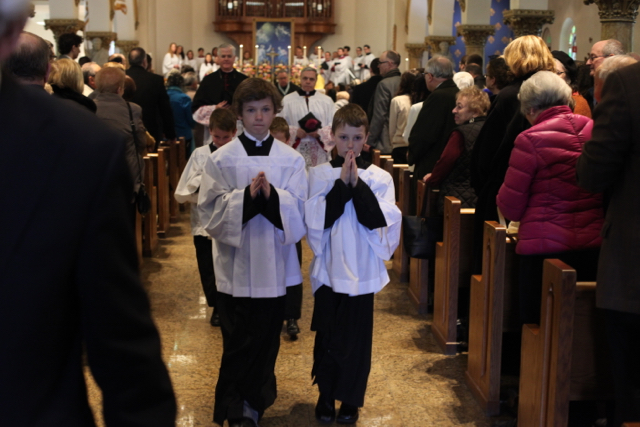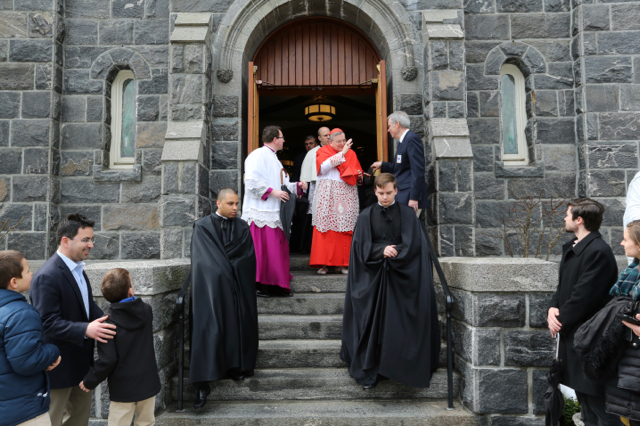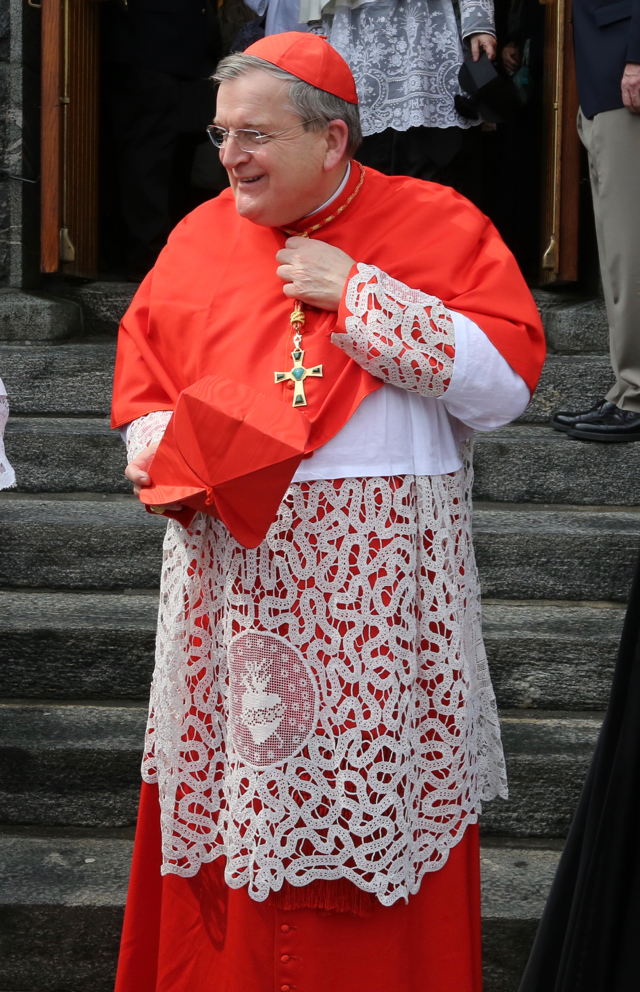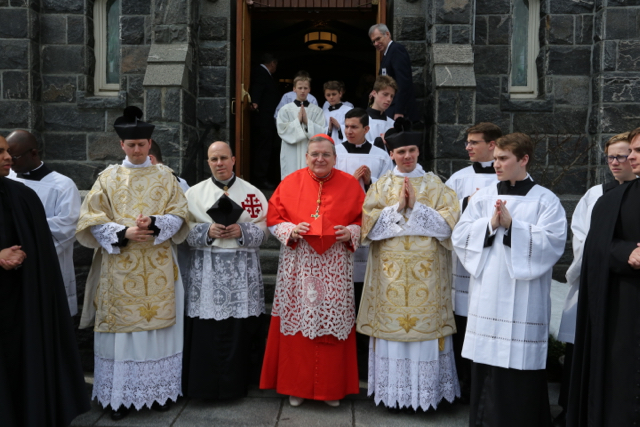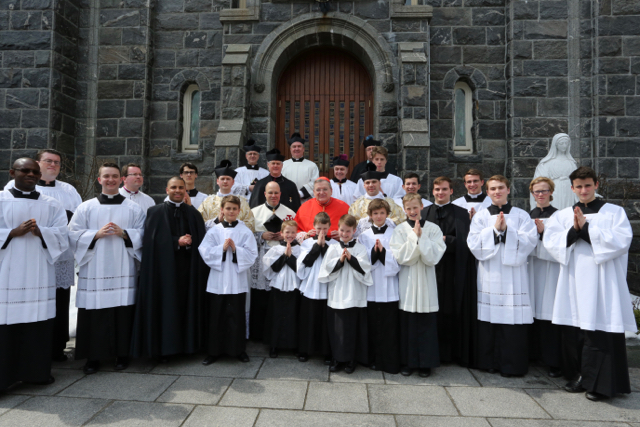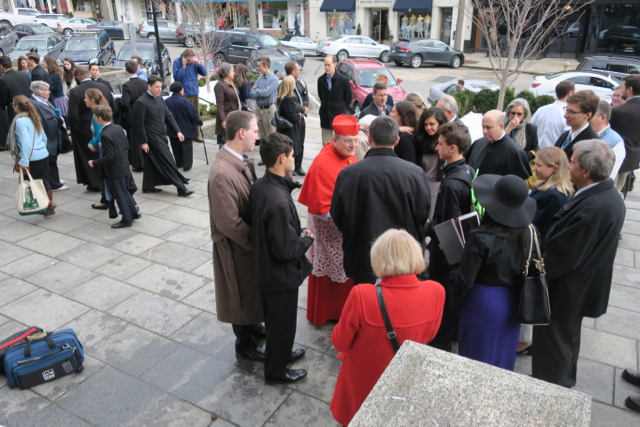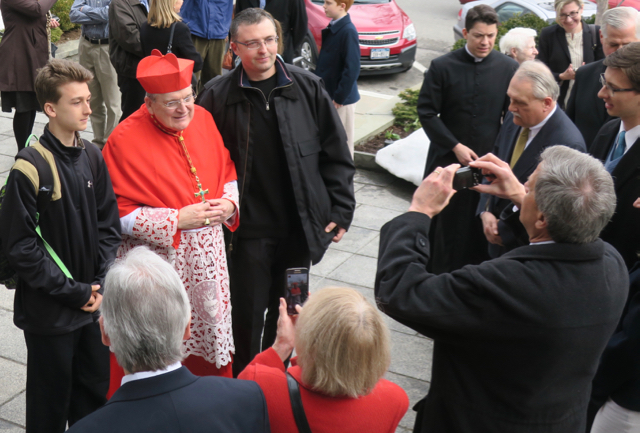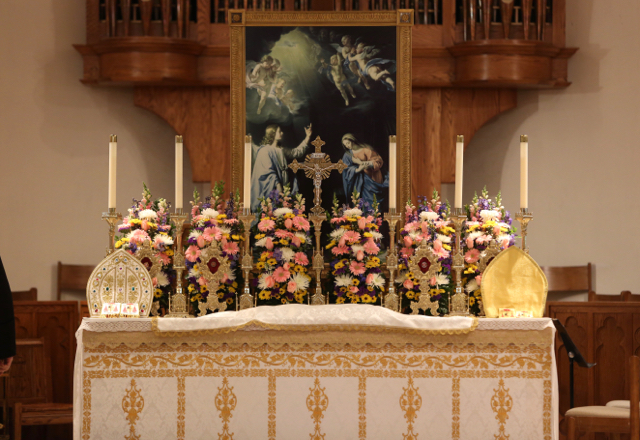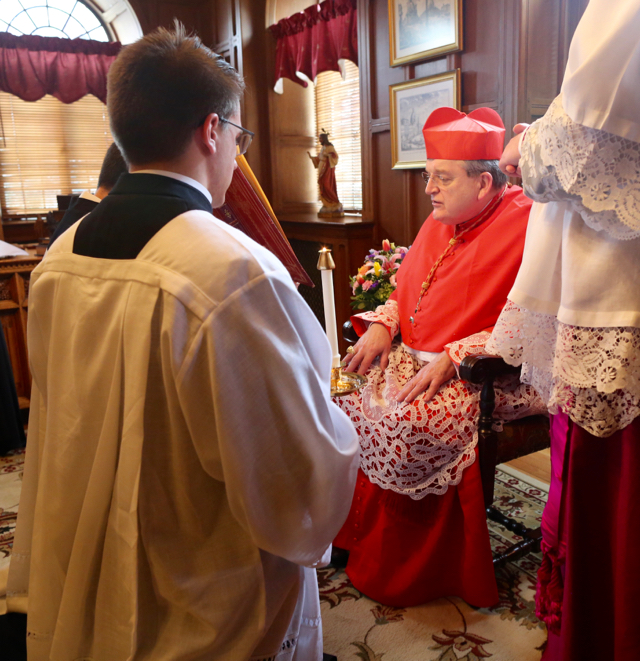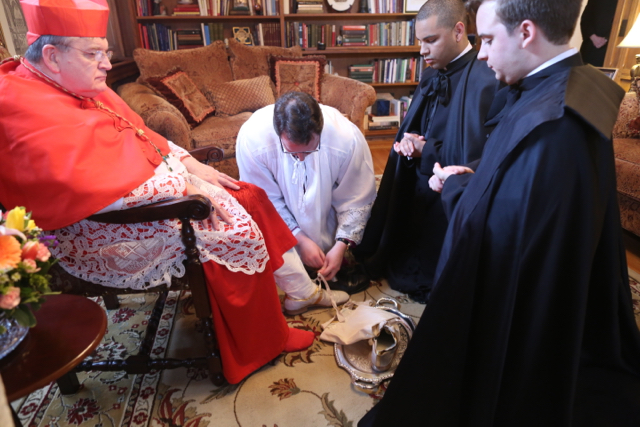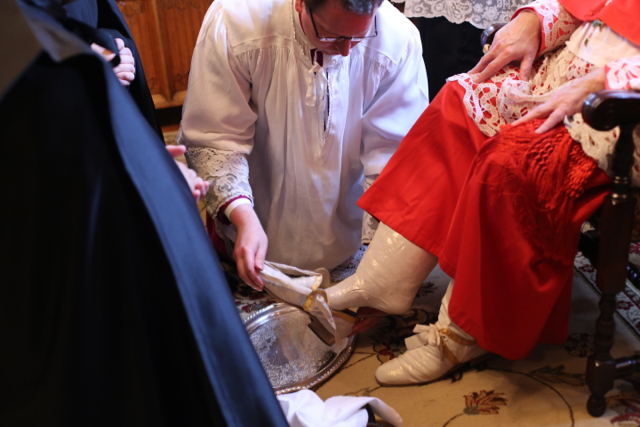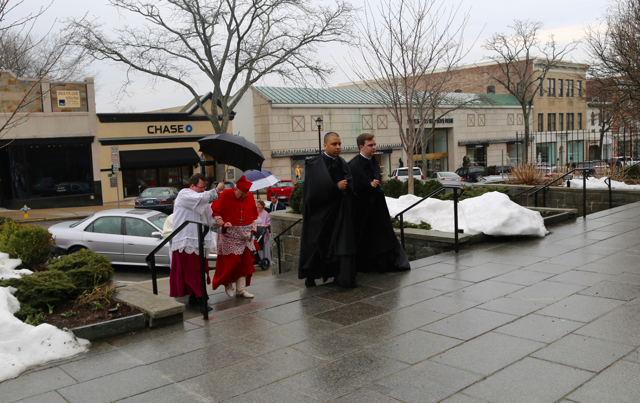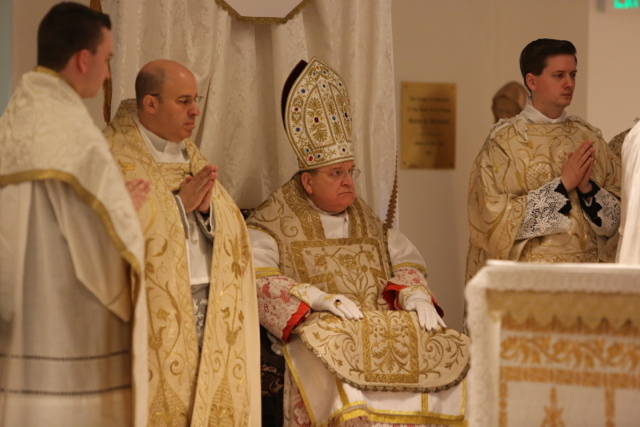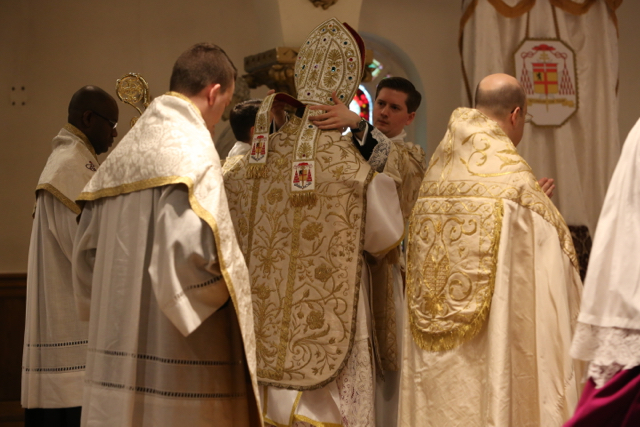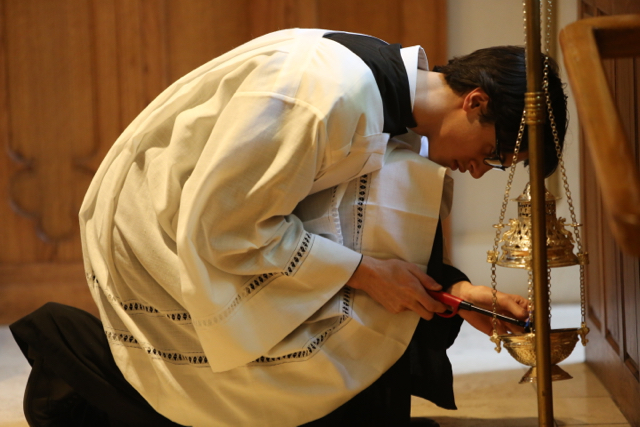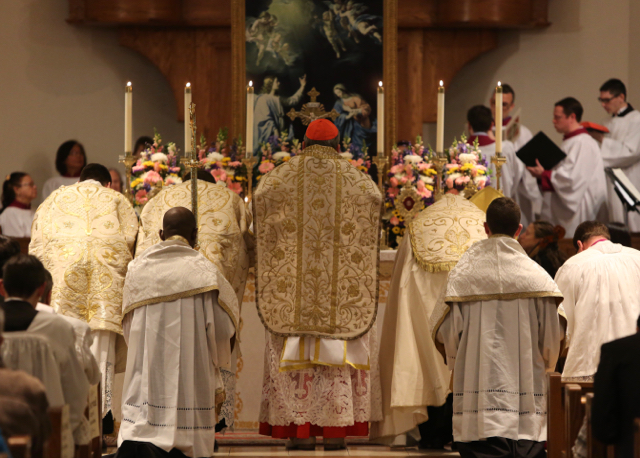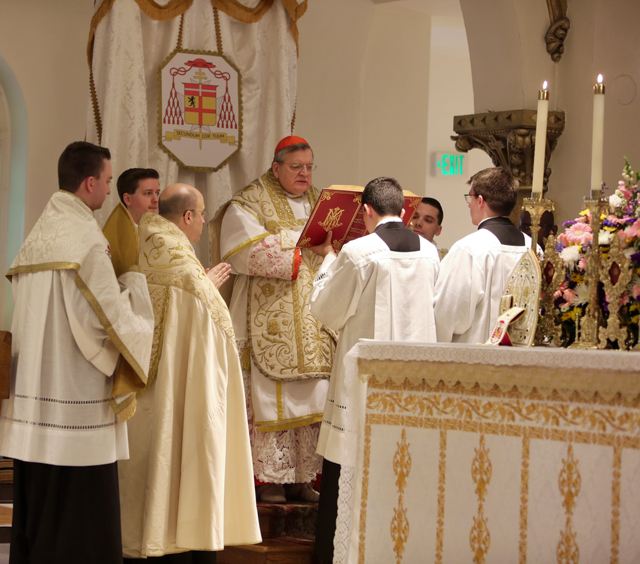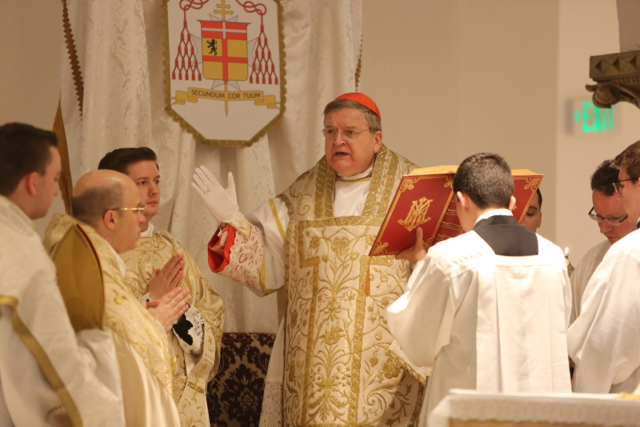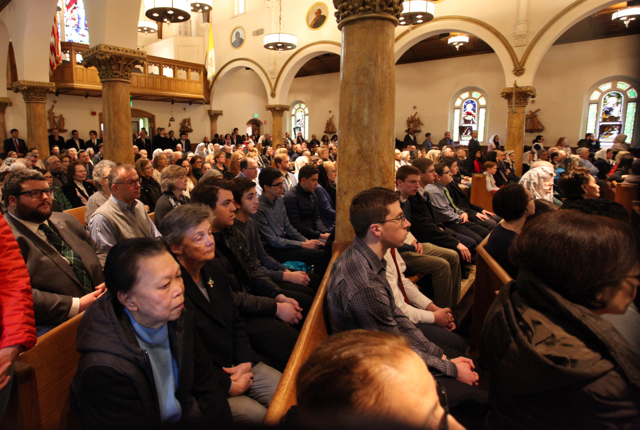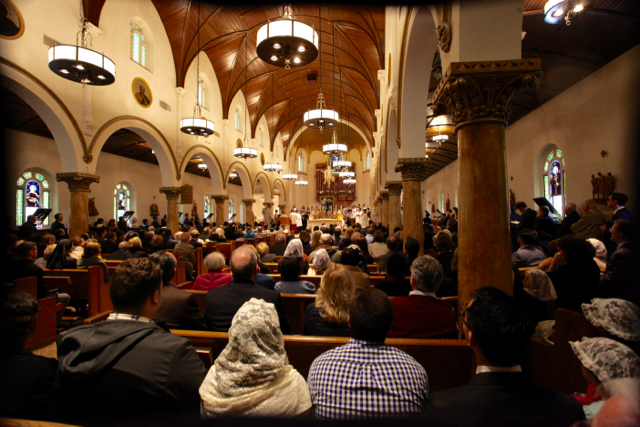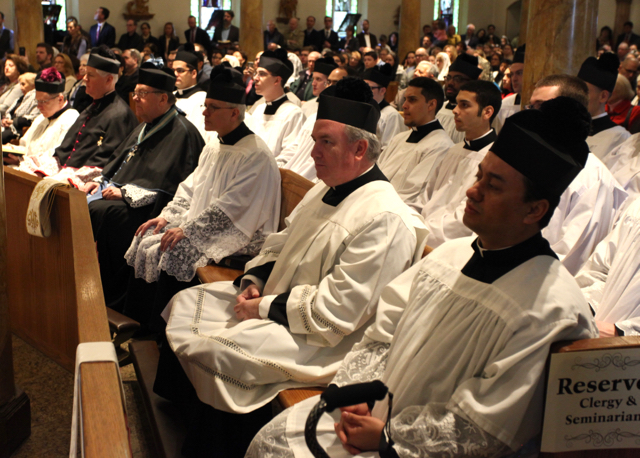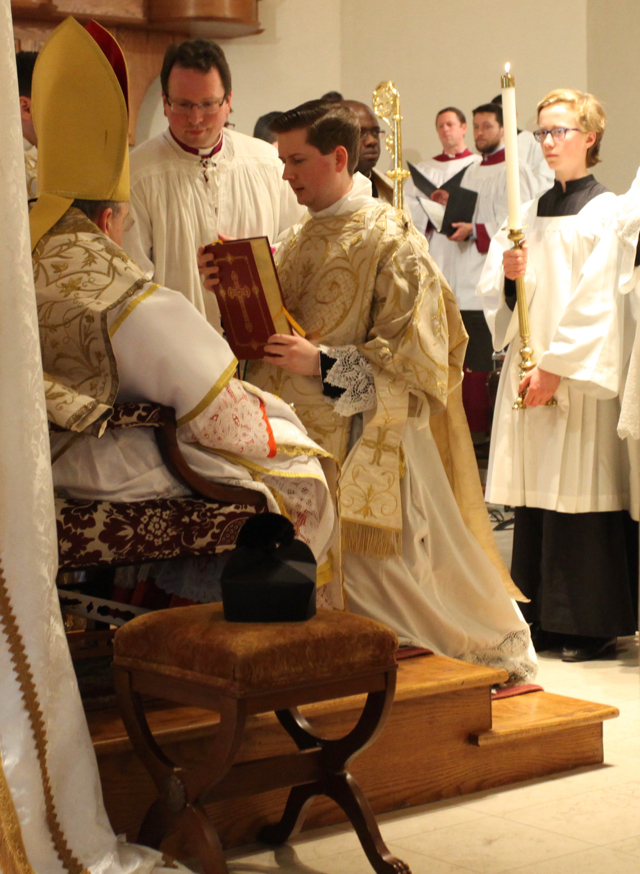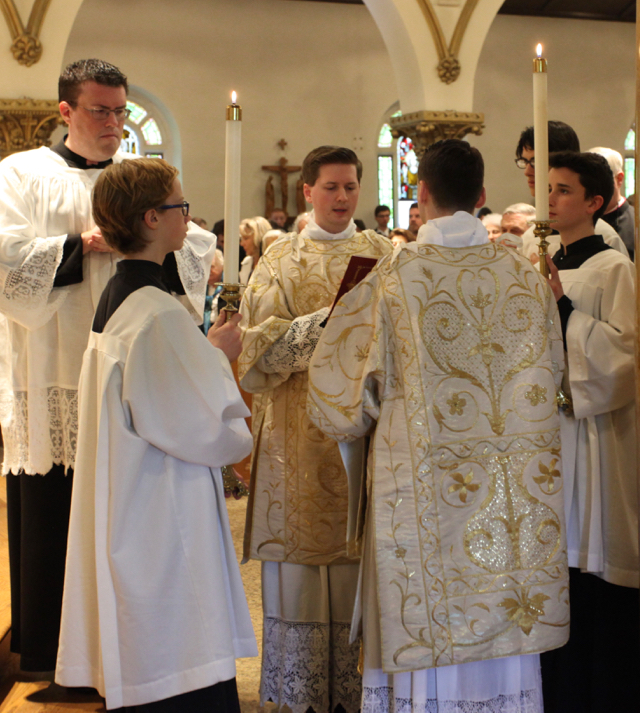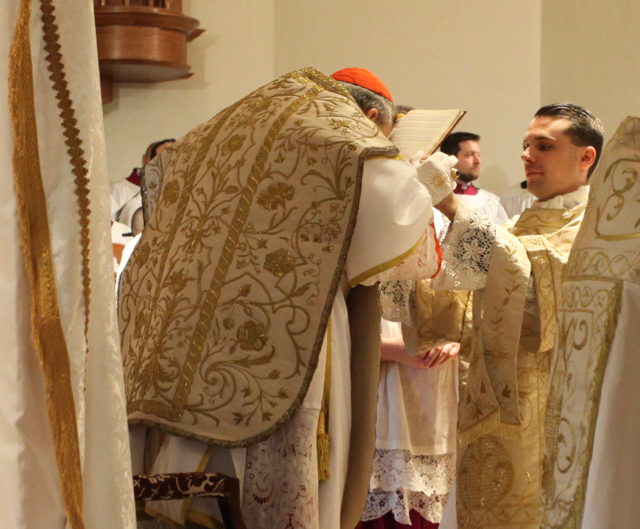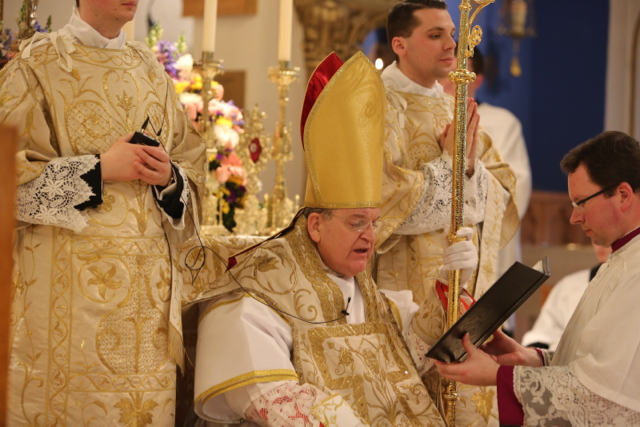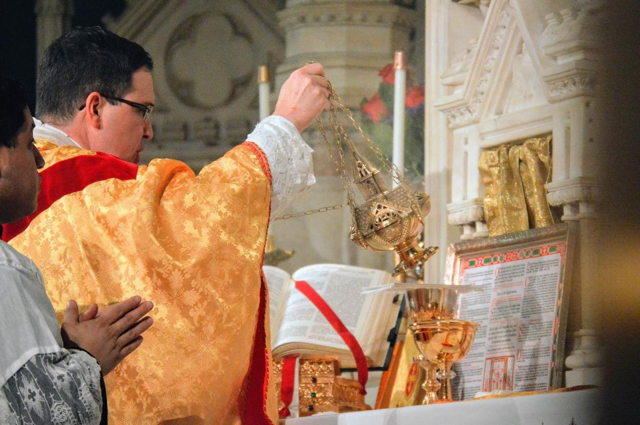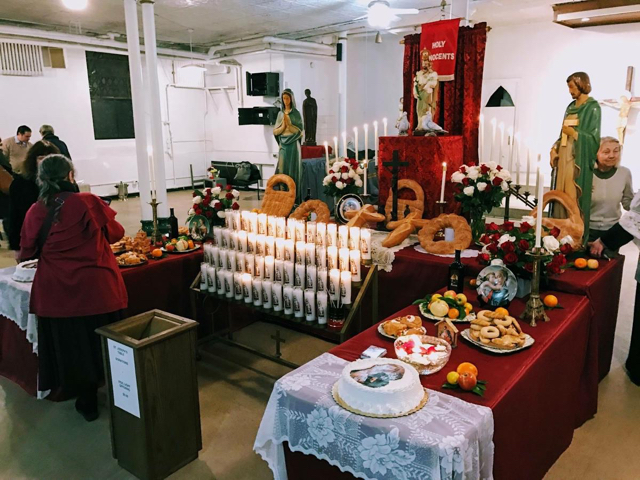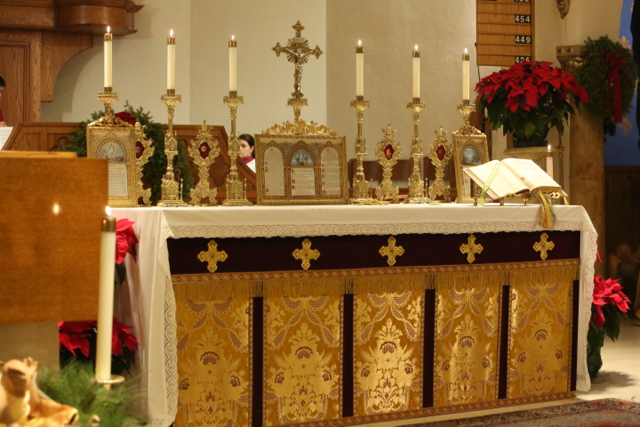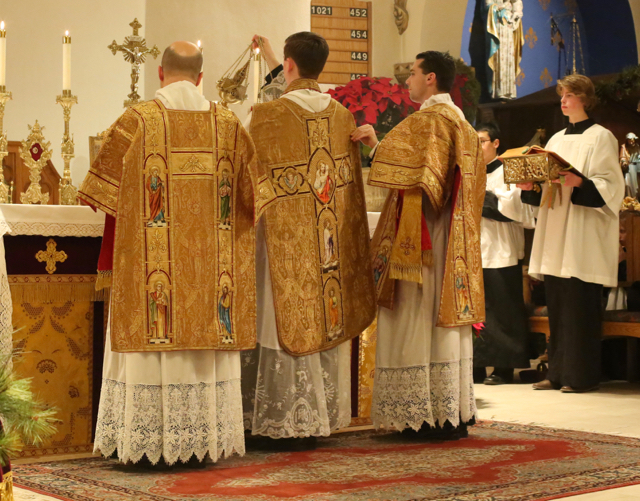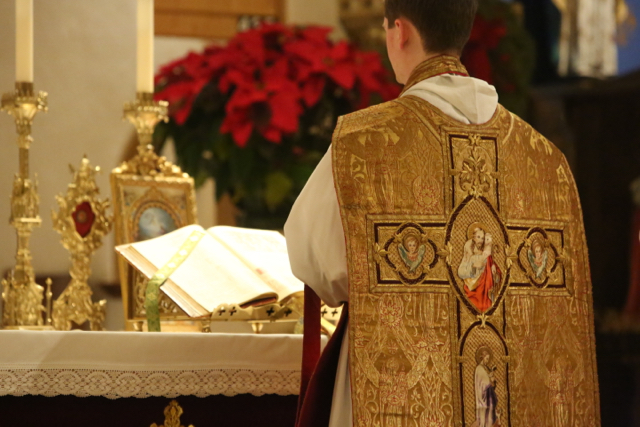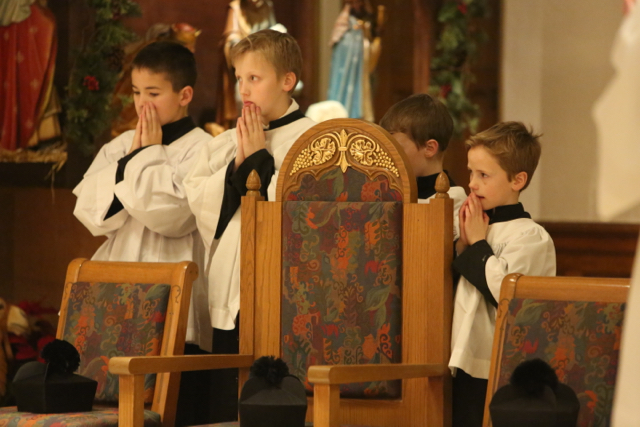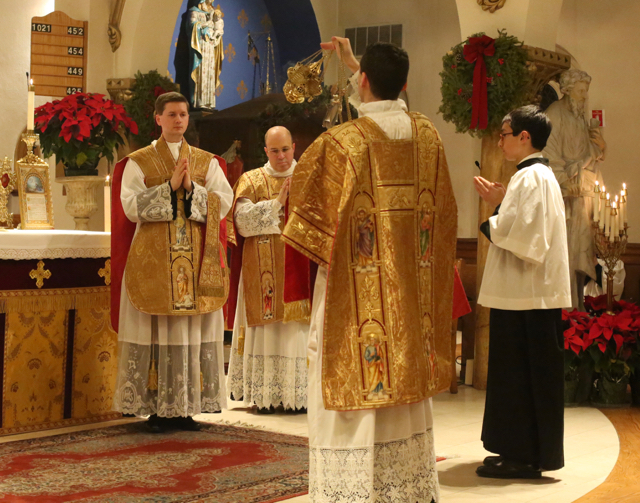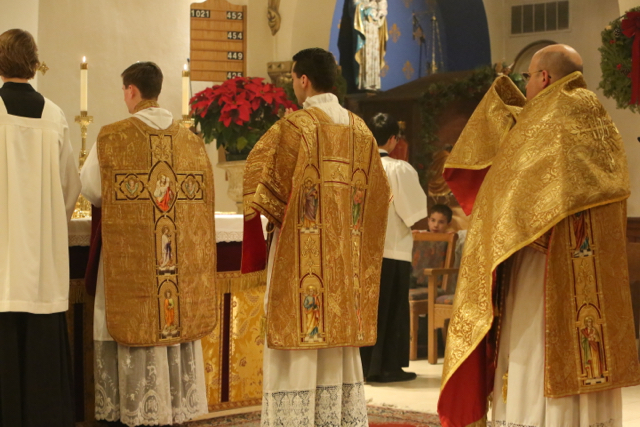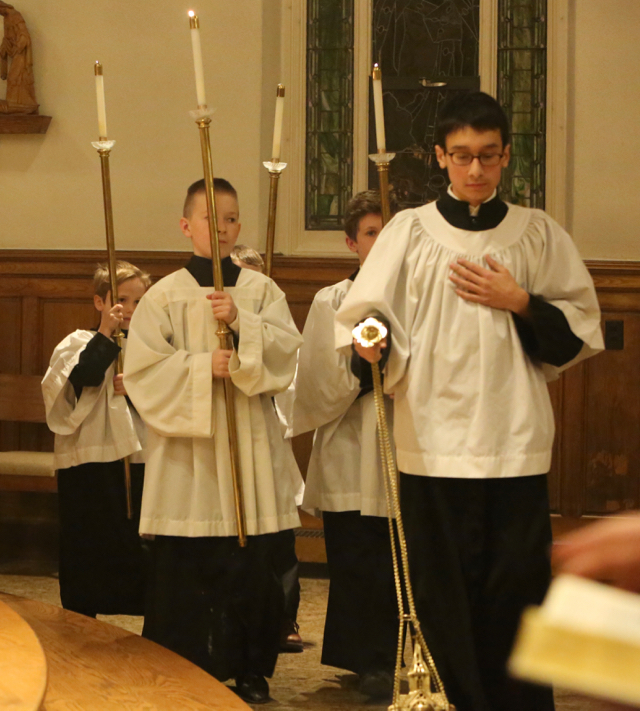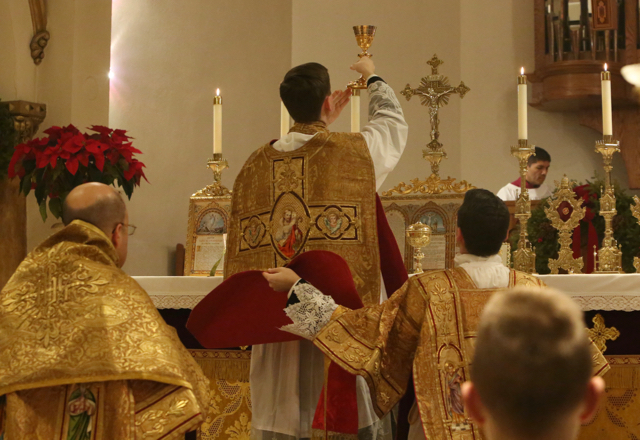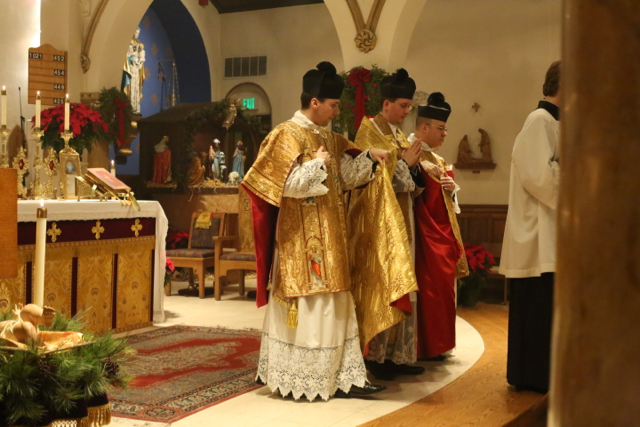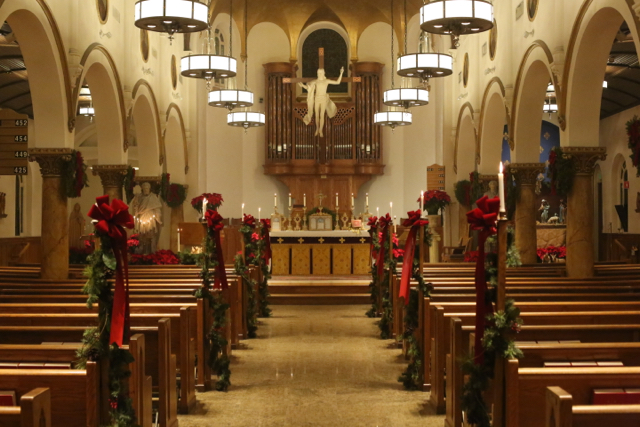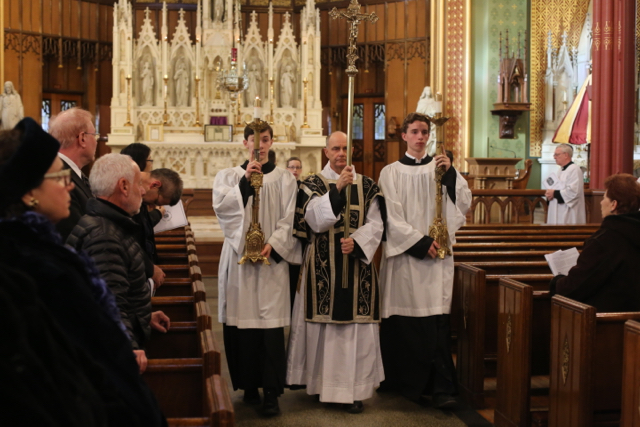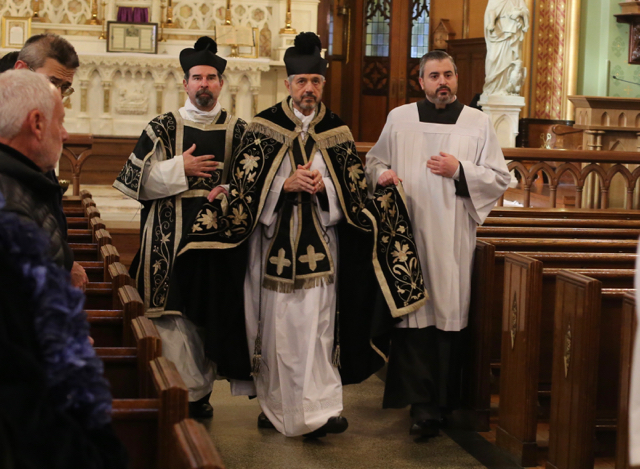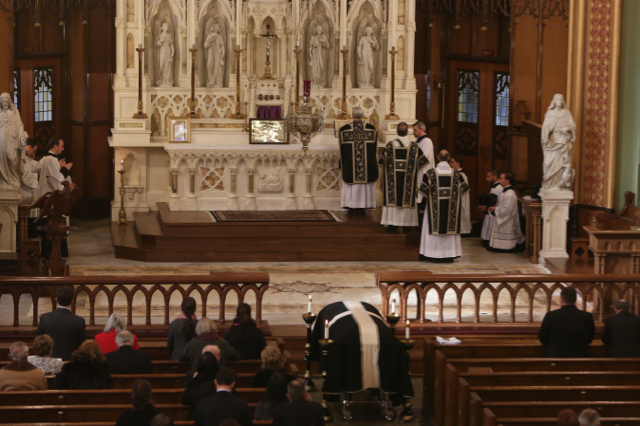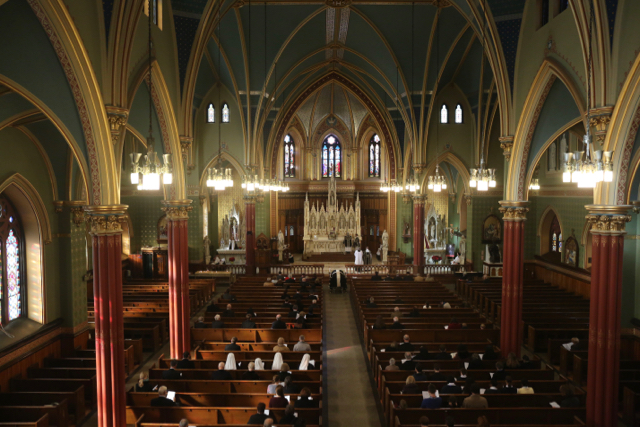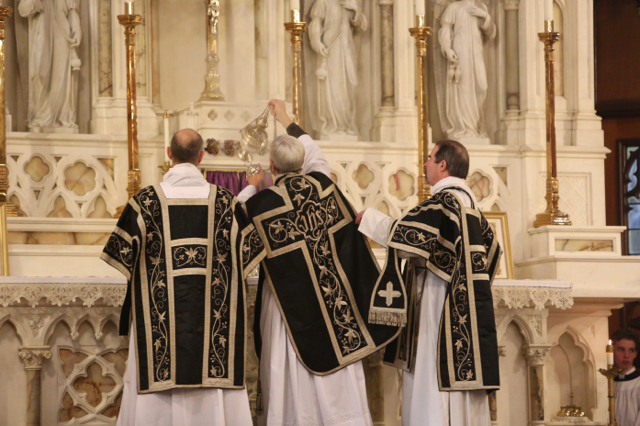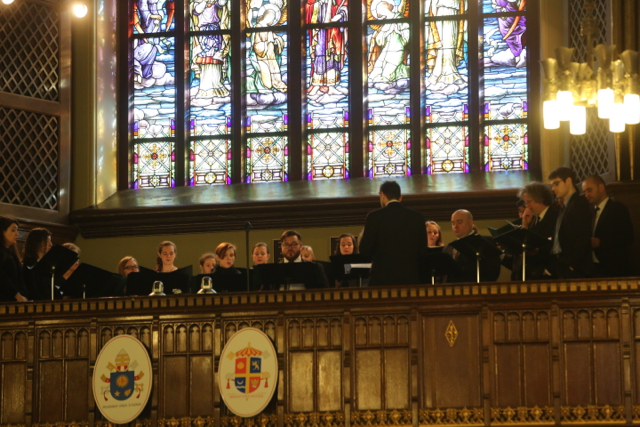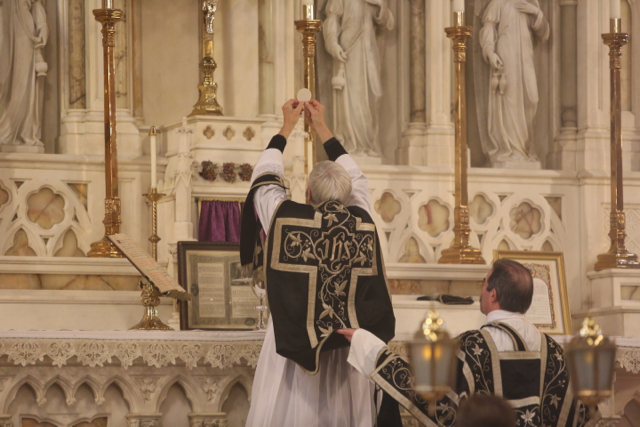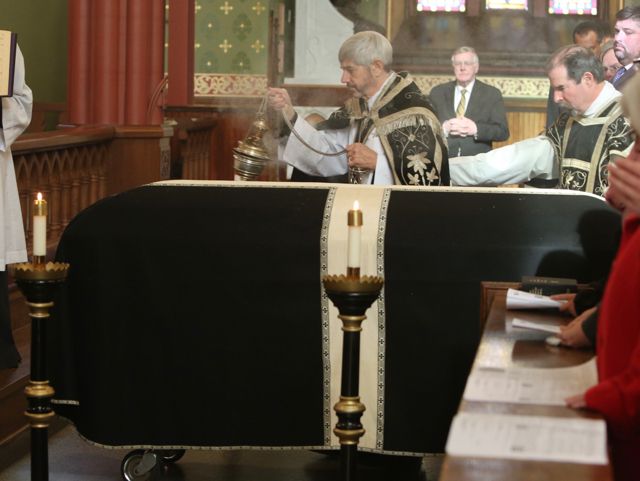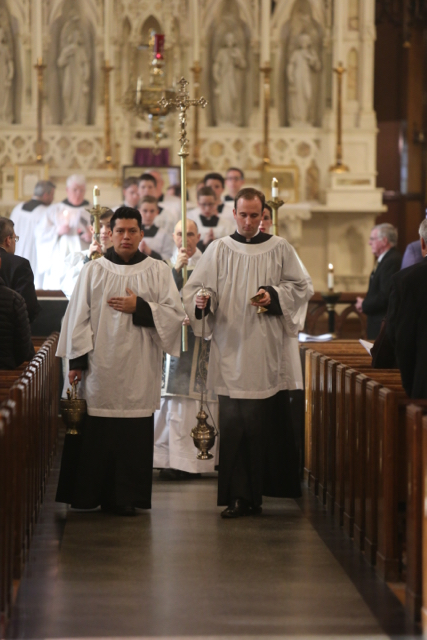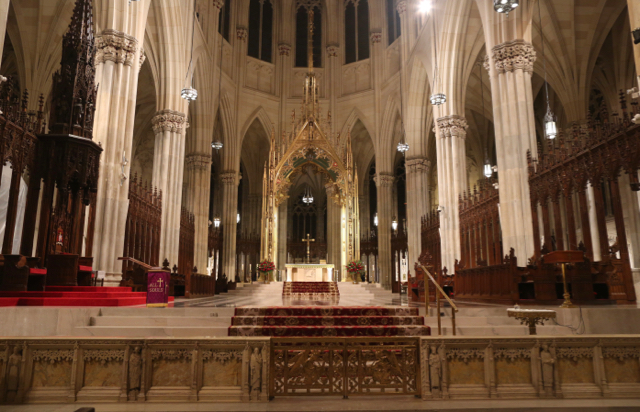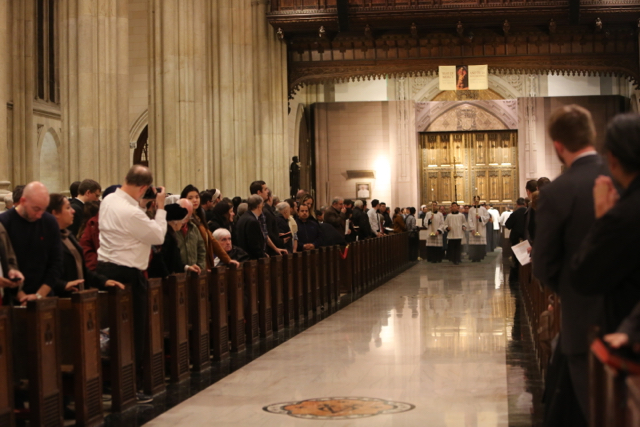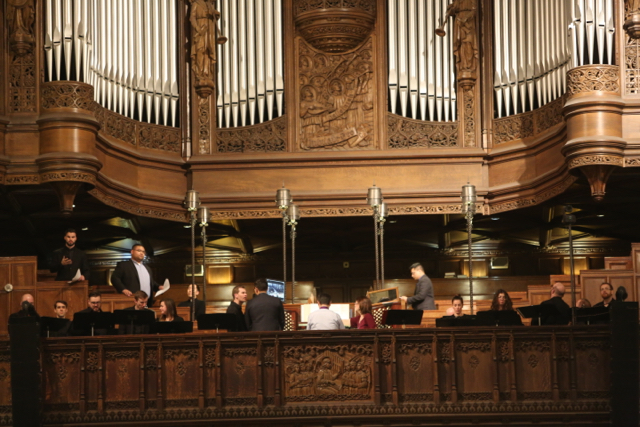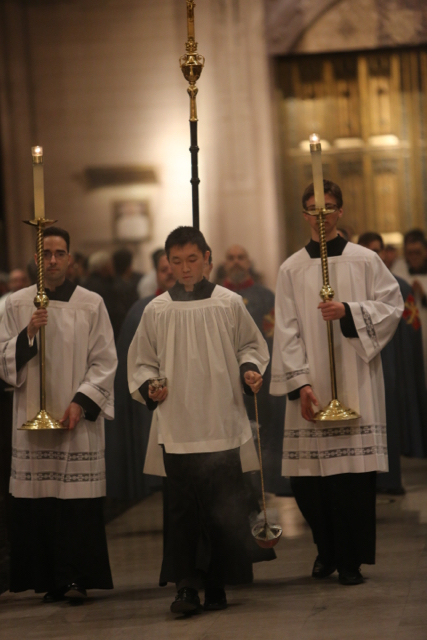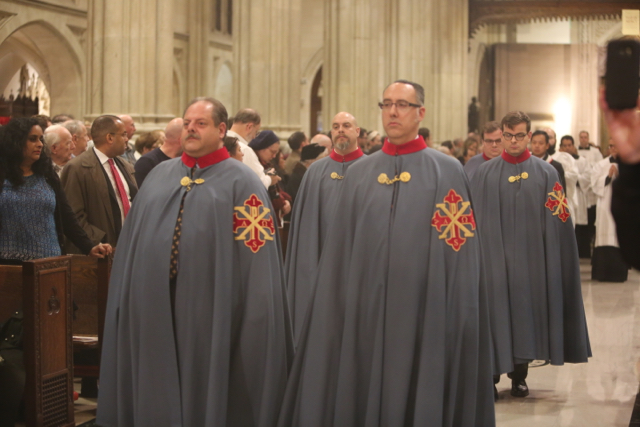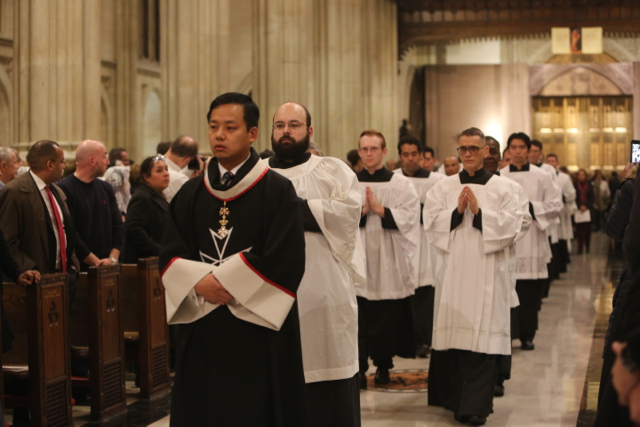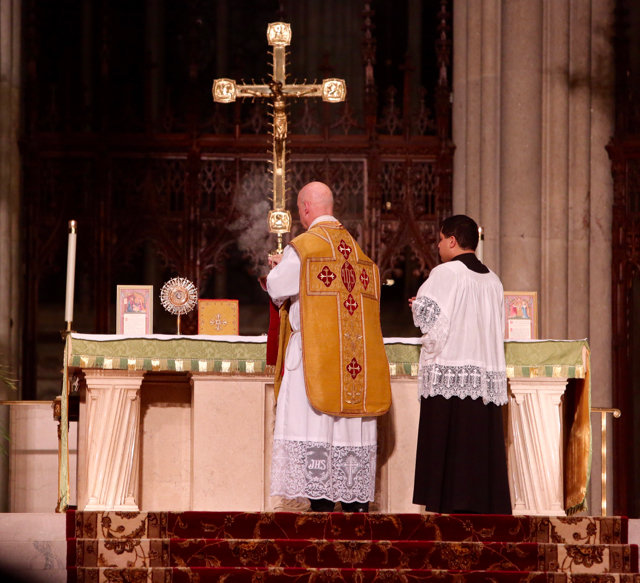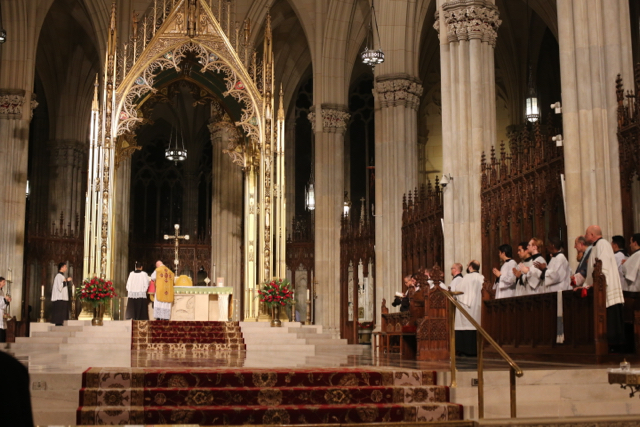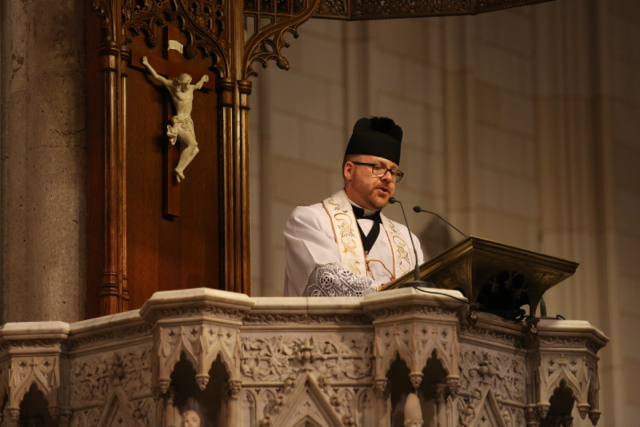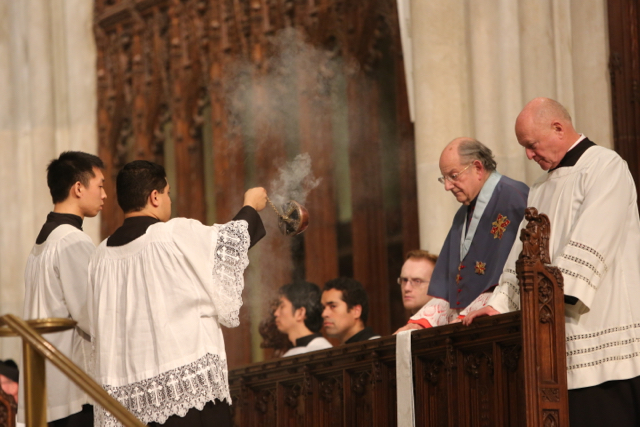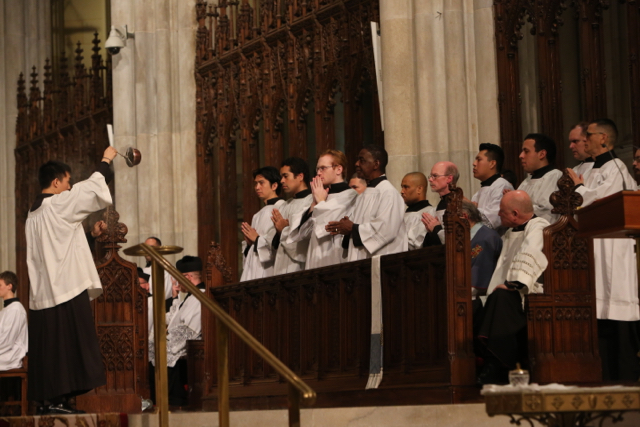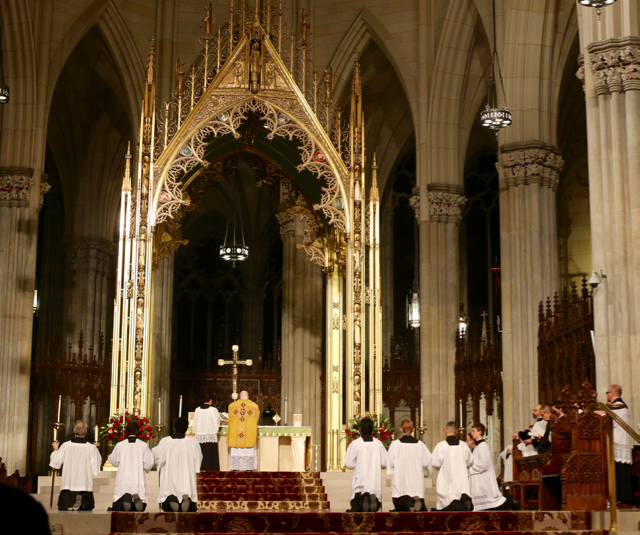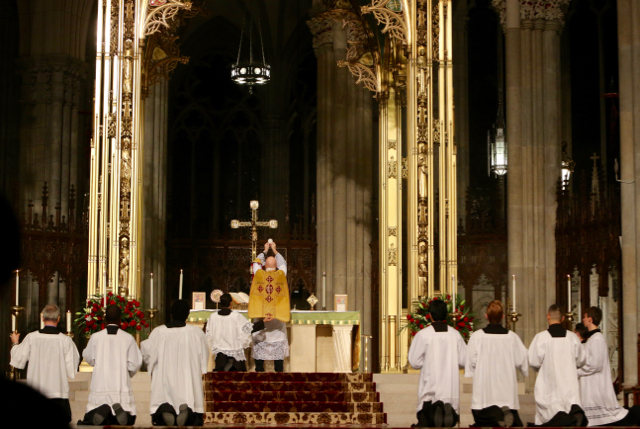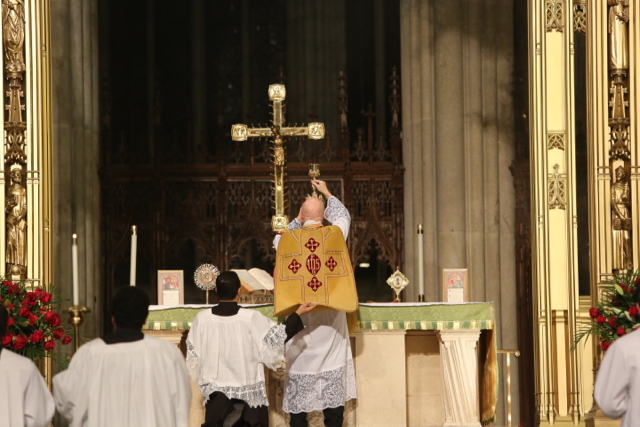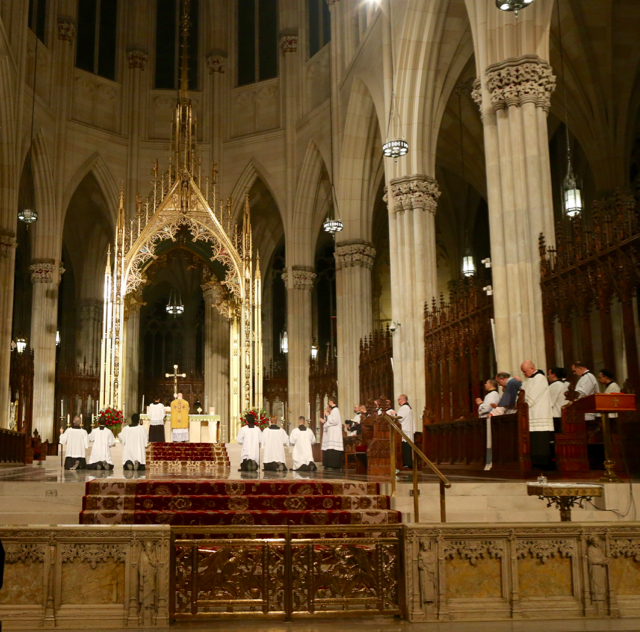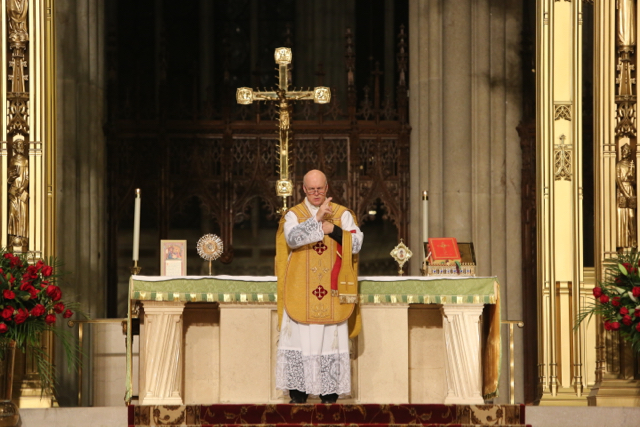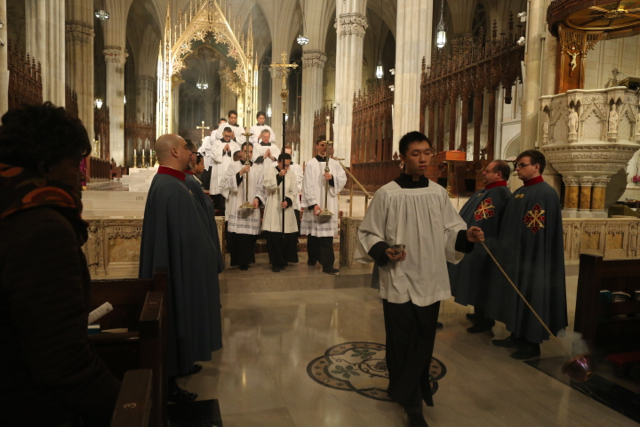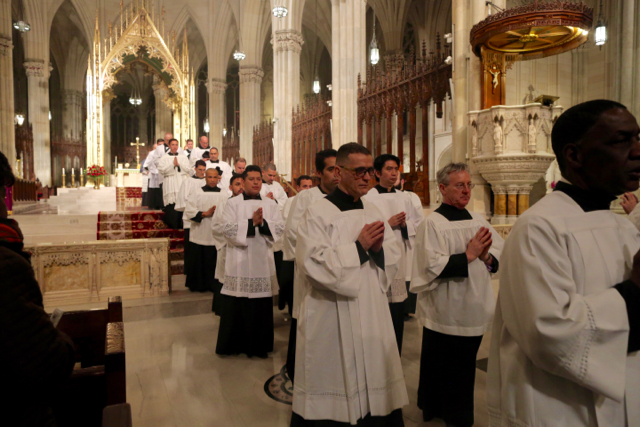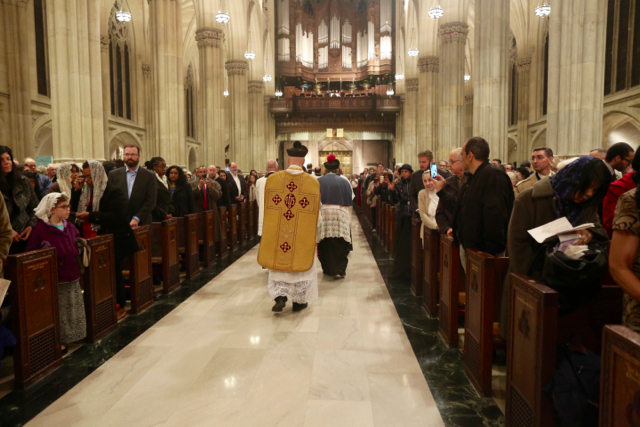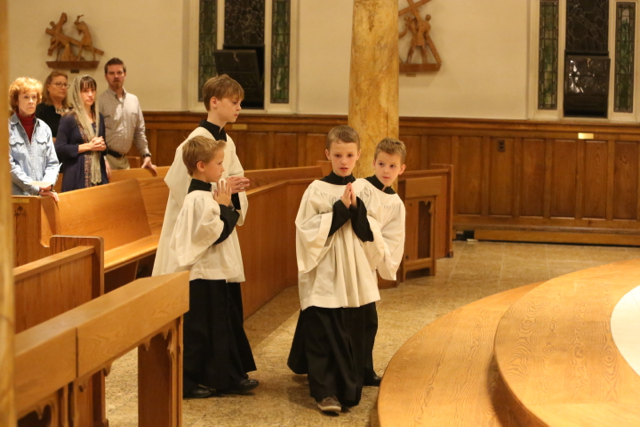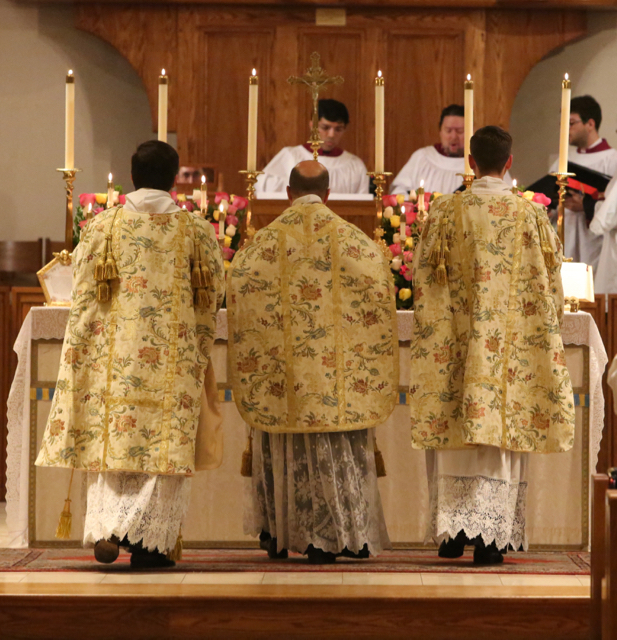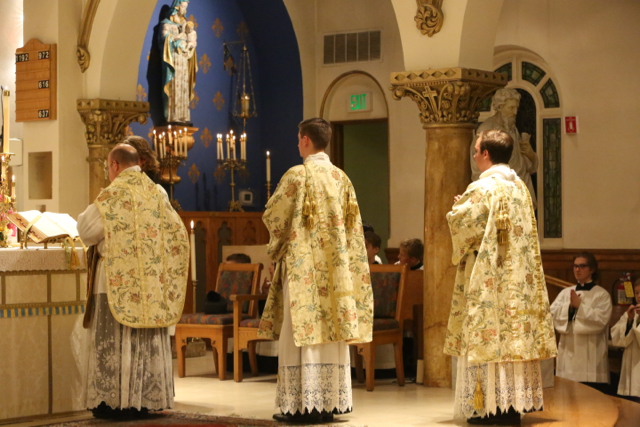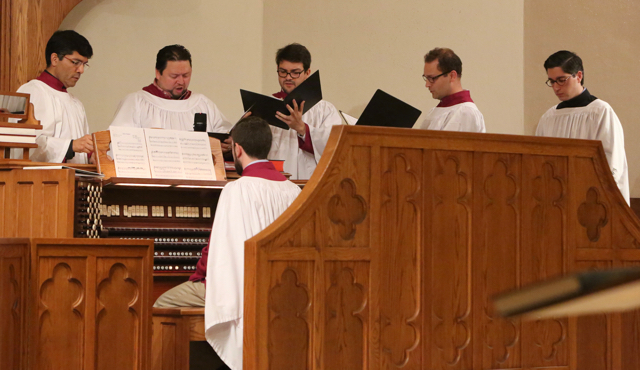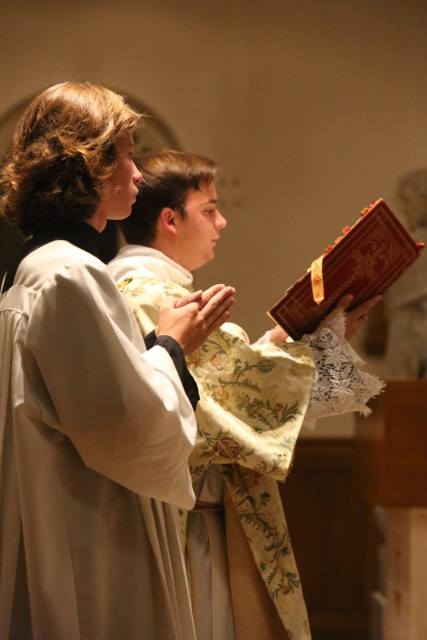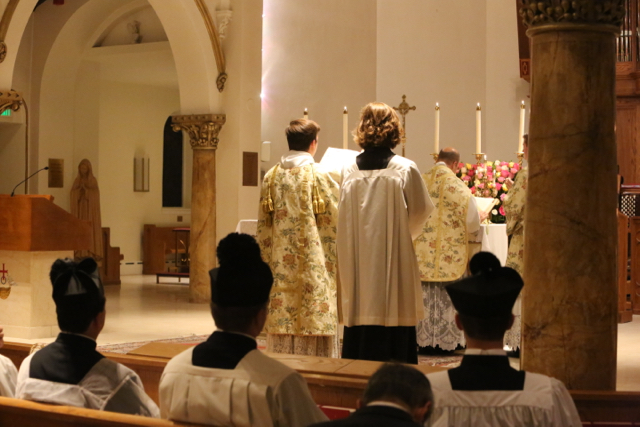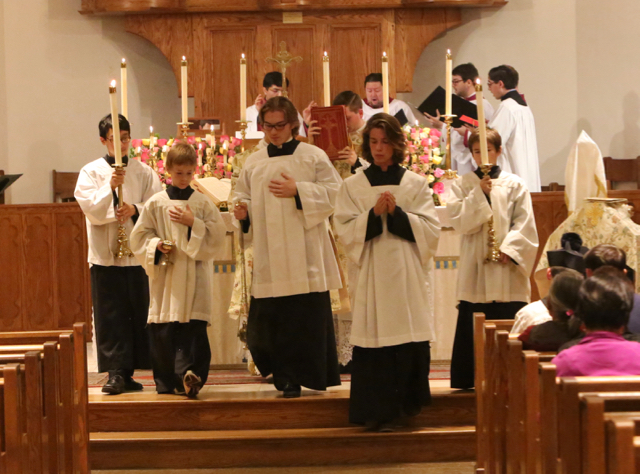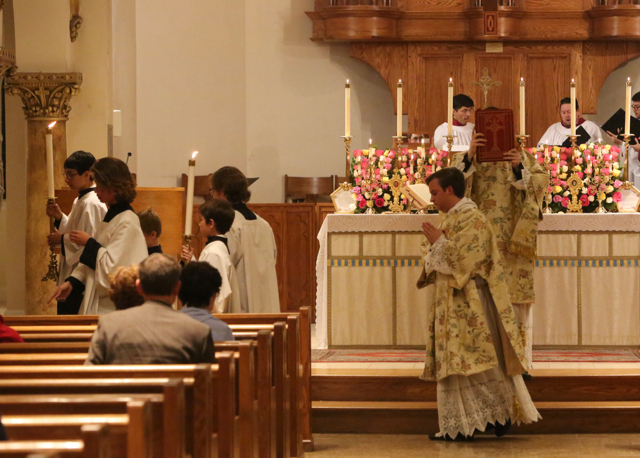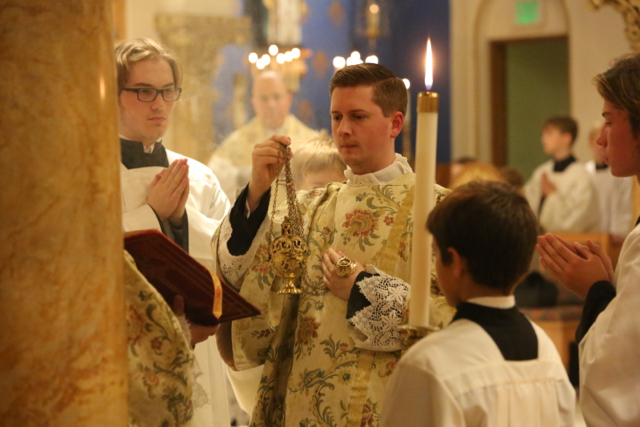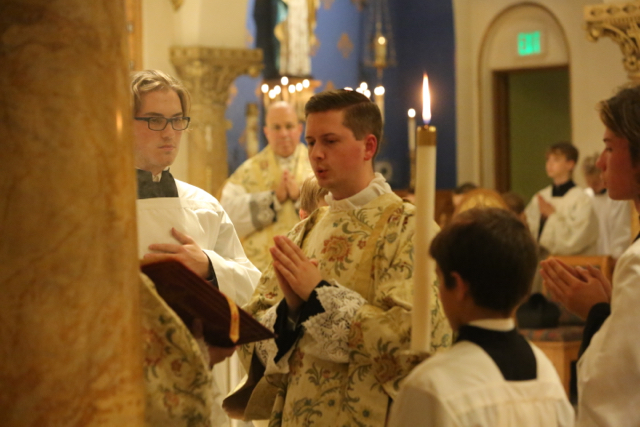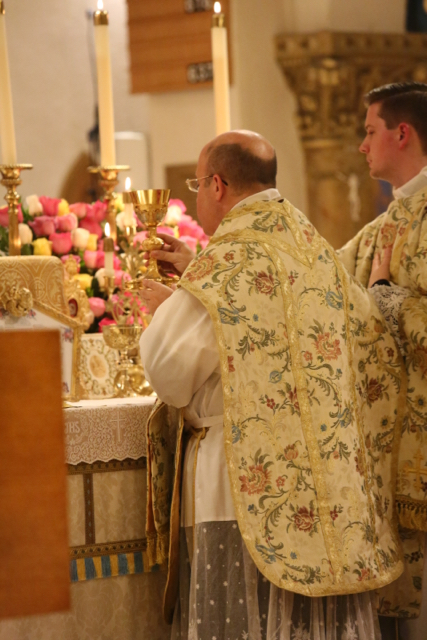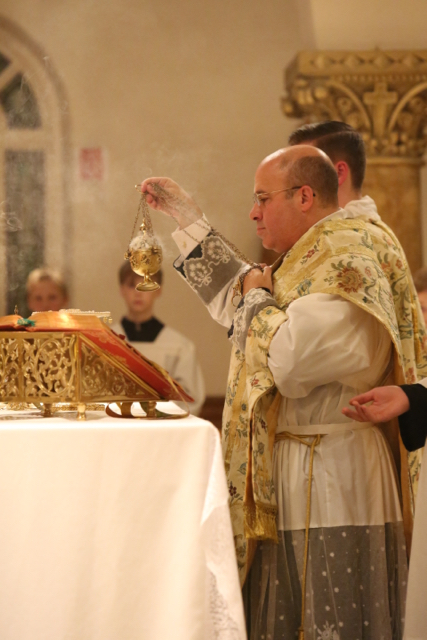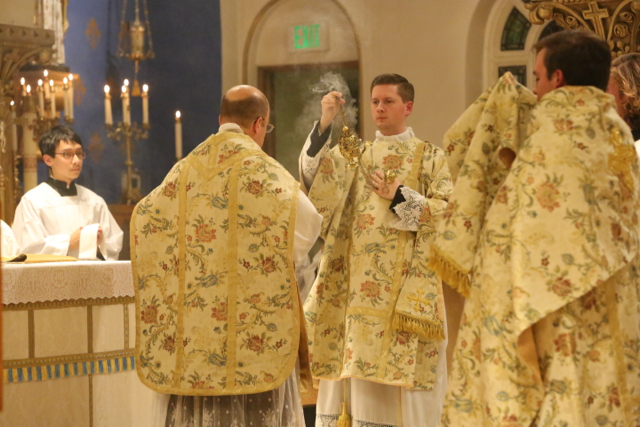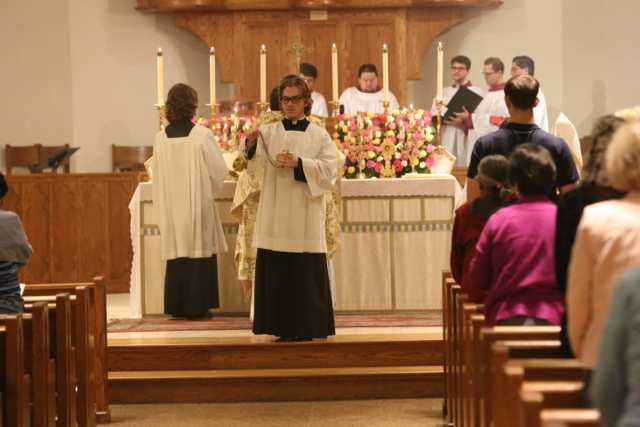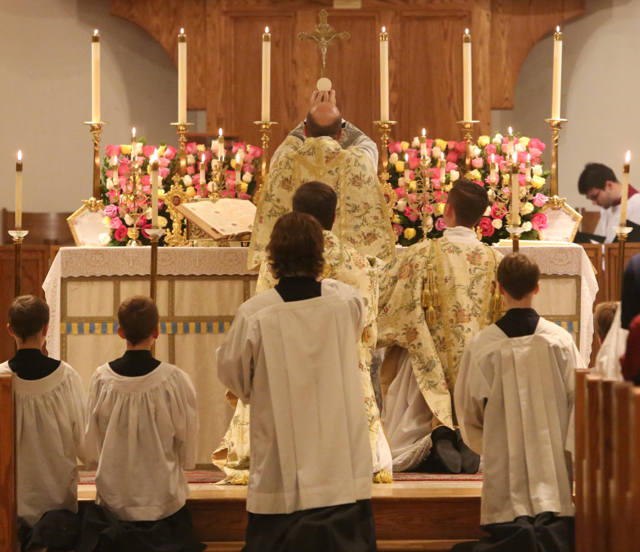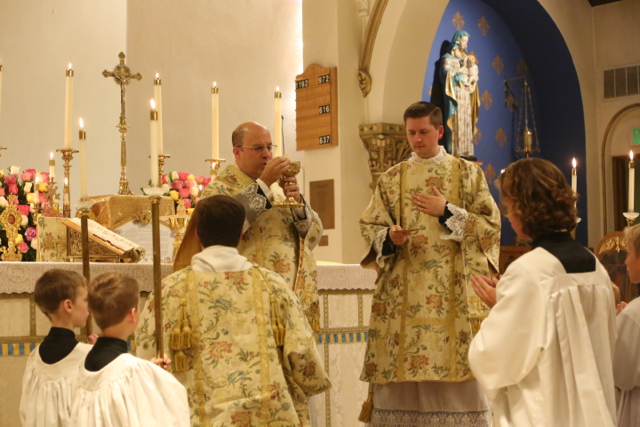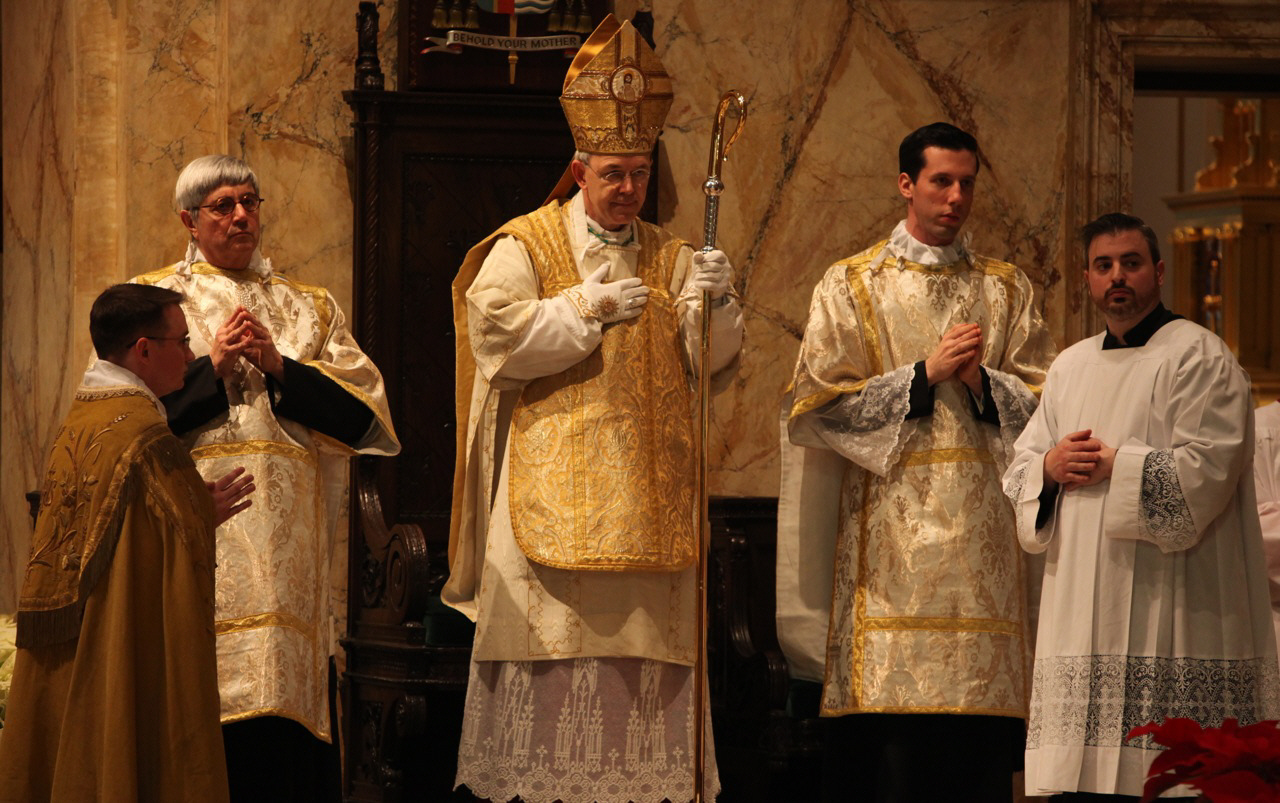
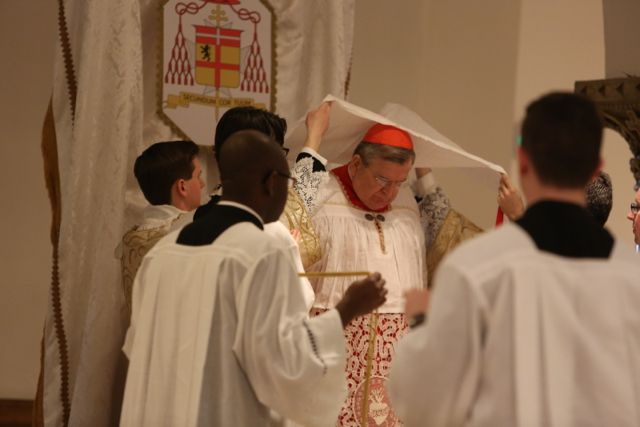
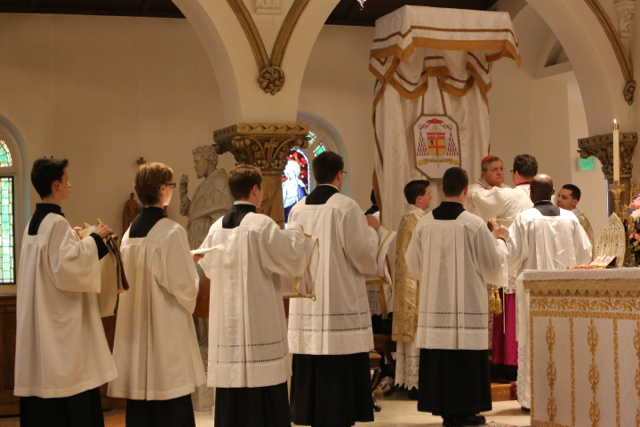
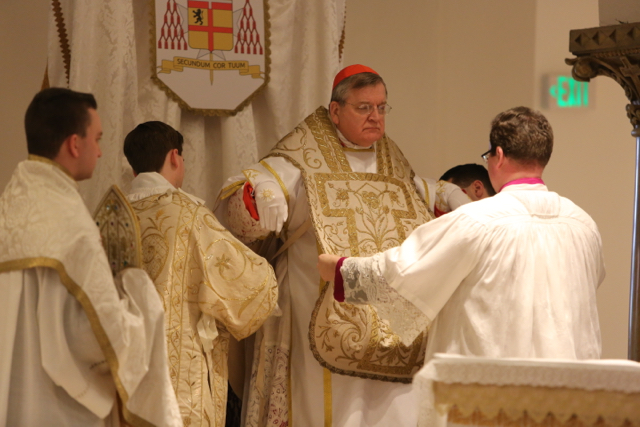
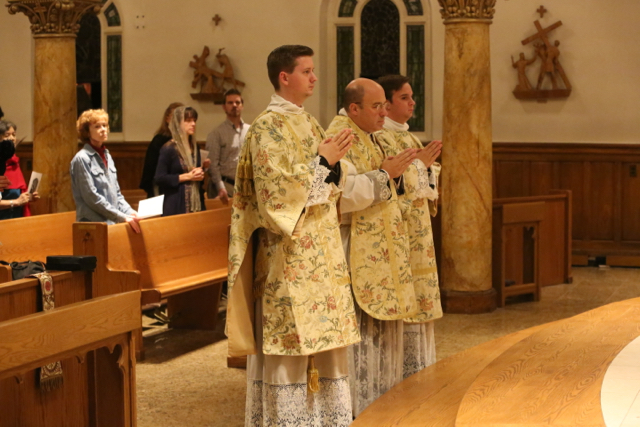
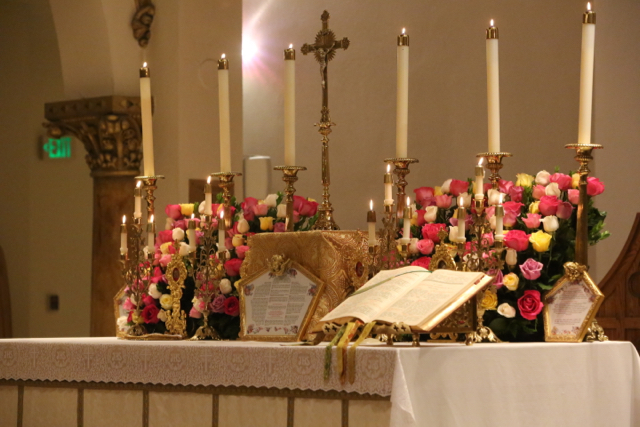
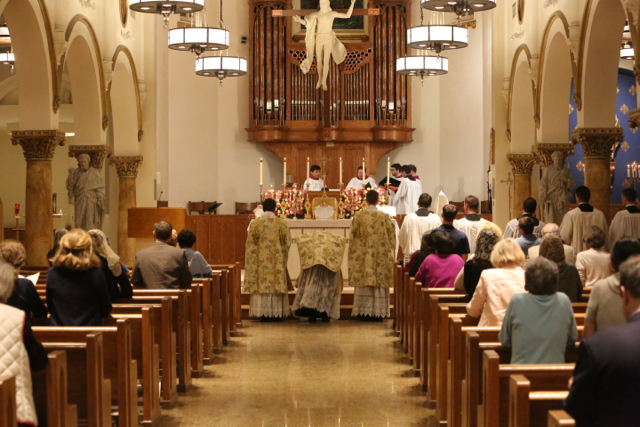
Pictures from this evening’s Solemn Mass celebrating the Feast of the Holy Rosary at St. Mary Church in Greenwich.
7 Oct
2016
Pictures from this evening’s Solemn Mass celebrating the Feast of the Holy Rosary at St. Mary Church in Greenwich.
25 Sep
2016

(Above) San Gennaro – or St. Januarius.
Solemn High Mass yesterday at the church of the Most Precious Blood – amid the noise and crowds of the San Gennaro Festival in New York’s Little Italy.
(Above) The first Solemn Traditional Mass in ages in this church – but the next is already scheduled for the 29th of September! It was a privilege for this Society to sponsor this mass in such a repository of Catholic tradition. The music included, among other works, Mozart’s Missa brevis in F (K. 192). Our thanks to Msgr Donald Sakano, Pastor of Old St Patrick’s and of Most Precious Blood, for the invitation to sponsor this mass during the San Gennaro festival!
(Above and Below) Occupying much of the rear of the nave is a huge Neapolitan Christmas creche. The church of the Most Precious Blood is a treasury of Catholic and Italian devotions. For more on this church see HERE
(Above) The Sermon – amid the forest of statues. For Fr. Cipolla’s sermon see HERE.
(Above) Good participation for such a small church – including some who ventured in from the nearby festa on Mulberry Street.
29 Aug
2016
by Jill Chessman
There are few places to visit in the United States that are so closely associated with a canonized saint as the island of Molokai in Hawaii. Fr. Damien de Veuster, a priest of the Congregation of the Sacred Hearts of Jesus and Mary, came from Belgium to Hawaii as a missionary in the late 19th century. At the time, there was an outbreak of leprosy on the islands. People with leprosy were sent in quarantine to an isolated peninsula on the island of Molokai to live with neither medical nor spiritual assistance. In 1873, Fr. Damien volunteered to go to Molokai to be their priest with the understanding that he would have to spend the rest of his life there. He labored tirelessly for 16 years caring for the spiritual and physical needs of those in the leper colony before dying of leprosy himself. He was canonized in 2009.
Molokai is a beautiful island with stunning scenery—a well-kept secret. There are no resorts here, few tourists, traffic lights are unnecessary. The sign on the road leading from the tiny airport says it all. “Slow down, this is Molokai.” The only way to get from “topside” Molokai to the Kalaupapa peninsula, where Damien served his lepers (below), is by airplane or by a steep mule path down the cliff that separates Kalaupapa from the mainland.
The mule-ride down to the Kalaupapa peninsula takes about an hour and a half.

Stunning scenery. This was the spot where leprosy patients were forced off boats into exile or sometimes dumped in the water and forced to swim to shore.
As former leprosy patients still live on the peninsula, there are strict rules and restrictions about touring the peninsula. But the trouble is worth it, as you can visit the church, St. Philomena, where St. Damien said mass everyday, and venerate his tomb. Fr. Damien’s body was exhumed and returned to Belgium in 1936. The remains of his right hand were returned to the tomb in 1995.

St. Philomena
The former tomb of Mother Marianne Cope, also a canonized saint, who came to help in 1888 with four Franciscan Sisters. Her body had also been removed to her community’s headquarters in Syracuse, New York. When her order, like so many others, had to dispose of its property there, the diocese of Hawaii brought her body to the Cathedral in Honolulu 1n 2014.
A third figure important to Molokai is Brother Joseph Dutton, a lay helper to Fr. Damien, whose cause is up for sainthood. He is buried near the tomb of Fr. Damien.
The churches on Molokai that Damien built with his own hands are perhaps the most moving sites to visit. When he arrived, there was a small church in a dilapidated state. Damien restored the church—St. Philomena—and enlarged it several times as his flock grew. For Damien, a well-appointed church where mass could be celebrated with dignity was central to his mission. A beautifully celebrated mass lifted his poor forsaken patients from their misery. He organized altar boy groups and choirs, requesting from the Bishop of Honolulu surplices and robes. With remarkable energy, Damien built a second church on the leper colony and four churches “topside” on the main island of Molokai. He called carpentry his only hobby—for the rare moments he had to himself.
Fr. Damien enlarged St. Philomena several times, as can be seen from this side view. His final project was the stone front section and belfry. He embellished the interior as well. Below is the original altar. He later reoriented the church, creating a larger apse and nave, leaving the original altar as a side altar on the right. Notice in the foreground a “folding table” Vatican II altar, a make-shift addition that surely would have never suited Fr. Damien.
On the other side of the peninsula, Fr. Damien built a second church, which he called Our Lady Help of the Sick. The current church, St. Francis (below), was built next to it after his death and is the current parish church for the patients who remain on the peninsula.
The church that St. Damien built can be seen through the window of St. Francis (below)
Two churches remain that St. Damien built on the “topside” of Molokai. St. Joseph Church (below), built in 1876, is said to be in its original condition. A wooden steeple, removed when the tower was repaired, has not yet been replaced.
Our Lady of the Seven Sorrows Church (below) was built in 1874 and rebuilt in 1966 using original components and furnishings. Sunday Mass is still celebrated there.
(Above) Our Lady of Lourdes with a lei.(Below) The Stations of the Cross – a series of prints which was donated to this church around Fr. Damien’s time by admirers of his work.
(Above and below). In 2010, St. Sophia, the Catholic church in Kaunakakai, the main town of Molokai, burned down. Its modernistic replacement, dedicated to St Damien, hardly reflects the simple yet beautiful traditions of the old Catholic churches of Molokai and Hawaii – and has left the parish saddled with a debt to the diocese of over a million dollars as well.
(Above and below) Before coming to Molokai, Fr. Damien was active on the island of Hawaii (the “Big Island”). We doubt he would recognize certain modern Catholic churches there. This chapel in Puaku resembles more a lecture hall than a church – if you look carefully you will notice behind the tabernacle, instead of a reredos, a banner with an image of Pope Francis….
24 Jul
2016
The Fifth Annual Traditional Pilgrimage to the Shrine of Our Lady of Mount Carmel on East 116th Street, New York on Saturday, July 23. Over the last five years the number of pilgrims has steadily grown – the ceremonies and music have also become much more elaborate. The pilgrimage takes place a week after this parish’s patronal feast of Our Lady of Mount Carmel – a legendary festa which nowadays also prominently features the celebration of the Traditional mass. The pilgrimage involves individuals and Traditionalist organizations from all over the New York area. The celebrant was Canon Matthew Talarico ICRSS. The deacon was Fr Christopher Salvatore SAC and the subdeacon was Fr. Richard Cipolla, pastor of St. Mary Church, Norwalk.
(Above) The recently restored Image of Our Lady of Mount Carmel, over the altar
Statue of Our Lady used in outdoor processions
(Above) Greetings from the pastor; (below) Bill Riccio at the organ!
(Above) The congregation gathers around sanctuary for presentation of flowers.
(Above and Below) The procession of pilgrims into the church on their knees.
(Above) The entrance procession.
(Above) Representatives of the Constantinian Order of St. George
(Above) Canon Matthew Talarico ICRSS was the celebrant.
The procession after the mass followed by benediction.
(Above and below) The celebrant and subdeacon with the members of the Sacred Military Constantinian Order of St George before the image of S. Elena di Laurino.

(Above) S. Elena di Laurino. Our Lady of Mount Carmel church posseses an extraordinary variety of devotional images. (Below) In the baptistry note between two paintings of angels the framed image of the Madonna Incoronata, a devotion originating in Foggia in Apulia.
(Above and below). Sometimes the faithful grow too enthusiastic. A warning sign next to a statue of St. Ann – her book is the ideal place to write petitions to the Virgin in a place she can very easily read them.
4 Jun
2016
For the first time since Vatican II, on Saturday, June 4, 2016, at Holy Face Monastery, Clifton, New Jersey, a Solemn High Mass with Gregorian chant was celebrated in honor of Our Lady of Sacro Monte of Novi Velia, Salerno, at her shrine.
(Above) Holy Face monastery is a treasury of Italian saints and devotions, both inside the monastery chapel and outside in a number of separate shrines. From the monastery grounds a visitor has a magnificent view of New York City – this day largely obscured by the summer-like haze.
(Above and below) The Madonna del Sacro Monte: a devotion of the Cilento region near Salerno, Italy. Love for the Madonna of Sacro Monte was carried to the United States by Cilentano immigrants who arrived in the United States around 1900. In Jersey City, where many of them settled, an annual devotion was started. In the late 1960s the devotees from Jersey City moved their celebration to Holy Face Monastery in Clifton, New Jersey. At the Monastery they constructed an outdoor shrine to the Madonna and brought a small statue for veneration.
The annual celebration at Holy Face Monastery ended in 1980. It was revived in 2012 by Cilentani and their descendants in New Jersey.
(Above and below) Mass was celebrated in an open chapel consecrated to this devotion.
(Above) The Tony Neglia Italian Band featured prominently prior to the mass and at the procession. – here playing before a Marian shrine on the grounds of the monastery.
(Below) The start of the procession.
(Above) The procession circles the monastery three times – but does not go inside.
(Above and below) The conclusion of the procession – prior to the festive meal.
29 May
2016
(Above and below) The procession begins in the church.
A brass band added an Italian/Hispanic accent (although this is common elsewhere; e.g., Southern Germany and Austria)
The spire of St. Mary’s in the background.
Fireworks!
29 May
2016
The celebration of Corpus Christi at St. Mary’s Norwalk CT. Along with a visit by Monks of Norcia…..
(Above) Since there were only two masses this day, the assembled musical forces of the parish performed – including the student schola.
28 May
2016
Three hundred and forty (340) faithful attended the 6PM Solemn Mass and Procession at Holy Innocents Church, New York, for the 8th annual celebration of the Feast of Corpus Christi this past Thursday, May 26, 2016. Fr. Leonard Villa was the Celebrant, Fr. Tomasz Szczepanczyk was the Deacon, Fr. Robert Rodriguez was the Subdeacon, and 17 servers served Holy Mass. Photos are courtesy of Michael DeLong.
28 May
2016
Yesterday, at the beginning of the Memorial Day weekend, Solemn High Mass in the Dominican Rite was celebrated at the church of St. Vincent Ferrer in New York City.
The church of St Vincent Ferrer is worth a visit in itself. Bertram Goodhue’s masterpiece is a seemingly inexhaustible treasury of architecture, stained glass, sculpture, painting and metalwork. In nearly every corner of the vast church can be found a special devotional image or an intriguing artistic detail.
Preceding the Mass, Dr. Samuel Schmitt gave a lecture on the musical life of the Elizabethan recusants. Despite the most severe persecution, they were able (at least in some households) to maintain an astoundingly rich liturgical and musical culture. But their music underwent a transformation: from the grand public liturgical music of pre-reformation times to a more private, interior style. It was a style adapted to the “underground” nature of Elizabethan Catholicism. But this development was also furthered by the influence of the Jesuit order, whose missionaries brought with them new Roman musical ideas and a spiritual culture that, in contrast to pre-reformation times, assumed a largely literate laity.
The great Catholic composers of this era, such as Tallis and Byrd, also composed for the monarch and the established church. In that regard, Dr. Schmitt described the initial musical and liturgical strictures of the bishops and cathedral chapters of the Church of England as the reformation was imposed. All should be simple, clear and in English, only one note for each syllable of the text…. Much of this sounds eerily familiar to those of us who have followed developments in the Church for the last 50 years.
Dr. Schmitt’s talk was supplemented with musical examples. The performers were Charles Weaver (lute), Judith Malafronte (voice), Grant Herreid( bass viol) and Priscilla Herreid(voice).

(Above)The schola sang in front of the right transept.
We are grateful to the pastor of the combined parish of St.Vincent Ferrer and St Catherine of Siena and to the Dominican community for organizing this liturgy. The execution of the ceremonial of the Dominican Rite on this evening was of course exemplary.
Fr. John Sica, OP served as deacon. (Fr. Sica had been ordained to the priesthood at the National Shrine of the Immaculate Conception in Washington on May 21 of this year).
Fr. Innocent Smith, OP celebrated the mass and gave the homily.
(Above) Charles Weaver directed the Schola. David Hughes was organist. (Both are associated with the music program at St. Mary’s parish in Norwalk CT)
(Above and below) Priscilla Herreid, Grant Herreid, Judith Malafronte, Richard Dobbins and James Wetzel sang. The music included works of Fairfax, Tallis, Taverner and Lambe. It was an outstanding performance of this often challenging music – sung in architectural surroundings intended to duplicate the pre-reformation churches and chapels where these works were first performed. And these musical masterpieces were of course also being performed in the context of the liturgy for which they were created. For it is the purpose of the Society of St. Hugh of Cluny to integrate the arts in support of the overriding objective of promoting and restoring the Traditional liturgy.
Finally, we were gratified to see that, despite the heat and the upcoming holiday, so many people from all over the area attended the lecture and then assisted at mass. Afterwards, a lovely reception was organized by the hospitality committee of the parish at which everyone could enjoy some conviviality on the feast of St. Bede!
27 May
2016
Solemn High Mass for Corpus Christi was celebrated on Thursday Evening in East Harlem. The shrine statue of the Madonna was resplendent in newly restored robes.
Fr. Marian Wierzchowski SAC, the pastor of Our Lady of Mt Carmel,was celebrant and homilist. Fr. Christopher Salvatori SAC served as deacon; Fr. Charez “Don” B. Gringco, as subdeacon. Mr. Lorenzo Tinio was the master of ceremonies. Also, thanks are due to Mr. Teddy Thongratnachat. Last but not least, The Society of St. Hugh of Cluny sponsored this mass.
Mass was followed by the procession with the Blessed Sacrament through the surrounding streets.
(Above and below) What had started as a devout but modest congregation at the start of the mass had grown to very respectable size when the time came to form the procession. The public display of Catholicism (and one of the specific doctrines of Catholicism)that is of the essence of Corpus Christi seems to find remarkable resonance everywhere. It’s the only effective way to “take back the streets.”
And so the procession went its way as the streets gradually grew darker. Languages heard in addition to Latin and English included Polish, Spanish, Haitian Creole…..
(Above) At times the chants of the procession had to compete with boom boxes; the incense with the aroma of joints. But here and there beautiful floral displays had been set up by residents of the area. (Below) The first altar on the processional path was in a florist’s shop; the second in a convent.
Benediction concluded the procession.