8 Dec
2025

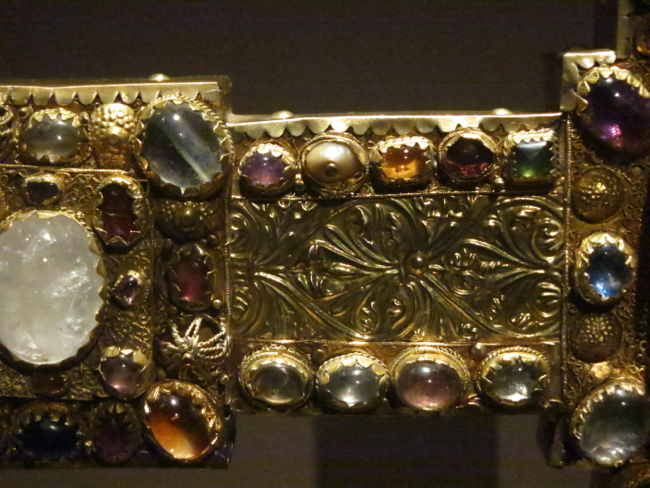
(Above) Antonio de Laurentiis, Throne of Eucharistic Exposition, 1754 (Gift of Kingdom of Naples). (Terra Sancta Museum, Jerusalem) © The Frick Collection
To the Holy Sepulcher: Treasures from the Terra Sancta Museum
Exhibition at the Frick Collection in New York (till January 5, 2026)
The Frick Collection now is showing a very special exhibition of liturgical objects from the Church of the Holy Sepulcher in Jerusalem. These treasures will be displayed in the Terra Sancta Museum in Jerusalem once it is completed.
After the final fall of the Holy Land to Islamic armies, the Western Catholic presence at the Church of the Holy Sepulcher was maintained by the Franciscan order – and still is today. Not that the relationship with other “faith communities” was necessarily easy. Over the centuries the ruling Muslim authorities oscillated between repression and tolerance. And, as described in the catalog, there were also violent clashes with the Greek Orthodox neighbors at this church. Yet whatever their religious feelings might be, the Ottoman Turkish authorities were constrained by the need to maintain good relations with the Western states, above all France. Of course, they also ere cognizant of the ongoing econmic benefits of the pilgrim trade.
Despite periodic vicissitudes, over the centuries the Franciscan mission accumulated a spectacular collection of liturgical art, donated by the leading Catholc powers. Ironically, unique vestments and liturgical objects have survived in this place so remote from Europe – because in Jerusalem they escaped the destruction and looting of the French revolutionaries and Napoleon’s armies.
The Frick hosted a similar exhibition in 2018-19 on the work of the 18thcentury Roman goldsmith Luigi Valadier. Indeed, Xavier F. Salomon, one of the co-organizers of the Holy Sepulcher exhibition, played a leading role in that exhibition as well. The Valadier exhibition also brought to our attention rare gold and silver works that survived in out-of-the-way churches and cathedrals in Southern Italy and Sicily, where they had escaped later post-1789 French depredations.
To the Holy Sepulcher is a remarkable and overwhelming show. There are gigantic silver candelabra, antependia and “thrones” for the display of a monstrance. There are of course chalices, monstrances, patens, croziers, sanctuary lamps and other liturgical apparatus. Magnificent sets of vestments in gold and scarlet can be seen. All of this was not “treasure” to be hoarded or put on display but was dedicated to actual liturgical use. Indeed, some of the vestments were refurbished later to preserve them for ongoing use.
The objects in the exhibition generally date from 1560 to around 1780. The artistic styles represented range from the later renaissance to baroque, rococo and early classicism. All of the powers of the Catholic world as it existed during and after the Counter-Reformation are represented: Spain, the Kingdom of Naples (perhaps the main donor state), France and Portugal but also the republics of Genoa and Venice. Given my own interests, I would single out the gifts from the Holy Roman Empire. Emperor Charles VI and Empress Maria Theresa are named donors of works created in Southern Germany and Austria.
It is a truly amazing reminder of how Christendom had survived into the 18th century and how the Catholic monarchs and republics thought it an honor to create magnificent objects for the Catholic liturgy in such a special place as Jerusalem. There was no question here of separation between church and state!
Now all of this art was destined for the celebration of the traditional liturgy. Indeed, the catalog features an essay by Jacques-Charles Gaffiot, one of the organizers of the exhibition, specifically discussing the Mass and the practical and symbolic role of the exhibits in liturgical celebrations. 1)
This exhibition leaves us with more solemn and melancholy thoughts. We encounter the glory of the Catholic liturgy as it existed in the last years of Christendom. But hasn’t the Church of today turned its back on the liturgy that gave rise to these objects? For these magnificent works the Church has often substituted vessels of glass and pottery. Then we must consider the current political situation. These liturgical objects and the Terra Sancta Museum in which they will be housed remind us of the perilous state of the Christian presence in the Holy Land. For the recent conflicts in the Near East are leading to the disappearance of the Christian minority in those countries.
For descriptions and photographs of the exhibits see To the Holy Sepulcher: Treasures from the Terra Sancta Museum (frick.org)
Postscript: It was my first visit to the Frick collection after its recent reconstruction and expansion. I only had time, however, to view the Holy Sepulcher exhibition. Inside the exhibition space, the layout and viewing conditions were excellent. I regret to say, however, that as a whole the Frick Collection itself has become a less pleasant place to visit. It is crowded and confusing, with vistors formed into lines under the supervision of guards. I would add to the irritations the steep admission charge and restrictions on photography (fortunately I am a member and hadn’t brought a camera along). “Points of light,” to be fair, were several helpful staff. The Frick, which once was an oasis of calm and contemplation in the city, now has an atmosphere more like that of its neighbor up the street, the Metropolitan Museum of Art. But perhaps these problems were only of that day; I will return after the New Year to find out more.
7 Dec
2025
Monday, Dec. 8 is the Feast of the Immaculate Conception of the Blessed Virgin Mary. The following churches will offer Traditional Masses.
Connecticut
St Mary Chuch, Norwalk, 8 am Low Mass; 7 pm Solemn Mass
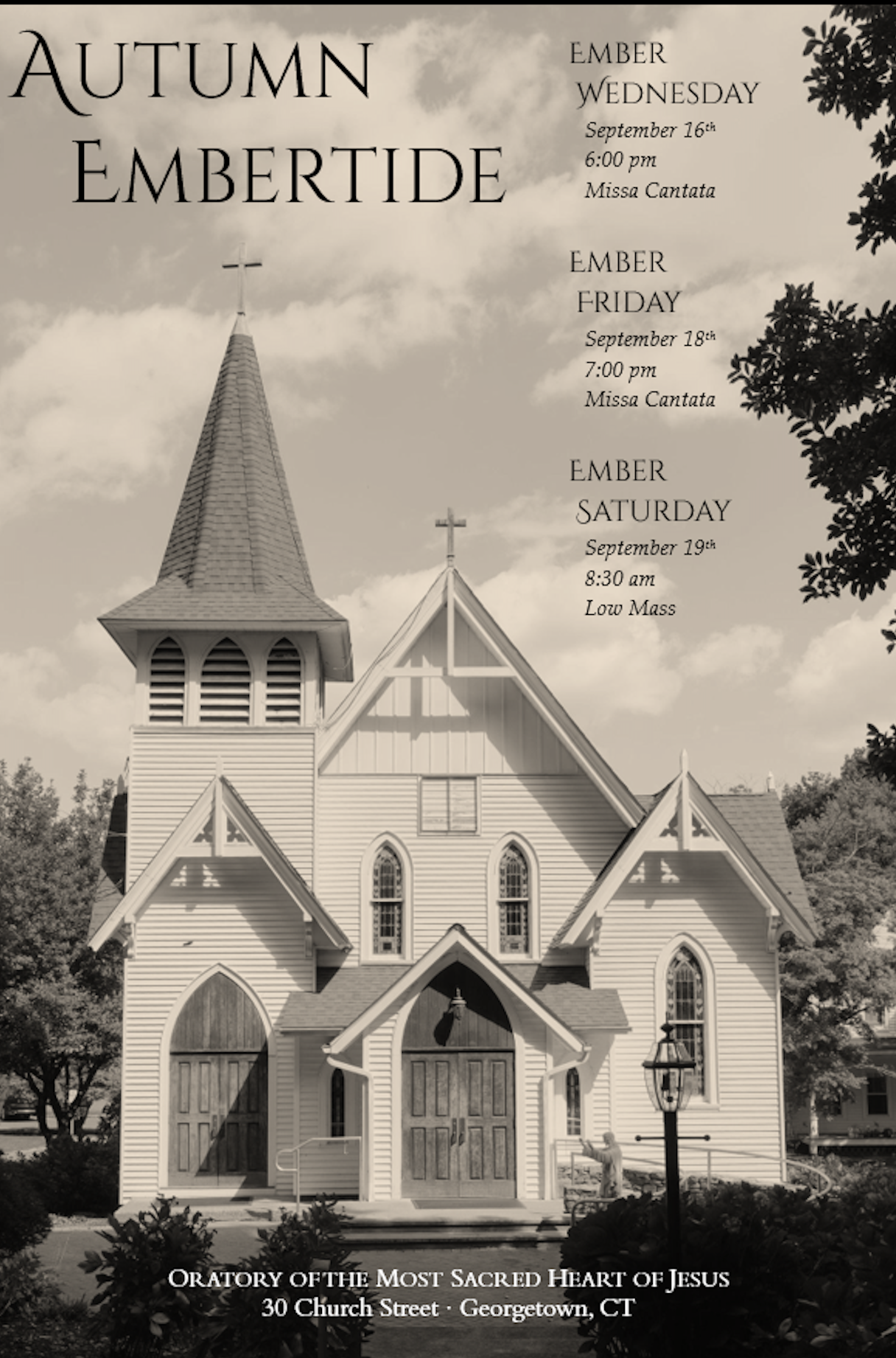
Georgetown Oratory of the Sacred Heart, Redding, 6 pm Missa Cantata followed by a tree-lighting
Sts. Cyril and Methodius Oratory, Bridegport, CT, 7:45 am Low Masss; 6 pm High Mass (“Missa O Soberana luz” – Felipe de Magalhães). Also on Sunday, Dec. 7: 6:00 p.m. – Solemn Choral Vespers and Benediction (First Vespers of the feast)
St. Patrick Oratory, Waterbury, 12 pm Low Mass; 6 pm High Mass
St. Martha Church, Enfield, 7 pm
New York
Holy Innocents Church, New York, NY, Low Mass 8 am; High Mass 6 pm
Our Lady of Mount Carmel, New York, NY, 7 am, 7 pm
St. Josaphat Oratory, Bayside, Queens, 7 am Low Mass; 7 pm High Mass
St. Rocco, Glen Cove, Long Island, 7 pm Missa Cantata
St. Matthew Church, Dix Hills, Long Island, 10:30 am
St. Paul the Apostle, Yonkers, 12 noon
Annunciation Church, Crestwood, NY, Lower church, 7 pm
New Jersey
Our Lady of Sorrows, Jersey City, 5 pm Missa Cantata
Our Lady of Victories, Harrington Park, 6 pm
Our Lady of Fatima, Pequannock, 7 am, 9am, 12 noon, 7 pm
St. Anthony Of Padua, West Orange, NJ, 7:30 am and 9 am Low Masses; 7 pm High Mass
Shrine Chapel of the Blessed Sacrament, Raritan, 7 pm
St. John the Baptist, Allentown, NJ, 7 pm Solemn Mass
1 Dec
2025
28 Nov
2025

A rally to save Most Holy Redeemer Church has also been announced for Sunday December 7 at 2 pm at 173 E. 3rd Street (Avenues A & B). The Dec 7th event will include speakers discussing the canonical situation, the efforts that have been made so far to contact the archdiocese, etc. The Village Preservation Society and some elected officials will be at the Dec 7th event.
More details to follow.
28 Nov
2025
28 Nov
2025
Please join us for the next
New York Purgatorial Society Sung Requiem Mass (Dominican Rite)offered this coming
Monday, December 1, 2025, at 7 p.m.Fr. Leo Camurati, O.P., celebrant
Church of Saint Vincent Ferrer 866 Lexington Avenue at 66th Street | New York City, www.svsc.info | www.nypurgatorial.com
First NYPS Mass in the new year:
Thursday, January 22nd, 2026National Day of Prayer
24 Nov
2025

One of the largest lecture halls at Princeton University Is nearly completely full Saturday afternoon. The attendees are young and enthusiastic. For the Aquinas Institute, the Catholic chaplaincy at Princeton University, is hosting Cardinal Sarah. The Cardinal has just published a book – The Song of the Lamb – written in conjunction with Peter Carter, the music director of the Aquinas Institute about music and the faith.
The Cardinal first gave a lecture and then entered into a wide-ranging dialogue with Peter Carter. In the course of the afternoon Cardinal Sarah touched on many topics of which I can capture only a small selection. He spoke of how he had learned in his village from his parents and a French missionary that there is a different kind of music for the church, one rightly called sacred. He spoke of how chant always has the priority of place and of the importance of the Latin language. The liturgy is not something that we do or we create but something that Christ, dwelling within us, performs. Active participation does not mean uniformity. There are different roles within the liturgy: the celebrant, the choir, the congregation each has a different role to play but they are all working together in the one action. Each is participating actively but in different ways.
Again and again, Cardinal Sarah returned to the importance of music. Perhaps paradoxically, music is where our heart speaks to God without words. Music is essential to the liturgy – not a nice addition to it. And Gregorian chant is not something we made up but was given to us.
Cardinal Sarah spoke of the injustice of the persecution of those within the Church who follow the old rite of the Mass. We should pray that the Holy Spirit inspires Pope Leo to liberate this Mass and the Latin language in general. I note that the cardinal did not give any indication whether he thinks Pope Leo will actually do this.
Speaking of inculturation, he remarked that what the liturgy can convey is unity with other Christians at the present time in other parts of the world and throughout history. In the liturgy we are not trying to express ourselves, our identity or our culture. We should not seek to cut ourselves off from other cultures but to join with them.
As to Africa, the Church has found a new home there because the African is still open to God. There obviously remain tremendous problems and challenges in that continent. Nevertheless, this openness of the African culture to God can help other peoples (re)discover the primacy of God.
We should not prioritize too much “understanding” the liturgy. Cardinal Sarah noted that even in our own language we cannot understand the mysteries of the Catholic faith. Understanding is not sufficient. Sarah pointed out, for example, that even though the liturgy has been translated into German, the German Church is anything but a role model, what with their demands to change doctrine, to ordain women as priests, etcetera….
At the end we must always return to the need for evangelization and above all must evangelize our fellow Christians. In places like Europe many are baptized but not evangelized. We should recall that we are not just another Christ but Christ himself in this world. And to do this we should strive to “be holy.”
At the conclusion of the talk and interview Cardinal Sarah offered to sign his book. A very significant percentage of the listeners took him up on it and formed a long line to obtain the signature. All at all, it was a remarkable experience.

Fr.Zach Swantek, the chaplain of the Aquinas Institute, introduced the speakers. Those familiar with the Catholic chaplaincy at Princeton as it existed in the 1980’s are amazed at the progress.

(above) Peter Carter.


(Above) The long line forms for an autograph.

19 Nov
2025
The Georgetown Oratory in Redding, CT will be offering a Sung Latin Mass on Thanksgiving Day at 9 AM. It will be a Votive Mass of the Holy Eucharist and will conclude with Benediction.