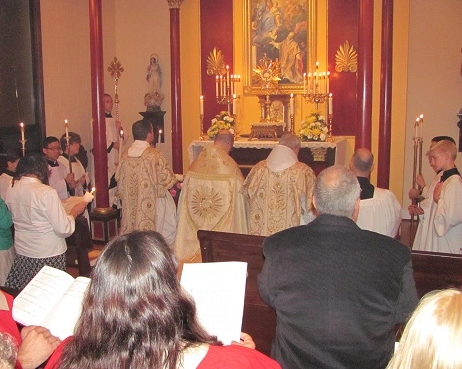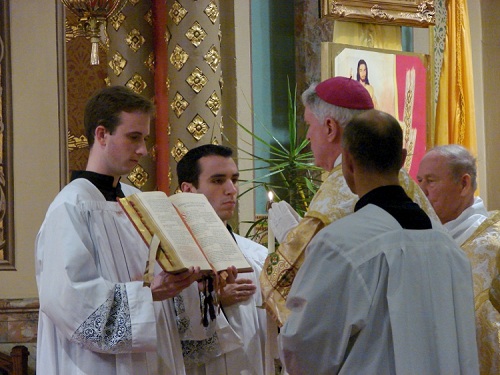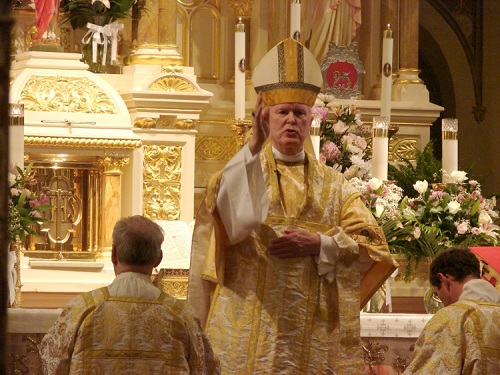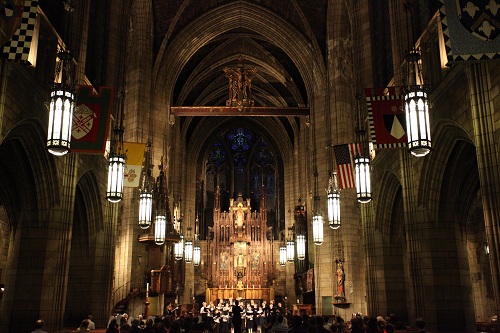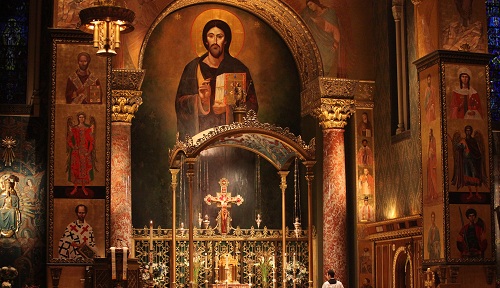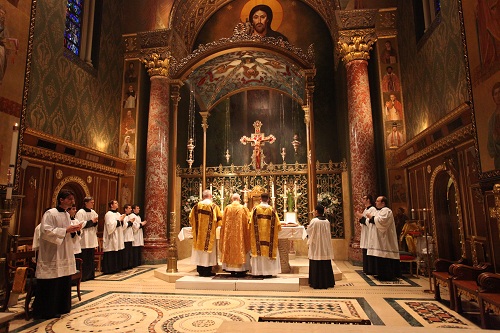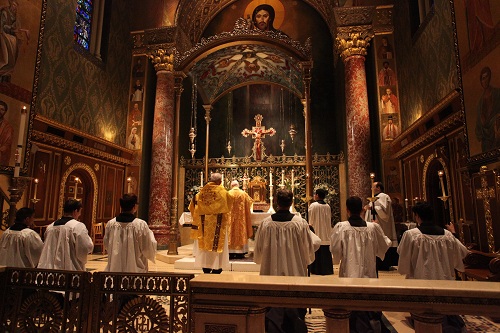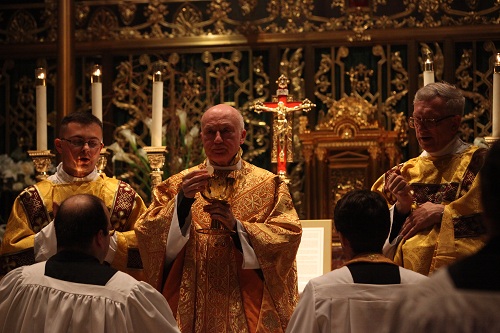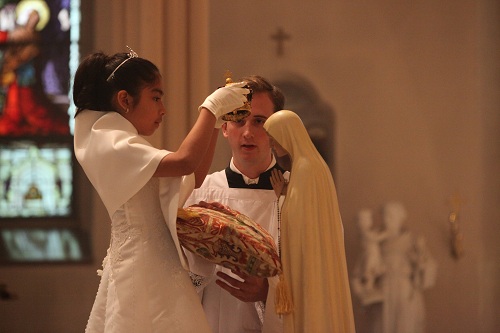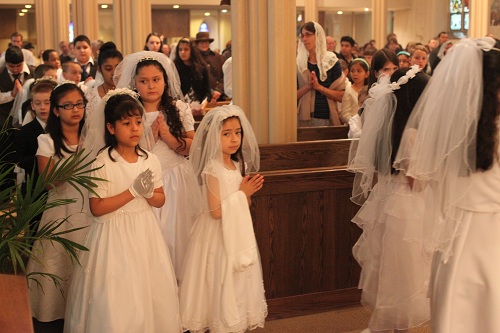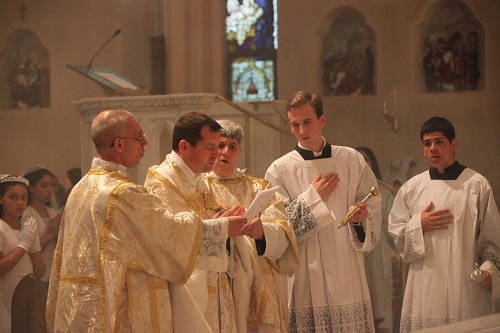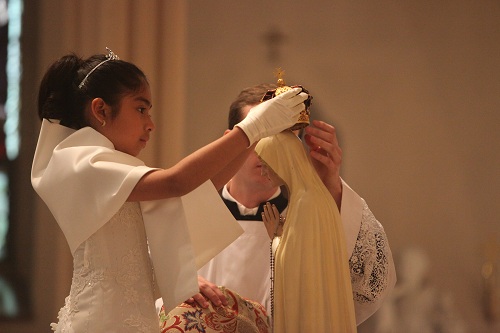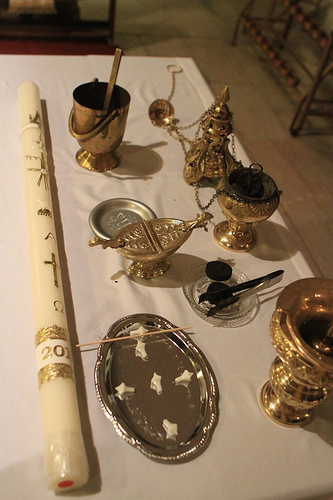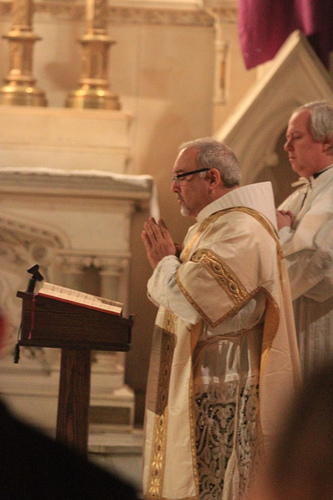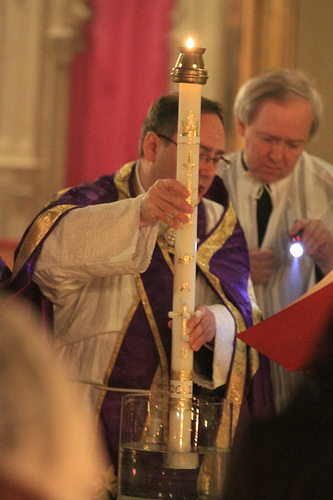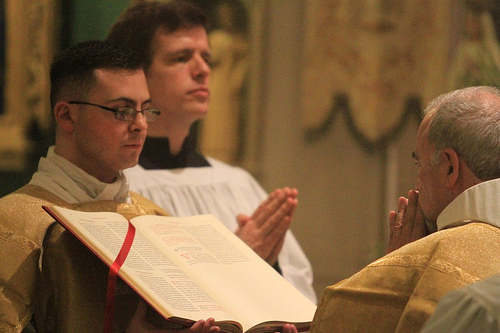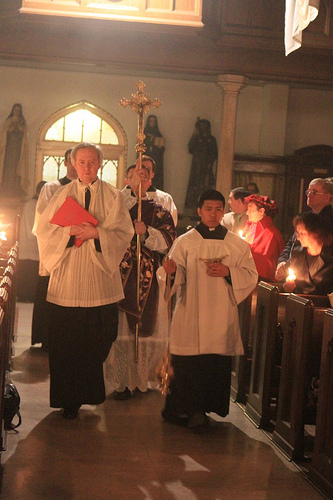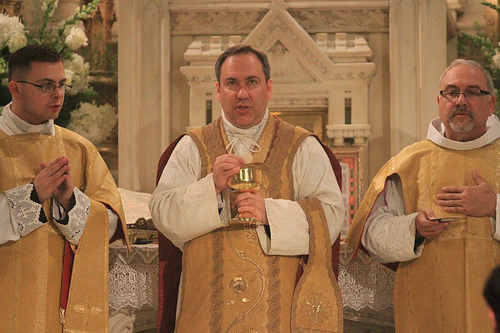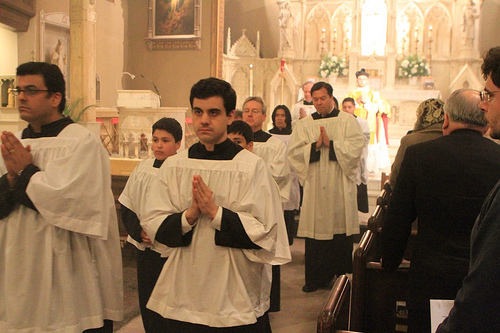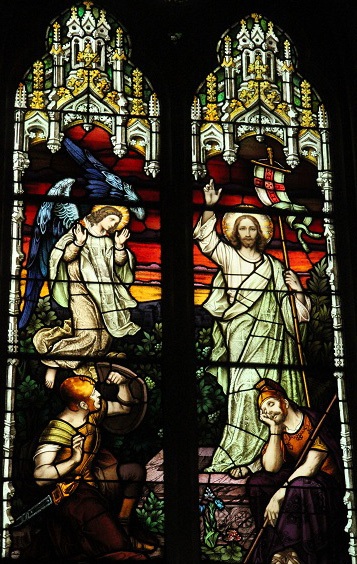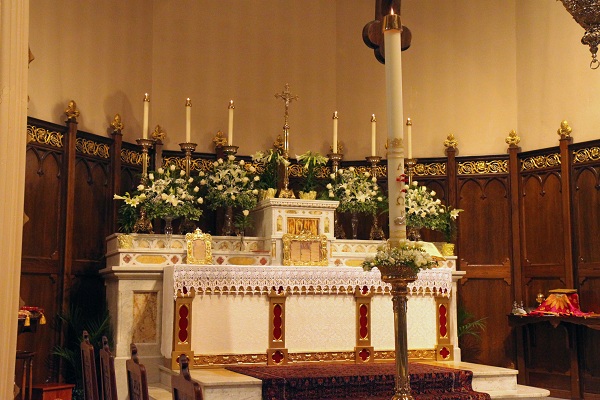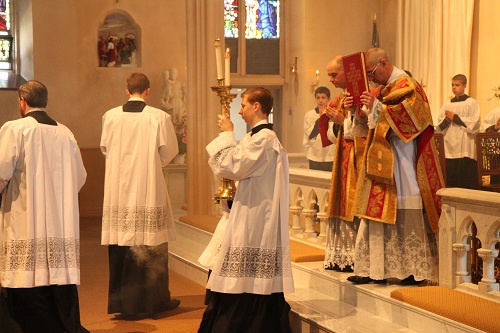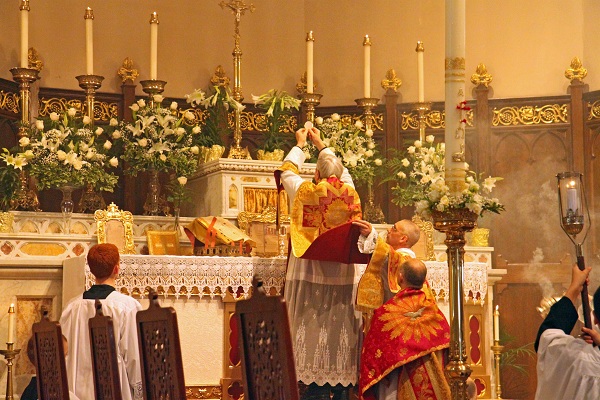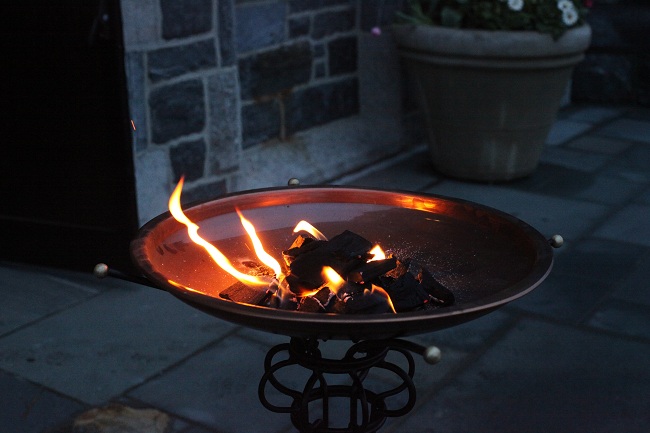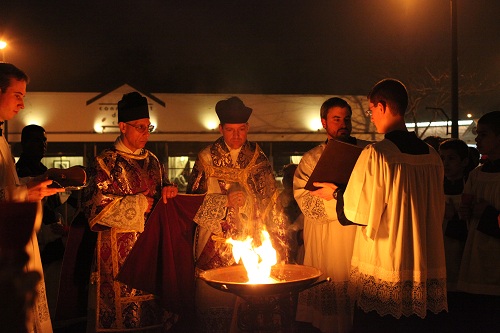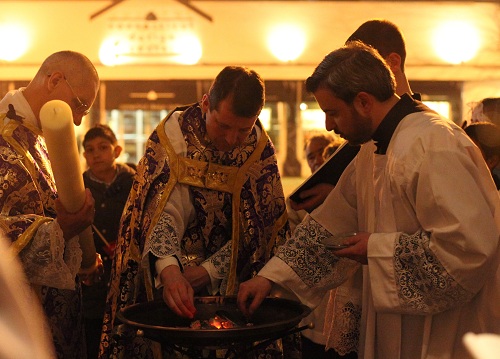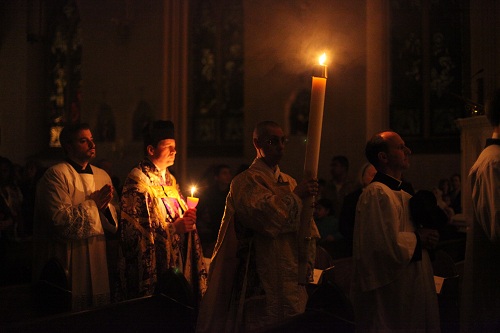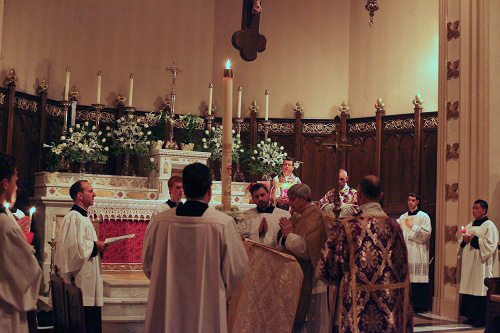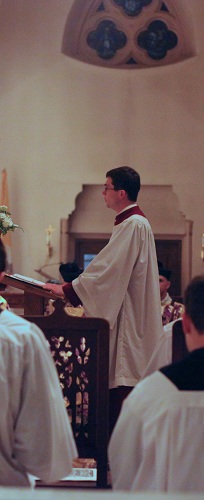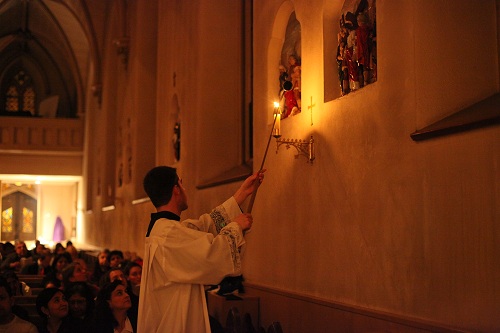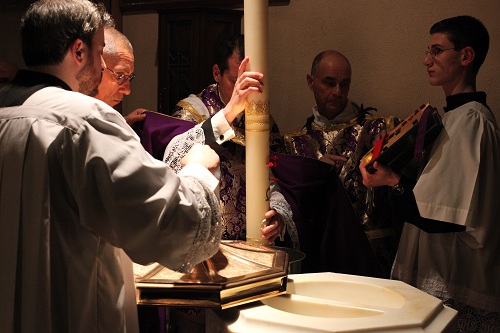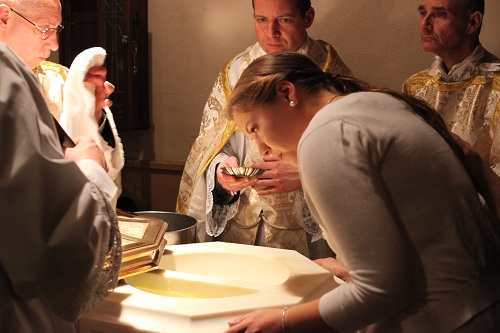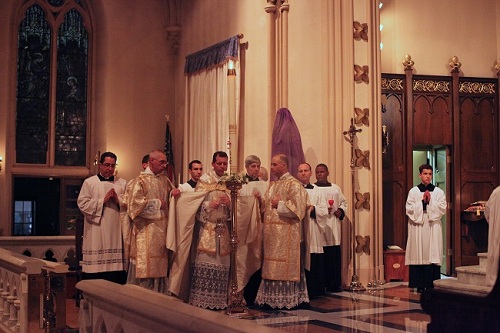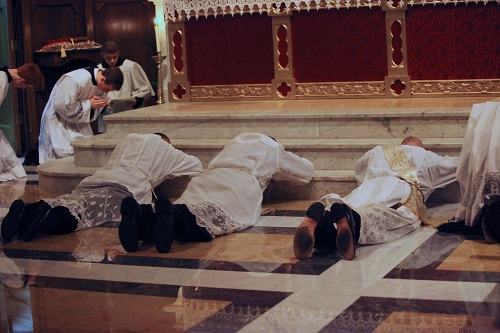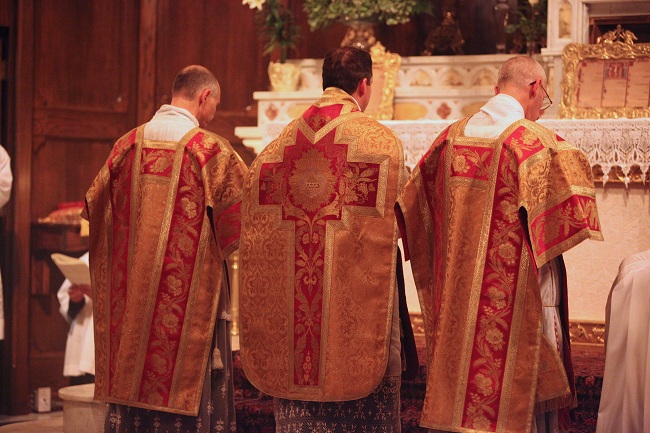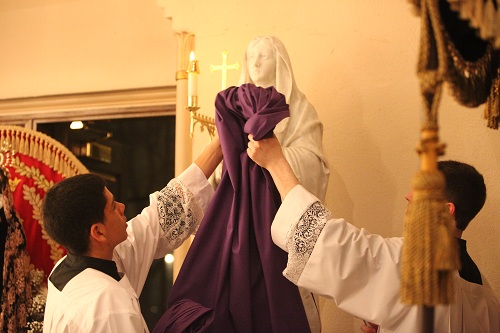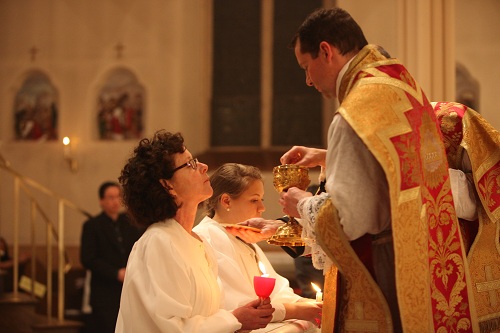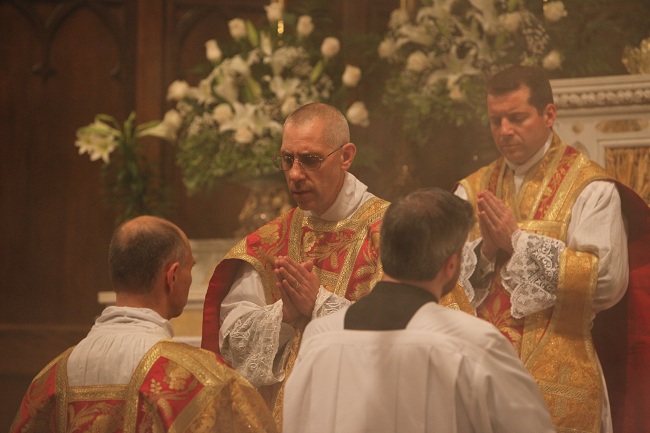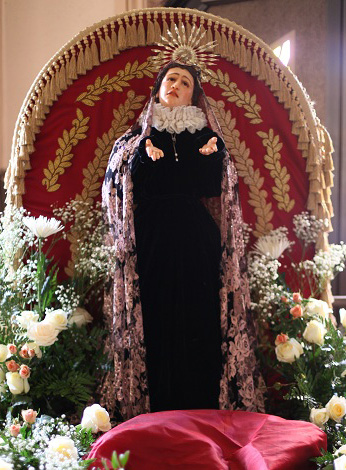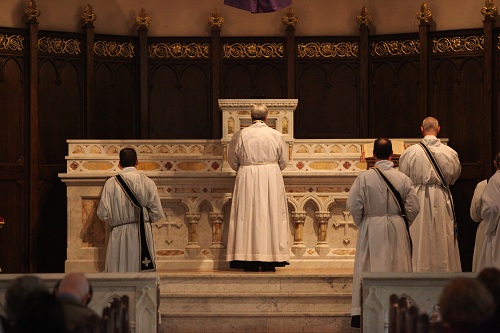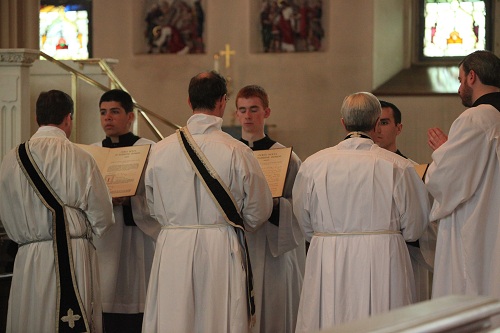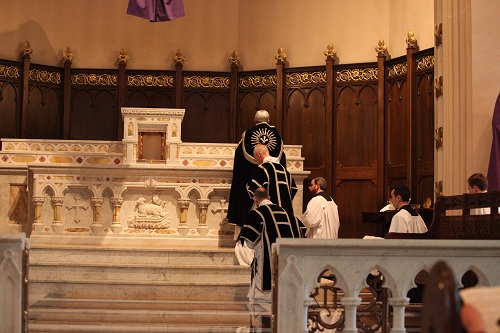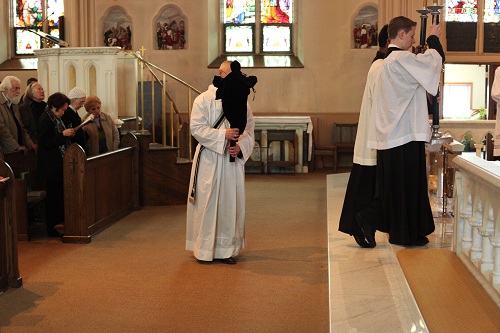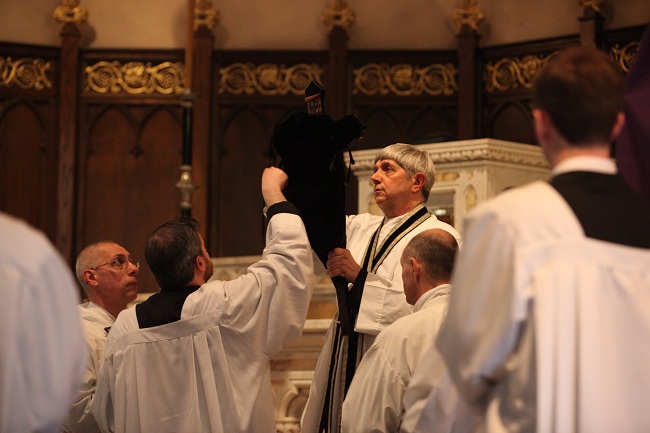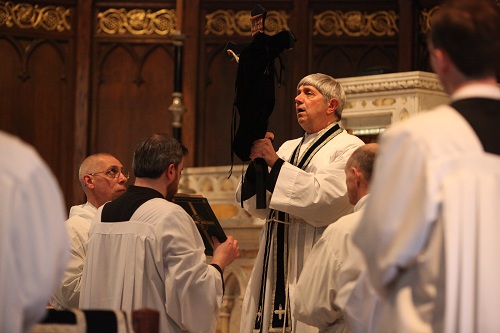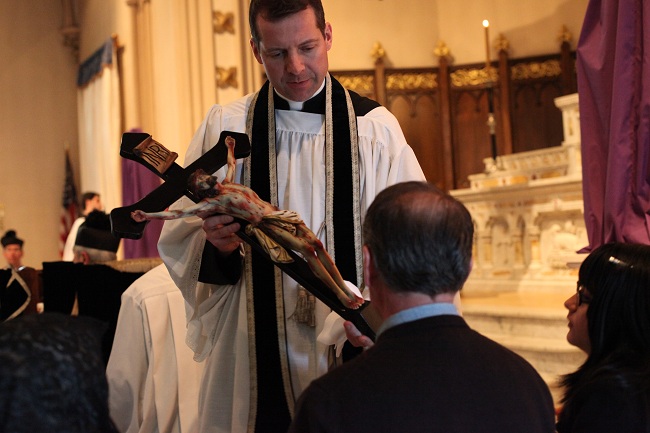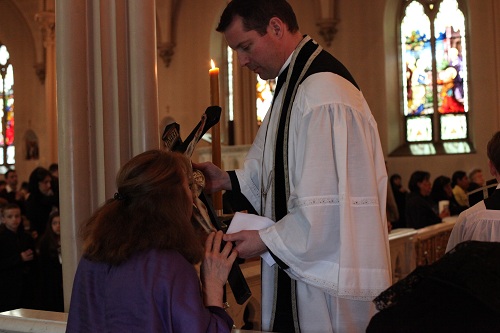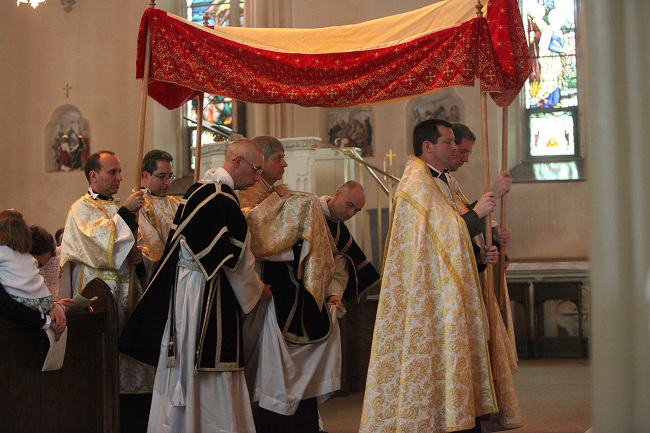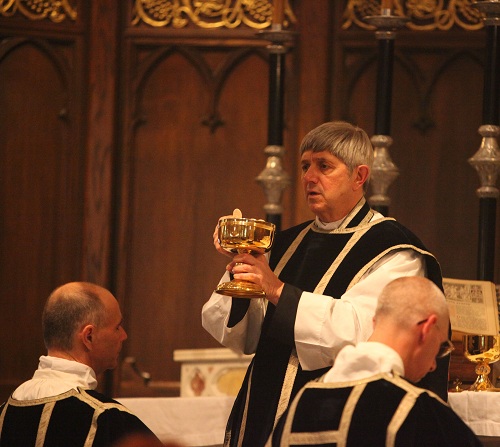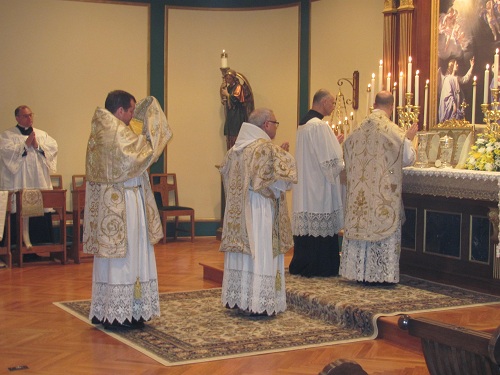
The Chanting of the Passion.
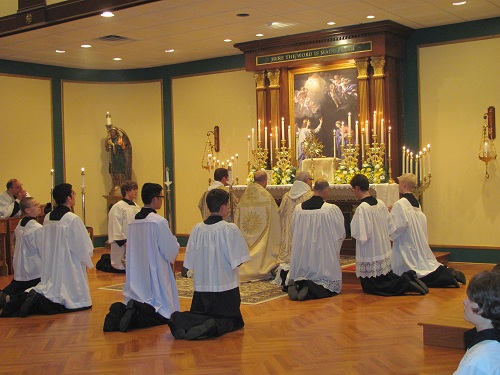
The Solemn Prayers.
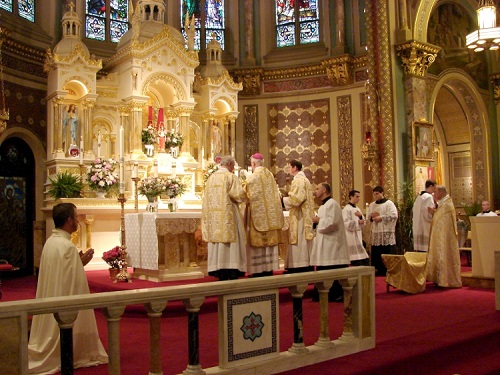
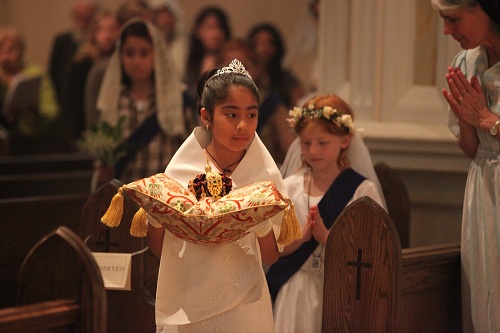
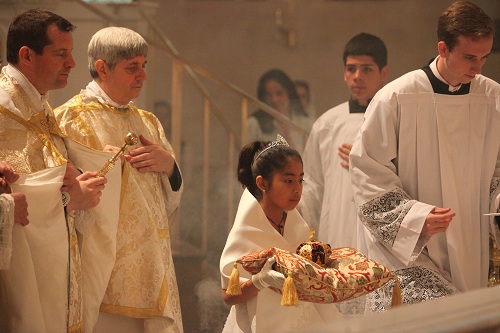
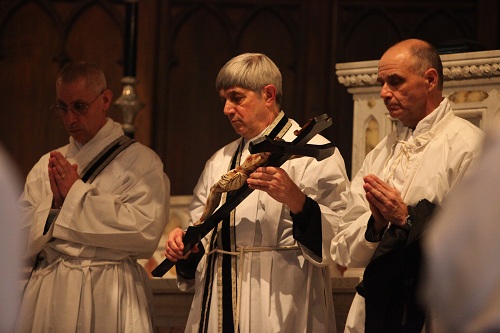
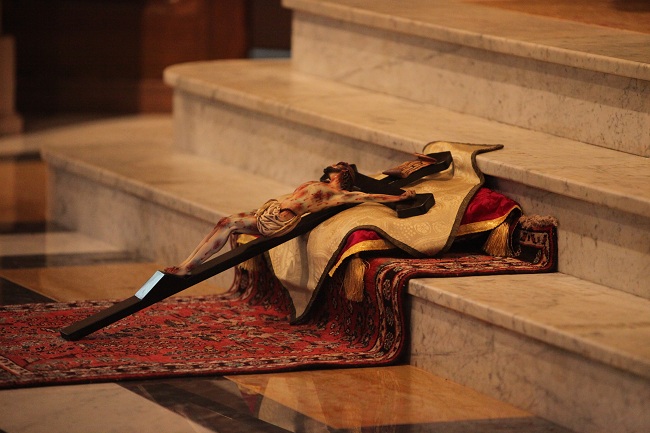
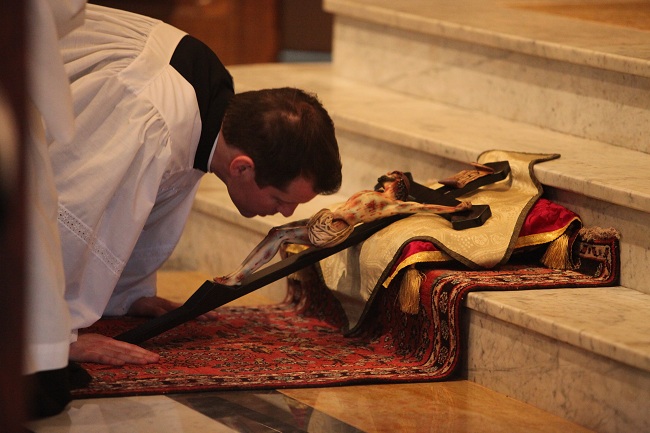
The Adoration of the Cross
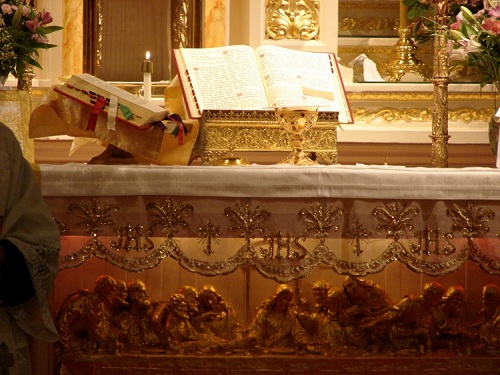
Ecce Lignum Crucis…
Ἅγιος ὁ Θεός, Ἅγιος ἰσχυρός, Ἅγιος ἀθάνατος, ἐλέησον ἡμᾶς.
Vexilla Regis prodeunt…
23 Apr
2011
The Chanting of the Passion.
The Solemn Prayers.
The Adoration of the Cross
Ecce Lignum Crucis…
Ἅγιος ὁ Θεός, Ἅγιος ἰσχυρός, Ἅγιος ἀθάνατος, ἐλέησον ἡμᾶς.
Vexilla Regis prodeunt…
23 Apr
2011
Holy Thursday in the Traditional rite at St. Mary, Norwalk – need we mention that the church was standing room only? (Please click to enlarge).
The washing of the feet.
The mass.
The Procession through the church and then through the main doors to the chapel.
The stripping of the altar (including the removal of the altar frontal). The ceremony is accompanied by the chanting of the antiphon Diviserunt and Psalm XXI.
The altar of repose.
12 Apr
2011
Yesterday a large congregation of the faithful was present at St. Mary’s Church, Norwalk for the Solemn Requiem Mass for Robert James Monahan. Fr. Paul Check was the celebrant. As member of our society, Robert was an indefatigable supporter of the traditional Mass and of the ongoing restoration of the church of St. Mary’s. It was his wish to be buried according to the Extraordinary Form of the Roman Rite. However, I don’t think even Robert could have imagined the splendor with which his Requiem Mass was celebrated.
About twenty-five acolytes served the Mass, including many students from Anchor Academy, the independent Catholic school to which Robert was a major benefactor.
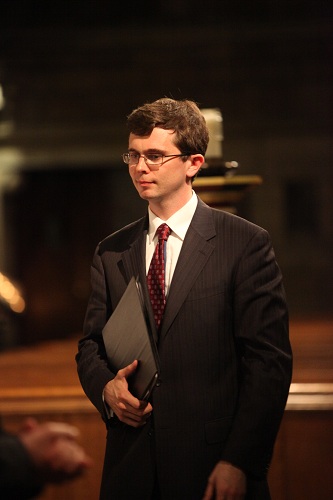
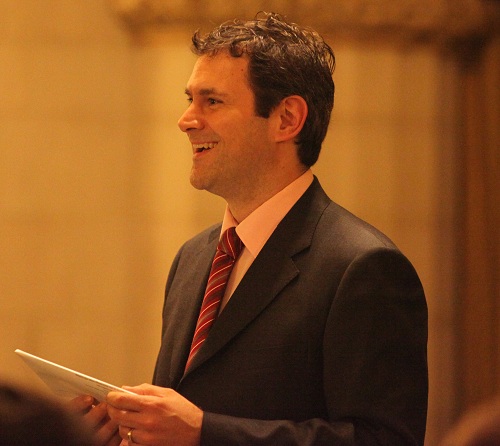
David Hughes conducted the choirs of St. Mary’s in the Requiem Mass of Tomas Luis de Victoria
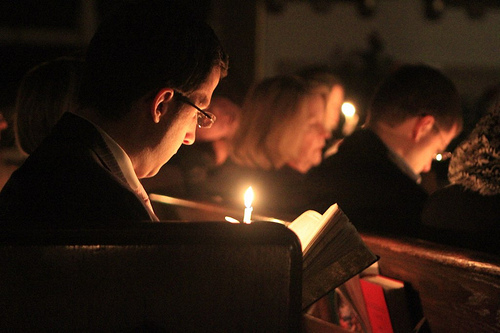
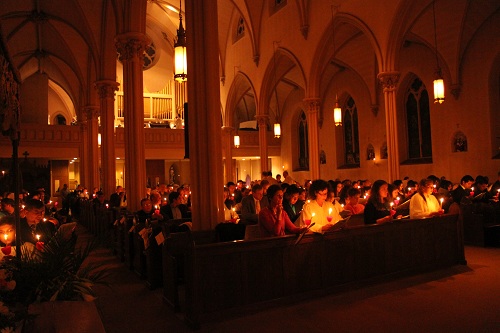
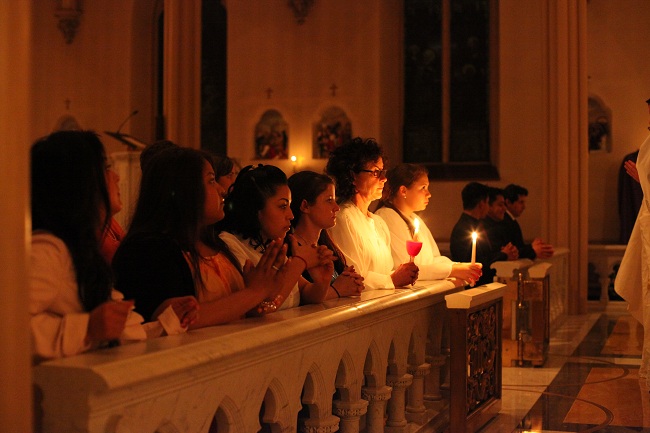
During the proclamation of the Gospel, the faithful hold lighted hand-candles, a symbol of Baptism.
Ecce Agnus Dei
Before the body is borne out of the church, Fr. Check circles the catafalque twice, first to sprinkle it with holy water, and then to incense it.
10 Apr
2011
The Church of Notre Dame
405 West 114th Street
Joris-Karl Huysmans tells us in Les Foules de Lourdes how the graces of Lourdes began to spill over and manifest themselves in satellite shrines having the same image and dispensing imported Lourdes water. Indeed, subsidiary sanctuaries in Belgium and even in Constantinople were the site of even more numerous cures than at Lourdes itself! A similar process began in New York with the importation of Lourdes water at the Redemptorist parish of Most Holy Redeemer. Miracles followed shortly thereafter. Soon half the parishes of New York displayed a Lourdes Grotto. But it was only in 1915 with the consecration of the Church of Notre Dame on West 114th Street that New York acquired its own replica of Lourdes.
This church, a great treasure of the Golden Age of Catholic church architecture, is one of the finest Beaux Arts spaces of New York City. Like St. Vincent Ferrer or Blessed Sacrament of the same era, this church and its furnishings – the windows, sculptures and metalwork- were conceived as a whole. Such architectural sophistication required substantial resources, and these were provided by a rich patron, Mrs Geraldyn Redmond. It was she who donated more than $350,00 of the original $500,000 cost to erect this church. The Church of Notre Dame was also intended to be a French national chapel – a satellite of the original French national church of St. Vincent de Paul on West 23rd street. Construction began in 1910. It is astonishing to read that, when Cardinal Farley dedicated the church on February 11, 1915, over 2,500 French Catholics were in attendance. 1) (By 2011 French Catholics have disappeared from the New York City landscape even more completely than their German and Czech counterparts.) In 1915 Notre Dame also became an independant parish. It was originally in the care of a French religious order, the Fathers of Mercy.
Work on the interior continued through the 1920’s. The ambitions of the architects, however, had outstripped the available funds. For their original conception was to crown the Church of Notre Dame with a spectacular raised baroque dome in the manner of the great models for this church: the achievements of the France of Louis XIV. This dome was never completed. Rather, 40 years later a flat dome was finished. 2) Thus the church of Notre Dame resembles more the Pantheon than its original model, the Invalides. The exterior is surrounded on three sides by three different facades employing classical columns and pilasters. That facing west is a free-standing colonnade or ambulatory providing direct access to the interior Lourdes shrine.

The interior is of great spaciousness, simplicity and grandeur – despite the restrained dimensions. The vast circular dome is suspended over a nearly square space. Chapels adorn each corner. As a unique touch, there rises behind the main altar a life-size duplicate of the Lourdes Grotto serving as a vast reredos! it seems almost surreal – yet the rough stone of the grotto blends pleasingly with the cut stone surfaces of the interior.
The metalwork – including the poor boxes! – is of the highest quality. It is matched by the windows and most of the sculptures. All would be perfect but for the usual unfortunate Conciliar “renovation” of the sanctuary (1988).
In the course of time, the original French parishioners disappeared. The Fathers of Mercy moved out in 1960 and the church of Notre Dame became an ordinary parish of the Archdiocese. In 2003, in an uncharacteristic stroke of genius, the Archdiocese entrusted this parish to Polish Dominicans and made iNotre Dame the site of the chaplaincy of Columbia University. 3) We do not know what these Dominicans are doing at Columbia but we have heard good things of their activity at other places. It is good that students have chance to experience the Catholic liturgy in such a magnificent setting. Lourdes water is still dispensed here. At the Church of Notre Dame, the Catholic students of Columbia can reconnect with their own glorious religious and artistic past – classical, Catholic and traditional. And maybe in the course of time more New York area Catholics will make the pilgrimage to their own special Lourdes shrine of Morningside Heights.
1) New York Times, February 12, 1915.
2) http://ndparish.org/Church_of_Notre_Dame/History.html
3) http://ndparish.org/Church_of_Notre_Dame/History.html
27 Mar
2011

Most Holy Redeemer
173 East Third Street
New York, New York 10009
Once upon a time the Germans made up one of the most prominent nationalities in New York. Old timers will recall Yorkville around 86th Street as the center of their activity – maybe certain neighborhoods in Queens as well. And then there was Luchow’s restaurant on East 14th Street… But very few even of these cognoscenti know that the original home of the Germans in New York was what is now called the “East Village.” A casual stroll in the neighborhood will reveal as many relics of Kleindeutschland carved on buildings and churches than can be seen today in its more famous successor on 86th Street.
The Catholic Germans were also a key component of the immigrant community. The original German parish in New York, St. Nicholas, disappeared in the early 1960’s. But Most Holy Redeemer, carved out of St. Nicholas in the 1840’s to handle the burgeoning immigrant population, remains. Perhaps that is not the right word – Most Holy Redeemer is one of the most spectacular Catholic parishes in New York! The present church was dedicated in 1852 by Archbishop Hughes assisted by four bishops including St. John Neumann and the bishop of Bogota. The parish originally was in the care of the German-dominated Redemptorist order. 1) In contrast with the ascendant Neo-Gothic wave, Most Holy Redeemer was designed in a unique style – called “Byzantine” at that time – combining baroque, byzantine, romanesque and reneaissance elements. The architect was Joseph Walch of Munich – it was in Munich under King Ludwig I that the first “Byzantine” revival church was built. (As early as 1878 “Walch” had become “Walsh.”) The collective memories of rococo masterpieces like Vierzehnheiligen, Ottobeuron and the Wieskirche also remained strong at Most Holy Redeemer. Now New York may have none of these churches – but it does have Most Holy Redeemer.
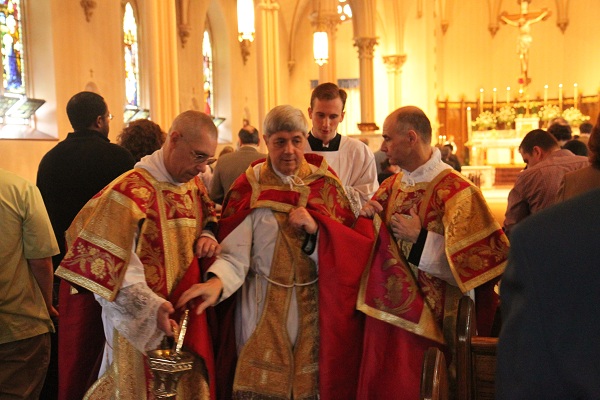
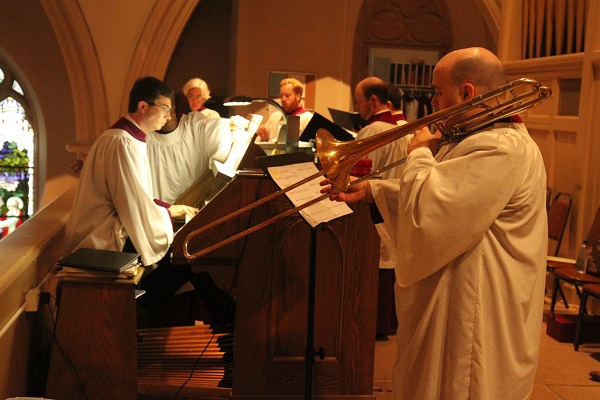
The façade of Most Holy Redeemer, with its massive tower, totally dominates the decrepit streetscapes surrounding the church today on East Third Street. The present sober, quasi-Romanesque appearance is the result of a restoration and simplification in 1913. The original exterior seems to have been a wild baroque fantasy with a tower even taller than the current example. 2)
But nothing prepares the visitor for the interior: an overwhelming medley of magnificent stained glass, startling color, statues, paintings and shrines all in a cathedral-sized space.
In terms of superabundant, extravagant decoration Most Holy Redeemer puts to shame much later Italian competitors like Our Lady of Pompeii. What could they have thought of all this in mid- 19th century New York?
“The church, as planned by Mr Walsh the architect, rose rapidly, impressing all with its beauty and proportions. To the Protestant mind it was a wonder. it seemed some vast cathedral not a mere parish church for Catholics of a single nationality. 3)
And if contemporaries may have been puzzled, what about the “Conciliar” Catholics of today? What indeed can the Catholic “man in the street” make of the life-sized sculptural groups of the crucifixion and deposition in the rear of the church? Or of the “diorama” of the poor souls in Purgatory? Or of the recumbent wax images of the saints – just like in the old country? Or the angels everywhere? (Just compare how this kind of image succeeds here but flops 125+ years later at St. Agnes in the same city) There are even touches of the Beuron style in the apse murals. This is Catholicism unashamed, exuberant and confidently anticipating an even brighter future on the other side of the Atlantic.
Such an outlook of course would characterize Isaac Hecker. In 1844-45 the future founder of the Paulists “spent many hours in prayer at the Redemptorist Church of the Holy Redeemer on Third Street.” 4) (This was at the first and, at that time, brand new church building of Most Holy Redeemer). Later, Hecker was ordained a Redemptorist priest and returned to New York in 1851 where he acted as a missionary in various parishes operating out of the Redemptorist convent on East Third Street. Ironically, although Hecker was himself of German heritage, he felt that the heavy German and Central European ethnic focus of the New York Redemptorists hindered his vision of mission to the “Americans” and Protestants. This contributed to Hecker’s eventual break with the Redemptorist Order and the founding of the Paulists.
Even before the First World War, the Geman inhabitants had largely fled this neighborhood. Later, the area grew distinctly seedy. Catholic New Yorkers -at least the more well-to-do ones – seemed to have lost track of their baroque treasure. But the “Hispanic” population of this area has kept the parish going and in better repair than many another church in the city. Today the church is a shrine to Our Lady of Perpetual Help -the patroness of the Redemptorists and a favorite devotion in many other parishes of New York City.
1) Shea, John Gilmary. The Catholic Churches of New York City (Lawrence G. Goulding & Co, New York 1878) at 360.
2) Dunlap, David W. From Abyssinian to Zion: A Guide to Manhattan’s Houses of Worship (Columbia University Press, New York 2004) at 147.
3) Shea. Catholic Churches at 358-59.
4) http://www.paulist.org/hecker/biography.php
22 Mar
2011
St. James
32 St. James Place
The visitor truly enters a time warp as he approaches St. James after feeling his way through a faceless landscape of government buildings and housing projects. He discovers to his joy that the two or three streets immediately surrounding St. James are perfectly preserved if decaying holdovers from the 19th century. The brownstone Greek temple that is St. James is appropriately situated among other curious monuments – like the similarly styled “mariner’s church”, the former St. James parochial school and the city’s oldest Jewish cemetery. The facade is studded with commemorative plaques , for there is no parish in New York more historic than St. James. The original parish had been founded in 1827 by the great Father Felix Valela, a native of Cuba and the founder of several venerable New York parishes. The current church was dedicated in 1836 – allegedly designed by the noted neoclassical architect Minard Lefever. Like most early New York parishes St. James was predominantly Irish. Indeed, it was at St. James that the “Ancient Order of Hibernians” was founded in 1836. Later, the priests of the parish struggled and died caring for the waves of immigrant fleeing the great famine in Ireland in the 1840’s. As time went on and Catholic immigration to New York drastically increased, this parish grew huge. It was in these streets and at this parish that Alfred E. Smith (1873-1944), the future governor of New York and Democratic presidential candidate in 1928, grew up. Smith’s name is everywhere – on his house, on the parochial school building where he received all his formal education, on the church where he served as an altar boy and where the pew his family owned is proudly displayed.
The house of Al Smith is on the left, then the rectory and finally the former convent.
“St. James was not only Al Smith’s school and parish, it was also the most important institution in the community… . St. James was a typical urban church, small and overcrowded by the time Al Smith became a congregant. The original altar was made of stone brought over from Caen, France and covered a large area, at least fifty feet….By 1878 the congregation had reached twenty-five thousand, far too many for a building this small, and this figure did not include the floating population of three thousand Catholic sailors. Masses must have been frequent and crowded…….”
“Father John Kean became pastor in 1879 and was a dominant influence in Al Smith’s life….Father Kean appeared omniscient, constantly looking in on the classrooms, observing the children at play on the street, inserting his presence into every aspect of parish life….Fr. Kean was also instrumental in creating the organizational life of the parish, the myriad services and organizations that St. James provided for its community. By 1878, for example, there was a Society of the Sacred Heart…a Society of the Living Rosary; a Holy Name Society (with three hundred members by 1886) a St. Vincent de Paul Society; the St. James Rifle Corps (“which took part in all public celebrations”, Al (Smith) later explained) the Longshoreman’s Protective Society; plus a Young Men’s and a Young Women’s Sodality….Above all the church provided services for the children of the parish. By 1878 there were approximately 1,450 young people attending classes at St. James (650 boys taught by the Christian Brothers and another 800 girls taught by the Sisters of Charity). This institution had a fine reputation. One historical critic of Al Smith still referred to it as “one of the best grammar schools in the city.” In addition to the school, in 1882 Father Kean built an orphanage …and an industrial school… 2)
From this account we see that what distinguished the Archdiocese of those years of growth from its present day successor is not primarily the number of Catholics or their economic status but an entirely different and broader understanding of the Church’s role. It is a Church imbued with a sense of mission, that reaches out into society and takes a leadership role in all aspects of life: education, labor relations, the arts, public morality, politics and even entertainment. It was an age when every Catholic felt an intense loyalty to his territorial parish -feelings that persisted in New York City right up to the Second Vatican Council. Al Smith is reported to have described St. James in the 1880’s as “the leading Catholic parish in New York, not excepting the cathedral itself.” 3) We may not totally agree with that – but it does show the pride of Catholics of that day in their local church.
St. James is not only a historical monument but is artistically impressive as well. It is clear that there must have been significant resources at hand in 1836 to construct such an elegant Christian temple. The facade, faced with brownstone, boasts plaques with Protestant-style scriptural quotations. It is surprising to reflect that this is the second oldest Catholic church building in New York – so completely has its style lost any association with Catholicism! Once upon a time the exterior featured a long-vanished tower above the classical pediment. 3) The interior is a simple rectangle with a sanctuary inserted and set off by a communion rail. The remarkably light and festive space is adorned with elaborate decorations in a “Greek” manner. The magnificent sanctuary (including the above-mentioned huge altar) dominates through greater density of detail, its paintings and the whiteness of the marble. Doubtless Pugin (a contemporary) would have been horrified at the utilization for Catholic church of pagan decoration and a design more likely to be found in Protestant churches. But yet it works – splendidly!
The organ, too, is historic although not all of it can be played. Concerts have been held seeking to advance its restoration. 3)
After the days of glory of the 19th century, St. James parish gradually sank into obscurity. Judging by the dedications in the church, the dwindling parish had become largely Italian by the middle of the 20th century. In more recent years a “Hispanic” population of various nationalities has predominated. The church itself grew more dilapidated as the financial resources of the parish declined. in the 1980’s the city almost mandated closure because of the deterioration of the structure. The Order of Hibernians, however, rose to the defense of St. James and saved the parish. The order also funded a restoration of the building at that time.
Nevertheless the path of decline resumed despite heroic efforts of the parish community. Lately this church attracted the attention of the archdiocesan planners. St. James is small, poor and located very close to three other Catholic parishes – the tower of Transfiguration church can even be seen to the northwest. In 2006 St. James was reduced to a mission of nearby St. Joseph’s church. In early 2010, after more than 150 years of existence, Al Smith’s school was closed (fortunately the building is now being used by the school of Transfiguration parish). Finally, a fire broke out on January 10 of this year in the attic of the church. It is reported that the damage was not that great and Archbishop Dolan has expressed his support. Costs of repair, however, have been used in the past by the Archdiocese as an excuse to close churches. Especially when a massive Archdiocesan downsizing is underway.
It is really a shame. With a thorough-going restoration and imaginative leadership such a beautiful, historic space could become a magnet for downtown and the entire city. Given the reviving residential character of the general area, it would be a wise investment for the future – viewing the matter in merely material terms. We certainly pray that St. James continues as a reminder to New York Catholics of their glorious history – and re-assumes its rightful place as a citywide spiritual center.
1) See the parish history at http://church.stjamesnyc.org/histo
2)Robert A. Slayton, Empire Statesman: the Rise and Redemption of Al Smith (The Free Press, New York 2001) at 26-28
3) http://www.nycago.org/Organs/NYC/html/StJamesRC.html
13 Mar
2011
St. Agnes
143 East 43rd Street
New York, New York 10017
In the world of “orthodox Catholicism” two schools of thought have long contended. “Traditionalism” has always attracted the most attention and controversy: the return to the immemorial tradition of the church including the pre–Vatican Council liturgy and the traditional understanding of morality and theology. The alternative, less known to the non-Catholic world but generally enjoying – at least verbally- more support from the official church, today goes by the name of the “Reform of the Reform.” It accepts absolutely the changes of the Vatican council and the new liturgy. In contrast to the practice of mainstream Catholicism, however, it asserts that these new elements can and should be integrated with cultural heritage of the past. Can this succeed?
In the shadows of Grand Central Station and the Chrysler building lies the Catholic parish of St. Agnes. A classic “commuter church,” most of its geographic population had vanished ages ago. Until fairly recently, it boasted a high school. A once very active soup kitchen has also been displaced. Starting in the 1980’s a group of priests stationed at St. Agnes presided over by Msgr. Eugen Clark established this parish as the center in New York of orthodox Catholicism and of Catholic mission. The “Novus Ordo” mass was celebrated with more care and adherence to tradition. Later, St Agnes was one of the first New York churches to open its doors to the Traditional liturgy after the 1980’s Indults. This “Extraordinary Form” is celebrated at St Agnes every Sunday even today. To support its liturgical aims the parish developed and maintains today an excellent musical program. A very well-stocked bookstore can be found here as well. Constantly busy, as are all such commuter churches, St. Agnes welcomes each day a never ending stream of visitors for mass, confession or prayer. But the current structure is not the original.
Old St. Agnes was a typical New York Victorian Gothic church, much like Holy Innocents, St. Bernard’s or St. Stephen’s. The church was completed in 1877. The plot offered little floor space, giving the church a squarish layout somewhat unusual for the gothic style. The high ceilings and splendid stained glass compensated for these restrictions and imparted an atmosphere of spaciousness. St. Agnes used to boast fine white marble altars typical of the period of its construction. St. Agnes’s claims to fame included the residence there of the late Archbishop Fulton Sheen and the fact that Eamon de Valera, the future president of Ireland, was baptized in this church (proudly commemorated on the old baptismal font!)
Regrettably, by the 1980’s the fabric of St. Agnes had fallen on hard times indeed. Painted a uniform battleship gray, the dismal, dilapidated interior had been crammed over the years with the worst art conceivable. The visitor was confronted with an age- darkened and grossly disproportionate copy of Da Vinci’s last supper suspended over the main altar, a ludicrous 1950’s style mosaic of the Virgin and Child, and finally, a marble copy of the infant Heracles strangling a snake as a memorial to aborted children. Compared to all this, the usual array of plaster saints – including, of course, St. Lucy with her eyes on a tray – was welcome aesthetic relief. To complete the dismal picture, the interiors of the church and the structures surrounding it (other than the rectory) seemed permanently coated in grime. Your discomfort was not just visual: the old church – and even more so the adjacent current and former school buildings – exuded an unpleasant smell.
In 1992 St. Agnes was severely damaged by fire. Now a unique opportunity presented itself to Msgr. Clark. For it was the first chance in over 20 years to erect a new Catholic church on the island of Manhattan. We can only be grateful that at that time the universal assumption was still to rebuild the church – in the 1990’s the decay of the Archdiocese was not as advanced as today. Nowadays the site would simply be sold to developers. The option to rebuild on the original plans was rejected – if it was ever seriously considered. Nor would the 1966 example of Epiphany parish be followed; no modernist monstrosity would arise on the ashes of a destroyed predecessor. Rather, this parish would demonstrate to the city and the Archdiocese the reconciliation of Council and Tradition. In line with developments in liturgy, art and ecclesiastical rhetoric, a monument to the “Reform of the Reform” would be erected. St. Agnes would prove that the ”modern church” could successfully employ the language of traditional – and specifically classical – art and architecture. The new structure was finished in 1998.
From outside, the new St. Agnes presents a quasi-classical appearance with two towers. Closer inspection revelas that the “classical” facade is in fact applied to the brick towers from the older church. The surface of the façade is also largely “stencilled”, but this is OK – there is some precedent for this in Europe ( e.g., Munich). Less forgivable are the crude arches and half columns.
Inside, we have a somewhat cramped longish space with a barrel vault. No windows are visible. The interior seems vaguely inspired by works of the Florentine renaissance. The articulation of the interior includes elements of the classical architectural vocabulary: columns or half-columns, capitals, entablatures. On either side of the sanctuary a shallow “transept” opens up. The sanctuary itself is nearly on the same level as the nave and ends in a flat windowless wall. It is, however, surrounded by a communion rail – a major “restoration” in 1998!
We cannot say that this architecture is successful. The elements of classical architecture seem disproportionate to the small space. The impression is one of confinement and dullness. The drab color scheme of white and gray heightens the drab appearance. But if the architecture itself reveals limitations, the decoration and furnishings are far worse. Low side chapels are filled with statuary seemingly purchased from the catalogue of a purveyor of third-rate devotional art. There are several copies of Baroque paintings. A faintly ludicrous leitmotiv of small sculptured cherubs recurs all over the church. And then there is the apse painting combining the art of the comic book with that of the 15th century Italian renaissance. The painting does add a welcome note of color to the interior. But then there is the centerpiece with the voluptuous figures of St. Agnes and the Virgin Mary – one senses the influence of Wonder Woman. St Agnes herself wears an unusual and highly inappropriate short skirt. Is this an attempt to “Americanize’ the saint?
We cannot dispute the good faith of this endeavor. But this courageous attempt to reuse the vocabulary of classicism – as an ideology – without clearly understanding its rules has manifestly failed. Indeed, this new church strangely reiterates some of the worst features of the old: the bad copies of renaissance paintings, the cherubs, and the gray paint. Compared to the new St. Agnes, its 19th century predecessor was Chartres Cathedral. To appreciate how far St Agnes falls short of a true classical style, the visitor has only to compare this church with the light, airy St. Francis De Sales on East 96thStreet, an ordinary parish church also erected in a classical beaux arts style but 100 years earlier.
But beyond issues of artistic competence in an idiom that had fallen totally out of use, there is perhaps a more fundamental intellectual flaw. For can the “language” of Catholic traditional art indeed express the modernistic, non-traditional and ever changing nature of the new liturgy? To point out just one example, by setting up a communion rail, the builders of the new St. Agnes intended to memorialize the return of the traditional mode of receiving communion – kneeling and on the tongue – to the Novus Ordo liturgy. Yet, not too many years after the completion of this church, the US bishops tried to mandate receiving communion standing as obligatory in the Novus Ordo. Thus, developments in the Novus Ordo have always continued to run ahead of the would-be defenders of the status quo. Thus, the architecture of St. Agnes remains not an example for the future but a solitary statement of a limited ideological movement.
Grammar?
6 Feb
2011
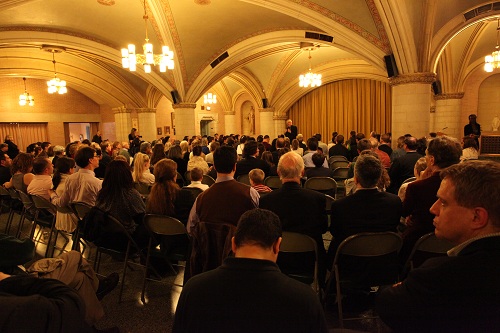
Last Wednesday St Mary’s Norwalk saw a truly memorable celebration of the feast of Candlemas or of the Purification. It was a truly “spectacular” conclusion to a day of dramatic developments on the weather front: snow, sleet, ice, rain and finally fog. Since the preceding evening it had been a open question whether the mass and Martin Mosebach’s talk would have to be cancelled. In the end the decision was taken to proceed and a window of opportunity amidst the a conditions did indeed open up that evening. The impressive congregation which braved the weather to attend the mass and lecture was not disappointed. The Candlemas service including the blessing of candles procession and solemn Mass, was one of the most perfect liturgical experiences we have witnessed. The adverse conditions- the real effort many needed just to get to this mass – seemed to give a new intensity to the worship. The music was, as always, magnificent featuring the premiere of a mass by the choirmaster David Hughes.
(Please click on an image to get an enlarged view.)
The blessing of the candles.

The distribution of the candles.
The procession.

The procession of the faithful proceeds around the side aisles, vestibule and before the sanctuary of the darkened church.
The procession.
The Mass.
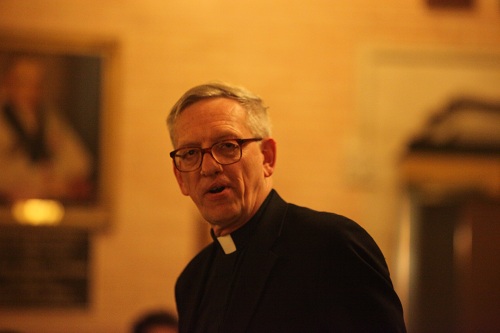
Martin Mosebach gave his usual dramatic reading – this time a chapter from the “Heresy of Formlessness.” After having experienced the liturgy of this day, he confessed it may have been the most impressive February 2 of his life. And all this musical and liturgical perfection has come into existence from scratch after the effective date of Summorum Pontificum – at the time of Mr. Mosebach’s last visit to the US just three years ago!
5 Feb
2011
On Sunday, January 30, Martin Mosebach spoke at the parish of Our Saviour, New York. A solemn high mass preceded his talk. We were heartened by the impressive turnout for both the mass and Mr. Mosebach’s talk. In attendance were numerous seminarians and clergy as well as some well-known represenative of various Catholic media. Mr Mosebach gave a forceful presentation on the Traditional liturgy: how it had been destroyed; its essential features; how it is being recovered; and its significance for the overall liturgical and spiritual life of the Church. The text of the original version of his talk (given at an Archdiocesan conference in Sri Lanka last year) can be found HERE.
On Tuesday February 1, Mr. Mosebach spoke at the New York Goethe Institute in a presentation in English and German with critic Liesl Schillinger of the New York Times Book Review. The weather was terrible, yet attendance vastly exceeded expectations using up all available chairs. 70 or so guests had assembled to hear a discussion of a writer none of whose works of fiction have been translated into English! the response of the audience was enthusiastic. When asked if his Catholic faith influenced his novels, Mosebach replied that undoubtedly it did – but exactly how he could not say. Mr Mosebach has written an essay Catholic Literature making much the same point.
The interior of Our Saviour’s about 15 minutes before mass. As always, each new visit to this church reveals new icons, shrines and adornments. By the time of the start of the mass, there was standing room only.
Father Richard Cipolla gave the sermon.
The music was provided by the schola of St. Mary’s Norwalk.
An enthusiastic audience attended the subsequent talk. Discussions and book signings continued long afterwards.
A successful evening!
24 Dec
2010
For a Christmas treat, we bring you pictures of the Anchor Academy Christmas pageant, which was recently performed on December 15. Anchor Academy school is an independent Catholic school in Norwalk, CT. The school is committed to providing a curriculum from the classical tradition of the Roman Catholic Church, with a strong emphasis on religious formation. Classes are small, the faculty are committed Catholics, and the tuition is reasonable. Many students, faculty and parents begin the day by attending the 8:00 am Mass at nearby St. Mary Church. The school is currently conducting a fund-raising campaign, with the aim to keeping the tuition affordable. If you would like to know more, visit the school website at http://www.anchoracademy.org/.
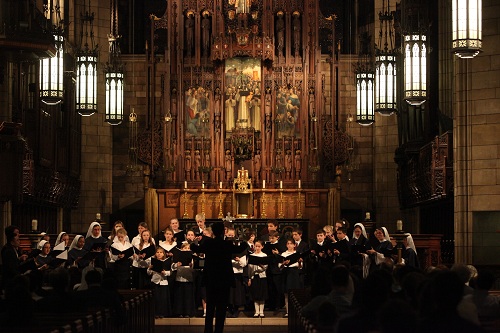
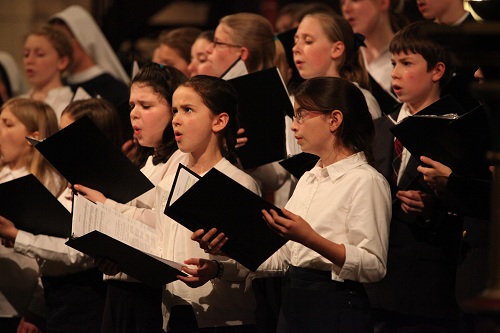
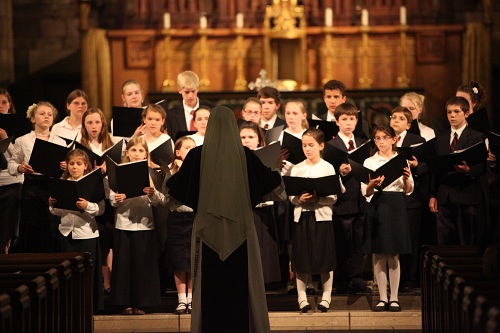
David Hughes conducted the student choir, which performed many carols for the pageant. Mr. Hughes is a member of the faculty at the school and provides instruction in choral singing each week. The student choir performs once a month at the Extraordinary Form Mass at St. Mary Church.