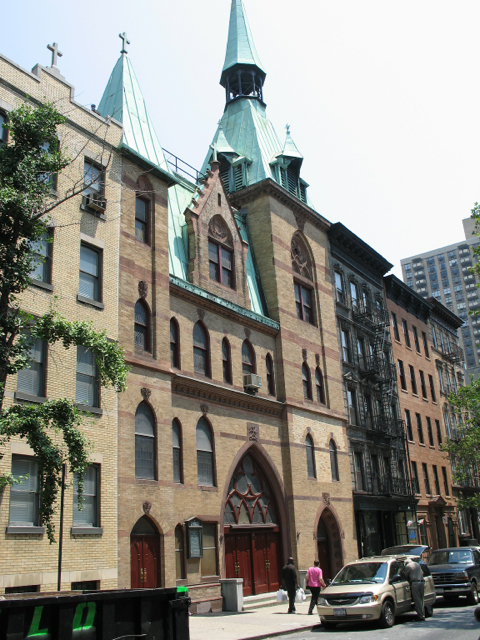
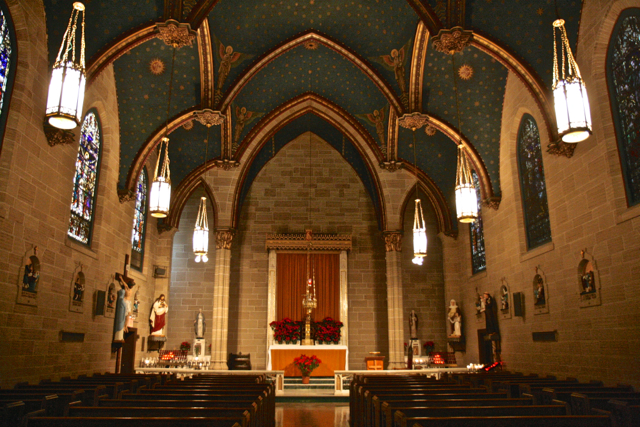
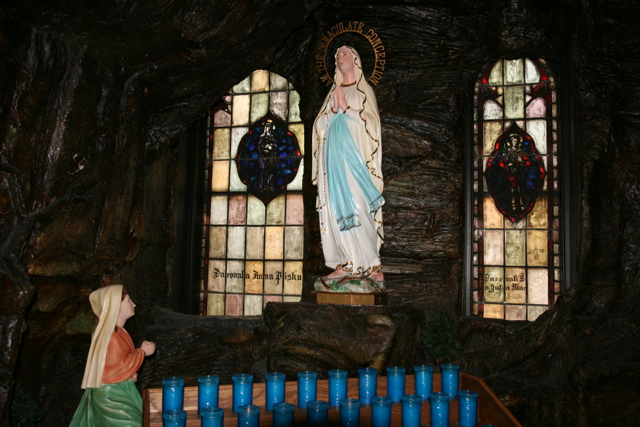
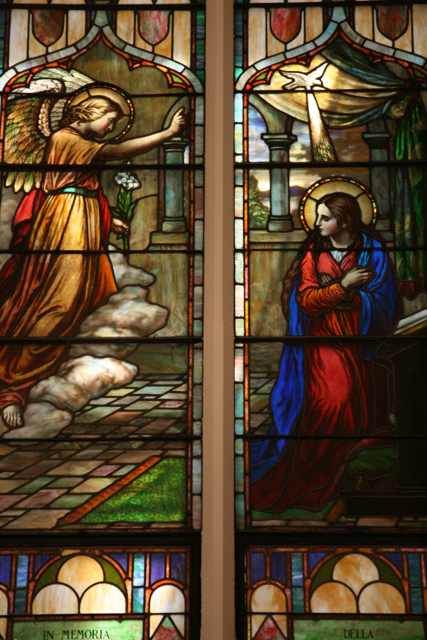
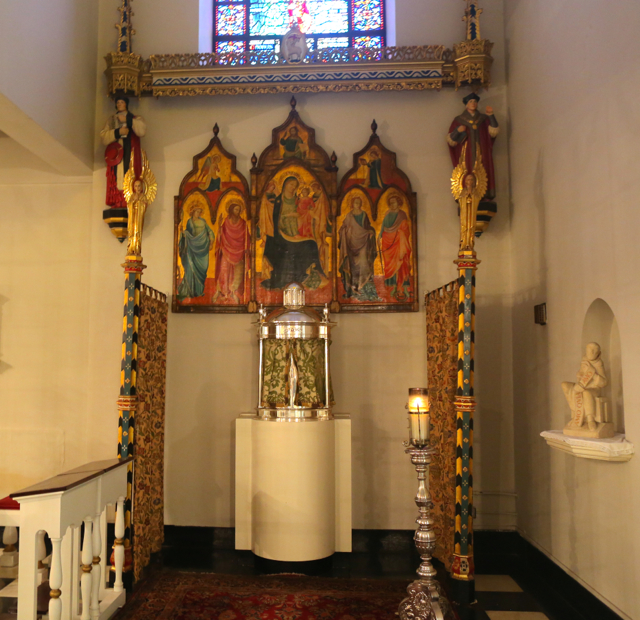
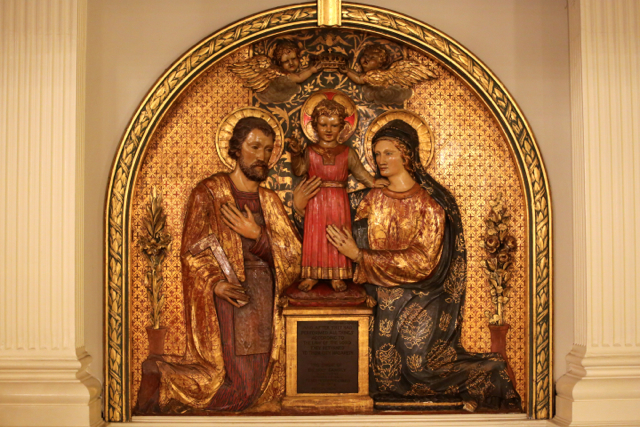
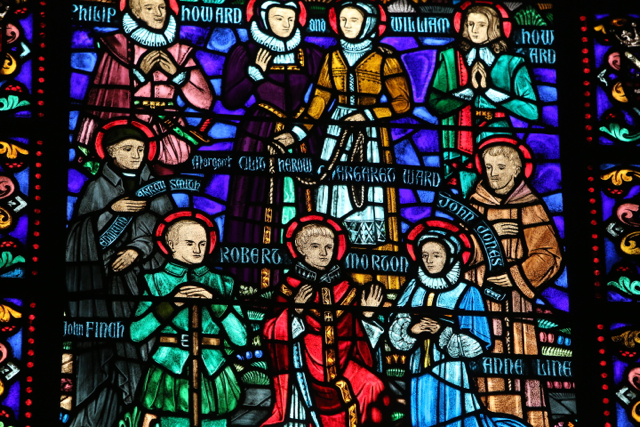
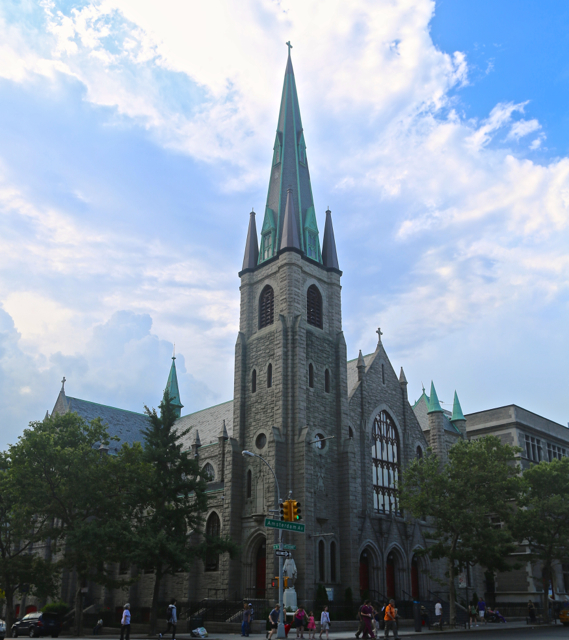
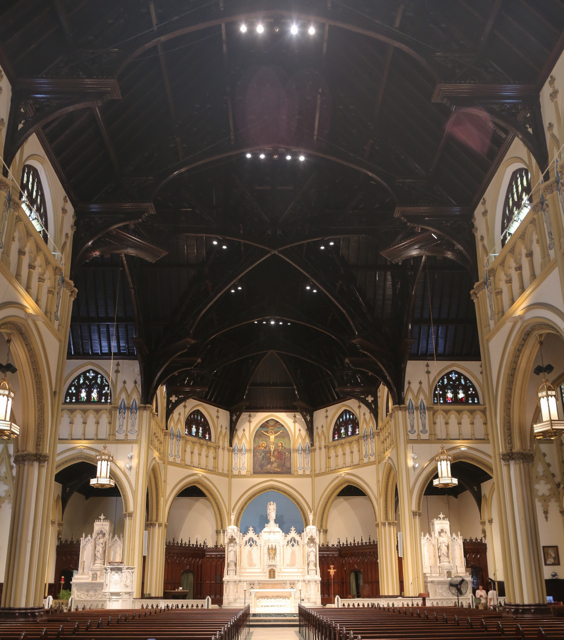
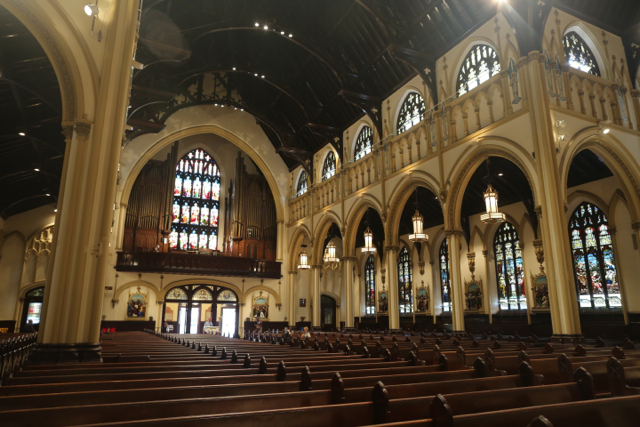
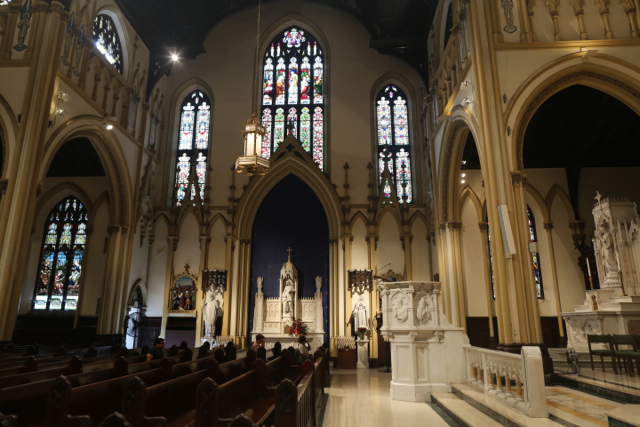
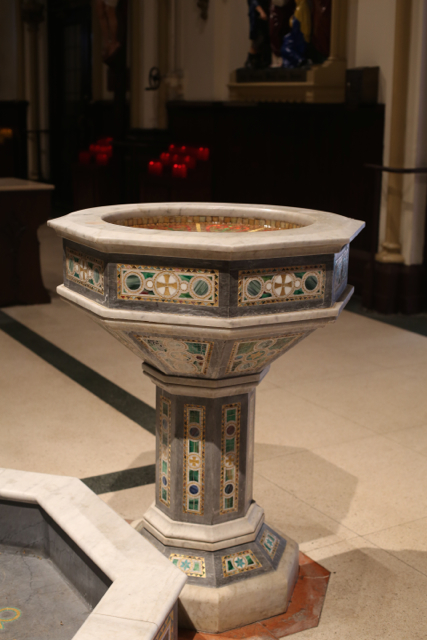
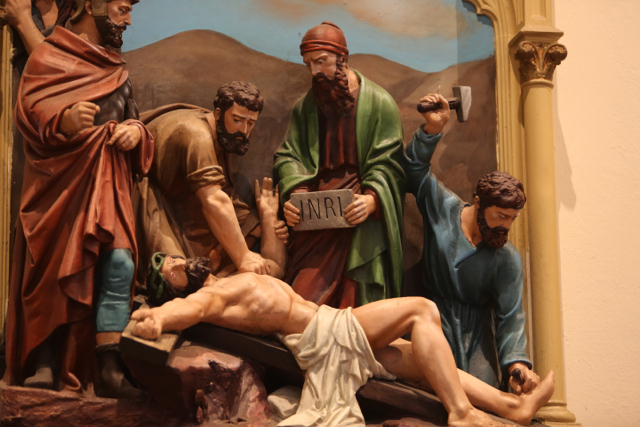
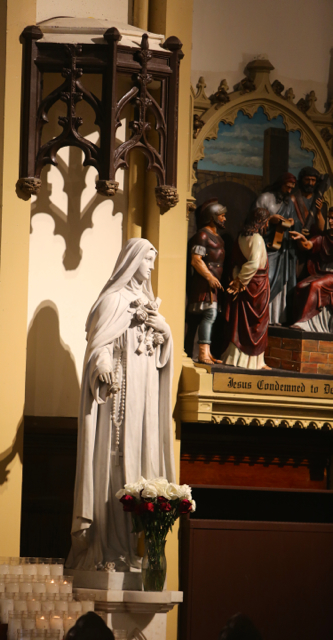
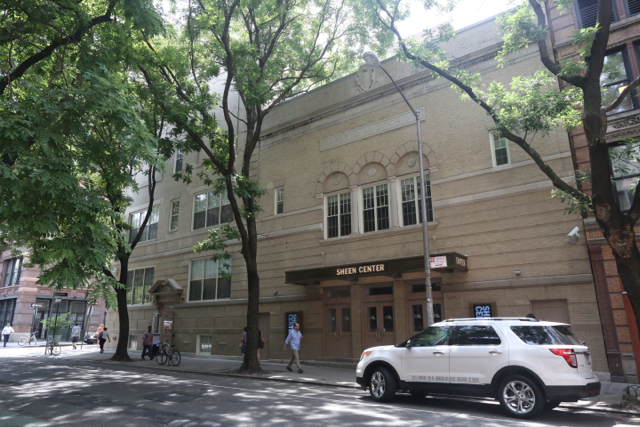
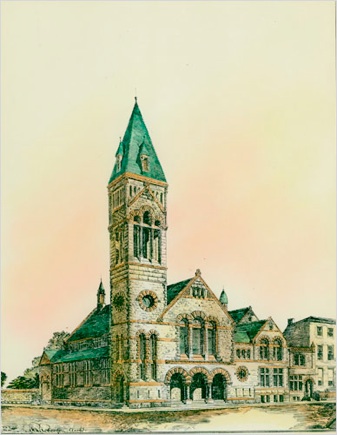
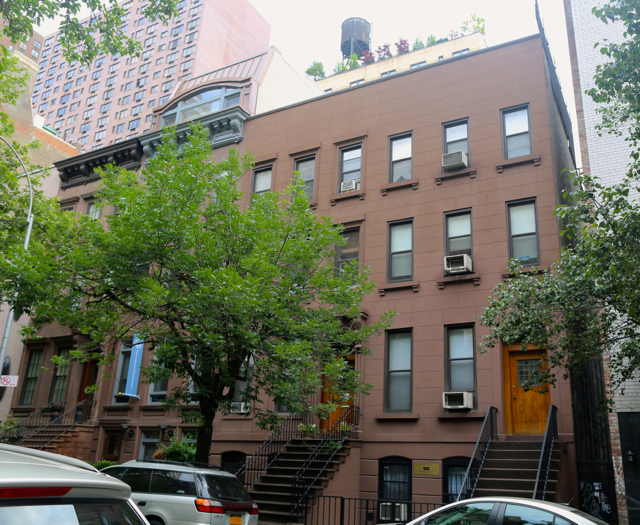
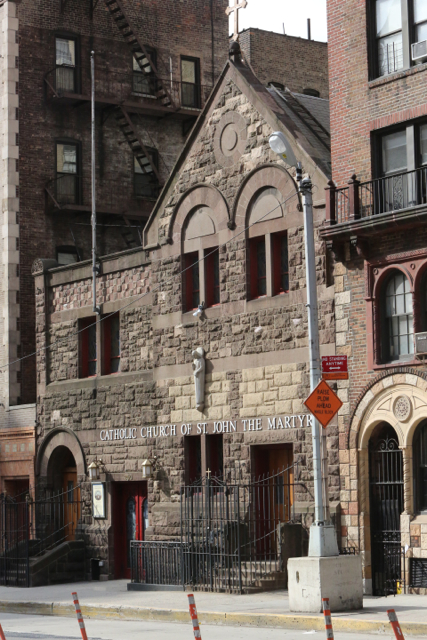
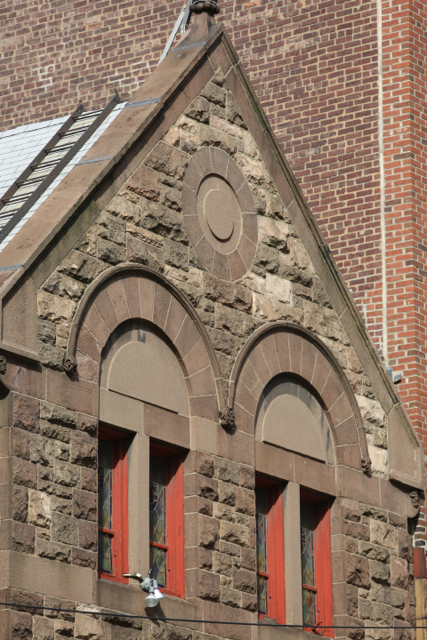
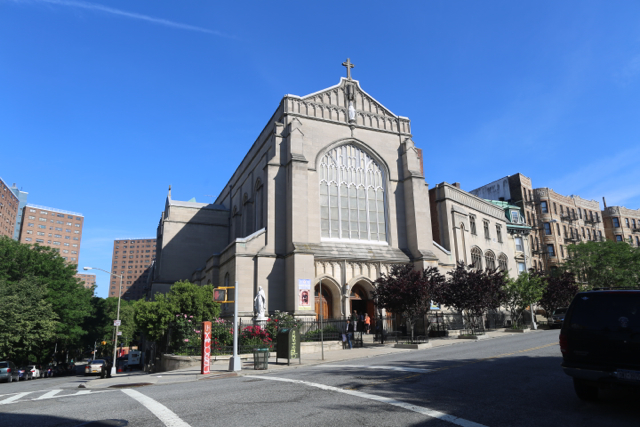
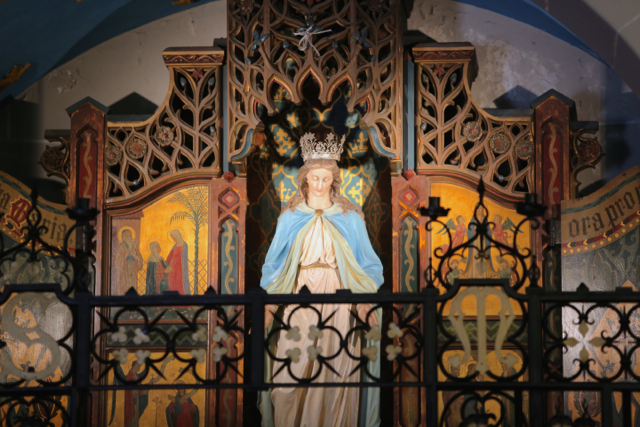
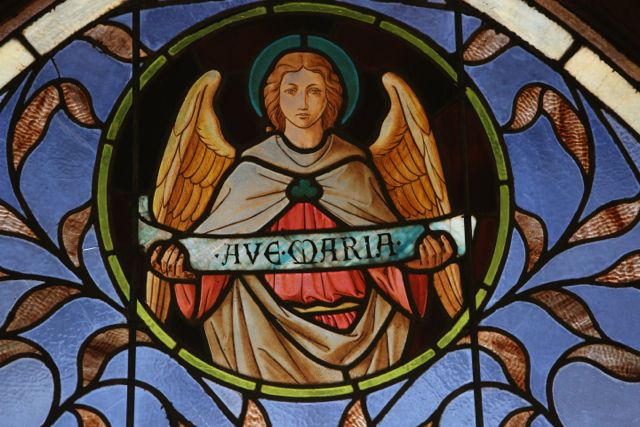
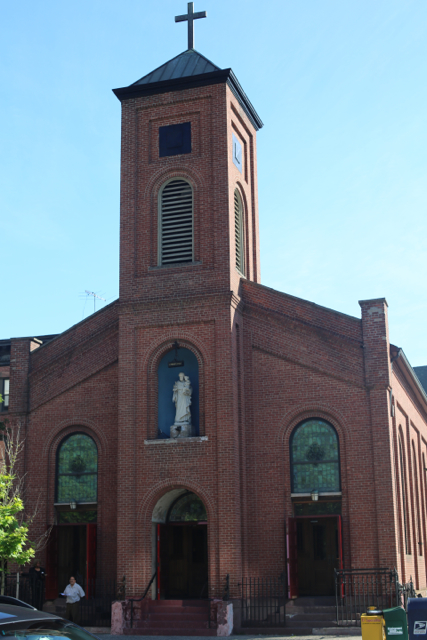
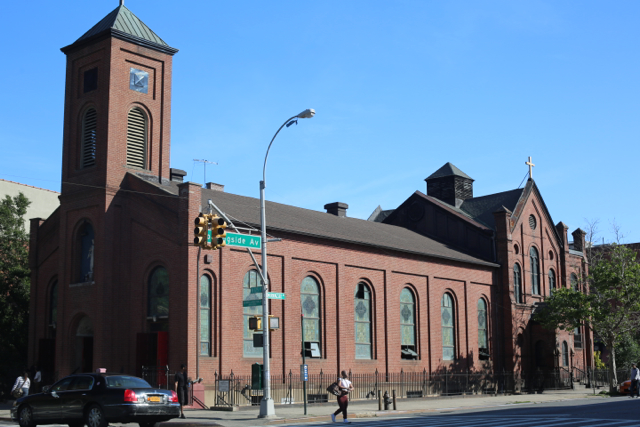
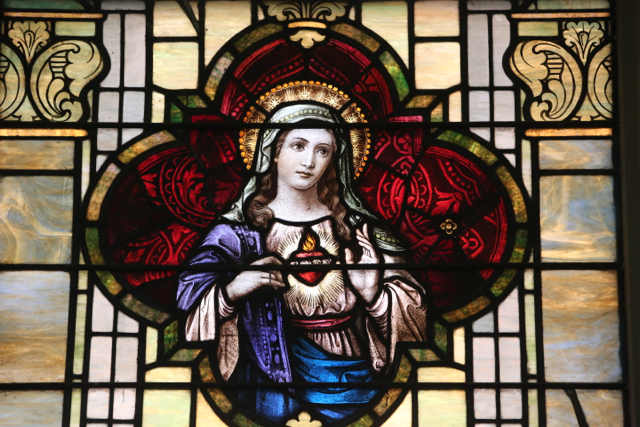
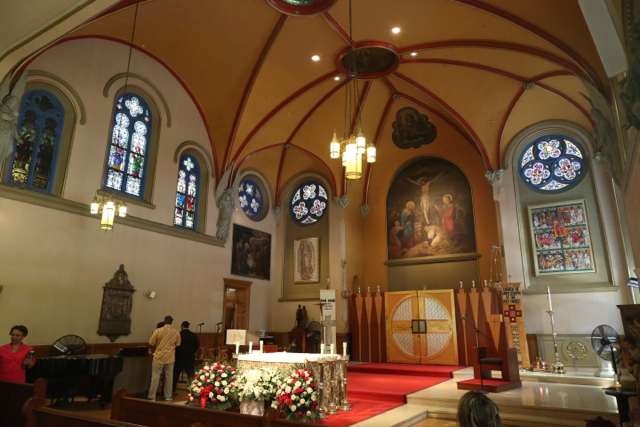
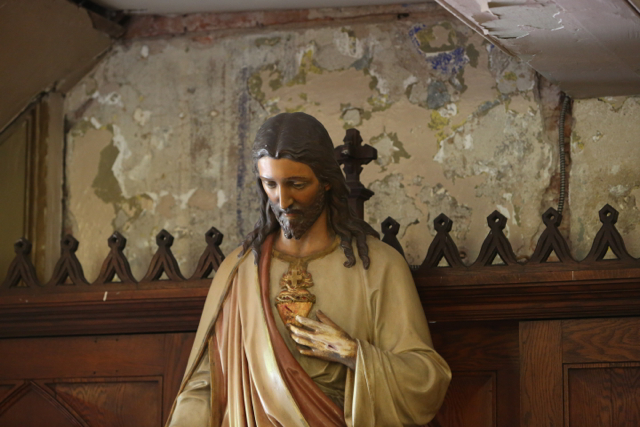
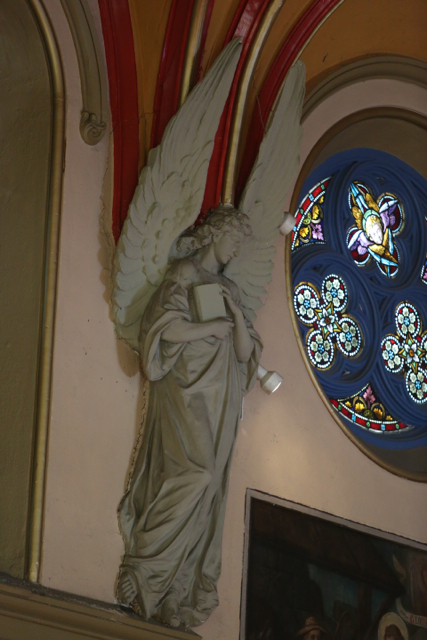
Mary Help of Christians – now gone.
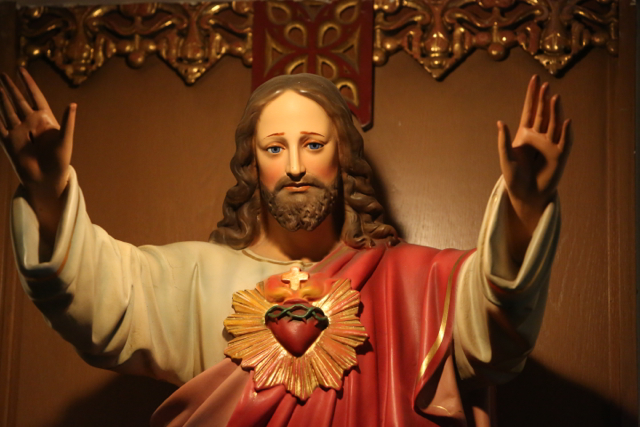
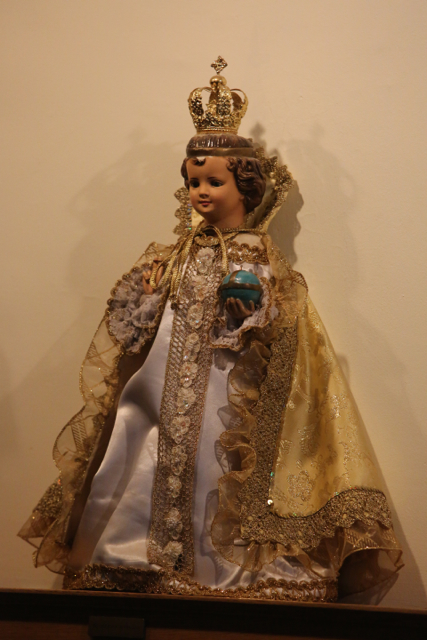
I found this ‘holy card” affixed to the billboard.
24 Aug
2013
17 Aug
2013
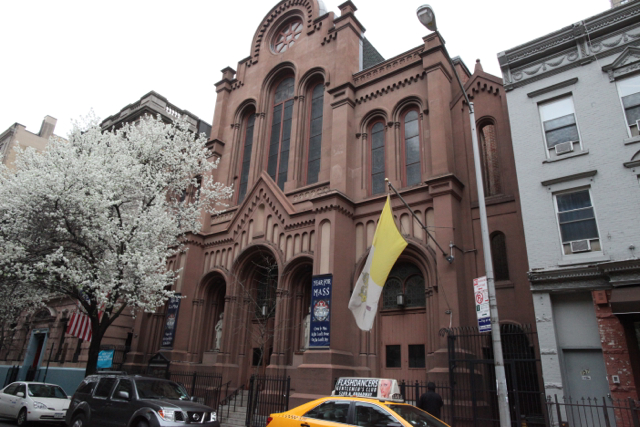
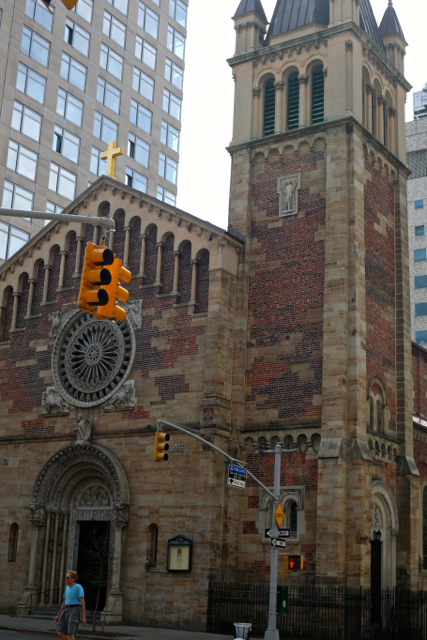
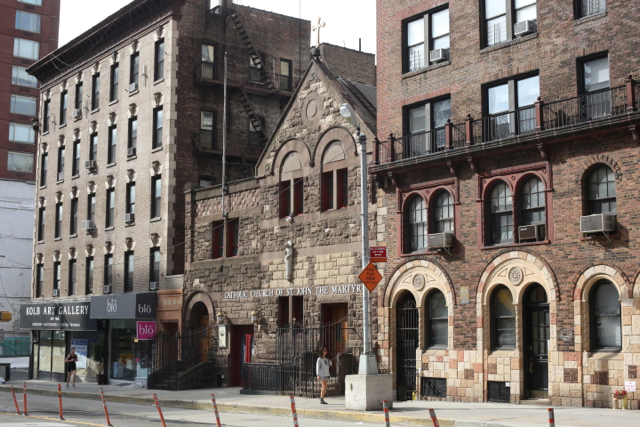
When a church dies – the end of the parish of Mary Help of Christians on East 12th street. Only the wreckage of the church itself is left – the surrounding buildings have aleady been razed.
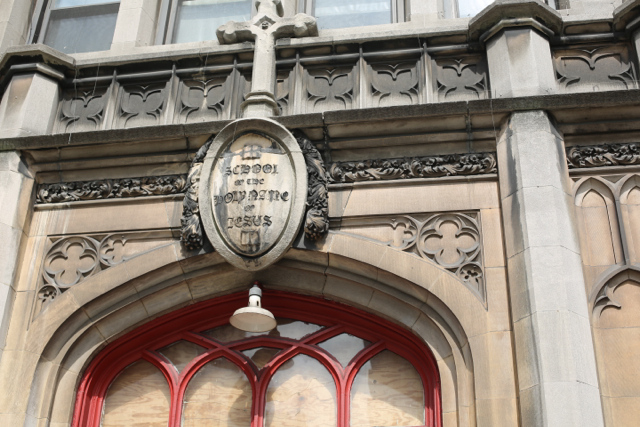
(Above and below) The inscription greeting the congregation as it left Mary Help of Christians: “This is my House from here my Glory will go forth” (In latin: Hic Domus Mea inde Gloria Mea”). This is the motto given to the original basilica of Mary Help of Christians in Turin, Italy by St. John Bosco (this New York parish was also a Salesian parish)
1 Aug
2013

Demolition of Mary Help of Christians begins (Photo from Ginsburg’s old apartment by Daniel Maurer)
No sooner had we reported on the impending fate of Mary Help of Christians in New York than the scaffolding goes up to implement the razing of the church.
One very unlikely source, however, was impressed by the role of this parish in a very tough time for this neighborhood. According to Daniel Maurer:
I imagine that view – and the cheap rent, of course – was part of what kept Ginsberg on the block during its darkest days. In “Notebook: 1983-1984,” he wrote about summer on East 12th: “the heat smog humidity stench and sulfur color of sky and street dust gave me to think I was living in Hell City – the inhabitants violently inclined to each other on my street.”
He described a heroin shop, a cigarette smuggling storehouse, a stolen car ring, and an abandoned garage from which someone shot him in the arm with a BB gun. But in the middle of the block’s madness was Mary Help of Christians, where “Sunday mornings a crowd dress’t in white and fresh lace Sunday pants and hats goes up & down the church’s front steps into the big wooden doors.”
Looks Like It’s Time to Give Up Allen Ginsberg’s Old Apartment
For another report see here (with pictures).
More photos from today: how to demolish a church.

The end of the school (from the rear).

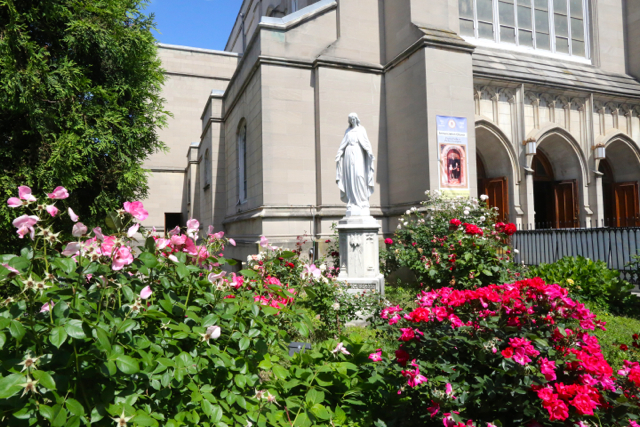
The statue of Our Lady is already gone.

As in many New York churches only the facade was “finished” in stone.

A view you could never have had from the building of the church until now: the rectory has already been torn down.
22 Jul
2013

St Cecelia – and feathered friends.
St. Cecilia
112 – 120 East 106th Street
It is a strange and wondrous vision: a vast red brick complex rises amid the colorless, nondescript and frequently decrepit high- and low-rise streetscape of Spanish Harlem, broken only here and there by a row, somehow intact, of old townhouses. The distinctive buildings of this impressive complex – so rare in Manhattan – extend over most of a city block. Only one corner is free – and is occupied by a public school, oddly complementary is scale and style. For this is the church of St Cecilia – the Roman martyr and patroness of church music.
This parish was organized in 1873, carved out of the parish of St. Paul to the north. The gestation, however, seems to have been unusually long. For years the parish had to make do with its first modest wood church on East 105th street (this building was later transported to another site for use as the original church of the new Our Lady of the Rosary parish!) In 1881 the present site of St. Cecilia’s was acquired and a ”lower church” begun. But things only moved into high gear with appointment of Fr. Michael Phelan as rector in 1884. Fr. Phelan was one of those dynamic priests so frequently encountered in that era – the driving forces behind the creation of so many great parishes in that age of expansion. He supervised the construction of the upper church and indeed served himself as the general contractor the church, thus saving his parish a small fortune. The church was finished in 1887. 1)
The architect was Napoleon LeBrun (1821-1901) – along with Renwick and Keely one of the leading lights of the Archdiocese’s age of high Victorian gothic (1850 to 1890). LeBrun’s other creations include most of old St Ann’s (his own parish; destroyed in 2004 by the Archdiocese); the Gothic jewel of St John the Baptist on West 31st Street (originally German) and St. Mary the Virgin (Episcopal). And there were numerous prestigious secular commissions as well (such as firehouses!). 2) Despite the impression one might gain from the above, LeBrun’s stylistic repertoire was by no means limited to the gothic. St Cecilia’s, in a style that can be categorized as “Romanesque revival,” is the best example of that.
The church’s red brick façade is a truly amazing creation: a portico with three bays juts out over the entrance to the church. Above this towers a façade entirely covered with intricate, bizarre terracotta ornamentation, culminating in the great image of St Cecilia. Nowadays the crevices and projecting surfaces resulting from the elaborate patterns create a welcome home for plants and pigeons. Only a handful of New York churches, such as St Patrick’s cathedral, Blessed Sacrament, All Saints or St Vincent Ferrer, can rival the imposing exterior of this out-of–the-way parish!
On each side of the façade stands a stout tower. A glance to the side reveals that the rest of the exterior of the church, largely invisible from the street, is finished only in plain brick and wood. Like so many New York churches, ornamentation is limited to the one great façade emerging from the streetscape tightly enclosing the church.
But a step inside, however, reveals that there is much more to St Cecilia’s than just a splendid exterior. The interior is light and harmonious, like LeBrun’s church of St John. There are galleries on three sides, including a two-tiered organ loft like St Anthony of Padua. Stained glass, paintings and altars exhibit a high level of workmanship. Statues and votive lights complete the very Catholic interior. Unfortunately, the “spirit of the Council” has intervened rather drastically in the sanctuary – just look at the high altar that has been sawed off from its reredos.
The spirituality and apostolic activity of St Cecilia’s in the 19th century were also much more than skin deep. Like most parishes of that age, St Cecilia’s fostered a whole series of charitable and educational apostolates. In addition to the parochial school, were no less than two chapels for two different Catholic schools: a kindergarten/nursery school and the Regina Angelorum home for working girls.. The legacy of Regina Angelorum and its sisters’ convent is the vast red brick edifice to the west of the church built in 1907. Nowadays both convent and home are combined into one building that houses the “Cristo Rey” school. 3)
After the First World War the gradual transformation of East Harlem into a purely Hispanic area began. St. Cecelia’s parish ceased to be Irish, then became Puerto Rican and now serves many nationalities. The parish was handed over, first, to the Redemptorists and since 2009 the “Apostles of Jesus.” 4) What continues to impress us is the architectural legacy of the founding parishioners and priests. For the attention – grabbing, landmarked exterior of St Cecilia’s is just not external pomp and empty rhetoric that contradicts the true mission of the Church. It is the outward sign of a living community that has continued to serve the poor and working class here for some 150 years.
1) Shea, John Gilmary, The Catholic Churches of New York City at 236 -237 (Lawrence G. Goulding & Co., New York, 1878); The Catholic Church in the United States of America, Vol. 3 at 321 (The Catholic Editing Company, New York, 1914).
2) http://en.wikipedia.org/wiki/Napoleon_LeBrun
3)http://en.wikipedia.org/wiki/St._Cecilia%27s_Church_and_Convent_(New_York_City) ; http://www.nycago.org/Organs/NYC/html/StCeciliaRC.html
4) http://www.saint-cecilia-parish.org/index.php/History/hview/the_first_one_hundered_years_1873-1973/ (From the informative parish website)
21 Jul
2013
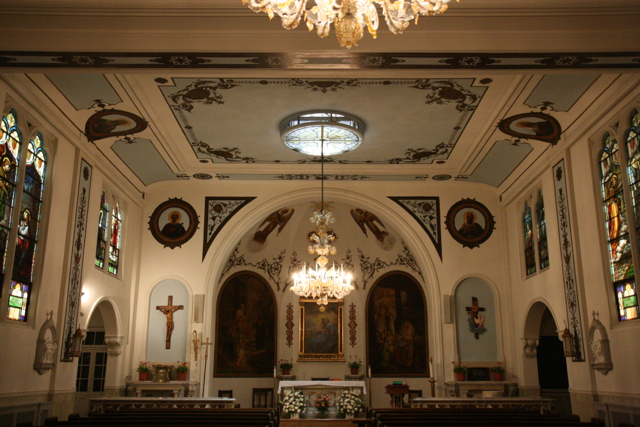
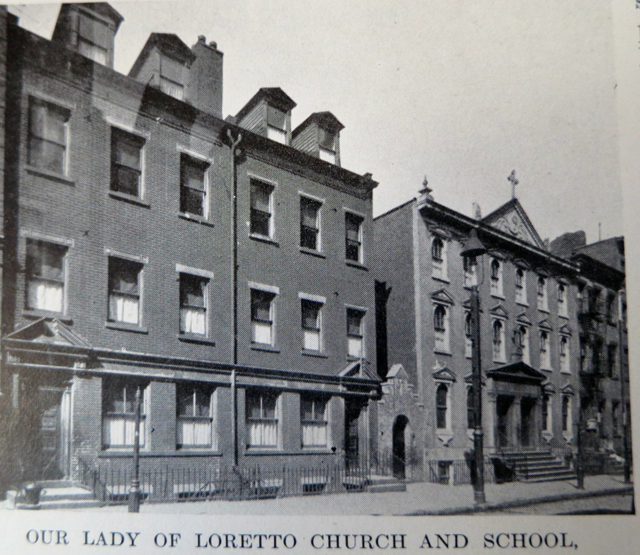
Last year yet another parish celebrated its last mass: Mary Help of Christians. 1) Now this was a small, originally Italian ethnic parish erected in 1908. It was in the care of the Salesians. The present church was built in 1918. The architect, Nicholas Serracino, was a prolific builder of churches in a baroque, beaux-arts idiom around 1910 – 20. His grand masterpiece is St Jean’s; his other commissions were for parishes with significantly less money. Since the 1930’s much of his work has disappeared (e.g., St. Clare’s (demolished in 1930’s); Sacred Hearts of Jesus and Mary (demolished 2007)). At Mary Help of Christians he created a miniature version of a grand baroque façade – staying within the constraints of the obviously extremely limited resources of this parish.
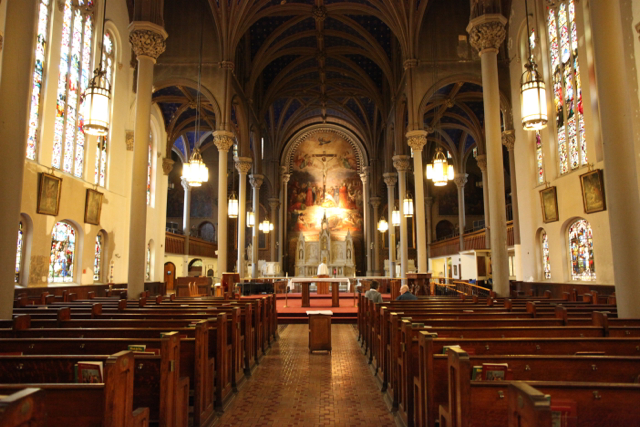
The parish may have been modest. Yet around its church arose an entire complex of buildings, most notably an impressive school. As time went on, this Italian parish became almost entirely Hispanic. The church and rectory grew noticeably dilapidated. The Council definitely left its mark on the interior. Yet the parish and school of Mary Help of Christians – as the parish dedication suggests – remained a beacon of hope in a very tough times of a forgotten neighborhood.
In 2007 the Archdiocese determined to close the parish. More clearly than elsewhere, a leading motive of all this “making all things new” activity has been spotlighted here: the large and valuable parish grounds have been sold to a developer for $41 million. A petition to demolish the church and the other strucures has been filed. 2) Luxury condominium units are to be erected on this site. So here the Archdiocese “cashes in” on the “widow’s mite” of past generations that financed the building of these churches of the poor. Other relics of New York’s Catholic identity and history are also on the block: Our Lady of Vilna (for $13 million – it was a flourishing parish as late as the 1980’s); St Vincent de Paul (a 140 year old building). 3) The air rights to St Patrick’s Cathedral are also up for grabs. 4) Yet all this deal-doing only serves to defer for a little while longer the day of reckoning for the Archdiocese.
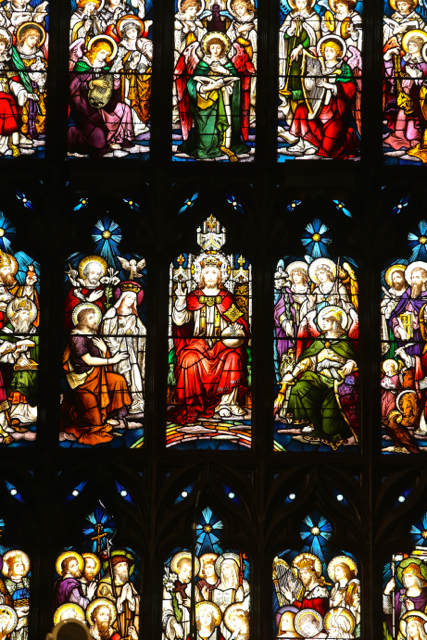
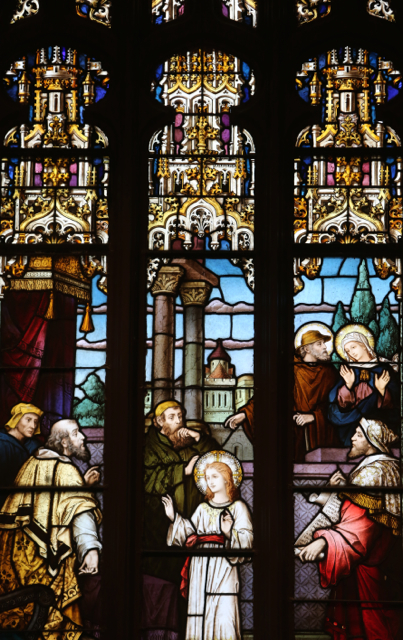
The schoolyard – this is all valuable stuff nowadays.
Just as at St. Thomas, Our Lady of Vilna, St. Ann’s, St Vincent de Paul and St Brigid a devoted group of parishioners is making a last stand for their parish. They assert the rights of past generations buried in an ancient cemetery at this site. 5) Will they succeed in blocking these Archdiocesan deals? It is not promising – but yet in one of the above cases the parishioners succeeded in fending off the destruction of their parish (admittedly at the cost of shutting down another)! 6)
1) http://eastvillage.thelocal.nytimes.com/2012/09/10/slideshow-last-mass-at-mary-help-of-christians-church/ (a beautiful slideshow showing the last mass at this church – and also revealing the interior)
2) http://evgrieve.com/2013/04/permits-filed-to-demolish-mary-help-of.html
3) http://www.nypost.com/p/news/local/manhattan/ny_losing_all_its_old_churches_1PLSdD92TpfrkUYfbDVLqK
4) http://www.nydailynews.com/new-york/archdiocese-new-york-sell-lucrative-air-rights-properties-including-st-patrick-cathedral-article-1.1159272
5) http://gvshp.org/blog/2013/05/23/more-evidence-of-historic-cemetery-under-endangered-church/
6) This site summarizes developments regarding Mary Help of Christians: http://ny.curbed.com/tags/mary-help-of-christians
15 Jul
2013
St. Catherine of Genoa
506 West 153rd Street
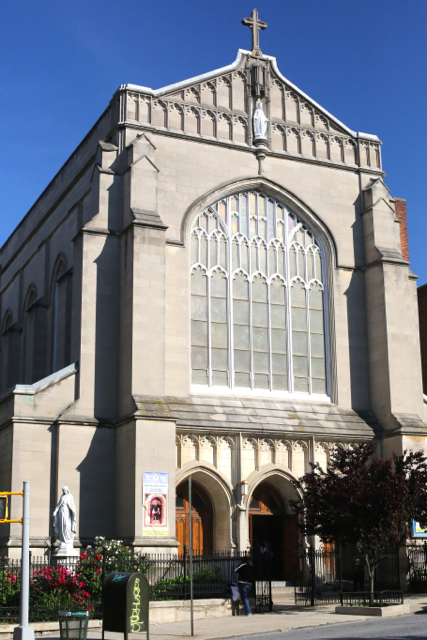
Just a year earlier than his fairy-tale masterpiece of Our Lady of Good Counsel on East 90th Street (built 1890-92), architect Thomas Poole had built a second, very similar Catholic church on the West Side – but much further north. St Catherine of Genoa church offers us a unique insight into the architect’s creative development.
The parish of St Catherine (originally “Catharine”) of Genoa was what was then the far north of the city in 1887. The church was commenced and completed in 1889. It was one of a number of churches of various denominations that sprang up around the cemetery of Trinity Church – above all Goodhue’s Anglican church of the Intercession. It was a modest parish from the beginning with a modest church. It is claimed that the existing church building was intended to be temporary only – but in fact was never replaced.
The façade of St Catherine of Genoa is quite similar to its cross town sister, but less elaborate, smaller in scale and built of red brick instead of stone. It is a mixture of Flemish secular architecture and Late Gothic elements such as the windows. Curiously, the church looks out over the undeveloped grounds of the cemetery – just as Our Lady of Good Counsel presided over low-lying commercial buildings until the 1970’s.
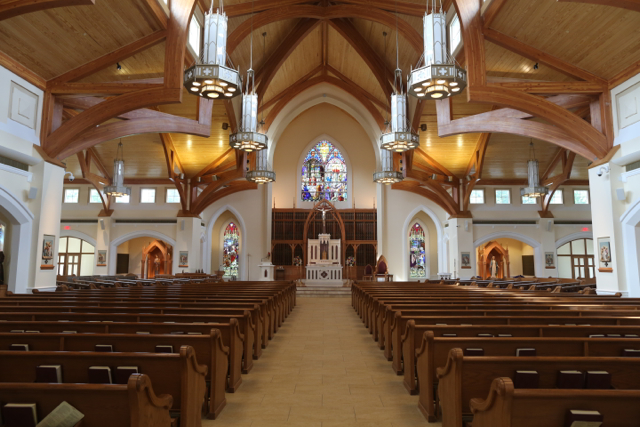
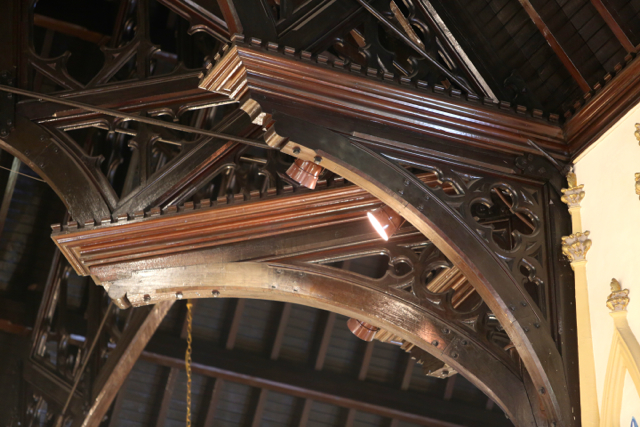
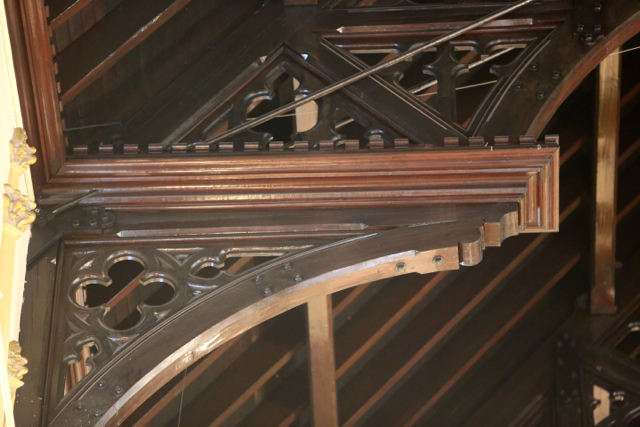
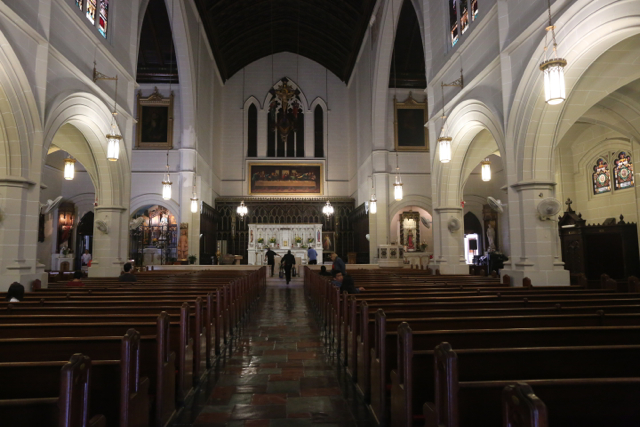
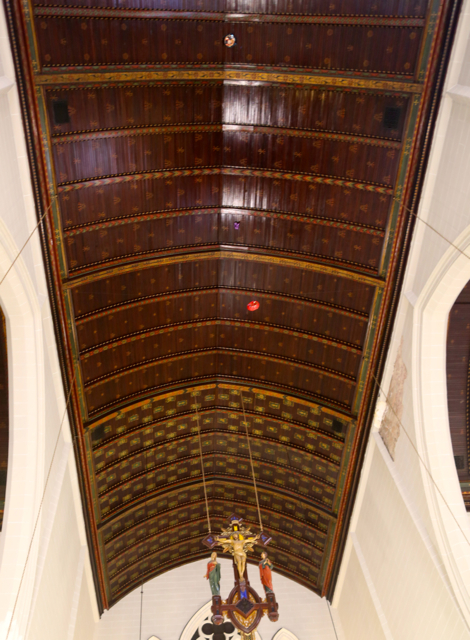
If St Catherine of Genoa’s façade is modest, the interior is downright plain. In contrast to the unorthodox blueprint of Our Lady of Good Counsel, Poole’s St Catherine of Genoa has a much more traditional layout. In form it is just a simple rectangular space oriented towards the south. The architecture strikes a more original note in the fine ceiling with its elaborate beams.
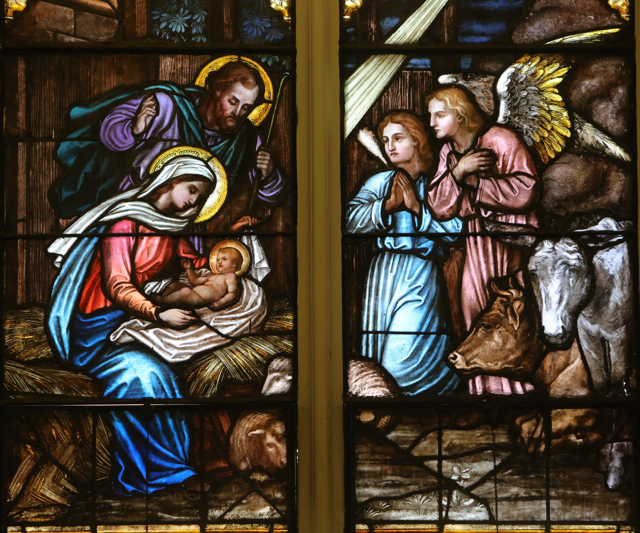
We doubt the decorative scheme was very elaborate even in the early decades. And whatever did exist has mostly fallen victim to a thorough post – Conciliar house cleaning. But every church of that era, however humble, had at least one striking feature. In the case of St Catherine it is the series of skylights: unique stained glass windows narrating the life of St Catherine of Genoa. It is a creative solution to the problem of tightly adjoining buildings, which so often in New York plunge magnificent stained glass windows into eternal darkness.
St Catherine of Genoa was always a small parish – and not very well off. As time went on, the original Irish population left. This part of New York became overwhelmingly “Hispanic” after the Second World War. The parish now serves a wide variety of nationalities. The parochial school was closed a few years ago and the parish itself seemed to be on the Archdiocesan hit list. However, there may have been second thoughts about that. So for the time being St. Catherine of Genoa continues its humble service of over 125 years. That service has included hosting the Traditional mass in 2012 – for the first time since the 1960’s.
14 Jul
2013
Our Lady of Good Counsel
230 East 90th Street
By 1890 the Catholic population of New York continued to explode. The relentless march of the city– East Side, West Side – northward on Manhattan Island continued as well. For the new developments more parishes were needed and ever more magnificent churches. It was the golden age of the Catholic parish, of Catholic Church architecture and indeed of the Archdiocese of New York as a whole.
Archbishop Corrigan organized Our Lady of Good Counsel parish in 1886 for the Yorkville area; construction of the lower church began in that year. At the time the immediate neighborhood of the future parish church was open fields. The church would rise on a difficult site – uneven but commanding a magnificent view. In 1890 work on the upper church began; the church was dedicated in 1892. The architect was Thomas Poole, a Catholic convert who hailed from Liverpool. He played a significant yet neglected role in this golden age of Catholic Church architecture both as a builder of churches active throughout the New York area and as a writer.
The church we encounter today is mainly attributable, first, as is so often the case, to the efforts of one extraordinary pastor, the first rector Father William J. O’Kelly. He died in 1901 shortly after the consecration of the church. And second to the innumerable sacrifices by the members of a not at all well -to -do parish. The dedication to Our Lady of Good Counsel derives from a miraculous image found in the village of Gennazano near Rome.

The Original Image of Our Lady of Good Counsel.
The church faces north. Nowadays it confronts the huge apartment (now condominium) complex of the Ruppert towers. But originally there were open fields, and eventually the low buildings of the Ruppert brewery, producers up till 1965 of the late lamented Knickerbocker beer. An “old timer” at the parish pointed out to me long ago that Our Lady of Good Counsel in the pre- Ruppert Towers days enjoyed an outstanding location; travelers southbound on both the Third and Second Avenue els had a grand view of this church’s facade. The elaborate, light gray stone façade at first makes a rather fortress-like and forbidding impression with its crenellations and massive Tudor gothic towers. A rectory in the same style is attached. But on second glance, the elaborate windows and staircases intrigue the visitor, who can also admire the clever disposition of the church on a sharply sloped street.
The contrast with the lush interior could not be greater. For Our Lady of Good Counsel is perhaps the most exuberant and fantastic late Victorian interior in the city. Most impressive is the elaborate fan vaulting. The inspiration is clearly English perpendicular gothic of Henry VII’s lady chapel at Westminster Abbey or of King’s College chapel, Cambridge. The church has side aisles and galleries – but, unusually for a Catholic church, the sanctuary is set against one of the long sides of the interior. This layout, which in Protestant meeting houses deliberately serves to deemphasize the importance of the (no longer existent) sanctuary, is in this church counterbalanced by the fantastic elaboration of the main altar. The relatively small dimensions of this church allow the furnishing and decoration to extend all over the interior – carved altars, stained glass windows, paintings, even the beautiful wood of the pews contribute to the overall impression.
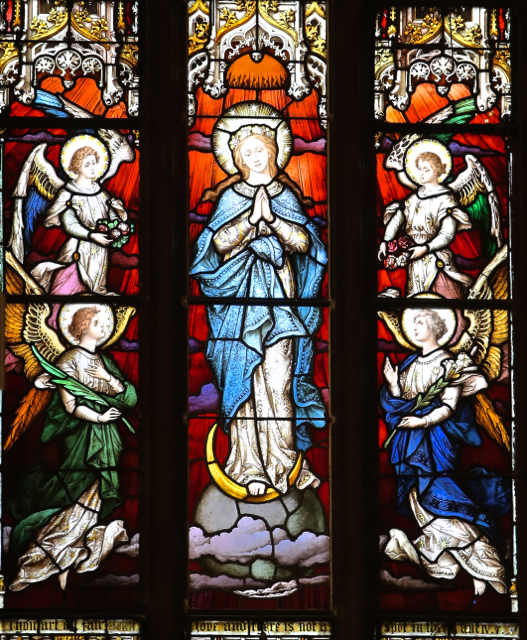
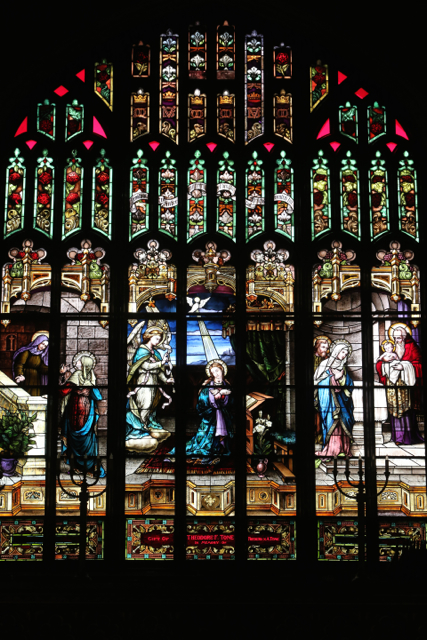
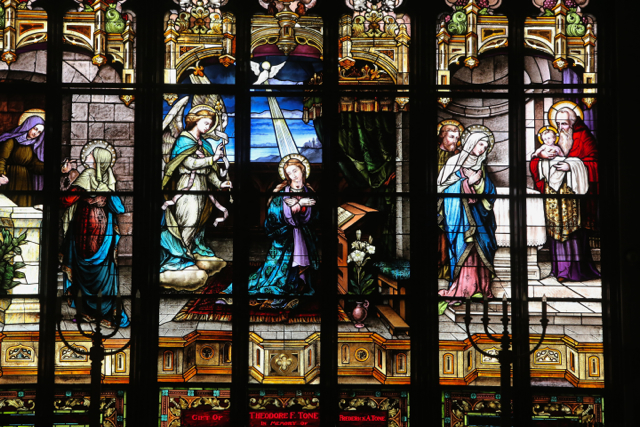
The decoration of the interior draws on disparate sources and styles. Italians carved the altars. The main painter, Rossi, was also Italian and well regarded in his day. The magnificent windows of the firm of Mayer in Munich are some of the finest and best preserved in the city – especially the spectacular large north window dedicated to the apparitions of and devotions to the Blessed Mother. Now German stained glass, frescoes and white marble altars were the key components of the décor of many other Victorian churches – one thinks of St Stephen’s or Holy Innocents! Yet one senses here a new effort – as compared to these earlier churches – to integrate all these elements and styles in a single work of art. The interior of Our Lady of Good Counsel, despite all its richness and intricacy, makes an amazingly harmonious artistic statement. We also sense a growing desire of the parishes of that time to create original architecture – to try to more sharply distinguish themselves from each other.

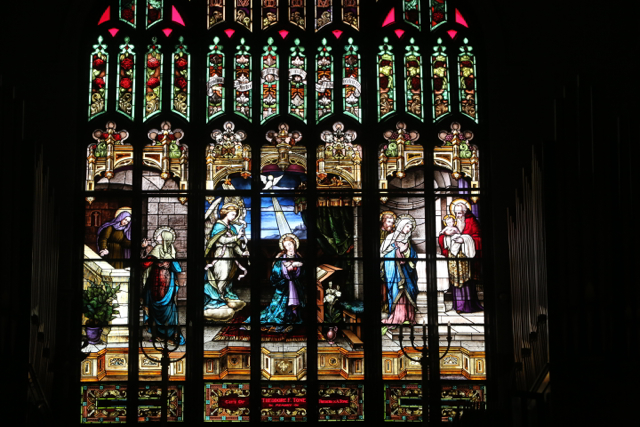
The great window of Our Lady – with the image of Our Lady of Good Counsel in the center.
Above, Our Lady of the Rosary. Below, Our Lady of Lourdes (a virtually identical window by Mayer is in St. Stephen’s church).

This painting with the inscription “Suffer the little children to come unto me…” undoubtedly commemorates the reduction in the age of receiving first communion promulgated by Pope Pius X in 1910. We would point out to certain pontificators on matters ecclesiastical that no houseling cloth is on the altar rail.
This Yorkville parish soldiered on through the years. The neighborhood began to shift after the 1960’s from a solid middle and working class district to a more upscale and transient environment – the transition from the Ruppert Brewery to the Ruppert Towers. Most fortunately, the liturgical changes of the Council did not involve here the wholesale destruction of the interior of the church – particularly the sanctuary. In 2005 – just in time for its 100th anniversary – the parochial school of Our Lady of Good Counsel was closed by the Archdiocese. Yet in 2012 the NYC Department of Education signed a 15-year lease on the location of the former parochial school in order to handle the great and growing demand for school space in the district. Just recently there have been restorations to the basement and organ.
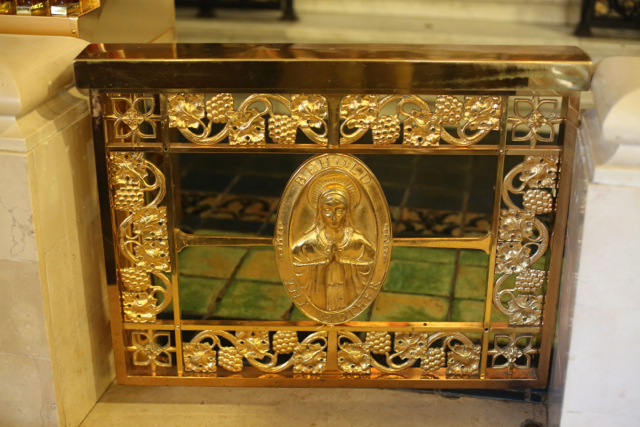
We would hope that Our Lady of Good Counsel, with the advantage of its unique sanctuary and history, would continue to maintain and develop the presence of Catholicism in Yorkville. I have read that this church is in much demand for weddings – as well it should be! There is no more enchanting location in New York. Father Groeschel’s Friars of the Renewal have also been active here. And now and then, since Summorum Pontificum, the Traditional Mass has returned as well to these magnificent surroundings, which were after all created to enable its celebration with all the requisite beauty.
8 Jul
2013
The Church of the Transfiguration
25 Mott Street
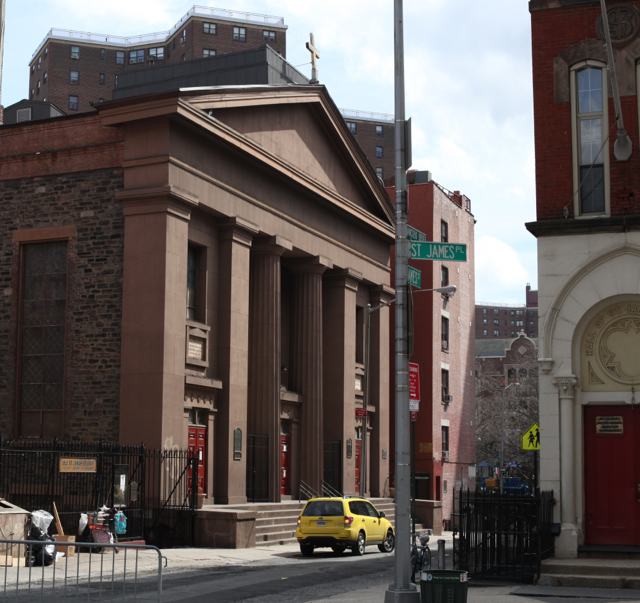
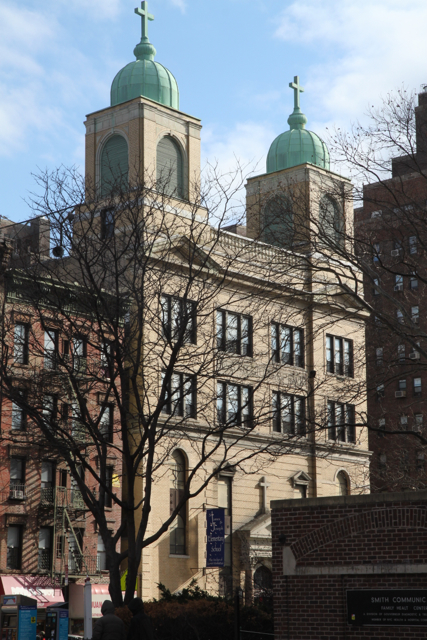
If you pay a visit to Chinatown you will come upon an ancient Catholic church on Mott Street at the corner of a curious one block street, Mosco (up till 1982 Park, and originally Cross Street). You realize it is very, very old from the neoclassical exterior composed of dressed gray stone with brownstone details; the windows have Gothic arches and tracery. Indeed. Transfiguration parish (for such it is) is old – but the building before you, originally built as a Protestant church, is even older. Erected in 1801, rebuilt in 1818 after a disastrous fire, the church of Transfiguration parish can claim to be the oldest building used for Catholic worship in New York. 1)
The story of this church goes back to the early days of Catholicism in New York and to that intrepid founder and leader Fr. Felix Francisco Varela y Morales. A priest of the Havana diocese, a scholar , a philosopher and a political figure, he had to leave Cuba for political reasons and found himself in New York by 1824. Here he devoted his manifold talents and vast energy to the building up of the Catholic Church in the city and the state of New York under the early bishops. In addition to numerous other activities and literary efforts, he was the vicar general of the New York diocese and advised on the first edition of the Baltimore catechism.
In 1825 Fr. Varela was entrusted with a new parish on the east side of Broadway. In 1827 he purchased the building of Christ Church from the Episcopalians and established in that year a Catholic parish of the same name. When that church became structurally unstable, the diocese acquired land in James Street and commenced the construction of the present St. James church (of Fr. Varela is revered as the founder) for the congregation of Christ Church. But to the parishioners this seemed at that time a little out of the way; only part of the congregation wanted to move to the new site (The present St. James church was finished in 1836). Fr. Varela thus looked for a site further downtown and established a second parish on Chambers Street in 1836. (Mr. John Delmonico of restaurant fame purchased the property and was one of the original trustees) This was Transfiguration parish.
Fr. Varela presided for some 14 years over Transfiguration, leading it through the stresses of financial problems, incompetent management by trustees, cholera epidemics and ever growing waves of Irish immigration. Throughout his ministry at Transfiguration, as at Christ Church, he was assisted by an international team of priests – there were as yet few native clergy. It is claimed that Fr. Varela’s language ability stood him in good stead, as he was able to master and communicate in the Irish language. Worn out, Fr. Varela had to retire to St Augustine for the sake of his health. He died there in 1853, allegedly neglected by the diocese of New York. He has been talked about for sainthood…2)
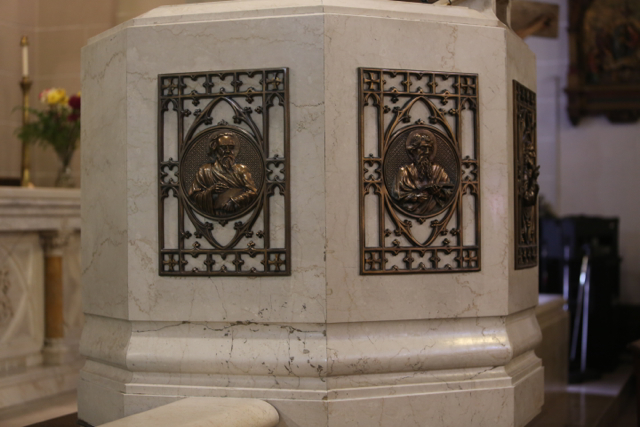
The saintly Fr. Varela: “social reformer”….
The parish was soon bursting at the seams. In 1853 after Fr. Varela’s death, the former Zion Episcopal church on Mott Street was purchased. This has remained the home of Transfiguration parish until the present day. With the acquisition of the Mott street church, and the establishment of order in the diocese – then archdiocese – under Archbishop Hughes, the “heroic age” of Transfiguration parish ended. It now followed the normal course of dramatic expansion typical of the New York City parishes in the second half of the 19th century. By 1878 there were thirteen thousand parishioners – mostly Irish. But our trusted guide Mr. Shea sounded a cautionary note that year:
“But (this Catholic population) is not now increasing, many Chinese, with all their pagan ideas, having settled in the parish, with some from Catholic countries of Europe, indeed, bur who seem to lose all faith and religion here, and seldom cross the threshold of the church.” (the latter reprobates are presumably the Italians.) 3)
But the Italian immigration continued its explosive growth. In 1902 the parish was handed over to the Salesians – Transfiguration was now virtually an Italian national parish. In 1914 the Catholic population was 10,000 – presumably mostly Italian. Yet even in that year services were already being held in the lower chapel for the Chinese…. 4)
In subsequent years the Chinese population only increased. Now Transfiguration became a first in New York: a Chinese national parish. By the 1940’s care of the parish was accordingly handed over to the missionary Maryknoll order. 5) Since that time the Chinese population of the vicinity has steadily increased and prospered a trend that has only accelerated in the last few decades. Transfiguration may be the only honest-to-God middle and working class ethnic parish left on the island of Manhattan. In contrast to its gentrified (and/or depopulated) sister parishes, Transfiguration is still very much what it has always been: a “Church of the Immigrants.”
Transfiguration occupies a nice corner site. The rough stone façade testifies to its great age. In the 1868 the quaint but impressive tower was added by the ubiquitous architect Henry Engelbert. Regrettably, the church is often closed. But once inside, the visitor encounters the pristine architecture of the original meetinghouse – a plain hall with galleries. Yet this space is light appears spacious, despite the rather small dimensions.
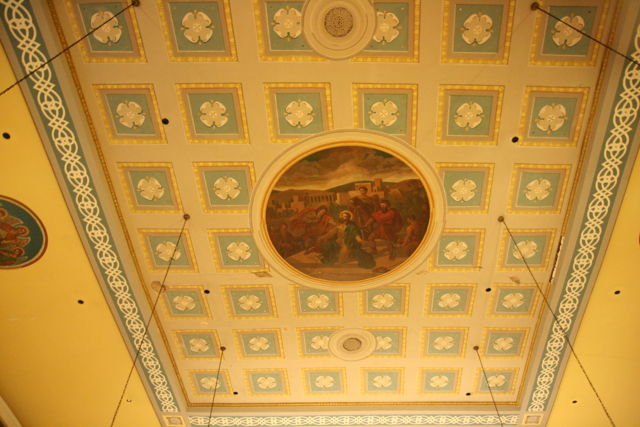
Subsequent Catholic improvements have survived here in greater quantity than at the similar St. Teresa church. From the “age of the Irish” we notice some (apparently) archaic stained glass windows of the 1860’s. The ceiling was decorated, also in the 1860’s, with paintings by “Brandenberg.” 6) Finally, rising up before us is the grand apse painting of the Transfiguration (echoing Raphael).
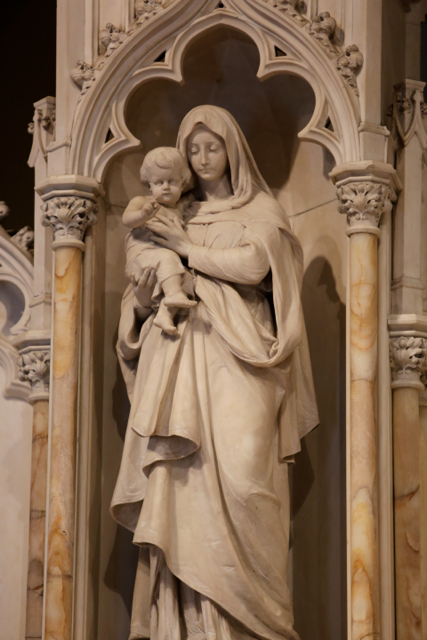
The Italians have left a variety of statues and cults like St Rocco “di Ruoti. “ Some of this work is of outstanding quality indeed: a beautiful statue of the Virgin and child; a magnificent reliquary. The more recent parishioners have contributed a Chinese Virgin and Child.
The council has also left its traces in the form of a gutted sanctuary. A tabernacle seems to have been assembled out of the earlier Victorian–era architectural elements. It is a sad anticlimax to what is otherwise an impressive architectural achievement.

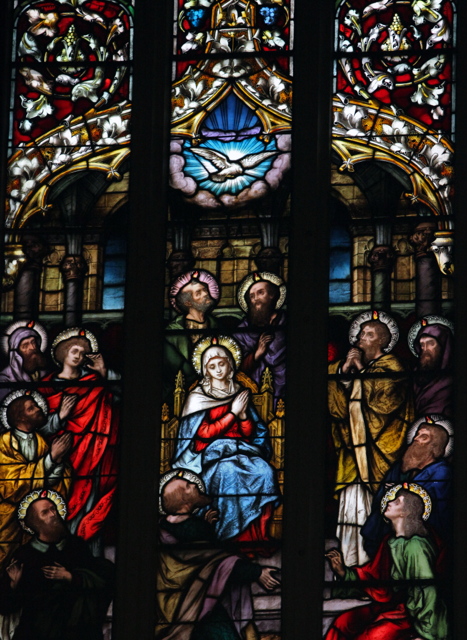
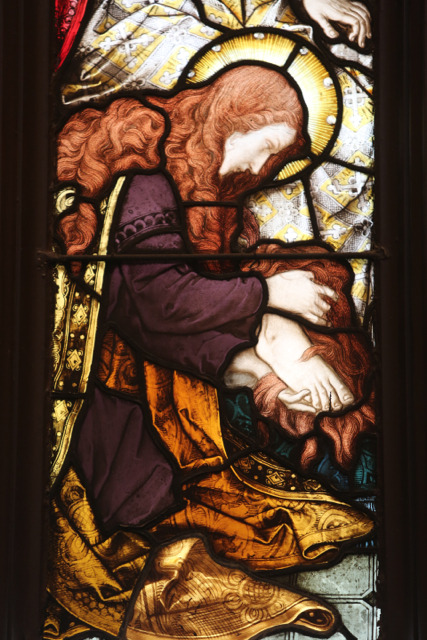
(Above and below) ancient stained glass – from the 1860’s(?).

A beautiful Italian crowned Madonna.

This reliquary holds relics of, among others, St. Rita of Cascia, St John Bosco, St Anthony of Padua, St Theresa of Lisieux, St Frances Xavier Cabrini…..
Since 1832 Transfiguration has also had a school – also founded by Fr. Varela. It is till flourishing and even expanding. We learn that 96% of the pupils are Chinese and 75% are non-Catholic. Indeed the school has done so well that it has taken over the building of the equally ancient but closed St James school. The tower of Transfiguration indeed is visible from St James. Will these two parishes, both arising out of Fr. Varela’s original Christ Church and occupying two of the most ancient church buildings of the Archdiocese, be reunited someday as well?
1) Willensky, Elliot and White, Norval, AIA Guide to New York City at 76(3rd Edition, Harcourt Brace Jovanovich, New York, 1988); Dunlop, David W., From Abyssinian to Zion: a Guide to Manhattan’s Houses of Worship at 275 (Columbia University Press New York 2004)
2) See, Shea, John Gilmary, The Catholic Churches of New York City at 687-691 ( Lawrence G. Goulding &Co., New York 1878)
3) Shea, op. cit. at 696.
4) The Catholic Church in the United States of America, Vol 3 at 378 (Catholic Editing Company, New York 1914)
5) http://www.transfigurationnyc.org/parish/en/home; “The History of Transfiguration Parish” (with many pictures – including some of the interior of the unrestored “pre-conciliar” church); http://daytoninmanhattan.blogspot.com/2011/02/1801-catholic-church-of-transfiguration.html
6) Shea op cit. at 694.
7) http://www.transfigurationnyc.org/parish/en/home
5 Jul
2013
St. Teresa
141 Henry Street
Recently, Catholic New York covered the 150th anniversary of the parish of St Teresa – one of those stark survivors (like St. Mary’s, Transfiguration or St James) from the distant foundational age of New York Catholicism. Truly there is much to celebrate in a parish that has lived through such tremendous vicissitudes yet come down, apparently intact, to us in the twenty-first century! For the external appearance of St. Teresa is very much as it was in 1863. 1)
And the parish had taken over an existing building of an even older congregation, that of the Rutgers Presbyterian church (which congregation, after several migrations, still exists on the Upper West Side). The Presbyterians had built their first church on this site in 1797; the present building dates from 1841. Within a few years of its completion the neighborhood was overrun by the “Romans.” These were the Irish of the great wave of migration in the 1840’s: the era of the Famine. The growth of the Catholic population was such that a new parish had to be erected out of the overwhelmed St Mary’s. Thus was St. Teresa founded; in 1863 the Presbyterian church was purchased and the new parish established.
St Teresa soon became one of the largest parishes in New York. Like her sisters (except for the German national parishes) it was overwhelmingly Irish. By 1878 this parish had over 1500 students in its parochial school and “academies.” 2) But towards the end of the 19th century a radical reversal of fortune followed. The neighborhood of St Teresa became heavily Jewish. By 1914 there were only 1000 parishioners – fewer than the number of students in the parish schools in 1878 – and only 250 students in the school. 3) By 1942 the parochial school had closed. 4)
We lack specific details on the subsequent period but the story was undoubtedly similar to that of St Mary parish. After the Second World War a new wave of Hispanic immigration settled in the area. The Lower East Side developed a fearsome reputation for poverty, violence and drug trafficking. Yet despite it all the Hispanic population saved the parish. But St. Teresa’s situation remained precarious. And so it looked like the end for St Teresa’s when the roof collapsed in 1995.
But, once again, Providence came to the rescue of St Teresa’s. From the 1990’s onward the economic situation in the LES started changing dramatically and consistently for the better. Much of this has to do with the relentless expansion of the highly successful Chinese community. The parish was able to sell for a considerable sum the real estate on which its old school had stood. With the proceeds the entire church could be repaired. 5)
Now, at least according to Catholic New York, the parish finds itself in quite a flourishing condition. The population is still relatively poor. Ethnically, the parish is predominantly Hispanic and (undoubtedly increasingly) Chinese. A number of years ago, St. Teresa took over the older yet faltering Nativity parish – a prisoner of its abominable building. Reflecting its immigrant population, there seems to be an unusually high number of adult conversions and baptisms. 6)
Such a long eventful history and the untouched exterior of the church raise the expectations of the visitor. Alas, the bare interior is disappointing. The architecture of he 1841 church is transitional: an early, somewhat timid Neo-gothic exterior enclosing a traditional meeting house. Unlike its mother parish of St. Mary’s (built as a Catholic church but in a native “Yankee” style, St Teresa remains as it was in Protestant times: a purely functional preaching hall with galleries. We can say of this interior that it is spacious, light and airy. The main “Catholicizing “ touches are the large murals against the wall of the apse dating from the 1880’s. These have been newly restored after the 1990’s disaster. 7)
We would have expected to see more physical remnants of efforts made over the generations – limited by the poverty of the parish – to more fully adapt the interior of this church to Catholic ritual. Such subsequent Catholic accents found in other similar churches include a much more pronounced sanctuary, impressive altars, stained glass windows and, of course, a host of statues. In that regard, I suspect that St. Teresa’s present barren appearance owes as much to post-conciliar “renewal” and the post-1995 restoration as it does to the non-Catholic liturgical needs of the Presbyterian builders and the permanent economic limitations of the neighborhood. The very recent restoration of St. Brigid’s is clear evidence of that. Thus, the original architectural vision of the Calvinist church and the current liturgical and aesthetic ideas of the Catholic Church seem to converge. What does exist, however, is maintained in very fine condition.
(above) The stone work of the exterior witnesses to the great age of this church.
(above and below) Remnants of the original Irish heritage that was disappearing by 1900.
Constant change, demographic and economic – such has been the lot of the poor parishes of the LES and adjoining neighborhoods since the first half of the 19th century. St. Teresa’s – which was and still is a church of the poor and of the immigrants -has shared with her sister parishes the ups and downs of fortune and prosperity – at least if we consider “prosperity” as the size, not the wealth, of the congregation! Yet, in the past at least, there was no question of giving up, of retreating from the ancient, ungainly structure that had been purchased so long ago in 1863. And this commitment proved justified, for in the course of time the parish found new congregations to continue Catholic worship here and even regain some modest degree of material success. “Keeping the faith” has enabled St. Teresa’s to endure and overcome the adversities of fortune; are New York Catholics today capable of understanding this lesson?
1) Chicoine, Christie, St Teresa’s, a Beacon on the Lower East Side, Turns 150, Catholic New York at 32, 27 (6/27/2013)
2) ) Shea, John Gilmary, The Catholic Churches of New York City at 679 -680 (Lawrence G. Goulding & Co., New York, 1878).
3) The Catholic Church in the United States of America, Vol. 3 at 376 (The Catholic Editing Company, New York, 1914).
4) http://www.stteresany.org “The History of St. Teresa’s Parish”
5) Ibid.
6) Chicoine, op.cit at 27.
7) http://www.stteresany.org; “The History of St. Teresa’s Parish”
30 Jun
2013
Holy Innocents Church
128 West 37th Street
Surely the Garment District is one of the most mind-numbingly ugly areas of Manhattan. And what these buildings spew out in the way of women’s’ fashions is consistent with their exterior. In the midst of these oversized and dilapidated architectural horrors the visitor is overjoyed to find an elaborate, gaily decorated stone façade. It is that of Holy Innocents Church: an island of aesthetic and spiritual health in a wasteland.
Of course, when this parish was founded the surroundings were utterly different. It was a residential area – indeed quite nice in some respects. Archbishop McCloskey founded the parish in 1866 to keep pace with the relentless northward progress of the city. In that year a chapel of the Episcopal Church, Holy Innocents, was purchased for the new parish. John Gilmary Shea, ever a goldmine of obscure details, relates that:
“When we have acquired churches which a protestant denomination has dedicated to our Blessed Lord, or any of the holy mysteries of his Life and Passion or to any of the Saints it has been the custom to retain the name.” 1)
In 1870 the church of the new parish was completed – designed by the ubiquitous Patrick C. Keely who had previously given the city St Bridget and St. Bernard. The centerpiece of the new church’s interior – as at St. Stephen’s across town – was a great apse fresco by Constantino Brumidi. In light of subsequent disputes, I note that Shea attributes it to Brumidi already in 1878. 2) Holy Innocents of course also had a school from the beginning.
As we have seen, this neighborhood was originally residential. This parish appears to have had early connections with the wealthy and socially prominent. In particular, Holy Innocents benefitted from strong links with the Havemeyer family – usually considered non-Catholic – whose magnificent city residence was located across town in Murray Hill. The Catholic connection apparently originated with Emilie de Loosey – an Austrian-born lady who married Mr. T. A. Havemeyer. He made a deathbed conversion to Catholicism in the presence of the pastor of Holy Innocents in 1897 but may have been quietly frequenting the parish beforehand.
T. A. Havemeyer’s children appear to have been raised either Catholic or Protestant. It is recorded that his daughter Dora, in 1899, could not marry in Holy Innocents church because the groom was Protestant. She did marry in the chapel of her parents’ mansion in Newport and the pastor of Holy Innocents officiated along with the local Catholic clergy. When her (reportedly Protestant) brother shot himself in 1898 – “accidently” – the sexton of Holy Innocent was charged with the funeral arrangements . A service was held at this parish – where the brother, despite his religion, was reported to have attended services. 3)
Other than generating `gossip in the social pages, the Havemeyer – and other high society – connections materially assisted in development of the parish. It is recorded that the Havemeyers contributed to the construction of the church (as did the Iselin family, another prominent Protestant/Catholic family – with a similar death bed conversion saga of the family patriarch – who were lavish contributors to the Catholic Church in New York, Westchester and Pennsylvania). Under Fr. Michael O’ Farrell, who became pastor in 1894, the already splendid church was lavishly redecorated with the aid of wealthy donors. The altars date from this time (the above mentioned Mrs. Havemeyer donated two side altars). “Other parishioners donated twenty beautiful Munich stained glass windows”. 4) The result was one of the most beautiful Victorian interiors in New York. Holy Innocents illustrates the growing role of wealthy benefactors – not all of them Catholic- in financing the ever more splendid Catholic churches of New York of that era (cf. The church of Notre Dame; St. Jean Baptiste; Our Lady of Esperanza)
During all this time Broadway in the West 30’s was rapidly changing. The area around Holy Innocents was becoming commercial and to some extent a center of theatrical life (the Metropolitan Opera opened shop not far away in 1883). Sleazier enterprises followed – after all, this neighborhood was now the infamous “tenderloin.” Eugene O’Neill was baptized in this church in 1888 – his father was a peripatetic actor who, by the way, had married in the now-destroyed St. Ann’s. That Catholic poetic hero of a bygone era, Joyce Kilmer, often visited this church and it was here that he felt inspired to become a Catholic. He wrote a letter to Father James Daly, SJ in January 1914:
“Just off Broadway, on the way from the Hudson Tube Station to the Times Building, there is a Church, called the Church of the Holy Innocents. Since it is in the heart of the Tenderloin, this name is strangely appropriate – for there is surely need of youth and innocence. Well, every morning for months I stopped on my way to the office and prayed in this Church for faith. When faith did come, it came, I think, by way of my little paralyzed daughter.” 5)
But even these glory days were not to last. The neighborhood of the church after the First World War lost its last residents. It became the purely commercial center of the garment industry – low-tech, sweatshop enterprises. Yet Holy Innocents survived – as that quintessential Manhattan phenomenon, the commuter church. For decades it has offered to a transitory population a blessed refuge from the ugliness, noise and chaos of the surrounding streets. The best evidence of the importance of this function is that candle fees are one of its main sources of revenue! Yet income is limited since the majority of Catholics who enter Holy Innocents are not relatively well-off commuters on their way to or from the suburbs but the poor and working class individuals who make up much of the work force here.
As a second focus, the parish has attempted to reconfigure itself as a shrine to the unborn – capitalizing on its name. In the narthex various exhibits and images remind the visitor of the tragic consequences of abortion in the United States. It must have been a dedication dear to the heart of the late Cardinal O’Connor!
Finally, since the promulgation of Summorum Pontificum, Holy Innocents has taken the leading role in the Traditional Mass community in Manhattan. The parish currently offers the only daily traditional mass in New York – and a Missa Cantata on Sundays. In addition, vespers, benediction and a wide variety of Catholic liturgies and devotions are available. The liturgical life has culminated over the years in several magnificent pontifical masses. In addition to all this, the parish conducts an active ministry to the poor of the neighborhood.
The colorful, intricately patterned design of newly restored façade of Holy Innocents forms the greatest possible contrast to the monstrous, forbidding structures surrounding it. Inside, Holy Innocents is a grand Victorian, like St Stephen’s or Most Holy Redeemer if on a smaller scale. The interior resembles St Bernard, by the same architect, with its galleries on three sides. A contemporary visitor to Holy Innocents, unwittingly echoing remarks by John Gilmary Shea of 130 years earlier on Patrick Keely’s church of St. Bernard, pays the greatest possible tribute to church and architect:
“[T}he church has remained loyal to its original, traditional Catholic design. It is a church that looks like a church. … [T]he sensation is of breathing an entirely different atmosphere. The presence of God is palpable.” (italics added) 6)
The Munich windows (by Mayer?), famous at the time, are splendid; regrettably, because of the construction of high–rise neighbors some remain cloaked in permanent obscurity. Of course statues and devotions of every kind, accumulated over the ages, abound in such a church. Most impressive is the great Crucifix in the rear of the church.
Dominating all is the newly restored fresco of Brumidi. The signature of another artist has disappeared. Regrettably a glaring blue border now surrounds the fresco. On the other hand, the lighting is so vastly improved that one can finally make out the details that previously were either washed out or shrouded in darkness.
(Above) The signature of an artist other than Brumidi from 19- on the unrestored fresco.
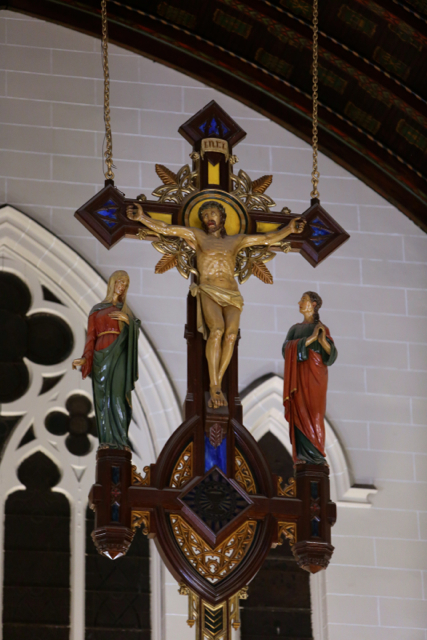
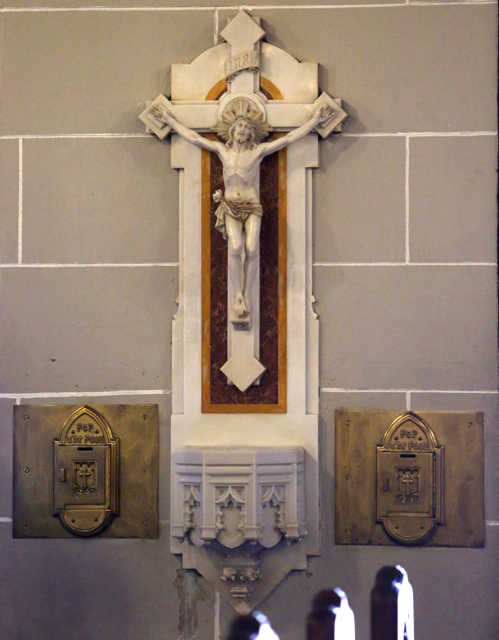
Like many older churches in New York, Holy Innocents has a great crucifix in the rear of the church, associated with an indulgenced prayer. It has just been restored.
Charles Bosseron Chambers (1882-1964) was a prominent illustrator and religious artist of the past (his images of the Sacred Heart of Jesus and of the Immaculate Heart may still be found everywhere) who worked in the city. The story goes that he found once a man praying before this crucifix in Holy Innocents – a man who, before going off to fight in the French army in World War I, had just rediscovered his ancestral Catholic faith. Chambers then produced this image:”The Return.”
It was before this very crucifix that Joyce Kilmer also prayed for faith and for his little paralyzed daughter.
(above and below) The Traditional Mass at Holy innocents – mass in the presence of Cardinal Egan
In a late development, we understand that an administrator, not a pastor, will now head Holy Innocents. Rumors have abounded that the parish might be shut down – in spite of its importance as a shrine to the unborn victims of abortion, as a spiritual oasis for so many, as a provider of services to the poor and as a magnificent monument of 19th century Catholic ecclesiastical art. Yet this new administrator is none other than the talented Fr. George Rutler! We hope that after spending of such vast amounts to beautifully restore the exterior and interior of of this church many more visitors will find their way here – to encounter a truly Catholic atmosphere in prayer, in art and in liturgy. And we hope that their visit will not just be the discovery of a refuge from the surrounding world, but an inspiration to sally forth and convert it.
1) Shea, John Gilmary, The Catholic Churches of New York City at 338-339 (Lawrence G. Goulding & Co., New York, 1878).
2) Shea, op. cit. at 341.
3) For the Havemeyer connections see: http://daytoninmanhattan.blogspot.com/2013/04/the-lost-1866-havemeyer; The New York Times, “Death of T.A. Havemeyer” (4/27/1897); “Dora Havemeyer Married” (9/19/1899); “Funeral of Charles F. Havemeyer” (5/12/1898); “Death of C. F. Havemeyer” (5/11/1898)
4) The Catholic Church in the United States of America, Vol. 3 at 330 – 31 (The Catholic Editing Company, New York, 1914); The New York Times, “Adrian Iselin Dead at his City Home” (4/29/1905). Shea doesn’t mention the Havemeyers and Iselins as being among the main contributors to the construction of Holy Innocents. Shea, op. cit. at 342.
5) Joyce Kilmer, Poems, Essays and Letters in Two Volumes, vol 2, Prose Works at 128 ( George H. Doran Company, New York,1918). See also “Holy Innocents Church” NYC Straycat (9/5/2011) at http://nycstraycat.blogspot.com/2011_09_01_archive.html;
http://en.wikipedia.org/wiki/Holy_Innocents’_Church_(New_York_City
6) National Catholic Register, Joseph Albino, “Where Manhattan Mothers go to Grieve,” (May 9-15, 2004) at: http://www.ncregister.com/site/article/where_manhattan_mothers_go_to_grieve