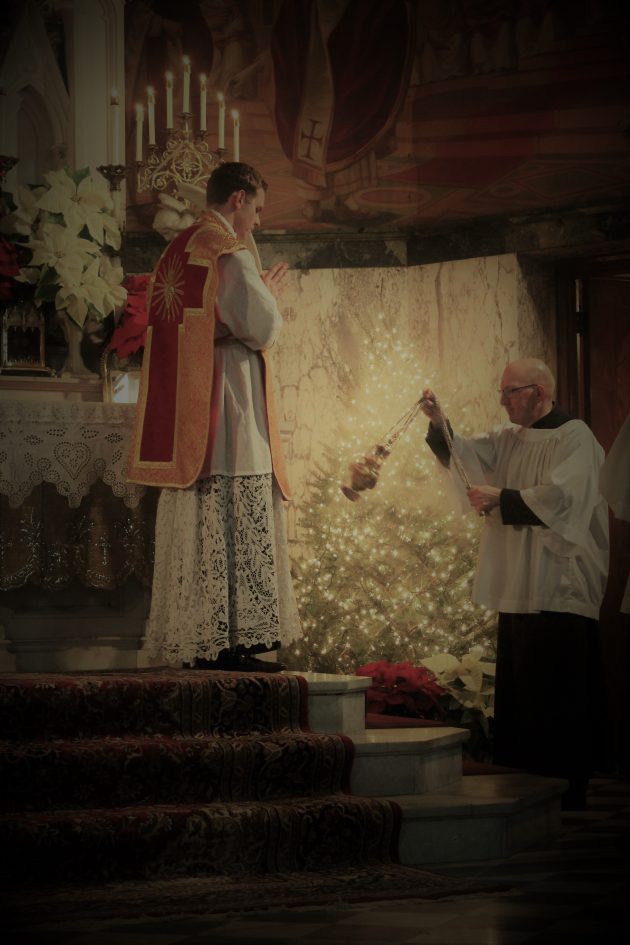
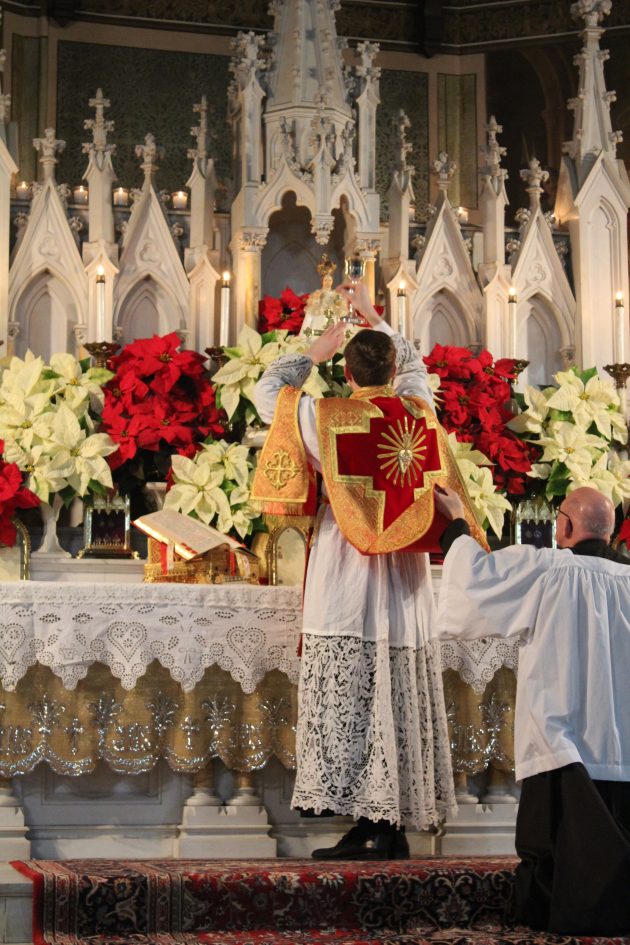
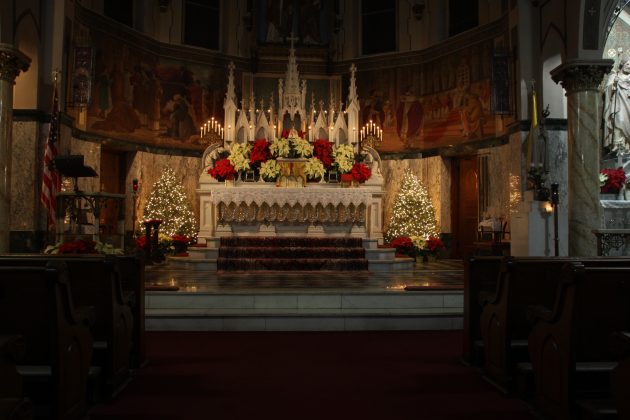
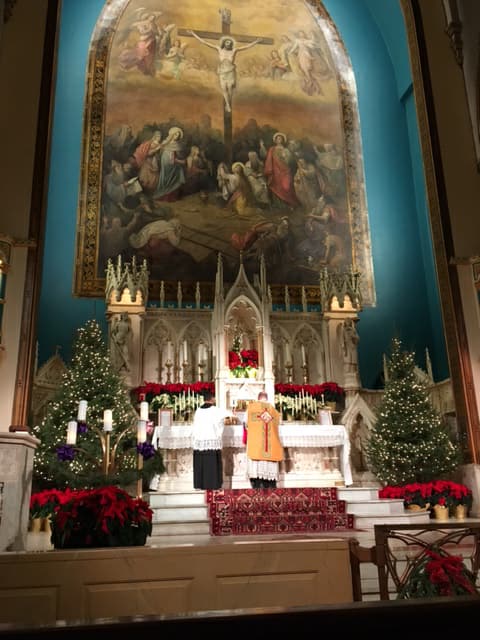
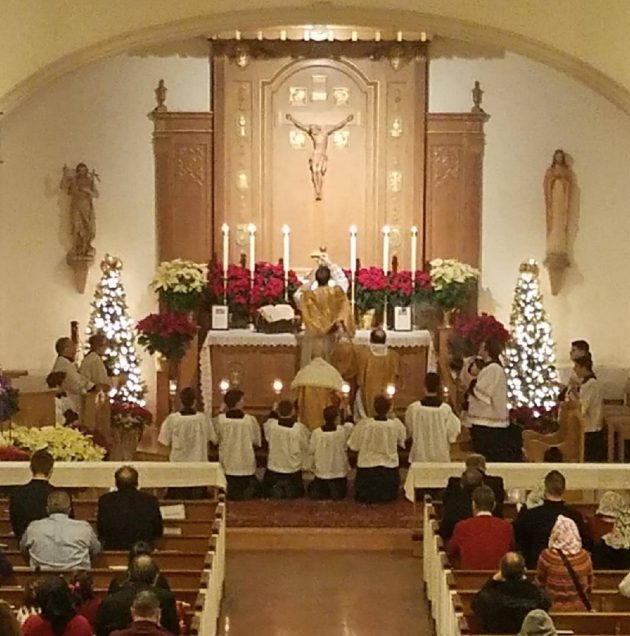
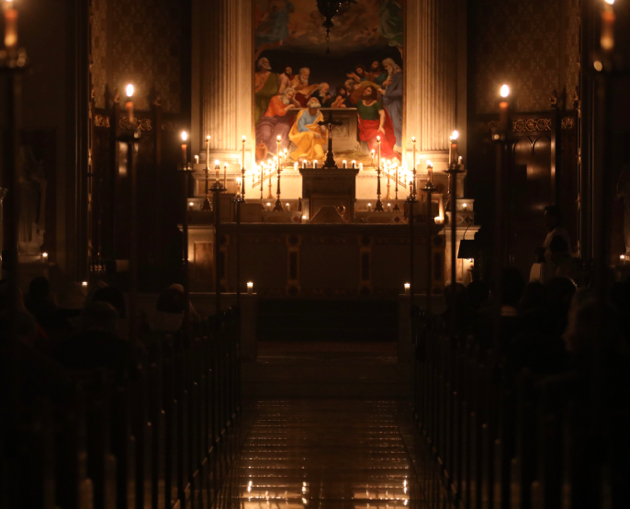
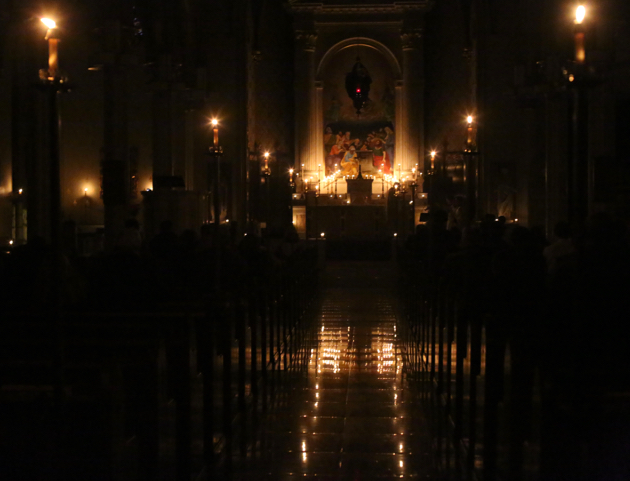
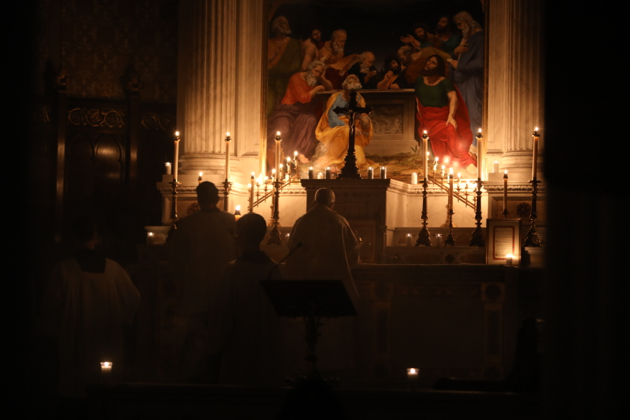
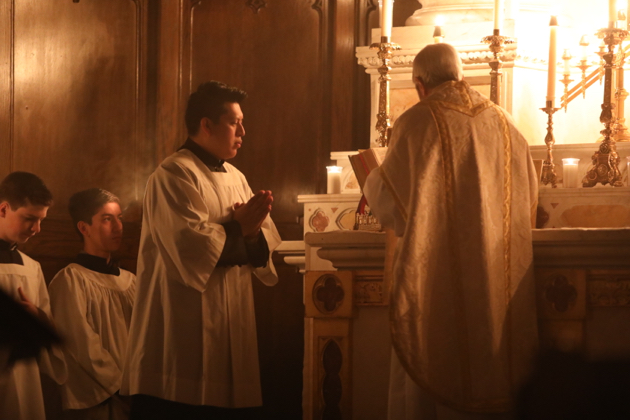
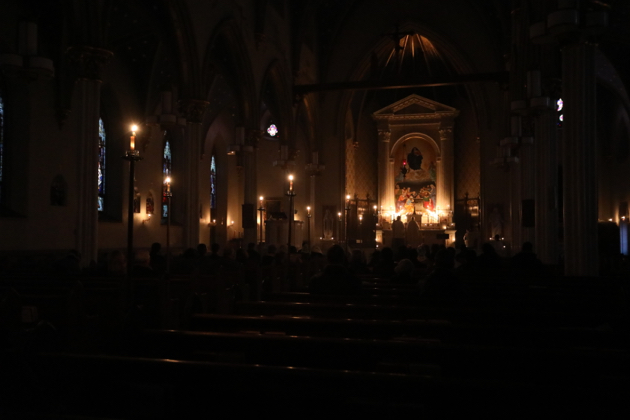
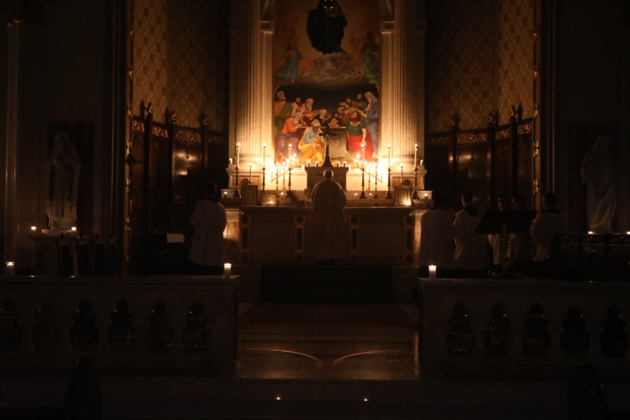
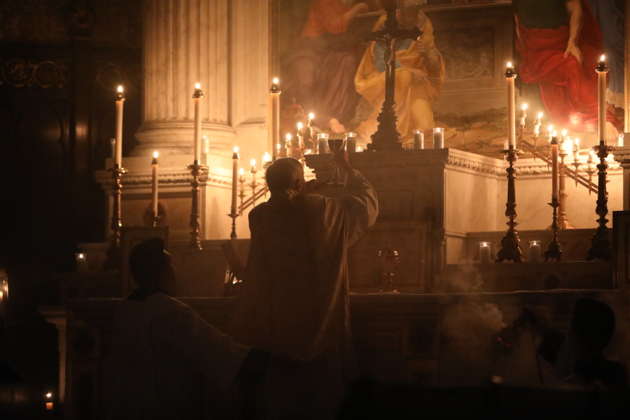
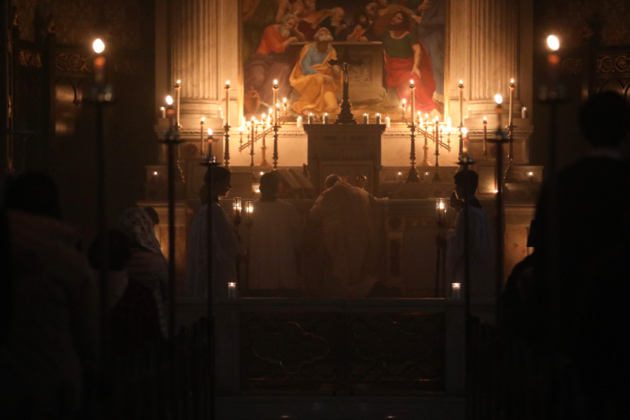
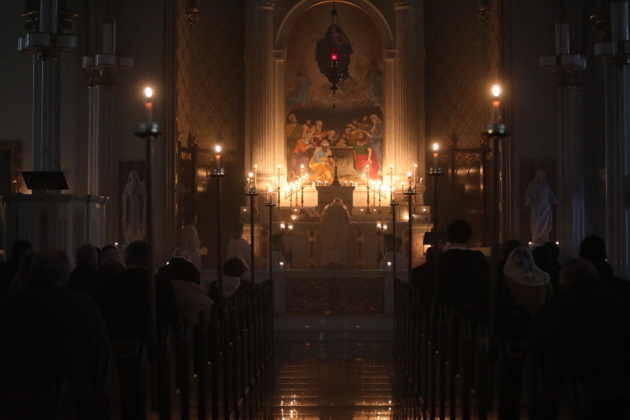
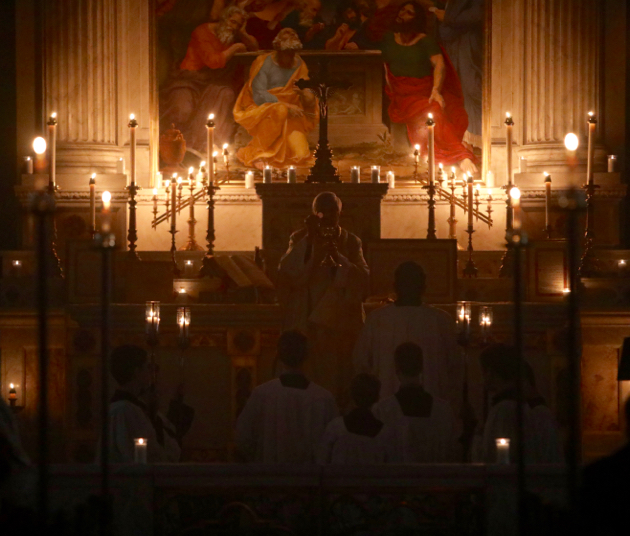
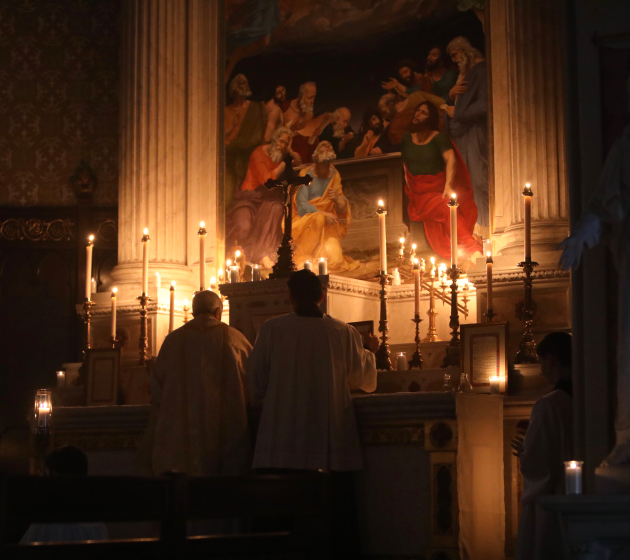
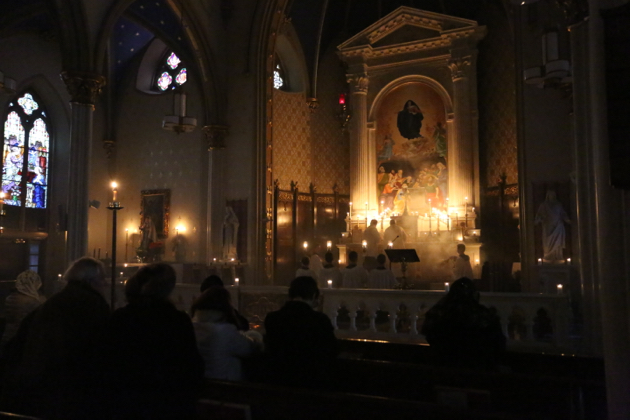
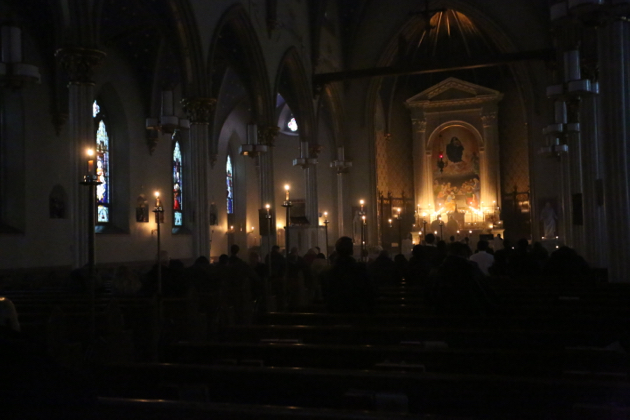
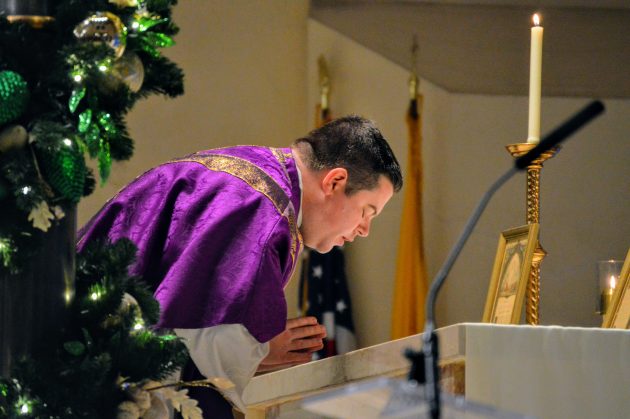
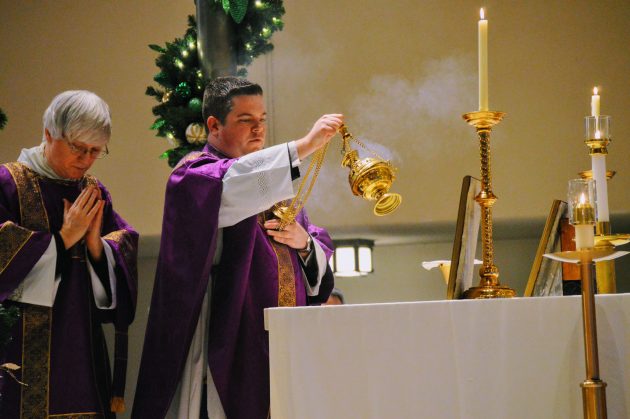
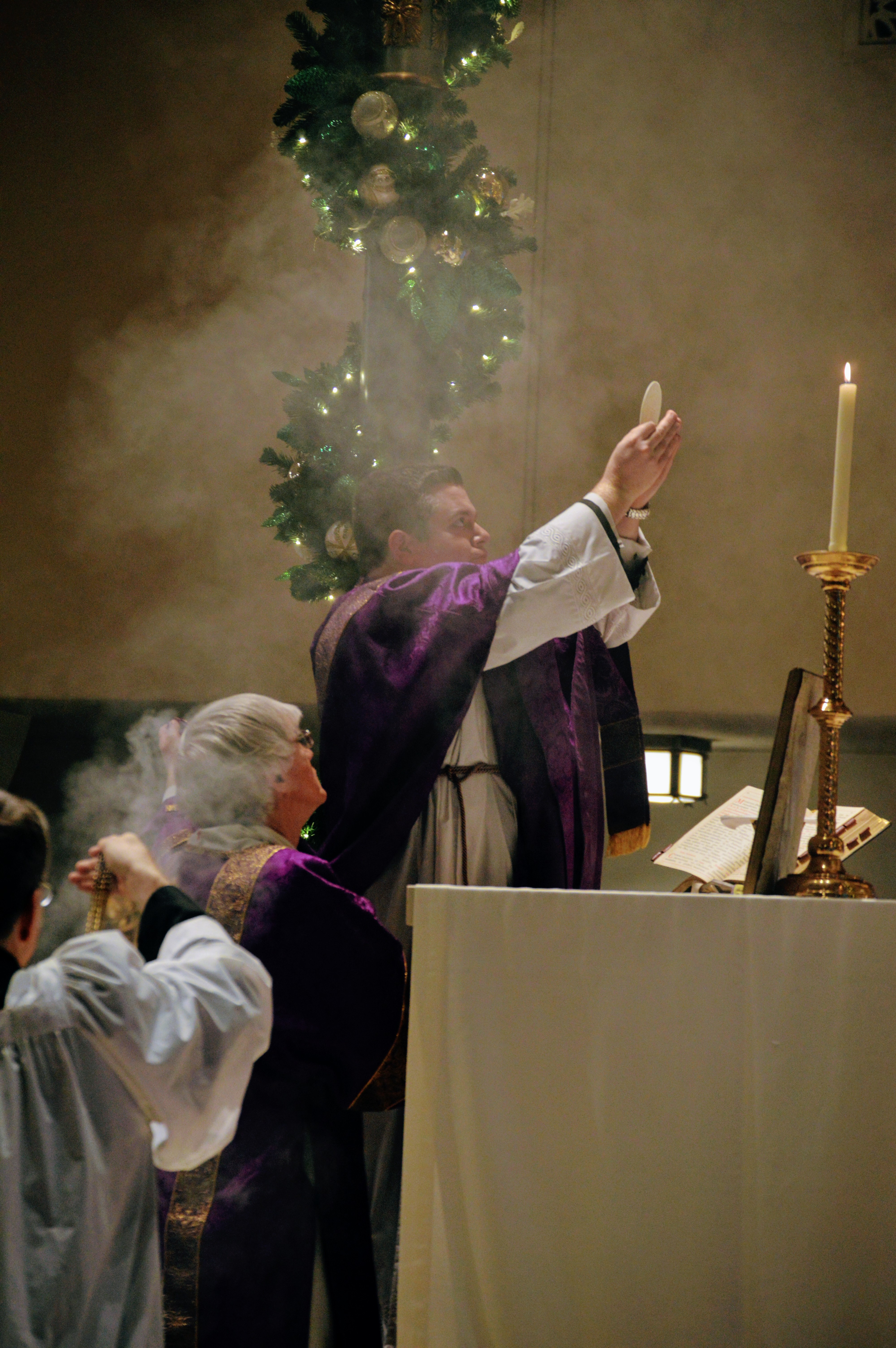
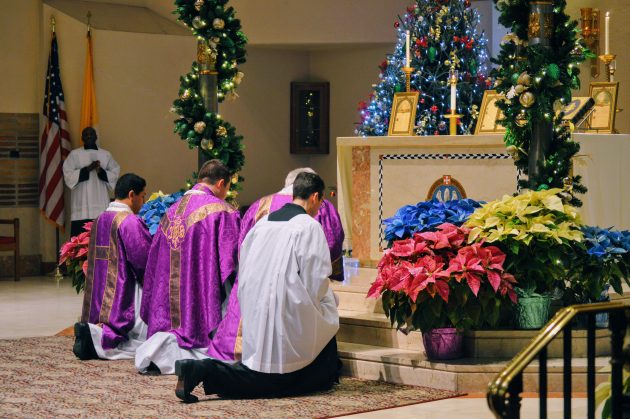
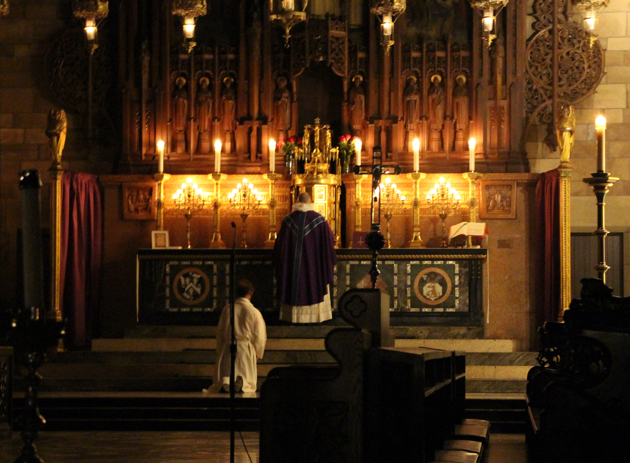
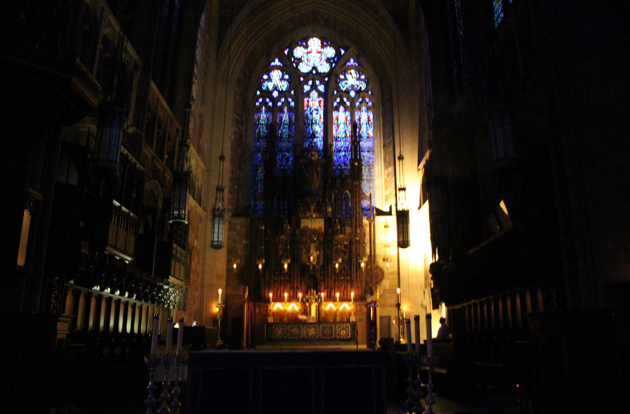
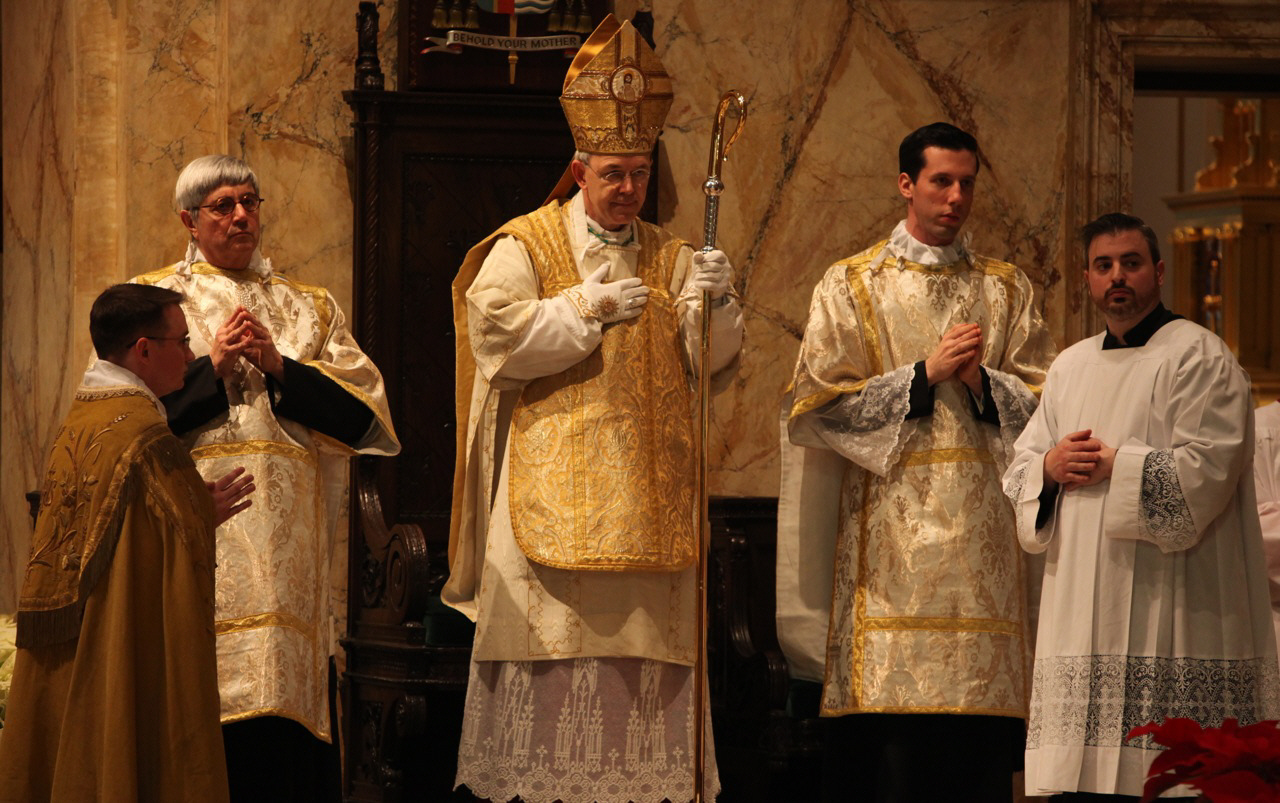
Fr. McElerhon celebrating traditional Mass at St. Adalbert Church in Enfield, CT. Traditional Mass is celebrated there every Sunday at 12:30 pm. Photo courtesy of Una Voce Hartford.
25 Oct
2017
Fr. McElerhon celebrating traditional Mass at St. Adalbert Church in Enfield, CT. Traditional Mass is celebrated there every Sunday at 12:30 pm. Photo courtesy of Una Voce Hartford.
25 Oct
2017
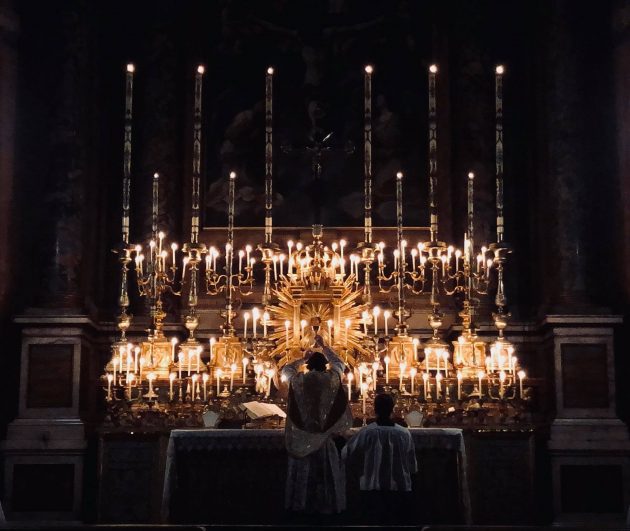
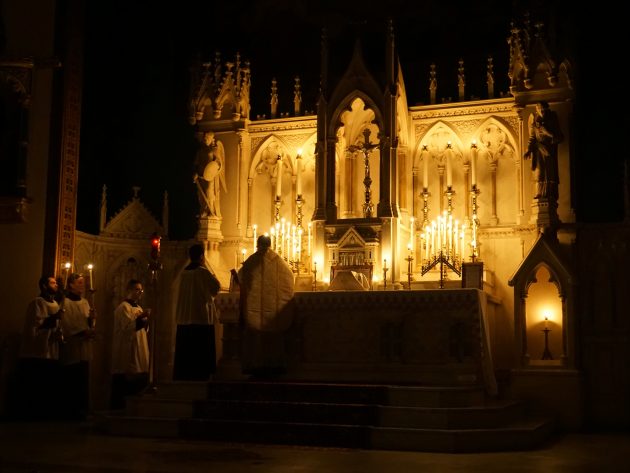
Yesterday, the Schola Cantorum of the London Oratory School sang at the evening Mass at the Church of the Holy Innocnets in New York for the Feast of St. Raphael.
25 Oct
2017
23 Oct
2017
23 Oct
2017
Last Thursday, October 19, St. Mary’s Church, Norwalk, hosted a conference and Solemn Pontifical Mass commemorating the 10 year anniversary of the Motu Proprio Summorum Pontificum.

The first speaker was His Excellency Bishop Athanasius Schneder, auxiliary bishop of Astana, Kazakhstan.


The second speaker was Father Innocent Smith, OP of St. Vincent Ferrer, New York.

After the talks, preparations were made for a Solemn Pontifical Mass of the Blessed Sacrament.

Bishop Schneider ceremonially arrived at the door of the church (accompanied by master of ceremonies John Pia) and was greeted by pastor Fr. Richard Cipolla. He was given a crucifix to venerate.

Bishop Schneider knelt before the Blessed Sacrament at a side altar before approaching the high altar.

The Bishop is vested for Mass and sits at a faldstool before the altar.

The Bishop blesses the Deacon, Steven Genovese, in preparation for the proclamation of the Gospel.
The Bishop with Fr. Richard Cipolla, as assistant priest.
Proclamation of the Gospel
The Sermon, delivered from the faldstool.
The offertory
After Mass, Bishop Schneider, greeted many of the congregation at an reception in the church hall.

The next morning, Bishop Schneider celebrated the 7:30 am low Mass.
15 Oct
2017
Dear Friends,
On behalf of the Society of St. Hugh of Cluny I would like to extend our gratitude to you, our supporters. Your contributions have made it possible for our Society to achieve so much in 2017.
What has the Society of Saint Hugh of Cluny been doing in the midst of all the turmoil of the present–day Church?
We continue to exercise two basic roles:
First, we run a website that keeps track of the burgeoning Traditional scene in the New York area.
Second, we sponsor and organize Traditional masses and presentations by noted speakers on issues directly relevant to the traditional cause. Almost all the budget of the Society goes to this aspect of our operations.
This year has been one of the most active in our history.
We are sponsoring the following:
In each case, given our limited resources, we try to bring the Traditional liturgy to new churches and to the wider public.
The music performed at these liturgies has also been unique. It has been gratifying to us to see the public response to all these events.
These kinds of things do, however, involve the expenditure of money. We spend it overwhelmingly on the music involved in the liturgies and for travel expenses of the speakers.
We depend on the services of many people who receive no monetary compensation for the great work they do. And we always partner with another group or parish to share the costs.
You can readily see looking at our Archive how, compared to earlier years, the pace of Traditionalist activity has picked up.
We would like to continue this development and do much more next year!
This is the tenth anniversary of Summorum Pontificum and of this Society. We already have several very interesting events in planning. But we need your help!
Please consider making a tax-deductible gift to the Society of St Hugh of Cluny today!
Checks made out to the Society of St. Hugh of Cluny may be sent to the following address:
Mr. Stuart Chessman
2 Tamarack Place
Greenwich CT 06831
Donations can also be made by Paypal. Go to the Paypal icon on our website www.sthughofcluny.org.
Thank you for your generosity and may God bless you,
Stuart Chessman
President
9 Oct
2017
We have found out about a valuable website that lists the Traditional Mass schedule for churches throughout New York City. Kudos to Diana Yuan for providing this service. She asks that you get in touch for any news or corrections. (Any Masses on Staten Island?) The website is latinmassnyc.com
Here is the schedule as of today.
Manhattan
Mt. Carmel (East Harlem)
* Sunday – 10:25am Sung Mass
* Monday-Saturday – 7:45am Low Mass (except First Saturdays, for which there is 9am Sung Mass instead)
* First Thursday – 7pm Sung Mass
* First Saturday – 9am Sung Mass
* contact: Mr. Teddy Thongratnachat, tbtcom1213@yahoo.com
Holy Innocents (Midtown West)
* Sunday – 9am Low Mass; 10:30am Sung Mass
* Monday-Friday – 6pm Low Mass
* Saturday – 1pm Low Mass
* contact: Mr. Eddy Toribio, ejtm83@aol.com
St. Agnes (Midtown East)
* Sunday – 9am Sung Mass
St. Christopher’s Mission – SSPX (Midtown East)
* Sunday – 2:30pm
Brooklyn
Our Lady of Peace (Carroll Gardens)
* Sunday – 9:30am
Queens
St. John’s Cemetery Chapel (Middle Village)
* Sunday – 9:30am
St. Fidelis (College Point)
* First Friday – 7:15am
* Third Friday – 7:15am
St. Matthias (Ridgewood)
* Second Monday – 7pm
Bronx
St. Anthony
* Sunday – 9am Sung Mass
Outside NYC
St. Ladislaus (Hempstead, Long Island)
* Sunday – 9am
St. Matthew (Dix Hills, Long Island)
* Sunday – 12:30pm
7 Oct
2017
We are happy to announce that the Society of St Hugh of Cluny and St. Mary’s parish, Norwalk, Connecticut are sponsoring a conference and mass on Thursday, October 19 at St Mary’s Church. The conference and mass commemorate the tenth anniversary of Summorum Pontificum. The proceedings will be as follows:
5:30 PM. Bishop Athanasius Schneider and Fr. Innocent Smith OP will give presentations.
7:30 PM. Pontifical Solemn Mass celebrated by Bishop Schneider.
9:00 PM. Reception in the parish hall.
We are proud once again to welcome Bishop Schneider back to Connecticut. I hope that many of you will be able to participate in this special evening!
No registration necessary. Free-will donation suggested.
Music for the Pontifical Mass:
At reception of the bishop: Ecce sacerdos magnus (Hans Leo Hassler, 1564-1612)
At the vesting: Versets on Verbum supernum (Nicolas de Grigny, 1672-1703)
Coronation Mass (Mass in C Major, K. 317) (Wolfgang Amadeus Mozart, 1756-1791)
Gregorian Votive Mass of the Blessed Sacrament: Cibavit eos
Qui manducat meam carnem (David Hughes, b.1980)
O sacrum convivium (Olivier Messiaen, 1908-1992)
Ave verum corpus (Mozart)
Postlude: Prelude in C Major (9/8) (BWV 547/1) (Johann Sebastian Bach, 1685-1750)
2 Oct
2017
Sermon for the 17th Sunday after Pentecost
by Fr. Richard Cipolla, St. Mary Church, Norwalk, Oct. 1, 2017
“You shall love the Lord your God with your whole heart, and with your whole soul, and with your whole mind. This is the greatest and the first commandment. And the second is like it: You shall love your neighbor as yourself.” (Matthew 22: 37-39)
“To be or not to be: that is the question.” So said the melancholy Dane, Hamlet, the prince of Denmark in one of the most famous lines in all of English literature. The question of existence is itself asked here. But it is the wrong question in the end. The question to ask, the fundamental question to ask is not “to be or not to be”. It is rather: “To love or not to love: that is the question”.
Post -modern man finds the very idea of love something difficult and perhaps in the end impossible. In the post modern world of distrust of accepted truths, where subjectivism is seen to be the only way to function in the world, a world of fragmentation and liquidity, the ability to love and the reality of love is put into question. Surely this is one of the reasons for the decline of marriage as one of the fundamental institutions of society. But postmodern man also understands that the question of the possibility of love is somehow linked to the possibility of truth. The rejection of one possibility almost demands the rejection of the other. This is just one of the ironies of postmodern man: that at least he knows the real questions that modern man often did not even ask, such as the link between love and truth.
But this is something that the Catholic understands. Because for the Catholic the possibility of love in a selfish world—and the world has always been selfish– is real only because of the reality of truth in the man Jesus Christ and his supreme act of love on the Cross. For the Christian love cannot be separated from faith in Jesus Christ as the way, the truth and the life. For the Christian. love cannot be separated from the God who gave his only begotten Son to die precisely for those who refuse to love.
For the Christian to be IS to love. The God we worship is the one whose name is “I am who am:” Being itself. But the God we worship is also Love, and so for us, to be is to love. Existence itself, in the most basic and profound sense not only is grounded in love, but also for me the measure of my being is the measure of my love. It is Jesus himself who grounds being in love in today’s Gospel. Ah, those familiar words! “You shall love the Lord your God and your neighbor as yourself.” Those words are so familiar that we forget what they mean. All too often they come across as some general ethical principle: do good things for other people. And this is the definition of Christianity for too many people. Thus the Christian is the one who is active in social programs, who is obviously out there helping those in need. That is the way we find out who is really Christian and who is not. But no, this is wrong headed. The Christian is not identified merely by the person who does good for his neighbor. For there are those who do not identify themselves as Christians in any way, certainly not Catholic, who do good for their neighbors, who work in shelters and soup kitchens, who are kind and gentle, who go out of their way to be attentive to and to respond to the needs of others.
What then marks the Christian from the rest of those who do good to their neighbor? What marks the Christian is the reason, the ground, for his doing good for his neighbor. The grounding, the reason is one and simple: he can and does good because of the love of God: the love of God for him or her and the response of love for God by each person. It cannot be said too often: I am able to love, that is, I am able to do good in an unselfish, un-egotistic way, only because of my love for God. I can do good, that is, I can love my neighbor, only because I love God and only when I love God. That separates us from secular humanists, those who ground love of neighbor is some sort of abstract notion of the good, or in some basic ethical principle that they assume is obvious to all, or in some generally optimistic view of the general goodness of all men and women. They are wrong, deeply wrong. For the fact is that left on our own, we will not love, we will play the love-game, but we will love because it gives us personal satisfaction to be doing the right thing, the noble thing.
This caring for neighbor does not mean caring for the homeless man in the subway. It means caring for your wife, your husband, your parents, your children, yes, even your priest. This is not something natural that we do, something nice. It is rather unnatural, and that we can care and love is a gift of grace. It is the grace of God that enables me to love my neighbor, that enables me to love at all. I do not love, when I do love, because of something within me that enables me to love, something I draw from, something that is within me as a man or woman. I do not love because of some fidelity to an ethical system, some principle. I can love, when I do love, because of the sheer grace of God, because my being is grounded, depends on, Love itself.
And when we understand this, what Jesus is telling the Pharisees and us today in the Gospel, then we are humbled, we are brought down to the ground, we come into contact with reality, a reality shorn of the warm fuzzies of romantic love, to a reality of the love that is shown forth supremely in the Cross of Jesus Christ. I can love at all because God loved me so much that he sacrificed Love in the flesh on the wood of the Cross so that my sins can be forgiven and so that I can love in the deepest sense. When I realize this, the scales of secular humanism fall from my eyes. And I no longer see my Catholic faith as merely a set of rules to help me and my family do the right thing. I no longer use my faith and the Church as only a moral association meant to keep my children in line. No: I see clearly and fearfully and humbly that the question to ask is not “to be or not to be”, but rather “to love or not to love” And the answer does not depend on me, it does not hang on me. It depends, or rather, it hangs on the crucified Christ, which image hangs in this church over the altar rail that separates earth and heaven.
26 Sep
2017
We are happy to announce that the Society of St Hugh of Cluny and St. Mary’s parish, Norwalk, Connecticut are sponsoring a conference and mass on Thursday, October 19 at St Mary’s Church. The conference and mass commemorate the tenth anniversary of Summorum Pontificum. The proceedings will be as follows:
5:30 PM. Bishop Athanasius Schneider and Fr. Innocent Smith OP will give presentations in the parish hall of St. Mary’s.
7:30 PM. Pontifical Solemn Mass celebrated by Bishop Schneider.
9:00 PM. Reception in the parish hall.
We are proud once again to welcome Bishop Schneider back to Connecticut. I hope that many of you will be able to participate in this special evening!
No registration necessary. Free-will donation suggested.