The Remnant provides what is apparently a more detailed review of what is happening.
And Phil Lawler provides incisive commentary.
The Remnant provides what is apparently a more detailed review of what is happening.
And Phil Lawler provides incisive commentary.
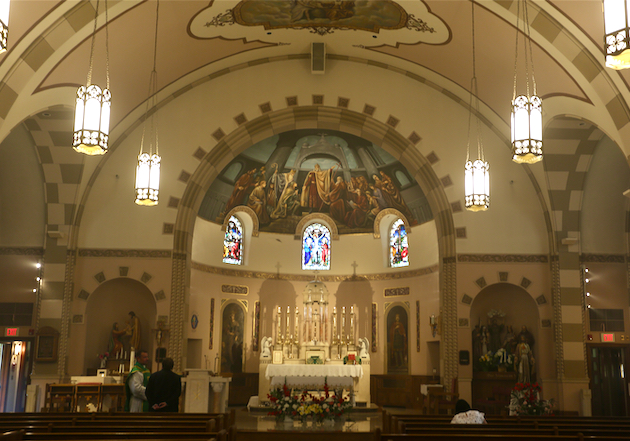
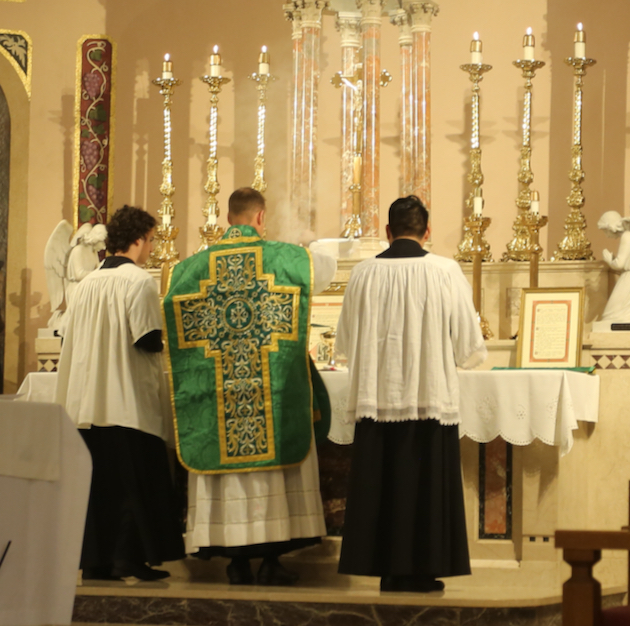
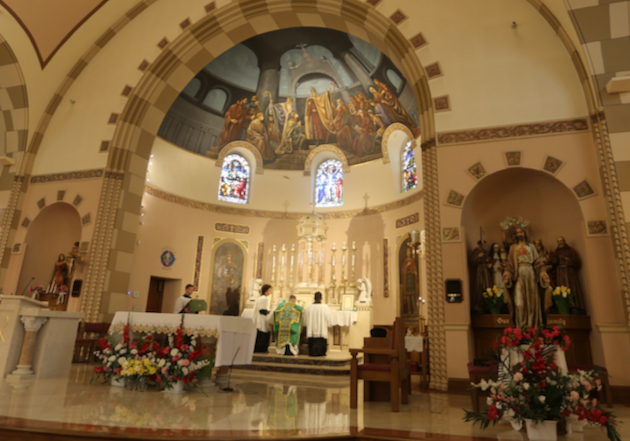
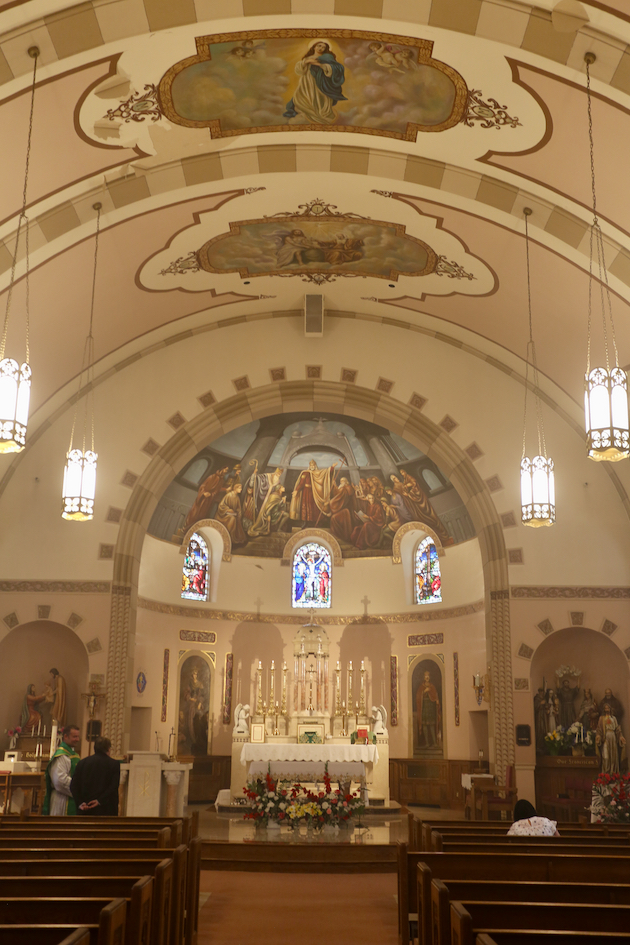
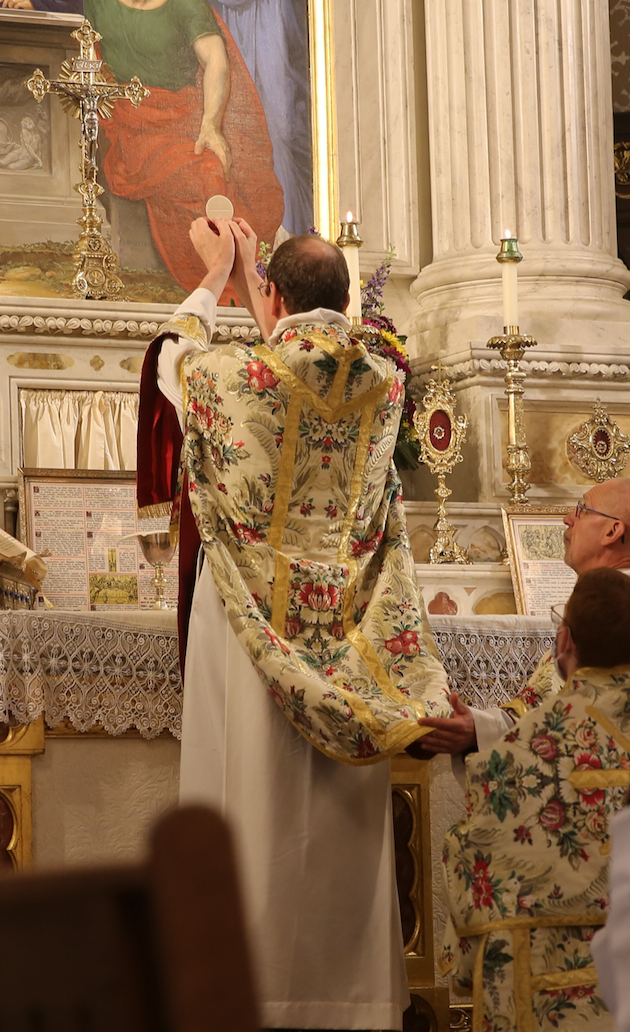
Fr Frantisek Marie Chloupek, CFR, who was ordained a priest on Saturday, celebrated his first Solemn Mass on Monday at St. Josaphat Church, Bayside, Queens. The Assistant Priest was Fr. Sean Connolly. The Deacon was Fr. Sebastian Maria Kajko, CFR. The Subdeacon was Fr. Elijah Marie Perri, CFR. The Master of Ceremonies was Mr. William Riccio. The organist and choir director was Mr. David Hughes.


1
Jun
Thursday, June 3
St. Mary Church, Norwalk, CT, 8 am
St. Pius X, Fairfield, CT, 7 pm, Missa Cantata followed by Exposition and Benediction.
Sts. Cyril and Methodius Oratory, Bridgeport, CT, 7:45 am low Mass; 6 pm Solemn Mass, indoor procession and Benediction
St. Joseph Church, Danbury, CT, 6 pm, Solemn Mass followed by outdoor street procession and a festive reception.
St. Martha Church, Enfield, CT, 7 pm, Missa Cantata and procession
Church of the Holy Innocents, New York, NY, 6 pm, Missa Cantata followed by an outside process with triple Benediction
Our Lady Of Mount Carmel, New York, NY, 7 pm, Solemn Mass followed by an outdoor procession and Solemn Benediction.
St. Josaphat Church, Bayside, Queens, NY, 7:30 pm, Missa Cantata and outdoor procession.
Our Lady of Loretto, Cold Spring, NY, 6 pm, Solemn Mass and procession.
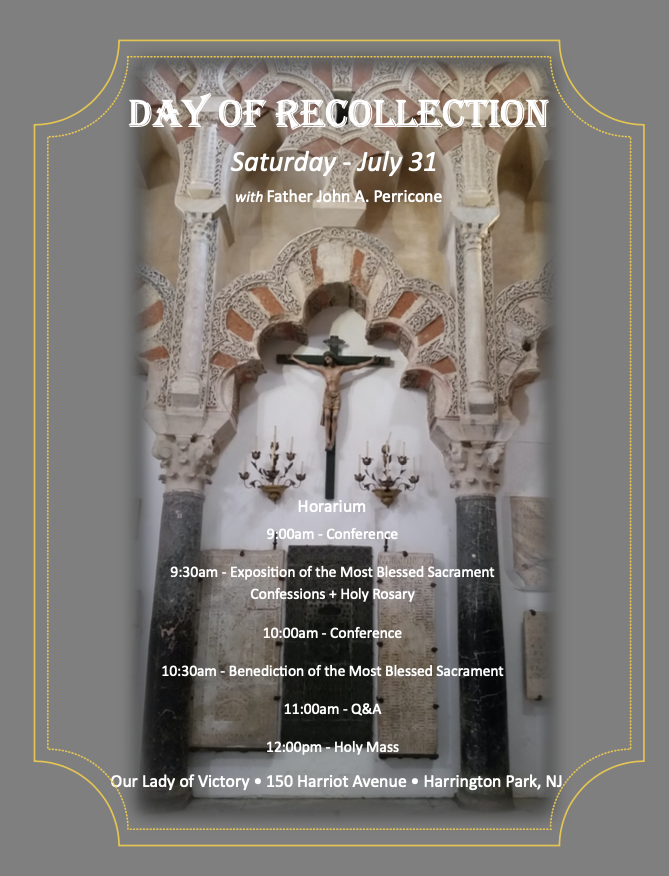
Our Lady of Sorrows Church, Jersey City, 5 pm, Missa Cantata and Solemn Procession, Fr. John Perricone, celebrant. Parking lot across the street.
St. Anthony of Padua Oratory, West Orange, NJ, 7 pm
External Solemnity: Sunday, June 6
St. Mary Church, Norwalk, CT, 9:30 am, Solemn Mass followed by a procession around the church and two altars of repose. A light breakfast in the gym sponsored by the Indian and Spanish communities and the coffee hour organizers.
Church of the Holy Innocents, New York, NY, 9 am Low Mass in Coram Sanctissimo (in the presence of the Blessed Sacrament); 10:30 am Missa Cantata in Coram Sanctissimo followed by a procession in the church and Benediction. At 2:30 vespers will be sung in the presence of the exposed Blessed Sacrament followed by benediction.
Our Lady of Mount Carmel, New York, NY, 4:30 pm, Solemn Vespers followed by an outdoor procession and Benediction.
St. Paul the Apostle, Yonkers, NY, 2:30 pm, Missa Cantata
Immaculate Conception, Sleepy Hollow, NY, 2 pm low Mass; 4 pm Missa Cantata followed by procession, Benediction and convivium.
Shrine of the Blessed Sacrament, Raritan, NJ, 10 am Missa Canta and procession to other churches.
St. Anthony of Padua Oratory,, West Orange, NJ, 11 am, Missa Cantata


1
Jun

The pilgrimage is re-located to eastern Pennsylvania due to continued lockdown in NYS. Normally, we journey through majestic Adirondack forests sanctified by the blood of martyrs.
But the saunter through peaceful Penn’s Woods and rural Pennsylvania will still offer the Traditional Roman Liturgy, confession, counsel and teaching from priests of solid faith every day. Fellowship & fun in bundles. Shuttles & TLC for the foot-worn and weary.
31
May
( I wanted to present to you as soon as possible a translation of this powerful essay that has just appeared in Paix Liturgique ( Letter 799 of 5/28/2021). It deals with the menacing developments in Rome but is also a brief summary of the history of Traditionalism, especially in France. And that history is reason for much hope. For fortunately, the Church is not just the preserve of the Vatican and the hierarchy but also includes the sensus fidelium of the laity. Please forgive my somewhat limited command of French! – SC)
UPDATE: In the meantime, here is Paix Liturgique’s own translation.
The provisions of the motu proprio Summorum Pontificum were measures of peace. Totally atypical from the perspective of liturgical legislation, Summorum Pontificum effectively met a situation which itself was atypical. It created a modus vivendi between the old liturgy and the new liturgy, acknowledged a right of every Latin priest to the ritus antiquior and set forth the rules for its public implementation. It aimed to pacify liturgically a church which was sinking ever more into a crisis.
But this right, finally recognized, appeared intolerable to the gentlemen in power since 2013. Among them, the view is gaining the upper hand that this text must be, if not abrogated, at least dismantled in order to destroy the essence of its meaning. According to them, the pre-Vatican II Mass cannot enjoy anything more than tolerance, appropriately restricted.
Their mental and ideological structure makes them undertake “with a light heart” – to cite the words of Emile Ollivier who thrust France into the war of 1870 with all the consequences we know – the responsibility of a renewal of liturgical hostilities. Because of them, the risk exists that we will find ourselves once again in a situation resembling that of the years after the council but under conditions far worse for the institution of the Church.
Celebrating the Tridentine Mass: A hard-won Right
One must understand that it was under the pressure of a protest movement that could not be suppressed that the Roman legislator came through a series of stages (in 1984, Quattor Adhinc Annos; in 1988, Ecclesia Dei and, in 2007, Summorum Pontificum) to interpret as non-obligatory the promulgation of the missal of 1969.
Indeed, in France but also everywhere in the world, pastors had calmly continued to celebrate the traditional mass. During the same time “wild” chapels were organized in many places. The measures taken by certain bishops had no other result than to further incentivize the propagation of these celebrations. They acquired even more cohereence when the young priests formed and ordained by Archbishop Lefebvre began to exercise their priestly ministry both in the independent houses founded in order to receive them and in the places is set up for worship – often of in a summary manner – in the town or in the country.
The suspension a divinis of Archbishop Lefebvre in 1976 gave his cause even more notoriety. This event was followed by another; the peaceful occupation of the church St. Nicholas du Chardonnet in Paris by Msgr. Ducaud-Bourget and the faithful. They entered one Sunday, and they are there even today. In the same way, 10 years later, near Versailles, the traditionalist parishioners of St. Louis du Port Marly – who had been chased out of their church and against whom the doors had even been walled up – simply smashed them open and settled down again on the premises. They have never left since.
A historical survey of the IFOP (Institut Français d’Opinion Publique) in 1976 published in Le Progres, a Lyon daily, showed that 48% of regularly practicing Catholics thought that the Church had gone too far in the reforms and that 35% remained favorable to the mass in Latin. Subsequent surveys made until the present day by Paix Liturgique in France and in the rest of the world highlight a decisive trend: the request to celebrate the traditional mass in their parishes by a significant part – even at times the majority – of the practicing faithful.
Subsequently, as a consequence, on the one hand, of the favorable psychological atmosphere created by the motu proprio of Benedict XVI, and, on the other, of the continued growth of the institutes specialized in the traditional liturgy (the FSSPX and the Ecclesia Dei institutes founded after1988) the number of places where the traditional mass was celebrated also continued to grow throughout the world. Between 2007 and 2017, for example, this number simply doubled.
It’s a paradox noted by sociologists of religion like, in France, Daniele Hervieu-Leger: the traditionalist movement opposed the Conciliar trends in a manner modern in appearance – a rising up against authority. The traditionalist reaction has certain characteristics which today would be called populist: challenging the legitimacy of the elites because these adopt novel positions worked out in their elitist bubble. Another paradox: the traditionalist movement from its origin has been based on the actions of laypeople who supported and even “produced” priests by means of the specialized traditionalist institutes. They rejected the instructions of Vatican II, which were supposed to advance the laity. We could even add that while the Roman church ceased after Vatican II to be “Tridentine,” “Tridentinism,” in its essence hierarchical, from that time on was taken over by the people at the base.
In truth, we could say that theologically and not just sociologically, we have a manifestation, astounding and providential, of the sensus fidelium, of the faithful’s instinct of the faith, which fights tooth and nail for the expression in the lex orandi of the doctrine of the eucharistic sacrifice, of the real presence, of the hierarchical priesthood, and more globally of the transcendence of the mystery of “do this in memory of me.”
An Indomitable Capacity for Resistance.
In the face of the danger which today is taking shape, one can attempt to assess the forces now in action by looking at the French situation (which is certainly not that of the entire Church, but which always gives very good indications in this area)
The “official” Church is not at all anymore the solid institution that it was in the first decades after the Council. It has been bled white regarding the number of priests and of religious. The number of seminarians and even of seminaries continues to diminish. The practicing faithful – ever older – are ever more “socially distanced” in the naves of the churches without the need of any anti-Covid measures. Logically enough, all this is accompanied by a catastrophic financial situation in not a few of the dioceses. Added to this are the consequences of what is called the coronavirus crisis which has made approximately 30% of the remaining parishioners vanish. Because of historical habit, which fades away only with difficulty, Catholicism is still considered as an essential component of society. In reality, however, the Church appears now totally exposed: she has practically disappeared from the public sphere.
In contrast, the traditional world represents an exception in the Church especially regarding priestly and religious vocations – resembling the situation before 1965. Many young people who have never experienced the conciliar quarrels turn spontaneously to this movement today. The Sunday congregations are full, and the average age is young. In the traditionalist matrix, everything takes place – in the liturgical life as well as in the “fecundity” of its vocations – as if Vatican II had never occurred. Catechetical instruction in the old style – very structured – and an important network of schools assure a good transmission of the faith, of the practice and of the habits of Christian life. What is more, the frontiers are porous between Traditionalism and the “official” “conservative” world – the St. Martin community, Emmanuel, etc. – whose vitality is partly explained by reason of its differences with the official policies, and which is partially inspired, more or less, by the traditionalist resistance.
I acknowledge that this success has its shadows: generational renewal has certainly been assured but, in a world that has been secularized to the ultimate extreme, this was not achieved without losses. In comparison to the militant situation of the immediate post-Conciliar years, the traditionalist world might appear at times more “settled down” than it was before. Yet we can assert that actions and pressures deemed necessary to maintain the hard-won positions and to achieve further growth could be organized without difficulty. The social networks constitute here, as elsewhere, a considerable aid to the development of a non-conformist network.
All things being equal, an explosion of discontent like that of the gilets jaunes (the “Yellow Vests” – a populist protest movement in France) could occur at any moment in the Church. With the great advantage that, in Catholicism, for the Christian people doctrine and practice are centered on the celebration of Sunday Mass. To celebrate the Mass, it’s sufficient that that a priest says it and that the faithful participate – ultimately nobody can prevent them from doing that. That’s what happened after 1965 and especially after 1969 – the Tridentine mass continued to be celebrated as if nothing had happened. Threats, opposition and even persecution followed each other – nothing worked. Priests and the faithful continued to do what the Church had always done, as Archbishop Lefebvre loved to say.
A recent, very instructive, fact is that while the bishops of France and elsewhere stupidly imposed on the Eucharistic celebrations the coronavirus measures laid down by the government (by prohibiting the communion on the tongue), a number of the faithful, respectful of the sacrament, left the “ordinary” churches to go and receive with dignity the Holy Eucharist in Traditionalist celebrations. So, it was found that, after the coronavirus crisis, the number of those attending traditional masses has notably increased in most places.
A Useful Reminder
The phrase of St. Jerome is well known, who said in the 4th century: “the whole world groaned and was astonished to find itself Arian.” While the hierarchy had largely gone over to the heresy, nevertheless, numerous faithful remained attached to the Christological doctrine of Nicaea. Have we not seen; do we not see a similar situation repeating itself today? But this capability for resistance, rooted in practical experience and of its nature uncontrollable, does not exclude demonstrations and powerful actions, which are already being seriously contemplated in many places in the world.
30
May
30
May
29
May

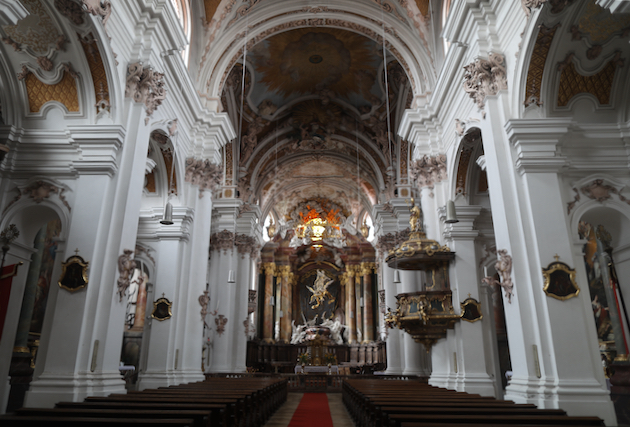
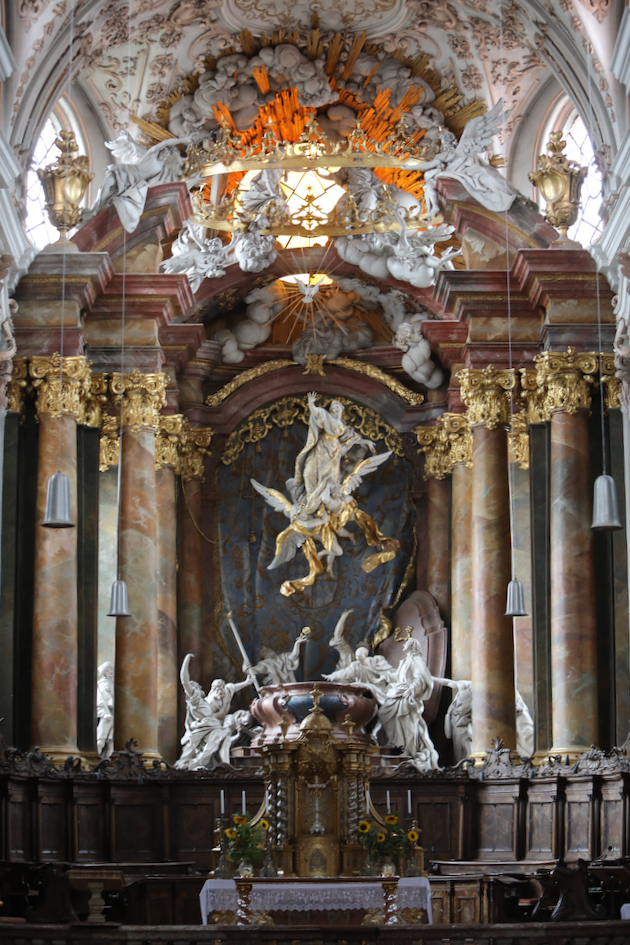
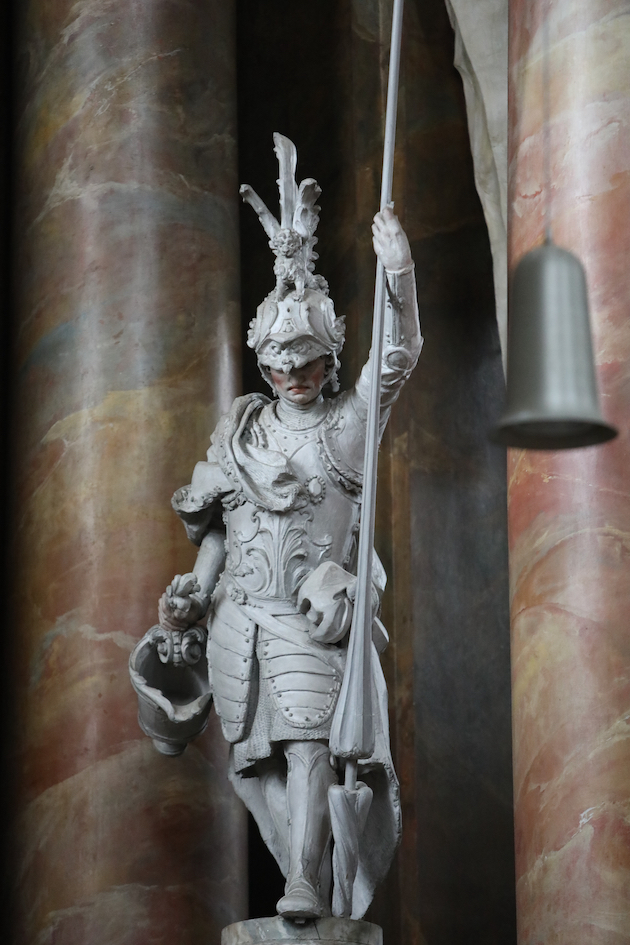
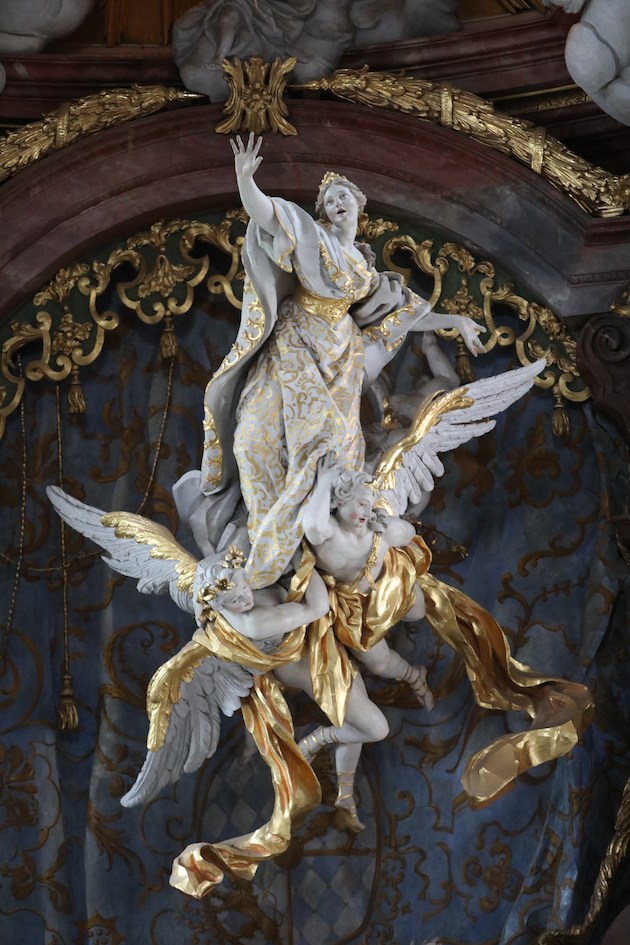
The “Holy Roman Empire of the German Nation” was the scene of an unimaginable outpouring of art and music between 1660 and 1770 – the final period of organic creativity in Western art. The works of this era were as a rule created for emperors, princes, monasteries and nobles. Yet in one case the artists themselves were the patrons. Egid Quirin Asam (sculptor and worker in stucco) and Cosmas Damian Asam (architect and painter) stood at the border between the baroque and rococo periods. They unfolded a vast activity all over the German lands, from Silesia to the Rhine. Yet in Munich they determined to build their own personal church, dedicated to the recently canonized St John Nepomuk (Nepomucene) whose cult quickly spread from Bohemia to all the Catholic lands of the Empire. They worked together on this church between 1733 and 1746.

The artists resided at Munich in the principality of the elector of Bavaria (an “elector” was a prince of the empire entitled to vote for the emperor). The reigning elector, Karl Albrecht, presided over an age of unprecedented artistic splendor for Bavaria. Yet he was tempted to grasp for the imperial crown, becoming the first non-Habsburg Holy Roman Emperor – Charles VII – since the 15th century. Alas, his reign was brief and unhappy. Loyalty to the Hapsburgs (represented by the redoubtable Maria Theresa) ran strong in the Empire, especially when the alternative was a prince dependant on the support of the king of France. Charles VII was forced on occasion to flee his own domains, and died in 1745. A double-headed eagle with the emperor’s coat of arms which still remains in the church of St. John Nepomuk is one of the few tangible remnants of Karl Albrecht’s brief imperial glory.


Egid Quirin purchased a row of late medieval houses in Munich. One he tranformed into his own house – lavishly decorating the exterior with allegorical and other figures. Another he made into a rectory, and in the middle he and his brother built the church of St. John Nepomuk, with their own money and designed and decorated by their own hands.


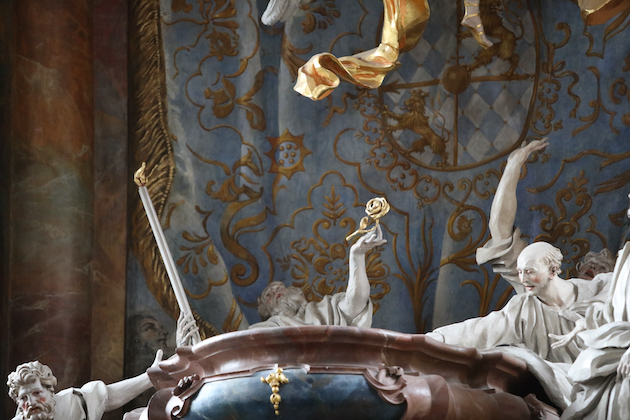
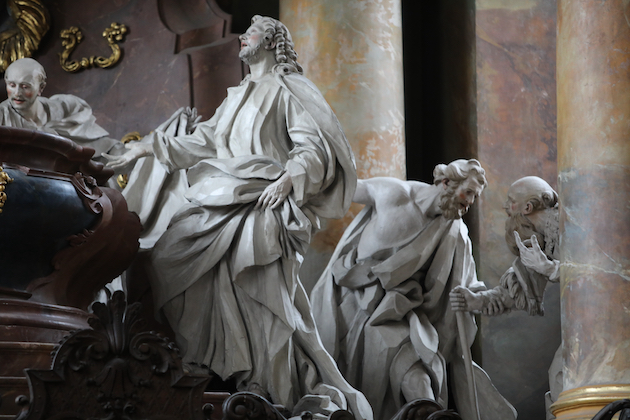
Entering, the visitor passes through a small vestibule with confessionals (in keeping with the church’s patron, St. John Nepomunk, one of its main purposes was to facilitate the sacrament of penance). Then, one stands before the dazzling interior. More than a century before Richard Wagner, it already constitutes a true Gesamtkunstwork in the German tradition, uniting architecture, painting, sculpture and stucco. Before a window, filled with yellow glass, was inserted in the apse by a 1982 restoration, the only light in the church was indirect, from hidden windows. As the visitor’s gaze gradually turns upward, the effect is that of rising from mysterious darkness into subdued light. The focal point of the entire artistic unity is the image, based on medieval motives, of the Trinity – Father, crucified Son and Holy Ghost – which soars far above the congregation.


In the overwhelming visual splendor one doesn’t at first appreciate the unusual layout of this church: extremely narrow yet long and high, as dictated by the restricted plot available to the brothers. For the same reason, it is oriented to the West instead of the East. The Asam house communicates directly with the church; there is also a window from which Egid Quirin Asam could follow the mass from his bedroom.


In subsequent decades the colorful, expressive art of the brothers Asam fell out of favor and neoclassical coldness prevailed. The Holy Roman Empire and, a century later, the monarchy of Bavaria itself, eventually disappeared. The church of St. John Nepomuk suffered from a long series of successful and unsucessful restorations, water damage to the paintings of the ceiling and bomb damage to the choir. Yet despite these inevitable vicissitudes of time, it has miraculously survived more or less intact until the present day.

29
May

n.b. Fr. Sean Connolly has written an interesting article about the MacSwiney Chalice which will be used in this Mass. https://www.ncregister.com/blog/macswiney-chalice
29
May

A Bernini marble sculpture of a skull rediscovered in Dresden – as described in Art News:
The artistic sensitivity of the baroque world was extraordinary! The marble skull was made for Pope Alexander VII around 1655. If you visit Dresden the skull can be viewed in an exhibition that has just opened. The gallery’s full description is here:
“In the seventeenth century, sudden and often violent death was omnipresent, which is why people were intensely preoccupied with mortality. A constant threat was posed not only by wars and assaults, but above all by diseases. In 1656 there was an outbreak of plague in Rome, and it is remarkable how closely the measures Alexander VII used to fight the epidemic (quarantine, masks, and the extensive shutting down of public life) resemble those that determine our everyday life in the face of the coronavirus today. Death, too, is again more prominent in people’s consciousness due to the current situation, and Bernini’s death’s head thus proves to be a memento mori of extraordinary topical relevance.“
(From the gallery’s description)
Actually, people “were intensely preoccupied with mortality” in almost all ages and cultures up to the dawn of Western Modernity, which has made a deliberate effort to suppress and marginalize the subject. A topic already incomparably set forth by Edgar Allen Poe in The Masque of the Red Death.