18
Jun
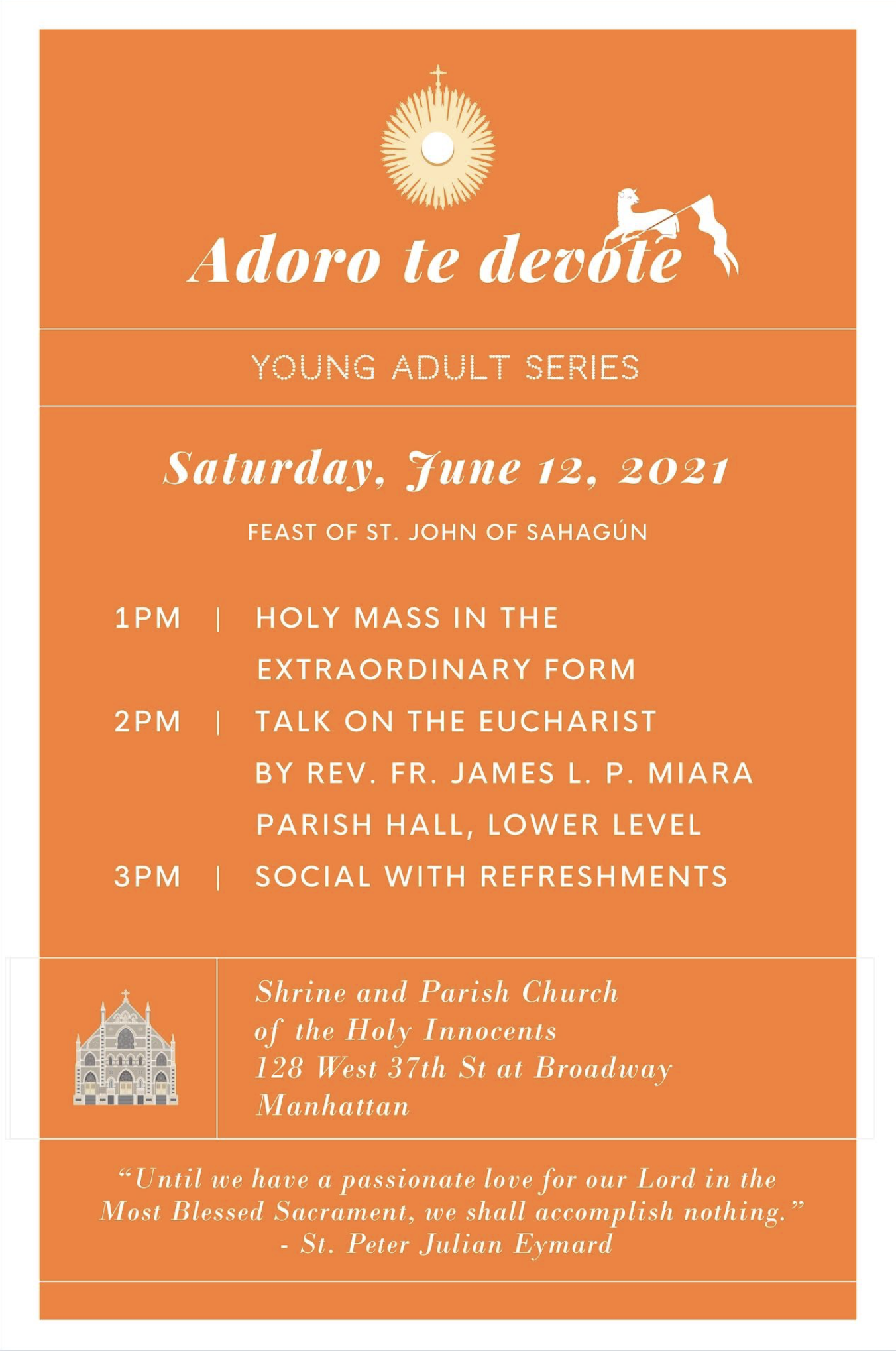
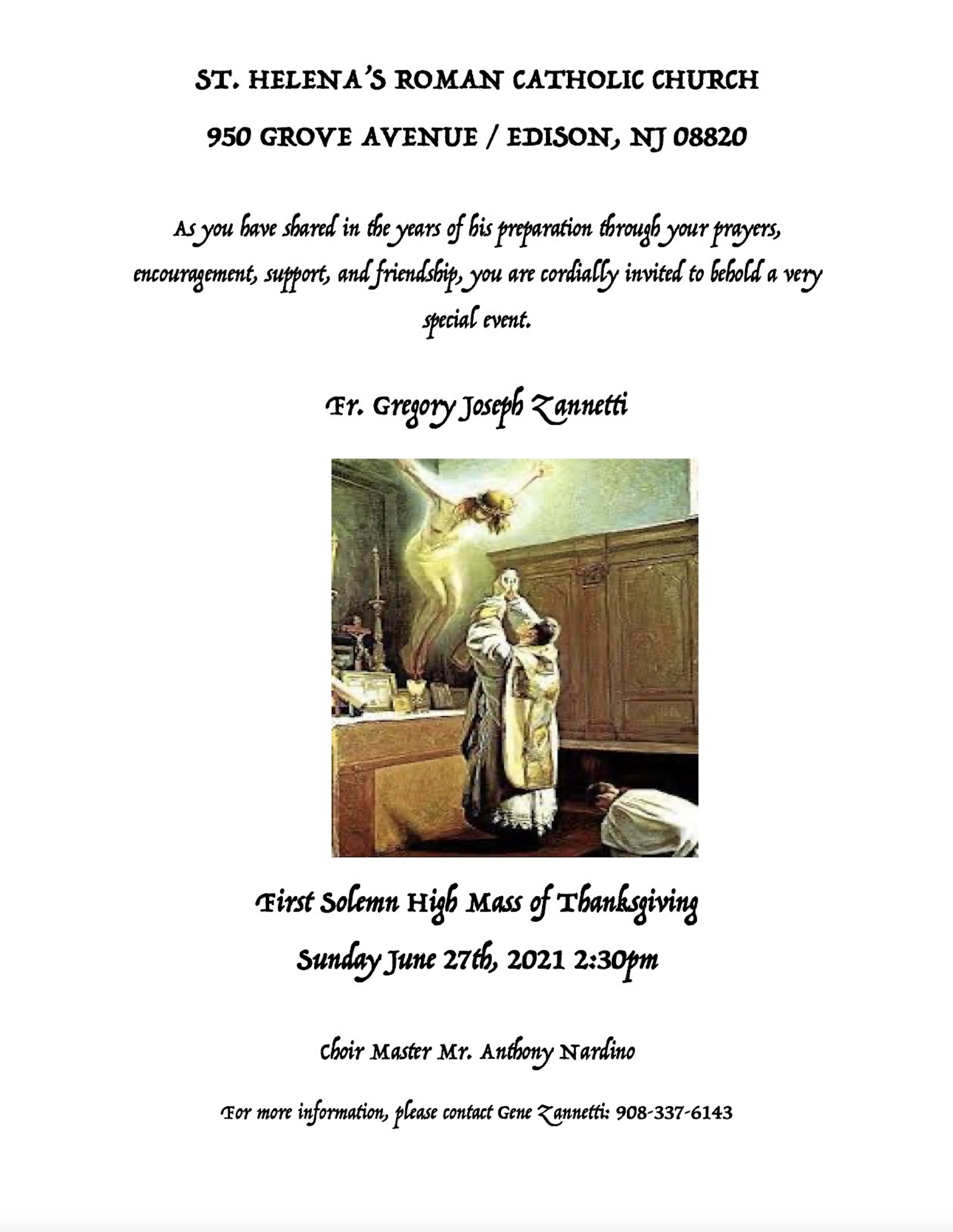
Our Eastern Catholic friends inform us there will be an opportunity to participate in an Italo-Greek (or Italo-Albanian) liturgy.
Date: Sunday, 18 July 2021
Time: 12:30 PM
Place: Holy Trinity Ukrainian Catholic Church, 288 Vanderbilt Ave., Staten Island NY
Text messsage to (516) 606-4914 if you plan to attend.
15
Jun
from the president of the association Notre-Dame de Chrétienté (Our Lady of Christendom) – the organizers of the Paris/Chartres pilgrimage. This year attendance at the opening and closing masses was drastically limited by the French Coronavirus restrictions. Nor could a unified pilgrimage take place. Nevertheless, more than 11,000 pilgrims joined in smaller events dispersed all over France and beyond (as far away as Egypt and Armenia!). Jean de Tauries takes the opportunity to forthrightly address the issue most on the minds of Traditionalists today.

On the Way Home from Chartres
By Jean de Tauries, President
The 39th pilgrimage has just ended. We hear that the rumors of a new motu proprio, limiting the one signed by Benedict XVI in 2007, have allegedly been turned into a text ready to be signed by Pope Francis.
What a contradiction between these new restrictions and the exceptional number of pilgrims this year (more than 15,000 pilgrims including the “Guardian Angel” pilgrims)! 1) What a paradox, in contrast to the missionary spirit of our chapters in France and in so many countries! What a profound lack of knowledge of our Traditional Catholic world!
Let’s take a step back. Among the innumerable rebukes which we have received ( the “summary note” of the Conference of French Bishops, the Dijon Affair etc.) 2) I read : “The instruction that is given, the liturgy that is celebrated, date from before Vatican II and cannot be representative of the present age.”
I’d like to invite our clerical critics (often in their 70s) to come and talk with our pilgrims in their 20’s. They might be surprised to find an approach that is radically different from the subjects with which they are obsessed. Our pilgrims are not living in 1965 – in the midst of the “springtime of the Church” – but in 2021, the post-Vatican II era. Our clerical critics should clearly understand that they have before them a representative sample of the last practicing Catholics in France.
The first preoccupation of all these families is to give their children a Catholic education in a world that hates Christianity. Our pilgrims are youth engaged in evangelical movements (at times in contact with Islam), professionals inquiring about the application of the social doctrine of the Church, fighters for the defense of life. They may not know, perhaps, the essence of the conciliar documents, but they know very well the Church that has emerged from the Council. They see every day her eradication from society, the persecutions she endures, her suffering, the break in catechetical instruction….
Our pilgrims never say “it was better back then” because they know nothing of that “back then”; moreover, even their parents had not yet been born at the time of the Council! On the contrary, they explain very clearly their well-considered choice for traditional religious practice: the sacramental life, the liturgy, the religious instruction, the pastoral leadership assured by priests who know and love this apostolate. Our pilgrims do not think themselves outside of the Church. On the contrary, above all they want to be capable of remaining faithful to her.
As Bishop Rey 3) told us on the Monday of Pentecost before 700 pilgrims in the cathedral of Chartres (not including those following the Mass on our website):
The world doesn’t need a “soft underbelly,” “Christianity light,” but professing and confessing Christians who take up fully their baptismal identity and undertake to sanctify the world – beginning by sanctifying themselves. These Christians are not isolated and withdrawn into themselves but take up and unfold their heritage in their surroundings by their personal, evangelical influence and by their courageous witness to the truth, which for us has the face of Christ. Christ will demand an accounting from us of our compromises, of our hollow words and of our cowardly silence.
I thank from the bottom of my heart Bishop Rey for having accepted our invitation despite some very complex circumstances. His visit and his remarks were a great encouragement for the “Pilgrims of Christendom,” spread out over all of France. Also, my great thanks to Father Laurent for his invigorating words which we needed so much in the morning of the Saturday of Pentecost at Saint Sulpice.4) I would like to reiterate once again my thanks to all the clerics, the religious, sisters, priests, deacons and seminarians of our allied communities and of the dioceses who accompanied us for three days. I remember all our pilgrim friends of Our Lady of Christendom who’ve demonstrated that they know how to make a pilgrimage under any circumstances. We will be working during the summer vacation on analyzing the feedback from this pilgrimage. In the expectation of meeting you again after the return from the summer holidays, I’d like to remind you of the main dates of the second half of the year 2021: the retreat at Fontgombault on October 2nd-3rd and the day of Christian Friendship on the 20th of November.
Saint Joseph, protect the Church,
Our Lady of Chartres, protect us,
Our Lady of Holy Hope, convert us!
Source: Appel de Chartres #249 (My translation). For a description of the 2021 pilgrimage (in French) see HERE.
14
Jun
I feel I have to respond to two items creating a tempest in the traditionalist teapot. Is it simply fortuitous that as reports circulate of an imminent confrontation between the Vatican and Traditionalists subversive voices 1) are heard? Self-appointed “conservative” and “Traditionalist” spokesmen of the internet now denounce Traditionalists. And their alleged status as Traditionalists gives their words added credibility. Is it an accident that both articles discussed below appeared or were favorably reviewed in the American Conservative, where Rod Dreher holds court? Rod Dreher recently has made a specialty of combining cultural criticism with endless denunciations of Donald Trump and his supporters. In other words, the conservative may criticize at length the political and ideological deviations of today’s culture but may not confront – like Trump and his movement do – the establishment in any meaningful or effective way.
Michael Warren Davis is a cultural commentator who held – briefly – the leading editorial positions of Crisis magazine and of the US edition of the Catholic Herald. He identifies as “conservative “ or “orthodox.” But he now also claims to have attended the Traditional Mass “on two continents” “almost exclusively since I was received into the Church” and speaks of “us trads.” Davis was the author of a 2018 article denouncing long-departed Catholic conservative heroes – Joe Sobran and the editors of Triumph Magazine – while pontificating on how relevant some of at least Sobran’s thought may be. 2) The similarity to the Dreher party line is obvious.
His Prodigal Trads and the Holy Father continues in the same vein. In a nutshell, Davis argues that any action the Pope takes against against Traditionalists is justified because of their strident criticism of him. You see, Pope Francis was initially favorably inclined to the Traditional mass but changed his mind after “we Traditionalists” became critics of his policies. Davis’s article is one long diatribe against Traditionalists.
Both in the text of the article and the published title and headings Davis employs constant anti-Traditionalist innuendos: “prodigal“ trads: “liturgical dissenters” “defiant,” “bizarre,” “angry,” “defensive,” a “clique.” Pope Francis is of course quoted at length. And our author builds up to this indictment :
The fact is that no other “clique” within the Church shares our (sic!) reputation for disobedience and uncharity. …trads are in a league of our own here.
Davis’s judgement in making these assertions is appalling; his errors of fact are monumental. Let me give some examples. For the proposition that Bergoglio began his papacy as an “eager friend” of the Latin Mass Davis quotes Michael Matt and Jeffery Tucker – neither of whom, regardless of their other merits, had any knowledge of Argentinian situation – while ignoring authoritative reports from 2013 detailing the new Pontiff’s consistent hostility to the Traditionalist movement. I should add that, entirely apart from this, I myself have spoken with two knowledgeable people who confirmed the actions and style of Francis the Pope are identical to those of Bergoglio the Archbishop of Buenos Aires. This consistency in word and action has been evident from the earliest days of his pontificate ( consider the actions taken against the Franciscan Friars of the Immaculate) – all of which Davis ignores.
Quoting Bishop Fellay in favor of Francis is a little misleading: the bishop’s statements very likely were made in the context of negotiations between the FSSPX and the Vatican. Claiming Cardinal Sarah to be the “world’s most prominent Traditionalist” is simply nonsense; if anything, his adherence is to the “reform of the reform.” His appointment had nothing to do with favoring Sarah’s liturgical ideas but was undoubtedly a specific response to a spat over the role of African bishops in Francis’s synods. Davis doesn’t mention, of course, how Francis subsequently consistently undermined Sarah and blocked his (Novus Ordo) liturgical initiatives.
Davis seems to think that the Protestant Reformation only developed as such because Luther raised the level of antipapal rhetoric too high – after all, didn’t he just want to stop the sale of indulgences? At the Council of Nicaea in 325:
The Council then declared Arianism a heresy, and nearly all of Arius’s supporters relented.
Of course in historical fact the response of the Arians was the exact opposite. It’s true that “for a while, it looked as if the Arians would win control of the Church” but that happened, contrary to what Davis implies, years after, not before the Council. And it’s a joke to whine now about unique Traditionalist “disobedience” after that vice has been practiced by the entire Catholic left with great success for decades and as the German Church is indulging in now once again (with the Pope’s understanding).
More importantly, though, I don’t get a good idea of what Davis really stands for. He asserts that:
[S]o many trads over the last few months … are walking away from the Latin Mass. That’s ( the attacks on the bishops the Pope, Cupich, Martin etc. – SC) not what they signed up for.”
I’d like to know what they and Davis actually did “sign up for.” Nice vestments and music? For Davis has nothing good to say about them in this article. Even though the things that Davis says the Trads criticize about Francis – which generally are not liturgical questions – have also been the subject of attack by conservatives and by Davis as well, as a cursory review of the archives of Crisis magazine will demonstrate. He himself says:
As the Francis papacy wore on, and as the controversies piled up—“Who am I to judge?”, Amoris Laetitia, the McCarrick scandal, the Abu Dhabi declaration, the Affair of the Pachamama, etc.—traditionalists began to grow wary of the Holy Father. And I believe that our suspicions are often warranted.
Yet now all is forgiven:
I also believe that most of Francis’s actions can be reconciled with Catholic orthodoxy.
Davis quotes, in support of this assertion, from an essay by a fellow cultural commentator, also unqualified to render judgment in all these areas. And “can be reconciled with Catholic Orthodoxy” is, I might add, a mighty low standard for assessing a Pope’s teaching.
According to Davis, it’s just a matter of interpreting Francis’s papacy in the best possible light – a mandatory “hermeneutic of putting the best spin” on whatever he says. At this moment, Michael Davis seems to be striving to be neither a Traditionalist nor a conservative but rather a “man of the establishment.” And that establishment’s real operative rules are obedience and avoidance of criticism of ecclesiastical authority. I wonder: is Michael Warren Davis seeking employment with Bishop Barron’s organization?
Steve Skojec has been running a website, Onepeterfive, that I have found helpful and informative. Recently, however, he seems to have had an altercation with his FSSP pastor in Phoenix, who according to Skojec denied baptism to one child and first communion to another. That resulted in a rambling article “Against Crippled Religion” in which the author gives vent to many different frustrations with the Church. And he concludes by saying he’s done with that crippled religion: “Nobody is coming to save us. Not even God.”
Now I sympathize with much of what Skojec says. The author is obviously suffering a crisis of faith. I too have certainly had my difficulties over the years with the “crippled religion” of today’s Roman Catholic Church and its clergy. A religion that often harshly enforces petty formalities yet condones behavior of those having media, political or economy power. It’s commendable that somebody can summon up the character to react – however explosively – to these at times insufferable conditions.
More specific to the facts Skojec’s case, I have heard tales of harsh, unpastoral treatment by FSSP priests and, going back quite a few years now, even experienced it directly in a few minor incidents. So, although it would be unfair to generalize from what little I know to an overall judgement about the order, I am not exactly surprised to hear about this kind of thing in connection with thee FSSP. In his pre-Traditionalist days, moreover, Steve was exposed to the Legion of Christ and its practices – I have only indirect experience of that but I can imagine what it was like. So to a great extent I am sympathetic with Steve Skojec’s predicament.
I am far less sympathetic about other aspects of Skojec’s article. Such as combining a narrative of a personal crisis of faith with petty resentments about the lack of space at the overflowing traditional parish. (It seems they are acquiring an additional church anyway) Skojec seems to ignore the role of his own decisions in certain bad experiences. He voluntarily went to one of the World Youth Days; he stuck with Legionaries of Christ after he himself began to perceive problems. In these negative encounters and circumstances, as Skojec himself describes them, an unacknowledged element of his own bad judgment is playing a role.
What I cannot accept at all is for Skojec to proceed from these real issues to a specific all-out attack on traditionalism, e.g.,
“Traditionalism, in my experience, often attracts an unrelentingly toxic and negative sort of person.”
“Traditionalism remains akin to that DVD collector or civil war re-enactor: a recreation out of place and time needing to justify its own existence in the present as a nostalgic aberration.”
Instead, (Traditionalism) is an ideological mask more identifiably in the shape of true Catholicism (compared to the post-conciliar Church-SC).
But it is essentially an affectation; an attempt to reconstruct and live within a historical context that no longer exists.
Thus Skojec himself adopts as his own the litany of lies Traditionalists have heard about themselves for the last 50 years from progressives and the official Church: that they are toxic, rigid, perhaps mentally unbalanced; they are trying to recreate the past; they are ideologues; they are aesthetes… . It is distressing to hear someone say such things who claims he has lived with the traditional liturgy since 2004 and who set himself up as a spokesman. For it indicates to me the author, after all these years, has no real understanding of why someone is a Traditionalist in the first place. Does Skojec believe the families he reports as thronging his (former) parish became members of it because any of the things he enumerates? If these caricatures really reflect Skojec’s internet experience, that is an entirely different matter. And I can assure him unpleasant individuals are not confined to Traditionalism – or, for that matter, even the right wing of the religious and political spectrum.
Again I am sorry for Steve Skojec who has contributed so much of value over the years. He has had the honesty to publicly reveal his pain. But to suddenly radically reject a movement that one had adopted as a mature man, had practiced and advocated – ultimately because of an experience, however distressing, with one priest, indicates that perhaps the foundations were not quite right in the first place. As Nicolas Gomez Davila says somewhere:
He who is rejecting the Church is often really rejecting the Sacristan.

I think I recognize a figure familiar to New York area Traditionalists….
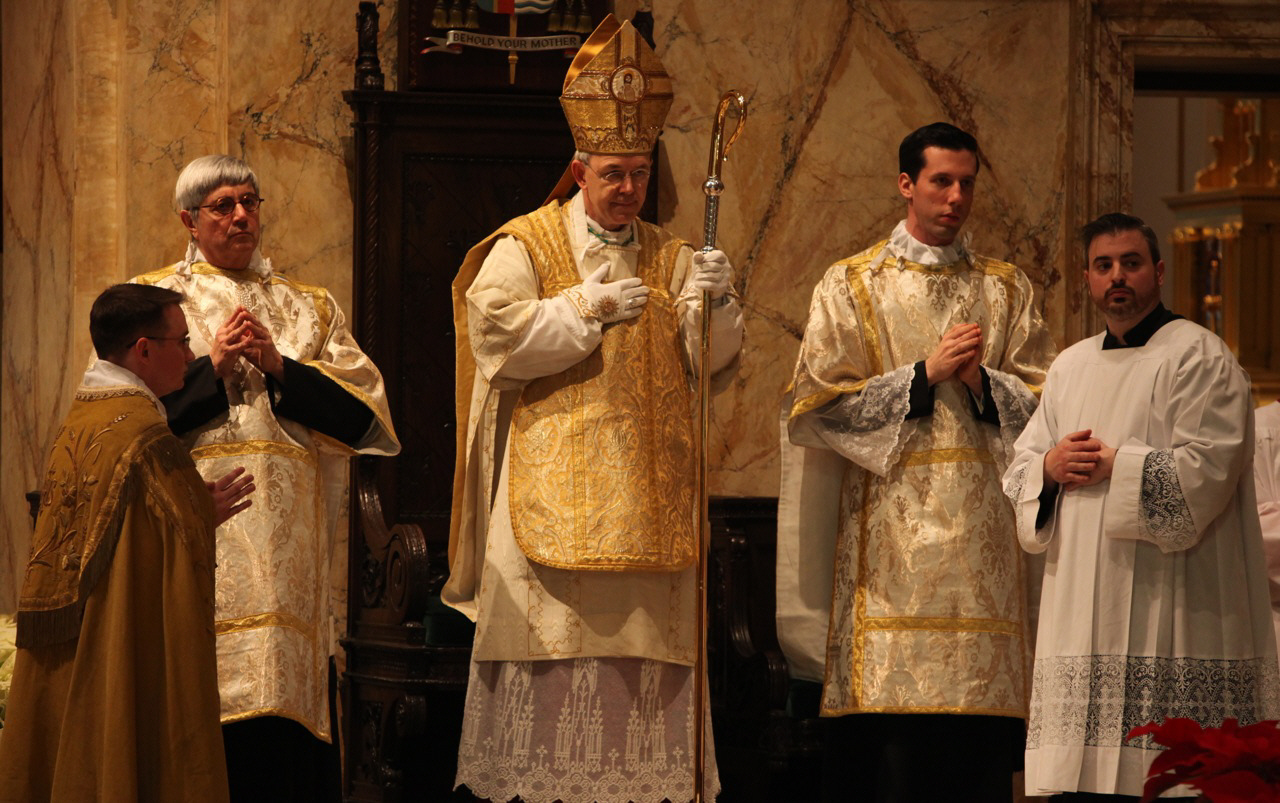
Photo provided by the Institute.
12
Jun
A Movement Advancing out of the Coronavirus Crisis
By early summer of 2021, Catholic Traditionalists had emerged from the grip of the coronavirus panic. They had survived in better shape than anyone perhaps expected. Throughout the crisis, Traditionalist priests on the whole had maintained a more generous schedule of Masses and had interpreted the restrictions much more liberally than elsewhere in the Church. This was not just because of conservative political suspicion of the whole affair. Rather, it reflected the foundational Traditionalist principle that preserving the Mass and the whole of Catholic tradition for the Christian people overrides “following the rules” – both ecclesiastical and secular – otherwise the governing axiom of the Catholic Church.
We continue to witness the beneficial consequences of SP. The lists of masses reported on this site – and their photographic record – speaks for itself. Just in one corner of my own diocese some 5 Traditionalist priests are now active where none were found 5 years ago. Remarkable, above all, is the outward, evangelical focus of Traditionalism today. Young priests, both secular and religious, celebrate the Traditional Mass without regard to the consequences to their own careers. The laity – as always, the dominant supporter of the celebration of the Old Mass – publicizes masses, processions and devotions by word and image. Now, in some corners, the old fears of publicity and of confrontation with clerical authority remain – I am thinking especially of the Ecclesia Dei communities. But this is now a receding aspect of Traditionalist life!
American Traditionalism retains its spontaneous, voluntary, even undisciplined character. I certainly admire the ties that exist in France between Catholic Traditionalism and patriotic, monarchist and even Maurrassian currents. This is not a defect, but a strength – no wonder Traditionalism first coalesced as a major movement in France! In the United States, however, virtually no “infrastructure” of this kind exists; no favorable social or cultural milieu supports preserving the Old Mass. And Traditionalism offers no economic or career benefits. As noted above, there is a perception that a cleric or seminarian who espouses Traditionalism has thereby given up any hopes of ecclesiastical preferment. In the United States, people commit to the Traditional Mass because they want to – regardless of the consequences. And, as ever, Traditionalism wins its new adherents only one by one – by offering to individuals the opportunity of experiencing the Traditional liturgy. Traditionalism continues on its chosen path regardless of whether millions or a handful join its ranks.
I would further note the increasing resilience Traditionalists display today. Inevitably, their rise generates conflicts with the clerical establishment(more on that later!). And even where no “ideological” confrontation exists, just the embedding, in accordance with the principles of SP, of Traditionalist communities within the established Church exposes them to all the ills of 21st century Catholicism. I am familiar, for example, with a parish described some fifteen years ago as a “Molokai” for clerical “troublemakers” – originally none of them Traditionalists! This church gradually adopted the celebration of the Traditional mass as its guiding – not exclusive – liturgical feature. That attracted new parishioners, families and apostolates (musical, liturgical, artistic and educational – even an elaborate coffee hour!). What had been an elderly church teetering on the brink of collapse had become a center of Catholic life – dare I even use that Catholic cliché,“vibrant.”? Within the last few years and for a variety of reasons, however, the original leadership was scattered – two priests now reside outside the diocese, one is deceased, one has been retired and one has assigned the duties of chaplain to a nursing home. Yet the celebration of the Traditional mass at this parish continues – after the coronavirus, once more with exemplary music and ceremony. Moreover, former parishioners of that parish – also scattered – have helped to found or expand some half dozen Traditional mass communities. The same observation can be made of the young priests who are often reassigned to the fringes of their dioceses – they then use the opportunity to build up the Traditionalist ministry there. Traditionalists cannot escape the problems of the Church – yet every reverse they suffer seems to yield an even greater harvest!
An Attack against Traditionalism is being Prepared
Of course, I could not foresee when I started this series of posts just a month ago that a long-feared Vatican move against Traditionalists would begin to take concrete form and indeed may be imminent. As always, I would recommend waiting to see what – if anything – emerges. People forget, for example, that in 2011, according to well-founded rumors, a move was underfoot in the Vatican to undercut SP by issuing restrictive regulations on its implementation. When the actual guidelines emerged, however, SP had only been reconfirmed. So let us see what actually is published. Moreover, some of the rumored restrictions (such as requiring diocesan priests to obtain permission from their bishop to celebrate the Traditional mass) resemble how SP is in fact administered today in most places – as a variant of the Ecclesia Dei indult.
The key consequence, however, will be a change in the political atmosphere. Any such document issued by the pope, whatever its operative provisions, will confirm once more the status of Traditionalists as an alien enemy within of the Catholic Church. It will send a clear message to bishops and religious orders that they now can take any restrictive actions against Traditionalists they deem appropriate without fearing any correction from Rome. Every clerical careerist will understand that protecting Traditionalists will be detrimental to his further rise in the organization.
Already we see evidence of such effects – what the Germans call “preemptive obedience.” In France, a long-established FSSP apostolate in Dijon was summarily terminated without explanation or discussion with any of the affected parties. Here in Connecticut a Traditional mass in the local Cathedral has been terminated without any reason being given. I would expect such examples to multiply.
The Ideological Basis of a Crisis
Traditionalists should not be surprised. For at the root of it all is a profoundly ideological disagreement with the “Second Vatican Council” – by which I mean the totality of changes introduced between 1962 and 1970. I would best summarize these developments as a process of conformity to the world of modernity. The leadership of the Catholic Church expected thereby to bridge over the gulf that existed between the modern world and the Church, to dissolve an alleged Catholic ghetto.
From its very inception, Vatican II failed in its mission of securing a safe home for Catholicism in modernity. On basic issues touching in one way or another every human family – divorce, birth control, abortion, homosexuality, euthanasia – modernity continually offered new developments ever more irreconcilable with the principles of Christianity – and even those of rationality itself. In turn, the Catholic Church came to resemble more and more one of the many monotonous bureaucracies of secular modernity: a business corporation, a government ministry or an educational institution. Given the institutional Church’s growing resemblance in style and substance to the secular establishment, certainly in the developed world, laity, clergy and religious saw no further need to remain in it. The result of Vatican II was an institutionalized, unresolvable crisis for the Church: declining Catholic resources coupled with unremitting pressure from the secular world, exercised in a hundred ways, for further conformity to its agenda.
Traditionalists are those who acknowledge no obligation to conform to modernity, who dispute the modern world’s claim to embody a final revelation. They emphatically deny to the modern age any semi-divine nature – indeed, for them “the world” has negative associations. Following the words of their Founder, Catholic Traditionalists understand conflict with this world to be a normal aspect of life for the Church – not a regrettable tragedy. The concrete expression of these principles is the celebration of the Traditional Mass – a form of worship that arose entirely outside of the culture, politics and ideology of modernity.
Accordingly, regardless of what they might be saying about these broad spiritual topics, just by celebrating of the old Mass, Traditionalists constitute a reproach to the ideology of the establishment in a way, let us say, that pro-abortion Catholics do not. The indictment is all the stronger in that the Traditionalists are growing, not declining. Their flourishing holds up an unflattering mirror to the failure of the grand dreams of the Council. From the beginning hostility was inevitable, since the institutional Church, like its secular equivalents, is incapable of self-reflection or of reexamining its principles. No “hermeneutic of reform in continuity” could resolve this “clash of cultures.”
Actions such as those Pope Francis is contemplating are proof of the establishment’s weakness, not its strength. The need to stoop to strongarm tactics only demonstrates how little authority Vatican II actually has. We might say the same about Bishop Barron’s claim that the documents of the Council need to be better explained. But hasn’t the Church been doing that for 60 years? Are we not admitting that the verbose documents of the Council are themselves the greatest barrier to understanding?
Nor do I think the political context is right for this kind of thing. Any measures taken against Traditionalists will be juxtaposed with the ongoing synodal path in Germany – which Francis himself is fostering. Nor will comparisons be lacking with Francis’s efforts to derail consideration of the abortion issue in the US Church. Potential restrictive measures against Traditionalists of course constitute a clear change of course from SP, issued just 14 years ago – a sense of bad faith on the part of the hierarchy is all too perceptible. Observers will also be struck by the contrast between the Pope’s treatment of a more youthful, growing segment of the Church compared to the favor shown to groups in decline: the mainstream religious orders, much of the educational system, the European episcopates etc. The consequence of these reflections will be a further massive loss of credibility for the Catholic Church.
Do I need to add that these rumored actions are an incredible insult to the author of SP, Pope Benedict, who, after all, is still alive? That they are further evidence of how correct was the course of the FSSPX in rejecting various offers of reconciliation by the Vatican – the last such formal occasion being in 2012?
“Stay the Course!”
Given the above facts, I would advise calm. Traditionalism is strong. Traditionalists should continue as before and let their opponents make the first moves. Certainly our Society of St Hugh of Cluny is developing several major projects for the second half of this year – and we are assuming that they will be realized. Sharing of information among Traditionalists will be, however, critical. Over the years, we have often remarked on the lamentable communications gaps that exist right here in the New York area, let alone nationwide. Fortunately, attempts to address this deficiency are already underway.
What if significant restrictions are imposed? Could the experience of adversity even be beneficial to American traditionalism? The French website Paix Liturgique, in an important essay, reviewed the French experience leading up to the indults and SP. It highlighted an important fact – often overlooked by American Traditionalists – that the gradual recovery of the right to the Traditional Mass was not a disinterested gift of the Vatican, of Popes John Paul II and Benedict. Rather it was also a right fought for and won by the efforts of many among the clergy and laity – principally, of course, Archbishop Lefebvre and his followers. Starting as early as the 1960’s, their activity created public pressure that eventually induced the Vatican to progressively lift restrictions on the Traditional Mass.
The American experience was different. Here, prior to the indults, the work of the FSSPX and of the independent priests was more marginal. The permission for the Traditional Mass in the 1980’s was, in the American perspective, a gratefully received gift from above. Will Americans fight to defend these rights, apparently so easily obtained?
I am confident the answer to that question is yes. For since the 1980’s Traditionalists here have had more experience of working together. Moreover, they have on occasion stood their ground against authority when challenged. For example, when in 2014 the New York Archdiocese proposed closing Holy Innocents church – one of three Manhattan parishes that regularly celebrated the Traditional Mass – parishioners organized a massive action involving extensive publicity in secular media. And the key argument of the defense was preserving the Traditional Mass in New York – its celebration at Holy Innocents was illustrated by a beautiful video. Ultimately the archdiocese backed down and to the present day Holy Innocents remains an active parish with an ever-growing congregation. Not all actions challenging the targeted closing of Traditionalist parishes have been as successful. But Traditionalists can learn from these campaigns – if the need presents itself.
The only real danger I see is that Traditionalists would succumb to the temptation to conform to the establishment, to water down the message of Traditionalism in order to reach an accommodation with the ruling ecclesiastical powers. We have experienced in the not-too-distant past Traditionalists engaging in self-censorship in an attempt to win the favor of the clerical masters of this or that parish, diocese or order. And at the present moment, we see the related phenomenon on the internet of alleged Traditionalists such as Steve Skojec and Michael Warren Davis launching attacks against Traditionalists – employing rhetoric similar to that employed by Pope Francis, Bishop Barron, the French episcopate, etc.
Such tactics, assuming they are meant honestly in the first place, are extremely short-sighted. Do these people imagine that the “powers that be” of the Church will for one moment agree to any kind of durable compromise on such matters? Their actions and statements are only welcome to them as a tool for discrediting Traditionalists.
For the strength of Traditionalism is its nature as a spiritual and religious movement – in contrast to the ideology of today’s Catholic establishment. Beyond all discussions of tactics, Traditionalism’s aim always remains the greater glory of God, not arranging an accommodation with worldly powers or achieving secular economic or social goals. Catholic Traditionalism will remain vital as long as it adheres to these principles, however “rigid” and “unyielding” they may be.
To the present-day Traditionalists have kept this faith. And some sixty years of experience have shown that people will continue to respond to this message.
“Never ask if meaning it, wanting it, warned of it – men go.” (Gerard Manly Hopkins)
The saga of American Catholic Traditionalism will undoubtedly offer many more surprising and glorious chapters!
12
Jun

Manny Albino shares this image of the interior of his old parish, Mary Help of Christians. We reported on its demolition in 2013 – also here. The site is now occupied by luxury apartments.
10
Jun

This Friday, June 11, is the Feast of the Sacred Heart. The following churches will offer Traditional Masses.
St. Mary Church, Norwalk, CT, 8 am Low Mass
Basilica of the St. John the Evangelist, Stamford, CT, 7:30 pm, Missa Cantata.
Sacred Heart Church, Georgetown, CT, Patronal Feast Mass, 6 pm. There will be confessions available during Holy Mass, which will be celebrated by Father Peter Lenox. The Viri Galilei, under the direction of David Hughes, will provide the chant and music. After Mass there will be a procession and Benediction and a festive reception will follow.
Our Lady of Mount Carmel, New York, NY, 7 pm, Missa Cantata.
St. Josaphat Church, Bayside, Queens, NY, 7:30 pm, Solemn Mass in front of the exposed Blessed Sacrament with procession. Fr Saffron, Fr. Frantisek and Mr. Joseph Falciano as subdeacon.
St. Paul the Apostle, Yonkers, NY, 12 noon.
St. Mary Church, Washingtonville, NY , 7 pm, Solemn Mass.
St. Anthony of Padua Oratory, West Orange, NJ, 9 am, 7 pm.
St. Stephen Church, Kearny, NJ, 7:00 pm Missa Cantata,
8
Jun

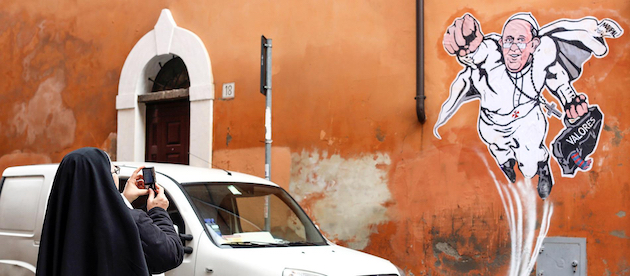
Katholisch.de (the voice of the German Catholic establishment) affixed the above image as an introduction to Pope Francis’s latest statements:
“‘Superman’ priests always end badly”… “The fragile priest, who knows his weaknesses, will do well”… The head of the Church also warned against preconceived ideas and plans….