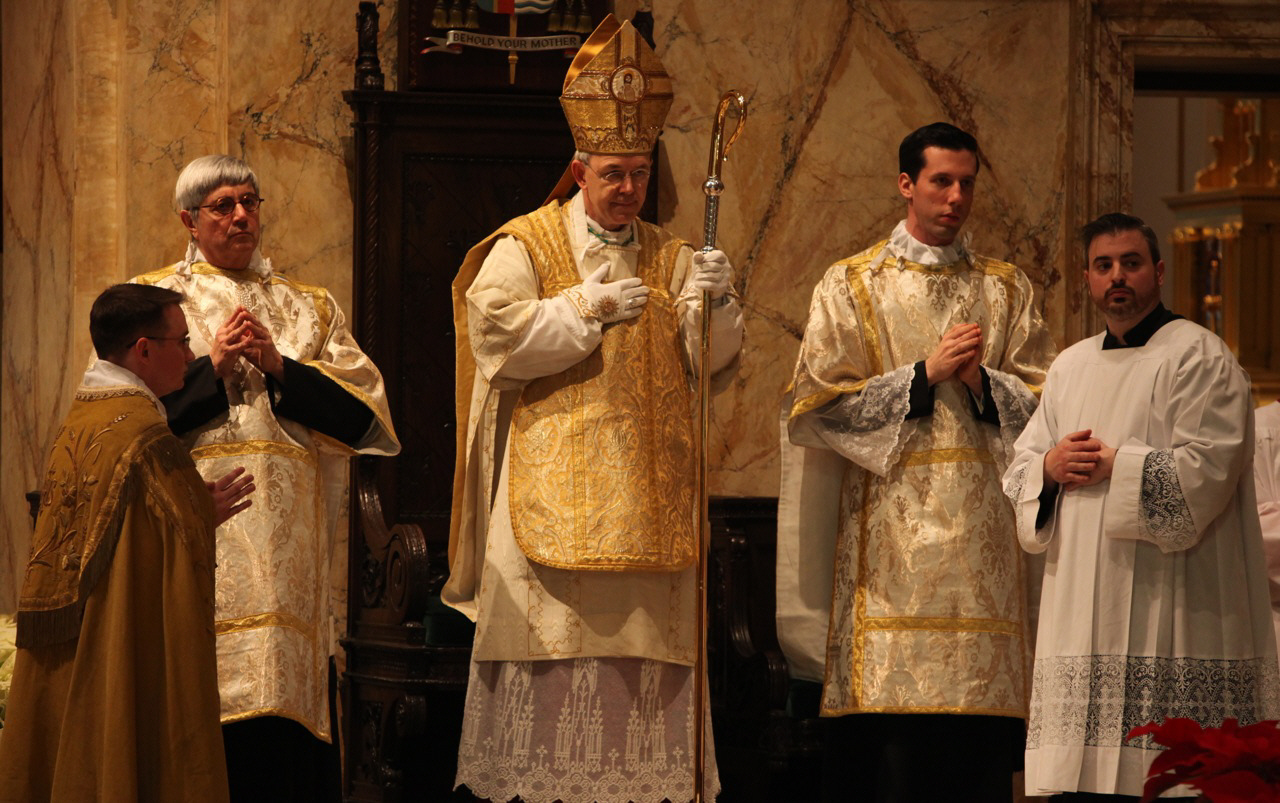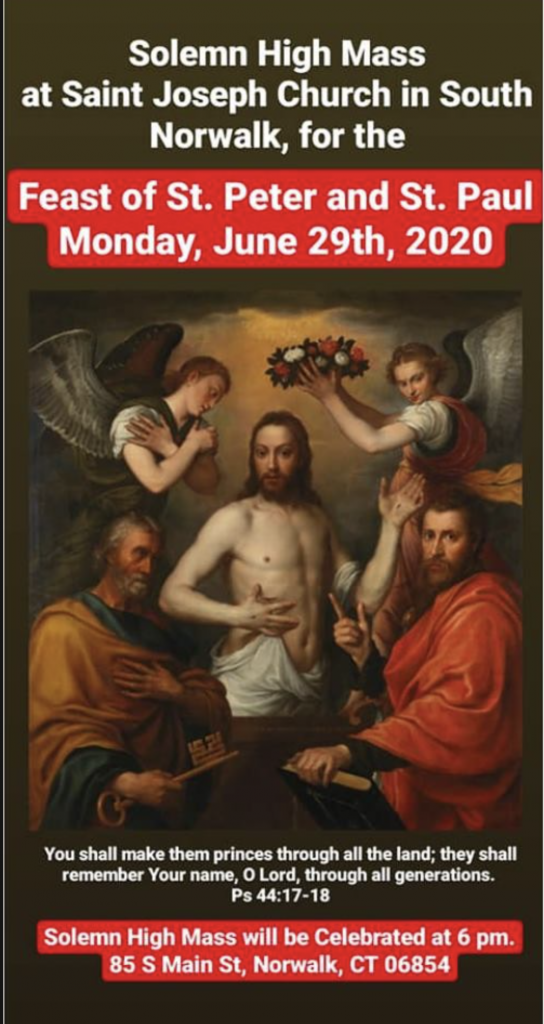
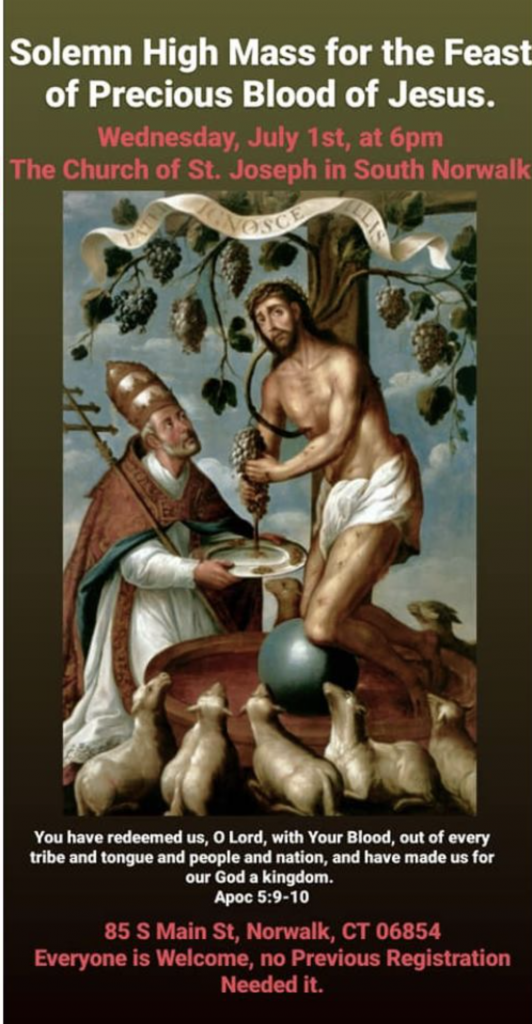
Frs. Kachuba and Iannacone will be offering Low Masses every week from now on on Mondays and Thursdays at St. Pius X Church in Fairfield, CT at 7 pm.
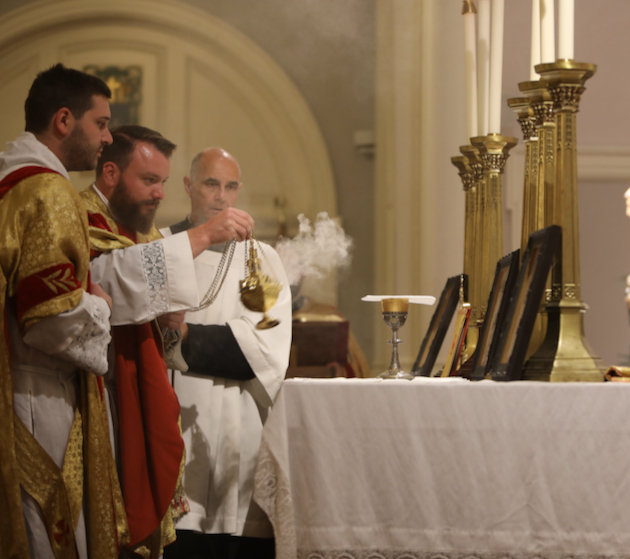
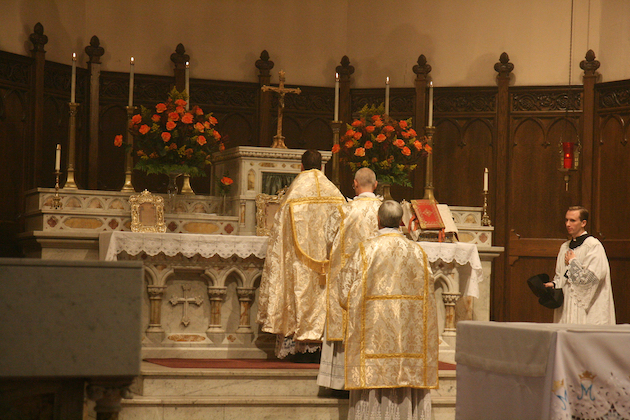
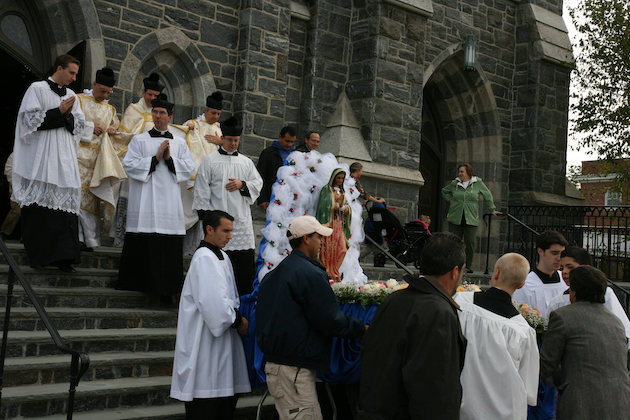
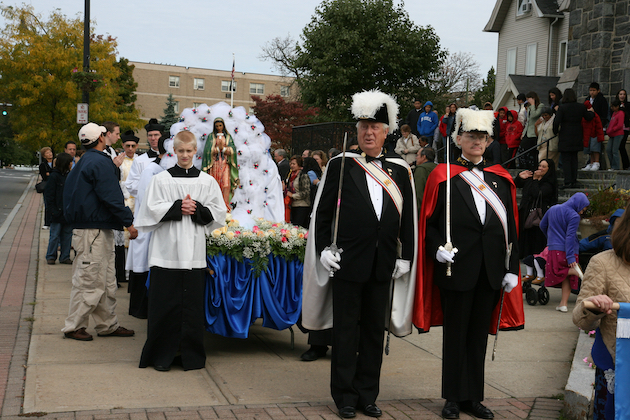
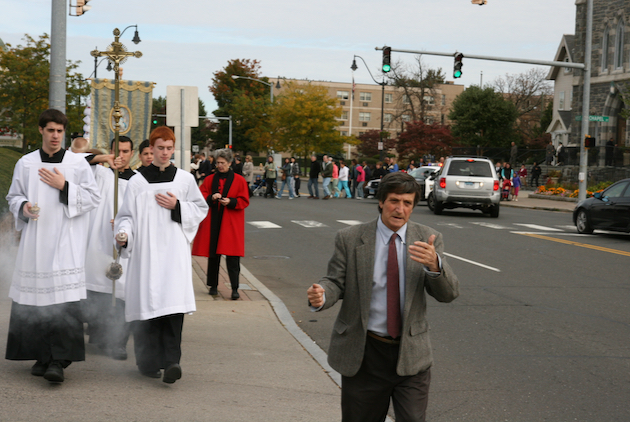
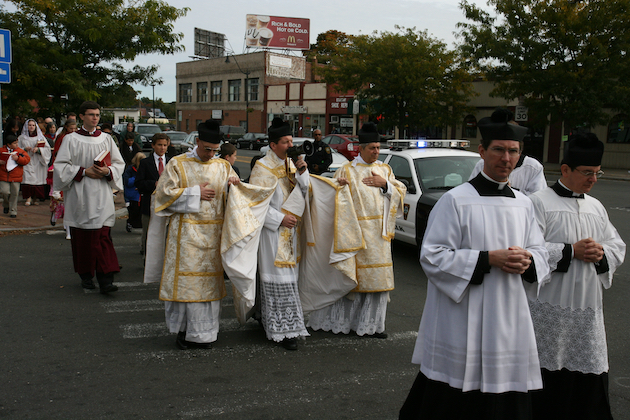
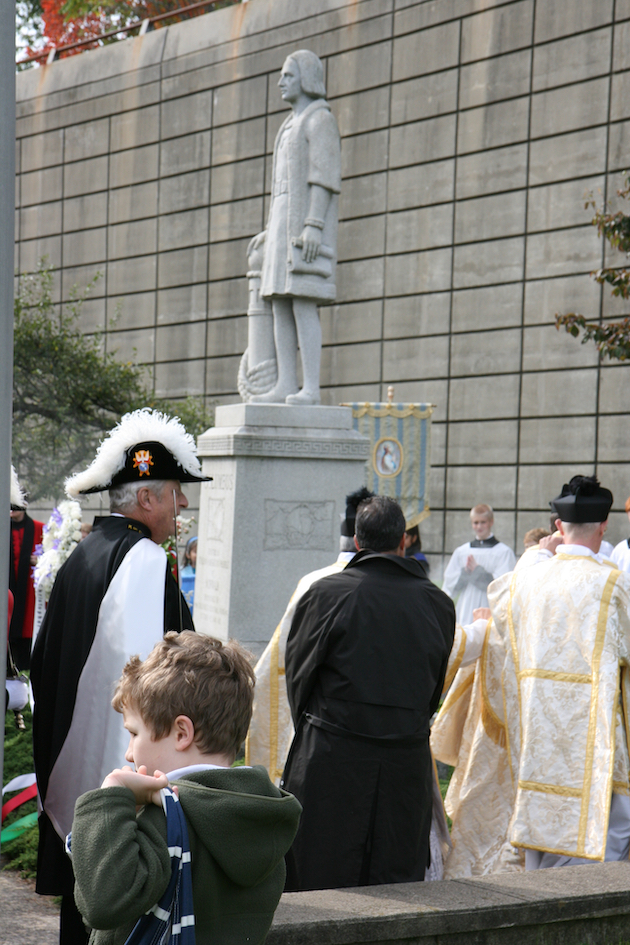
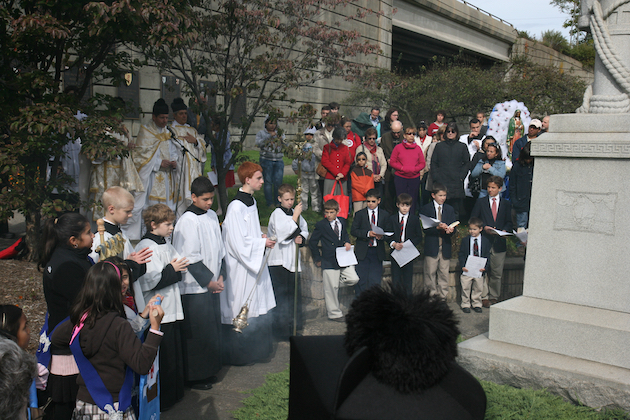
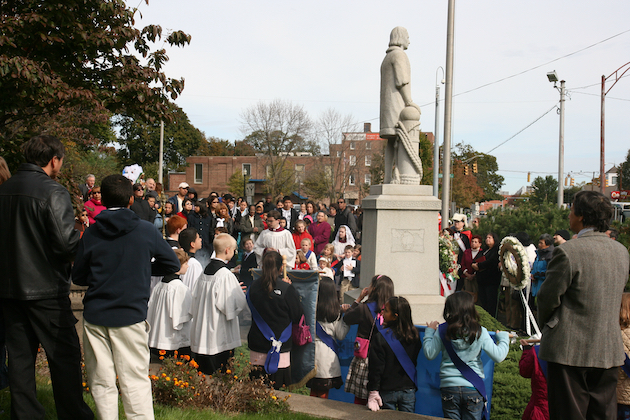
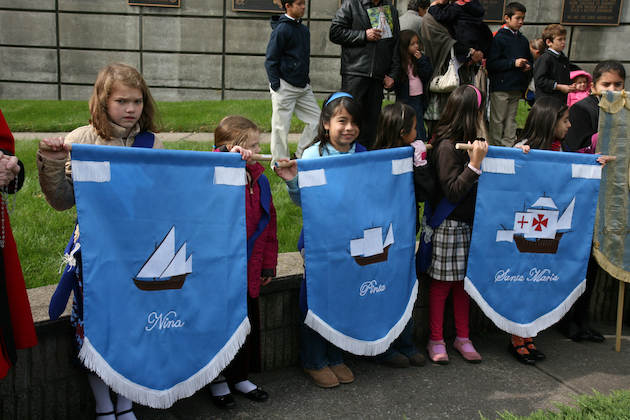
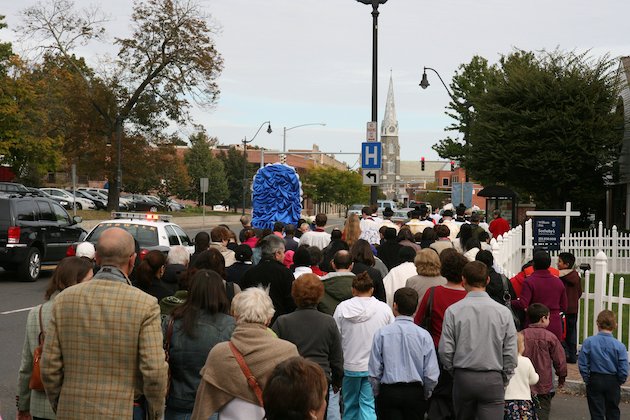
Under the prior management of St Mary’s parish, a Columbus day procession to this nearby statue was an annual event. Above is a set of pictures from the 2009 procession. It features several prominent former members of the parish, living and deceased, clerical and lay (including the current pastor and his two predecessors).
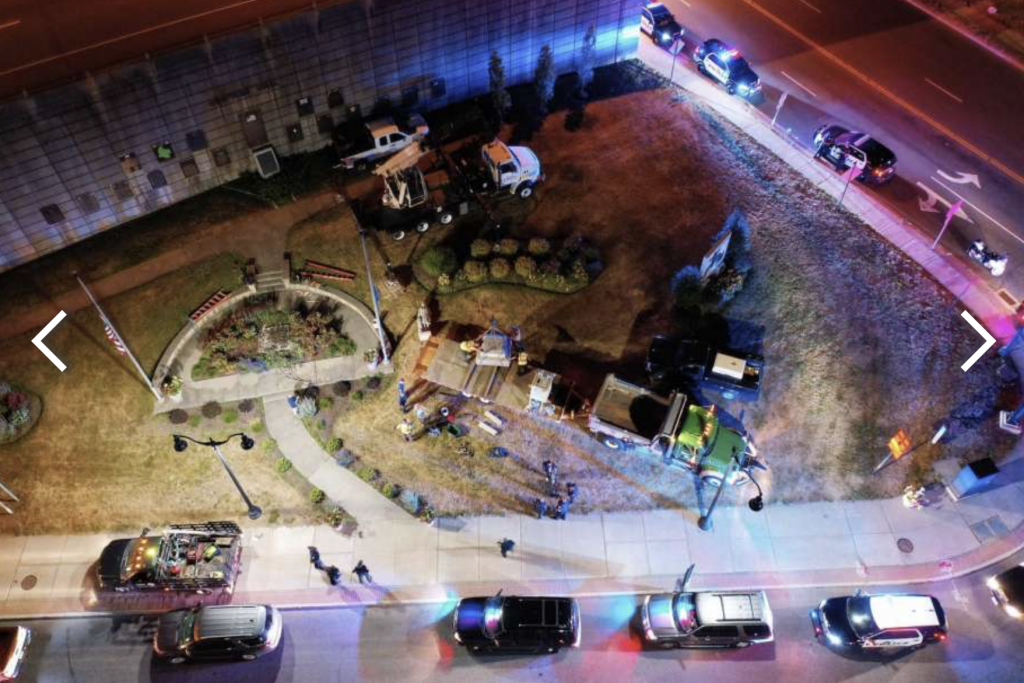
Now the statue is summarily removed. The current pastor of St Mary’s says nothing. The bishop of Bridegeport says nothing. And the Knights of Columbus (will they be changing their name soon, along with their uniform?) say nothing as well. Even though they have all the big mouths of Cruxnow on their retainer.
Will Catholics finally wake up? Does this not tell you what the American establishment (of which the mayor of Norwalk, CT is a petty peon) actually thinks of you? You should have learned that lesson a long time ago – by 1973 (Roe v. Wade) at the latest. And the lessons about the “American Catholic Church” are too obvious to require commentary.
UPDATE:
A measure to protect the statue? Iconoclasts had that strategem figured out 1200 years ago when initiating an iconoclastic revival:
…(The emperor) Leo (V) determined to act on his own account, but he did so in a typically tortuous and underhand way. The scene chosen was the Chalke Gate of the palace where, eighty-eight years before, Leo III had pulled down the picture of the Saviour. This picture had been restored by Irene, but was now to be desecrated once more. On secret orders of the emperor, some guardsmen gathered at the porch and began to throw stones and mud at the image, uttering the most fearful imprecations. Out came the emperor: “We had better take that down,” he said, “lest the soldiery dishonor it.” And down it came.
Jenkins, Romilly, Byzantium: the Imperial Centuries A.D. 610-1071 at 134-135 (Random House, New York, 1966)
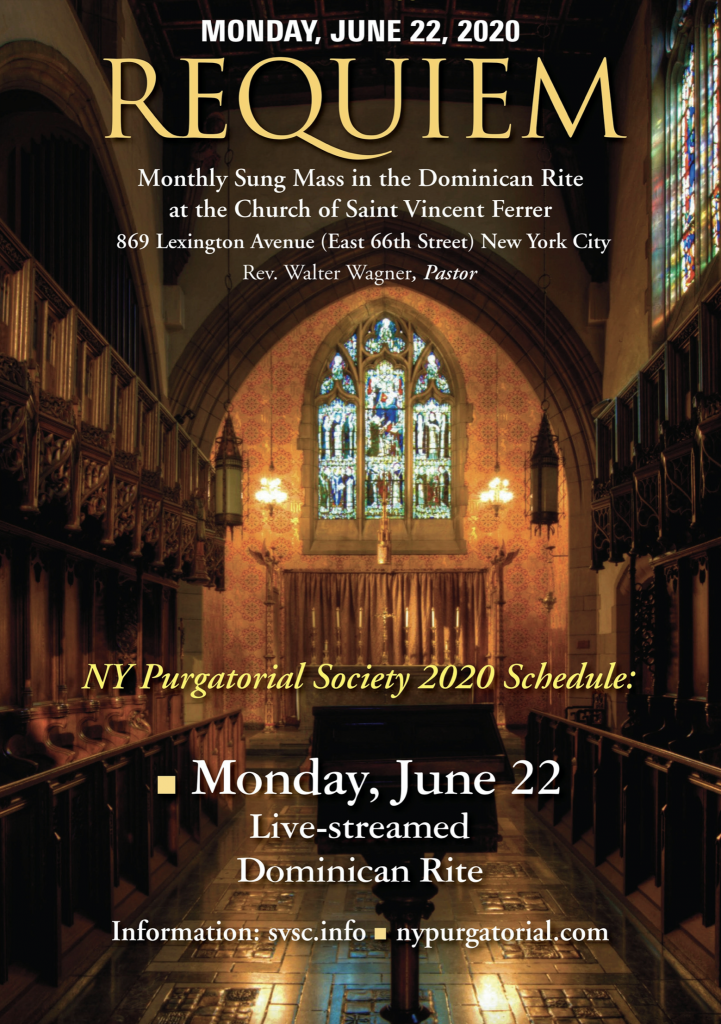
The Mass is at 7:00 PM.
at direction of our media, other statues are rising:
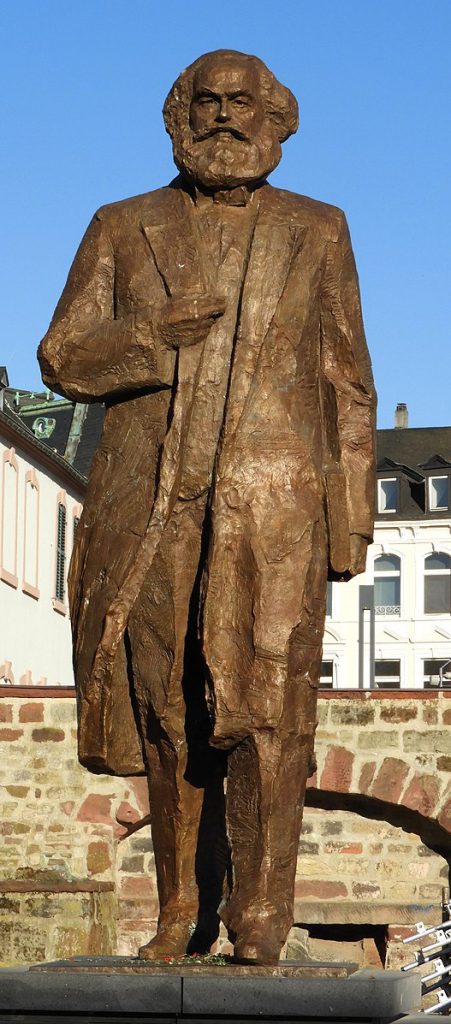
After months of discussions, Trier (in Germany -SC)city council voted on Monday in favor of accepting a 6.3-meter (21-foot) bronze representation of the revolutionary socialist thinker Karl Marx. Council members in the southern western German town voted by a majority of 42 to 11.
The debate over the gift began last year when China announced that on the occasion of Marx’s 200th birthday on May 5, Beijing would present the economist’s hometown with a bronze statue.
“Trier accepts controversial Karl Marx statue from China”
There the statue of the “economist” has stood since 2018. in an allegedly “Catholic” region of Germany.
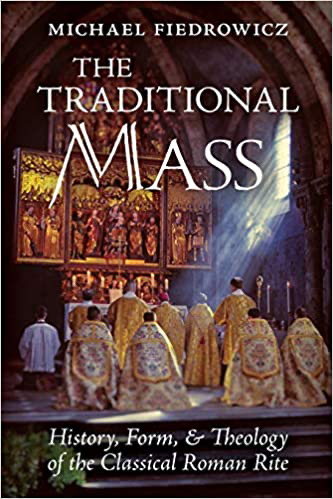
The Traditional Mass: History, Form and Theology of the Classical Roman Rite
By Michael Fiedrowicz.
Translated by Rose Pfeiffer
Angelico Press, Brooklyn, NY, 2020
A wonderful addition to any Roman Catholic’s library is the new translation of Fr. Michael Fiedrowicz’s The Traditional Mass. For the moment, it is the definitive handbook on the Traditional liturgy: what it is, how it arose, what it means and how to celebrate it. Perhaps most astonishing is that the author is a professor at the Theologische Fakultät (School of Theology) in Trier, Germany. He has published extensively in the field of patristics.
The first thing we note with pleasure is that the author is committed to the Traditional Mass. He writes as a passionate supporter, not a distanced observer, let alone an adversary. And he views the Mass as a whole: the texts, the music, the ceremonies, the readings all taken together. It is quite a contrast to most pre-conciliar authors (even Adrian Fortescue) who seemed to reduce the Mass to a jumble of rules and texts arising from historical accidents. Fiedrowicz does not hesitate to draw on the riches of the symbolic and allegorical interpretations (especially of the medieval liturgists) to demonstrate the unity and meaningfulness of the Mass. And of course he devotes many pages to the theology of this Mass.
Equally surprising – but so very welcome – is that Fiedrowicz approaches the Traditional Mass as a living rite of the Church (which, after Summorum Pontificum, it fully is – at least on paper). The author in fact draws heavily on the experience of the post – Vatican II, post-Novus Ordo era. It is heartening to see prominently among these sources the works of Martin Mosebach, who has so often appeared in this blog. Or those of Michael Davies, who fought for the Traditional Mass for so many years. Like Mosebach, these authorities are often not “official” liturgists at all. Certainly that is no detriment if the author’s purpose is not to win plaudits in academia but to describe and even advocate a cause very much alive. For Traditionalism has had to develop largely outside the domain of the Catholic academic establishment.
Yet there is another reason Fiedrowicz cites the witness of artists: Mosebach today; Huysmans, Gertrude von Le Fort, Ida Görres and especially Claudel in years gone by: “ People of aesthetic sensibility, much scorned and suspect, are the recipients of a terrible gift: they can infallibly discern the inner truth of what they see, of some process, of an idea, on the basis of its external form.”1) Fiedrowicz discusses in his book the necessary link between the sacred and the beautiful
Fiedrowicz systematically outlines the case for the Traditional Mass, covering virtually every issue and objection a Catholic Traditionalist needs to consider and address. Most importantly, he shows that the Traditional Mass is in direct continuity from its earliest manifestations in the Fourth Century (and before) to its formalization at the Council of Trent. Fiedrowicz then illustrates “organic development” by looking at those additions that were made and how they proceed from the basic structure of the liturgy. He makes the case for Latin, as a “Sacred language,” the Traditional liturgical seasons and for celebration ad orientem. He explains the meaning behind the orations and the cycle of readings. There is even a lengthy discussion of all the various names for the Traditional Mass: the “classical rite,” the “Tridentine rite,” etc.! And in a very sensible and very un-German manner he sees this terminological issue as having secondary importance. Do I need to state that our author’s conclusions on the liturgy accord with what the advocates of Catholic Tradition have been writing over the last 50 years? The Catholic Mass, however, clearly summarizes all these positions is in one volume; in that respect it is a unique compendium.
Let me end this review with an observation I also made concerning the first English-language edition of Martin Mosebach’s Heresy of Formlessness. After considering the facts and conclusions so ably and compellingly presented by Fiedrowicz, is the Traditional Mass not a prerequisite for any real Catholic recovery? Do not the arguments Fiedrowicz presents inevitably lead to the conclusion that the Traditional rite should be made a rule one more for the entire Western Church? That it should no longer remain an option reserved for some kind of elite or subculture but become once more a common treasure accessible to all? So I would conclude! In the meantime, before that happy event occurs, I would highly recommend this book as the best systematic treatment of the Traditional Mass available today.
15
Jun
Uprooted: Dialogues on the Liquid Church
By Aldo Maria Valli and Aurelio Porfiri
Translated by Giuseppe Pellegrino
Chorabooks, Hong Kong, 2019
To comprehend the great events and trends of our time do we not turn first to the witnesses, even the direct participants, for the most immediate and elemental insights? Didn’t Whittaker Chambers’s Witness and the works of Aleksandr Solzhenitsyn bring about a long term change in the world’s understanding of communism – regardless of what the American establishment and the European intelligentsia had been pontificating? The same holds true for the Church of today.
Witnesses of what is going on in the Church whose testimony I value have come from many perspectives and schools of thought. The witness of Catholic novelists (e.g., Alice Thomas Ellis, Martin Mosebach) has proven over the years to be particularly valuable. Then, we have the testimony of the “conservatives,” politically right-wing yet stalwart defenders of the Catholic establishment until confronted by developments that could no longer be swept under the rug (Mgr. George Kelly in the 1970’s, Philip Lawler and many others in the age of Bergoglio). There are even those who started out in the camp of Catholic progressivism and moved to Traditionalism (Malachi Martin). We have the “searchers,” the outrageous, the atheists and even the dedicated enemies of the Church who nevertheless offer important insights ( M. Houellebecq, M. Onfray, O.Fallaci, F. Martel).
Finally we encounter in Uprooted Aldo Maria Valli – a Catholic journalist, (born 1958) – and Aurelio Porfiri, a writer and musician (born 1968), cradle Catholics who have recently emerged from the heart of mainstream Italian Catholicism. For years they were closely associated with the ecclesiastical establishment. Aldo Valli worked as a journalist for Avvenire, the mouthpiece of the Italian episcopal conference, and even was on close terms with Cardinal Martini, archbishop of Milan, the patron saint of Catholic progressivism. Aurelio Porfiri performed widely as a church musician. This slim book is a dialogue between them on the state of the Church and how they came to their current views of it.
Now for the not totally insignificant minority of Italian Catholics who still practice their faith, loyalty to the Papacy was and is of preeminent importance. Each Catholic country has, after all, its own personality. In complete contrast to France or Germany , but like pre-1988 United States Catholicism, being a Catholic in Italy was synonymous with loyalty to the pope, the hierarchy and the establishment. For until recently, the controversies among Catholics on the right over liturgy, pro-life witness and the state of the Church made no impression in Italy except for a tiny elite (Count Neri Capponi, Augusto del Noce). Only the far left of the Church could speak out loudly and distinctly. Both Valli and Porfiri speak emotionally of the cult of the papacy and of the prior individual popes they had known who had meant so much to them even in their private lives.
Under Bergoglio, this state of mind ended. Indeed, Valli speaks of a “conversion,” of the falling of a “veil” that had obscured his vision. In the case of Valli, reflections on Amoris Laetitia led to a sudden break with the ultramontane culture. Porfiri, a church musician, had had a more gradual development of his views based on what he saw and heard week after week. Once he had the experience of a choir singing more traditional church music and asked himself: “Why has this music been forbidden to us”? In both cases, our authors suddenly realized that within the one institution of the “Church” there were in fact two entities: one modernist, the other still Christian. This insight led them to a re-evaluate their understanding of a whole series of topics. Their exchange of ideas makes up the bulk of Uprooted. Let me quote from it!
The first topic they have to address is the ultramontane papacy. “The reigning popalatry was largely born with Pope John XXIII.” (From the opening of the Second Vatican Council) “the Pope was no longer simply head of the Catholic Church but a media personality whom the mass media bent to the logic of emotions and entertainment.” (With Pope John Paul II) ”…we had a pope who was praised more and more in his personality and less and less followed in his faith.” “…the consequences are devastating. Emotion prevails over reason, images over words…the World Youth Days were the triumph of this sort of narration. And yet while all this was happening, the churches were emptying, the faithful were falling prey to relativism imposed by the prevailing culture, traditions were being abandoned….” Then there is the cult of obedience associated with ultramontane papalism. “The insane papism we are witnessing in our days is the child of ignorance and manipulation.” (The cult of blind obedience) “means there is an absolute identification between the faith and the institutional church, which instead is meant to be at the service of faith.”
The liturgy? Aldo Valli speaks of the innumerable “sloppy liturgies” with their “sentimental songs and music, liturgical abuses, exaggerations, excessive focus on the celebrant’s personality, misinformed laity, a lack of respect towards Our Lord, the absence of a sense of the sacred, contempt for silence, no reverence and all getting progressively worse over the last few years.” All features almost universal in the liturgical life specifically of the Italian Catholic Church! “In the course of a few decades we Catholics have allowed ourselves to be despoiled of a spiritual, religious and liturgical inheritance which was guarded and handed down for centuries and centuries.”
On the Church today: “Sometimes, even often, I no longer feel at ease in the Church, I feel like I am out of place and frequenting Catholic circles does me no good. I feel uprooted. …I understand that if you want to be accepted…you must uncritically embrace the narrative of a Church that is now liquid, as Vittorio Messori has said. But I don’t feel this way, it is not for me, I prefer a self-imposed exile living at the margins of official Catholicism, where what is exalted is charismatic and. Pentecostal religiosity, emotionalistic in the extreme, and clearly coming from a Protestant background. This is not the Church in which I feel my faith grows and becomes stronger.” Do I need to mention that both authors have paid a steep professional price for the positions they have taken? For the “Church of Mercy” is unforgiving!
Regarding clerical sexual abuse: “many maintain it is a question of discipline, when in fact it is a question of faith!” “[O]nly if I believe in God who became man and died and rose for me, for the forgiveness of my sins, can I live in the light of divine law.” Both authors have very strong words about the current state of the Catholic clergy – both their lack of faith and their lack of knowledge – and the terrible responsibility of these priests for the disastrous situation in which the Church finds itself.
An interesting chapter deals with homosexuality in the clergy and the famous “gay lobby.” The authors perceive its influence in the recent “Synod on Young People” and in “a certain type of religious sentimentalism, deprived of virility and extremely feminized.” “Responsibility for this must be identified at different levels, from seminaries up to the highest levels of the Roman Curia.” Here the thoughts of our authors seem to confirm what Frederic Martel describes in his In the Closet of the Vatican – obviously from an entirely different perspective!
There is so much more! Almost every sentence of this short book seemed to me a succinct summary of a feeling or an impression most of us have undoubtedly experienced. As I have noted, our authors have paid personally for “daring to name these things with a raised voice.” And they confess they are unable to offer any immediate solution for the Church. They do have a chapter on the positive role of social media – indeed, in the last ten years, Traditional Catholic Italian sites have achieved worldwide prominence. But nevertheless Valli and Porfiri have to ask themselves the stark question: “Will we die as Catholics”? But, by telling the truth, by becoming witnesses, have they not gone far in laying the foundation for recovery at some time in the future in some way unknown to us? For is not truth the prerequisite, the indispensable foundation, for everything else?
In the first half of 2020, life in the “ developed world” world came to a shuddering standstill. The pleasant cocoon surrounding the populations of Western Europe and the United States seemed to disintegrate and apocalyptic hysteria seized the upper hand. The media and forces of the establishment, for their own reasons and based on murky data, seized the opportunity to whip collective fears into a fever heat. Suddenly a culture devoted exclusively to money, sex, pleasure and bodily health had hit a road mine. The denizens of the global society without limits had to confront limitations – even, at least in their own minds, the possibility of imminent death. Overnight a quasi-totalitarian regime was imposed, in which the state was empowered to regulate, in the greatest possible detail, public, business, religious and even personal life. (Here in Connecticut, for example, the governor devoted considerable efforts to deciding whether beauty salons can use blow dryers ). We are slowly re-emerging “from under the rubble” of the pandemic. Yet within days a new crisis has been ignited.
As we have done almost every year since 2013, we will reflect upon the current status of the Catholic Traditionalist movement; its successes, failures and outlook. What are the next steps for Traditionalists seven years into the pontificate of Francis? Although we confine our efforts to the United States, of necessity these reflections will stray from the narrow confines of the “American Catholic Church” as appropriate.
Regarding the Church, we can only record the abysmal failure of the hierarchy, of the Catholic institutions and of the Pope. In the greatest domestic crisis in decades, the clergy have been silent, the state discontinuing their “services” as “non-essential” – with their own concurrence. Nor did we see a wave of discontent about that among the laity, as, depending on the location, churches were locked, masses were suspended and some or all of the sacraments were withheld. Catholics died in hospitals and nursing homes alone without the presence of their family or clergy and bereft of prayers or the sacraments. The hierarchy took its direction from the media, the government bureaucrats, the scientists and, to the extent avoidance of liability was involved, the lawyers. Right now the dioceses of the New York area are issuing page after page of regulations on the resumption of masses and the sacraments, which are obviously more concerned with avoiding legal exposure that the good of souls.
The permanent damage of these days will be enormous. For in all honesty, is not sheer inertia the greatest force propping up the post-Vatican II Church among the laity ? How many of the minority which still regularly attends Mass will return after this interruption of months? And how many others will remember with resentment the passivity of their shepherds? At a minimum, an institutional decline that has assumed record levels under Pope Francis will only accelerate.
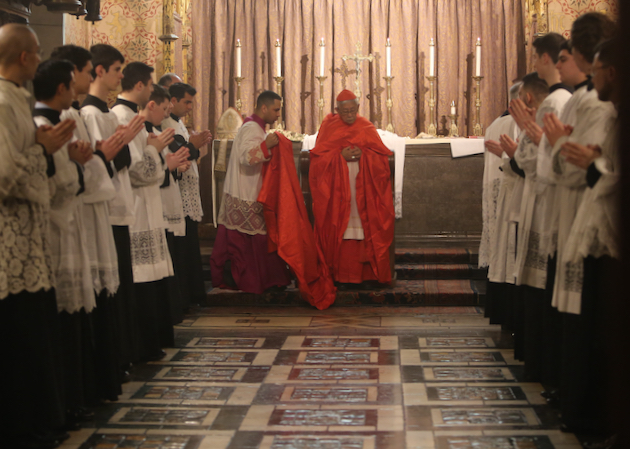
But where does Catholic Traditionalism itself stand? Before the grand shutdown, celebrations of the Traditional Mass had been growing by leaps and bounds both in quantity and quality. The movement had been successfully passed on to a new generation of priests and laity. Monasteries such as Silverstream or Norcia – situated outside the US but closely linked to US Traditionalism – were flourishing, overcoming incredible obstacles of all kinds. At home, the celebration of the Traditional Mass had moved into cathedrals and basilicas. It seemed that each year brought new accomplishments. In the New York area, early 2020 saw not just one but two solemn pontifical masses celebrated by cardinals. Just recently even the New York Times had to acknowledge -viewed from their perspective of course – the new popularity of Catholic Tradition among younger “weird” Catholics. Meanwhile, Traditionalists assumed more and more the role of leaders of the overall Catholic right as their conservative allies (and erstwhile adversaries) fell into ever greater confusion and intellectual chaos in the face of the unshakably radical course of Pope Francis & Co. indeed, a sign of the maturity of the Traditionalist movement today is its independence from the need of Vatican favor. If 15 or 20 years ago Traditionalist events such as the annual Chartres pilgrimage felt compelled to insinuate – falsely – in words and images that Pope John Paul II supported their endeavors I doubt anyone would make the same claim today for Francis!
Yet the great coronavirus panic largely brought the celebration of the Traditional Mass to a halt. We have seen the vitality of the movement, however, in the high number of Traditional Masses that have been streamed in these dark days. And Traditional priests- at least some of them- have been more willing than the others to bend the rules to keep at least some semblance of the sacraments available. Let’s also not forget that – even if it happened outside the United States – it was the French Traditionalists, not the indifferent French hierarchy, which obtained in court the reversal of state measures restricting the celebration of the Mass in that country. Nevertheless, Traditionalists too will face fallout arising from their conduct during the pandemic.
More regrettably, the last year has seen an outbreak of bitter infighting among Traditionalists themselves on a national, regional and local level. Once more the FSSPX has become a target. A well-known Traditionalist parish in the Northeast has been torn apart by intramural conflict among clergy and laity. Conflicts have erupted routinely on all kinds of occasions. Some of this is a natural consequence of growth, as Traditionalists deepen their interaction with each other, the rest of the Church and the world and encounter new and unanticipated points of friction. But much of the current agitation arises from sheer stupidity and inability to subordinate individual wishes and grievances to the common good of Catholic Traditionalism.
The institutional adversaries of the Old Mass have hardly been inactive either. As the Traditional Mass gains greater visibility in the “Catholic public square,” the machinations and maneuvers of the Catholic establishment against Traditionalism continue and even intensify. In some cases, perhaps unsurprisingly, the instigators of anti-Traditionalist vendettas were not the clergy but the aging laity of the Vatican II generation. Here a Traditionalist professor is forced out of a “Catholic” college; there a Traditionalist priest is dismissed from his parish and made chaplain of a nursing home. Diocesan clergy committed to celebrating the Traditional Mass are subject to all kinds of harassment and chicanery, while certain priests who only occasionally celebrate the Tradional Mass continue to demand that they not be identified or photographed. There were still instances where the Traditional Mass, even a Nuptial Mass, could only be celebrated on a semi-clandestine basis. (N.B. This was before the imposition of the current restrictions!).
We have previously spoken of the hostility of the current pontiff to the Traditional Mass – I don’t think anyone doubts that. Recently, however, speculation has revived once again that Bergoglio might be considering imposing restrictions of some kind on its celebration. This fear has been prompted by the circulation by the Vatican to the worlds’ bishops of a tendentious questionnaire on the status of the celebration of the Old Mass. Also, certain bureaucratic moves and restructurings (e.g., the abolition of the Ecclesiae Dei commission) in the Vatican lead some to think that a clique adverse to Traditionalism is consolidating its power. Curiously, some of the more recent developments took place after the release by the Vatican of optional new prefaces and saints’ commemorations for the Old Mass – a move seen at least by outraged progressives as an unacceptable acknowledgment of that Mass’s continued vitality.
One might puzzle over the timing of such a hypothetical papal intervention. For the state of the Church and of the Vatican under Pope Francis is anything but good. As we have set forth above, regardless of what anyone is publicly saying, the Church will not emerge unscathed from Coronavirus. Numerous Vatican scandals continue to seethe. All objective statistics regarding mass attendance, reception of the sacraments, vocations etc. show a Church in catastrophic retreat across the world. Concerns are mounting over the German “synodal path,” an initiative, after all, originally instigated by Francis, with worldwide ramifications. And the tensions over Francis’s “Amazonian” synod triggered not very well disguised opposition in the form of essays written by Cardinal Sarah and more importantly, the “pope emeritus.” I would be very surprised if those essays hadn’t played a role in temporarily putting the brakes on the seemingly triumphal progress toward married priests and women clergy.
It would not seem a propitious moment to set off an ecclesiastical civil war. But, as I wrote in 2014, a moment like today, where Francis is confronting setbacks on other fronts, would likely be the perfect occasion to launch an attack on Traditionalists. For, in addition to distracting from his other difficulties, such a move would certainly win the applause of most hierarchies and ecclesiastical bureaucracies – especially those of Europe – as well as of the secular media. But will it happen? Possibly, but the Traditionalist movement has had to live over the years with various threats from the Vatican, both known and not so well known, and by the grace of God has thus far survived them.
Yet what will be the outcome of all this? Will Traditionalism survive only as a Roman Catholic version of Anglo-Catholicism? Does not Pope Francis increasingly give the Church an “Anglican” face: a bureaucratic superstructure entirely focused on the secular, devoid of any specific spiritual and moral content, but to some extent tolerating the existence of “minorities”- the African churches, the Traditionalists – still loyal to a different and older morality, liturgy and theology? If so it would be a tragic and futile conclusion of a sixty – year struggle.
At times the temptation has indeed been great for Traditionalists to play the role of “High Church Catholicism”: preserving the Traditional Mass, often presented as a special event, but otherwise quietly accepting the present state of the Roman Catholic Church and of that of the society to which the Church in turn has conformed. Such Traditionalists, going beyond requisite and commendable prudence, have restrained their commentary on the pressing issues of the day. They have at times practiced self-censorship as the price of admission to the churches and institutions owned by the establishment.
But, by its very nature, the Traditional Mass rejects confinement within such a straitjacket. This liturgy can never be a private option or merely a psychologically beneficial ritual. By constantly recalling and representing the presence and active role of God, by making visible and vital once more the riches of art and history and by insisting on the role of reason, the Traditional Mass can never be a pliant servant of modernity. This Mass leads souls to contemplation yet paradoxically – or not?- inspires them to external works, setting off shock waves in art, politics and ecclesiastical life. Do we not see this in the “direct action” of Alexander Tschugguel (tossing Pachamama in the Tiber) in response to the highly symbolic adoration of fake idols in the Vatican? Or in the continuing active participation of Latin Mass congregations in the US pro-life movement? Or in the apostolic voyages of men such as Cardinal Burke, Cardinal Zen or Bishop Schneider, who take uncompromising public stands on the crucial issues of Church and society, regardless of the popularity of these opinions? Or even in one prominent Traditionalist blog’s transition from the futility of covering the day-to-day nonsense of today’s Church to a more immediately relevant, unapologetic advocacy for Donald Trump?
It is now the time to advocate openly for Catholic truth in liturgy, morality and theology. As we have said, this may well lead in the short term to conflict – even a dramatic showdown – with the forces controlling the Catholic institutions. But to shirk this confrontation will mean only to involve Traditionalism in the overall collapse of the Catholic establishment. After this crisis, Traditional Catholics will need to work ever more diligently and learn to cooperate closely among themselves – despite the recent difficulties!. They will need to continue supporting the prayer of contemplative monasticism and the intellectual life of scholarship. They must maintain the commitment to liturgical excellence and completeness which happily has been so widely achieved today. And they will continue to foster vocations as priests and religious.
They cannot shy away from the conflicts that will inevitably arise with a disintegrating hierarchy and secular society . They must take in stride being called mentally ill (Pope Francis) repressed homosexuals (Frederic Martel) “enemies of the Pope” (the establishment Catholic news media) and, of course, “fascists” (everywhere in Europe), and know that it cannot be otherwise. As Pope Benedict so bitterly experienced, the old order will not go down without a savage fight. It will be a struggle in which the opponents of Catholic Tradition will continue to enjoy the full support of the secular world. Yet when they look at the numbers, Traditionalists are increasingly confident that the future is on their side, regardless of whatever drastic challenges the immediate future may bring. And for the vital majority of Traditionalists, the scope of their mission is no longer, as in 1970, “saving the Mass” for a few, but restoring integral Catholic Tradition in all its glory to the whole Church.
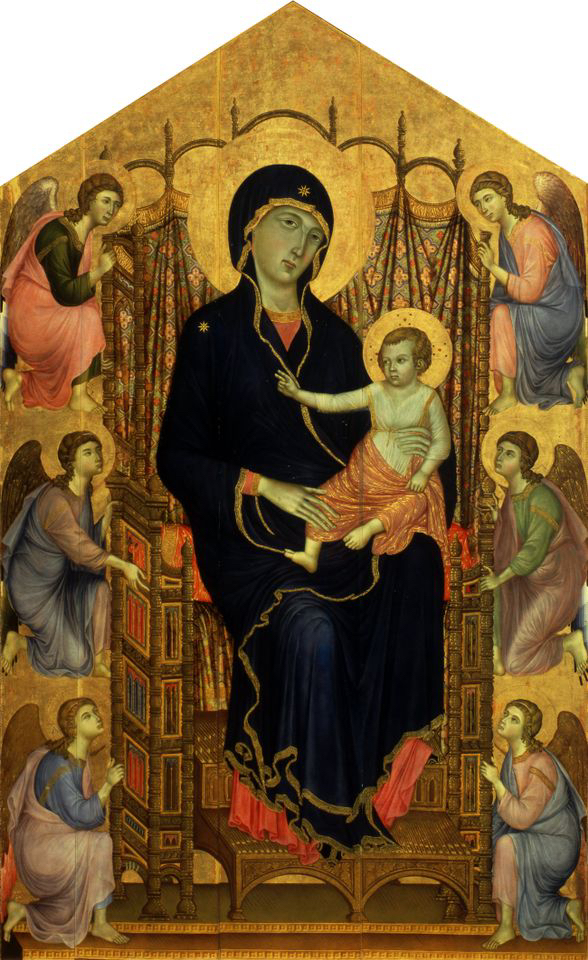
Eike Schmidt, the director of the Uffizi gallery in Florence, told the press on 27 May that he thought many religious works of art currently in Italy’s museums and stores should be returned to the churches from which they came. He went on to suggest that one of the most famous early medieval works in his gallery, the Rucellai Madonna by Duccio, painted around 1275, should go back to its original home, the Florentine church of Santa Maria Novella, from which it was removed in 1948.
… [T]he Rucellai Madonna’s absence from Santa Maria Novella takes away an essential part of its history and meaning.
“Devotional art was not born as a work of art but for a religious purpose, usually in a religious setting”, he told The Art Newspaper. He went on to say that, returned to the building for which it was created, it would be seen in the right historical and artistic space and the viewer would potentially be led to recognise its spiritual origins.
SOURCE: The Art Newspaper (Thanks for the reference to The American Conservative)
Strange: writers, critics and philosophers of various schools have been making the same points for years. Indeed, it is a sure sign of a society’s decadence when its art – preeminently religious art – is removed from life and enclosed in museums. Of course, according to The Art Newspaper, representatives of the Catholic Church had doubts about Schmidt’s idea….