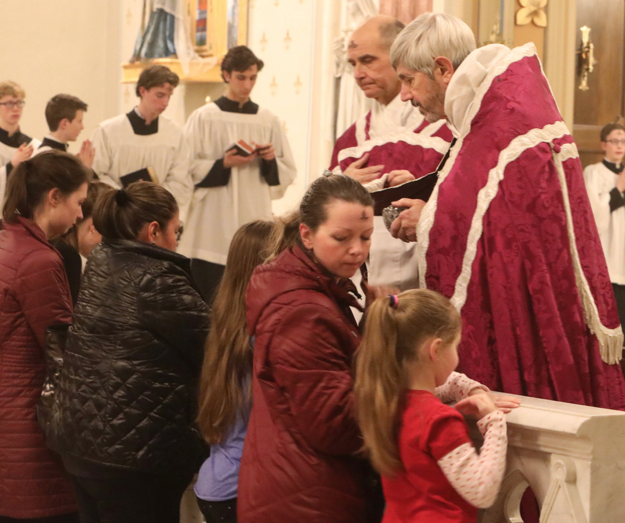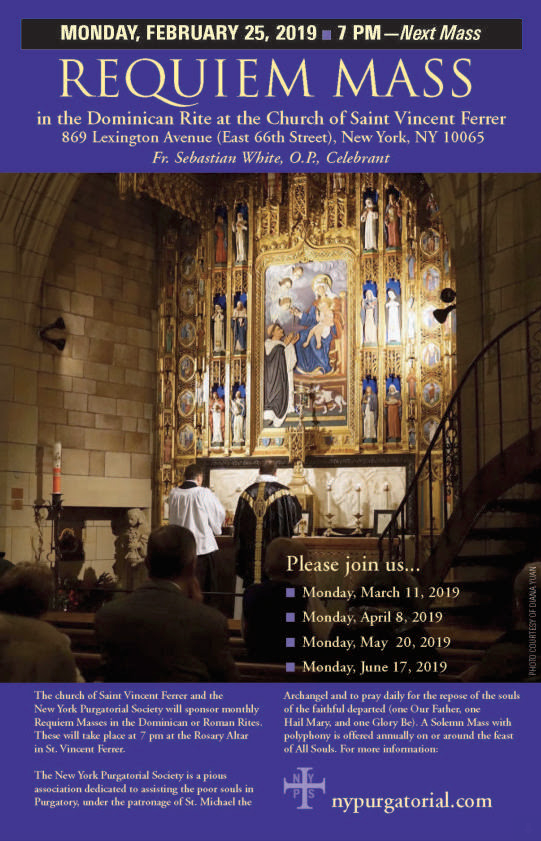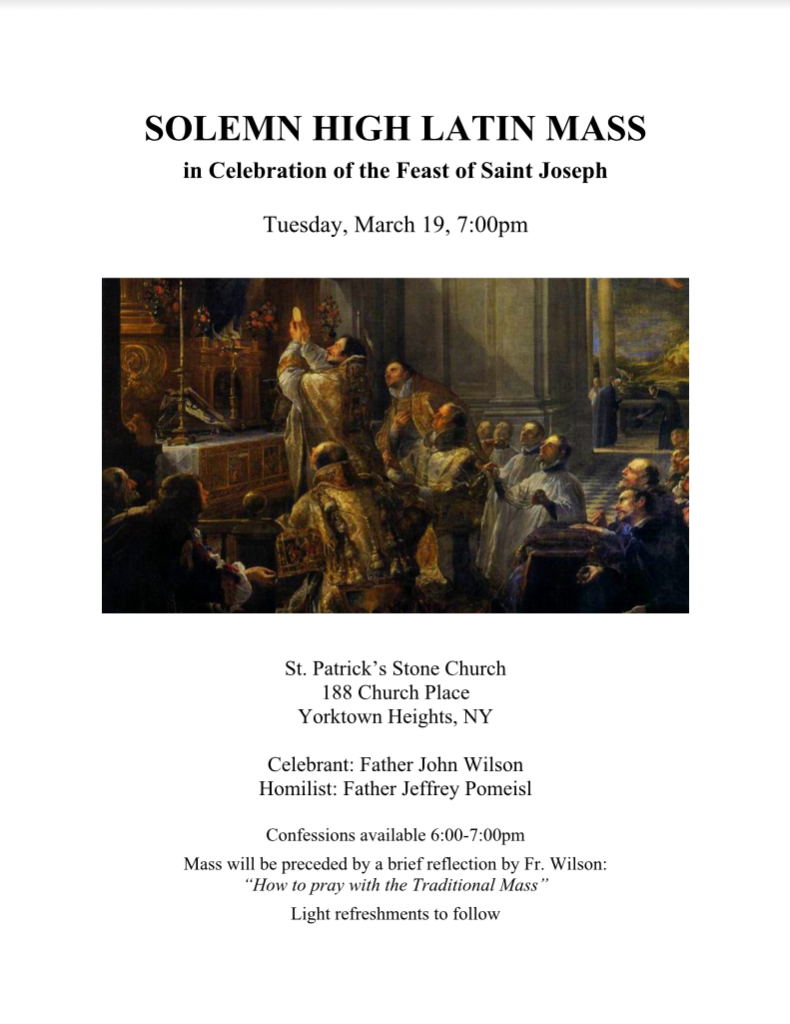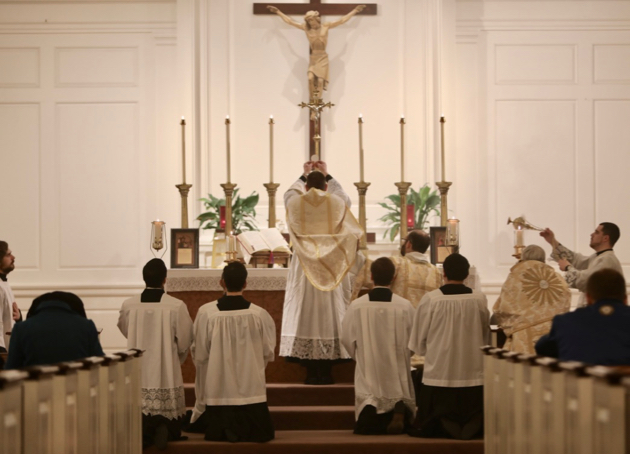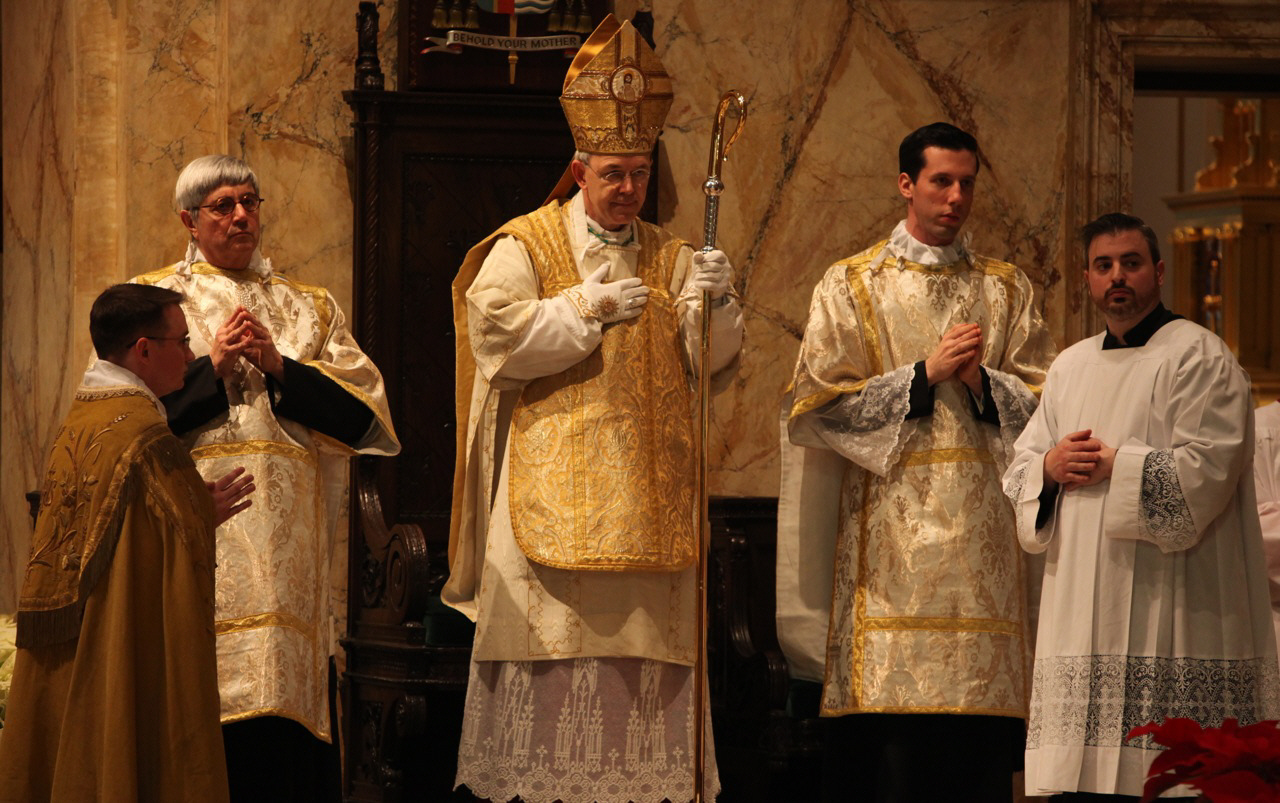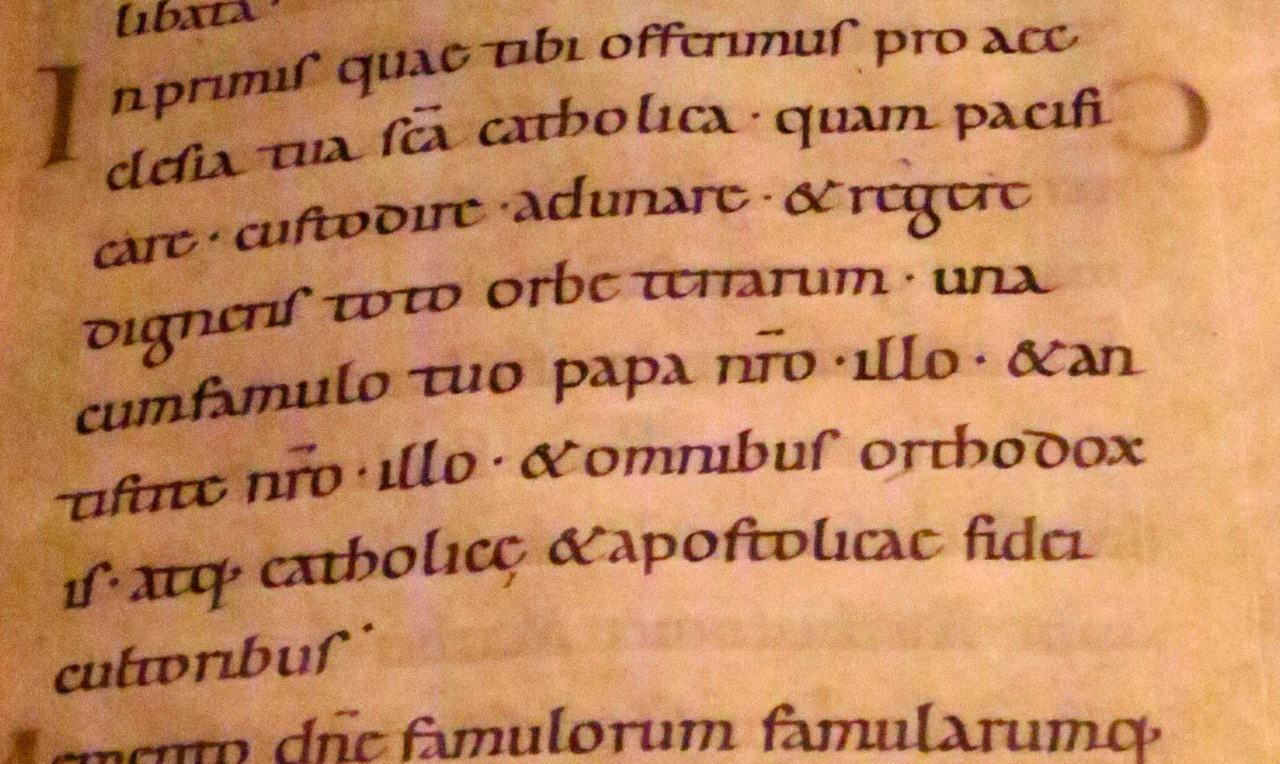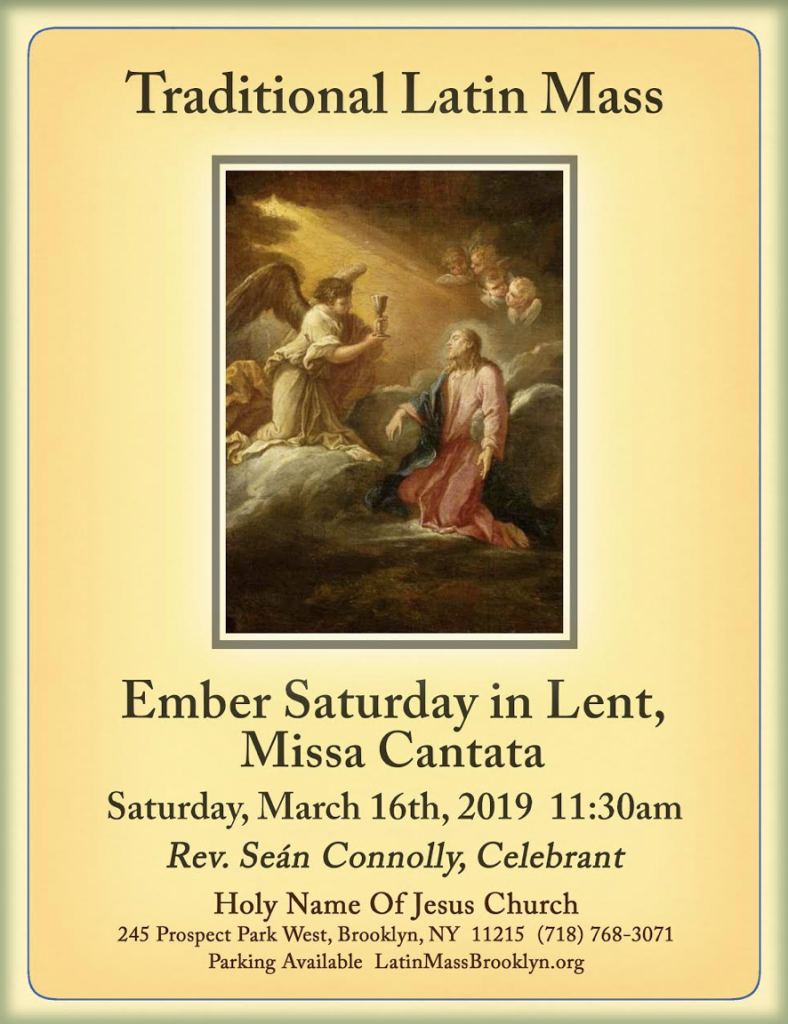
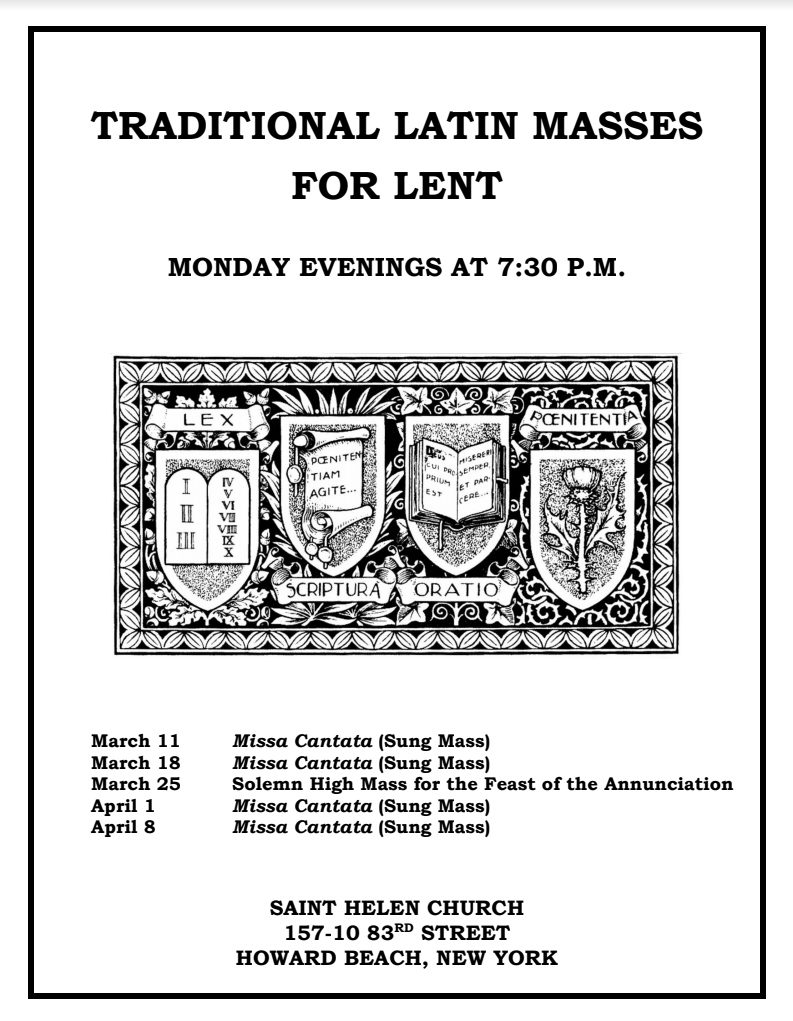
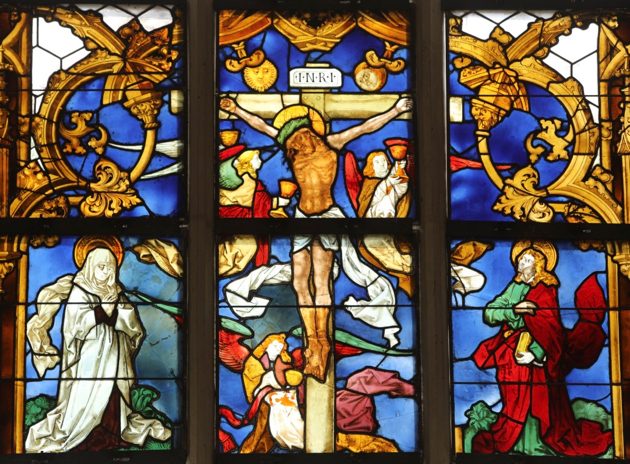
Pictures supplied by our readers of traditional Christmas Masses


Our Lady of Mount Carmel, Sung Mass of the Day, 10:30 AM


26
Dec
Pictures supplied by our readers of traditional Christmas Masses


Our Lady of Mount Carmel, Sung Mass of the Day, 10:30 AM


26
Dec
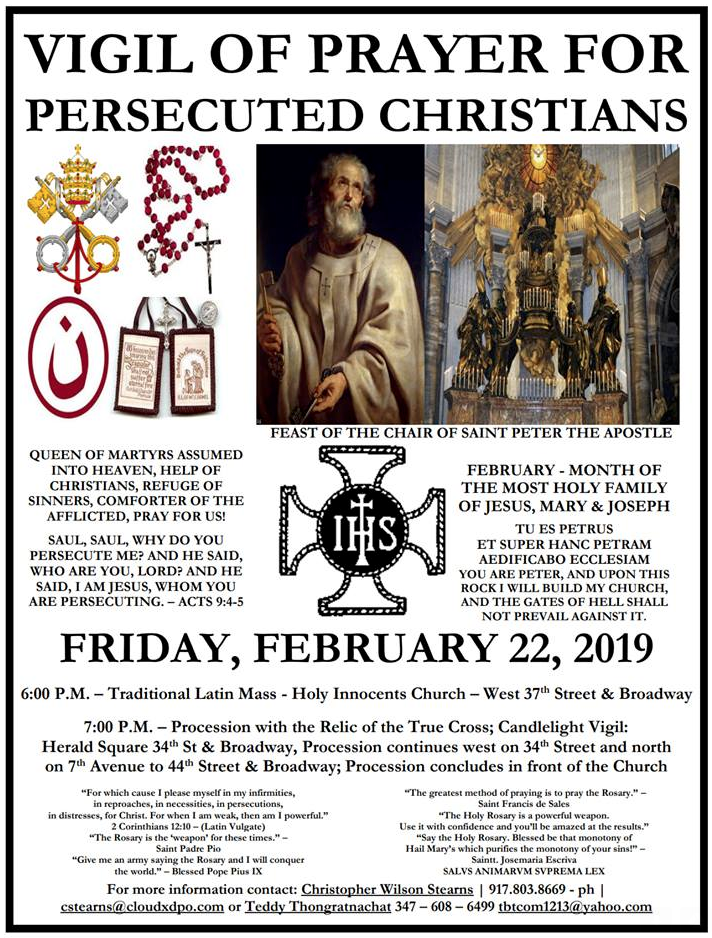
On Friday, December 28, 2018, there will be a Prayer Vigil for Persecuted Christians. The Holy Sacrifice of the Mass (Latin, 1962 MR-EF) will be offered at 6:00 PM at Holy Innocents Church on West 37th Street and Broadway.
Following Mass, we will meet at the front steps of the Church to prepare the prayer books, banners and candles. At approximately 7:00 PM, we will walk south on Broadway to Herald Square, West 34th Street and Broadway.
At Herald Square, we will pray the Holy Rosary. Following the Holy Rosary, we will walk west on 34th Street and north on 7th Avenue while we pray the Divine Mercy Chaplet and sing Hymns and Christmas carols.
PLENARY INDULGENCE FOR FEAST OF HOLY INNOCENTS A PLENARY INDULGENCE is granted to those who devoutly visit the parochial church on its titular feast, which in the case of the Shrine & Parish Church of the Holy Innocents is on Friday, December 28. In visiting the church IT IS REQUIRED that one Our Father and the Creed be recited as well as the usual conditions of Sacramental Confession, Holy Communion, prayer for the intentions of the Holy Father, and detachment from all sin. Holy Innocents, pray & intercede for us!


25
Dec


(Below) The Third Mass of Christmas: “Puer Natus Est.”

24
Dec
The cadets at West Point Military Academy have organized a Solemn High Mass, on Friday January 11, 2019 @ 7 pm at Most Holy Trinity Catholic Chapel, 699 Washington RoadWest Point, NY.
Fr. Donald Kloster (celebrant), Fr. Michael Novajosky (deacon), Fr. Timothy Iannacone (subdeacon)
Mr. David Hughes (choirmaster)

You still have time to visit two extraordinary exhibits at the Frick collection – both having a direct relationship with Catholic doctrine and liturgy:
The Charterhouse of Bruges: Jan van Eyck, Petrus Christus, and Jan Vos
(until January 13, 2019)
Luigi Valadier: Splendor in Eighteenth-Century Rome
(until January 20, 2019)
Centerpiece of the Charterhouse exhibition is The Virgin and Child with St. Barbara, St. Elizabeth, and Jan Vos, by Jan van Eyck and his workshop, which has long been a highlight of the Frick collection. Is paired with The Virgin and Child with St. Barbara and Jan Vos by Petrus Christus (now in Berlin) and displayed in the context of other objects from the Carthusian monasteries. The patron, Jan Vos, was prior of the charterhouse of Bruges. For a period in the 15thand 16thcentury the usually hidden Carthusians took a much more active role in affairs outside their monasteries, as writers, patrons and – in England – as martyrs.
The exhibition puts a magnifying glass at the visitor’s disposal – a necessity in viewing these astonishingly detailed works. The “sacred conversation” of The Virgin and Child with St Barbara and St Elizabeth looks out upon a depiction of a medieval town and indeed of the whole world. Swan float on a river while a boat is rowed by, figures sit on a wagon, men (hunters?) advance through a forest – the incredible detail underlines the universal significance of contemplative figures in the foreground. This painting, moreover, is directly connected with Catholic doctrine on indulgences.
Jan Vos commissioned the Frick panel as a “memorial” displayed in the monastery church. An indulgence forty days could be obtained by anyone who said and Ave Maria in front of it. But as the Frick catalogue helpfully points out:
“The indulgence, meant to call attention to the memorial and increase prayers for Vos’s salvation, was only valid as long as the panel remained in the Carthusian order. Today, on the walls of The Frick Collection, the Virgin has therefore long lost its power of spiritual remission.”
Luigi Valadier: Splendor in Eighteenth-Century Rome deals with a different, yet still Christian, world, some 325 years later. If Jan van Eyck is representative of the golden age of the art of Christendom, Luigi Valadier (1726–1785) lived shortly before its extinction. Valadier(of French parents ) was a multi-talented man: sculptor, designer, gold and silversmith and worker in semiprecious stone. He catered to Roman aristocrats, great prelates and wealthy nobles and royalty visiting Rome from all over Europe. His style is transitional between rococo and neoclassicalism.


What interests us here, however, are his sacred works. Silver statues are displayed from the high altar of the cathedral of Cefalu in Sicily (famous for its 12thcentury mosaics). The expressive quality of these sculptures in precious metal is amazing – the contrast with recent Catholic attempts at figurative sculpture is devastating (for the latter). You will not get to see the Cefalu statues again unless you go to Sicily – and probably never this closeup!

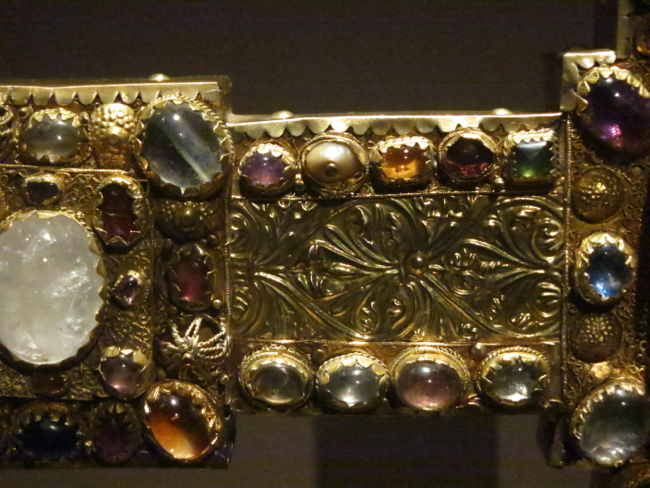
An Orsini cardinal commissioned from Valadier a full service for the Mass (thirteen silver-gilt items including a chalice, cruets, a ewer, a holy water bucket etc.) – it only has survived because he donated it to a remote southern Italian church. Finally, there is a set of altar cards, very much in the rococo style, made for an altar in Santa Maria Maggiore. Valadier’s art has transformed objects originally intended for utilitarian use into small masterpieces.

These works testily to the reverence still accorded in Valadier’s day to objects in sacred use. For all these works are not just senseless display but fulfill a specific purpose, to serve which nothing could be too fine. These exhibits are among the last witnesses to an art and a world that were shortly to expire.
(All photographs from the Frick Collection website). For more information on the exhibitions and the Frick Gallery see HERE
22
Dec
Midnight Mass of Christmas | Monday, Dec. 2411:30 p.m. Christmas Carols of England, Germany, Italy, and Mexico
12:00 midnight Solemn Mass
Missa O magnum mysterium (Victoria)
Mirabile mysterium (Handl)
Verbum caro factum est (Lassus)In dulci jubilo (Bach)
Versets on A solis ortus cardine (Grigny)
Christmas Day | Tuesday, Dec. 259:30 a.m. Solemn Mass
Missa tertia (Hassler)
Viderunt omnes (Pérotin)
Lux refulget (anon., ca. XII C.)
O Regem caeli (Victoria)
Organ works of Grigny and Bach
St. Stephen’s Day | Wednesday, Dec. 266:00 p.m. Missa cantata (sung by Viri Galilæi)
Mass of Tournai (anon., XIV C.)Organ improvisations
Sunday within the Octave of Christmas | Sunday, Dec. 309:30 a.m. Solemn MassMissa super Ich stund an einem Morgen (Handl)
Pastores quidnam vidistis (Clemens non Papa)
Resonet in laudibus (Lassus)
Livre de Noëls: Livraison 2 (Guilmant)
Feast of the Circumcision & Octave Day of Christmas | Tuesday, Jan. 1
9:30 a.m. Solemn Mass
Missa Sancta et immaculata (Guerrero)
O magnum mysterium (Rota)
Mirabile mysterium (Lassus)
Canonic variations on Vom Himmel hoch (Bach)
22
Dec
This year St. Anthony of Padua Oratory in West Orange, NJ (Institute of Christ the King) is offering seats on a chartered bus to the March for Life in Washington D.C. on Friday January 18, 2019. Seat will be avaliable on a first come first serve basis.
The itinerary (to be finalized) is as follows: – January 18, 2019
7:00 am Low Mass at St. Anthony’s (continental breakfast after Mass)
8:00 am Departure from St. Anthony’s for Washington, D.C.
1:00 pm March for Life begins
After the March, people may visit the Senate Office Buildings or the House of Representatives to meet their local state officials
4:30 pm Departure from Washington D.C. to St. Anthony’s
Depending on traffic, our arrival back is expected before 10:30 pm.
For more information and to register, go the the church’s information page.
21
Dec
December 20, 2018 – January 18, 2019 at the Gallery at the Sheen Center (18 Bleecker St, New York)

Last Thursday Oksana Prokopenko opened an exhibit at the Sheen Center of her works in mosaic. On display are mosaics both traditionally Eastern and Western (St. Francis). Mosaics, assembled from hundreds and thousands of small pieces of colored glass and stone, have magical effect all their own. A large depiction of two angels, an icon of the Virgin Mary and Christ – all shimmer in gold and bright colors reflecting the lights of the gallery.
The artist forthrightly acknowledges the spiritual essence of her work:
“The process of creation is a spiritual practice, communion with the divine, a prayer that involves mind, soul and body. My hands that create the work are obedient to the Spirit. I become the proverbial pencil in the hands of God. The Eternal Divine is expressed in the myriad temporal, yet no less divine parts. So is my work composed of tiny bits, which when taken together bring forth the divine spiritual image. That in turn awakens and brings forth the divine in the viewer.” (From the Sheen Center announcement)
In the present wasteland of Christian art, the relatively intact Eastern Tradition is a good starting point for recovery. For the restrictive rules governing images in Eastern ecclesiastical art impose limits on the artist’s unhinged fantasy yet provide him with a clear model to follow. Now Oksana Prokopenko’s images and icons, executed in the difficult and expensive medium of mosaic, confirm both the continued vitality of the Tradition and its ability to accommodate individual creativity.
More on the artist:
“Oksana Prokopenko is a Ukrainian-born artist now living and working in the NYC area. She received university education in both the US at NYU and the Ukraine, at the Kiev Moyla Academy. She creates oil paintings as well as micro-mosaics from tiny pieces of glass. Prokopenko’s works have been acquired into the permanent collections of museums in the USA and Italy. She has been featured on the Russian international TV network, NTV, radio shows, and numerous publications. To quote Margo Grant, the Museum of Russian Art’s director, “The soul of Prokopenko’s work is in her walking that fine line between the transcendent and the ordinary. Prokopenko has achieved sheer brilliance in her deft treatment of the tiny pieces in her micro-mosaics. What’s more is that it is done with a rainbow of majestic colors.” Sue Dymond of The Glass Craftsman describes viewing Oksana’s work as “basking in quiet brilliance” and suggests – “Prepare to be inspired.” Russian NTV network’s Blagonravova states, “Oksana’s work is made not only with thousands of glass pieces, but also out of thousands of prayerful words.” Prokopenko is a rarity in today’s contemporary art scene. Her work process is similar to artists that worked hundreds of years before her with an intense focus on precision, quality and detail. Often described as a colorist, her colors inspire the viewer to spiritual and emotional heights similar to those felt by Prokopenko during her creative process, which has been described as a spiritual practice – a colorist’s communion with the divine.” (From the Sheen Center announcement)

For more information see HERE
This article appeared in the Una Voce New York bulletin:
“By God’s grace, on January 22, 1989, the traditional Latin Mass was restored to the Church of Saint Agnes in Manhattan. It was celebrated on that day by the Pastor, Msgr. Eugene V. Clark, and the “Mass of the ages” has been offered without interruption at Saint Agnes’s since that momentous occasion. Accordingly, a traditional sung Mass, followed by the singing of the Te Deum, will commemorate this Anniversary on Sunday, January 27, 2019, at Saint Agnes’s (143 East 43rd St., bet. Lexington and Third avenues).”


20
Dec

For those who understand German, katholisch.de, the official website of the Catholic Church in Germany, makes fascinating reading. For it is one of the few official new sources of the establishment Catholic Church anywhere that actually reports news instead of suppressing it (to borrow a quip of Damian Thompson’s regarding two similar-sounding US Catholic news services).
Of course, the bias of the website is relentlessly progressive. Just in the last few days we learned from a “liturgical scholar” that it is entirely appropriate for priests to alter the text or the Novus Ordo mass. Bishop after bishop gives permission for the reception of communion by Protestant spouses of Catholics. A report on the historical status of female deacons has been submitted to the pope – it is insinuated that the conclusion is that the early historical record is “unclear” – coincidentally, exactly what Francis himself said “off the cuff” two years ago. Katholisch.de picks up a report (from the New York Times?) about a “nun” who prays for Trump by sending him a tweet every day. Katholisch.de then quotes one of her aggressive, hostile political “prayers.”
Yet katholisch.de ran several favorable articles on the recently deceased philosopher Robert Spaemann. And when one of this site’s editors raged recently against Princess Gloria of Thurn und Taxis, stating that her “wish for Christmas” was that the princess “shut up,” katholisch.de did post a rebuttal from the editor of the conservative Die Tagespost.
And all is not well in the happy home of Catholic progressivism. Katholisch.de reports on cases of sexual abuse exploding everywhere, monasteries that are closing and financial and sexual scandals (that the Vatican is seeking to cover up) in a diocese in neighboring Austria.
But perhaps the most surprising developments are financial. For we in the US have the impression that “Germanchurch” is awash in money. On a worldwide comparative basis that is undoubtedly true. It is only the famous church tax (Kirchensteuer) and more generally the relationship with the German state and its funding that is gives the Catholic Church in Germany what life it has – and I suspect accounts for its influence in the Vatican. But although the revenue from the church tax has hit a record level, the Catholic and Protestant churches continue to lose up to 500,000 members each year.
And we learn from katholisch.de that three dioceses located in areas with a predominantly Catholic population have just recorded massive deficits; Würzburg, Mainz and Trier. The stated causes are low interest rates and massive increases in expenses for personal including pensions. But in the case of Trier, the diocese is also reducing the number of parishes from 887 to 35 – triggering protests by the laity. The administrators of the diocese, however, don’t see any problem at all.
Similar financial crises have been happening in German dioceses for many years now. For example, the critical situation of the Catholic church in Archdiocese of Hamburg – an area without a significant Catholic population – is prompting the closure of up to 8 of its 21 schools. Once again, the laity is up in arms. Do we need to add that even katholisch.de’s hero, Cardinal Marx of Munich (an archdiocese in in better financial condition than most of the others) has had to scale back expensive construction projects?
Germanchurch is finding that when salaries get out of hand even their ample resources are inadequate. The future on the revenue side is also dark – the impact of “demographic trends “and the uninterrupted decline in church membership call into question the long-term viability of the church tax. And, as we all should know, all the money in the world can’t motivate people to attend church or serve at the altar.
For further information see: katholisch.de