30
Mar
29
Mar
Yesterday evening a very beauiful Office of Tenebrae was sung at St. Mary’s Church, Norwalk, CT. The psalms were chanted in the front by a men’s choir. The St. Mary’s Schola Cantorum sang the Lamentations of the Prophet Jeremiah and the responsories in polyphony in the choirloft. The liturgy ended in complete darkness with a polyphonic setting of the Miserere. The clergy, choirs and congregation departed in silence.
25
Mar
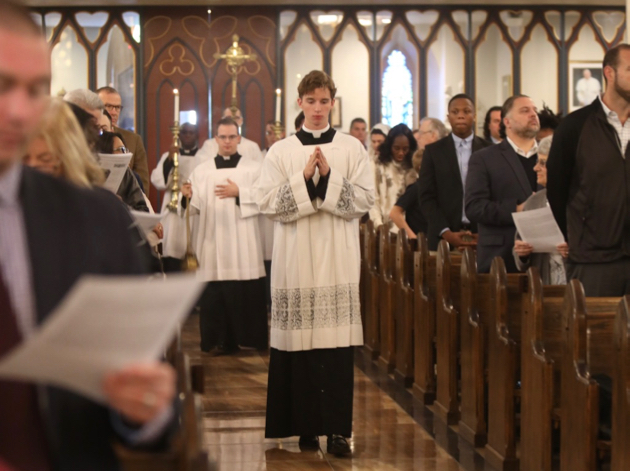
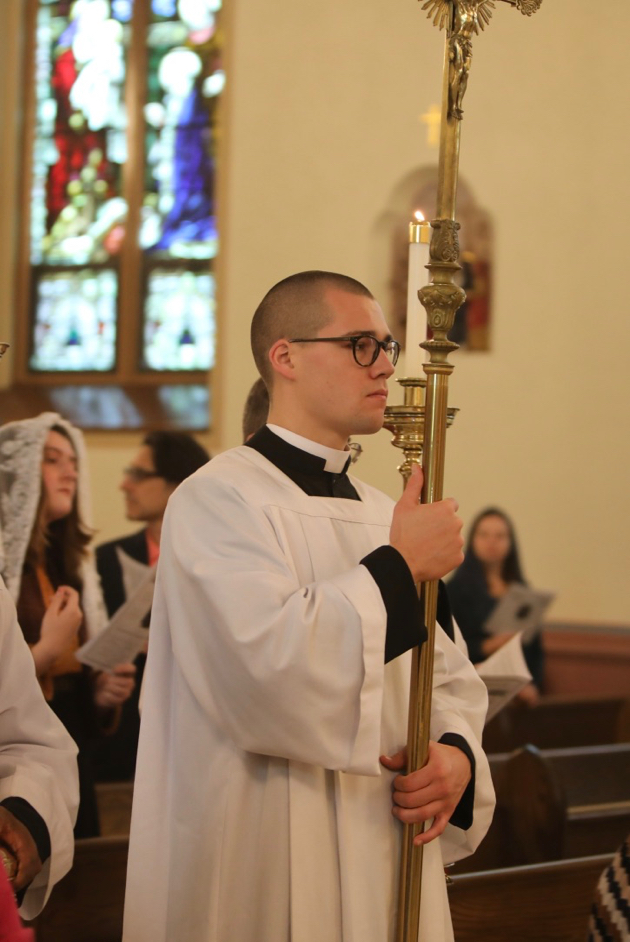
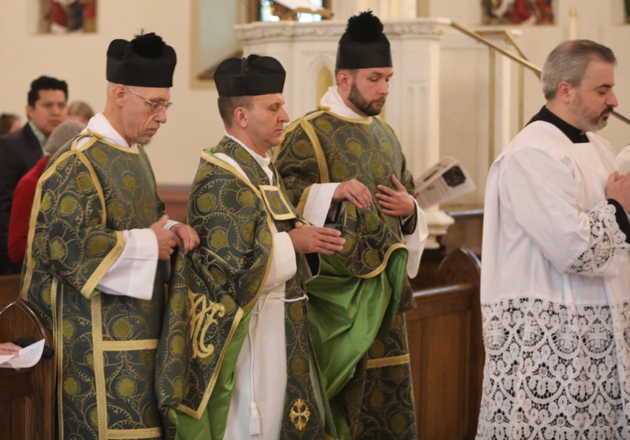
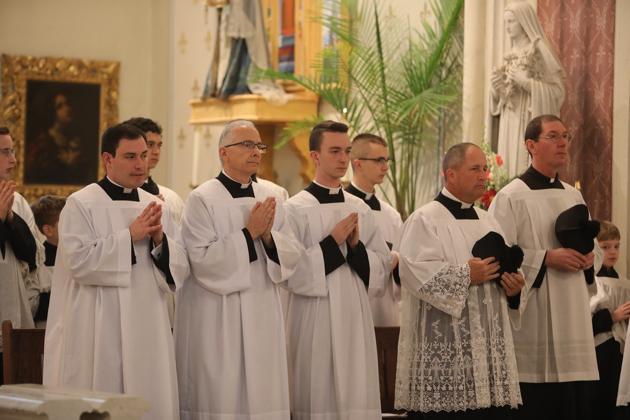
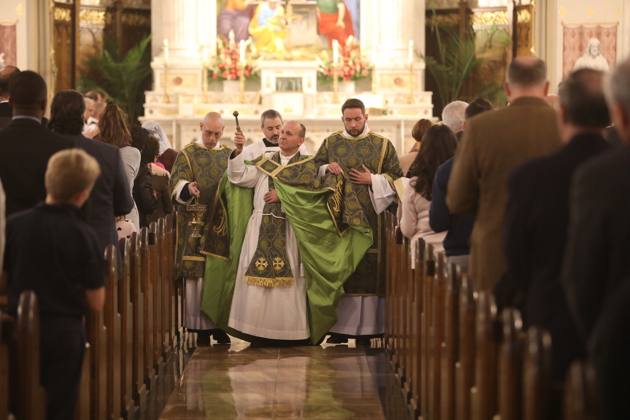
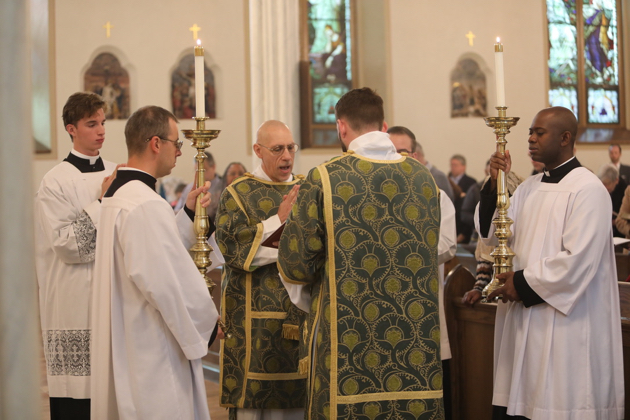
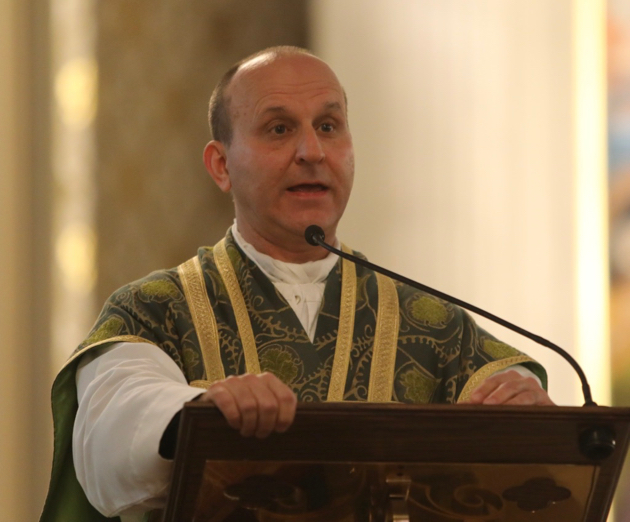
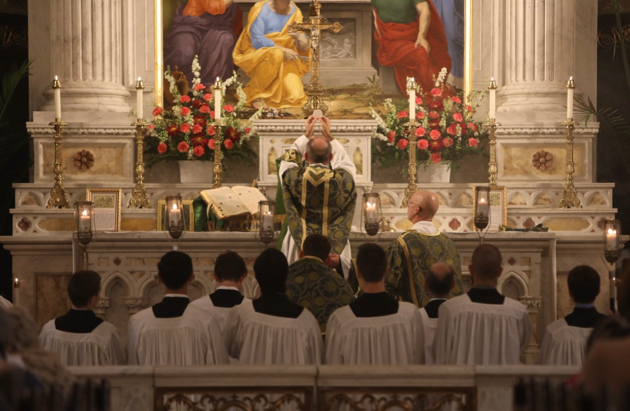
Palm Sunday 2018 at St. Mary’s Church, Norwalk CT. Fr. Donald Kloster, celebrant.
The beginning of the Mass of the Palms.
The blessing of the palms.
Distribution of the Palms.
(Above and below) David Hughes, music director of St Mary’s, led the assembled musical forces of the parish:the schola cantorum, combined student scholae, the men’s chant choir and the parish adult choir. It is a most challenging day of the year in terms of musical complexity!
The procession through the streets of Norwalk on a chill early spring day.
The procession reaches the door of the church.
The cantors inside the church sing: Gloria, laus et honor tibi sit, Rex Christe Redemptor...
After the final repetition of the refrain, the subdeacon bangs three times on the doors with the foot of the cross. The door is then flung open.
The Mass of the Passion.
The Passion according to St. Matthew. The Passion is sung by three cantors; the choir provides the polyphonic responses of the crowd.
After the cantors of the Passion leave, the conclusion of the Passion is proclaimed by the deacon.

We end on a meditative note. The palm crosses from the day’s ceremonies left at the tomb of Fr. Ignacio Barreiro, curate of the parish, who died almost a year ago on Holy Thursday, April 13, 2017.
25
Mar
For a schedule of traditional liturgies during Holy Week in Connecticut, New York and New Jersey, go to Holy Week Schedule
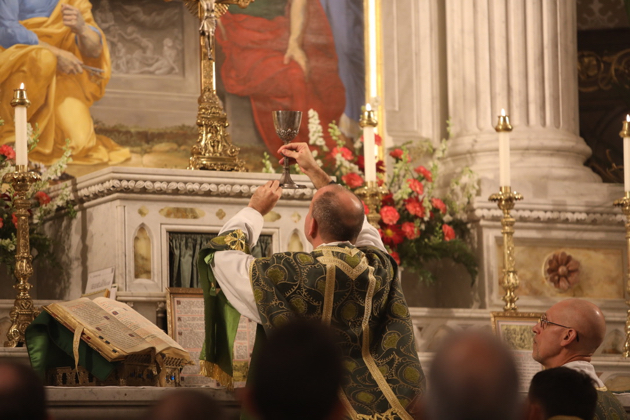
(above: The reredos at Holy Redeemer Church, Manhattan)
24
Mar

(above) “Judah” by Francisco de Zurbarán.
A Haydn oratorio, a Bruckner symphony, the drawings of Michelangelo, baroque oratorios, a 16th century Aztec feather-work recreation of a Netherlands devotional print – these are objects and performances that you could have seen or heard in New York in just the last few months. But what do we know about the religious influences and the culture in which they arose? Certainly the local Catholic establishment is of no assistance in learning more ( even if it’s aware of these events in the first place). The secular authorities – the curators, the writers of program notes and the media – can, on occasion, be much more helpful in rediscovering these links. Yet their analysis all too often focusses on the personality of the artist, on narrow issues of history, technique or ideology or on the “general human.”
In this regard, I’d thought I’d mention a couple of small exhibitions at the Frick collection that a fan of “Catholic culture” might find interesting. In contrast to the crowded “blockbusters” found further north on Fifth Avenue, the exhibitions at the Frick generally show one or several selected paintings from places one would very likely never visit. For a hefty admission fee one can contemplate such works ideally displayed and in a peaceful environment.

(Above) “St Jerome” by Veronese.
Two exceptional works by Veronese have left Italy for the first time. They are from a rarely visited church in Murano. If you are like me, you may have visited this island’s tourist trap glass emporia but never ventured into the local churches or seen the art they contain. The subject of one painting is familiar – St. Jerome in the desert – that of the other less so(at least to me): St Agatha in prison visited by St Peter. The color is of course magnificent – and every detail isn’t just “decorative” but derives from the legend of these two saints. As the exhibition notes point out, it is testimony to the superabundance of creativity in late sixteenth century Venice that one of the the main artists of the period painted two such major works for a small chapel on an outlying island.
Also on display is a cycle of 17th century paintings of Jacob and his sons by Francisco de Zurbarán – reunited for the first time in ages. The artist has shows great familiarity with the e biblical texts describing the history and destiny of these brethren. Zurbarán has given each of them a distinctive identity with bizarre costumes and attributes. I frankly found these works less successful than many other works of this artist I have seen. I would guess that assistants had a large share in executing such a massive project. But what is indeed interesting is the subject matter. For, at that time, some were of the opinion that the American Indians were descendants of the lost tribes of Israel. Depictions of Jacob and his sons – perhaps this one too – were created for patrons in the New World. So let’s not laugh at the Mormons – others had strange ideas of pre-Colombian history several centuries before them!
Of course, if curators feel constrained in giving full credit to the Catholic Church, they are not so inhibited in repeating the platitudes of our currently reigning ideology. Based one one incident in the 18th century, the Zurbarán paintings – artwork commissioned in 17th century Spain – are “reimagined” as symbols of religious tolerance and diversity. That’s life….
For more on these exhibitions see HERE. You only have till tomorrow to see the Veronese paintings!
22
Mar
Photos of the Missa Cantata for the Feast of St. Joseph at Our Lady of Mount Carmel Church in Newark (From the Facebook page “At the Table with Tony)
Monsignor Joseph Ambrosio, Celebrant, with Clergy, Altar Servers, and Knights of the Sacred Military Constantinian Order of Saint George.
21
Mar
Lost Shepherd: How Pope Francis is misleading his Flock
By Philip F. Lawler
(2018 Regnery Gateway, Washington DC)
Many of us know Philip Lawler as a sharp-eyed critic of the media and Catholic institutions. On his Catholic Culture site and in his book The Faithful Departed, he provides perceptive and honest commentary on the press and the (pathetic) state of the institutional Church. He shows a special talent in dissecting official pronouncements and press releases to reveal what is being said or not said.
In Lost Shepherd he attempts to make sense of the pontificate of Pope Francis. But it is one thing to provide running commentary on current developments. It is quite another to attempt to understand a revolutionary movement and put in its political and historical context. The recent Dictator Pope made a commendable first effort to do just that. Lost Shepherd is less successful.
A Catholic Conservative is at a distinct disadvantage here. Since 1968 or so his entire “ideology” (a perhaps inexact term) has been unswerving loyalty to the papacy. He saw his mission as defending it and (depending on the writer)other Church institutions against both the attacks of so-called dissenters and the all too frequent failings of the local hierarchy. This framework of analysis and the a priori positions it entails are totally inadequate to deal with the phenomenon of Francis. For the fundamental problem is that, after his initial reluctance to face the truth, Lawler has to admit:
[E]very day (I am exaggerating, but only slightly ) the pope issues another reminder that he does not approve of Catholics like me.
Indeed, as chronicled in this book, Pope Francis and his team have specifically rejected all the characteristic positions of Lawler and his fellow American Conservative Catholics. The pope even may be a “radical.” But for Lawler to acknowledge that the papacy has gone over to the progressives would be too much; instead, he has to speak of Francis “misleading” or “confusing” the Church.
One largely misses Lawler, the biting commentator, in this book. Only here and there do we encounter his usual style:
His (the Pope’s – SC) warning about being “obsessed” with abortion and contraception made many loyal Catholics uneasy; it hardly seemed necessary to complain about a “obsession” with issues that are rarely even mentioned in a typical parish.
Instead, in an attempt to be even-handed, we are offered blander prose, studded with quotes from fellow conservatives and “centrists.” Now and then Lawler even falls into sycophantic church-speak, such as, when discussing Evangelii Gaudium:
Francis provides a rich variety of useful suggestions for pastors and for lay people who wish to share their faith.
Lawler discusses the 2013 papal election, the failed economic and organizational reforms at the Vatican, Amoris Letitia and the reaction thereto and Francis’s style and leadership. I didn’t find his analysis of any of these topics particularly insightful. At no time does he provide a detailed comparison of the policies of Francis with the reigning ideas of progressive Catholicism or indeed of the secular establishment. That would show that Francis’s policies are a lot less confusing than Lawler makes them out to be.
The author provides only sketchy historical background. And what he does provide is incomplete and superficial – such as his contrast of a supposed age of stability and sanctity under John Paul II and Benedict with the current regime. For as Lawler himself acknowledges in Lost Shepherd, this prior era of Vatican excellence may not always have made any difference in the life of Catholics at the parish level. Moreover, when our author praises the laissez-faire appointment policies of John Paul and Benedict, we must question his judgment. For are not their incompetent appointments one main reason that we have the Francis pontificate today? And if Lawler finds that:
Pope Francis has not taught heresy.
he has done so without having stated or responded to any arguments of those who presumably think he has.
It is of course a welcome development that yet another conservative feels compelled to disassociate himself very publicly from what is going on at the highest levels of the Church today, And readers wanting a reasonable summary of the last 5 years of Pope Francis may appreciate this book. It’s certainly miles ahead of the Francis biographies put out by the Pope’s media claque. But Lost Shepherd is unlikely to satisfy those seeking for real answers to how things could have come to this state.
20
Mar
St. Mary Church, Norwalk, CT
PALM SUNDAY
9:30 a.m. Solemn Traditional Mass with Blessing and Procession
HOLY MONDAY
7:30 a.m. Traditional Latin Mass
HOLY TUESDAY
7:30 a.m. Traditional Latin Mass
HOLY WEDNESDAY
7:30 a.m. Traditional Latin Mass
7:00 p.m. Tenebræ of Maundy Thursday
MAUNDY THURSDAY
1:00–2:00 p.m. Confessions (Main Church and Chapel)
7:00 p.m. Solemn Mass in Cena Domini
8:30 p.m. Vespers and Stripping of Altar
9:00 p.m. Seven Churches Visit
9:00 p.m.–8:00 a.m. Vigil before the Blessed Sacrament
GOOD FRIDAY
8:00 a.m. Matins and Lauds
1:00–2:00 p.m. Confessions (Main Church and Chapel)
3:00 p.m. Liturgy of Good Friday
7:00 p.m. Procession of the Cristo Muerto and Burial with Compline
9:00 p.m.–8:00 a.m. Vigil before the Sepulchre of the Buried Christ
HOLY SATURDAY
8:00 a.m. Matins and Lauds
1:00-2:00 p.m. Confessions (Main Church and Chapel)
2:00 p.m. Blessing of Easter Food
7:00 p.m. The Great Vigil of Easter
10:00 p.m. Festive Reception
EASTER SUNDAY
9:30 a.m. Solemn Traditional Mass
Sts. Cyril and Methodius Oratory, Bridgeport, CT
PALM SUNDAY 8:30 am low Mass, 10 am high Mass with blessing of palms and procession.
MAUNDY THURSDAY, 6 pm high Mass followed by procession to altar of repose and stripping of altars. Adoration will end at 9 pm.
GOOD FRIDAY, 12 pm Mass of the Presanctified; 3 pm stations of the cross and veneration of the Cross
HOLY SATURDAY, 4 pm, Easter Vigil
St. Stanislaus Church, New Haven, CT
PALM SUNDAY, 2 pm, blessing of palms, procession and Solemn Mass
GOOD FRIDAY, 12 noon
EASTER SUNDAY, 2 pm, Solemn Mass
St. Marguerite Bourgeoys, Brookfield, CT
EASTER SUNDAY, 12:30 pm in the chapel
Church of the Holy Innocents, New York, NY
PALM SUNDAY:
Solemn Mass with blessing of Palms and Procession at 12:30PM, No Vespers
HOLY MONDAY:
Low Mass at 6PM
Confessions: 7:30-8:30AM; 12 NOON-1:30PM; and 3-9PM
HOLY TUESDAY:
Low Mass at 6PM
SPY WEDNESDAY:
Low Mass and devotions at 6PM, Tenebrae at 7:30PM
MAUNDY THURSDAY:
Solemn Mass and stripping of the Altar at 6PM
All-night Adoration of the Most Blessed Sacrament at the Repository
Opus Angelorum Passio Domini Devotions: 9PM-12Midnight
GOOD FRIDAY:
Adoration of the Most Blessed Sacrament at the Repository continues until 3PM
Stations of the Cross: 11:15AM
Three Hours Agony Devotions: 12Noon
Mass of the Pre-Sanctified at 3PM
EASTER VIGIL:
Church opens at 9AM for Veneration of the Cross and visits to the Lord’s Tomb
Confessions: 12Noon-1PM; 3PM-4PM
Traditional Blessing of Easter Food: 12Noon
Solemn Easter Vigil at 6PM
EASTER SUNDAY:
Low Mass at 9AM
Solemn Mass at 10:30AM
Vespers at 2:30PM
Our Lady of Mount Carmel Pontifical Shrine, 448 East 116th Street NY, NY
PALM SUNDAY, 10:20 AM – Blessing of Palms, Procession and High Mass followed by Coffee Hour
HOLY MONDAY, HOLY TUESDAY AND SPY WEDNESDAY, 7:45 AM – Low Mass
EASTER SUNDAY, 10:25 AM – High Mass and Coffee Hour
St. Agnes Church, New York, NY
PALM SUNDAY, high Mass, 9 am
EASTER SUNDAY, high Mass, 9 am
Our Lady of Peace Church, Brooklyn, NY
PALM SUNDAY, 9:30 am
EASTER SUNDAY 9:30 am
St. Anthony Church, 1496 Commonwealth Ave., Bronx, NY
PALM SUNDAY, Missa Cantata, 9 am
EASTER SUNDAY, Missa Cantata, 9 am
St. John’s Cemetery Chapel, Middle Village, NY (Queens)
EASTER SUNDAY, Missa Cantata, 9am
Immaculate Conception Church, Sleepy Hollow, NY
PALM SUNDAY, Missa Cantata, 3 pm
EASTER SUNDAY, Missa Cantata, 1:30 pm (note earlier time)
St. Matthew Church, Dix Hills, NY (Long Island)
PALM SUNDAY, 12:30 pm, Mass in parish center chapel
EASTER SUNDAY, 12:30 pm, Mass in parish center chapel
St. Ladislaus Church, Hempstead, NY (Long Island)
PALM SUNDAY, 9 am
EASTER SUNDAY, 9 am
St. Patrick Church, Newburgh, NY
EASTER SUNDAY, 3 pm
Our Lady of Mount Carmel Church, 259 Oliver Street, Newark NJ
HOLY THURSDAY, Sung Mass, 7 pm, Rev. Msgr. Joseph F. Ambrosio celebrant and pastor. Ample parking behind church.
St. Anthony of Padua Church, Monmouth St., Jersey City, NJ
PALM SUNDAY, 9 AM: Blessing, Distribution and Procession. Traditional Latin High Mass
SPY WEDNESDAY, 7:30PM: Tenebrae (Anticipated Matins and Lauds of Maundy Thursday) Responsories by Victoria & Miserere by Allegri
HOLY THURSDAY, 6 PM: Missa Vespertina in Cena Domini. Solemn Eucharistic Procession to the Altar of Repose
GOOD FRIDAY, 5 PM: Solemn Liturgy Commemoration of the Passion and Death of the Lord.
HOLY SATURDAY, 10 PM: Great Vigil of Easter. Messa da Cappella by Monteverdi.
EASTER SUNDAY, , 9 AM: Low Mass
Our Lady of Victories Church, 150 Harriot Ave., Harrington Park, NJ
PALM SUNDAY, 8:15
EASTER SUNDAY, 8:15
Shrine Chapel of the Blessed Sacrament, 52 West Somerset St., Raritan, NJ
PALM SUNDAY, 11 AM Low Mass
EASTER SUNDAY, 11 AM Low Mass
St.Catherine Laboure Church, 110 Bray Avenue, Middletown, NJ
PALM SUNDAY, Noon: Solemn High Mass according to the 1955 Missal. 7 PM, Tenebrae.
EASTER SUNDAY, 9 am.
Our Lady of Fatima Chapel, 32 W Franklin Ave., Pequannock Township, NJ
PALM SUNDAY
7:30 AM, 9 AM, 10:30 AM Blessing of Palms, Chanting of the Passion,Solemn Mass;5 PM.
HOLY THURSDAY
9 AM Tenebrae. 5:30 PM Confessions, >7 PM Solemn Mass of Holy Thursday with Adoration at Altar of Repose until Midnight.
GOOD FRIDAY
8 AM Tenebrae, 1 PM Confessions,2 PM Stations of the Cross, 3 PM Good Friday Liturgy
HOLY SATURDAY
9 AM Tenebrae, 12:30 – 1: 30 PM Confessions, 8:30 PM Easter Vigil
St. Anthony of Padua Oratory, 1360 Pleasant Valley Way, West Orange, NJ
PALM SUNDAY
7:30 AM: Low Mass; No 9 am or 11 am Masses, 10 AM: High Mass. Solemn Blessing and Procession with Palms.
MAUNDY THURSDAY
6 PM: Confessions, 7 PM: High Mass of the Last Supper, 8:30 PM: Eucharistic Adoration at the Altar of Repose
GOOD FRIDAY
2 PM Stations of the Cross & Confessions, 3 PM Mass of the Presanctified
HOLY SATURDAY
6:30 PM Confessions, 7:30 PM Easter Vigil Mass
EASTER SUNDAY
7:30 AM Low Mass, 9 AM Low Mass with Hymns, 11 AM High Mass
St. John the Baptist Church, 1282 Yardville-Allentown Road, Allentown, NJ
PALM SUNDAY, 12:30 pm: blessing of palms, procession and Mass.
EASTER SUNDAY, 12:30 PM: Traditional Latin Solemn High Mass. Messa Solennelle by Louis Vierne sung by The Schola Cantorum of St. John the Baptist
St. Catharine’s Church, Spring Lake, NJ
SPY WEDNESDAY: Tenebrae 7:30 pm (according to the ’62 Liber Usualis although modified) The Central New Jersey Catholic Chorale will be singing.
20
Mar
On Friday, March 23, the following churches will commemorate the Seven Sorrows of the Blessed Virgin Mary with a traditional Mass:
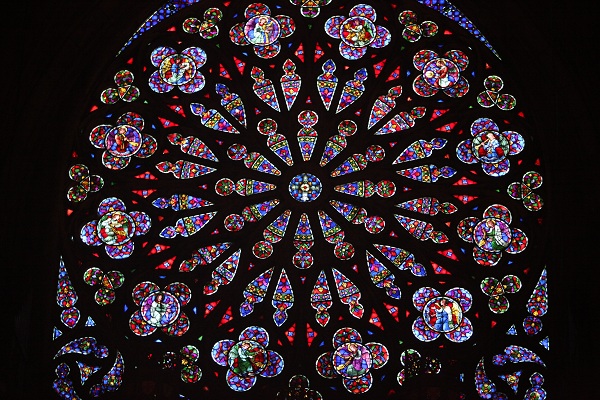
St Mary Church, Greenwich, CT, Solemn Mass, 7:30 pm (stained glass window above from this church)
Most Precious Blood Church, Little Italy, New York (113 Baxter Street), Solemn Mass, 7:15 pm (see information below)
Holy Name of Jesus Church, Brooklyn, NY, Missa Cantata, 7 pm.