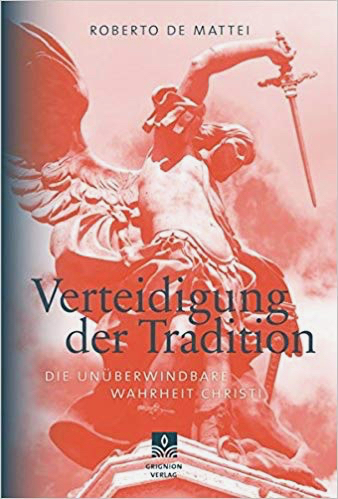
Verteidigung der Tradition: Die unüberwindbare Wahrheit Christi.
(In Defense of Tradition: The Invincible Truth of Christ)
By Roberto de Mattei (German translation by Wolfram Schrems)
Foreword by Martin Mosebach
2017 Sankt Grignion Verlag, Altötting
(Original Italian edition, 2011)
The current age of the Church is of unmatched doctrinal confusion. Every dogma, every rule of morality is directly challenged by those within the church. And those claiming supreme teaching authority are exacerbating the confusion. Pope Francis has formally taught doctrines hardly reconcilable with the prior course of Catholic teaching. He has also confirmed, “with magisterial authority” the practices (presumably liturgical) of the Second Vatican Council. And then there is the series of canonizations of the heroes of Catholic modernity. This has left Catholics – particularly those who imagined themselves papal loyalists – in an increasingly dire situation. Professor Roberto de Mattei in this slim volume offers intellectual assistance.
The first half of In Defense of Tradition is a review of pre-conciliar church history. Critical moments are highlighted in which the institutional church and specifically the papacy initially failed to stand up to political and theological challenges. These existential crises finally were surmounted or contained only by the joint action of all members of the Church: the ordinary laity, the doctors of the church, the councils, the episcopate, the new religious orders, the papacy – and, we should not forget, the secular rulers. In the course of these conflicts issues such as the possibility of papal heresy and the duty to correct hierarchs and even popes were freely discussed and acknowledged.
We may wonder about the purpose of the first half of this book. Is it addressed to those few remaining true blue Catholics (like Opus Dei soldiers?) who conceive of church history as one triumphant progress under the day-to-day direction of an always infallible papacy? For I would expect that readers interested in a book like this (and who perhaps have read previous works of de Mattei and Mosebach) would be familiar with most of these historical facts. Rather, I think this historical outline “lays the foundation” for the specific discussion of tradition in the second half of this book. For it shows that exclusive concentration on the actions and pronouncements of the hierarchy and the papacy is an inadequate historical and theological basis for understanding the Church and its history. Yes, the Church and the papacy did endure these assaults in the past. But what then was the principle that enabled the Church to survive?
Now the most significant part is de Mattei’s theological exposition of the meaning of tradition in the second half of his book. For it was though faithfulness to tradition that the prior crises of the Church were overcome. What is tradition? It is the deposit of faith handed down from Christ to the Church. Indeed, for the first decades of her existence, the Church had to rely exclusively on tradition – the first scriptures were only gradually being written. This tradition is the true “rule of faith” made manifest in many ways over the course of history but above all in the liturgy.
Relying on extensive theological literature, de Mattei in particular takes pains to distinguish tradition from the Church’s teaching authority or magisterium (itself a very late concept to develop). The magisterium is not a “source” of truth or creator of tradition, but rather an authority or “function” bestowed upon the Church.
De Mattei clearly expounds and defines the sources of theological truth, the meaning of “Church” and the meaning of magisterium. He warns against the concept of a free-floating magisterium as the ultimate criterion of truth. Outside of the “solemn magisterium” the so-called “ordinary magisterium” can acquire a character of infallibility only when it is in harmony with tradition. De Mattei also takes issue with the notion of “hermeneutics” as the key to discerning tradition. For that concept introduces a “subjective” element which shifts the focus from objective tradition to the interpreting subject.
This precious second half of In Defense of Tradition provides the Catholic reader with the clearest and most succinct exposition of these issues of which I know.
Marin Mosebach has contributed a forceful introduction to the German translation of de Mattei’s book. For there has been a very significant shift in the ecclesiastical context since 2011, the year of this book’s original publication. At that time, the author did have to define and justify tradition against the claims of the Second Vatican Council and its implementors. But he also had to defend the authority of Pope Benedict XVI against a renewed tide of anti-papal rage fostered by the Catholic progressives and specifically by the Catholic church in Germany. Today, under Bergoglio, we have both the greatest rupture with Catholic doctrine and practice since the 1960’s combined with unlimited assertions of the scope of the magisterium.
Mosebach brings out some points more explicitly than in the original text, e.g.,
“After the First Vatican Council a papalist theology arose that greatly exceeded the definition of the papal office in Catholic tradition. The consciousness of the strict anchoring of the pope in tradition faded – the excesses of the political claims of the medieval popes found their equivalent in the exaggeration of their spiritual authority in the 19th and 20th centuries. It could appear to the naive believer that infallibility extended to every imaginable aspect of life and that the plenary authority of the pope permitted even the abolition of tradition. As this then actually occurred at a most sensitive spot – I am referring to the liturgical reform of Pope Paul VI – the first doubts arose regarding this theology…”
Mosebach then provides a frank discussion of the reign of Francis, in which it often appears that the pope is less concerned about transmitting what is specifically Catholic than in following the agenda of the mass media. Mosebach states:
Roberto de Mattei wants to show his readers how to remain a Catholic loyal to the pope without as a consequence becoming deaf and blind.
In Defense of Tradition answers a real need. This brief handbook and guide will serve well in this time of crisis. Evidence of the interest in this text was the presentation of this book on July 9 at a well-attended conference in Munich with both de Mattei and Mosebach (among others) speaking. Fortunately, we understand an English translation will be forthcoming shortly.
(Translations are mine for which I ask the reader’s forbearance)