6
Nov
5
Nov
A votive Mass for the Dead will be offered on Tuesday, November 14 at 7:00 p.m. at Saint Stanislaus Church, New Haven for those enrolled in the St. Gregory Society Purgatorial Society.
You can enroll your loved ones in the SGS Purgatorial Society. An enrollment for one name is $35.00 and for each additional name $10.00, for one year.
For this Mass, previously enrolled Purgatorial Society members need to be enrolled again for the coming year..
The enrollment form is accessible here: http://saint-gregory.org/purgatorial-society/
Those enrolled in the SGS Purgatorial Society are remembered at the Altar on this annual Mass, and each First Friday Mass and the spiritual benefits throughout the year.
1
Nov
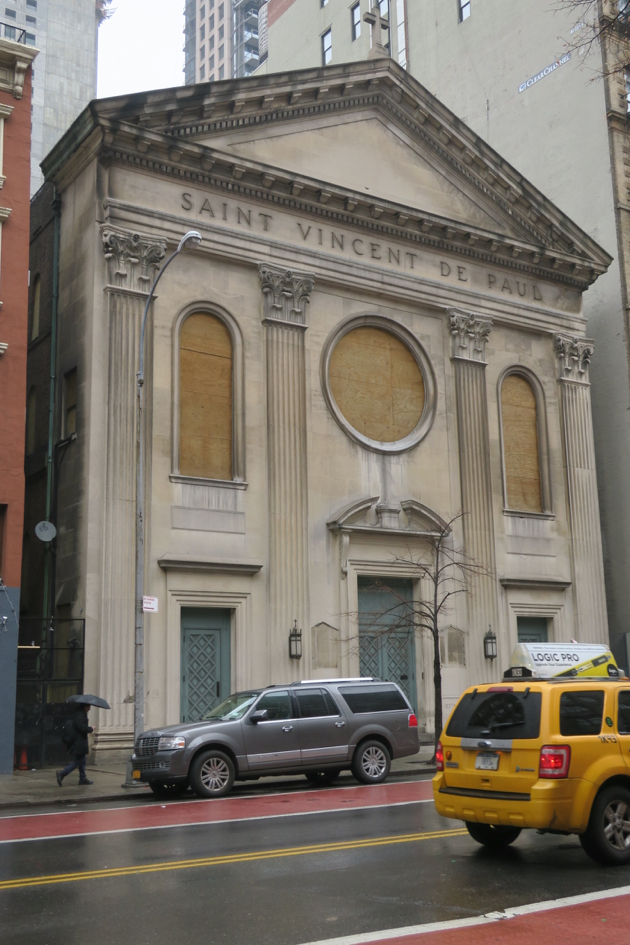
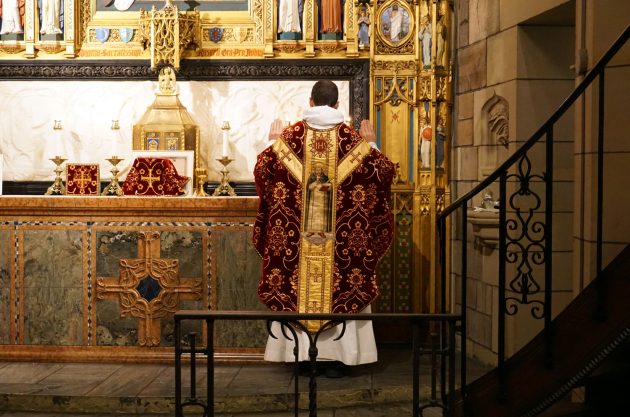
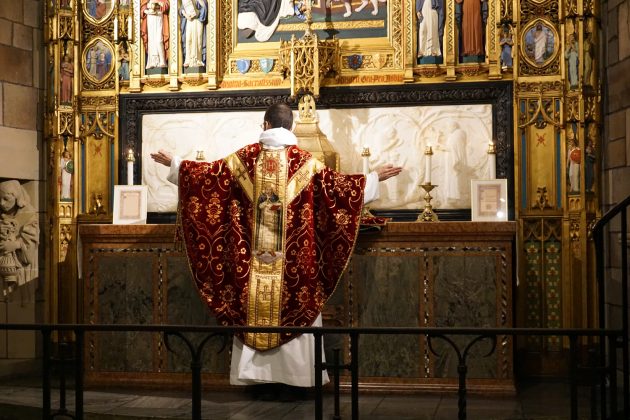
The 7:45 low Mass today for the Feast of All Saints at Our Lady of Mount Carmel Church in Harlem, New York, Father Christopher Salvatore, celebrant. There is a 7:00 Solemn Mass this evening, and tomorrow a 7:45 am low Mass, and 7 pm Solemn Requiem Mass. This photo was submitted by Diana Yuan.
30
Oct
One of the great tragedies of New York today is the lack of “characters.” I mean by that not “eccentrics,” but unique men and women of education, taste and intelligence, the pleasure of whose acquaintance lingers indelibly in the memory. Such distinctive individuals are always rarities – we would nevertheless expect to encounter them, if anywhere, in our great cities: London, Paris and America’s own supreme metropolis, New York. Yet the culture of New York in recent decades has evolved into a regimented and all-encompassing ideological uniformity, vulgarity, ignorance and rudeness. There remain, fortunately, a handful of exceptions. One such gentleman is Arcadi R. Nebolsine, who celebrated his 85th birthday this month.
Once you see and hear Arcadi Nebolsine you do not easily forget him. He speaks with a cultured accent – a kind of British- flavored American – all his own. One hardly notices his eighty-five years. He is a most pleasant conversationalist, drawing on a seemingly infinite pool of knowledge. He can discourse on the Roman sojourn of Nikolai Gogol (a favorite author of his) and on all aspects of English literature (in the twentieth century, ranging from the Catholics Chesterton/ Belloc to the moderns Ezra Pound/T.S. Elliot). Moreover, he is man who also can supply on short notice, if necessary, the piano accompaniment for a Haydn cello concerto.
Mr. Nebolsine is of a distinguished Russian family and has always been a proud member of the Russian Orthodox Church and the community of noble Russian exiles from Communism. He was born in Switzerland and grew up on Long Island – his parish there celebrates this year the 75th anniversary of its founding. His education included study at Oxford and Columbia. In regard to Oxford, he only regrets having had but limited contact with C.S. Lewis during his stay there in the early 1950’s. Although he held a number of teaching positions on this side of the Atlantic, Mr. Nebolsine, like his old friend Thomas Molnar, enjoyed after the fall of communism greater acclaim in his European spiritual home – in Arcadi Nebolsine’s case, Russia – than he ever experienced in the United States.
While a devoted son of the Orthodox Church, Mr. Nebolsine has always taken a great interest in the Roman Catholic Church. Indeed, his knowledge and appreciation of the Latin Church far exceeds that of most of his co-religionists – and that of most Roman Catholics as well. He shared early on many of the concerns of the Catholic Traditionalist movement about the direction the Church was taking after Vatican II. Almost annual visits to Portugal have given him over the years a great appreciation of Catholic culture – and of Fatima and its message.
How can I best summarize Mr. Nebolsine’s many insights and passions? We perhaps can start with his great adversary: poshlost. A key concept in Russian literature, it can be defined as a syndrome of smugness, dishonesty, banality, ugliness, obscenity and vulgarity. You can get an “ideogram” (Ezra Pound’s terminology) of it today by perusing MSNBC and other internet media, casting a glance at the magazines offered for sale next to supermarket check-out counters or, as indicated above, just by strolling around midtown New York. Mr. Nebolsine recognizes poshlost as a defining characteristic of the culture of modernity; the offspring of the French and subsequent revolutions. At Columbia, Mr. Nebolsine wrote his PhD thesis on this concept. His thought can be viewed as an attempt to mobilize all spiritual forces against it.
Mr. Nebolsine has set forth his ideas in a series of curious and unique books and essays, e.g., On Silver, On Gold, The Metaphysics of the Beautiful (all unfortunately available only in Russian). In these works he unites philosophy, literary criticism, liturgical studies, art history and questions of cultural, environmental and architectural preservation. For example, he describes and explains the silver ornaments on black velvet found on the vestments for the Requiem Mass in the context of the writings of the Catholic mystics and Novalis’s poetry of the night.
Arcadi Nebolsine has not only critiqued poshlost but has always actively combatted it by his engagement in all kinds of causes. Early on, he fought for the preservation of ethnic Catholic churches in Pittsburgh threatened with closure by one of the first Catholic “downsizings.” He has argued against the excessive, destructive restorations of churches, paintings and sculptures (including the Sistine chapel) and has made the case for the revival of classical architecture (only a few know that Russia has one of the largest collections of neoclassical architecture in the world). For decades he has led a “Society for the Preservation of Russian Cultural Monuments and Landscapes.” In that capacity, he continues to fight against misguided post-Soviet Union developments in St Petersburg – for example, the erection of skyscrapers in this most beautiful of Russian cities. More recently, he has been trying to find a formula – of his own making – to reconcile the Orthodox and Catholic Churches.
Isn’t this all quixotic, you may ask? To some extent, that may be. Yet in 1985, Mr. Nebolsine already was concerned about the need to avoid a self-righteous reaction (by “lace curtain Russians”) in Russia itself against the hapless regime conformists after the fall of the Soviet Union – at a time when the Kremlinologists of Harvard and Princeton still assured everyone the Soviet Union would be with us for all time. Speaking of the 1980’s, Mr. Nebolsine at that time was not at all a fan of the policies of John Paul II. Are we not now experiencing their less attractive fruits? And, thanks in part to Mr. Nebolsine’s efforts, the movement for historical preservation in Russia has become a potent force both in and outside of St Petersburg.
To emphasize further the unexpectedly explosive potential of the seemingly benign artistic and cultural concerns pursued by Mr. Nebolsine, consider the career of a man he reveres greatly, Dmitry S. Likhachov (1906-1999). After a few years, ending in 1929, of imprisonment in a Bolshevik concentration camp, Likhachov became a supreme authority on Russian culture in all its aspects – from ancient Russian literature to the wooden churches of Northern Russia. Given the officially espoused nationalist line during and after Stalin, it was very difficult for the communist authorities to take further action against so prominent an exponent of Russian culture. Yet one could hardly avoid seeing behind Likhachov’s evocation of the glories of past Russian artistic achievements – without disguising their Christian foundations – a not-so-subtle critique of the regime and its ideology. “It is beauty that will save the world” – this challenge from Dostoevsky was indeed taken up by Likhachov in the Soviet Union. Likhachov’s use of cultural rediscovery to undermine a monstrous regime of ugliness and stupidity may be unique in its explicitness. Those Catholics who sense the transformative power of beauty and want to reawaken its presence in the Roman Catholic Church (currently under a regime, like that of the Soviet Union, that explicitly rejects it) would do well to study the example of Likhachov and his followers!
So I congratulate Mr. Nebolsine on his 85th birthday and wish him many more years. Inevitably, he has suffered in recent years – he has been assailed by heath problems and has had to mourn the loss of like-minded friends who were dear to him: Thomas Molnar, Helmut Rückriegel. But I am sure Arcadi Nebolsine has the satisfaction of seeing, both here and in Russia, how so many others from more recent generations have rediscovered the ideals he himself has advocated for so many years.
30
Oct
This Wednesday, November 1, is All Saints Day, a Holy Day of Obligation. All Catholics are under an obligation to attend Mass. Thursday, November 2 is All Souls Day. The following churches will offer traditional Masses. If you know of any churches that we had not included, please send us an email with the information for our schedule.
St. Mary Church, Norwalk, CT,
Wed. November 1, All Saints Day, 7:30 am Low Mass, 5:30 pm, Solemn Mass
Thurs. November 2, All Souls Day, 7:30 am Low Mass, 5:30 pm, Solemn Requiem Mass
Oratory of Sts. Cyril and Methodius, Bridgeport, CT
All Saints Day: 7:45 Am low Mass, 6:00 PM high Mass
All Souls Day: 7:45 am low Mass, 6:00 pm high Mass
St. Patrick Church, 170 Thompson St., Bridgeport CT.
Thursday, Nov 2, All Souls Day, 7 pm, sung Requiem Mass
St Adalbert, Enfield CT,
Nov 1, All Saints 7 pm low Mass
St. Stanislaus Church, New Haven, CT
Nov. 1, 5:30 pm low Mass
Nov. 2, 5:30 pm low Mass
Church of the Holy Innocents, New York, NY
Nov. 1, 8 am low Mass, 6 pm sung Mass
Nov. 2, 8 am and 8:45 am low Masses, 6 pm sung requiem Mass and Rite of Absolution at the Catafalque
Pontifical Shrine of Our Lady of Mount Carmel, New York, NY
Nov. 1, 7:45 am low Mass, 7 pm Solemn Mass.
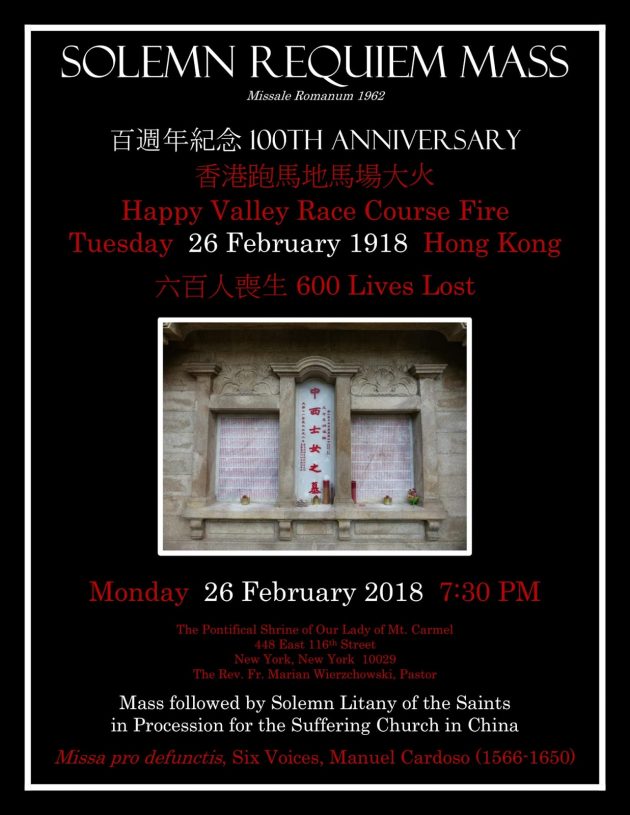
Nov. 2, 7:45 am low Mass, 7 pm Solemn Requiem Mass.
Church of Saint Anthony, 1496 Commonwealth Avenue, Bronx, NY
Nov. 1, All Saints Day, 7:30 p.m., Missa Cantata. The celebrant will be the parochial administrator, Fr. Louis Anderson
Church of Saint Paul the Apostle, 603 McLean Avenue, Yonkers, NY
Nov. 1, All Saints Day, 12 noon, Low Mass (dialogue). The celebrant will be the pastor, Fr. Leonard Villa.
Immaculate Conception Church, Sleepy Hollow, NY
November 1, All Saints Day, 5PM Low Mass
November 2, All Souls Day, 7PM Sung Requiem Mass
St. Matthew’s Church, Dix Hills (Long Island), NY
Nov. 1, 10:30 am
Nov. 2, 9:30 am and 10:15 am, low Mass in the chapel
Church of Saint Anthony of Padua, Jersey City NJ
Wed. November 1, All Saints Day, 8:00pm
Thurs. November 2, All Souls Day, 8:00 pm
Church of Saint Anthony of Padua at the Oratory Of Christ the King, West Orange, NJ
Wed. November 1, All Saints Day, 7:00pm
Thurs. November 2, All Souls Day, 7:00 pm
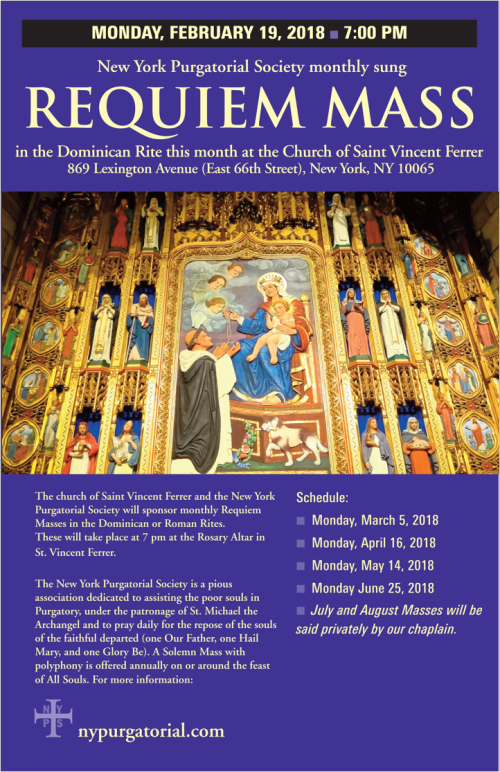
On Monday November 13 at St. Vincent Ferrer Church, New York:
Solemn Requiem Mass at 7 pm featuring Requiem in D Minor by Wolfgang Amadeum Mozart. information
Painting of Christ the King and the Saints in the Pontifical Shrine of Our Lady of Mount Carmel, New York. Painting of the Souls in Purgatory in St. Catherine of Siena Church, New York.
30
Oct
St. Mary’s Church, Norwalk, CT, will host a concert devoted to the music of Franz Schubert (1797–1828) on Sunday, November 5 at 3 pm.
This event will feature the St. Mary’s Schola Cantorum performing a variety of works by Schubert, including excerpts from his Deutsche Messe, chamber and choral works, and solo songs with keyboard and guitar accompaniment. The St. Mary’s Schola Cantorum provides sacred music every Sunday for the 9:30 Traditional Mass at St. Mary’s Church.
The individual musicians of the Schola will also sing a selection of Schubert’s most beloved solo songs, including his “Ave Maria” in the original poetic German. The singers will be accompanied by Schola Director David J. Hughes on piano and organ, and Assistant Director Charles Weaver on 19th-century guitar.
The concert will be performed in St. Mary’s Church at 3:00 p.m. General admission is $25 ($15 for students and seniors); special reserved seating in the choir loft in close proximity to the performers is $50. A light reception will follow the concert, and Solemn Vespers will be sung in the church at 5:00 p.m.
Proceeds from this concert will help fund a special liturgical performance of Schubert’s Mass in G Major, with the combined choirs of St. Mary’s Church, and stringed instruments, at the Midnight Mass of Christmas (prelude starts at 11:30 p.m. on Sunday, December 24).
For further information, please visit the St. Mary’s Church website at www.stmarynorwalk.net.
30
Oct

This icon by local artist Ken Woo is in the Church of Our Saviour, New York
Sermon for the Feast of Christ the King, Oct. 29, 2017, St. Mary Church Norwalk
by Father Richard Cipolla
Pilate said to him, “So you are a king?” Jesus answered, “You say that I am a king. For this I was born, and for this I have come into the world, to bear witness to the truth.”
(John 18:37-38)
The Feast of Christ the King was added to the Roman Calendar in Pope Pius XI’s Encyclical Quas Primas on December 11, 1925. This was the time of a most troubling interlude between the two World Wars that devastated two generations. It was also a troubled time for the Catholic Church. This time was the beginning of the rise of the understanding of an ideal government as purely secular. This was also the time when the so called Roman question had not been resolved, the question being the dispute regarding the temporal power of the popes as rulers of a civil territory in the context of the Italian Risorgimento. It ended with the Lateran Pacts between King Victor Emmanuel III of Italy and Pope Pius XI in 1929.
The Pope was quite explicit in why he thought it necessary and salutary to institute this feast for the whole Church. The date, the last Sunday in October,
was chosen because it was the Sunday before All Saints Day, when the manifestation of the kingdom of Christ is seen in the glorious holiness of the saints in heaven; also because it was near the end of the liturgical year, and finally, because that Sunday had been traditionally observed as Reformation Sunday by Protestants.
I want to read to you the Pope’s own words that enable us to understand his conception of this feast from his Encyclical that promulgated the feast of Christ the King. He quotes St. Cyril of Alexandria. “Christ has dominion over all creatures, a dominion not seized by violence or usurped, but his essence and nature”. Then the Pope goes on: “His kingship is founded upon the ineffable hypostatic union From this it follows not only that Christ is to be adored by angels and men but that to him as man angels and men are subject, and must recognize his empire; by reason of the hypostatic union Christ has power over all creatures. But a thought that must give us even greater joy and consolation is this: that Christ is our King by acquired, as well as by natural right, for he is our Redeemer.”
He then goes on to explain how Christ’s kingdom is spiritual and not at all concerned with worldly power. But it is at this point he adds: “It would be a grave error, however, to say that Christ has no authority whatever in civil affairs, since by virtue of absolute empire over all creatures committed to him by the Father, all things are in his power….Thus the empire of our Redeemer embraces all men. To use the words of Our immortal predecessor Pope Leo XIII: “ ‘His empire includes not only Catholic nations, not only baptized persons who, though of right belonging to the Church, have been led astray by error, or have been cut off from her by schism, but also all those who are outside the Christian faith; so that truly the whole of mankind is subject to the power of Jesus Christ.’”
How do we react to those words, to this insistence that the kingship of Christ extends to all men and women living on this earth and that as a conclusion every government must understand their obligation to govern in a way that is consonant with the teaching of Christ the King? To those of us who have grown up with the dictum of separation of Church and State, to those of us who have grown up since World War II and the secularization of society, to those who are young who have grown up with the assumption that Catholicism and Christianity are just one religion among many, for those who have grown up with pluralism as the ultimate gift of the gods, what can the kingship of Christ mean? We could take refuge in trying to spiritualize the whole thing, but that would be dishonest with respect to what Pope Pius XI was saying. Or we can transfer the feast to another day and thereby change its meaning. That is what the reformers of the calendar did in 1970. In the Novus Ordo calendar this feast was transferred to the last Sunday of the Year, immediately before the First Sunday in Advent. The readings for that Sunday are always about the end times: stars falling out of the sky, earthquakes, terrible tribulations. There is avalidity in associating this feast with the end time when the Kingship of Christ will be made totally manifest. But to associate this feast with only the future—even the ultimate future—makes it much easier to dismiss the reality of the Kingship of Christ as just part of the End Times, which for many Catholics and for most people in general has no meaning right now in their lives in this world. It is much easier to deal with Christ the King who will come again in some vague way in the future than to deal with Christ the King right now.
Imagine someone—lay man or woman, deacon, priest , bishop or Pope, going to the UN and speaking about the kingship of Christ and the implications of his kingship for every member of the United Nations using the words of Pius XI. The representatives of the UN would be polite and not say out loud what they are thinking—this guy is crazy. And there would be polite applause after the speech, and then they would go to a fancy dinner in New York and talk about the crazy Catholic who spoke of the kingship of Christ in practical terms for each of their countries. They would laugh and order cocktails before dinner. At least Pilate had the sardonic intelligence to ask the King: what is truth?
The paralysis that has beset the Catholic Church after the Second Vatican Council threatens the very foundation of the Church, for it makes evangelization as defined by Christ himself before the Ascension impossible. Playing footsie with the world is not the same as being wise as a serpent and gentle as a dove. Denying the objectivity of sin in the name of mercy is not consonant with Jesus’ words at the beginning of his ministry: “Repent and believe the Gospel!” Making mercy a principle that trumps the justice of God is worse than phariseeism. But the current situation in the Church would be impossible without the rise of a hyper-papalism, that reduces the Church and her teaching to the person of the Pope. This irrational reduction of the teaching of the Church and the authentic development of doctrine to the preferential musings of a Pope is destructive to the Church of Jesus Christ. “You are Peter”. The Pope is the Vicar of Peter. And his job, and it is a job, a job that has certain perks handed down by Tradition, his job is to pass on the Catholic faith totally and unalloyed and to give his assent to those developments of doctrine that are the fruit of centuries of thought and prayer and then to define them as credenda, those things that are to be believed by Catholics because they are true.
What is missing? Why are we Catholics in the situation in which we find ourselves, emasculated and irrelevant with respect to the world? Because we no longer hear those words that are the antidote to the poison of secular contemporary secularism, the world of tweets and texts. Catholics no longer hear and understand those words: Hoc est enim corpus meum.. those words that are the antidote to the frivolous and empty culture in which we live. Not “This is my body” or “Este es mi cuerpo”, or “Questo é il mio corpo, or “To jest moje ciałot”. But Hoc est enim corpus meum. Those words that transcend the particularity of the cacophony of language and that are uttered in a language that is no longer a spoken language and therefore transcends particularity: they are the words that make real the presence of Christ the King in a world that despises him or does not know him or is bored with him or cannot turn off their text messages to pay attention to him or cannot stop tweeting to express their own banality—there it is. The words of Christ the King. The Truth. What is truth? Hoc est enim corpus meum.
27
Oct
26
Oct