4
Oct
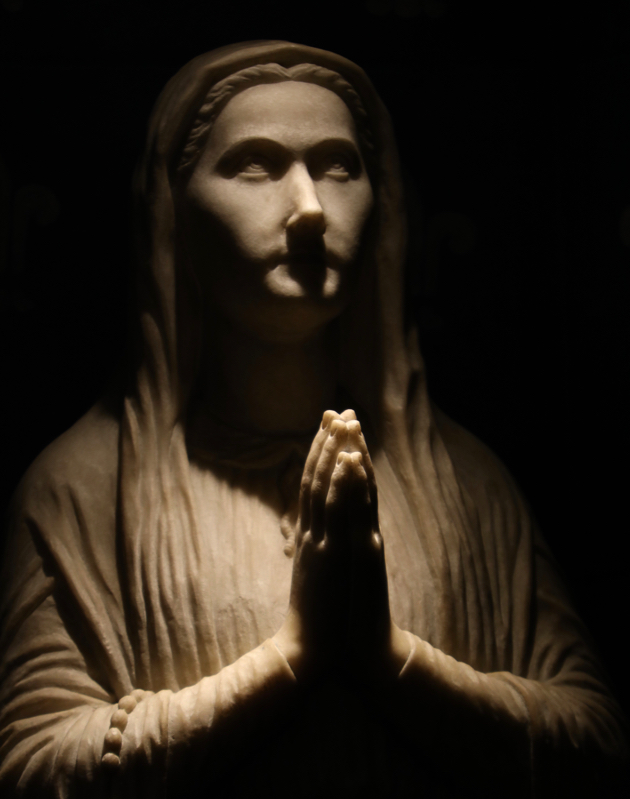
On Tuesday, October 10th at 7:30 p.m., the Pontifical Shrine of Our Lady of Mount Carmel in East Harlem, Manhattan, New York will celebrate a Solemn Traditional Latin Mass in honor of Saint Helen of Laurino.
August 18th is the Feast Day of Sant’Elena (St. Helen), patroness of both Laurino and Pruno in the Province of Salerno . One of four major observances held in her honor (May 22nd, June 29th and October 10th are the others), the Feast should not be confused with that of Saint Helena of the Cross, also celebrated on August 18th. Born in Laurino in the first half of the sixth century (some say late eighth- or early ninth-century), Sant’Elena was a beautiful and pious maiden. Abused at home, she fled to the nearby mountains of Pruno to live the ascetic life of a hermit in solitude and prayer. After 21 years she died. Her remains were discovered in the grotto and translated to the Cathedral of Capaccio-Paestum. Over the centuries, her relics were moved several times before finally being interred in the Church of Santa Maria Maggiore in Laurino. According to legend, neighboring Valle dell’Angelo contested the ownership of the relics. To appease the rival claimants it was decided her body would be put onto a cart driven by two heifers and they would decide. When the oxen reached a fork in the road leading to the two towns, they chose Laurino.
In 1923 Italian immigrants from Laurino in East Harlem created a replica of their hometown’s Shrine of Sant’Elena at Our Lady of Mount Carmel. They obtained a major relic of the saint that will be venerated after Mass.
2
Oct
Sermon for the 17th Sunday after Pentecost
by Fr. Richard Cipolla, St. Mary Church, Norwalk, Oct. 1, 2017
“You shall love the Lord your God with your whole heart, and with your whole soul, and with your whole mind. This is the greatest and the first commandment. And the second is like it: You shall love your neighbor as yourself.” (Matthew 22: 37-39)
“To be or not to be: that is the question.” So said the melancholy Dane, Hamlet, the prince of Denmark in one of the most famous lines in all of English literature. The question of existence is itself asked here. But it is the wrong question in the end. The question to ask, the fundamental question to ask is not “to be or not to be”. It is rather: “To love or not to love: that is the question”.
Post -modern man finds the very idea of love something difficult and perhaps in the end impossible. In the post modern world of distrust of accepted truths, where subjectivism is seen to be the only way to function in the world, a world of fragmentation and liquidity, the ability to love and the reality of love is put into question. Surely this is one of the reasons for the decline of marriage as one of the fundamental institutions of society. But postmodern man also understands that the question of the possibility of love is somehow linked to the possibility of truth. The rejection of one possibility almost demands the rejection of the other. This is just one of the ironies of postmodern man: that at least he knows the real questions that modern man often did not even ask, such as the link between love and truth.
But this is something that the Catholic understands. Because for the Catholic the possibility of love in a selfish world—and the world has always been selfish– is real only because of the reality of truth in the man Jesus Christ and his supreme act of love on the Cross. For the Christian love cannot be separated from faith in Jesus Christ as the way, the truth and the life. For the Christian. love cannot be separated from the God who gave his only begotten Son to die precisely for those who refuse to love.
For the Christian to be IS to love. The God we worship is the one whose name is “I am who am:” Being itself. But the God we worship is also Love, and so for us, to be is to love. Existence itself, in the most basic and profound sense not only is grounded in love, but also for me the measure of my being is the measure of my love. It is Jesus himself who grounds being in love in today’s Gospel. Ah, those familiar words! “You shall love the Lord your God and your neighbor as yourself.” Those words are so familiar that we forget what they mean. All too often they come across as some general ethical principle: do good things for other people. And this is the definition of Christianity for too many people. Thus the Christian is the one who is active in social programs, who is obviously out there helping those in need. That is the way we find out who is really Christian and who is not. But no, this is wrong headed. The Christian is not identified merely by the person who does good for his neighbor. For there are those who do not identify themselves as Christians in any way, certainly not Catholic, who do good for their neighbors, who work in shelters and soup kitchens, who are kind and gentle, who go out of their way to be attentive to and to respond to the needs of others.
What then marks the Christian from the rest of those who do good to their neighbor? What marks the Christian is the reason, the ground, for his doing good for his neighbor. The grounding, the reason is one and simple: he can and does good because of the love of God: the love of God for him or her and the response of love for God by each person. It cannot be said too often: I am able to love, that is, I am able to do good in an unselfish, un-egotistic way, only because of my love for God. I can do good, that is, I can love my neighbor, only because I love God and only when I love God. That separates us from secular humanists, those who ground love of neighbor is some sort of abstract notion of the good, or in some basic ethical principle that they assume is obvious to all, or in some generally optimistic view of the general goodness of all men and women. They are wrong, deeply wrong. For the fact is that left on our own, we will not love, we will play the love-game, but we will love because it gives us personal satisfaction to be doing the right thing, the noble thing.
This caring for neighbor does not mean caring for the homeless man in the subway. It means caring for your wife, your husband, your parents, your children, yes, even your priest. This is not something natural that we do, something nice. It is rather unnatural, and that we can care and love is a gift of grace. It is the grace of God that enables me to love my neighbor, that enables me to love at all. I do not love, when I do love, because of something within me that enables me to love, something I draw from, something that is within me as a man or woman. I do not love because of some fidelity to an ethical system, some principle. I can love, when I do love, because of the sheer grace of God, because my being is grounded, depends on, Love itself.
And when we understand this, what Jesus is telling the Pharisees and us today in the Gospel, then we are humbled, we are brought down to the ground, we come into contact with reality, a reality shorn of the warm fuzzies of romantic love, to a reality of the love that is shown forth supremely in the Cross of Jesus Christ. I can love at all because God loved me so much that he sacrificed Love in the flesh on the wood of the Cross so that my sins can be forgiven and so that I can love in the deepest sense. When I realize this, the scales of secular humanism fall from my eyes. And I no longer see my Catholic faith as merely a set of rules to help me and my family do the right thing. I no longer use my faith and the Church as only a moral association meant to keep my children in line. No: I see clearly and fearfully and humbly that the question to ask is not “to be or not to be”, but rather “to love or not to love” And the answer does not depend on me, it does not hang on me. It depends, or rather, it hangs on the crucified Christ, which image hangs in this church over the altar rail that separates earth and heaven.
2
Oct
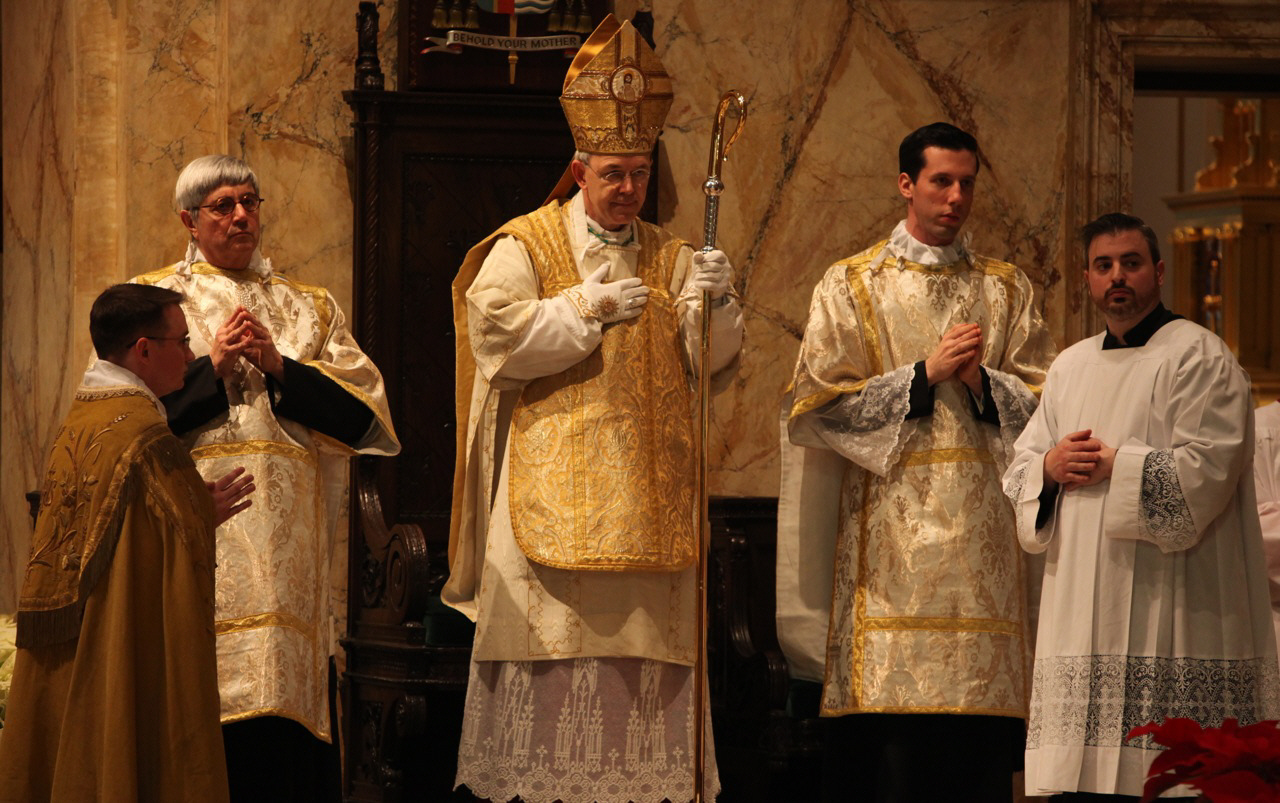
A well-attended Solemn Mass for the Feast of St. Michael on September 29 in the Shrine Church of the Most Precious Blood in Little Italy, New York, sponsored by the Sacred Military Constantinian Order of St. George. Photos courtesy of Diana Yuan.
1
Oct
28
Sep
26
Sep
We are happy to announce that the Society of St Hugh of Cluny and St. Mary’s parish, Norwalk, Connecticut are sponsoring a conference and mass on Thursday, October 19 at St Mary’s Church. The conference and mass commemorate the tenth anniversary of Summorum Pontificum. The proceedings will be as follows:
5:30 PM. Bishop Athanasius Schneider and Fr. Innocent Smith OP will give presentations in the parish hall of St. Mary’s.
7:30 PM. Pontifical Solemn Mass celebrated by Bishop Schneider.
9:00 PM. Reception in the parish hall.
We are proud once again to welcome Bishop Schneider back to Connecticut. I hope that many of you will be able to participate in this special evening!
No registration necessary. Free-will donation suggested.
24
Sep
The 22nd annual Pilgrimage for Restoration from the Lake of the Blessed Sacrament (Lake George, NY) to the Shrine of the North American Martyrs in Auriesville, NY, will take place this coming weekend, from Friday September 29th to Sunday, October 1st. This traditional walking pilgrimage will include daily Traditional Mass, culminating in a Solemn Traditional Mass at 3:15 this year in the Coliseum Church in Auriesville, the place where Saints Isaac Jogues, René Goupîl, and John de LaLande were martyred 373 years ago.
This yearly pilgrimage is organized by the National Coalition of Clergy and Laity. For registration and more information, go to the website for the pilgrimage.
24
Sep
The Institute of Christ the King will be administering the church of Sts. Cyril and Methodius in Bridgeport, CT beginning on October 8. We will be posting information on the new Mass schedule when it is available.
23
Sep
Prof. Eamon Duffy, from a 2015 review in the Guardian of The Nuns of Sant’ Ambrogio by Hubert Wolf:
But, mysteriously, he ( Joseph Kleutgen S.J. – SC)was soon back in favour. In 1870 Pius IX lifted all the ecclesiastical censures against him, and he was appointed a theological adviser at the first Vatican council. According to Wolf, the key to this remarkable turnaround lay in Kleutgen’s fashionably rightwing theological views. In the early 1850s he had pioneered the novel claim that not only were solemn decrees of popes and councils infallible, but the “ordinary magisterium”, or routine teaching of the pope and Curia, was itself binding on Catholic consciences and above scrutiny by theologians. This teaching rapidly became an official orthodoxy, music to the ears of Pius IX and his entourage, and Kleutgen was able to surf the rising tide of papalism back to respectability and influence.
How is Duffy adapting his “classic” Catholic progressive analysis to the current party line emanating from the Bishop of Rome and his courtiers ascribing quasi-infallibility to the “ordinary magisterium” of Bergoglio, to the Conciliar liturgical changes, etc.?