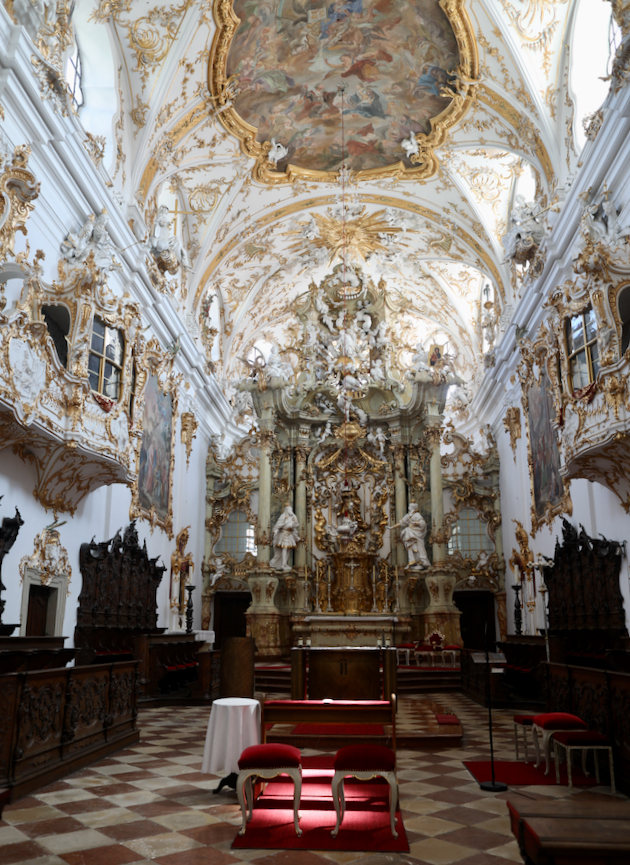
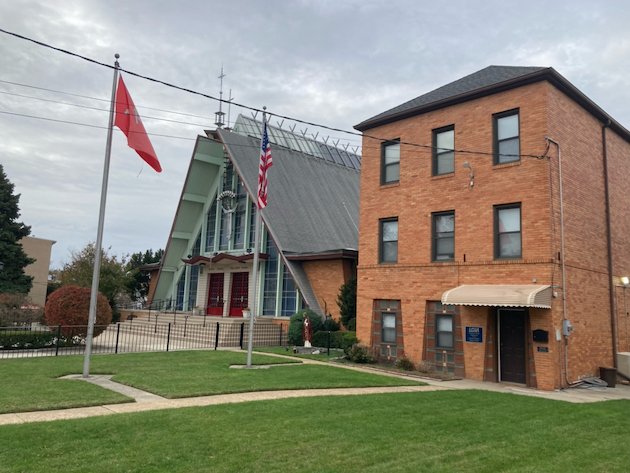
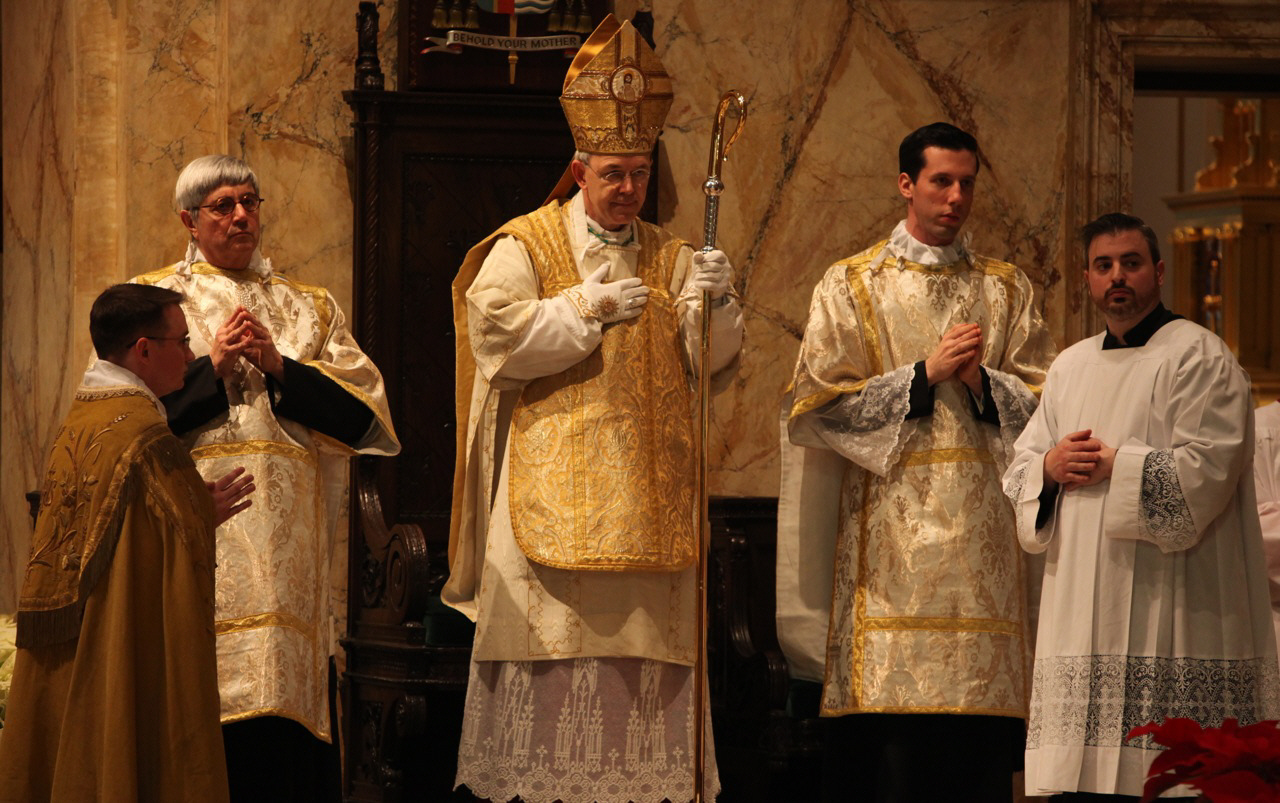
This morning, at 6 am, a Solemn Mass was offered at St. Mary Church Norwalk in candle light.


6
Dec
Join us for solemn Vespers with chamber orchestra at Old St. Patrick’s in New York City, celebrating the feast of Our Lady of Guadalupe with music composed for the great cathedrals of Mexico, including works by Juan Gutiérrez de Padilla, Manuel de Sumaya, Ignacio de Jerusalem, and Santiago Billoni. The event also features Fr. David Michael Moses as guest preacher, and concludes with Benediction of the Blessed Sacrament.
Please note the Society of St. Hugh of Cluny is co-sponsoring these Vespers.

4
Dec
Here are some of the Traditional Masses available on December 9th, which has been designated a Holy Day of Obligation this year.
St. Mary Church, Norwalk, CT, 8 am, 12:10 pm, 7 pm Solemn Mass
Corpus Christi Church, South River, NJ, Missa Cantata, 7 pm
4
Dec
We have observed an increasing attraction of Eastern Orthodoxy for “conservative” Catholic spokesmen dismayed by the post-Conciliar drift in the Western Church. This blog has commented on the cases of Alessandro Gnocchi, Rod Dreher, and Michael Warren Davis. That list, moreover, is not exhaustive. Now the New York Post takes up the topic, looking mainly at why men convert from Protestantism to Orthodoxy:
Schlott, Rikki, Young men leaving traditional churches for ‘masculine’ Orthodox Christianity in droves (12/3/2024)
Christenson, who works as a fundraiser for nonprofits, attends Saint Mary’s Orthodox Church in Falls Church, Virginia. Conversion (from Protestantism to Orthodoxy-SC) means that he now must frequently attend confession, recite prescribed prayers, and endure extreme fasting, sometimes over 40-day stretches. Weekly services are also highly ritualized and regimented, and can last up to two hours.
Christenson’s story isn’t just anecdotal. As more and more Protestant churches unfurl Pride flags and Black Lives Matter banners in front of their gates, young men are trending toward more traditional forms of worship.
A survey of Orthodox churches around the country found that parishes saw a 78% increase in converts in 2022, compared with pre-pandemic levels in 2019. And while historically men and women converted in equal numbers, vastly more men have joined the church since 2020.
Father Josiah Trenham, an Orthodox priest, attributes this to the “feminization” of Western Christianity (both Catholic and Protestant)
“The feminization of non-Orthodox forms of Christianity in America has been in high gear for decades,” Trenham explained.
He points to the fact that the vast majority of attendees at most Christian churches are female, and many services are accordingly dominated by emotional songs, swaying, uplifted hands, and eyes closed in ecstasy.
“Men are much less comfortable [in those settings], and they have voted with their feet, which is why they’re minorities in these forms of worship,” he said. “Our worship forms are very traditional and very masculine.”
Other witnesses cited in this article speak of the stability and unchanging nature of Orthodox ritual, of the beneficial challenges Orthodoxy imposes on its members and of the freedom of the Divine Liturgy from the personality of the priest/preacher. As one convert concluded:
“One might say Orthodoxy itself is more masculine, especially when compared to the more feminized forms of Christianity that exist today where the emphasis is on emotional experience, feeling good, and appealing to the self.”
Although this article deals mainly with Orthodoxy as an alternative to Protestantism, do I need to point out the similarity of the “Western” services described above to the Novus Ordo? Indeed, the “Synod on Synodality” and Pope Francis have committed to increase the presence of women within the Church. And did not some Orthodox churches and churches of the East (like the Copts) speak out forcefully against the errors of Pope Francis in Fiducia Supplicans when most Roman Catholic bishops (outside of Africa) were silent or even supportive of the Vatican?
These are all valid points. Those tempted to explore this path, however, should be aware that there is much more involved in such a conversion than what is described above. For a dominent tendency of Eastern Orthodoxy today posits an unbridgeable theological gulf existing between the churches of the “West” and “East.” According to this line of thought, the abyss dates back at least to the 4th century. This position is reflected in the conversion process. A convert to Orthodoxy from Catholicism will be required to expressly abjure the entire Western (Roman) Church: all its saints, liturgy, history, philosophy, art and literature.1) I doubt many Catholic traditionalists are ready to take such a step or to adopt such preposterous notions of ecclesiastical history. After all, have the traditionalists not made, often at great personal cost, a commitment to cultivate and defend these very things?
Certainly, I am not claiming that everybody in the Orthodox world has such exclusivist views. But I am afraid their prevalence makes it unlikely that Orthodoxy can be the answer to the spiritual crisis in the West anytime soon.
2
Dec

Once again last October, the Coetus Internationalis Summorum Pontificum assembled in Rome for its annual pilgrimage to Saint Peter’s Basilica. I want to add a few observations to what has already been reported. Our own photographic record can be found on this site. 1) The number of participants, primarily of the laity, happily continues to increase. Furthermore, a considerable number of clergy participate. In this respect, it is nothing like the American “National Summorum Pontificum Pilgrimage” in Washington on October 8 of this year, where no clergy were present. This year the Summorum Pontificum pilgrimage proceeded with relatively few glitches (aside from the unanticipated closure for restoration of the church of Santi Celso and Giuliano in front of which the pilgrims assemble on Saturday before setting out for St Peter’s.)
As far as I could tell, the serving clerical bureaucracy of the Catholic Church in Rome remained totally absent – except for one scowling ecclesiastic who stared at the procession as it passed him the street. In this very week, of course, the Synod on Synodality, the face of the official Catholic Church, was reaching its (preliminary) end. Its recommendations would open the door to a whole world of potential further change.
Paix Liturgique organized its customary conference prior to the start of the pilgrimage. Despite all the distressing developments, the atmosphere was positive and enthusiastic, free from polemics and apocalyptic emotions, Speakers from Spain, the UK and Nigeria told of their encounters with Catholic tradition. Indeed, in the first two cases their acquaintanceship dates only from the last several years! In contrast, John Rao, well known to us here in New York, took us back to the 1970s and the first stirrings of the traditionalist movement in the United States. Cardinal Gerhard Müller gave a most moving and impressive presentation. In conclusion, Christian Marquant, President of Paix Liturgique, spoke enthusiastically and eloquently of the present dramatic situation of traditionalists in the Church: “They have lost, but we have not yet won.” Traditionalism remains alive and well, yet it remains the target of continuing official disdain and relentless persecution.

At the Paix Liturgique conference: Cardinal Gerhard Müller (above); Prof. John Rao (below).

As always, the Saturday procession to Saint Peter’s attracts great interest from bystanders – some of whom even give signs of approval. Like last year, at the direction of Pope Francis, the final act of the pilgrimage has been limited to a solemn procession to the main altar followed by benediction before the altar of St. Peter’s chair. The ceremony and music were splendid; Cardinal Müller preached eloquently on the significance of the city of Rome, of the Christianized Greco-Roman culture it exemplifies and of the historic role of Saints Peter and Paul who are buried in this city:
If ancient Rome was the idea of peace among peoples under the rule of law, Christian Rome embodies the hope of universal unity of all peoples in the love of Christ
…
Do not, therefore, build the house of your life upon ideologies devised by men. But upon the rock of personal friendship with Christ in the divine virtues – faith hope and love – so that you may then be able to say with St. Paul: I live in the faith of the Son of God, who loved me and delivered himself for me.” (Gal 2:2))
The concluding service of the pilgrimage – a Solemn Mass for the Feast of Christ the KIng – was held in the FSSP church of Santa Trinità. Its dimensions are grossly inadequate for a congregation of this magnitude – to secure a seat one has to arrive an hour or more earlier. That’s a trial especially for families with young children. Of course, at the same time in Rome other, far larger, churches stand virtually empty. That one of these could be made available to this pilgrimage – as opposed to the Anglicans or Copts – is, at this moment, perhaps a fantasy under the current papal regime. Despite the discomfort, the solemn mass, celebrated by bishop Eleganti, was exemplary.
So this year’s Roman pilgrimage makes one very clear statement to traditionalists: you are not alone. An increasing number of individuals and countries are joining this pilgrimage. And the pilgrims’ attitude is not embittered, but relaxed, confident, enthusiastic – and also composed and prayerful. Inspired by this commitment, I am “cautiously optimistic” for the fututre.


1
Dec

The following churches will offer Rorate Masses. The Rorate Mass is a beautiful Advent devotion: the Mass of the Blessed Virgin Mary is offered by candlelight just before dawn.
Saturday December 7:
St. Mary Church, Norwalk, 6 am.
Holy Innocents Church, New York, NY, 7 am
St. Margaret of Cortona Church, Bronx, 6:30 am
St. Josaphat Church, Bayside (Queens), 6:30 am; Rorate Masses also on the following weekdays at 6:30: Dec. 2, 3, 4, 9, 10, 11, 13, 14, 16, 18, 20, 21.
Our Holy Redeemer , Freeport, NY, Solemn Mass, 6:15am.
Saturday December 14:
St. Patrick Oratory, Waterbury, CT, 6 am Missa Cantata. Parish social afterwards in the hall with an Advent spiritual talk, followed by Benediction of the Most Blessed Sacrament.
Holy Innocents Church, New York, NY, 7 am
St. Josaphat Church, Bayside (Queens), 6:30 am; Rorate Masses also on the following weekdays at 6:30: Dec. 2, 3, 4, 9, 10, 11, 13, 14, 16, 18, 20, 21.
Annunciation Church, Crestwood, NY, 6 am, upper church
St. Marys/St. Andrews, Ellenville, NY, 6:30
Our Lady of Mount Carmel, 259 Oliver St, Newark, NJ, 6 am. Ample and secure parking available accessed via Chestnut St. behind the church.
Our Lady of Sorrows, Jersey City, 6 am
St. John the Baptist Church, Allentown, NJ, 6 am.
Corpus Christi Church, South River, NJ, 6:30 am Missa Cantata.
Our Lady of Fatima Chapel, Pequannock, NJ, 6:30 am Missa Cantata
Saturday, December 21:
Basilica of St. John the Evengelist, Stamford, CT, 6:30 am.
St. Josaphat Church, Bayside (Queens), 6:30 am; Rorate Masses also on the following weekdays at 6:30: Dec. 2, 3, 4, 9, 10, 11, 13, 14, 16, 18, 20, 21.
Other dates
Our Lady of Mount Carmel, New York, NY: Rorate Masses at 6:55 on the following days: Dec. 2, 3, 4, 5, 6, 10. 11. 13. 16. 17. 18. 19. 20. 23, 24
27
Nov
Bishop Frank Caggiano has informed us that the weekly Saturday 8 AM Missa Cantata at St. Mary Church, Greenwich, CT will continue.
16
Nov

UPDATE: I have added some clarifying comments and notes here and there in this article.
I recently paid a visit to the neighborhood of Columbia University. That institution is currently almost on lockdown, with all the entrances to the “quad” controlled by security guards. We all have heard of the recent clashes related to Gaza. But this security and surveillance environment is more fundamentally the inevitable result of the woke ideological domination there. As for the Catholic Church, its presence near Columbia is divided between two churches, Corpus Christi to the north on West 121st St. and Notre Dame to the south on West 114th St. (I recognize that the Catholic churches I am discussing have responsibilities beyond just caring for the Columbia Univerity community; I think that aspect, however, is more interesting to outsiders.)
For decades the face of Catholicism to the Columbia University community was Corpus Christi parish – culminating in the idiosyncratic regime of Msgr. Myles M. Bourke from the 1960’s until 1992. He did foster his own unique liturgy – nevertheless he was devoted to Catholic truth and above all to the continuation of an outstanding music program superior to that of almost any other church of the archdiocese of New York.
Since his departure, the ecclesiastical situation between West 144 and West 121 Streets has been fluid. Institutions, personnel and philosophies have abruptly appeared and disappeared – sometimes very publicly, often with little notice or explanation. Notre Dame parish, originally separate from this world, was drawn into it when the chaplaincy of Columbia university was first shifted there.
Currently there is now one Catholic parish: the “Parish of Corpus Christi and Notre Dame.” The “parish church” of the united entity is Corpus Christi church. The chaplaincy of Columbia University, however, was installed in the rectory of Notre Dame parish – at considerable expense.(initally a figure of $10 million was claimed) I believe the intent of these changes is to make Notre Dame primarily a chapel for the Columbia community while Corpus Christi retains its status as the local Catholic parish.(see footnote 4 below)
This return of the chaplaincy to Notre Dame – it had already operated out of that church between 2003 and 2011 – should be a significant upgrading of the architectural image of the Catholic church in the eyes of the students and faculty of Columbia. For Corpus Christi church, however elegant, was designed in the 1930’s in part to appeal to the supposed expectations of protestant America. Notre Dame church, on the other hand, is exuberantly Catholic – even baroque, if in a restrained, classicizing 17thcentury French form.
Undeniably, positive changes have been made under the united parish’s current leadership. At Corpus Christi church, the tabernacle has been returned to the center of the high altar. Indeed, the parish bulletin compared the new arrangement of the tabernacle with a photograph of the 1950s. And, by all appearances, Corpus Christi’s tradition of musical excellence continues – backed by financial support independent of the parish.


Analogous changes to the layout of the church of Notre Dame also have been made, if with less publicity. At some point in the recent past, an altar – and the tabernacle – were placed, rather incongruously, inside the church’s Lourdes Grotto, which now serves as a kind of Lady Chapel. The previous location of the tabernacle in a side chapel has been terminated; whether the Blessed Sacrament in this church has now been restored to the “center of the sanctuary” literally depends on your point of view.
I recently attended the 12:10 PM weekday mass in the Grotto. A congregation of 25 to 50 was present, which isn’t bad at all for New York City ( I would guess 150 or so attend the weekday mass at around the same time at St. Patrick’s cathedral). The priest gave a detailed explanation of Saint Albert the Great which particularly impressed me as I had studied in Cologne where the saint is buried. The mass concluded with the recitation of the prayer to Saint Michael and the singing of the Salve Regina. Both would have been virtually unthinkable at the campus ministries (including those of “Catholic” universities) of the 1970’s.
Yet how sustainable are these gains? As the recent history of these two churches near Columbia has shown, in the current state of the Roman Catholic Church everything depends on the personality of the current pastor (and bishop). Yes, remarkable achievements have been made, but at the same time attitudes and ideologies persist that implicitly or expressly challenge these accomplishments. For example, the pastor of Corpus Christi has emphasized the role of the restoration of the tabernacle to its central place as a key step in the “eucharistic revival” in the Church. 1) Yet, a month earlier, in the same bulletin of this church, a lengthy quotation of Cardinal Cupich appeared:
As Cardinal Cupich and other commentators have recently noted, since the Eucharist is our Life, it is more an action (taking, blessing, breaking and sharing) than an object. We should focus on the dynamic action and prophetic challenge of the Eucharist….more than on the worship of Jesus present on the altar. Likewise, our liturgy should be a community action and consciousness, rather than an act of individual piety. The very fact that the Eucharist is under the forms of bread and wine shows that it is essentially transitory, made to be consumed by us to transform us, all together into the Body of Christ….2)
Cupich clearly is setting forth the reasons why the tabernacle was moved off the high altar in the first place.
Further, the Catholic chaplaincy also has just offered the “Annual Thomas Merton Retreat” led by Robert Ellsberg, the son of Daniel Ellsberg of Pentagon Papers fame. He has long been a stalwart of Catholic religious and political radicalism. The advance publicity for the retreat would seem to promise an uncritical presentation of the thought of Thomas Merton and Dorothy Day, among others. And of course, Ellsberg now can draw on papal authority:
Pope Francis has distinguished between what he calls a “laboratory faith” and a “journey faith.” The first can appear like a “compendium of abstract truths” while in a “journey faith” we find God along the way…3)
We could also mention the uncertain existence of the mysterious “personal parish” of St. John Henry Newman for the students and faculty of Columbia University. 4) And Fr. Roger Landry, installed as chaplain to Columbia University with great fanfare in 2022, and who led a procession with the Blessed Sacrament at Columbia this year is leaving at the end of December 2024 for bigger if not better administrative responsibilities. 5) The parish of Corpus Christi and Notre Dame also has more mundane problems not dissimilar to those besetting many parishes in the city and beyond. The number of masses in the combined parish has had to be reduced because of the shortage of clergy. A French Sunday school associated with the historic French mission of Notre Dame parish recently moved out because of the lack of French families living in the vicinity of Notre Dame parish.
In summary, much has been improved on the Upper West Side. Yet, as always in the Novus Ordo, all such favorable developments remain linked to the current leadership of the parish. With new clergy, a different direction could be taken. That is why traditionalists place their trust not on present spiritual leaders, however charismatic, but on the fulness of the faith, in liturgy, theology and morality.


(Above) One of the plaques in their original location – St. Vincent de Paul church. Perhaps we cannot fully comprehend the identification of the French cause in World War I with the will of God. (Photo 6/2008)

(Above) Commemorating the reinstallation in 2017 of these memorials in Notre Dame parish. Perhaps if these worthies had shown more energy in the past St. Vincent de Paul parish could have been saved. (Photo 11/2024)


12
Nov
Nov. 26, 2024 Update: Bishop Caggiano has informed us that this Traditional Mass will continue!

The weekly Saturday 8 AM Missa Cantata at St. Mary Church, Greenwich will be discontinued at the end of January 2025 at the direction of Bishop Caggiano. As we understand it, the celebrant, Fr. Carl McIntosh, was only given permission to celebrate this traditional Mass until his time of retirement, which now will be the end of January.


Fr. McIntosh began celebrating a Saturday morning Missa Cantata in early 2021 at his parish, St. Roch Church, also in Greenwich. In 2023, in the wake of Traditionis Custodes, he was ordered to move the Mass out of the church, into a room in the school building next door. Later, the pastor of St. Mary church on Greenwich Ave. welcomed the Mass to his basement chapel.
Few of the locals know about this gem of Mass, as it was not mentioned in the church bulletin. Early rising joggers and dog walkers pass the door to the chapel, which has been propped open, unaware of the beautiful, chanted liturgy that is unfolding within. Regulars at this Mass found out about it by word of mouth or from notices in this blog.
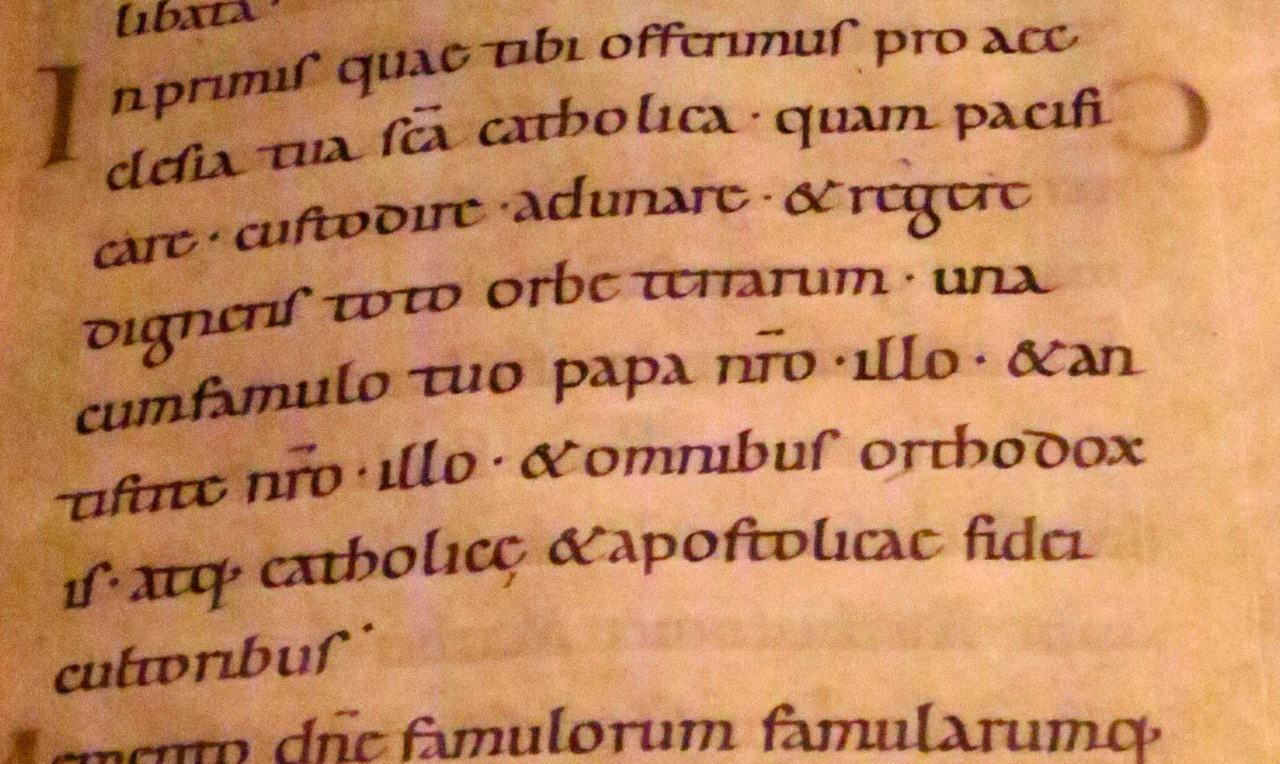
The 8 AM Mass is, on a very small scale, a remarkable achievement, evidencing the power of the traditional liturgy. This Mass is a Missa Cantata – at a very unusual time for such a liturgy! In particular, the music was performed at a very high level – equaling or exceeding what would have been heard at the Sunday Masses of a major parish in 1962! On at least one occasion, a solemn Mass was even celebrated.


And attendance at the Saturday Mass always recovered from the changes of location – it was a minor miracle of dedication, persistence, and devotion. Despite these “spiritual benefits,” it was more important to the diocese that this Mass first be exiled and then suppressed.
Do I need to mention that, to the best of my knowledge, Bishop Caggiano has at no time seen fit to communicate with any of the congregation regarding his decisions throughout these four years? The entire discussion has been among the clergy.
We urge you, if you care about this Mass, to write to Bishop Caggiano asking him to allow Fr. McIntosh to continue celebrating this Mass. Fr. McIntosh is in fact very interested and available. You might mention that there are no close Traditional Mass options nearby at that time. Sts. Cyril and Methodius, which has an 8:30 AM Mass, is 45 minutes away. Indeed, there are few Saturday morning Novus Ordo Masses in the area.
4
Nov
Tuesday Nov. 5th: St. Mary of Mt. Virgin, New Brunswick, NJ, Sung Requiem Mass, 7 pm
Wednesday, Nov. 6th: St. Mary Church, Norwalk, CT, Solemn Requiem Mass 1:15 pm. Missa pro Defunctis by Claudio Casiolini.
Thursday, Nov. 7th, Carmelite Monastery, 189 Madison Ave. Morristown, NJ, 7 pm the Purgatorial Society of Andrew Avellino 4th Requiem Mass of the 2024 year
Thursday, November 7, Our Lady of Mount Carmel, New York, NY,
6:00 PM – Confessions; 7:00 PM, Requiem Mass, Missa Cantata
(A Missa Cantata is offered on the First Thursday of the Month with Confessions before Mass, the Sermon is preached in Polish and a Coffee Hour usually follows the Mass. All are welcome to this Mass organized by the Polish Apostolate. There is an accessible lift at the 115th Street entrance and parking is available on a first come, first serve basis at the 116th Street driveway.)
Friday, November 8, Our Lady of Mount Carmel, New York, NY, 6:00 P.M. Confessions; 7:00 P.M. Anniversary Requiem Mass, Missa Cantata for the deceased members of the Regina Coeli Council #423 of the Knights of Columbus, Sermon and Absolution at the Catafalque. 8:00 P.M. Talk with Father Fidelis Moscinski CFR in the Parish Hall.
Monday, Nov. 11, Sts. Cyril and Methodius, Bridgeport, 6 pm, Armistice Day Requiem. Requiem High Mass for all the War Dead, particularly those of our parish. Absolution at the catafalque after Mass, followed by the placing of a wreath on the war memorial.
Wednesday, Nov. 13: Annunciation Church, Crestwood, NY, Annual Requiem Mass for Deceased Priests and Religious of the Archdiocese, 7 pm Upper Church
Tuesday, Nov. 26: St. Ann Church, Hampton, NJ, 7 pm, Traditional Latin Vespers for the Dead. Enroll deceased at PurgatorialSociety.org