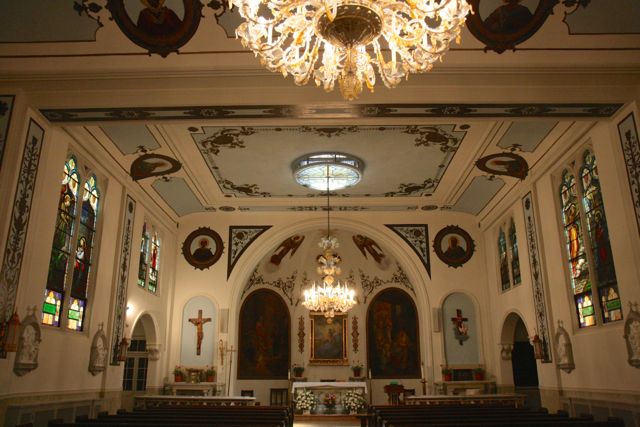
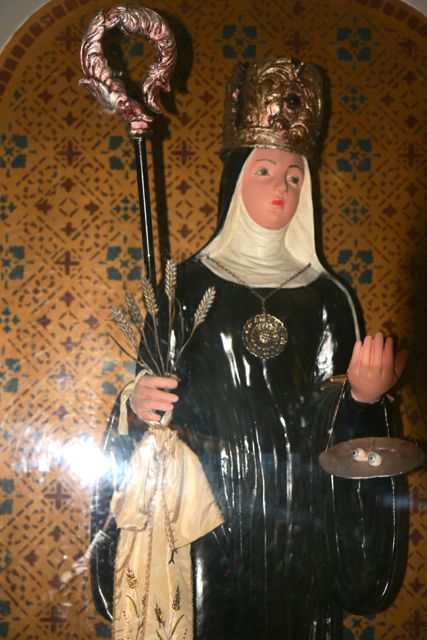
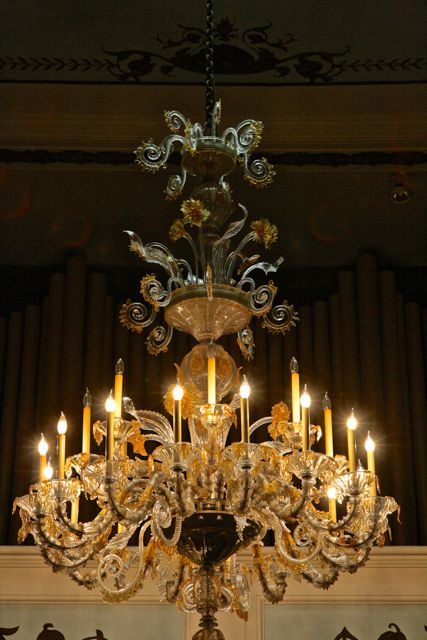
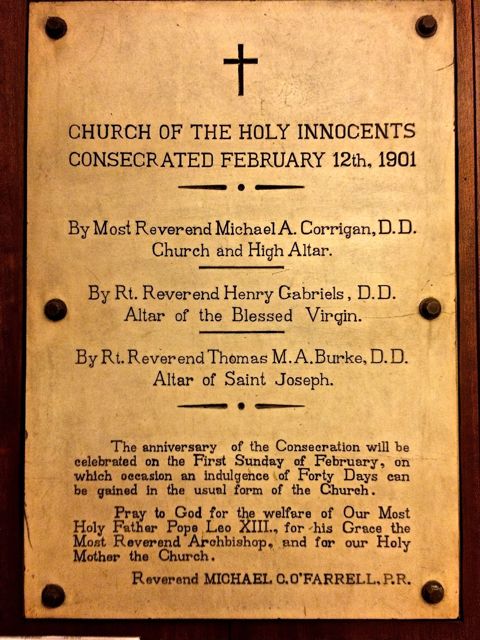
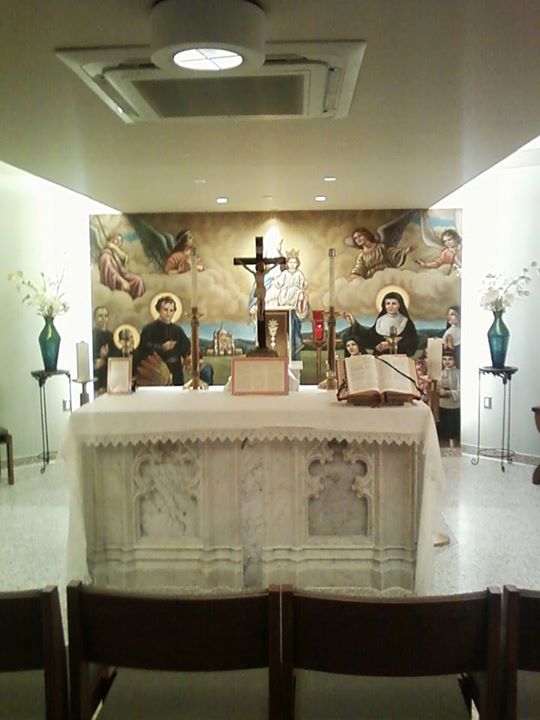
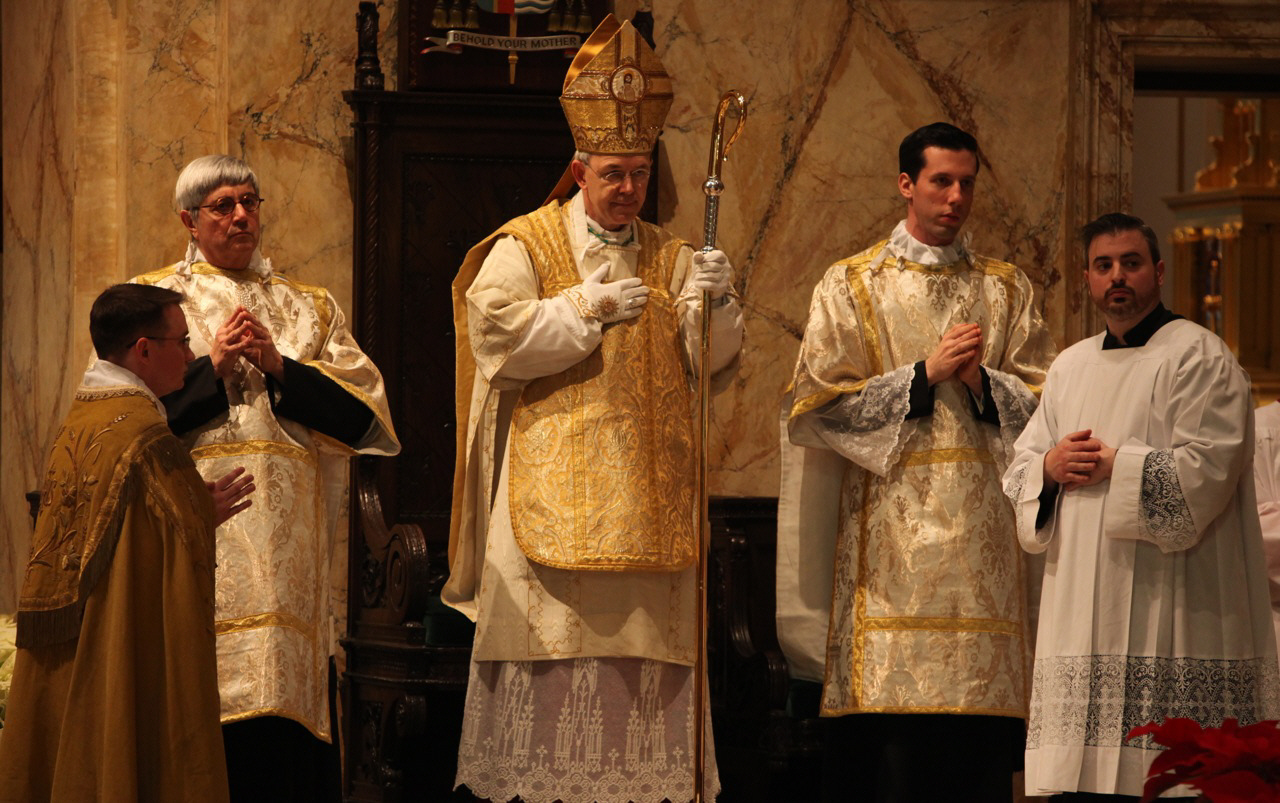
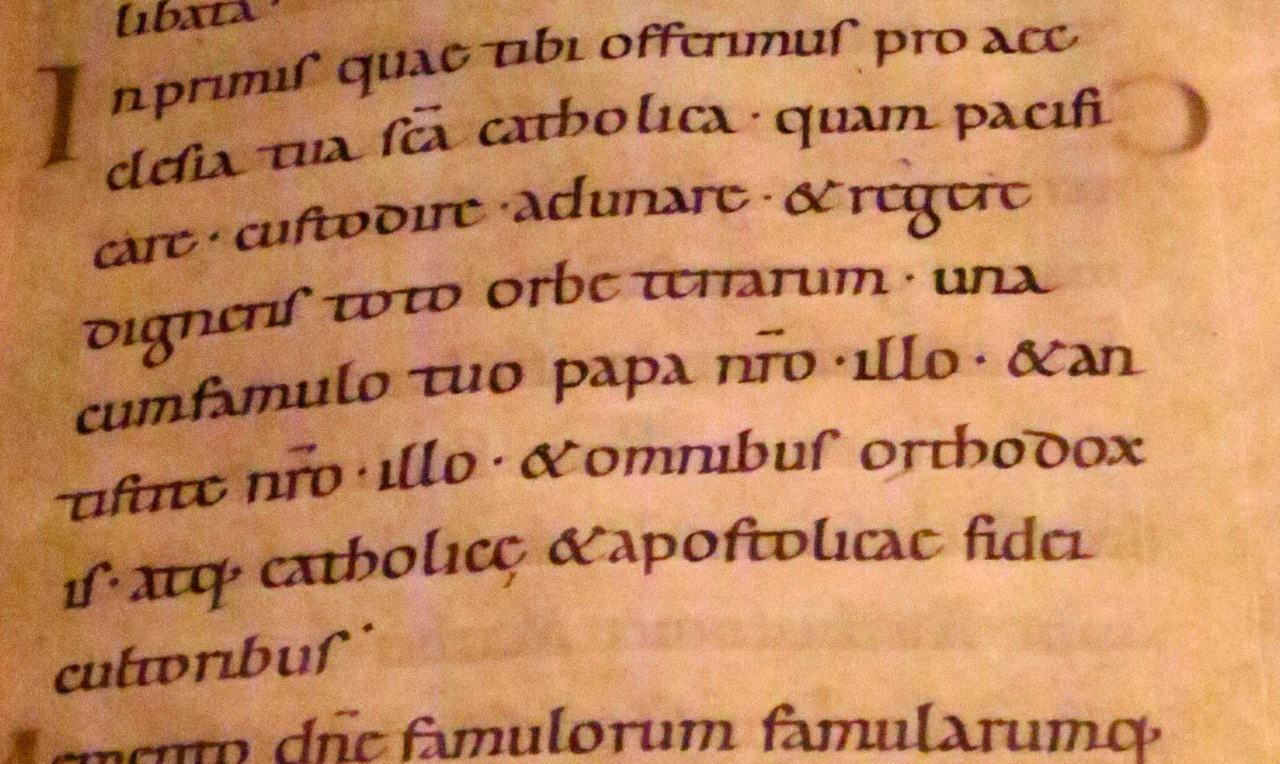
This week Wednesday, July 30th at 6 PM, there will be a Solemn Votive Mass of Our Lady of Mt. Carmel at the Church of the Holy Innocents
28
Jul
This week Wednesday, July 30th at 6 PM, there will be a Solemn Votive Mass of Our Lady of Mt. Carmel at the Church of the Holy Innocents
27
Jul
Holy Name of Jesus
West 96th Street (and Amsterdam)
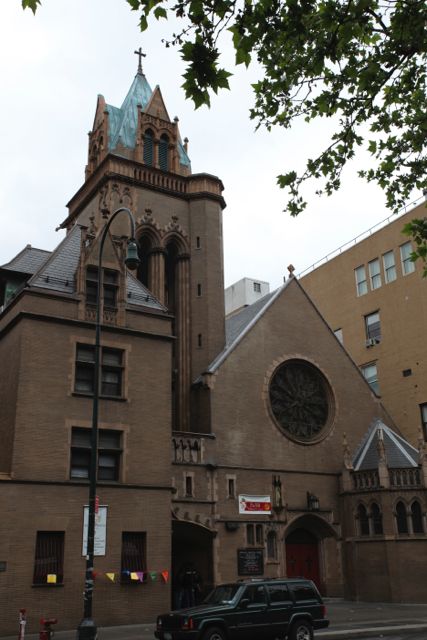
Heading west from Central Park on West 96th Street we leave the flourishing luxury of Central Park West and soon pass building after building the appearance of which indicates that this area wasn’t so nice at all in the not-too-distant past. As we proceed, we seem to be going back in time to these earlier, unlamented days of the West Side. It is upon reaching Amsterdam that we suddenly come upon the Church of the Holy Name of Jesus – prominently situated on a corner site and very traditionally Gothic in appearance, with its stone façade, large east window and single spire. It still dominates the anonymous or institutional structures of its immediate vicinity.
So it has done for many years, for Holy Name of Jesus is one of the oldest institutions of the Upper West Side. The new parish was established in 1873 in a district then called Bloomingdale, surrounded mainly by squatters tending their gardens. After the completion of the Dakota apartments on Central Park West the Upper West Side took off as the potential future residential and cultural center of the City. Holy Name of Jesus parish flourished as well – between 1890 and 1930 magnificent new parish buildings were erected. Stephen Joseph Donahue, a member of the first graduating class of Holy Name school in 1906, later became secretary to Cardinal Hayes, auxiliary bishop and rector of Holy Name parish – he was rumored to be a “home-town” favorite to replace Cardinal Hayes after the latter’s death (Spellman got the job).
After that, the decline was swift. By 1975 urban renewal, government social engineering, crime and drugs had reduced the neighborhood to a shambles. Most of the parish population had departed by this time. In 1990, the parish was entrusted to the Franciscans – never a sign of a parish’s health! Yet it was at his time that the dramatic economic upturn of the Upper West Side really began. And if vestiges of the past still exist in the immediate neighborhood of the parish, on the whole its situation – at least economically – is vastly improved from the grim days of the recent past. Yes, Holy Name of Jesus parish has seen it all!
This church’s Gothic exterior is somewhat austere and off-putting. But you soon notice that the church is just the center of a complex of buildings occupying a full block facing Amsterdam Avenue. The highlight on West 97th Street is a world-class parish center built in the 1920’s in an elaborate neo-Romanesque style reminiscent of St. John Nepomucene on the East Side. Then there is the impressive school building of 1904, with a former convent attached. A metal plaque commemorates the school’s 100th anniversary in 2005. Holy Name of Jesus School did not survive another ten years; it was closed in 2013. A ”De La Salle Academy” occupying several floors of the school also moved out to Holy Cross parish this year. Given the real estate values in the greater Upper West Side area I would expect that this fine school building is not long for this world. We may legitimately ask for a fuller explanation why a parochial school could not succeed in a part of the City particularly attractive to families. 1)
(Above and below) The former Holy Name of Jesus School
(Above and below)The parish house – now the “Franciscan Community Center.”
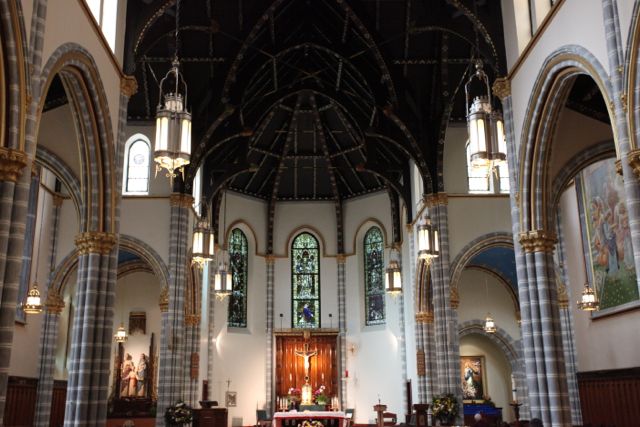
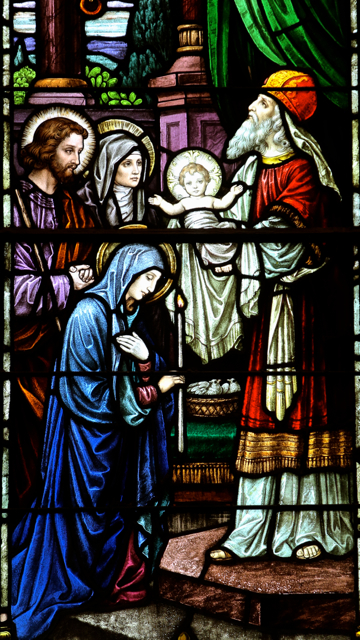
But the church interior reveals a new and entirely unexpected world. It is a cathedral-sized space – one of the grand parishes of the golden age of the Archdiocese. The decoration matches the elaborate architecture. Elaborate painting and traceries cover every inch of the walls. The Munich windows are of exceptional size, number and quality. The white marble altars and statues are among the best of their kind. Above all there is the great wooden hammer beam ceiling. Regrettably, the parish has recently installed blinding spotlights – of which it is very proud – all the better to see the Gothic details. Of course such lighting, like the similar installations under Cardinal O’Connor in St. Patrick’s, only proves that those who commissioned it had absolutely no idea what the Gothic style means.
(Above) A view towards the choir loft. (Below) A view of the south transept.
(Above and below) Details of the magnificent hammer beam roof.
One man who definitely did have a good idea of the Gothic was the architect of Holy Name, Thomas Henry Poole (1860-1919). A Catholic from England and also a writer – he contributed to the 1913 Catholic Encyclopedia – Poole was involved in the creation of some of the most extraordinary churches of around 1900, like St. Cecilia in Greenpoint and, above all, his own parish church of Our Lady of Good Counsel in Yorkville. Holy Name of Jesus, built in stages between 1891 and 1900, shares with Our Lady of Good Counsel a fortress-like exterior contrasted with an extravagantly detailed interior employing all the decorative arts to create a Catholic Gesamtkunstwerk. 2) Holy Name of Jesus church is admittedly far more conventional than its earlier Yorkville sister in both architecture and decoration.

(Above) The grand window of the east facade.

(Above)Holy Name of Jesus appears to be unique in that not only is there a side altar dedicated to Our Lady, but the entire decorative program of the transept reflects that dedication.

(Above) The (original?) baptismal font now does double duty as a holy water font in front of a “baptismal pool” at the entrance to the nave.
What will be the fate of this magnificent cathedral on West 96th Street? You can discern from the photographs that the post-conciliar “reforms” left the beauty of this church relatively intact. Certain indicia of parish life dear to the Archdiocese – like the assessment fro the Cardinal’s appeal – would seem to indicate that this parish is continuing on the upward ascent. And the very informative parish website documents a wide range of activity. 3) On the other hand, the recent summary closing of the school is not a good sign at all. Who knows – a beautiful cathedral is a great asset with which to start evangelizing in the not very Catholic atmosphere of today’s Upper West Side.
1) http://www.holyname.com
2) http://en.wikipedia.org/wiki/Thomas_Henry_Poole
3) http://holynamenyc.org. For more on the history of the church, see http://www.holynamenyc.org/index.php/about_us/church_history
20
Jul
It’s amazing! First Amy Welbrorn announces her satisfaction with a conservative Novus Ordo liturgy at a parish that – gasp! – has also celebrated the TLM for many years now. Then William Oddie proclaims his agreement with the view that the best way of showing loyalty to the papacy nowadays is silence. Now George Weigel himself, the apostle of blind obedience to the Pope, has had enough of the dishonesty emanating from the Vatican these days – at least on one limited historical question. He says, countering a presentation by Cardinal Sodano praising the 1970’s Vatican Ostpolitik:
“The Ostpolitik of Paul VI (who worried that he was not conducting a “policy of glory”) was based on the premise that the Cold War division of Europe would be a feature of the international landscape for decades, if not centuries; that the Church had to “save what could be saved” while making whatever deals it could with communist governments; and that Catholic criticism of the human rights violations of communist regimes should be muted. The results of this strategy included the effective destruction of the Church in Hungary, whose leadership became a subsidiary of the Hungarian communist party; the thorough penetration of the Vatican by Warsaw Pact intelligence agencies (to the benefit of communist negotiators); and the undercutting of Catholic leaders in Poland and in what was then Czechoslovakia.”
He does not mention that the Sodano party is reckoned to be among the constituent blocs that elected Bergoglio. Still – that George actually takes issue with a Vatican publicity initiative is news in itself.
19
Jul
The “Francis Effect” – we often hear assertions that, in contrast to the oppressive regime of his benighted predecessor, under Francis the Catholic Church has moved into a new era of light and life. On closer inspection, much of ballyhoo emanates from the expectations of the secular media – and the non-practicing Catholic laity – that Francis will abandon elements of Church doctrine and practice unacceptable to the secular establishment. But there are also factual assertions that people are “praying more,” attending church more, etc.
Now I understand Cardinals of Western Europe – with the conspicuous exception of some from Italy – were a key component of the coalition that put Bergoglio into the Papacy. No national hierarchy should have been more overjoyed at his election than Germany’s. Under Pope Benedict, the “German Church” had been resolute in its opposition to the Traditional Mass, correct translation of the Novus Ordo and to a reconciliation with the FSSPX. More recently, it has supported Francis’s initiative to explore changing the Catholic practice(and, really, doctrine)regarding second marriages through a questionnaire demonstrating that the Church “prohibitions” on divorce, contraception, premarital sex, etc., are disregarded by almost everyone in Germany. Voices calling for relaxing the Church’s positions on abortion, homosexualtiy and clerical celibacy are given prominent place in ecclesiastical venues. But this Church does keep detailed statistics. And here is the first report for 2013:
There are 24,170,754 “registered” Catholics in Germany; in 2012 there were 24,340,028
Parishes decreased to 11,085 from 11,222 in 2012
178,805 officially left the Catholic Church (2012: 118,335).
2.6 Million Catholics attend mass as opposed to 2.9 million in 2012 and 3 million in 2011
(10.3 % of registered Catholics attend mass)
Baptisms: 164,664 (2012: 167,505)
First communion: 191,169 (2012: 202,088)
Confirmations: 167,255 (2012: 175,967)
(Church)Weddings: 43,728 (2012: 47,161)
Burials: 252,344 (2012: 247,502)
Official (adult)entry into the Catholic church: 3,062 (2012: 3,091)
Official Return to the Catholic Church: 6,980 (2012: 7,185)
Number of priests: 14.490 (2012: 14,636)(of these only 9,222 are in “active pastoral service.”)
According to Cardinal Marx of Munich, “obviously the second half of 2013 had led to a loss of trust and credibility for the Church.” But there is no need to worry! The culprits for the “painful statistics” are Bishop Tebartz-van Elst and “continuing radical change in society.” One thing is sure both in Germany and the US: the Roman Catholic hierarchy and its (conciliar) policies are never at fault.
15
Jul
Living on Fire: The Life of L. Brent Bozell Jr.
By Daniel Kelly,
ISI Books, Wilmington, 2014
I have already written on this blog some notes on the history of Traditional Catholicism in this country. In that saga, no individual is of greater significance than Brent Bozell, the founding editor of Triumph magazine. For, from 1966 till its demise in 1975, Triumph was the voice of Catholic conservative opposition to the leftward avalanche in the Church and the country. Now the late Daniel Kelly has provided us with a new biography of this critical figure of the post-conciliar Church in the United States.
This is a much-needed work. Kelly, for the first time, gives us a coherent narrative of Bozell’s life. It is an amazing story. He worked with Bill Buckley (his brother in law) to found National Review for which he wrote extensively. He was the ghostwriter for Goldwater’s The Conscience of a Conservative – the single biggest success story in conservative publishing of that era -which helped launch Goldwater’s national political career. Later, he authored a respectable work on the Warren court.
Yet Brent Bozell was becoming disenchanted with the proto-“libertarian” doctrine of “mainstream” American Conservatism (although in that day the received opinion considered Buckley and his cohorts denizens of the far right). A period of residence in Spain in the early 1960’s had opened Bozell’s eyes to the still extant beauties of a Traditional Catholic society and culture. By 1966 he had split from the National Review circle, and had founded his own magazine – giving it a title deliberately calculated to enrage Catholic progressives, then and now: Triumph. After extraordinary vicissitudes the magazine collapsed in 1975 and Bozell descended into madness and alcoholism. Later, he partially recovered and ended his days in spiritual peace.
Kelly does a good job of “connecting the dots” of Bozell’s life, digging up a host of fascinating details and putting it all into a readable narrative. I could claim to be somewhat familiar with broad outline of this story yet I found many new and important facts. For example, I knew there had been a connection between some of the Triumph stalwarts and Christendom College, I didn’t know that that institution sprang directly from a Triumph summer program. Throughout the book, Kelly sets forth succinctly and clearly what Bozell, Buckley, etc. thought and wrote over the period covered by the biography – critical for what is primarily the history of an intellectual.
It is truly said de mortuis nil nisi bonum. Yet I have to report that, in my opinion, Living on Fire exhibits serious defects that prevent it from being more than a first essay on the subject. First, Kelly provides inadequate historical and intellectual context for the life and opinions of his protagonist. Living on Fire seems to presume familiarity with American history of the 1950’s through the 70’s as well as the details of the development American conservative movement. That can no longer be presumed of younger but interested readers. Moreover, failure to provide historical context tends to diminish the significance of Bozell’s Triumph years. For 1966-75 were years of the greatest social and intellectual change in America. It was a radical, public shift to the left in politics, culture and morality – opposed only in an incomplete way by the counterattack of Nixon and the “silent majority.” In the Church, there was the parallel conciliar revolution. Seen in this context, Bozell’s shift from the conservative focus on anti-communism and the defense of capitalism to the criticism and reform of culture looks remarkably prescient – even more so if historical developments since the 70s are also taken into account. The positions of Bozell, which in this book often appear as a series of strident ideological assertions, take on an entirely different and more favorable aspect in the historical setting of the craziness of the 1960’s in Church and society, .
Second, Kelly does not consistently provide critical evaluation of the positions of Bozell. Now Bozell was an intellectual – despite Kelly’s assertions, repeated several times in this book, that he could have attained high electoral office, Bozell’s vocation was that of a writer and editor in the fields of religion and politics. Essential to assessing such a man is judging whether the opinions he voiced were in fact correct. Kelly shares his opinions only here and there. Some are perceptive, others obtuse, such as his repeating uncritically contemporary descriptions of Bozell as “Anti-American.” However, from the author’s tone of detached irony – and his extremely favorable portrayal of William F. Buckley throughout this work – one gets the sense that, for Kelly, Triumph and all that it stands for was an aberration, a unfortunate departure from Bozell’s promising conservative career – perhaps motivated by rivalry with Buckley and even incipient mental problems.
Third, I am not totally persuaded by Kelly’s’ attempts to flesh out the personalities of Bozell (and of others covered in this book) and to provide psychological motivations for their opinions and actions. His narrative is too summary and disjointed to be totally convincing in this respect. For example, Bozell in 1962 suddenly moves his family to Spain. We are then informed for the first time that Trish, his wife, is an alcoholic – and that Bozell suffers from some kind of drinking problem as well. The book quotes letters written by Bozell on this tragic subject that are moving and eloquent in their language which stands out startlingly from Kelly’s surrounding gray prose. Then, upon the Bozell family’s return to America, the subject of alcoholism is dropped – only to be taken up again 14 years later when Brent Bozell succumbs to mental disorders. Was this something that afflicted both Brent and Trish only in moments of extreme stress? We do not know from this book. In another example, Thomas Molnar is depicted as a “voice of reason” in contrast of the “radicalism” of Bozell. That’s a very strange role for someone whose “anti-Americanism” exceeded anything Bozell put to paper. One longs to see the original interview notes of Kelly. (Molnar also is revealed to be a significant player at the foundation of Triumph yet then disappears – without explanation.)
What is to be said about Triumph? The apparently disdainful judgment of Kelly – and of American conservatism – is refuted by the very content and tenor of this book. Triumph offered the first critical reviews of the new mass and of the “liturgical renewal.” It forcefully advocated what were later called “pro-life “ positions years before Roe v. Wade. Above all it understood the unbridgeable and ever widening gap between the American establishment and the Catholic faith. It discerned very early on the processes that were gradually turning the United States in to a quasi-totalitarian progressive state. Bozell accomplished all this by gathering a team of gifted writers – a team that has never been duplicated since. And we should not underestimate the courage it took to criticize the Church establishment and the implementation of the Council. As one enraged reader wrote to the magazine:
“I hope your magazine will either never appear or very soon be forbidden to appear. How can grown-up intelligent Catholics be such an obstacle to the workings of the Holy Ghost?”
(The writer was Baroness Maria von Trapp of Sound of Music fame)
Yet the grand venture of Triumph failed. Living with Fire helps us identify some of the reasons. Especially after 1970, the editorial stance of the magazine became consistently more critical of the “American way of life.” That in my view was entirely appropriate. But at the same time Triumph increasingly opposed to American society a vision of Catholicism that verged on fantasy. The magazine that had been one of the most perceptive critics of the liturgical revolution became more and more an apologist of the papacy of Paul VI. The core of the Triumph staff had emerged from the conservative political movement; they would have needed need more liturgists, theologians and historians of the Church to understand what was going on. For the same destructive forces at work in the United States and that Triumph so eloquently denounced were also active in the Church. Bozell and his colleagues could never totally understand that. Instead, they engaged in an increasingly Quixotic effort to present the conflicted, crumbling Catholic Church of the 1970’s as the panacea for the social evils of the United States. Indeed, despite the talk of “Radicalism” and “Anti-Americanism” there was something eminently American in Triumph’s effort to make “the Catholic thing” a political program and to quickly create a ”Catholic culture” on these shores – something that had taken a thousand or more years in Europe.
Yet despite the limitations, Triumph was a great adventure and a great accomplishment. Kelly’s book – despite the reservations of its own author – makes that clear. For the issues that Buckley and Bozell addressed at National Review in the 1950’s and early 1960’s belong to another world and to an America that has ceased to exist. The issues addressed by Triumph are with us to this very day. Kelly’s book is good introduction to the subject – but I would refer all interested readers to the original texts of Triumph.
15
Jul
Fr. Raymond Flores, of the Brooklyn diocese, will celebrate the following Masses at St. Cecilia’s in Brooklyn, a beautiful church in the Greenpoint section. It’s a great neighborhood of Polish restaurants, bakeries and shops, well worth a visit.
August 6- Transfiguration (Sung) (Schola complete)
August 15- Assumption (Sung) (Schola complete)
September 8- Nativity of Mary (Low or Sung)
November 2- All Souls Day (Sung or Solemn)
November 21- Presentation of Mary (Low or Sung)
December 8- Immaculate Conception (Sung or Solemn)
(Thanks to Kevin Collins)
13
Jul

(From the website of St. Mary’s Church of Piscataway, Clinton, Maryland (1))
Henry Wingate is an artist dedicated to traditional art and specializing in oil paintings – many of Catholic religious subjects. He describes in a letter his recent work illustrated above:
“I received a great commission last summer to do a painting for a church in Southern Maryland of an historical event in the early history of the colony of Maryland. The subject was the baptism of the Tayac, or chief, of the Piscataway Indians by the Jesuit, Father Andrew White. This took place on July 5th, 1640. It is well documented because the Jesuits were required to send a yearly report on their efforts here in the New World to their superiors in Rome, and those documents are available to read.
The church that asked me to do the painting is Saint Mary’s of Piscataway. The baptism took place in the Piscataway Indian village which was someplace near where this church stands today, possibly even on the land owned by the church. The painting is in the entrance way to the church, and above the new baptismal font. I finished the painting after about seven months of work, in time for an Easter unveiling. At the Easter Mass their were three baptisms using the new font. Two of those baptized were descendants of Piscataway Native Americans. One of the most interesting things I learned while doing this project is that most of the Piscataways, to this day, are practicing Catholics. Father Andrew White’s efforts, and those of his fellow Maryland Jesuits, were very effective.
The painting is 16 feet across and nearly 13 feet high. It is on canvas that is glued to panels. I had to cut a slot in my studio wall just to get the painting out and into a truck to get it to Maryland.”
Henry Wingate’s website.
1)http://st-marys-church-of-piscataway.e-zekielcms.com
13
Jul
“Below the radar screen,” the restoration of Catholic Tradition steadily continues.
“A traditional mass took place for the first time in almost 50 years at St. Gregory the Great parish in Harrison, NY this past Wednesday. It was a Requiem Missa Cantata . Music was provided by the Sleepy Hollow Schola directed by Art Bryan Manabat.” The Requiem Mass was
for the repose of the soul of Anthony Scully, who died too young this past Easter Sunday. Requiescat in pace.
(Thanks to Dennis DeVito. Photograph: thanks to Art Bryan Manabat)
On Saturday, July 19th at 1 PM, there will be a Solemn High Mass for the feast of St. Vincent de Paul, founder of the Society of St. Vincent de Paul (Vincentians).
The Mass will be at the Church of Our Lady of Peace; 522 Carroll Street, Brooklyn, NY 11215.
The celebrant is Rev. Canon Jean-Marie Moreau, assisted by Rev. Fr. Stephen Giulietti of the diocese of Brooklyn as deacon. A seminarian of the Institute of Christ the King will act as subdeacon.
A schola will sing the setting and propers. The Church is close to the BQE by car, and the F, G and R trains.
Please make every effort to attend this mass, to pray in unison and to support tradition in the Diocese of Brooklyn!
9
Jul
Saint Mary Church, 178 Greenwich Avenue, Greenwich, Connecticut
Missa Cantata, Fr. Cyprian LaPastina, celebrant
Wednesday, July 16th at 7:30 PM
(NB: This is the first Traditional Mass at St. Mary’s Greenwich since 2008!)
Saint Mary Church, 669 West Avenue, Norwalk, Connecticut
Missa Cantata,
Wednesday, 16 July 2014, at 7:00 p.m.
Our Lady of Mount Carmel, 259 Oliver Street, Newark, NJ
Solemn Mass
Wednesday July 16th at 12 Noon followed by outdoor procession.
The Pontifical Shrine of Our Lady of Mt. Carmel, 448 East 116th Street, New York (East Harlem)
Traditional Latin Vespers, July 15th, 7:30 pm
Solemn Midnight Mass of Our Lady, Midnight between July 15 and July 16.
Sung Mass, July 16th, 9 am
Traditional Pilgrimage, July 19th, 11 am (Solemn Mass at 11 am)
The Statue is in Our Lady of Mount Carmel Church, Newark