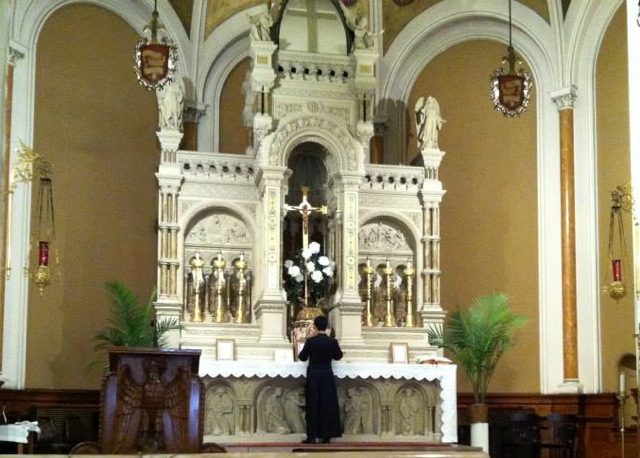
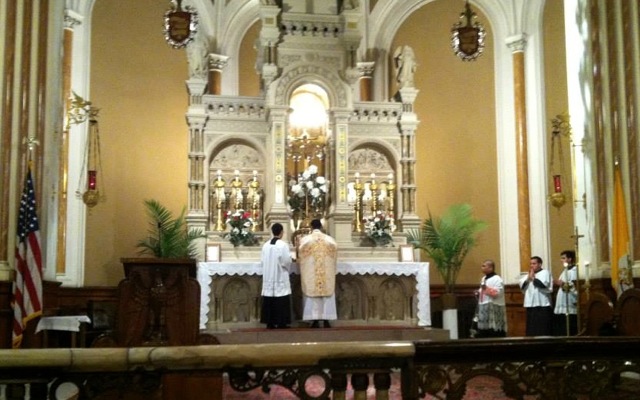
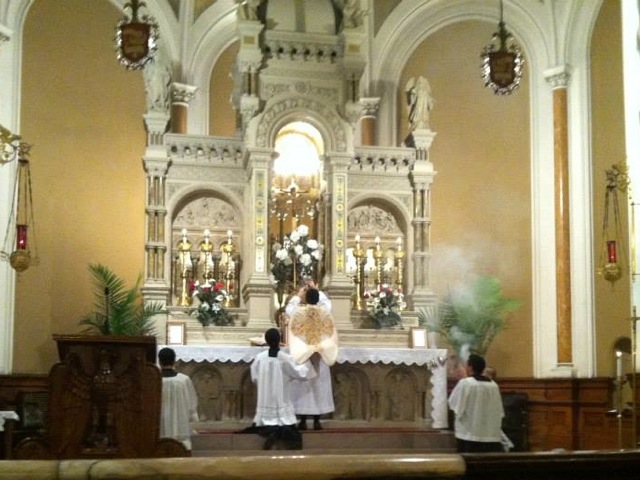
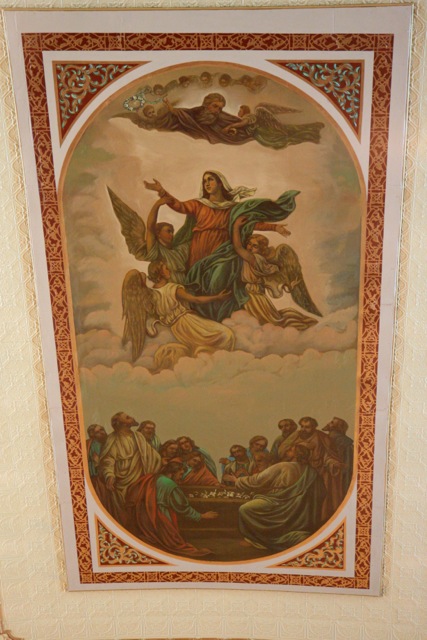
(Thanks to RM)
4
Mar
(Thanks to RM)
3
Mar
Ash Wednesday is this Wednesday, March 5. The following churches will be offering the Traditional Mass:
St. Mary Church, Norwalk, Ct, 5:30 pm, Solemn Mass
St. Stanislaus Church, New Haven, CT, 5:00 pm, Low Mass
Church of the Holy Innocents, Manhattan, NY, 8 am and 6 pm. Fr. George Rutler will celebrate the 6:00 pm Mass
Immaculate Conception Church, Sleepy Hollow, NY, 5 pm, Low Mass, blessing and distribution of ashes
28
Feb
From our “High Church” friends – the Medieval Latin Mass! (We’ve been sponsoring them for years.) The music promises to be “spectacular.”
The Medieval Latin Mass
featuring the Missa Ave Maris Stella by Josquin de Prez celebrated in the style of the period.
8:00 PM, Tuesday, March 25, at The Church of the Resurrection, 119 East 74th St., New York City
“A pre-mass lecture will be offered at 5:30 PM by Prof. Jennifer (Bloxam) of Williams College. This is an actual mass (not a concert or recreation), celebrated in Latin by candlelight in the style of the late Middle Ages. All events are free, and a reception follows. Free commemorative event poster for the first 100 to arrive! For more information or to donate, visit www.resurrectionnyc.org or contact Father Sean Wallace at swallace@gts.edu. ”
Source: The Renaissance Society of America
UPDATE: I thought it was clear from the description and the venue, but in case it isn’t, this service is in the Episcopalian church “not in communion with the Bishop of Rome.”
24
Feb
24
Feb
Saturday, March 1st
10:00 a.m. to 3:00 p.m.
David Hughes, instructor
St. Mary’s Church in Norwalk, CT, is pleased to offer this opportunity for students
with no prior experience in singing Gregorian chant.
Suggested ages: Grades 2 through 8.
Cost: Free!
Children should bring a bag lunch.
To register (by Friday, February 28th), please e-mail
music@stmarynorwalk.net
or call 203-866-5546 x115.
Further scholia of Nicolás Gómez Dávila on the Catholic Church of today from a second collection: New Scholia on an Implicit Text (1986). Once again I have to translate from the German translation: Auf Verlorenem Posten: Neue Scholien zu einem inbegriffenen Text (Karolingerverlag, Vienna, 2nd Edition 2006). These aphorisms dealing with contemporary Catholicism are of course only a tiny selection of Nicolás Gómez Dávila’s work.
Today the sacrifice of the mass is the torture of the liturgy. (p. 41)
When the progressive clergy has finally emptied the Church the last superstitious civilization will have come to an end. (p. 42)
To proclaim Christianity “the cradle of the modern world” is either a severe indictment or a severe calumny. (p.45)
By abolishing definite liturgies we abolish definite manifestations. Clearing sacred forests means eliminating traces of the divine. (p. 47)
The common clergy is aristocracy and people: the Benedictine family, the mendicant orders.
The Jesuits are the bourgeoisie of the Church. (p. 66)
Looking at the contemporary Church (clergy, liturgy, theology), the veteran Catholic first is outraged, then shocked – and finally bursts into laughter. (p.95)
Catholicism of the last few centuries has noticed the pit only after the whack of the club. (p.137)
Faith – any faith – is lost when it gets mixed up with the faithful. (p.144)
The increasing difficulty of gaining new priests should embarrass humanity and not worry the Church. (p.236)
To reintroduce an ancient liturgical gesture in a new context can border on heresy. For example, the way communion in the present day is received standing turns out to be a gesture of pride. (p.242)
A Catholic shouldn’t lodge a complaint against the pope with the council but with the papacy, (p. 140)
A cloud of incense equals a thousand sermons. (p. 254)
Courtesy of an Italian Website and the Forum Catholique – 500 photos of the Novus Ordo. (Well, almost 500 – a perceptive reader has identified at least one Anglican service at Trinity Church right here in little old New York). But no need to worry! After all, unlike the Traditional Mass all this is not a mere fashion that will go away…
DIRECT LINK to the pictures.
Thanks to CMdelaRocca and Le Forum Catholique.
Extracted from a Nineteenth Century volume on Irish Saints: “Moved by missionary zeal, like many others of his countrymen, Saint Tanco or Tanchon left the island of his birth (Ireland), to spread the Christian faith amongst strangers. He traveled to Saxony. There is said to have been another Tanco, a monk of St. Gall, who must be distinguished from the present holy martyr. St. Patto had vacated the office of abbot, over a monastery, named Amarbaric, near Verden. This establishment, founded for the use of Scottish or Irish monks, is mistaken by Colgan, for the Irish Armagh, on account of a supposed similarity between these names; he thinking, that Amarbaricensis was intended for Armachanensis. As he found no other monastery, having the former name, in either Ireland or Scotland, where he supposed it must be situated, he thus conjectured, this latter famous primatial city might have been meant. The pious Tanchon succeeded this saint, as Abbot of Amarbaric, and on Patto’s death, he likewise became Bishop of Verden. This is referred to the year 760, or thereabouts, by Arnold Wion. However, this appears too early a date, as it precedes even the erection of Verden into an episcopal see, according to the most authentic accounts. Tanco, who is also called Tatta, served God many years in Amarbarica Abbey, in great reputation for his singular learning and piety. He was raised, it is said, to the dignity of abbot. Through an ardent thirst after martyrdom, he resigned this charge. The holy missioner Tanchon was animated with a hope of shedding his blood for the sake of his Divine Master. Being desirous of reclaiming the morals of the Saxon people, he fearlessly applied himself towards this task and, he is said, by the writer already named, to have received a crown of martyrdom at their hands. He ascended gloriously to Heaven, on the xiv. day of the Kalends of March, or the 16th of February, about the year of our Lord 800. His dalmatic was long preserved, as a precious relic, in the church of Verden. Tanco is said to have been a holy man, a diligent observer of ecclesiastical decorum; a man who left a great reputation behind him for learning, but a still greater for sanctity.”
So now you know, when ecstatically enjoying ridiculous reruns of Sister Bertrille funnily flying over the Emerald Isle of the Caribbean, Puerto Rico, that the nonexistent nunnery to which she beneficently belonged was named after an authentically approved Saint!
Mr. Screwtape
12
Feb

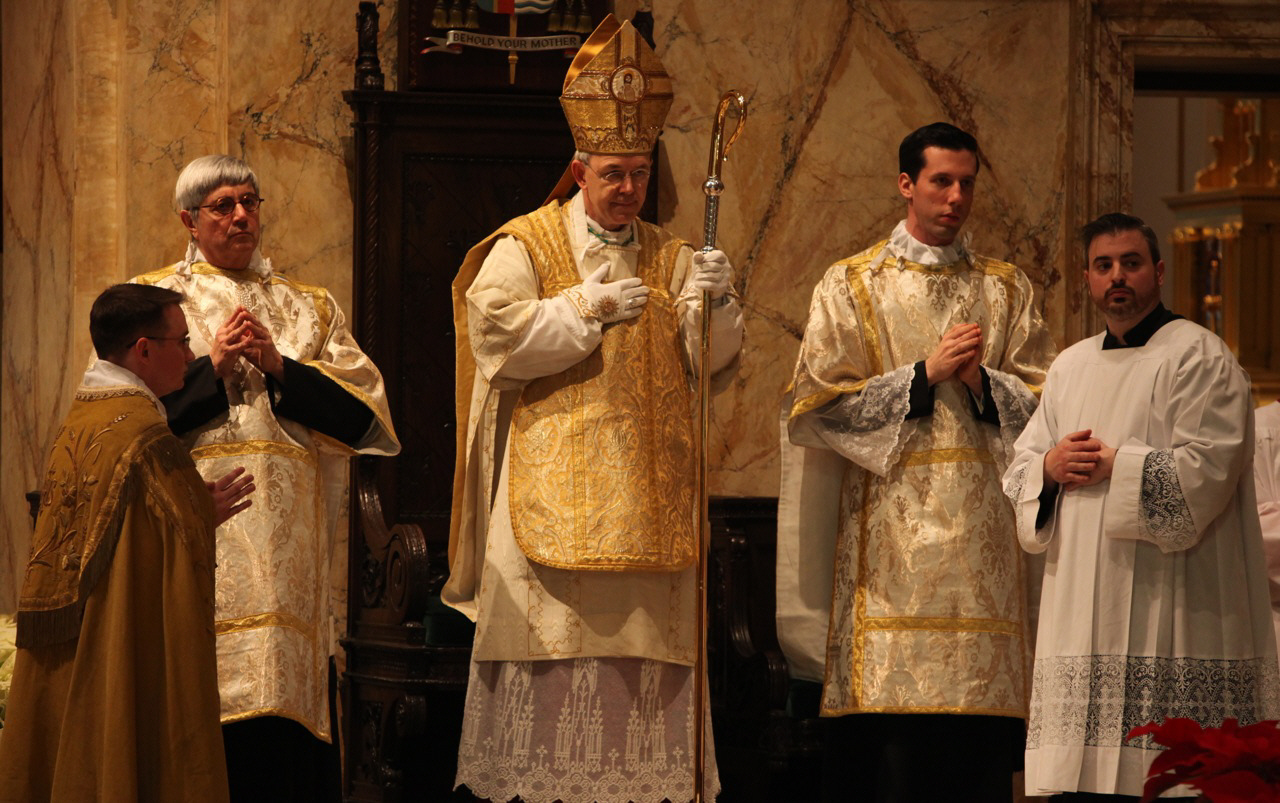
Last night the Church of St. Gabriel in Stamford was the scene of a very special observance of the Feast of Our Lady of Lourdes. Solemn Mass was celebrated in the presence of His Excellency Bishop Frank Caggiano. The Schola sang the Missa Surge Propera by Tomas Luis de Victoria. Father Cyprian La Pastina, pastor of St. Gabriel’s was the celebrant. Fr. Brandon O’Brien was deacon. Fr. Daniel Champioli was subdeacon. MC was Paul Reilly. Bishop Caggiano preached the sermon. After Mass was a procession to the altar of Our Lady and recitation of the Litany of the Blessed Virgin Mary. A reception followed the Mass.
10
Feb