More pictures can be found HERE.
http://traditionalcatholicism83.blogspot.com
28
May
Thursday, May 30
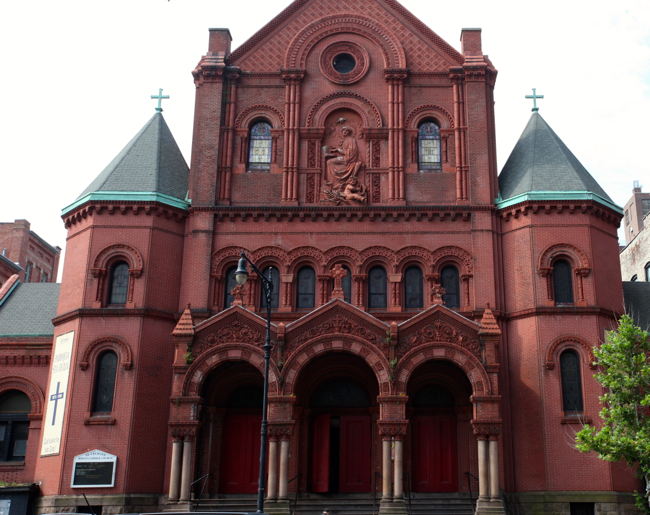
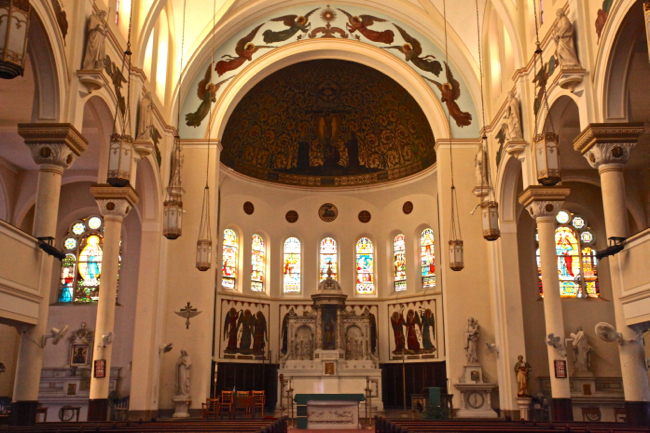
Saint Gabriel Church, Newfield Avenue, Stamford, Connecticut, Solemn High Mass at 7:30 PM
Byrd’s Mass for Three Voices with Gregorian Propers.
Outdoor Eucharistic Procession with Benediction
Light Reception to follow in Parish Meeting Room.
St. Anthony of Padua Oratory, West Orange, NJ, 9 am.
The Church of the Holy Innocents, New York, NY Solemn Mass at 6:00pm.
After the Mass, there will be an outdoors procession, which will conclude with Solemn Benediction of the Most Blessed Sacrament.
Sunday, June 2
St. Mary Church, Norwalk, CT, Solemn Mass, 9:30 am, Procession in the neighborhood, Benediction, Reception
Prelude: Fantasy-Prelude on Lauda Sion (Zacchaeus Lock, b.1996)
Cantus Missæ for double choir (Op. 109) (Josef Gabriel Rheinberger, 1839-1901)
Motet at the Offertory: Sacerdotes Domini (William Byrd, 1540-1623)
Motet at the Offertory: Sicut cervus (Giovanni Pierluigi da Palestrina, c.1525-1594)
Communion: Quotiescumque (plainsong, mode vii)
Motet at the Communion: O sacrum convivium (Olivier Messiaen, 1908-1992)
Motet at the Communion: Panis angelicus (Camille Saint-Saëns, 1835-1921)
St. Stanislaus Church, New Haven, CT, 2 pm.
St. Matthew’s Church, Dix Hills, Long Island, Missa Cantata at 12:30pm, followed by Benediction.
28
May
“Settimo Cielo:Tra confidenze ed esorcismi un papa tutto da decifrare” by Sandro Magister
(Translated by Fr. Richard Cipolla)
Among the Italian bishops who went to Frances for the “ad limina” visit, those from Puglia were the most talkative with reference to what was said by the Pope. There was not only the “revelation”—later in part contradicted by Fr. Federico Lombardi — by the bishop of Molfetta, Luigi Martella, on the two encyclicals that are “in transit”: the first, on Faith, signed by the actual Pope but written by his predecessor, who is probably finishing it up in his place of solitude at this very time. And the second, on Poverty, entirely the work of the reigning Pope.
There were also indiscretions regarding the Liturgy. The Archbishop of Bari, Francesco Cacucci, led off when he declared on Vatican Radio that Pope Francis had exhorted the bishops to “live in rapport with the Liturgy with simplicity and without useless additions”.
Then it was the turn of the bishop of Conversano and Monopoli, Domenico Padovano, who recounted to the clergy that the Apulian bishops had complained to the Pope about the state of division created within the Church by the champions of the Mass in the old rite. And what, may we ask, did the Pope reply to them? According to what was related by Msgr. Padovano, Francis urged them to be on guard against the extremists of certain traditionalist groups, but also to make Tradition a treasure for themselves and to make it live in the Church along with innovation. To explain this last point, the Pope had brought forth this very example.
“Do you see? They say that my master of papal ceremonies (Guido Marini) is of a traditionalist stamp. And many, after my election, asked me to relieve him of this post and to replace him. I replied, No, for the very reason that I myself can benefit from his traditional learning and at the same time he can take advantage, in the same way, of my more freed-up approach.”
If these words are authentic, they are instructive about the liturgical spirit and style of celebration of the present Pope. But it is not certain in what sense the Apulian bishops interpreted his words.
Another one of them, from Cerignola and Ascoli Satriano, Felice Di Molfetta, formerly president of the Commission of the Italian Bishops Conference for the Liturgy, in a message to his diocese wrote among other things: “ I suffered no lack of joy with the Pope by reason of the style of celebration that he took on; a style inspired by the ‘noble simplicity’ blessed by the Council, manifesting particular attention to the subject of our conversation and about which there was no lack on his part of remarks of a deep pastoral and theological nature, shared by all of the brothers present. I enjoyed so much the interwoven conversation, being myself engaged in a life of teaching liturgical and sacramental theology; in grasping the interest of the Holy Father in this vital aspect of the Petrine ministry, exercised by him in the daily celebrations at Santa Marta as well as in the solemn celebrations in the Vatican Basilica such as at the canonization of 800 martyrs of Otranto: a celebration restrained in time and in the totality of its ritual unfolding.
Pope Francis, in the light of certain phenomena of the recent past in which there have been seen on the liturgical field not a little drifting from the course, urged us bishops, giving some concrete examples, to live in rapport with the action of the liturgy, inasmuch as it is the work of God in the presence of true believers, beyond every pompous ceremonial, fully aware that the ‘noble simplicity’ of which the Council speaks, is not a botched up affair, but Beauty, beauty with a capital ‘B’”
But to assign a role to Pope Francis among the ranks of the progressives even in the area of the Liturgy is at a minimum hazardous. In particular, it is not clear at all that the Pope is hostile to the liberalization of the Mass of the old rite, decided by Benedict XVI in the Motu Proprio “Summorum Pontificum” in 2007. While it is certain that Msgr. Di Molfetta was in that same year one of the most combative critics of that Motu Propio, before and after its publication. He deemed the Mass in the old rite “incompatible” with that of the post-Conciliar rite and he did everything he could, without success, to have the CEI issue an ‘interpretative note – in a restrictive sense – on Summorum Pontificum.
A postscript: The presumed “exorcism” that Francis is said to have performed on Pentecost, in St. Peter’s square is in reality how he ordinarily does things, in a context that has nothing to do with the devil. For example, Francis, some days after at a morning Mass at S. Marta, met for the first time the director of Civiltà Cattolica, Padre Antonio Spadaro, who was present at the Mass. The Jesuit said ”When I asked Pope Francis for his blessing, he laid his hands on my head and made the sign of the Cross. This gesture was not unlike that which he had made on the young man whom some presumed to be possessed by a demon. For me, it was a simple, natural gesture of prayer and blessing”.
27
May

The church of St.Nicholas in 1878 (Shea, “The Catholic Churches of New York City”)
Over the years not a few Catholic churches of New York have fallen victim to the wrecker. There have been “natural” causes: fires have claimed many an old church – from Old St. Patrick’s cathedral in the 1860’s to St Agnes in recent years (of course, both of these were rebuilt). In the now distant past, old churches frequently were torn down and replaced as parishes expanded. The construction of the network of railroads, highways, tunnels and bridges in and around New York from the 1900 though the 1950’s took a toll of a number of New York Catholic parishes – and these were not necessarily replaced.
This statue of St. Clare, located in the Church of St. Cyril and Methodius, is virtually all that remains of the parish of St. Clare or Santa Chiara, located on 436 West 36th Street. St Clare’s was an Italian national parish, founded in 1903, and closed in the late 1930’s because of the construction of the Lincoln tunnel. The parish church, completed in 1907, was a small baroque gem created by the architect of St. Jean Baptiste. !)
In some cases churches – often ethnic parishes – were abandoned when their congregations acquired or built bigger and better churches:
This structure on 345 East 4th Street is the original home of the parish of St Elizabeth of Hungary. It was founded by Slovakian immigrants (from the Kingdom of Hungary) in 1891, and this, their first church, was finished in 1892. Later, the parishes of St.John Nepomucene and St Stephen of Hungary were formed from this parish. In 1917 St. Elizabeth of Hungary parish moved to the present beautiful church on East 83rd Street, as Yorkville had become the new center of Central European peoples in New York. Now the original church is the “Church of St. Idsidro Y Leandro – Western Orthodox Catholic Church of the Hispanic Mozarabic Rite.” 3)
Until recent times, however, it was highly unusual that a Catholic parish simply would be closed without any successor for no other reason than the decline in the size of the parish – that there was no longer a need for the church. Certain parishes, usually ethnic, seem to have vanished at various times. But what appears to be the first well-documented instance of such a closure was the fate in 1960 of St. Nicholas, one of the most historic parishes in New York, formerly located at 127 East 2nd Street.
This impressive Neo-Gothic structure, so incongruous in the architectural wasteland that surrounds it, is the former rectory of the German Catholic Church of St Nicholas. St Nicholas was organized in 1833 as the first German parish of New York. The rapidly expanding parish acquired a fine new Gothic revival building, similar to the nearby church of St Bridget, in 1848. St. John Neumann celebrated his first mass in 1836 at this parish (in the earlier church). Towards the end of the 19th century there was a lavish redecoration of the interior and the imposing rectory followed in 1903.

As in the case of several other downtown churches (e.g., St Mary’s), urban renewal has left a wasteland around the former rectory of St. Nicholas.
As time went on, however, St. Nicholas suffered from the competition of the much larger and more magnificent German parish of the Most Holy Redeemer – located only three blocks away and the tower of which is visible from the site of St. Nicholas. Then, well before the First World War, the German population deserted the neighborhood for Yorkville and elsewhere. By the 1930’s the congregation was tiny. In 1960 Cardinal Spellman closed St. Nicholas and had the church razed. In exchange the Cardinal erected next to the former rectory a kind of neighborhood center (where a former parochial school had stood?). 4) It was an ominous sign for the future.

There could be no question of Archdiocesan real estate speculation in this neighborhood in 1960 – a parking lot marks the site of St. Nicholas to the present day.
The gray area on the side of the rectory is the”ghost” of the destroyed church (above and below). A small fragment from the facade of St Nicholas also remains affixed to the side of the rectory
What had been an exception has become more frequent in recent decades. This statue in the “park” adjoining the church of St Anthony of Padua on Houston Street is all that remains of the Church of St. Alphonsus Liguori(below). It was originally a German parish, founded in 1847 by the Redemptorists. The parish church, built in 1870-72, received rave reviews at the time, especially for the magnificent altar imported from Munich. The church supposedly developed structural problems due to an underground stream and was demolished in 1980. Is this statue the same that is mentioned and shown in an early account as presiding from the gable of the old church? 4A)

St. Alphonsus Ligouri in 1878 (Shea, “The Catholic Churches of New York City”)
We conclude with St. Clare again – the facade of the former hospital of St. Clare on West 51st Street. If there have been painful losses among the churches of New York City and far more drastic reductions in Catholic schools, the general care hospitals of the Archdiocese have been entirely eliminated. As recently as 1998 the struggling St. Clare’s was rescued through the personal intervention and efforts of Cardinal O’Connor – by 2007 it was closed. 5)
1)http://www.nycago.org/organs/nyc/html/StClareRC.html; David W. Dunlap, From Abyssinian to Zion: A Guide to Manhattan’s Houses of Worship at 198 ( Columbia University Press, New York, 2004)
2)http://www.nycago.org/organs/nyc/html/StClareRC.html
3) Dunlop, op. cit. at 209.
4) The online resources for this historic but long-vanished church exceed in quality and quantity those available for many existing parishes. http://www.nycago.org/Organs/NYC/html/StNicholasRC.html; http://en.wikipedia.org/wiki/St._Nicholas_Kirche_(New_York_City);
http://www.stnicholascenter.org/galleries/gazetteer/2485/6/ (many pictures including the interior);
http://gvshp.org/blog/2012/04/12/135-east-2nd-street-then-now/ (clarifying the date of the rectory – which should have been obvious from its style and early pictures)
4A) Shea, John Gilmary, The Catholic Churches of New York City at 128 (Lawrence G. Goulding & Co., New York, 1878)
5) Martin, Julia, A Phoenix, Catholic New York, April 23, 1998;
Sulmasy, Daniel P., Then There was One: the Unravelling of Catholic health Care, America, March 16 2009.
(St. Vincent’s Hospital itself closed shortly after this article was written)
25
May
24
May

Due to the inclement weather tomorrow,the Mass and picnic at the Marian Shrine,Stony Point,N.Y. , scheduled for tomorrow, is cancelled. A rain date will be announced in the future. However it is not the end. Instead we will have the same Missa Cantata tomorrow at the Church Of The Holy Innocents at 1PM. That is Sat.May25th. Father Christopher J Salvatori,S.A.C. will be the celebrant.
Our photo shows the outdoor shrine dedicated to Mary Help of Christians, erected in 1954. The grounds also include splendid life-size statues depicting the 15 mysteries of the Rosary in Italian marble, outdoor Stations of the Cross, a replica of the boyhood home of St. John Bosco and a 48 foot tall statue of Our Lady of the Rosary.
20
May
This Pentecost three “events” nicely illustrated the current state of affairs, spiritual and artistic, in the Church. First, the Vatican – under the leadership of Cardinal Gianfranco Ravasi – offers us a preview of its pavilion at the Venice Art Fair. Obviously concerns about the “poverty of the Church” do not affect such initiatives. The cost, however, has decreased to about $1,000,000 – well below earlier estimates. Moreover, the Vatican went out of its way to note that “sponsors” funded this amount. Obviously the criticism of the cost of the pavilion had stung. 1)
And what is the art to be exhibited? – it appears to be the usual collection of arbitrary, meaningless objects devoid of beauty, craftsmanship or any reference to the Church’s Tradition. There is talk (by Ravasi) of “creation” and even of “recreation.” And to whom is this exhibit addressed? This art obviously does not appeal to the overwhelming majority of the Catholic Laity. I very much doubt that the Catholic clergy would have any more interest in it. Whether the dominant forces of “modern art” in the West today will develop some new appreciation for the Catholic Church and its continued love affair with modernity is also very doubtful. They have gone on to bigger and better things!
Rather in such exhibits the higher clergy of the Catholic Church in Europe are primarily talking to themselves – trying to convince themselves that the supposed reconciliation between modernity and the church still lives. For those of us outside the Vatican and the Archiepiscopal sees of Europe, the important point is that this art – not any “reform of the reform” or “other modern” – is still the official artistic ideal of the Roman Catholic Church.
A second “show” this Pentecost weekend was the gathering of the lay “movements” in Rome. The spokesman for the event was another of the Vatican’s dialoguers with modernity, Archbishop Rino Fisichella. Supposedly 200,000 gathered in St. Peter’s square. Over 150 new “ecclesial realities “ – like the Neocats, Focolare, Communione & Liberazione, Sant’ Egidio etc., dispatched their foot soldiers to this event.
Now “movements” is an uncertain concept derived from the political sphere. it embraces all the new organizations that have developed over the last 60 years – although some date to the 19th century. They all are focused an the laity, usually are “creative” in theology and liturgy, and often have a strong charismatic or Pentecostal flavor. These, according to Archbishop Fisichella, are the “Fruits of Vatican II“ and the future of the Church. 2) While the first statement may be true – with some reservations – I very much doubt the second!
First, it seems odd that the paragon of such organizations – Opus Dei – does not want to be included under the ”movements” rubric. Second, the track record of such communities is anything but a record of unbroken success. For example, their typical organizational form – an absolute charismatic leader demanding blind obedience _ continues to facilitate an almost endless series of scandals.3) Third, the spread of the “lay movements,” which has taken place primarily in the Latin countries, has not arrested the decline of the Church there or elsewhere in the West – on the contrary!
For I believe that closer look would reveal whatever success the new “ecclesial realities “ have achieved has come largely at the expense of established parish structures and organizations. It is a case of “robbing Peter to pay Paul” – so bizarrely appropriate for groups that assembled this weekend in St. Peter’s Square! Indeed, the positive witness of these groups is a protest against the monotonous spiritual and liturgical void that is the life of the typical parish and religious order. Yet the hierarchy draws exactly the opposite conclusion. For the establishment, the “movements” are the last hope that the great experiment of the 1960’s continues, that despite all evidence to the contrary, the “new springtime” is still alive.
Yet there was a third event taking place this Pentecost. As always some 10,000 – 15,000 youthful pilgrims proceeded from Paris to Chartres – through, it seems, somewhat adverse weather this year. (Tragically, because of Church politics, a comparable if somewhat smaller number undertake this same weekend a pilgrimage in the opposite direction – Chartres to Paris.) The relationship with the local bishops has improved – the Paris to Chartres pilgrims are now welcomed by the local hierarchs and their representatives. Yet it would be far from the truth to say that the pilgrimage for Tradition is “sponsored “ by the French Church – let alone by the Vatican. These groups follow no charismatic leaders, do not seek new liturgies or theologies but rely entirely on the unbroken Tradition of the Church. No Cardinals or Archbishops hold laudatory news conferences. The secular world is indifferent or hostile. Yet is there a better example of the laity spontaneously and publicly giving witness in shared prayer and sacrifice? 4) A quiet , personal example that paradoxically is more in tune with the actual if largely unexpressed needs of modern man, more respectful of his dignity and intelligence, than the extravagant shows and media initiatives that have dominated evangelization in the Church for these last 30 years and more….
1)http://magister.blogautore.espresso.repubblica.it/2013/05/17/alla-biennale-di-venezia-anticipi-di-ricreazione/ ; http://fidesetforma.blogspot.com/2013/05/santa-sede-alla-biennale-confermate-le.html
2) http://www.catholicnewsagency.com/news/church-movements-bringing-50000-more-than-vatican-expected/
3) For example, see last week:http://www.lemonde.fr/societe/article/2013/05/18/operation-verite-pour-les-freres-de-saint-jean-eclabousses-par-les-scandales_3313590_3224.html ( Thanks to Jean Kinzler at le Forum Catholique)
4) http://www.nd-chretiente.com/dotclear/index.php?post/2013/05/20/Pe
17
May
Sunday, 19 May, is Pentecost Sunday, Whitsunday. Historically, the Vigil of Pentecost was a day of fasting.
Norwalk, Connecticut
Solemn Mass, 9:30 am at St. Mary Church
New Haven, Connecticut
Solemn Mass at 2 PM at St Stanislaus Church (State & Eld Streets).
Sleepy Hollow, New York
Sung Mass at 3 PM atImmaculate Conception Church; Sleepy Hollow, NY
Published in Masses | no comment
14
May
it was a fortunate audience who had the chance to hear last Saturday the final performance this season of Poulenc’s Dialogues. The staging – from 1977 – was magnificent, the performances of the singers almost uniformly splendid and the conducting inspired. Poulenc’s modern musical idiom – if very much restrained here – works well in conveying the feverish, oppressive even nightmarish atmosphere of France in the revolution – or that of twentieth century totalitarianism.
For when Gertrud von le Fort published in 1931 the story upon which Bernanos’s libretto is based, the First World War had just ended and Catholics had experienced the persecutions in Mexico and the Soviet Union; the Spanish Civil War and its massacres, the Second World War and the conquests of communism in Europe and Asia stood immediately before. After the Second World War, Bernanos could survey all this. So possible martyrdom had become a reality for a large part of the Catholic world. For that world Bernanos crafted an extraordinary libretto of utter honesty, of bleak realism, of the courageous faith of flawed human beings in the face of seeming doom.
Soon, after the Council, Catholics had no more appetite for such depictions and such a message. I believe it was Mircea Eliade who interpreted the sudden rise of Teilhardianism in the early 1960’s as the Catholic repudiation of the “existentialist” spiritual drama and intensity of the Catholic Literary Revival with its focus on sin, redemption conversion and martyrdom. The soft and optimistic “spirit of Vatican II” is not that of Bernanos’ Dialogues.
In a similar manner, the Council paradoxically made impossible works like this opera. For those instances in the 1940’s and 50’s where “modern art” had achieved something in the spiritual realm – like Poulenc’s Dialogues or the churches of Matisse or Le Corbusier – had only come about through the fruitful confrontation of modernity with the still intact forms of belief and liturgy of traditional Catholicism. After the 1960’s such interaction was no longer possible – the Church either opted for junk or pandered to the worst excesses of a “modern art” gone mad.
It was impressive to see that each of these performances was nearly sold out and that so many young people attended. It was even more heartening to see in the audience musicians active in Catholic music and quite a few seminarians as well (2 in cassocks!). These young Catholics are rediscovering the links between the arts and the sacred lost to the Catholics of my generation. Those links that produced – not just in the middle ages or the Byzantine Empire but as recently as 1957 – a masterpiece like the Dialogues.
13
May
Our Lady of Lourdes
467 West 142nd Street
West 142nd Street and environs – Hamilton Heights – is a remarkably serene oasis tucked away in upper Manhattan. East of Broadway are quiet tree-lined streets featuring rows of townhouses, circa 1900, displaying a variety of stone facings. It reminds a visitor more of parts of Brooklyn Heights or Park Slope than Manhattan. Here and there are the vestiges of Catholicism – still existent or long since vanished – in upper Manhattan. The very name of Convent Avenue reminds us of the former Manhattanville Convent and school further south in the West 130’s. That institution had fled the growing problems of Harlem as early as the late 1940’s. That’s a story in itself: one of the most prestigious Catholic secondary schools and colleges for girls in New York flees to the supposed refuge of the suburbs, goes secular as early as 1966 and ends up as the undistinguished nondenominational operation that exists in Purchase today.
Our Lady of Lourdes, like St. James, Old St Patrick’s, St. Elizabeth of Hungary or St. Bernard’s is blessed in that it remains embedded in the original streetscape. The church, faced with white stone, takes a leading role in the architecture of West 142nd Street yet complements rather than overpowers its neighbors. It is a handsome rectangular edifice with a series of elaborately carved Gothic arches on the main floor – a touch of Venice on New York. On a second look, though, Our Lady of Lourdes does appear distinctly unusual for a church. There is a very good reason for that – this building was assembled largely from parts of demolished secular buildings!
For in 1900 Fr. Joseph McMahon set out to build a church for the new parish of Our Lady of Lourdes. Now in New York of 1900 and especially on the West Side it was no longer sufficient for a new church building to follow a canonical style (or at least the Victorian idea of such). Rather, in each case something distinctive and original had to be found. Added to Fr. McMahon’s difficulties was a dearth of funds which seemed to preclude anything but a very modest structure But the pastor solved both issues in the most radical and brilliant way: by re-using components of grand structures elsewhere in the City that for one reason or another were in the process of demolition.
The lower course of the facade was taken from the National Academy of Design building on 23rd Street and Fourth Avenue. The upper part of the façade was from the mansion of A.T. Stewart – the creator of Macy’s as a great department store and the founder of Garden City on Long Island. Iron beams and windows came from the Catholic Orphan Asylum at 50th Street. Finally, for the rear façade of the church, Fr. McMahon was able to secure the original apse of (new) St Patrick’s cathedral – demolished to make room for the present Lady Chapel. Yet all these fragments flow into and form a consistent whole rather than remaining an eclectic jumble. Our Lady of Lourdes was finished in 1903. 1)
The interior is somewhat disappointing after the grand exterior – a simple, moderately sized rectangular space supported by thin columns, and only adequately lit by smallish windows. Water damage has left its mark; paint is peeling everywhere. But upon closer examination the visitor discovers to his delight the immense wealth of decoration found almost everywhere in this church. It reflects the high quality of ecclesiastical art of that time. Indeed here and there it appears too rich, fantastic and extravagant. For example, there are the strange, exuberantly carved open brackets set against the side walls – were they intended as supports for galleries that have since disappeared or which were never built in the first place? But the furnishings of the sanctuary – the altar, tabernacle and metal work – are of the highest quality. The altar and other stone carvings are a mixture of white marble “Irish Gothic” interspersed with influences of the Renaissance and the Cosmati. The relatively few large windows in the sanctuary are superb – both those supposedly from St. Patrick’s and those created for Our Lady of Lourdes. In the rear of the church is chapel with large pieta; a Lourdes grotto is downstairs.
Regretfully, as in so many other churches, the conciliar “renewal” has left its mark especially on the sanctuary – only a remnant of the original elaborate metal and stone communion rail survives. The sanctuary is also cluttered with all kinds of inappropriate gear.
So Fr. McMahon could well feel proud of his achievement – one that fits in so well with the ecological ethos of today – the creation of a grand edifice primarily out of recycled elements! Nowadays, of course, when Catholic churches utilize older furnishings and decoration they come not from the secular realm but from cannibalizing the ever more numerous demolished Catholic churches….
But Our Lady of Lourdes parish has soldiered on over the years. In the course of time the parish became almost entirely Hispanic. This is very much a working class parish. As time went on, parts of the church fell into disrepair. A few years ago the New York Times featured a somewhat wistful interview with the pastor – seemingly a reflection on the decline of Catholicism in New York 2)
Yet the parish school continues to function. A repainting of the interior is underway. Gentrification will pose the same problems – and perhaps opportunities – for Our Lady of Lourdes that it has to half the parishes of New York City. And the challenges of the present day would be as nothing if today’s New York Catholics could summon up a fraction of the ingenuity and audacity – combined with (Traditional) faith – which Fr. McMahon possessed a century ago.

West 142nd Street: the intact rows of townhouses.

As in several other churches of that era, a “logo’ is applied throughout the decorative scheme.

(Above and below) the curious brackets.

(above and below) Windows salvaged from St. Patrick’s (or adapted from such?)

The remaining part of the communion rail – and piano.

The most unusual sanctuary lamp in New York?

Extraordinary holy water fonts – with the Traditional Asperges.
1) Gray, Christopher; Streetscapes/the 1903 Church of Our Lady of Lourdes, on West 142nd Street; a Coat of Many Colors, a Building of Many Parts in The New York Times, August 3, 2003.
2) Fernandez, Manny, A Parish Priest, Witness to Great Change in The New York Times, April 16, 2009