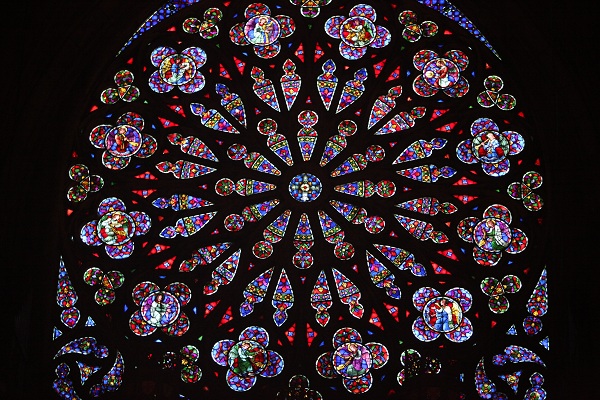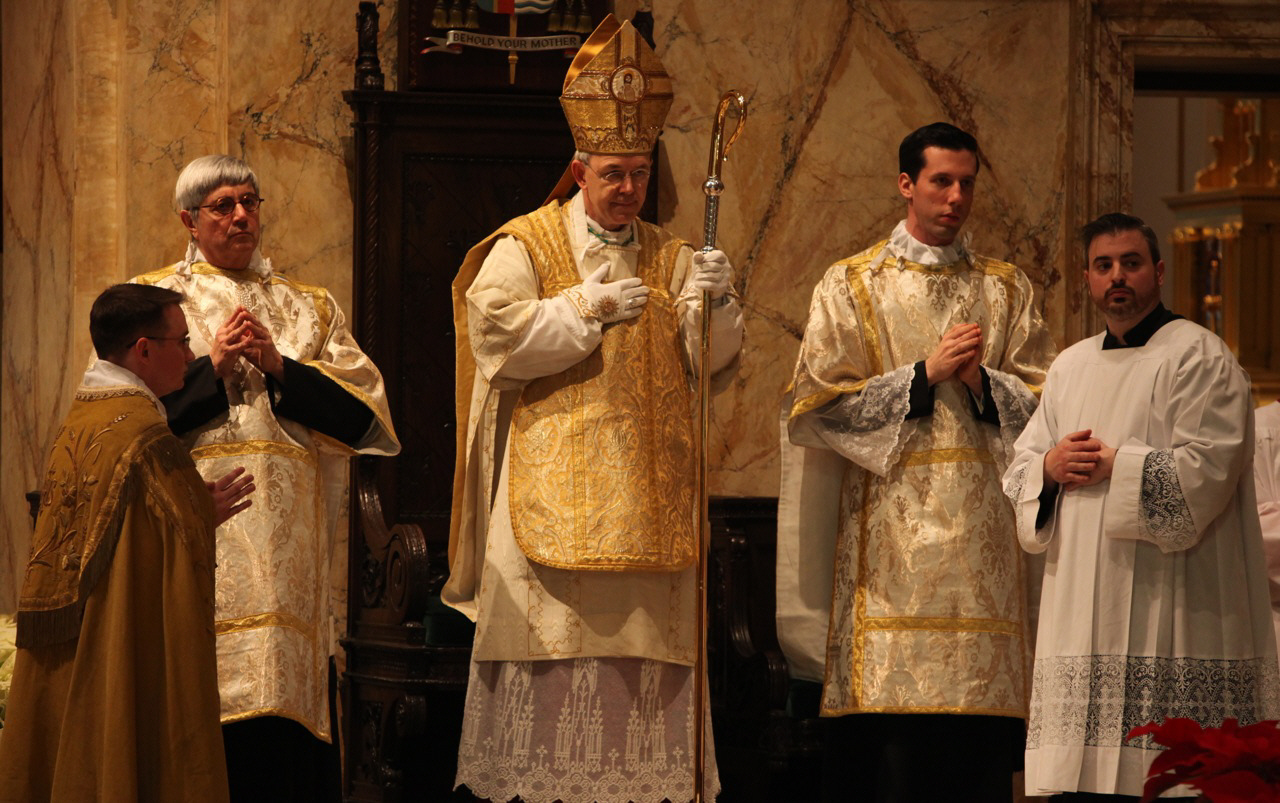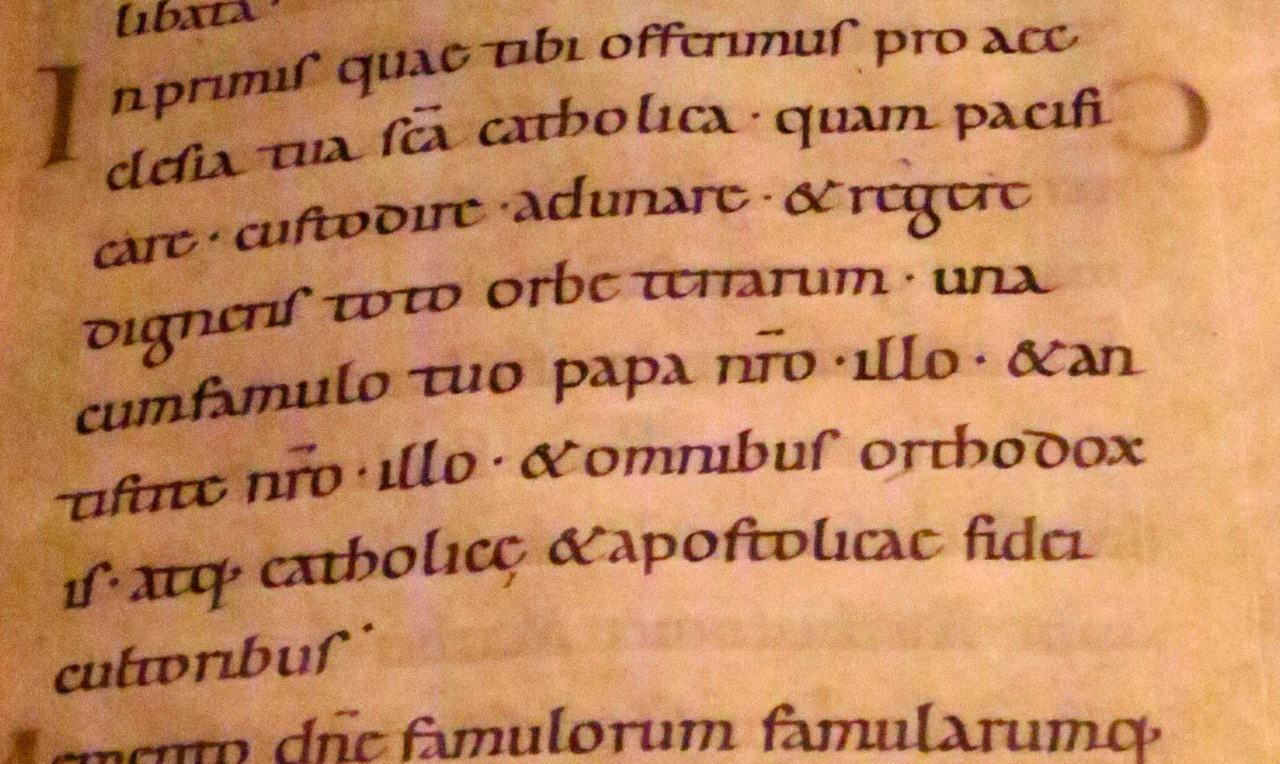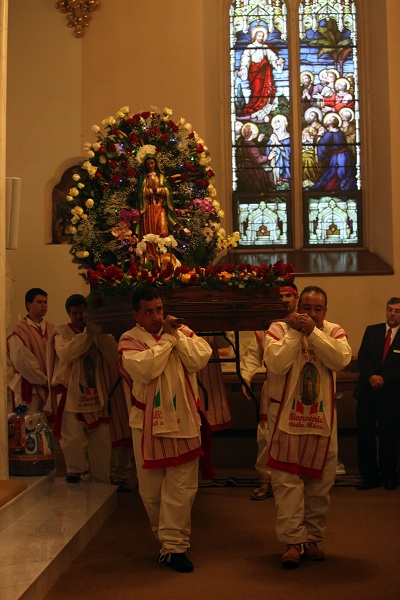
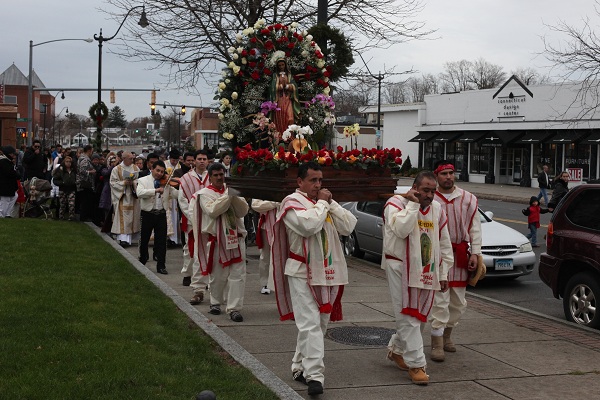
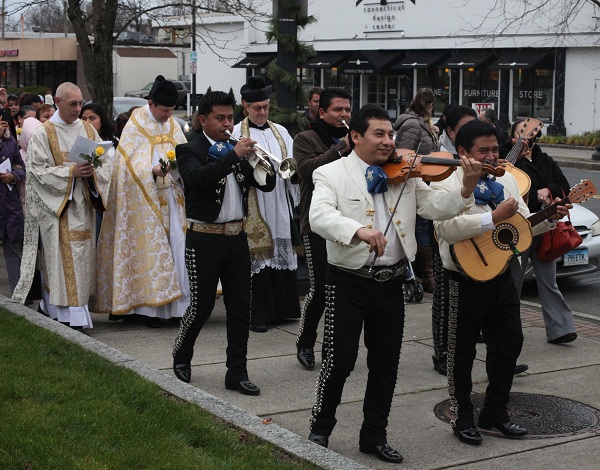

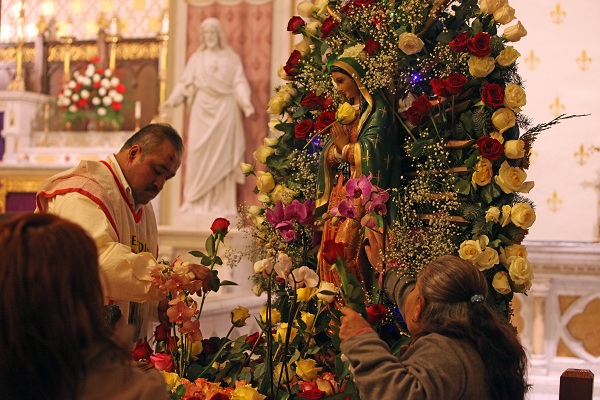
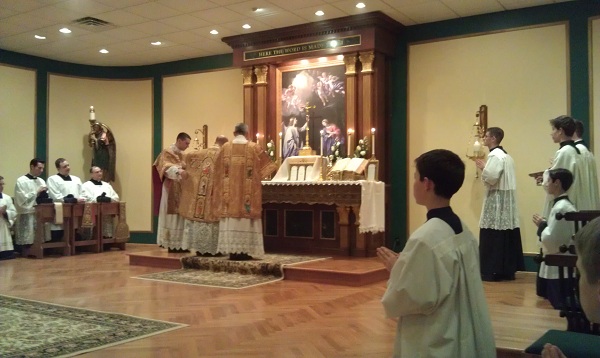
Father Cyprian LaPastina has kindly shared some pictures of last Thursday’s mass.
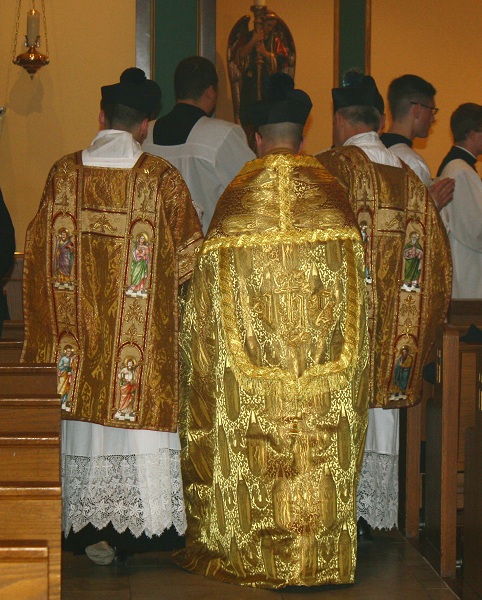
Wonderful vestments!

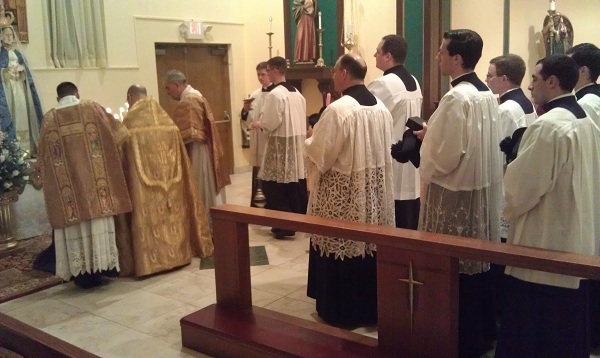
Following Mass, a Triduum to Our Lady was begun in preparation for the Immaculate Conception. The choir sang the Litany of Our Lady while a procession made its way to a statue of Our Lady.
The following churches will offer Traditional Masses for the Feast of the Immaculate Conception this Saturday, Dec. 8. Please let us know, if you know of any Masses in the area.

Savannah Cathedral
Connecticut:
St. Mary, Norwalk
9:00 AM Solemn High Mass
St. Stanislaus, New Haven
7:00 PM Low Mass
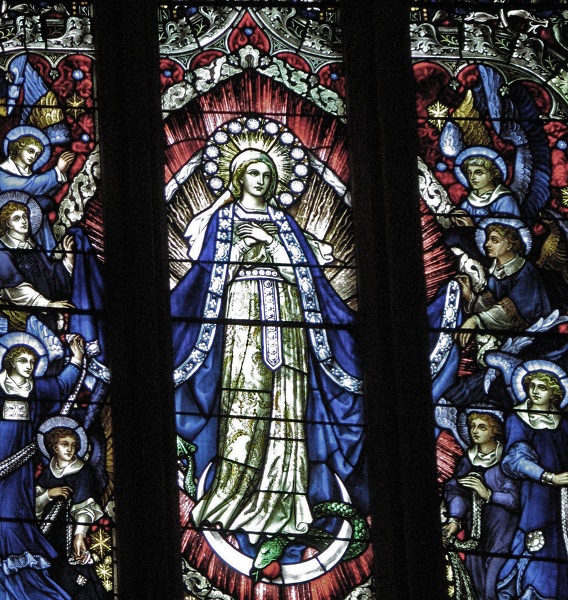
Sydney Cathedral
New Jersey:
Holy Rosary Church, Jersey City
12:00 noon Missa Cantata
St. Anthony of Padua Oratory, West Orange
9:00 AM Low Mass
11:00 AM Missa Cantata
Our Lady of Fatima, Pequannock
7:00 AM Low Mass
9:00 AM Low Mass
11:00 AM Missa Cantata
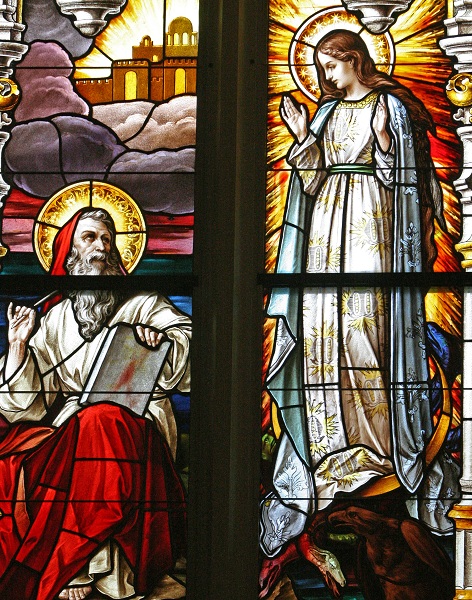
“I saw a woman clothed with the sun…” – Savannah Cathedral.
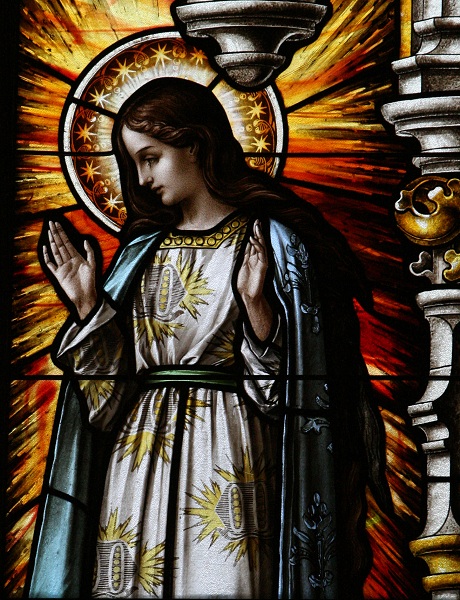
Detail, Savannah Cathedral
New York:
Church of the Holy Innocents, Manhattan,
Low Mass at 5 AM concluding the First Friday All Night Vigil
Solemn Mass at 1 PM with Fr. James Miara, celebrant.
Our Lady of Mount Carmel, East Harlem
10 am Solemn Mass, followed by a Day of Recollection with Fr. John Perricone, details:
St. Eugene’s , Yonkers
12:30 pm, Low Mass
Immaculate Conception, Sleepy Hollow
3:00 PM Low Mass

St Barbara in Vierzehnheiligen (“Fourteen Holy Helpers”)
In the late 1960s many little girls playfully imagined that they were the purple suited, fiery wig wearing acrobatic adventurer Batgirl! Of course the tiny titans were also interestingly intrigued by her civilian identity as Police Commissioner Gordon’s daughter who held the imposingly important job of Head Librarian of the Gotham City Library and whose name was Barbara.
Okay, I know that’s not the most serious segue but what do you expect from this Joker?
Switching Sixties screen symbolizations let us quoth from Around the Year with the Trapp Family by Maria Augusta Trapp regarding the Barbarazweig or Barbara Branch: “On the fourth of December, unmarried members of the household are supposed to go out into the orchard and cut twigs from the cherry trees and put them into water. There is an old belief that whoever’s cherry twig blossoms on Christmas Day can expect to get married in the following year. As most of us are always on tour at this time of the year, someone at home will be commissioned to “cut the cherry twigs.” These will be put in a vase in a dark corner, each one with a name tag, and on Christmas Day they will be eagerly examined; and even if they are good for nothing else, they provide a nice table decoration for the Christmas dinner.”
One of the medieval super-team known as the Fourteen Holy Helpers, St. Barbara is the patroness of artillerymen, military engineers, miners and others who work with explosives, fireworks manufacturers, firemen, stone masons and also of mathematicians; she is also invoked against sudden death, against fires, and against storms (especially lightning storms). Her feast is celebrated by the British (Royal Artillery, RAF Armourers), Australian (Royal Regiment of Australian Artillery, RAAF Armourers), Canadian (Explosive Ordnance Disposal Technicians (EOD), Canadian Air Force Armourers, Royal Canadian Artillery, Canadian Military Field Engineers, Royal Canadian Navy Weapons Engineering Technicians), New Zealand (RNZAF Armourers, RNZA, RNZN Gunners Branch) armed forces. Additionally, it’s celebrated by Irish Defence Forces Artillery Regiments, Norwegian Armed Forces Artillery Battalion, United States Army and Marine Corps Field and Air Defense Artillery, many Marine Corps Explosive Ordnance Disposal Technicians, and other Artillery formations. In art she is usually depicted as standing by a tower with three windows, carrying a palm branch and a chalice, sometimes with cannons by her side.
Biff! Bam! Kapow!
Mr. Screwtape
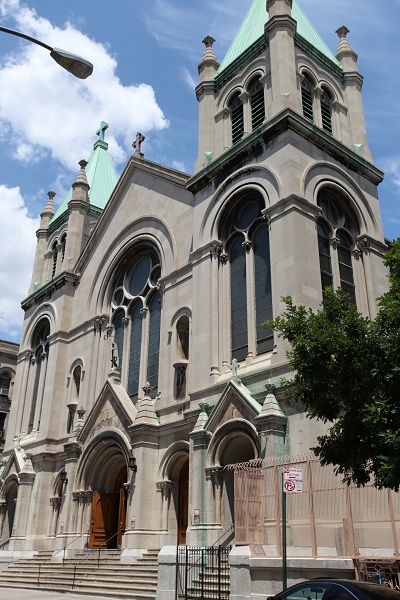
St.Paul’s
113 East 117th Street
(Old) St Patrick’s Cathedral was for many years the only Catholic church north of Canal Street in New York. At that time Harlem, far to the North, was a separate village in the midst of predominantly rural surroundings. It was under Bishop Du Bois in 1834 that St. Paul’s parish was founded to serve this vast region. Fr. Michael Curran from Pennsylvania, recommended by the saintly Fr. Prince Dmitri Gallitzin, was appointed the first pastor. What kind of priest was he? According to John Gilmary Shea:
“During the cholera of 1832 he was called to attend a man and his wife who were at the point of death on one of the highest peaks of the Alleghenies…(W)hen he could urge (his horse) no farther , he climbed on his hands and feet to the miserable shanty on the summit. Here he found the woman lying dead with an infant suckling at her breast; the man he had barely time to hear and absolve. Taking up the helpless baby, he wrapped it in his cloak, and carried it a considerable distance to the next habitation. He committed it to the charity of those good people by whom both the parent ere interred. He maintained a watchful care over his orphan for years, and when he died she was a full grown woman in Pittsburgh, a credit to her early benefactor” 1)
The contrast with present clerical lifestyles is all too glaring. We may also note that the curious fact that Fr. Curran’s “knowledge of the Irish tongue” was of special value to his ministry. 2) Construction of the first church of St. Paul commenced in 1835 and it was finished shortly thereafter.
Little is recorded regarding the life of this parish other than the usual 19th century narrative of population growth and the unfolding of educational and charitable activities. For the first century of its existence St Paul’s was predominantly Irish – some Germans and Italians arrived after 1900. The original St. Paul’s church had to be enlarged in 1871. But even this structure became inadequate – by 1900 it was considered one of the quaintest churches in New York. Fr. John McQuirk, pastor of St. Paul’s from the 1883 until 1924, launched after 1904 a massive building campaign, including a new school and rectory. Finally, the present huge church was erected in 1907-08.
St Paul’s still makes an imposing impression on East 117th Street. The gray stone, twin–towered facade is clear, simple and strong: Romanesque seen through classical eyes. Through a narthex one enters the grandiose interior – St. Paul’s is one of the largest parish churches in the city! It is one massive, simple space. Amid all the Byzantine domes, Baroque recreations and masterpieces of the French and English Gothic that made up Catholic Church architecture around 1910 there remained at least among certain of the Irish an atavistic yearning for the simple preaching halls of the first New York Catholic churches. St Paul’s evokes those early churches that replicate the architecture of the surrounding Protestant houses of worship – St. Mary, St. Teresa, St. James – only on an immensely greater scale.
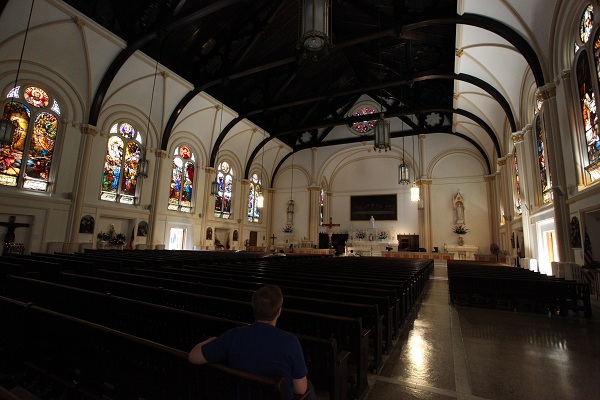

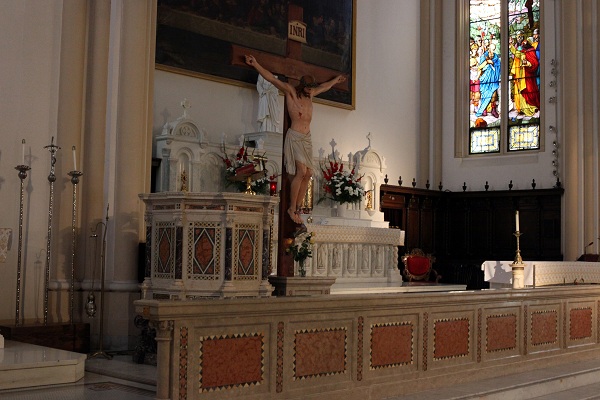
The sanctuary, all in white like the surrounding walls, does not succeed in setting itself apart in this immense space. Old photographs show that it once was far more elaborately decorated. There were further renovations to the sanctuary under Fr. McQuirk’s successor, Fr. Kane, between 1924 and 1940. The fine communion rail and pulpit in the style of the Cosmati date from this period. Some other elements of the décor installed at that time – such as a wooden reredos – have disappeared, perhaps in the wake of the Council. 3)
More impressive than the sanctuary is the wooden, hammer beam ceiling. The well preserved windows provide a much needed element of color. Although bold in design and startling in hue, the quality of the execution regrettably falls far below the standard of that era (individual windows of the same studio or artist can be found elsewhere in the city (such as in Old St. Patrick).
In the narthex is the baptistry – now the shrine of Our Lady of Lujan. Like the communion rails, it was erected between 1924 and 1940 – its decoration and windows are of a much higher quality than those of the rest of the church. A word should be said about the pews – elaborate benches do seem to be a specialty of Harlem churches. St. Paul’s features individual folding wooden seats resembling those of a movie theater. I wonder though if those seats aren’t a bit noisy…

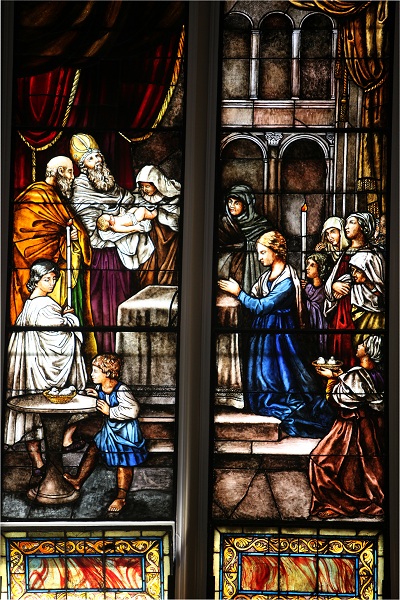
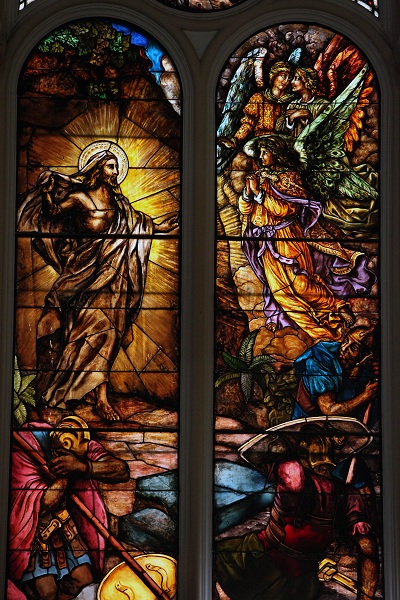
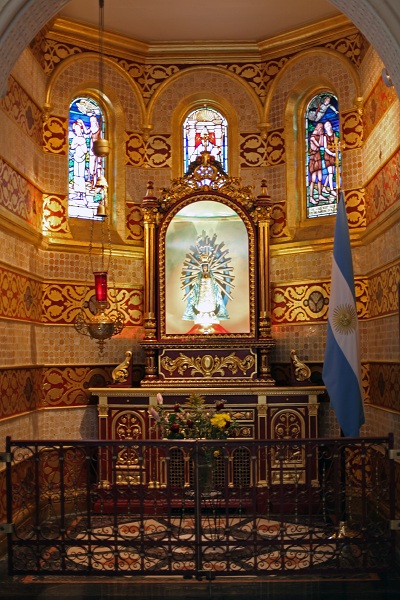
The splendid Baptistry -now a Shrine to Our Lady of Lujan (Argentina – and according to a notice in this church “Tachikistan”)
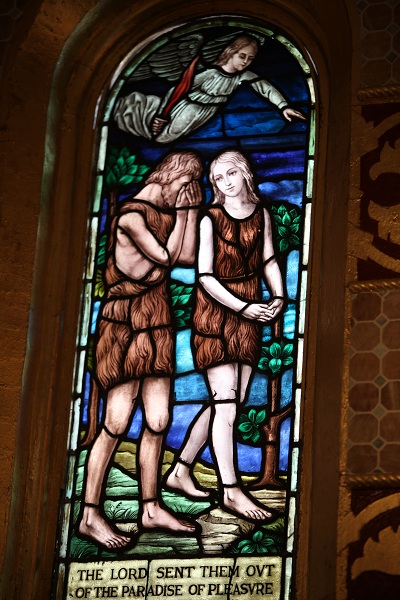

Even by 1940 the Spanish–speaking population of the neighborhood was growing. For many years now St. Paul’s has been an almost exclusively Spanish-speaking parish. It has become in effect a grand repository of Latin American devotions. A circuit around the “nave” is a like a tour through the Hispanic world: Madonnas from Puerto Rico, Argentina, Mexico and the Dominican republic, a wonder-working crucifix and an image of the Christ Child. This exuberant devotional life keeps St. Paul’s open for prayer – this not one of those parishes, all too common in New York, that remain padlocked outside of scheduled mass times. St. Paul’s is thus unmistakably a Catholic church, a house of God and a house of prayer.
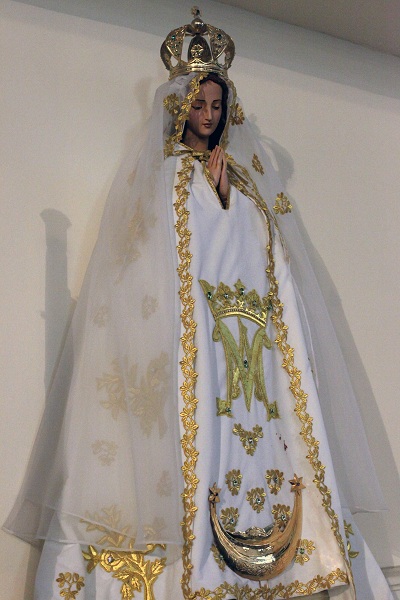
 the Lord of the Miracles of Daule (Ecuador)
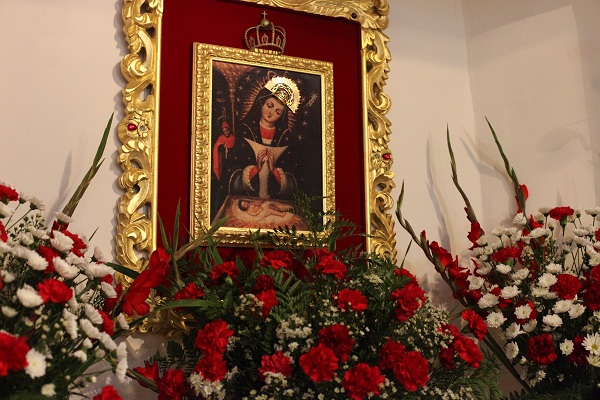
Our Lady of Altagracia (Dominican Republic)
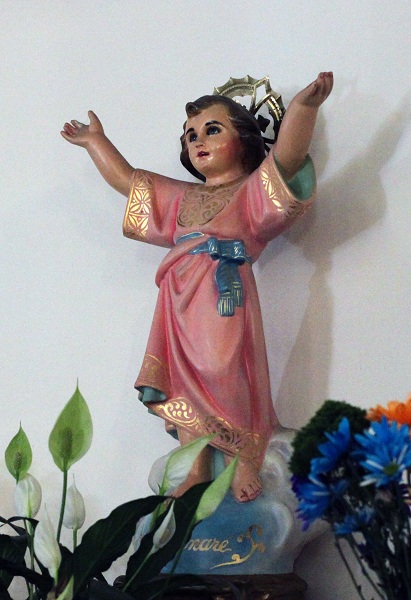
The Divne Child Jesus (originally Colombia)
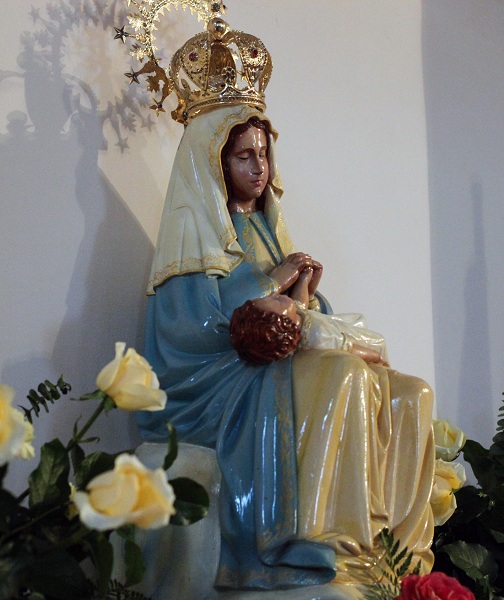
Our Lady of Divine Providence (Puerto Rico)
So St. Paul’s and its school continue to serve the community of Spanish Harlem. In 1998 the care of the parish was handed over by the Archdiocese to a religious order – the Institute of the Divine Word – not necessarily a good sign! Yet we are hopeful that St Paul’s, a treasury of Latin American devotion and more faithful than most of its sister parishes to the true function of a Catholic church, will survive. 4 )
1. Shea, John Gilmary, The Catholic Churches of New York City (Lawrence G. Goulding & Co, New York 1878) at 565.
2. Ibid. at 566.
3. http://www.stpaulchurchive.org/index.htm (the parish website, informative and featuring many sources – if difficult to read)
4. Ibid.