With many sketches and drawings.
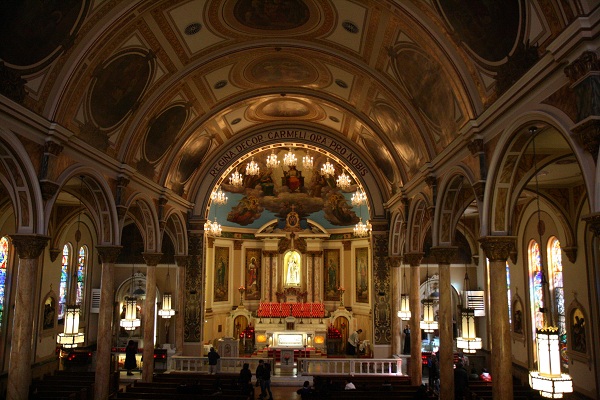
Our Lady of Mount Carmel
449 East 115th Street
The Italian community – although it later became perhaps the dominant element in New York Catholicism – came relatively late to the city. Thus, it has left surprisingly modest traces in art and architecture in Manhattan. In the early days resources were constrained. By the time the growing size and economic success of the Italians permitted grander building – from the 1920’s onward – the available artistic resources were already starting to flag.
If you ask a Catholic to name an Italian church in Manhattan, the usual answer would be Our Lady of Pompeii – a relatively late construction but well known because its prominent site in the Village. St Anthony of Padua is the oldest Italian parish and one of the largest churches as well – yet it has suffered a drastic house cleaning, giving the interior a highly un-Italian appearance. Our Lady of Peace is perhaps the prettiest – but this is no longer an Italian national parish. But then there is Our Lady of Mount Carmel – one of the earliest Italian parishes in New York and one that, thanks to its out-of-the -way location in “Spanish Harlem,” has preserved its extravagant interior intact.
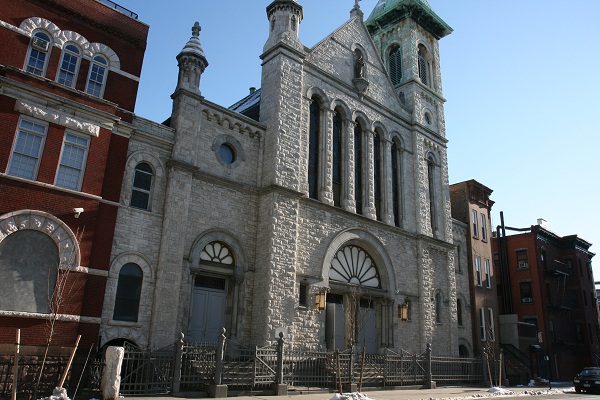
Our Lady of Mount Carmel parish was founded in 1884 and the present building finished in 1885. It exterior has the same facing of rough-hewn stone found on several other New York churches of that period. Much of the construction was done as volunteer work by the immigrant men outside of their long working hours. It is surprising to learn that the founding pastor of this quintessentially Italian parish seems to have been German, Fr. Emil Koerner. He was later killed when a wall of the parochial school under construction collapsed on him. Indeed, Our Lady of Mount Carmel parish has been staffed from the beginning by a religious order – the Society of Pious Missions, as it was originally known (the Pallotines). The clergy came from a variety of nationalities – indeed there are claims that the Italians were treated as second class citizens in their own national church! But by 1913, a contemporary chronicler records, this parish had a congregation of “25,000 Italians and 2,000 Americans.” 1)

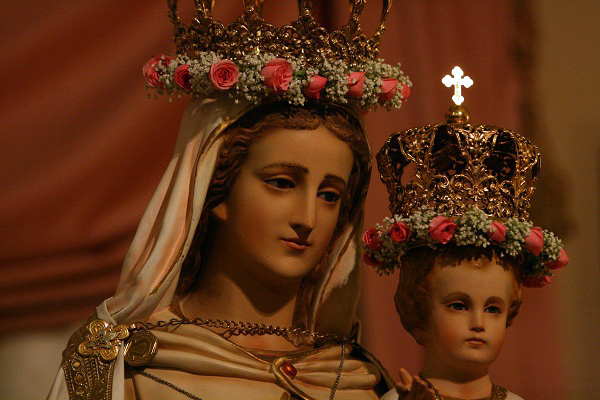
Now of course the main claim to fame of this church, then and now, is the image of Our Lady of Mount Carmel, adorned with two solid gold crowns studded with precious stones. The gold came in part from the wedding rings of the immigrants’ wives. The dress of the statue was made in India. The solemn crowning took place in 1904, having been authorized by Poe Leo XIII, who also raised the church to the dignity of a sanctuary – at the time, the only one of Our Lady in North America. 2) Even today this church’s statue is only one of three pontifically crowned images of the Virgin in North America – another is Our Lady of Guadalupe! It is claimed that many miracles have been associated with this shrine. Curiously, the image was only moved to the upper church in 1923! 3)
Tens of thousands used to gather for the Feast and procession of Our Lady of Mount Carmel. In the early days they would process barefoot to the church, carrying huge candles and wax copies of the limbs and other body parts that had been healed. And a huge giglio ( a tower carried in procession) was set up and carried right into the 1960’s. It was one of the most famous pilgrimage sites in North America – on Manhattan Island! Even after most of the Italian population had left the neighborhood, many still returned from all parts of the metropolitan area to celebrate their faith and heritage on the feast day. 4)
That all ended by the close of the 1960’s. As early as the end of World War II the vicinity of the parish started to suffer from the disastrous effects of urban renewal projects which displaced thousands of residents. Then, in the 1960’s and 1970’s, like so many other parishes in Manhattan, Our Lady of Mount Carmel was overwhelmed by crime and drug abuse. The attitudes fostered by the Council towards devotions such as Our Lady of Mount Carmel were certainly also unhelpful. As of 2006, only about 1,000 Italian–Americans still lived within the parish boundaries (probably a generous estimate). The last Italian language mass was celebrated in 2004. 4)
Nowadays the crowds at the festa are far smaller. Our Lady of Mount Carmel seems to have slipped into the same oblivion that has overtaken so many other once famous Manhattan parishes (Most Holy Redeemer, St. Stephen, All Saints ….). It is “Hispanics“ and even more so the Haitians who now make up most of the congregation and have kept the parish and its festival alive.
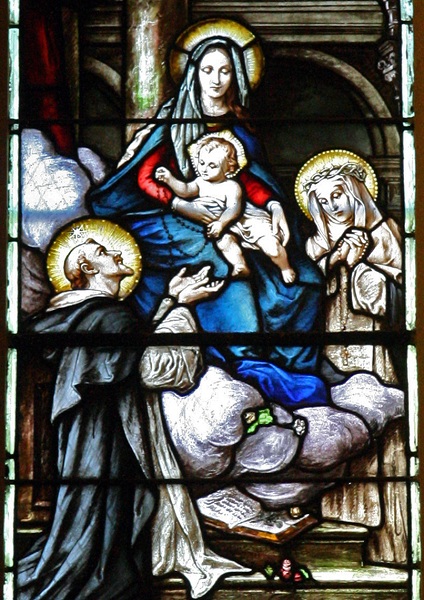
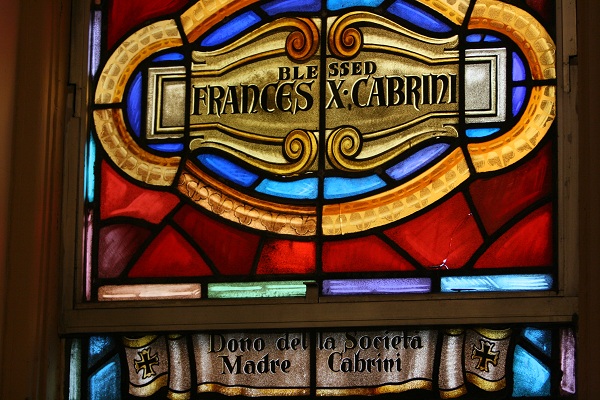
The interior of Our Lady of Mount Carmel forms a startling contrast to the austere stone façade. The quasi-renaissance architecture is fairly typical of parishes of that era. But the decoration and furnishing are everything one would hope to find in an Italian parish. Every devotion has its statue, window or painting; every inch of the walls and ceilings is covered with art; chandeliers, candles and electric lights superabound. Most impressive of all is the massed bank of candles under the image of Our Lady. The work of decoration obviously went on for many years and was executed by artists of very varying quality. What seems to be the earlier work is of higher artistic merit. The Irish, Central European and German parishes of that time exhibited more discrimination in their selection of artwork, but hardly any other parish exceeds the sheer abundance and variety of the decoration found at Our Lady of Mount Carmel. It is all extravagantly, barbarically Catholic. The Council has left its mark on the sanctuary – a “people’s altar” – but that is all.

The Sanctuary.

Some fine metalwork is to be found – here, the gate to the fabulous baptistry.

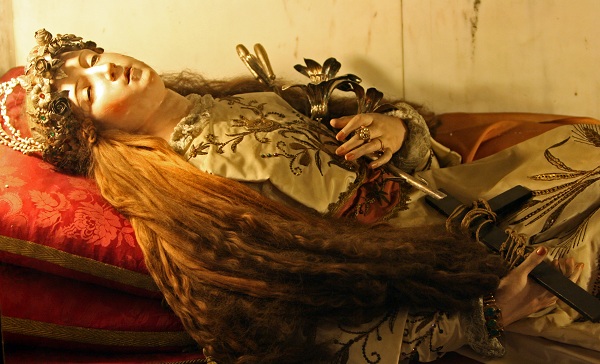
A wax image of a saint – just like in the old country. St. Elena (Helen) of Laurino, of which this church claims a relic, lived as a hermit and died around 530. She is revered especially near Salerno
Yet Our Lady of Mount Carmel was fated to play an important role in the revival of the Traditional Mass in New York. For in 1988, along with St. Agnes, this parish reintroduced the Sunday Traditional mass to New York. The pastor at that time, the legendary Fr. Peter J. Rofrano, was an enthusiastic champion of Tradition. It is reported that at his last public Mass, he spoke to a group of high school Latin students attending the Traditional Mass, telling them, “Be strong, remain strong in your faith. After all, as Catholics we have Jesus Christ as our Lord and Savior here with us at the Mass. What else do we need?” 6)
Later, in other hands, the initial active support waned – but the Sunday Traditional Mass has endured to the present day. Tragically, while St Agnes parish has cultivated a flourishing Traditional community because of its location, the much more magnificent church of Our Lady of Mount Carmel has struggled to maintain its Sunday low mass. But there are signs that situation may be changing – recently several missa cantata have been celebrated. On July 21 of this year the first Solemn mass in many decades was celebrated. We would hope that the fame of Manhattan’s once greatest pilgrimage church will experience a revival if the parish continues to pursue becoming a regional center for the revival of liturgical Tradition.
1. The Catholic Church in the United States of America: Volume 3 at 358-59 (Catholic Editing Company, New York, 1913)
2. Ibid.; Lisa Rocchio, Our Lady of Mount Carmel, http://www.fordham.edu/halsall/medny/rocchio.html
3. Gary Potter, Miracle on 115th Street, http://catholicism.org/miracle-on-115th-street.html (2009)(a lengthy and informative account of the history of this shrine and of the early Italian immigrant experience)
4. Our Lady of Mount Carmel Shrine of East Harlem: Celebrating Traditions, http://atjg64.tripod.com/olmc.html (an immense repository of information about Our Lady of Mount Carmel parish over the years – including many contemporary news articles)
5. Sarah Garland, A Reunion of Little Italy in East Harlem, http://www.nytimes.com/2006/09/05/nyregion/05festival.html (September 5 2006)
6. RIP Rev. Peter J. Rofrano, comment, http://catholicforum.fisheaters.com/index.php?topic=3290379.0;wap2
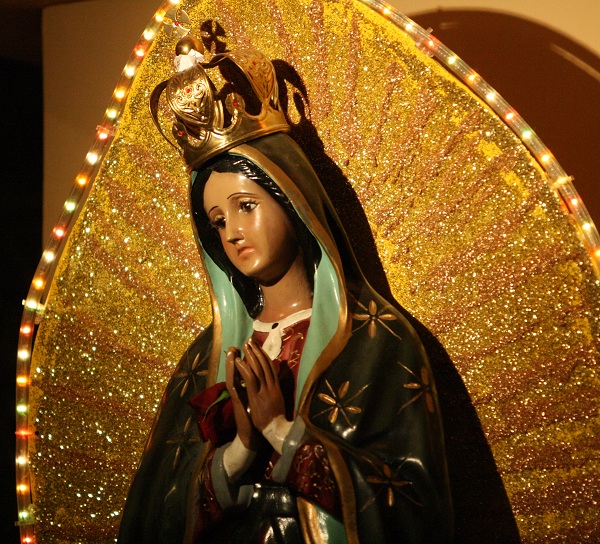
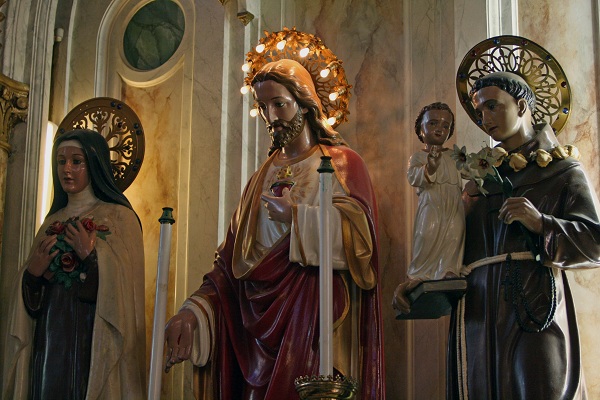
Several statues are of course surrounded by colored lights.

This statue of Our Lady of Monte Vergine is almost a caricature of the magnifcent 13th century icon preserved in Campania.


The miraculous image.
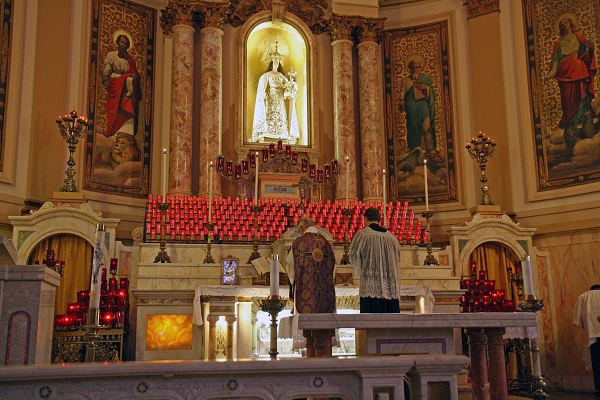
The Traditional mass at Our Lady of Mount Carmel.
Published in The Churches of New York | 1 comment
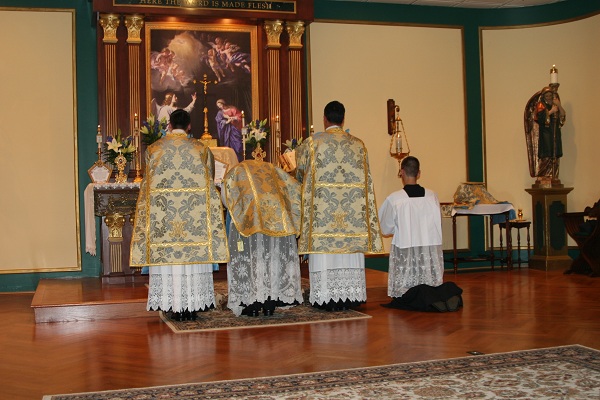
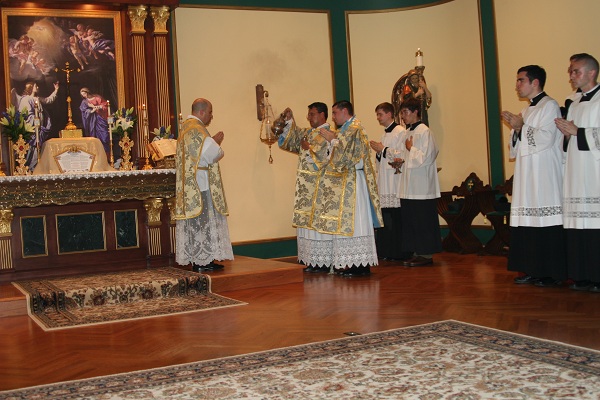
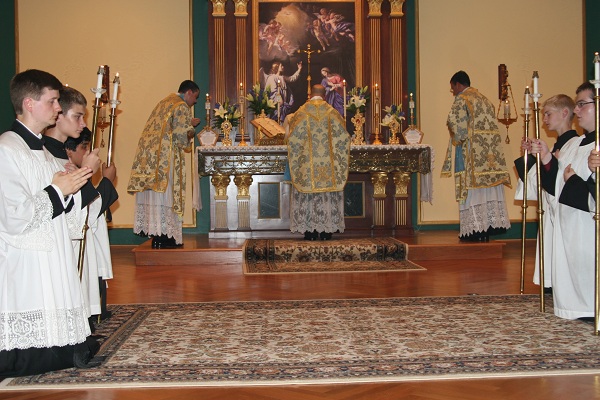
St. Gabriel’s Church in Stamford, CT celebrated the Feast of Our Lady of Mt. Carmel on Monday with a Solemn Mass. We are grateful to the pastor, Fr.Cyprian LaPastina, for sending us these photos.
Published in Masses | no comment
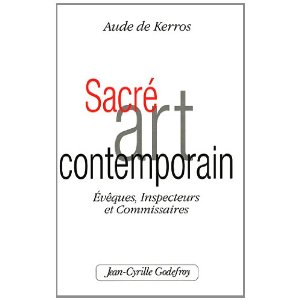
Sacré Art Contemporain: Evèques, Inspecteurs et Commissaires
By Aude de Kerros
Jean-Cyrille Godefroy Editions (2012)
From France – where at least some still think deeply about matters of the mind and spirit – comes a new shot in the culture wars. Aude de Kerros is a renowned artist (in painting and graphic works) and a cultural critic. In this extremely up to date account of the intrusion of the profane into the sacred in France, she tells us about the progress of conceptual art in France, how it became a dogma, the adoption of such “art” by the state for its own purposes and finally its takeover of the sacred spaces of France as facilitated by a subservient conciliar clergy. Although this is the specific focus of the narrative, de Kerros tells a story that has a much wider application. By the end of Sacré Art Contemporain the reader will have learned much about the nature of art, those forces in the market, the state and the Church that destroyed it in the last generation and the interrelationship of art and the sacred. And even something about those who are now struggling for art’s rebirth.
What occasioned this book were the recent unprecedented protests in France against the tidal wave of blasphemous artworks and plays – including, of course, Andres Serrano’s “Piss Christ.” A French public that had become habituated in taking direction in matters artistic from their ‘betters’ rose up in protest and even destroyed the offending works. It seemed that the unending series of outrages finally had goaded the public into action, even at the risk of being labeled as “reactionaries” and ignoramuses by the establishment. How did this unheard-of aesthetic “tea party” come to be?
It is a reaction to “contemporary art” – which de Kerros distinguishes from Modern Art. Contemporary Art has roots in certain personalities of the Dada and surrealist eras. It rejects concepts of form and beauty. Indeed, whether it is “art” at all is unclear, because it seeks to convey ideas and concepts (“conceptual art”) rather than create any kind of form. Instead of making anything, its practitioners use “found objects” and create “installations”. And what Contemporary Art seeks to do is to disturb, to trouble and to divide (Romeo Castellucci). “In a universe a prey to contradictions, an aesthetic advocating beauty and harmony would be hypocritical.” (Robert Brownstone”). There is an obsession with the blasphemous and the scatological, the sex organs and the anus.
Such tendencies in art had in the past been understood by its enemies and supporters alike as the reflection of revolutionary, antireligious developments. More recently, however, the adepts of Contemporary Art have attempted to see it as a manifestation of the “sacred.” But their understanding of “the Sacred” is not at all “religious.” Rather, it is immanent, “a kind of sacred drive preceding religions, free of all rationality and order,” “where the pure and the abominable are joined.” “The effects of the transgressive are a part of this “Sacred.’”(Sacré Art Contemporain at 11) When art reflecting such concepts is introduced into the magnificent sacred spaces of France – the cathedrals, monasteries and parish churches of earlier, greater ages – it can have only one objective and effect: to call the beauty of the art and architecture into question, to challenge and displace it.
Now de Kerros presents the progress of Contemporary Art and reveals the forces standing behind it. She shows the immediate source of the current incarnation of this art in the market of New York: France now functions as a provincial outlier of the New York scene. And precisely here we begin to a second thing radically new about Contemporary Art. For the blasphemers are no longer bohemians like the surrealists or beatniks of yore. Rather, they dispose of ample funding furnished by well heeled collectors and galleries in New York and France. The French state gives them domination over the state-controlled and financed art scene of France. And the subservient French Church collaborates in bringing their work and “installations” into the churches of France. Thus, an unholy trinity of the market, the state and the Church sustains “contemporary art” in France and gives it a near monopoly on major commissions. What was once supposed to be the protest of a fringe is now official dogma.
The Church in France, in its eagerness to “inculturate” and to “dialogue” with “modern culture,” has opened its doors to this art. Indeed, churches have become favored locations for exhibits and installations – what better places for the transgressive and the scandalous? What the Church spokesmen totally ignore is that Contemporary Art is not some cultural fact or “given” but a very specific instrument subject to the control and direction of the state and of civil society. This attempted “dialogue” of the Church with Contemporary Art – like so many others with modernity – is one-way street in which the state and economic powers impose their vision on the Church. De Kerros’ reflections here are of particular importance and have an application far exceeding the specific context of this book. It is a fundamental critique of the modus operandi of the Conciliar Church
De Kerros’ descriptions of some of these events makes entertaining if revolting reading. Consider the exhibit “The Virgins of Christmas” which took place at the famous Parisian church of Saint Sulpice 2011-12. Seven artists were invited to “revisit” plaster statues of the Virgin Mary. One “artist” repainted his statue in the colors of the rainbow – the symbol of gays. The state was covered with hearts, crosses and other signs derived from the art of Keith Haring which has its own secret sexual code. On the back of the statue was painted the devil giving a “thumbs-up” salute as if to say: “He’s won!” On the base of the statue four faces of demons appear. Public displeasure at the show was vented not so much at this “artwork” but at another statue of the Virgin clad in a burka…
De Kerros writes in a clear and entertaining style, free of jargon and pretention. The author is no reactionary in art nor does she end in despair. Rather, she introduces artists and critics – both established and of a new generation – who are “coming out of the woodwork” to challenge by word and artistic deed the hegemony of Contemporary Art. So this important work ends on a surprisingly inspirational and optimistic note. But de Kerros is clear: the Church cannot accommodate itself to a totalitarian Contemporary Art without denying her very essence. A choice must be made between the transcendental sacred open to the Divine, truth and beauty and the bogus immanent “sacred” of Contemporary Art. Finally, what can one say of the true artist who elects to continue to work in the face of the totalitarian system of Contemporary Art? De Kerros answers in a beautiful conclusion to her book: “It is an adventure in a far-off land, a poetic deed, heroic and human… It is an act of hope. One may lose, may die – but it doesn’t matter. There can be no question of renouncing a divine gift.”
Published in Book Reviews | no comment
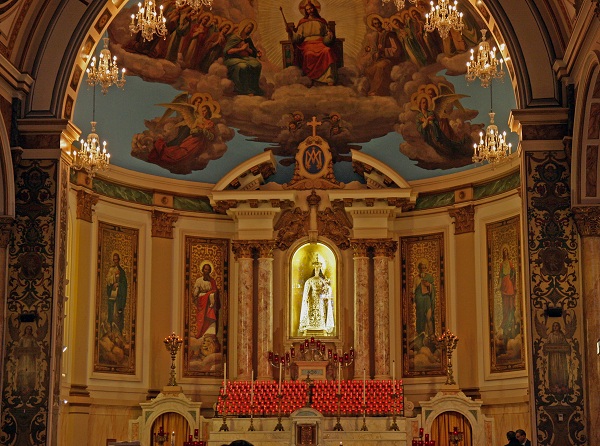
On Saturday, July 21, there will be a pilgrimage to the Shrine of Our Lady of Mount Carmel in Manhattan with Solemn High Mass at the altar of the pontifically crowned Madonna
Shrine Church of Our Lady of Mount Carmel
449 East 115th Street (between 1st Ave and Pleasant Ave)
New York, New York
(For those in new Jersey) A group will be leaving from in front of St. Anthony of Padua Oratory, West Orange at 8:30 am to take the NJ Transit train to NYC. A group will be leaving from in front of Holy Rosary Church, Jersey City at 9:00 am to take the PATH train to NYC.
Confessions will be available at the Shrine beginning at 10:30 am.
Solemn Mass and entrance of pilgrims will be at 11:00 am. Pilgrims who wish to process are requested to meet at the church hall. Those who do not wish to process are requested to go immediately into the church at 449 East 115th Street. Immediately after Mass there will be the investiture of the brown scapular for those who wish to be enrolled.
Following Mass there will be lunch in the church hall and a video documentary presentation on the history of the Shrine and miraculous image of the Madonna. You may bring your own lunch or pizza from the famous Patsy’s will be available at cost.
At 2:45 pm in the church there will be the Rosary recited in Latin, the Litany of Loreto sung in Latin, and Solemn Benediction of the Blessed Sacrament with prayers so as to receive the plenary indulgence.
A collection will be taken with the goal of $300 to defray costs to the shrine.
For pictures of this magnificent church see HERE.
Published in Masses | no comment
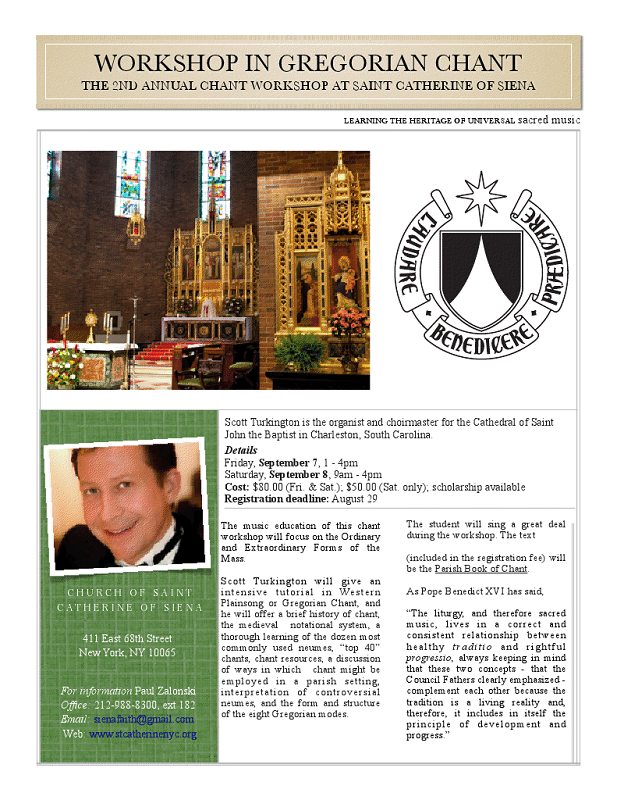
St. Catherine of Siena is offering a chant workshop September 7 and 8th given by Scott Turkington.
For those interested in learning the skills of singing the Ordinary and Extraordinary Forms of the Liturgy!
Contact: Paul A. Zalonski
The Church of Saint Catherine of Siena
Coordinator of Faith Formation
411 East 68th Street
New York NY 10065-6305 USA
212-988-8300, ext 182
212-988-6918 (fax)
http://stcatherinenyc.org
Published in Uncategorized | no comment
We visited today the church of Our Lady of Mount Carmel in Newark New Jersey on the occasion of its patronal feast. The mass and procession are held both today and on the actual feast day, July 16. And all week there is a street festival. Now contrary to what had been reported, the mass was not Traditional, but English Novus Ordo incorporating elements of a Solemn High Mass. (Was this a last minute change? – the brochure for the Feast Day masses includes the Traditional Mass propers) But the fine and touching music – in Latin and Italian – was most emphatically traditional. Indeed, it strongly reminded me of my own dimly remembered “pre-conciliar” experiences in Brooklyn and Long island in the 1960’s. Afterwards the procession with the Statue of Our Lady- and an Italian brass band – wound its way through the streets of the Ironbound district.
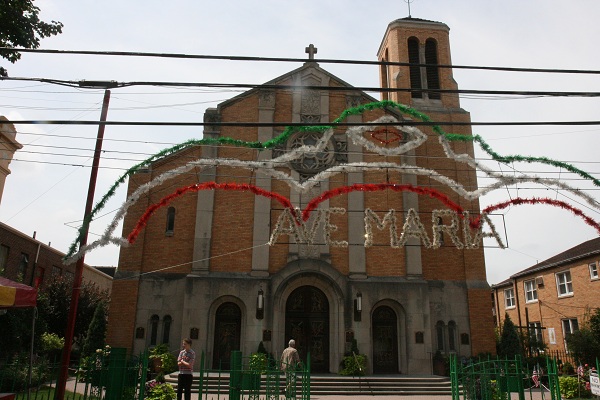
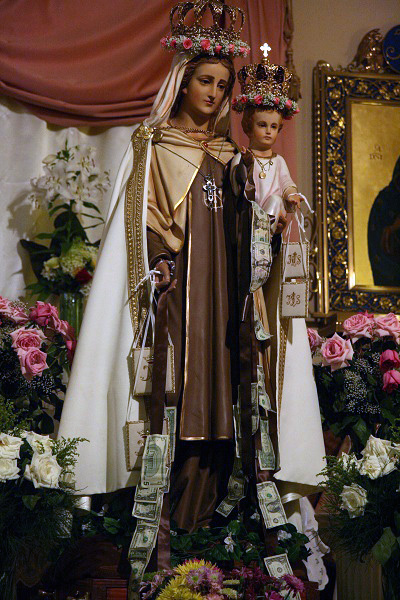
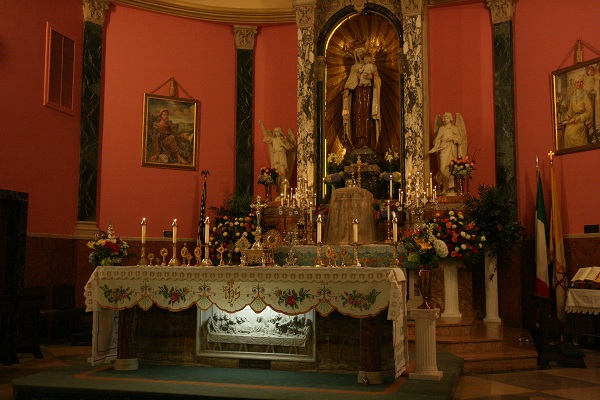
The altars, statues and other decoration of this parish church are magnificent.
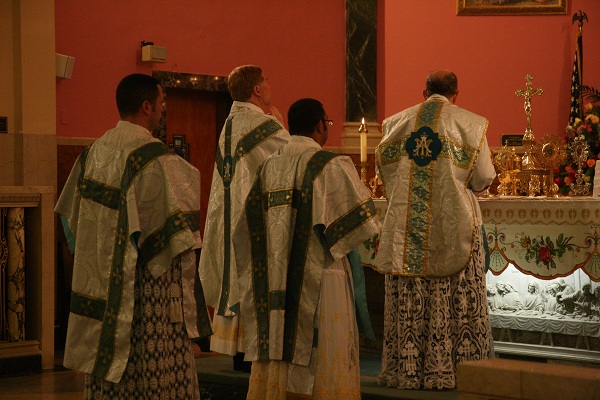
Hardly a Traditional Mass…
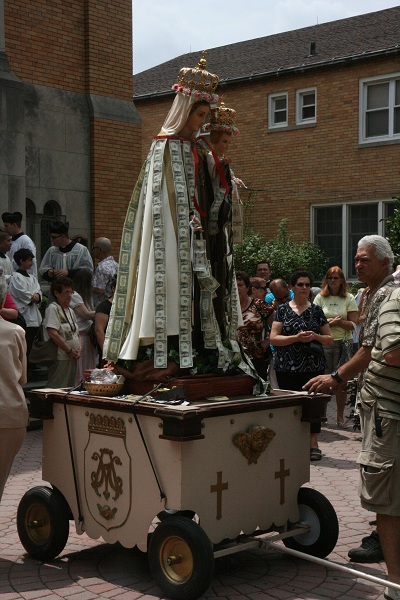
The statue of the Madonna is readied for the procession.
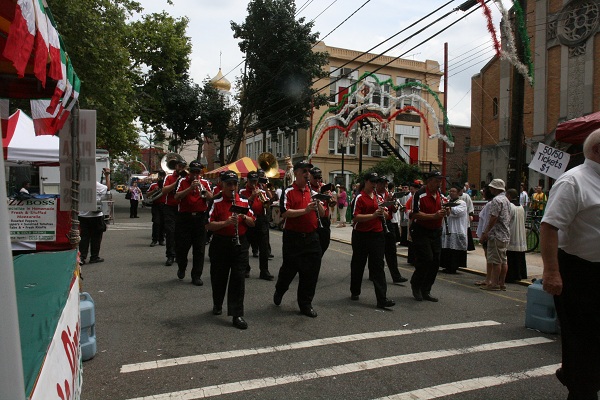
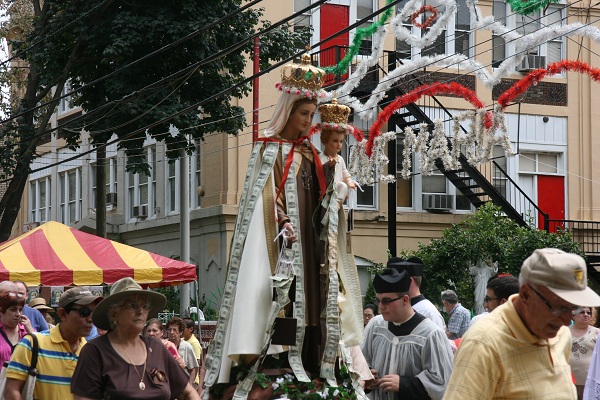
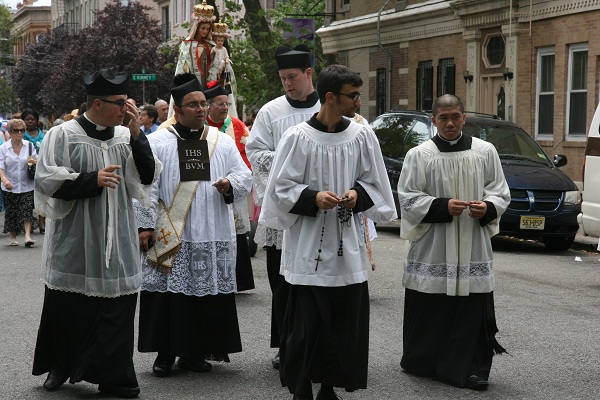
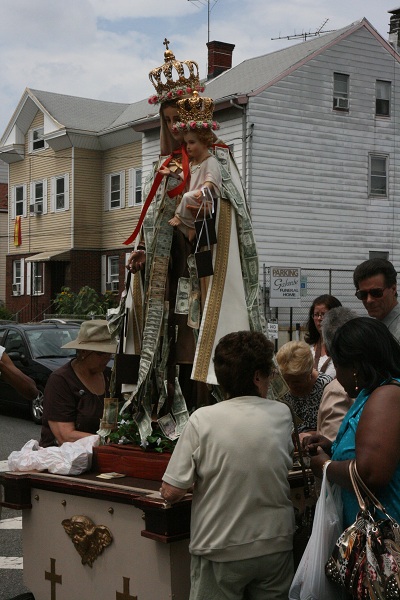
Every now and then there is a stop to distribute holy cards, scapulars and medals and to affix more bills.
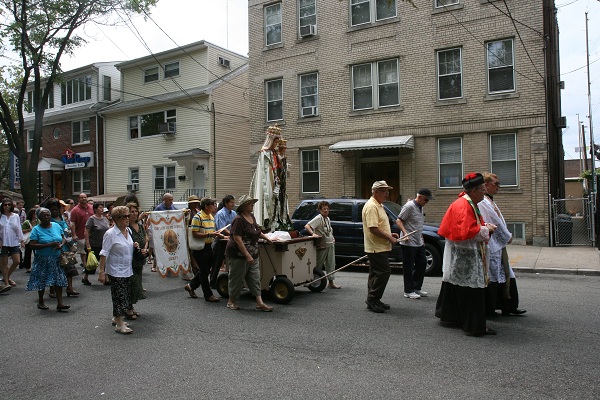
The procession still was continuing after an hour and a half.
Published in Events | 2 comments
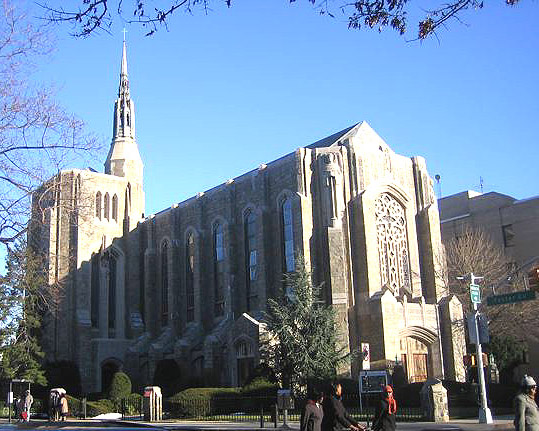
Courtesy of NY Organ Project
Concert at Our Lady of Refuge, 2020 Foster Avenue, Brooklyn, NY,
This Saturday, July 14th, at the 5pm Mass Sarah MacDonald will direct the Selwyn College Choir from Cambridge, England. The collection from that Mass will benefit the organ fund. The pipe organ is on schedule to be reinstalled by Quimby Pipe Organs in the summer of 2013.
Hymn: Morning has Broken
Introit: Henry Purcell:Remember not, Lord, our offences
Mass Setting by Orlando de Lassus: Missa Bell’ amfitrit altera
Offertory: Robert Parson: Ave Maria
Communion: Francis Piklington: Care of thy soul
Hymn: O’ Lord You Are the Center of My Life

Yesterday the Catholic Artists Society held the latest of its series of Evenings of Recollection, appropriately enough, at the “Actors’ Chapel” – St. Malachy’s.
Fr. Isaac Spinharney, CFR offered reflections on freedom, repentence and conversion. He first referred briefly to current developments (today’s Supreme Court approval of the Obama medical plan, its consequences for Catholic institutions and the Bishops’ “religious liberty” initiative) and noted that in the space of a week the Church has commemorated no less than five martyrs (Sts Peter, Paul, John the Baptist, Thomas More and John Fisher – the latter three martyred for issues of morality). Fr. Spinharney spoke of freedom as freedom from sin. Indeed the Old Testament – such as in the book of Judges – draws an express parallel between internal servitude to sin and external slavery. To achieve such freedom, repentence and conversion are necessary. It is a message of particular relevance to the artist who needs a geat deal of “internal freedom” in order to create.
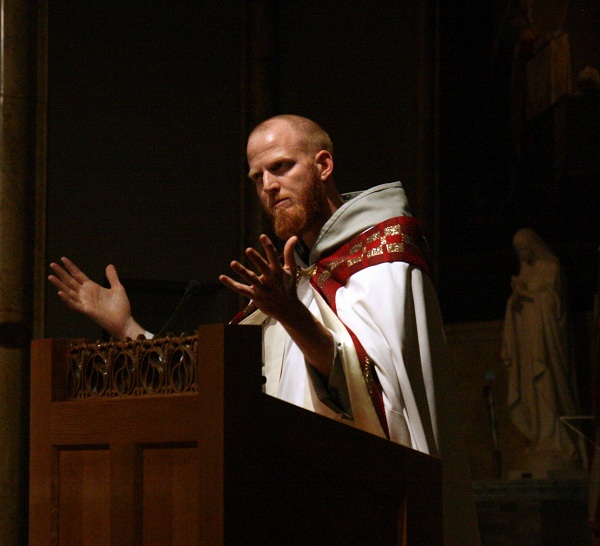

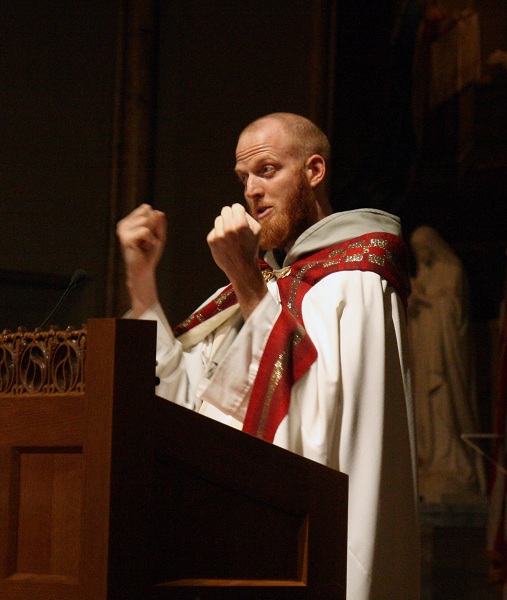

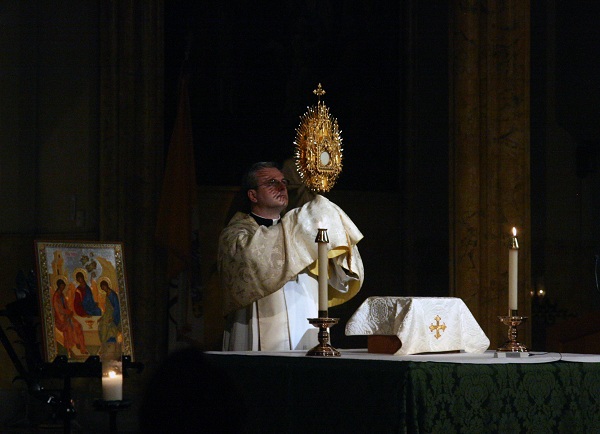
Fr. Richard Baker – the pastor of St. Malachy’s – at Benediction which concluded the evening of recollection.
Published in Events | no comment
Churches of New York
Holy Roman Empire
Website Highlights
Archives
[powr-hit-counter label="2775648"]