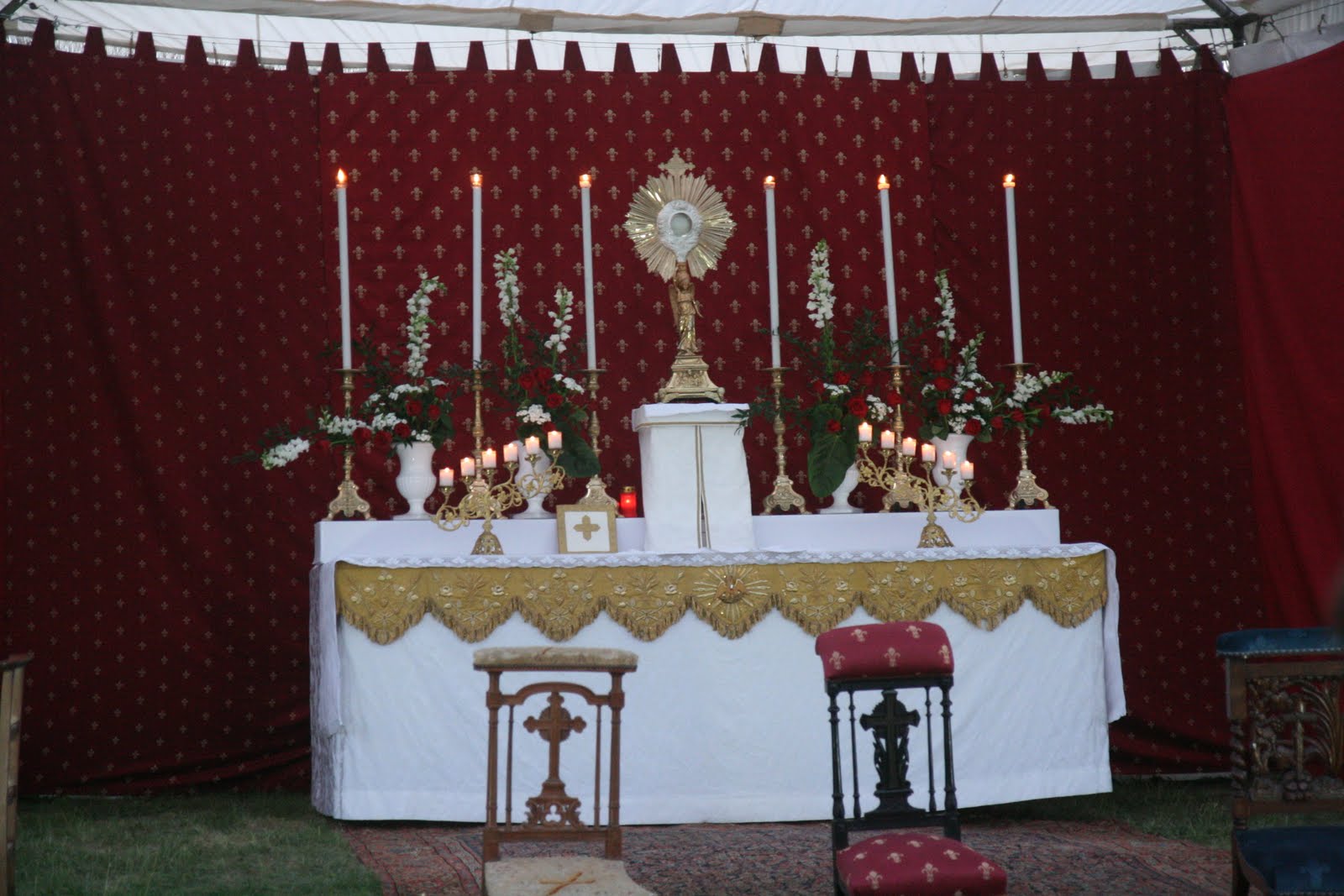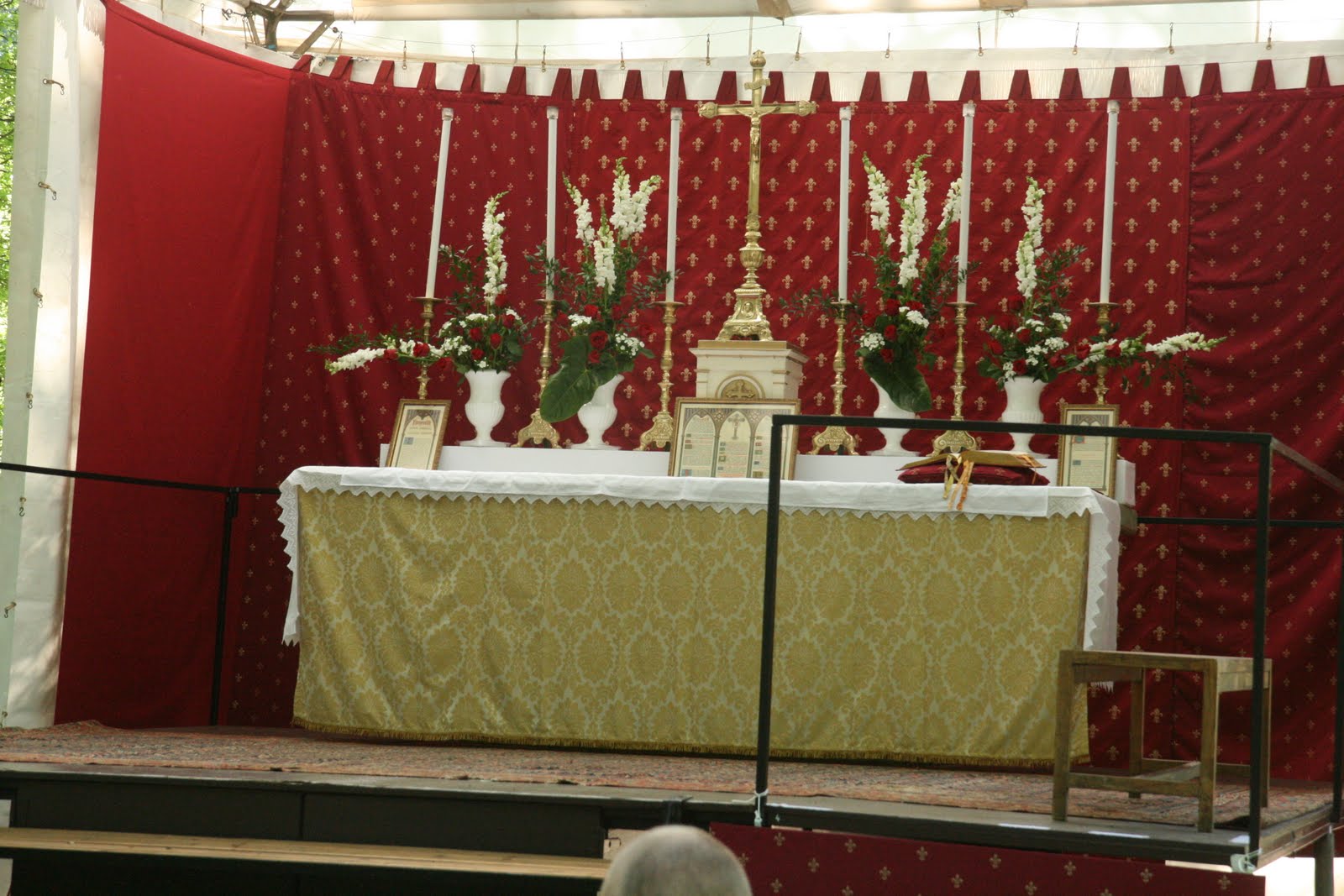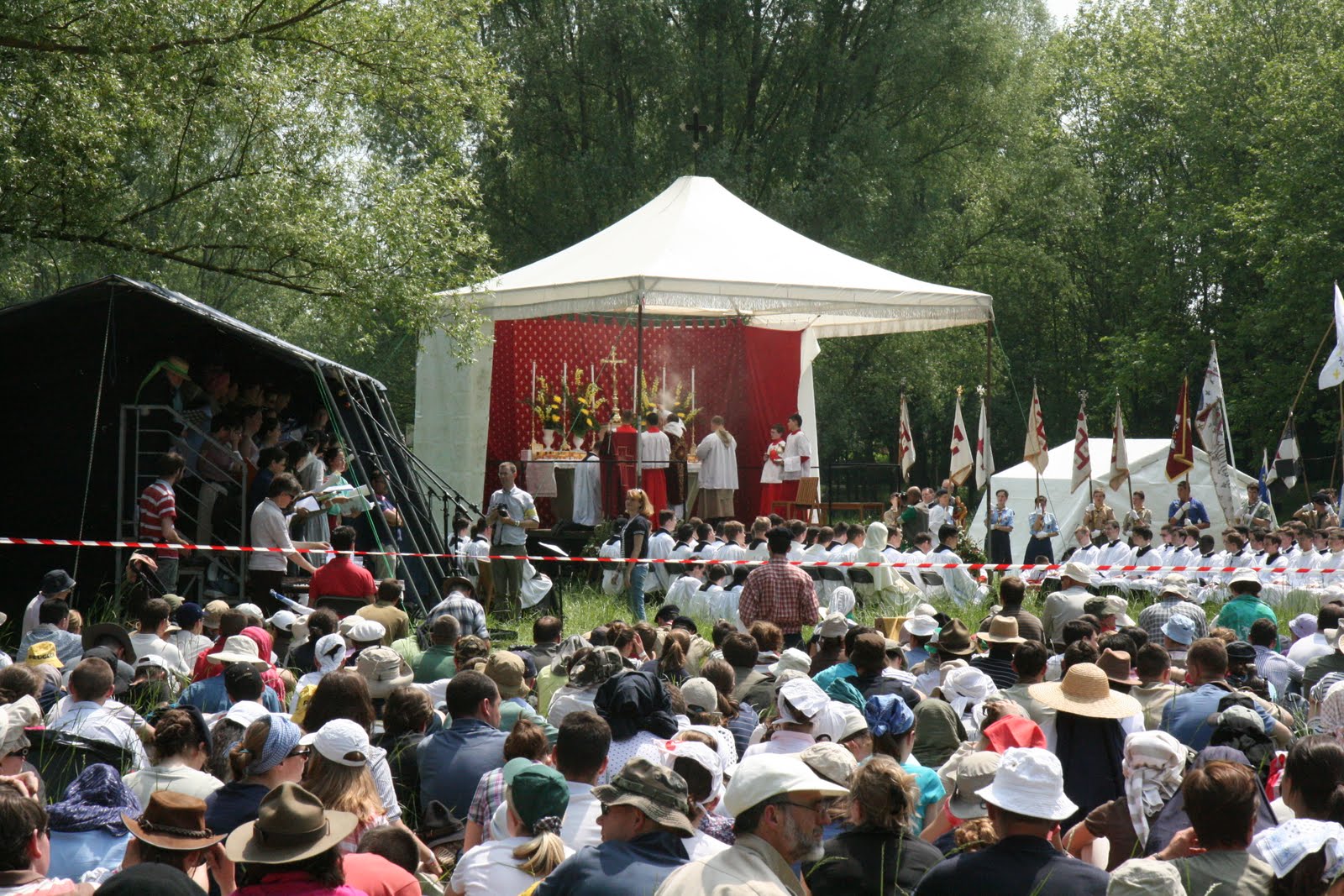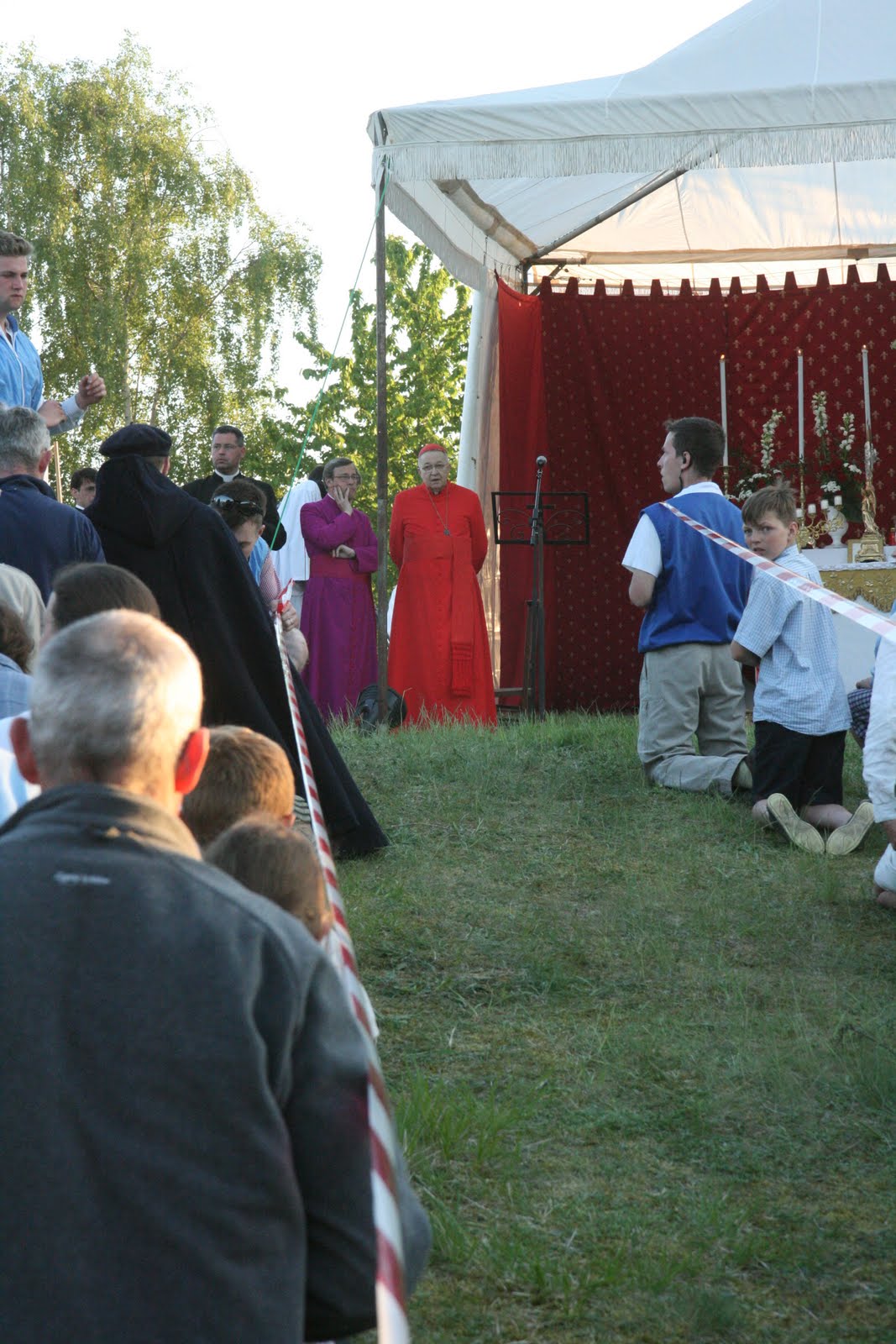
A Solemn Mass in the Extraordinary Form for the Feast of Our Lady of Sorrows will be celebrated this Tuesday, September 15 at 6:15 PM at Church of the Holy Innocents, 128 W 37th Street, New York, NY 10018.
13
Sep
A Solemn Mass in the Extraordinary Form for the Feast of Our Lady of Sorrows will be celebrated this Tuesday, September 15 at 6:15 PM at Church of the Holy Innocents, 128 W 37th Street, New York, NY 10018.

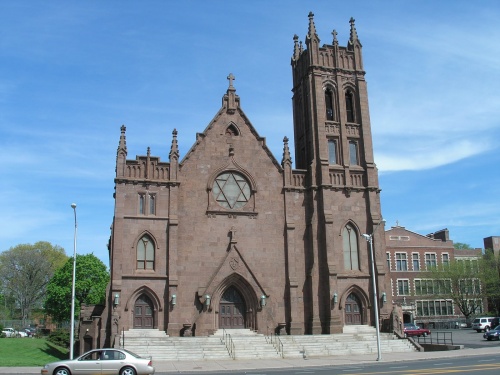
Today the St Gregory Society celebrated a Solemn High Mass in their new home at the beautiful St. Stanislaus Church in New Haven( Fr. Roman Kmiec, C.M. pastor). The mass was the anticipated liturgy for the Feast of the Exaltation of the Holy Cross – September 14 also being the second anniversary of the general effective date of Summorum Pontificum. The celebrant was Fr. John Ringley; Fr. Richard Cipolla was the deacon and Mr. Jefferey Collins the subdeacon. Bill Riccio was, as always, the perfect master of ceremonies. The Schola Cantorum of the St. Gregory Society maintained their tradition of excellence, singing works by Victoria, Palestrina and others.
2
Sep
This coming Friday, September 4, 2009 there will be a Solemn Mass in the Extraordinary Form at the Church of the Guardian Angel (West 21rd Street and 10th Avenue) at 6:30PM. This Solemn Mass is part of the nine Masses to promote devotion to the Most Sacred Heart of Jesus and is organized by the Oratory of the Sacred Heart.
25
Aug
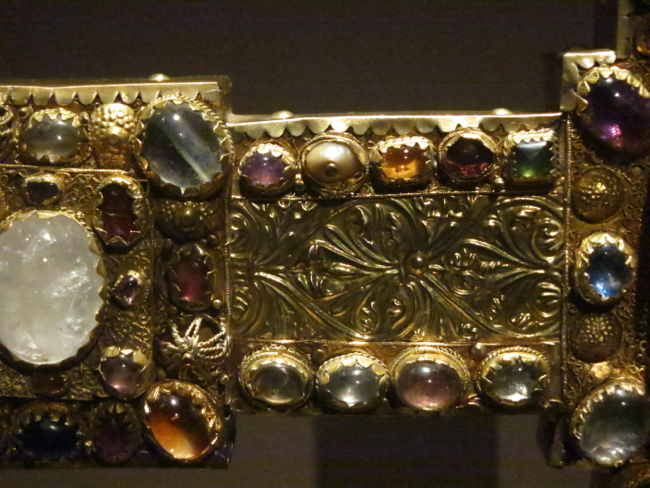
These photos were taken at the Solemn Mass for the Feast of St. John Eudes celebrated at St. Mary Church, Norwalk, CT, on August 19th, and at the talk immediately following in the parish hall on the subject of sacred art in the thought of Pope Benedict XVI. The celebrant and speaker was our friend Fr. Uwe Michael Lang, the noted Oratorian liturgical scholar presently working in Rome. Fr. Lang last visited us in September of 2007 alongside the German author Martin Mosebach. This event was sponsored jointly by the Society and St. Mary Church.
(With apologies in advance for the appalling photography. I began at the Gospel and promptly gave up. I could blame it on my cheap camera, but it’s probably not that simple…. Next time we will let Stuart take charge of the photography again!)
11
Aug
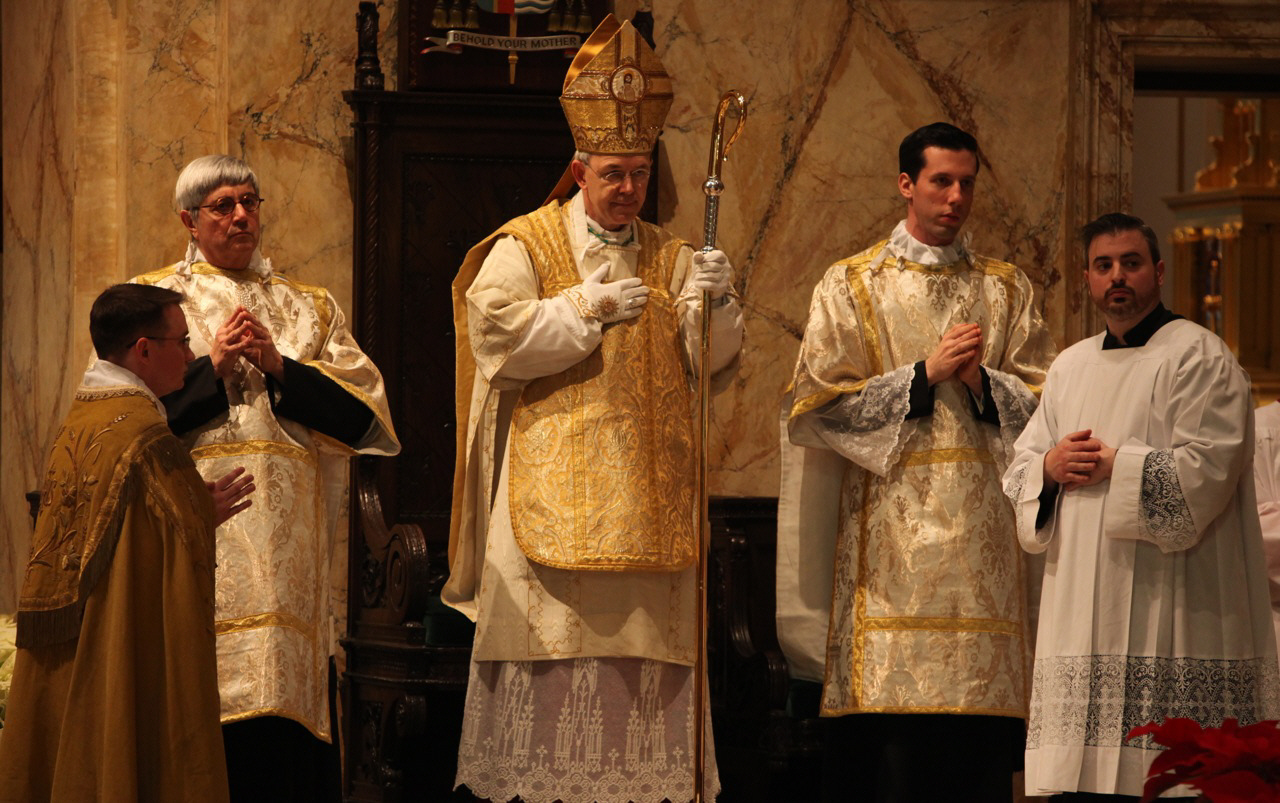
On Friday, September 18 at 5:30 PM, the Society will be sponsoring a Solemn High Traditional Mass at the Church of Our Saviour at 38th Street and Park Avenue, New York. This will be in association with St. Mary’s Church, Norwalk CT to support the restoration of that church. This will be our initial mass after the summer months and all are invited! Further details will be provided.
11
Aug
The following parishes will offer the Mass in the Extraordinary Form for the Feast of the Assumption on Saturday, August 15. If any of our readers know of another Mass in the area, please let us know.
Connecticut
St. Mary Church, Norwalk, missa cantata, 12:10 pm, followed by the Holy Rosary.
St. Lawrence Church, Shelton, 9 am.
St. Bridget of Kildare Church, Moodus, missa cantata, 10 am.
New York
Holy Innocents Church, 128 West 37th Street, Manhattan, missa cantata, 1 pm.
Immaculate Conception Church, Sleepy Hollow, low Mass, 10:30 am.
New Jersey
Holy Rosary Church, Downtown Jersey City, 344 Sixth Street,(201)795-0120, missa cantata, 9 am.
Day of Recollection
Father Richard Cipolla, the chaplain of our Society, will hold a Day of Recollection on the Feast of the Assumption at the Convent of St. Birgitta, Darien, Connecticut, from 9:45 am to 2:00 pm.
Further information is posted on our website: link
5
Aug
The Society of St. Hugh of Cluny and St. Mary Church, Norwalk are sponsoring a lecture by Fr. Uwe Michael Lang, “Sacred art and architecture in the thought of Joseph Ratzinger – Pope Benedict XVI” on Wednesday, 19 August 2009 in the parish hall of St. Mary Church, 669 West Avenue, Norwalk, CT. The talk will be preceded by a Solemn Mass for the Feast of St. John Eudes, beginning at 7 pm.
Fr. Uwe Michael Lang is a noted liturgical scholar based in Rome, and an expert in early Christianity. His study of the orientation of liturgical prayer, Turning Towards the Lord, is published by Ignatius Press. He is a director of the Master’s degree program in architecture, sacred art, and liturgy at the European University of Rome.
Mass will be celebrated in the “Extraordinary Form” with music provided by the St. Mary’s Schola Cantorum: Palestrina’s Missa sine nomine, motets by Palestrina and Victoria, and all the proper Gregorian chants.
Father Richard Cipolla, the chaplain of our Society, will hold a Day of Recollection on the Feast of the Assumption, August 15 at the Convent of St. Birgitta, Darien, Connecticut, from 9:45 am to 2:00 pm. The program will include three meditations by Father, the Sacrament of Reconciliation, the Holy Sacrifice of the Mass according to the Extraordinary Form, and Adoration of the Blessed Sacrament. There will also be a potluck lunch. A $15 contribution to the Sisters is requested. Please RSVP by Monday, August 10, calling Jacqueline Juhasz, (203)644-0056.
The address of the Convent is 4 Runkenhage Road, Darien.
4
Aug
There will be a Solemn Mass this Friday, August 7 at 6:30 pm at Holy Innocents Church, 128 W. 37th Street (Broadway and 37th), New York. The First Friday Masses in honor of the Sacred Heart of Jesus are organized by the Confraternity of the Sacred Heart. Please visit their website for a schedule of these Masses: http://sacredheartconfraternity.org/First_Fridays.html
2
Aug
The tower of the Frankfurt Cathedral reflects the form of the crown of the Holy Roman Empire
Frankfurt-am-Main in Germany would seem the very antithesis of the sacred. Oversized skyscrapers dominate the town as nowhere else in Europe. Thanks to the area bombing of the Second World War and the activities of postwar speculators, there is precious little evidence of the past. A crowd of every language, race and nationality swarms on the mall-like main shopping street. At night, however, the high-rise financial district lies deserted just like most US downtowns. What would otherwise be a pleasant, medium-sized European commercial city seems crushed under the weight of an impersonal modernity.
Yet, slightly off the beaten track and on either side of the Main River are astonishing Catholic churches, isolated witnesses to a more glorious past. For it was in Frankfurt that the German kings and the Emperors of the Holy Roman Empire were elected. After 1560, they were crowned here as well. Indeed, Frankfurt owes its very origin to its status as a possession of the Carolingian Emperors and before that, perhaps, of the Merovingians as well.
St Leonhard is remarkably well preserved, having survived World War II with very little damage. Emperor Frederick II founded this church in 1219, in connection with his vow to go on Crusade – a commitment that soon brought him much grief from the papacy.
Two towers (which mimic a tower in Jerusalem itself) still testify to this vow.
Inside, enclosed by later late medieval construction, are two Romanesque portals dating to the era of its foundation. One, of 1220, shows St. James and two pilgrims – this church also served as a departure point for pilgrims to Santiago. Indeed, this church has it its patron the patron saint of one of the main French stations of the pilgrimage route to Santiago: St.Leonard-de-Noblat.
The other portal of 1230 depicts various saints – including St. George, associated with the Crusades. St. George kneels, clad in the armor of a Crusader.
One is overcome by awe when contemplating these ancient ,hidden images while reflecting on the traffic, skyscrapers and global capitalism so near at hand. For when these portals were carved, St. Francis of Assisi, St. Clare, St. Elizabeth, St. Dominic and so may others walked the earth, the Cathedral of Chartres was rising, Christian knights were battling the infidel in Spain, in Prussia and in the Holy Land. Now all is quiet here – one can count the number of visitors, whether tourists or faithful, on one hand.
Later, between 1400 and 1520, St. Leonhard was mostly rebuilt and greatly expanded in an elaborate late gothic style. By then, Frankfurt was a large, prosperous city.
On windows and on carved stones the donors left their mark – like Dr. Stork (Storch) and his wife Mrs. Frog (Froschin). Much lovely glass, stone and metalwork survives from that era.
The original altars and statuary, however, were mostly lost in the Protestant reformation, the adaptation of the church to baroque tastes and subsequent damage by the French armies after 1792. As part of a little known yet remarkable 19th century restoration initiative, Fr. Ernst Franz Muenzenberger, the rector of the church of St Bartholomew, furnished this and other Frankfurt churches with magnificent altars, some newly carved or painted, some purchased and some a mixture of old and new elements. Much of the present appearance of St. Leonhard is due to him.
It is in this magnificent setting that the Frankfurt Traditional mass community celebrates what is called here variously the “Tridentine” or the “classical Roman” liturgy. Traditional Mass Community
Can we forget to mention that Martin Mosebach, who has done more than anyone else has in recent years to promote the restoration of the Traditional liturgy in Germany and the world, hails from Frankfurt?
St. Bartholomew, the “Cathedral” of Frankfurt (it has never been the seat of a bishop) is a much older foundation and a more splendid church. Like St. Leonhard’s and several other major Frankfurt churches, St. Bartholomew’s was eventually preserved for Catholic worship through the influence of the Holy Roman Emperors and of the nearby Prince-bishops of Mainz. Sadly, in contrast to St. Leonhard, St. Bartholomew’s suffered great damage by fire in 1867 and by bombing in 1944. Much of the original atmosphere has been irreparably lost. Piped-in music and horrendous modern art does not help.
Yet many original sculptures, tombstones, paintings as well as Fr. E.F. Muenzenberger’s magnificent altars do survive. Some 19th century frescoes in the style of the Nazarenes tell of the great days of the empire.
To the side of the sanctuary is the very chapel where the Holy Roman Emperors were elected. Later, after the Protestant Reformation and until 1792, the Emperors were crowned in St. Bartholomew’s as well. The very tower of this church features a “cap” reminiscent of the crown of the Holy Roman Empire.
The Cathedral museum preserves an amazing number of original vestments and precious liturgical artwork of St. Bartholomew, St Leonhard, and other Frankfurt churches. There is a chasuble worked in needlepoint by a princess – the wife of a prince-elector of the Holy Roman Empire.
Two great candlesticks from St. Leonhard dating to 1480 acquired four smaller companions in the 16th century. For it was then that the “Tridentine” liturgy was adopted which prescribed six candles for solemn masses.
A magnificent 18th century monstrance was curiously altered in the 19th century – a crown was substituted for the original Trinitarian eye of God, which was now felt to be “Masonic.”
Yes, it is a shock to turn from these wonders from the past and confront once again the “modern world” so stridently in evidence in Frankfurt. The Holy Roman Empire, the Crusades and even Christianity itself seem to belong to a dead age. Yet the “new beginning” after Summorum Pontificum of the Traditional Mass in St. Leonhard’s shows that it is far too early to declare absolute victory for modernity. To quote a much later historical figure but in the spirit of the 13th century Crusaders: we have not yet begun to fight….