At Holy Rosary Church in Jersey City there will be a Missa Cantata on Pentecost Sunday, May 31, at 10:00 a.m. The music will include Haydn’s Missa Brevis Sancti Joannis de Deo with string accompaniment and Gregorian chant propers.
27
May
At Holy Rosary Church in Jersey City there will be a Missa Cantata on Pentecost Sunday, May 31, at 10:00 a.m. The music will include Haydn’s Missa Brevis Sancti Joannis de Deo with string accompaniment and Gregorian chant propers.
26
May

Below is Fr. Greg Markey’s sermon preached on the occasion of his 10th anniversary as a priest on May 24 at St. Mary Church, Norwalk. We have also posted pictures from the Mass: link
I. Introduction
Now that Our Blessed Lord has ascended to heaven, the Apostles are left with the question, “How will the mission continue?” They reflect on the words of today’s Gospel understanding that the mission would continue when the Advocate comes at Pentecost; there would be a hierarchical Church, and men would be called to the priesthood.
One of the best descriptions of the priesthood comes from the book of Hebrews:
“For every high priest chosen from among men is appointed to act on behalf of men in relation to God, to offer gifts and sacrifices for sins. He can deal gently with the ignorant and wayward, since he himself is beset with weakness. Because of this he is bound to offer sacrifice for his own sins as well as for those of the people. And one does not take the honor upon himself, but he is called by God” (Hebrews 5:1-4).
A priest is a man called by God to offer sacrifices for the sins, offering the Mass. This Sunday’s Mass, the Sunday after the Ascension, is a time for us to give thanks for the gift of the priesthood of Jesus Christ, that men are called by God to this sacred ministry.
II. The call to the Priesthood
I think the best description of the call to the priesthood is Pope John Paul II’s phrase: “gift and mystery”. It is a mystery, something hard to understand, yet at the same time, the most valuable of gifts; so valuable that it is like the fine pearl which Our Blessed Lord describes as selling all that one has to possess it (Matthew 13:46); and as the finest of pearls, I do think one needs to be careful not to expose it to too much discussion less it loses its unique value.
Yet I have thought much over the past few months about how I arrived here to this point in my life. While the seed must have been present at my baptism, it seems that the vocation began to germinate in a secular college, in a room by myself praying to Our Lady. Within a few years after college I entered seminary. When I look back I am still confused how a vocation to the priesthood could emerge out of thoroughly secular atmosphere.
For me, the invitation to be a priest did not come from a particular priest or person, but almost completely from a life of prayer and study. More and more time spent in prayer before the Blessed Sacrament, reading books on Catholic spirituality or lives of the saints gave me such sense of fulfillment that all other things in life seemed less important. When I entered seminary and read Aristotle who wrote that “Happiness is the contemplation of truth”, I knew exactly what he meant.
The writings of the late Pope John Paul II exercised greater influence on my thought more than any other author. He woke me up out of my secularist slumber, and gave me the vocabulary to explain the faith, while repeatedly enkindling in my heart the burning desire to serve Christ and His Church. Many a late night was spent combing through his writings, excited at the prospect of being a Catholic priest.
Yet it was the current Holy Father, Pope Benedict XVI, who refined my understanding of the Church. Shortly after my ordination I read his book the Ratzinger Report, which was a dramatic paradigm shift on how I perceived the Church. Suddenly the Catholic Church no longer looked same, and my understanding of what it meant to be “faithful” to Mother Church was something very different. The then-Cardinal Ratzinger was able to articulate the internal struggles of the Church, and the liturgy, in a way that resonated with my experience as a newly ordained priest. I continued to study his writings for years until he was elected as the Holy Pontiff in 2004, as if the Holy Spirit was slowly preparing me to understand the mind and heart of the man who would be Pope.
During my discernment I learned to appreciate St. Therese of Lisieux’s desire to be every member of the Body of Christ. I have given serious consideration to being a missionary, a Benedictine monk, a Franciscan, or a scholar. At one point or another I pursued each of these particular vocations, yet in God’s providence I always seemed to be directed back to the life of a parish priest, and so I stand here today, the Pastor of St. Mary Church.
III. Anniversary Mass
Certainly this anniversary Mass is not about me. It is about Christ. We are here to thank Him today for the gift of the priesthood that he has freely given. Although my faith is weak, I do believe that Christ is present in the Blessed Sacrament, and I do believe that we have a Mother in heaven who is praying for us, and I do believe that the Pope is the Vicar of Christ. I do not know why I believe, but I do, and I think the reason I believe has much to do with this second point – the Blessed Virgin Mary. That a man in the current cultural atmosphere believes these truths is something for which we can all be grateful.
To be honest, I am not exactly sure why we celebrate priestly anniversaries. I am grateful for all the expressions of congratulations, and I know that you mean well. However, I must say that the words of congratulations are a bit premature. The real test for every priest is if he can persevere until death. If I have taken my last breath, worked hard at winning souls for Christ, and there is no more opportunity to fall out of God’s favor…then at that point I will more readily accept words of congratulations. I yearn with all my being for the day when I can hear those words: “Well done good and faithful servant…enter into the joy of your master” (Matthew 25:21).
That day has not yet arrived, and if the future is anything like the past, there are many more serious trials ahead. So while I suppose a moment of thanksgiving may be in order after 10 years, all the more is the need to recognize that we are still in the midst of a raging battle, and the stakes are high.
IV. Current situation
At the heart of this battle is the sense of the Sacred – the sacred liturgy, and the sacredness of the family. Both are under terrible attack, and both are interrelated. My seminary formation and experience at Mount St. Mary’s left a deep impression upon me about the culture of death: the annual March for Life, praying in front of abortion mills, Pope John Paul II’s encyclical Evangelium Vitae forged my priestly identity into a priest who would be very involved in these issues. I am very grateful to all of you here today who for many years have responded so fervently to the battle of the “culture of life” vs. the “culture of death”.
The root of this conflict is the profanation of marital love, separating life from love, and in the end leading to a dramatic decline in morals, as Pope Paul VI had prophesied in 1968. I do not think it an exaggeration to say that not only has his prophecy come to fulfillment, but the period of history we are living through, with all of its perversions, is unprecedented in the entire history of the world.
While the truths about family life are compelling on their own merits, my conviction about teaching these truths grew even stronger when in seminary I read the words of Popes Pius XI and Paul VI, and the specific counsel they gave to priests in their encyclicals Casti Connubii and Humanae Vitae. For example Pius XI wrote:
“We admonish…priests who hear confessions and…who have the care of souls…not to allow the faithful entrusted to them to err regarding this most grave law of God…. If any confessor or pastor of souls, which…God forbid, leads the faithful entrusted to him into these errors, or should at least confirm them by approval, or by guilty silence, let him be mindful of the fact that he must render a strict account to God, the Supreme Judge, for the betrayal of his sacred trust.”
– “Pastor of souls”, “Guilty silence”, “Rendering an account”, “Sacred trust” – these are the values that I hold before me when I enter the pulpit and the Confessional, and which motivate me as a priest.
As I have reflected on how to build a “culture of life”, it has become increasingly evident to me that it must begin with the root of culture – cult – i.e. worship. Until people are able to have an experience of the sacred when they worship God, they will always struggle to understand the sacredness of human love and life. As long as our Masses are informal and casual, based on societal norms rather than the proven traditions handed down to us by our forefathers, it will be very difficult for people to appreciate the transcendent presence of God, the very source of human love and life.
Pope Benedict XVI writes in his encyclical Spe Salvi that while the convictions of the faith may be drawn upon from the moral treasury of previous generations, they nonetheless “must always be gained anew by the community”, and that “every generation has the task of engaging anew in the arduous search for the right way to order human affairs” (16,17).
My brothers and sisters, we have come to a point in history where we must discover anew the convictions of the faith; we cannot imagine that where the Catholic Church and all of its institutions stand in relation to the rest of society today is somehow satisfactory; and I am convinced that this renewal in faith will ultimately come about with a renewal in the Holy Sacrifice of the Mass. Pope Benedict tells us in no uncertain terms that this is an arduous task, but we were born for this time in history, we are blessed to be here, and we have the strength of God and Our Lady’s intercession to guide us. May we be courageous, yet charitable and humble, as we travel this path.
V. Conclusion
With the daily pressure upon me for the parish (2 Corinthians 11:28), the center of my vocation still remains prayer and study, culminating in the Holy Sacrifice of the Mass. The contemplation of truth still brings me great happiness and peace, renewing my vocation daily.
When I look back on my past ten years as a priest, I am very grateful to the Lord for many blessings, but perhaps most of all for preserving my priesthood from falling into any number of disasters. Both disasters which are obvious, and disasters which are more subtle, like poisons which cause a priest to become disoriented from the truth. This is why I am so grateful to be the Pastor of St. Mary Church. I have arrived to a safe harbor where the Lord can be worshipped in spirit and truth, and the Gospel can be preached in its entirety.
When the Lord ascended to heaven and founded his Church on Pentecost, I like to think that this was what He had in mind: priests who would “devote (themselves) to prayer and to the ministry of the word” (Acts 6:4), that they would be “free to worship (the Lord) without fear” (Luke 1:73), preaching the word “in season and out of season” (2 Timothy 4:2), so that the Church would flourish. Our parish church devoted to the Blessed Virgin Mary is growing, becoming a light to the world, and a source of strength to many people even beyond our parish boundaries. To be Pastor of such a project is truly a gift for which I give thanks this day.
25
May
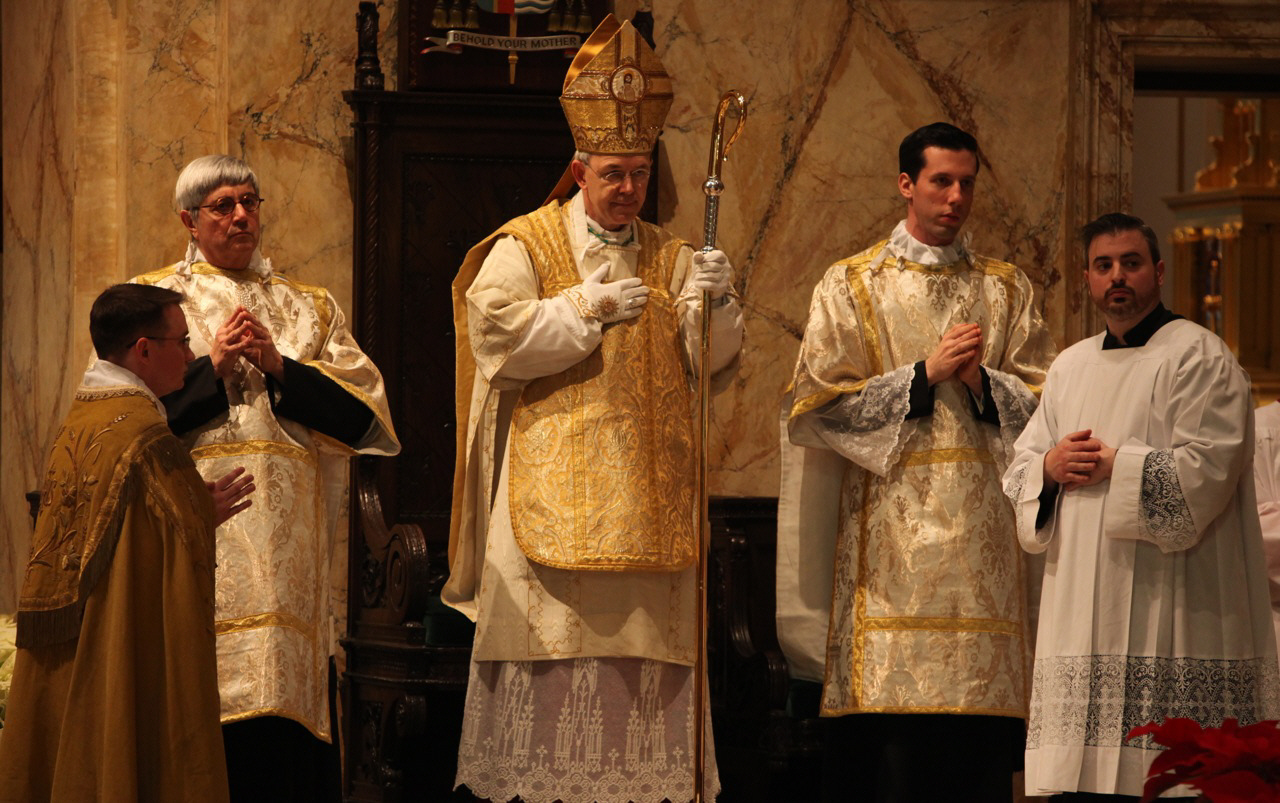
On Sunday, May 24, the parish of St. Mary’s Norwalk celebrated a Traditional Solemn mass for the tenth anniversary of the ordination of Father Greg Markey, the pastor. It was truly a joyous occasion for the various communities that make up this parish. As Fr. Markey put it in his sermon, the day should not be about him but about Christ. We can truly see over the last two years the amazing fruits that devotion to reverence and mystery in the liturgy can bring forth. We look forward to to the ongoing restoration of this church building to its former glory.

The altar set up for Holy Mass

Brigantine Sisters of the Convent of St. Birgitta, Darien, CT

St. Mary’s Schola Cantorum under the direction of David Hughes
23
May


An island of faith in a sea of ugliness and unbelief: a reflective Ascension Thursday evening amid the Victorian splendor of Holy Innocents parish, New York.
15
May
By Jonathan Riley-Smith
(Columbia University Press New York 2008)
Jonathan Riley-Smith, the eminent English historian of the crusades, published last year a slim volume containing lectures originally given at Columbia University in 2007. In it, Prof. Riley-Smith challenges this consensus among the media, academia, Christian religious leadership and the Muslim world: that the Crusades were an evil, destructive event in history – perhaps even the origin of the current insoluble conflict in the Middle East. In particular, the statements of Archbishop Rowan Williams and the “apology” of Pope John Paul II (which Riley-Smith claims was not in fact such) are key evidence of the thinking of the Western Ecclesiastical Establishment. These contemporary Western religious leaders, moreover, make the further claim that the Crusades are an aberration in Christian history – that they are essentially alien to the Christian faith.
Riley-Smith’s book undertakes to refute these claims. Its first two sections define the correct nature of the Crusades. They were essentially a religious phenomenon – a penitential pilgrimage. There is no evidence that contemporaries viewed them as imperialistic or profitable ventures. There was no exclusive focus on the Moslem world, either: Crusades were called against pagan Prussian and Lithuanian tribes in the Baltic, against the Albigensian heretics and against other Christians opposed to the religious and even political agenda of the Papacy.
The entire logic of the Crusades is intimately connected with the Christian “just war theory”. Indeed, for much of the age of the Crusades the leading just war analysis (following Augustine) was even more supportive of war than its scholastic successor.
The Crusades fit into a pattern of later Holy Wars: the struggles of the Knights of Malta on land and sea, the battle of Lepanto – right up to the siege of Vienna and the Christian reconquest of Hungary at the end of the 17th century.
Riley-Smith illustrates the ongoing vitality of the theology of the Crusade in Christian tradition by Pope Leo XIII’s praise of the past efforts of the Knights of Malta and his support of a semi-ludicrous late 19th century attempt to organize a “Crusader” police guard for Catholic missionaries in Sub-Saharan Africa. To assert that the Crusades form an aberration in Church history and theology is simply wrong. Rather, it is the current theology of Western European Christianity that has radically broken with the consensus that obtained in the Middle Ages and beyond. Riley-Smith points out that up to the end of the 17th century Catholics Protestants and Orthodox were united in support of the ideal of holy war.
European views on holy war and the Crusades began to change radically with the Enlightenment. The new perspective was embodied in the novels of Sir Walter Scott. In them, the Crusaders are depicted as uncivilized barbarians and the Moslems as advanced Europeans of the 19th century. This obviously preposterous view became a new orthodoxy. Riley–Smith points out that the popular 20th century history of the Crusades by Sir Steven Runciman “is almost what Scott would have written had he been more knowledgeable.” By the way, Riley-Smith observes that the level of civilization in Europe and in Islam was far closer in the 12th century than Scott and his successors imagined.
Regarding current Moslem views equating the Crusades with “imperialism’, Riley-Smith shows that they date back no later than the early 20th century. Prior to that, Islam basically had no interest in events outside the Moslem world, They are essentially a regurgitation of one school of the western European thought regarding the Crusades: the predominant “liberal” view of the 19th century. Like the secular nationalism imported at the same time, it is a by-product of the intrusion of the imperialistic West into the Moslem world.
This work is a must for anyone seeking a succinct, informed introduction to the Crusades, the theology that prompted them as well as some insightful views on the present political situation. For the Catholic, it is a useful antidote to the “apologies” and historical and theological distortions of clerics eager to please the secular establishment
13
May
On Pentecost Sunday, May 31, St. Bridget of Kildare in Moodus, CT, will have a Missa Cantata with choir and Gregorian schola at 10:30 am. There will be on that Sunday no noon Traditional Mass. directions
13
May
The following churches have scheduled Traditional Masses for Ascension Thursday, May 21. If you know of a Mass that is not on our list, please inform us so that we can add it.
Connecticut
St. Mary Church, Norwalk, Solemn High Mass, 5:30 pm
Sacred Heart Church, New Haven, 5:30 pm.
St. Bridget of Kildare, Moodus, low Mass, 10:00 am.
New York
Holy Innocents, 37th and Broadway, Manhattan,
May 20, Vigil of the Ascension 5:15 PM
Ascension Day at 6:15 PM
Our Lady of Mt. Carmel Church, 627 East 187th St. – the little Italy section of the Bronx, 8:30 am.
St Matthias, 58-15 Catalpa Ave. Ridgewood, NY 11385, Vigil of the Ascension (May 20) at 7:00 PM, sung Mass with choir.
Immaculate Conception Church, 199 N Broadway, Sleepy Hollow, NY (914-277-3368) Low Mass, 5PM
St Eugene Church, Yonkers, 10:00 am.
St. Matthew Church, Dix Hills, Missa Cantata, 10:30 am. Please note that this Mass will be held in the main church and not the parish chapel where Sunday Mass is held.
New Jersey
Holy Rosary Church, Downtown Jersey City, 344 Sixth Street,(201)795-0120, Missa Cantata, 5:30 pm.
Our Lady of Fatima Chapel, 32 West Franklin Avenue, Pequannock, NJ 07440, 7AM, 8AM, Noon and 7PM (Sung.
St. Anthony of Padua, West Orange, 9:00 am, 7:00 pm Solemn High Mass.
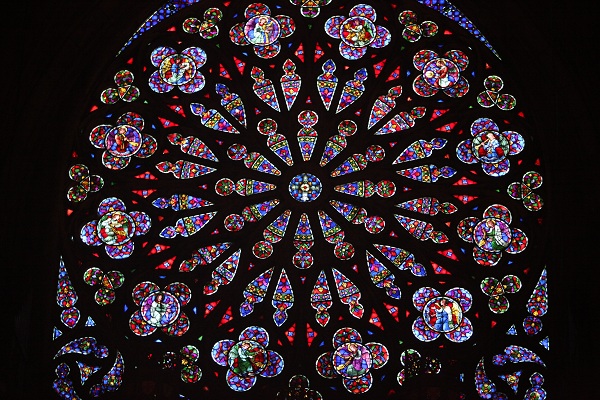
Stained Glass window from the Church of Notre Dame, 405W 114th Street, New York.
13
May
On Sunday, June 14, 2009 at 3:00 P.M., Fr. Peter Miara, Parochial Vicar at Our Lady of Mt. Carmel in the Bronx, will be celebrant of a Missa Cantata at Sacred Heart Church, 981 Castleton Avenue, Staten Island, New York for the Feast of Corpus Christi. The musical setting for the Mass shall be Missa de Angelis. In addition, traditional Catholic hymns such as O Sanctissima and Panis Angelicus, will be sung by the congregation. After Mass, a Solemn procession of the Blessed Sacrament will take place around the Church while Pange Lingua is chanted. This will be followed by Benediction of the Most Blessed Sacrament in Latin.
William J. Leininger, Chairman of the Staten Island based New York Latin Liturgy Association, stressed that Latin-English missalettes will be available to all those attending the Mass. Confession will be available prior to Mass. Gregorian chant practice will be held at 2:30 P.M.
Light refreshments will be served after Mass.
11
May
Fr. Greg Markey, pastor of St. Mary’s in Norwalk, CT, will celebrate a Mass of Thanksgiving for his 10th anniversary as a priest on Sunday, May 24 at 9:30 am according to the Extraordinary Form, at St. Mary’s. The Women’s Guild will host a reception afterwards in Msgr. Hajus Hall from 11:15 to 1:15. All are welcome. Directions to St. Mary.
27
Apr
On Friday, June 19th, 2009, Feast of the Most Sacred Heart of Jesus, Bishop Fernândo Rifan (Campos, Brazil) will celebrate a (traditional) Pontifical Solemn Mass at the Throne at the Church of St. Jean Baptiste (East 76th and Lexington Avenue) at 7 PM.
This Mass would be the first Pontifical Solemn Mass in a long time in NYC. There will also be a Conference on devotion to the Sacred Heart and a Dinner in honor of Bishop Rifan on Saturday, June 20th, 2009.
For more information about this Mass and other events related to it, please visit: http://sacredheartconfraternity.org/