Published in Masses | no comment
Published in Masses | no comment
17
Sep
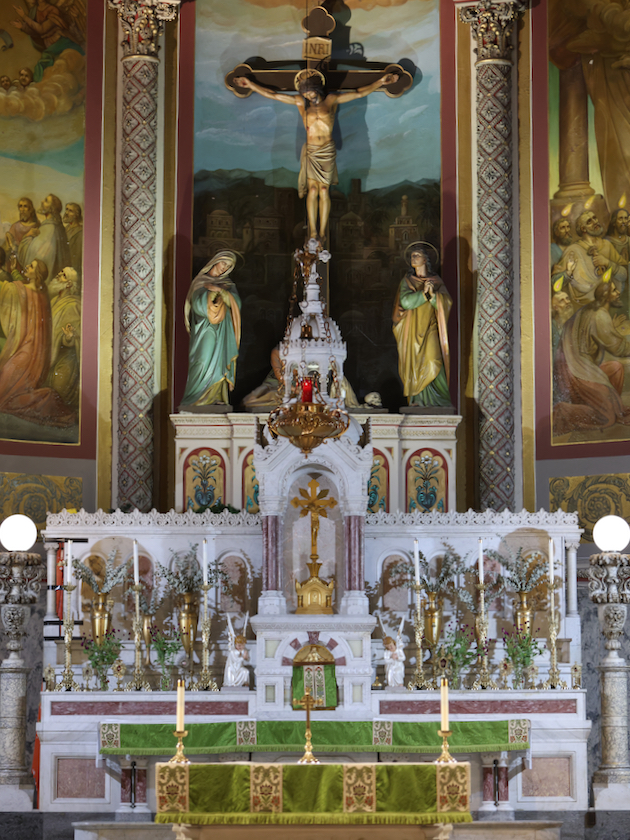
Last night a concert of the music of William Byrd took place in the splendid, resonant and historic setting of Most Holy Redeemer Church, East 3rd Street, New York. A good-sized audience heard a superb performance of Bryd’s music, both sacred and secular. The church was an ideal acoustical environment for this kind of smaller scale, somewhat melancholy music. The warmly applauded performers were Charles Weaver, Elizabeth Weaver, Terence B. Fay and Grant Herreid.
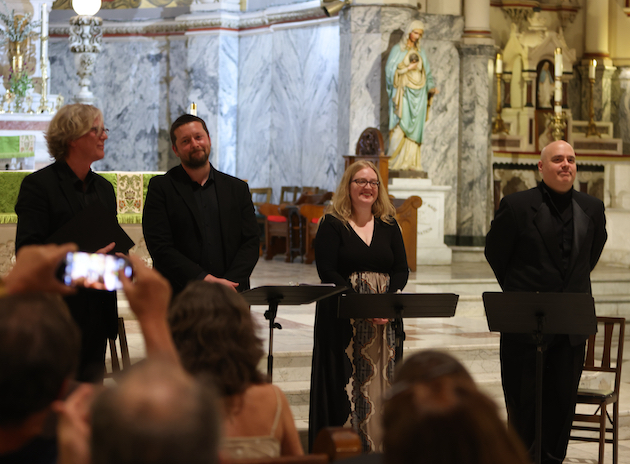
Do I need to point out that Charles Weaver is the Music Director at St. Mary’s, Norwalk, where Elizabeth Weaver and Terence Fay sing with him each Sunday at the Solemn Traditional liturgy? Throughout the evening Charles Weaver interspersed historic commentary which highlighted Byrd’s deep ties with the Catholic recusants (Byrd was one of their number). Indeed, he had a specfic connection with the manor of the Paston Family in Norfolk where some of the music heard last night would have been performed. Edward Paston was, moreover, not just a patron but an artistic collaborator of Byrd; a poem written by Paston in honor of the Catholic Queen Mary and set by Byrd was performed last night. For it is an amazing fact that in their clandestine celebration of the prohibited Mass the Catholic recusants of Elizabethen England often created magnificent music and art. As Julian Kwasniewski points out in an essay distributed last night with the program:
Although I have spoken primarily of his life as a musician, Byrd’s life as a recusant Catholic should serve as inspiration for Catholics today, who face varying degrees of persecution not only from secular governments, but from within the Church’s hierarchy itself. Figures like Byrd remind us that the creation of great art is possible even in times of adversity. 1)
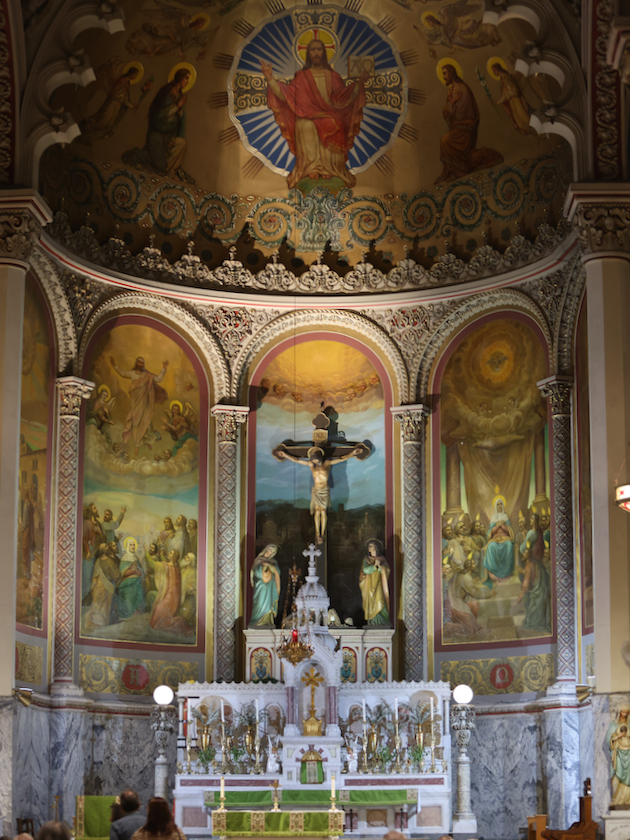
Since 2011 we at St. Hugh of Cluny have often covered events at the grand Church of Most Holy Redeemer, formerly Redemptorist, formerly German. Indeed, this Society has sponsored some of them. Today a young priest of the archdiocese leads this parish in the midst of what some might consider one of the city’s more inhospitable surroundings – half party land, half “underprivileged” neighborhood. Yet, under Fr. Sean Connolly, the church looks better than ever before and the parish is sponsoring an ambitious program of musical performances. 2)
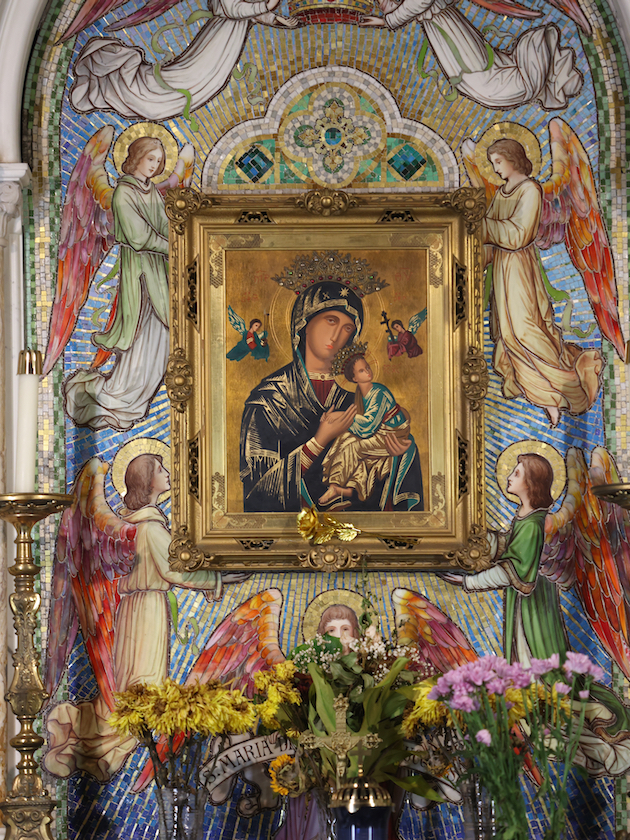
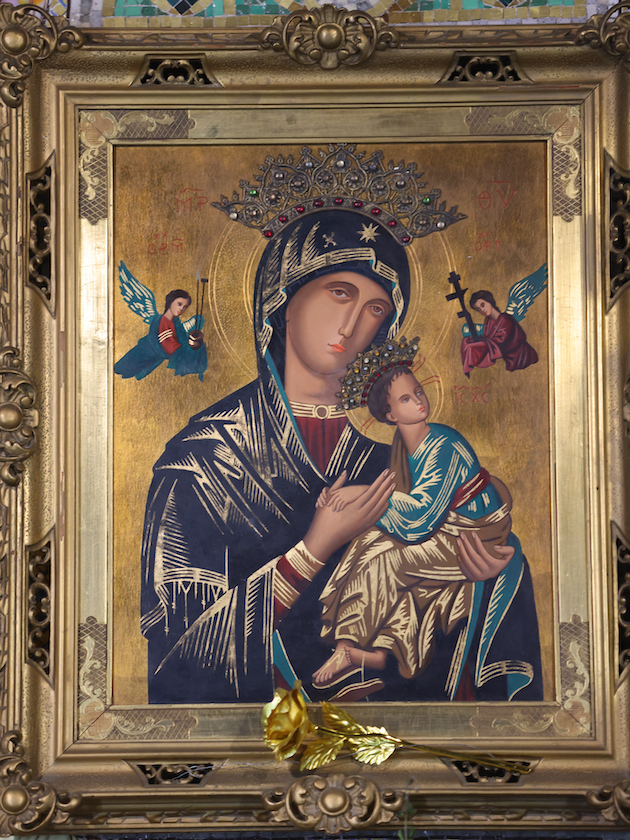
(Above and Below) Most Holy Redeemer is an endless source of insights into the Catholic devotional life of the past ( and, as is the intention of this parish’s current management, of the future as well). Since 1914 the lavishly decorated shrine of Our Lady of Perpetual Help is supposed to be the center of this devotion in New York City. 3)
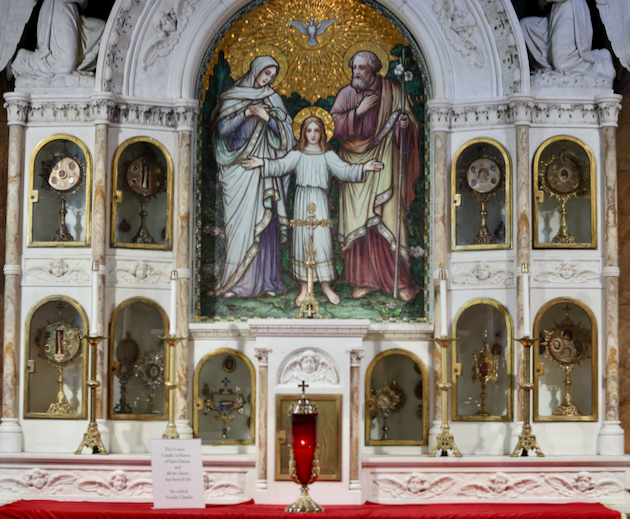
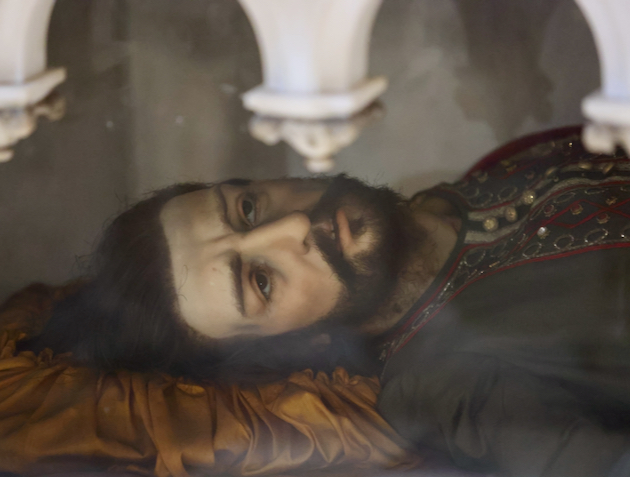
(Above and below) The chapel-shrine of the relics includes those of St. Datian, a romam Martyr, enclosed in a wax image. His relics were brought to New York in the 1890’s amid great rejoicing.
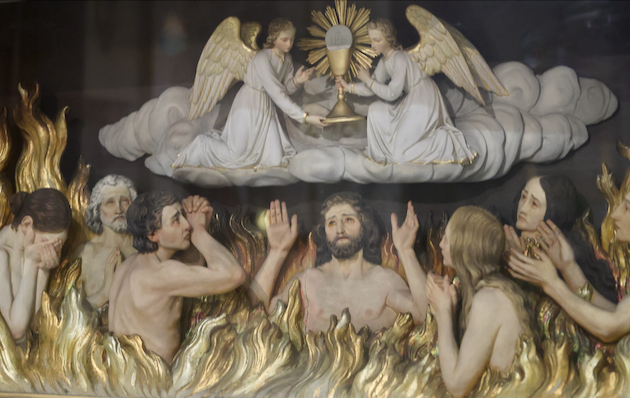
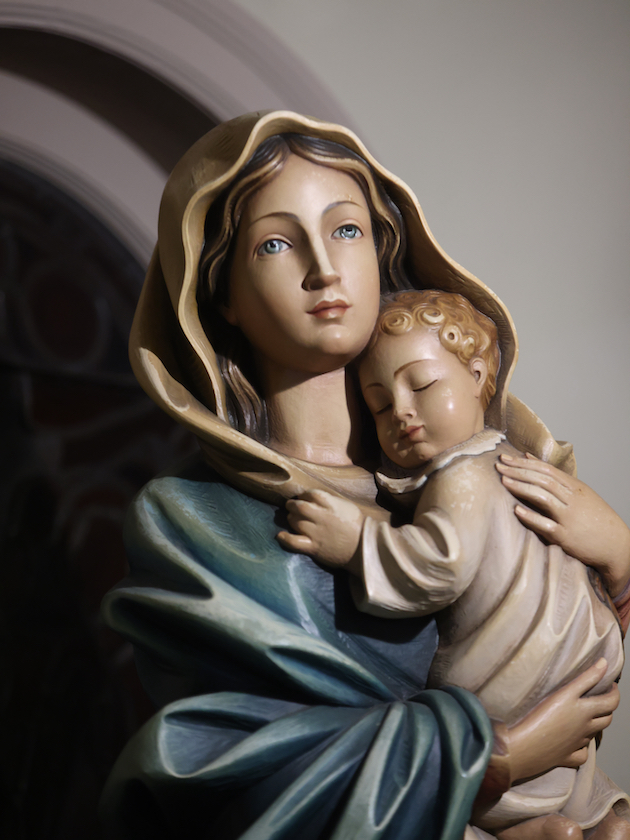
(Above) Catholic devotions of an “earlier age” – that of the poor souls in purgatory. (Below) This modern, somewhat expressionless statue used to adorn (protected by a cage) the facade of the nearby Nativity parish, victim of a recent Archdiocesan downsizing. Most Holy Redeemer parish is now “Most Holy Redeemer-Nativity.” 4)
- Kwasniewski, Julian, “Not a tame Byrd: Remembering a great recusant composer,” Catholic World Report (7/2/2023)
- See, e.g., “Solemn Mass of St. Nicholas at Most Holy Redeemer Church,” (12/6/2019); “The Churches of New York IX: Vierzehnheiligen on the East River,” (3/27/2011) both on the Society of St. Hugh of Cluny.
- “Chapel of Our Mother of Perpetual Help,” East Village Catholic (Accessed 9/17/2023)
- “The Churches of New York XII: Lady in a Cage,” Society of St. Hugh of Cluny (7/14/2011)
Published in Events, Photos, The Churches of New York | no comment
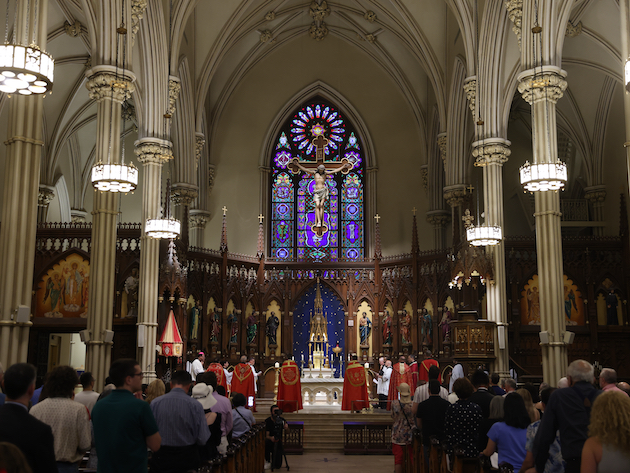
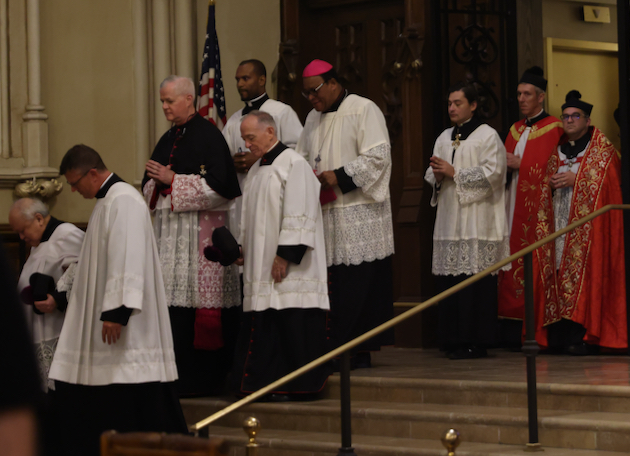
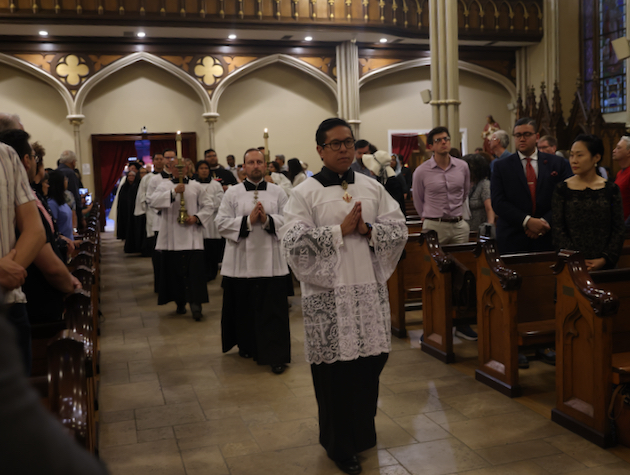
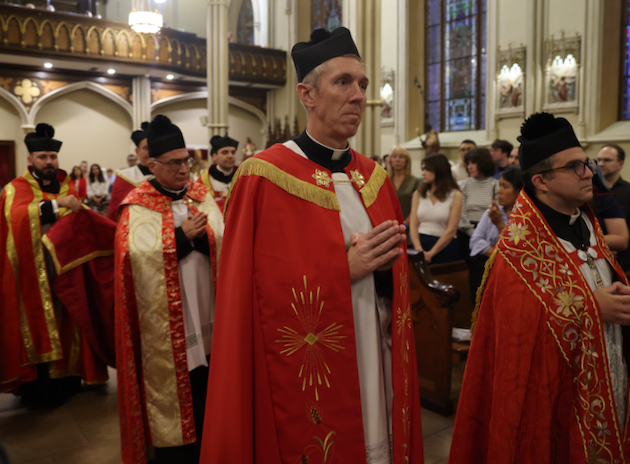
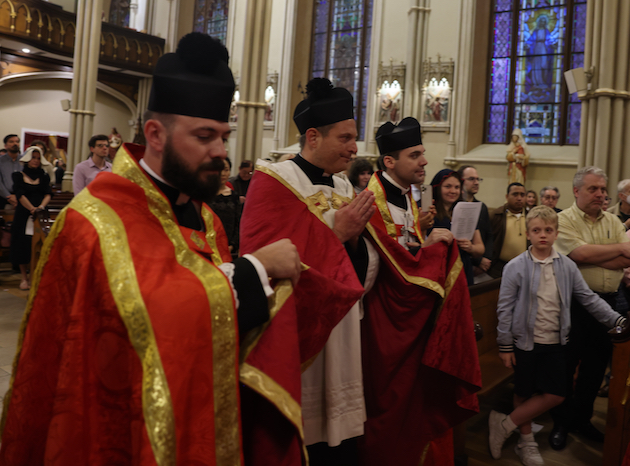
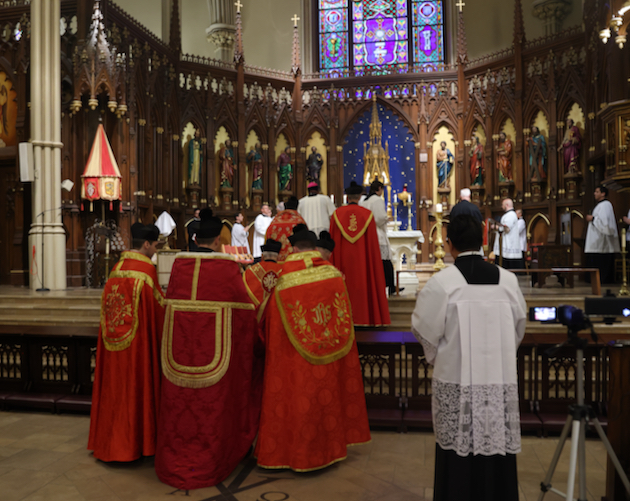
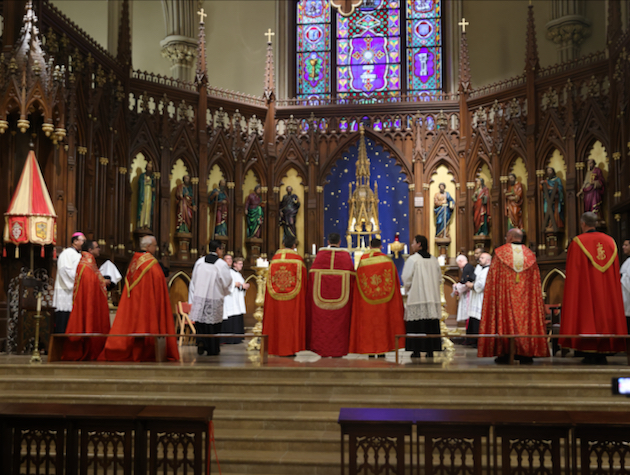
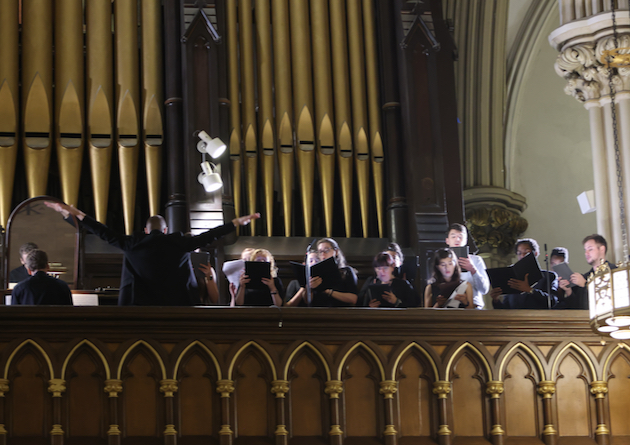
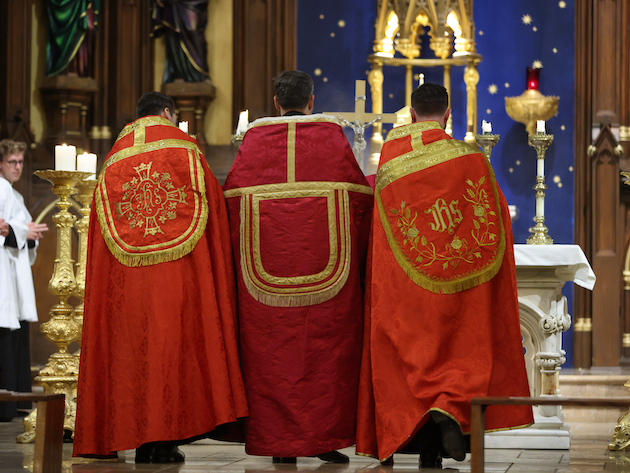
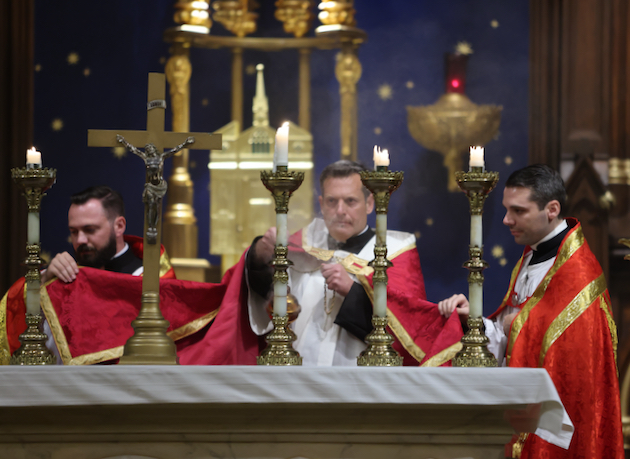
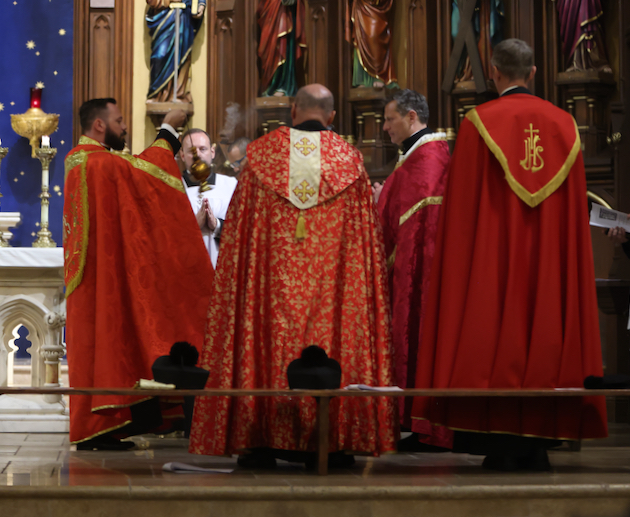
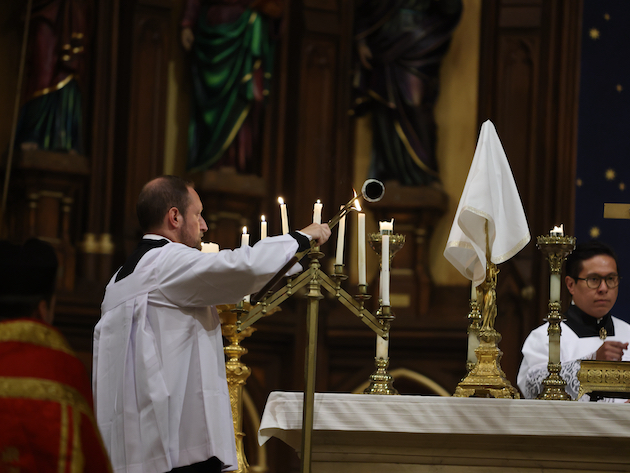
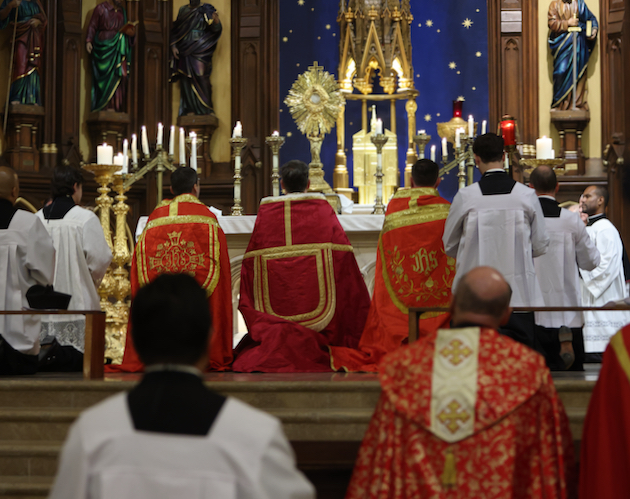
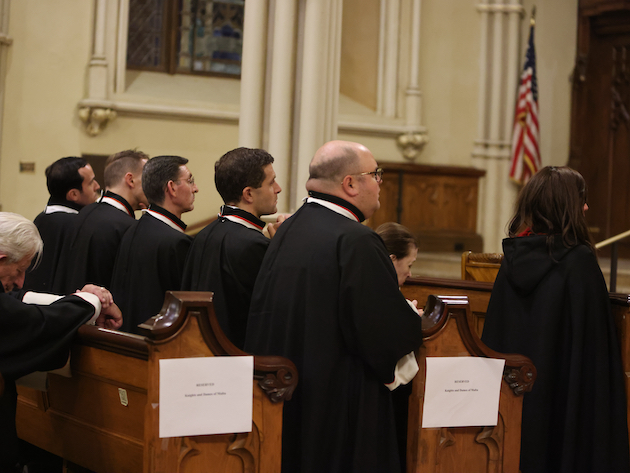
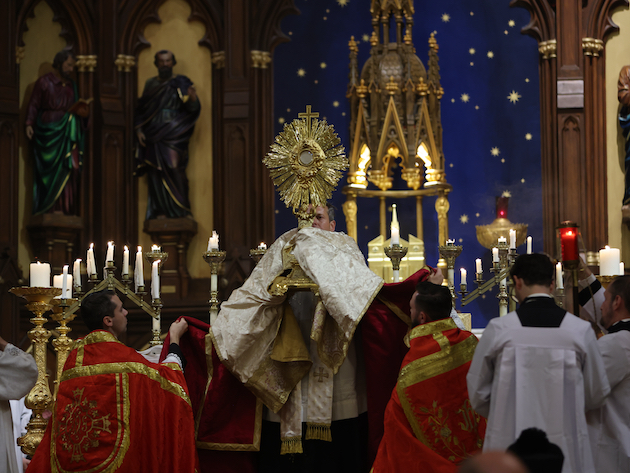
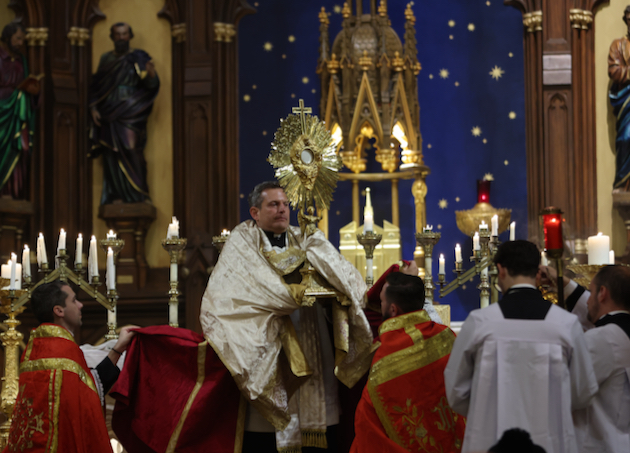
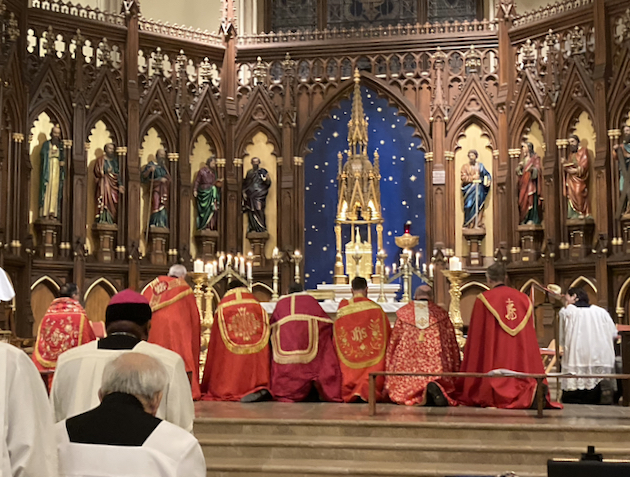
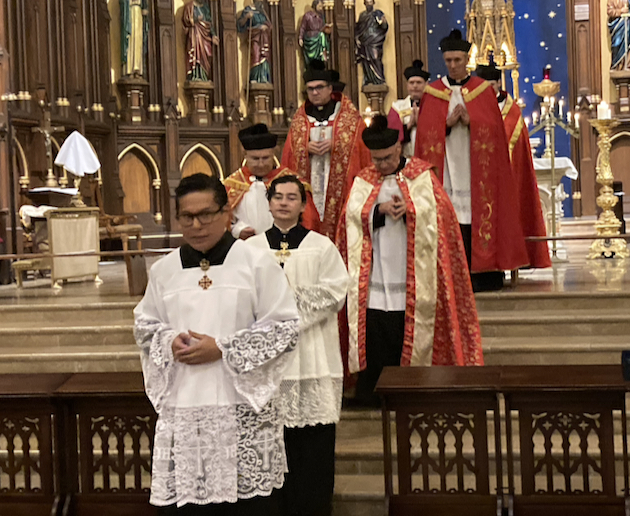
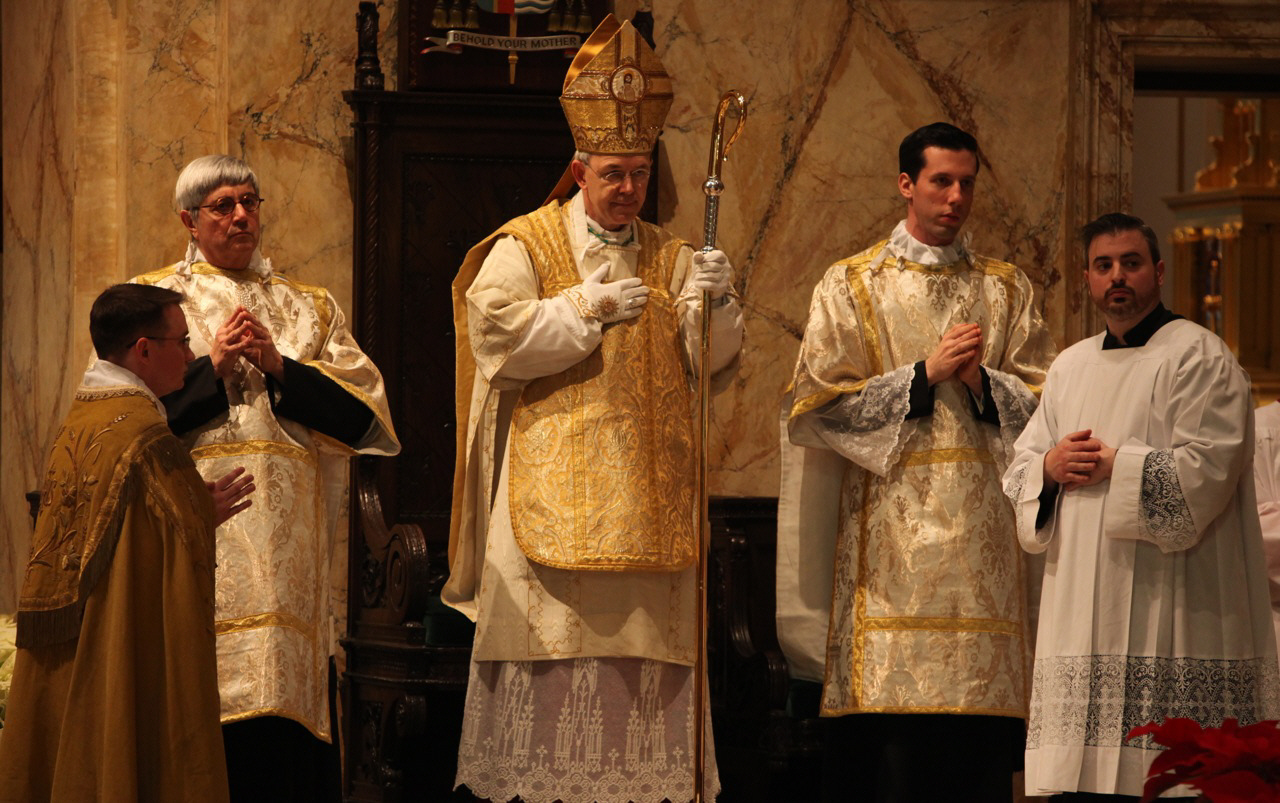
A full congregation at Old St. Patrick’s Cathedral in New York, was treated to a beautiful Solemn Vespers with Seven Copes for the Feast of the Exaltation of the Holy Cross on Thursday evening. (Nearby, the San Gennaro Festival was in full swing.) Very Reverend Enrique Salvo was the celebrant, assisted by six priests. Assisting in choir was the Most Rev. Pierre-André Dumas, Bishop of Anse-à-Veau and Miragoâne, numerous clergy and members of the Order of Malta and the Order of the Holy Sepulchre of Jerusalem. The Basilica Schola Cantorum and Chamber Orchestra, under the direction of Jared Lamenzo, performed the sumptious Solemn Vespers K 339 of Mozart and other pieces by Mozart, Bellini and Cherubini. Our Society was a sponsor of this ceremony.
Published in Events, Photos | no comment
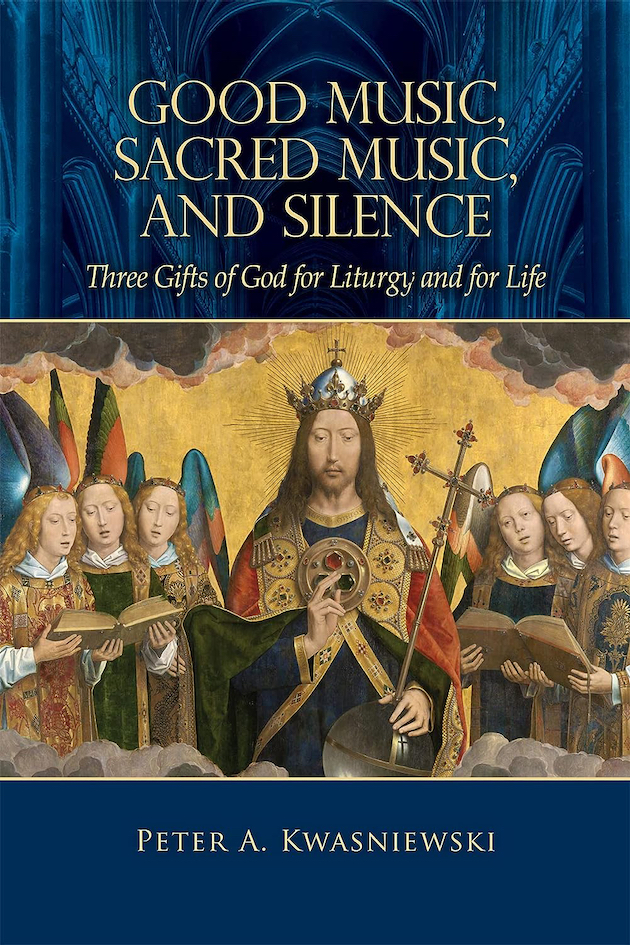
Good Music, Sacred Music, and Silence: Three Gifts of God for Liturgy and for Life
By Peter A. Kwasniewski
Foreword by Fr. John A. Perricone
TAN Books, Gastonia, NC, 2023
The indefatigable Peter Kwasniewski has given us yet another book relating to Catholic liturgy and culture. Good Music, Sacred Music, and Silence, however, differs in certain important respects from Kwasniewski’s other recent works. It deals with music and especially sacred music. It arises out of the author’s own experience as a music director and as a composer. Kwasniewski’s other books testify eloquently to his warm admiration for the traditional Roman Rite. While his love for the Latin mass is evident in this book as well, Kwasniewski reaches out here to a “broader” audience. He discusses how good music has a role to play in the home and in the Novus Ordo mass as well.
The style of this book is concrete and often colorful. Throughout the book, Kwasniewski offers specific suggestions and recommendations. Although this work at various points does address theological and theoretical issues, Good Music, Sacred Music, and Silence never loses its character as a practical handbook for recovering the role of music in the world and in the Church.
Good Music, Sacred Music, and Silence, as the title indicates, is divided into three major themes. The first, good music, discusses how to develop or rediscover good taste in music. The second, sacred music, deals with the music that is appropriate in the sacred liturgy of the Catholic Church and how to enable its performance. Finally, and to some perhaps enigmatically, Kwasniewski argues for the place of silence in the liturgy.
Kwasniewski starts with the need to break away from today’s popular music in order to develop one’s own ability to appreciate great music. The author offers concrete recommendations as to what media to use and what composers to listen to. This part of the book is particularly intriguing. For how can someone appreciate the role of music in the liturgy, for example, if he has never internalized the basic structures of western music? For, as the author states, “the prevailing western popular culture is impervious to and, at times, subversive of, the process of Christian inculturation.” I myself have often reflected on how in earlier years a child would have heard classical music or music derived from it in cartoons, film scores and pop and band concerts. Today, where this is lacking, it is much more difficult to appreciate more demanding and elaborate art forms like opera which are totally alien in the current musical context. No wonder the audience for opera in the United States continues to diminish.
Kwasniewski next turns to the role of music in the liturgy. Not unexpectedly, our author argues strongly for the preeminent role of Gregorian Chant in the liturgy of the Church. He makes ample reference to the statements of the magisterium over the years in support of Chant up to and including Vatican II. I only have this reservation, however – the entire culture of the Catholic Church is currently governed by the repudiation of all such authority- including, in this instance, that of the supposedly sacrosanct Council!
Consistent with the style of this book, the author discusses in detail what Chant exactly is in relation to other kinds of music, and how to establish the performance of chant at the parish level. He demonstrates that this is completely feasible – rebutting claims that such music is too demanding or unintelligible for parish use. Kwasniewski is a harsh critic of the “Contemporary Worship Music” that has dominated celebrations in the Novus Ordo for decades. And he gives good reasons for banishing guitars and pianos from the church.
Regardless of this book’s practical focus, Kwasniewski does not necessarily neglect theory. For example, he shows that bad music has a deleterious effect on the souls of those who hear it relentlessly. Thus, establishing a high mutual culture is not a luxury, but a necessity for the restoration of a truly Catholic spirituality. Of course, this is entirely in accord with the considerations of Plato and Aristotle regarding the effect of music on the soul of man.
Finally, we come to the role of silence. An aspect of a fine music culture is the necessity at times to be silent. For example, in the Western liturgy even in elaborate musical settings silence prevails at the most sacred moment, that of the consecration. 1) And from an early stage both in the West and in the East large portions of the liturgy – like the Western canon – began to be said silently. Indeed, recurring moments of silence in the liturgy are actually most conducive to participation by the congregation. Obviously a particular target of these reflections is the Novus Ordo liturgy which fills every moment with readings, responses, or music.
This thesis of the book, moreover, is most consistent with the recent experience of the traditionalist movement in the United States. I am perhaps not as confident as Kwasniewski that immediately before the last Council a high level of music performance could be frequently found. But clearly in much more recent times, St. Mary’s parish in Norwalk, or the Saint Gregory Society in New Haven (to name just two institutions) have achieved an extraordinary level of musical perfection. At these places which celebrate the Traditional mass, inspiring music is not a show, but an an integral part of the parish worship. Here, Chant, polyphony and more recent sacred music may be performed by professional singers, parish choirs and children’s groups – sometimes all together. The wonderful musical culture found in these fortunate locations has contributed greatly to the success of these apostolates and has radiated outwards. The value of good music is of course not only its pragmatic effectiveness. But these few examples powerfully support Peter Kwasniewski’s arguments that great music is necessary and can and should become a part of ordinary Catholic life.
- I know there have been and are exceptions…..
Published in Book Reviews | no comment
A New Jersey priest and commentator writes:
A pall hung over the gathering of the leadership of 14 religious orders of Charity Sisters in Halifax, Nova Scotia, last month. Among them were the New York Charities who, in April, decided to eventually dissolve their community and will no longer accept new members as they are on a “path to completion.”
Sister Maureen Shaughnessy, the General Superior of the separate New Jersey Charities who was at that meeting, told me: “We’ll be facing the same decision in the next 10 years.” She had served as the head of the order from 2003 to 2011 when there were about 500 sisters in the community. Yesterday, she started her second four-year term after finishing one that began in 2019. Today there are 164 N.J. Charities with the average age of 83. 1)
I have previously covered the decision of the New York Sisters of Charity to, in effect, go into liquidation. 2) The New Jersey “Charities,” as the article quoted above calls them, find themselves in a similar situation. As the joint letter of the two institutions reproduced below indicates, their latest response to the crisis seems to be exploring some kind of combined operations:
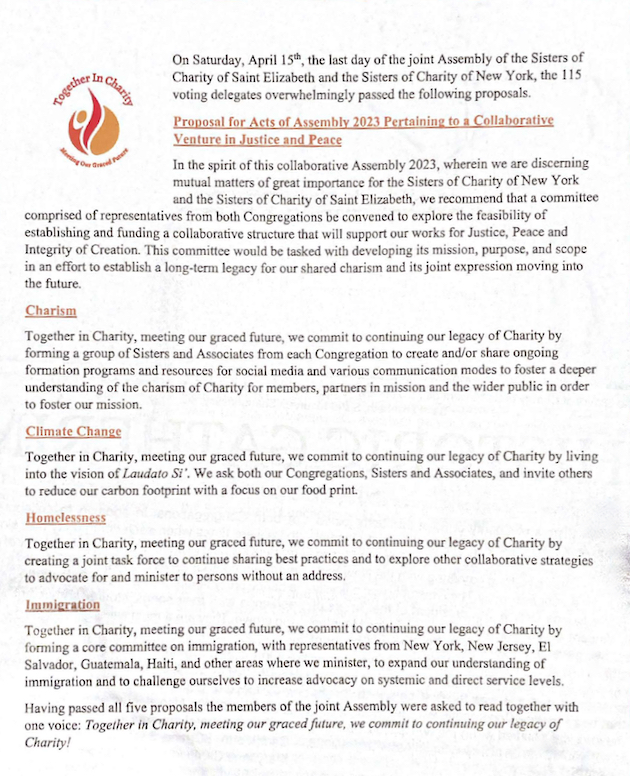
In business, a combination of two failing companies usually ends up saving neither of them. But the main problems this letter reveals are not so much faulty tactics of the moment, but fundamental weaknesses. In the joint statement, I note no reference to God or Christ. The sisters, however, do commit to “live into” Pope Francis’ “vision” in Laudato Si’. The issues the sisters identify as critical are entirely secular: climate change, homelessness and immigration. Proposed actions include reducing “our carbon footprint with a focus on our food print,” creating committees and task forces. I cannot imagine that any woman interested in religious life would be attracted to such an organization with these goals couched in this kind of language.
Indeed, in the entire Summer 2023 issue of New Dimensions (the sisters’ publication from which the above letter is taken) only a handful of clearly, specifically Catholic passages stand out. Such as where the founder of the Sisters of Charity of St. Elizabeth is quoted as stating in 1859 that “the principal end (for) which God has called and assembled the Sisters of Charity is to honor Jesus Christ, Our Lord, the source and model of all charity, by rendering him every temporal and spiritual service in their power in the persons of the poor… .” 4) Or where a half dozen young, apparently Vietnamese and African sisters from a variety of orders ( but no Sisters of Charity), while visiting the Blessed Miriam Teresa’s “crypt.” speak of their faith and their appreciation of her life and writings. Blessed Miriam Teresa Demjanovich, a Sister of Charity, died in 1927. 5)
I should add that this situation is entirely endorsed by Church authority. Neither the Vatican nor the local bishops, as far as I am aware, have decreed an apostolic visitation or even discussed reforms or sanctions regardless of the status and conduct of these declining religious institutions. Indeed, the opposite is true: in 2015 a Vatican investigation of the LCWR (to which both groups of Sisters of Charity discussed here belong), was terminated (with the direct participation of Pope Francis) with practically no action taken.
- Santora, Rev. Alexander, “What’s next for Sisters of Charity as members age”?, NJ.com( 7/2/2023). In the 1960’s there were up to 2,000 sisters.
- “On a ‘Path of Completion’: The Sisters of Charity of New York,” The Society of St. Hugh of Cluny (5/1/2023)
- New Dimensions, Summer 2023 at 4 (A publication of the Sisters of Charity of Saint Elizabeth).
- Id. at 14
- id. at 16
Published in Events | no comment
Churches of New York
Holy Roman Empire
Website Highlights
Archives
[powr-hit-counter label="2775648"]