8
Feb
3
Feb

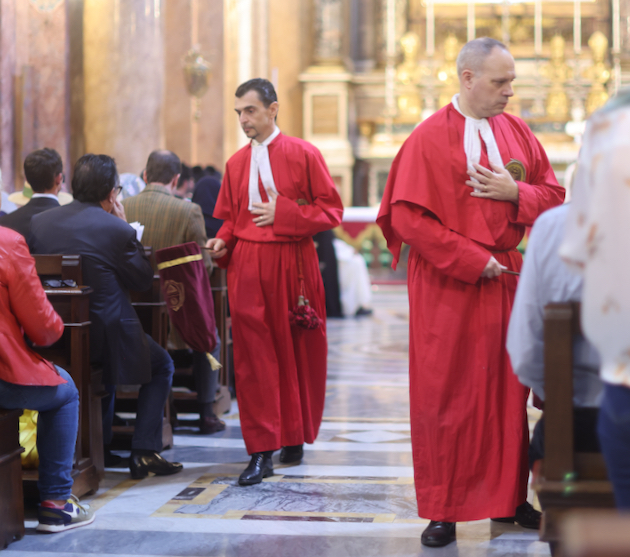
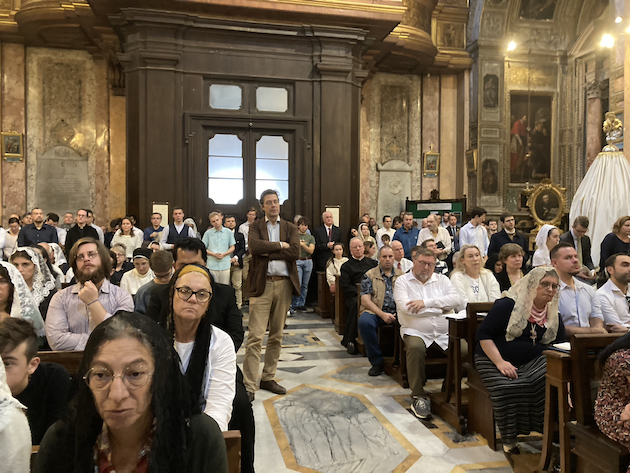
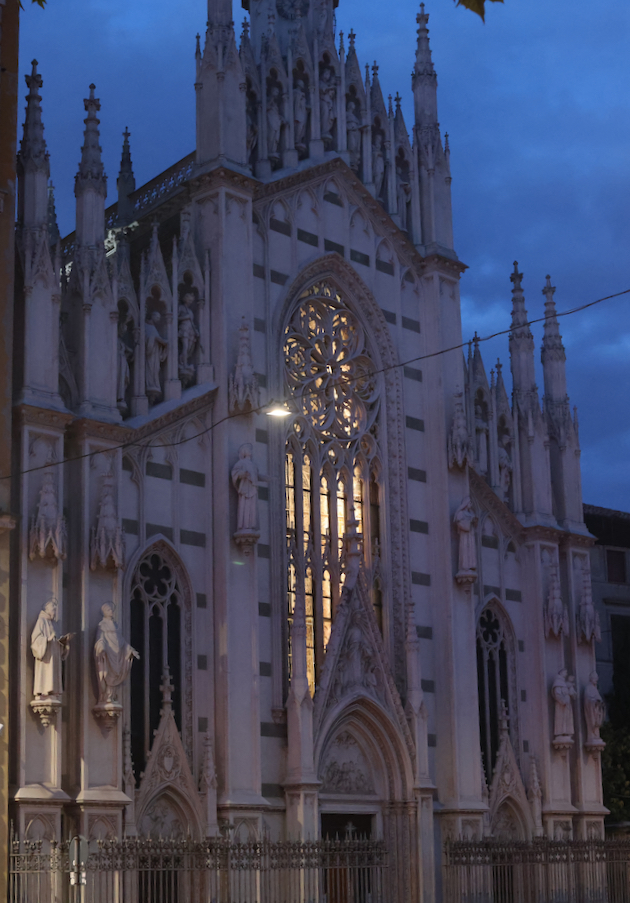
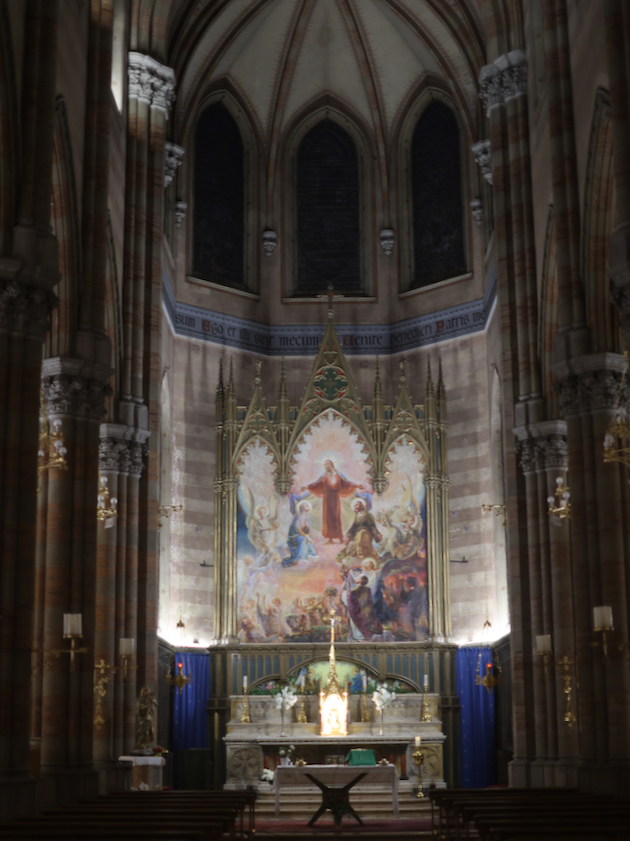
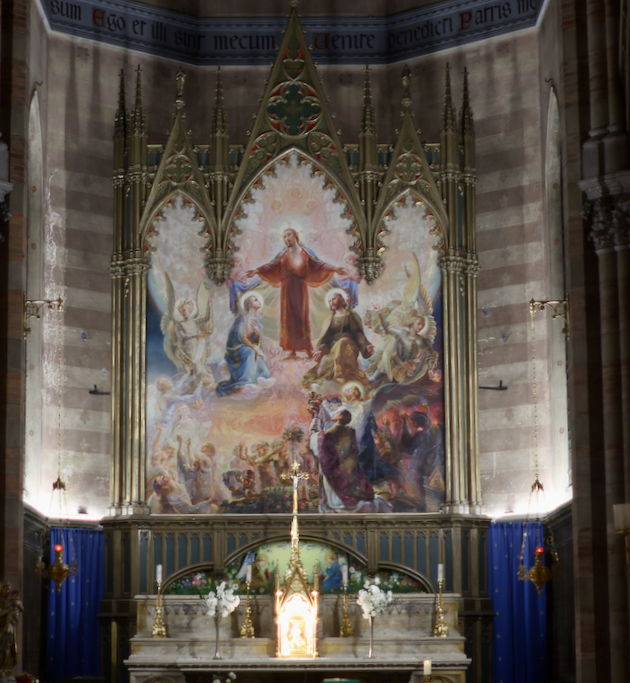
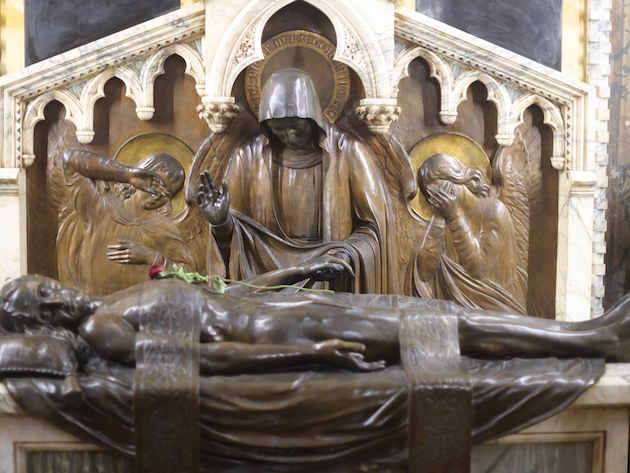
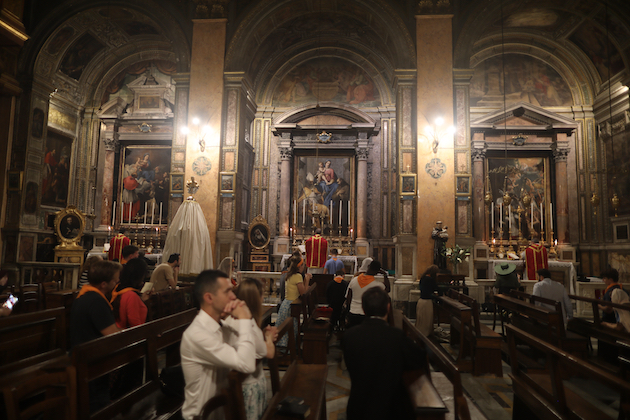
For the feast of Candlemas, February 2: mass, blessing of the candles and procession at the historic church of the Transfiguration on Mott Street.


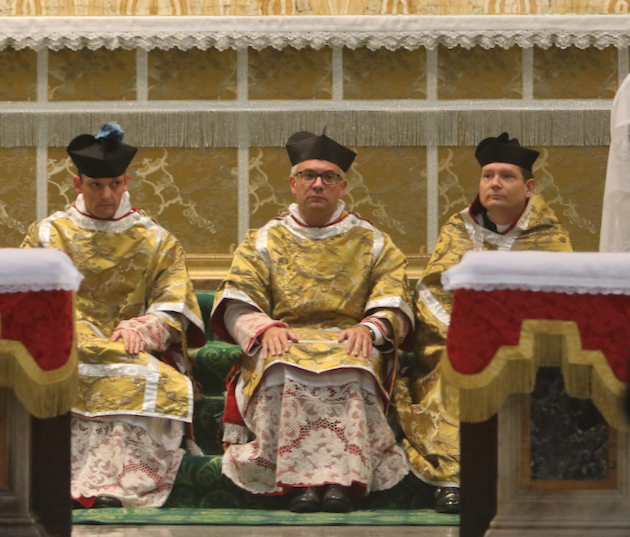
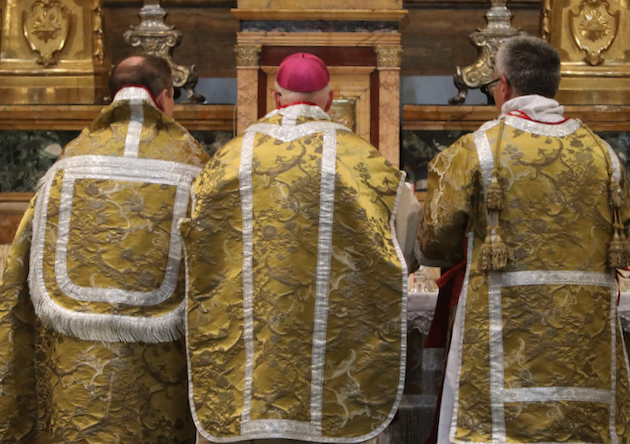
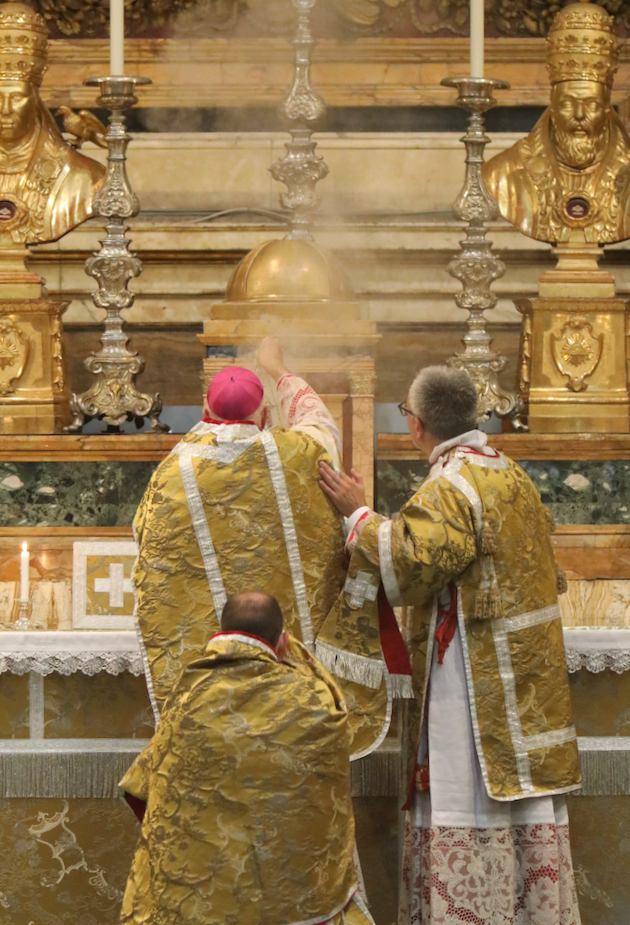
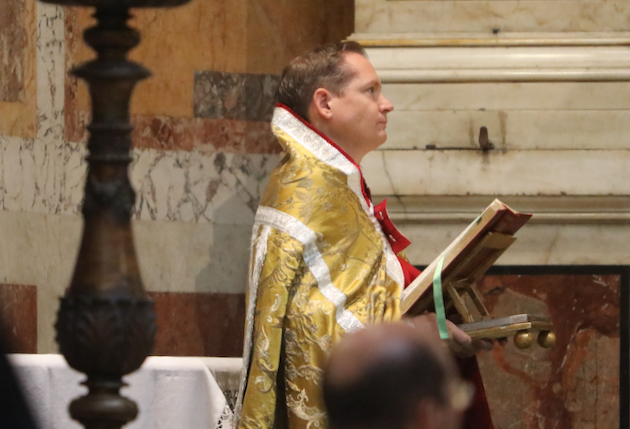
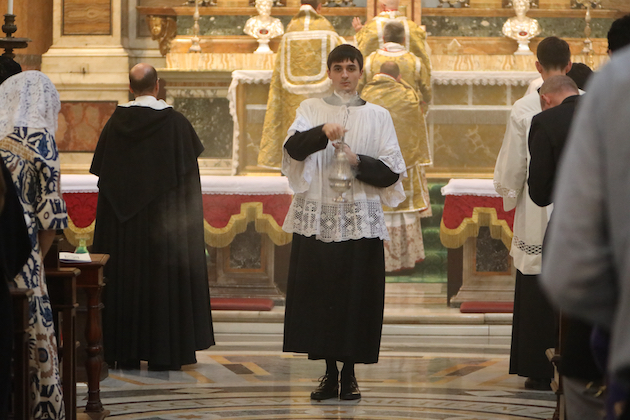
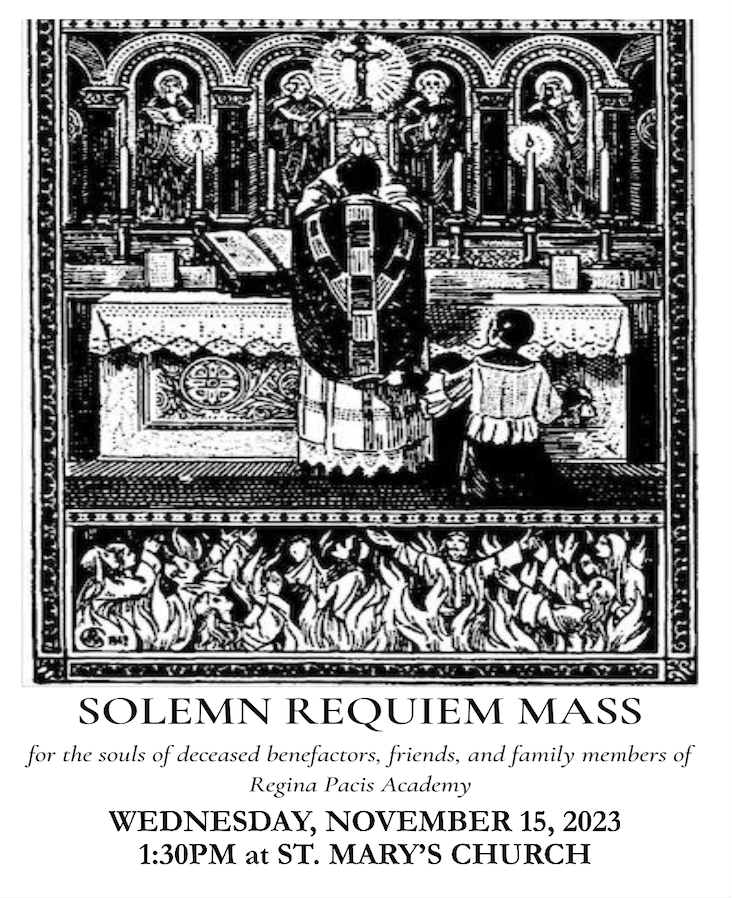
This afternoon a Solemn Mass was offered at St. Mary Church, Norwalk, CT for the Regina Pacis Academy community. The celebrant was Fr. Peter Lenox, the deacon was Fr. Michael Clark and the subdeacon, Mr. William Riccio. A host of Regina Pacis students served at the altar.


31
Jan

Peter A. Kwasniewski
The Once and Futrure Roman Rite: Returning to the Traditional Latin Liturgy after Seventy Years of Exile
2022 TAN Books, Gastonia, NC
It’s no exaggeration to say that Peter Kwasniewski is the most energetic advocate of the traditional Roman Rite in America today. We have covered his many lectures and conferences on the site since 2015; he is a familiar presence on the internet. The books he has written or edited just since 2018 have been remarkable both in quantity and quality. In addition to all this, Dr. Kwasniewski is active as a church musician. Thus, his knowledge of the liturgy, both in the West and the East, is based in large part upon his own practical experience.
The Once and Future Roman Rite is the most complete summary of Kwasniewski’s thought and advocacy on behalf of the traditional mass, for which he makes a passionate case. Dr. Kwasniewski’s tone can be intense, engaged, colloquial, even argumentative. He does not pretend to be a disinterested observer. But in this regard is St. Augustine’s City of God any different ?
The author first sets forth tradition as the governing norm in Catholicism. Tradition is not static but is, as the Newman explained, always involved in a process of organic development. Dr. Kwasniewski argues, however that the Novus Ordo can in no way be viewed as an organic development of the Roman rite. Its content has been largely changed and the basic features of the rite have been altered as well. Dr. Kwasniewski further argues that the traditional Latin mass and the divine liturgy of the East are much more closely related to each other then either of them is to the Novus Ordo. Kwasniewski profoundly disagrees with Pope Benedict’s “two forms of the Roman rite” solution of Summorum Pontificum – if that is to be understood not just as a political solution but as a statement of liturgical theory.
Kwasniewski finds support for his conclusions in a series of key addresses by Pope Paul VI between 1965 and 1969. Our author quotes them in full instead of taking selective passages to support foreordained conclusions. It is very clear from these documents that Paul VI viewed the new mass as superseding the old, that it represented a revolutionary change, and that even the earliest so-called abuses (such as universal use of the vernacular or the discarding of Gregorian chant)were intended and modeled by Paul VI himself. This completely undermines the theories of conservative Catholics and other “reform of the reform” advocates who wish to dissever the Novus Ordo as it was created and imposed in 1969 from the conciliar documents themselves or from the post-conciliar magisterium of the popes.
Dr. Kwasniewski proceeds to a definition of a liturgical rite. He finds that the Novus Ordo is in no way the same as the Roman rite because: the Roman canon is not used, mass is not offered in Latin, the liturgical texts are not recited or chanted, most of the prayers of the Latin mass have been eliminated or extensively reworked and reordered, a multi-year lectionary has been introduced, the calendar of the saints has been a severely reduced, the traditional offertory has been eliminated, mass is not said ad Orientem, the liturgy is celebrated in a sequential manner, and the communions of the priest and of the faithful are mingled. Note that this description fits the Novus Ordo as it is usually celebrated, not unusual adaptations in favor of Catholic tradition such as we find in the Oratory churches in the UK.
Indeed, for Kwasniewski the presence (or absence) of the Roman canon is decisive. A memorable chapter of this book is the author’s detailed analysis of the text of the canon and the theological meanings of each sentence. Kwasniewski argues that this ancient text inculcates a whole series of theological truths that are downplayed or even absent in the Novus Ordo, e.g., that the Church’s unity and her other perfections are gifts for which we must pray to God; that the sacrifice of the mass is offered for Catholics who hold the true faith and they are its beneficiaries; that faith and devotion are prerequisites for participating in the mass; that we are protected by the intercession of the saints; and that there is divine predestination (only not in the Calvinist sense!). And the optional version of the Roman canon found in the Novus Ordo – which is rarely used – has been altered in significant respects. Dr. Kwasniewski devotes a whole chapter to the fate of the mysterium fidei (the mystery of faith) in the Novus Ordo.
Dr. Kwasniewski believes the liturgical aberrations of today did not start with Vatican II and Paul VI but with the revision of the Holy Week ceremonies under Pius XII. For it was then, after 1948, that the great themes of the liturgical revolution first received concrete application. It was with the changes to the Triduum that the modus operandi of centralized liturgical renewal was first consolidated.
In this book, depending on the subject, Dr. Kwasniewski takes up the role of a theologian, a liturgist, a historian, or a spiritual advisor. Parallel to his main arguments, he touches on a multitude of other issues and facts. In so doing, Dr. Kwasniewski is not afraid to clear up errors and misinterpretations that have gained currency among traditionalists – even if they support their cause. This book is a gold mine of facts and arguments for the traditionalist seeking to better understand his own position and to respond to his adversaries.
The overall conclusion that Dr. Kwasniewski draws should be obvious: to adhere fully to the traditional Latin mass. In a sense, the pontificate of Francis has been liberating. The Catholic traditionalist no longer needs to feel any residual obligation to be a politician – the pope has clearly rejected that possibility. Thus, the only option remaining is to “do the right thing,” without any fear or hesitation. But wasn’t this conclusion already foreshadowed in the Heresy of Formlessness by Martin Mosebach (who has written a superb foreword to The Once and Future Roman Rite). When I reviewed Heresy almost twenty years ago what struck me was the universal application of the author’s arguments. The traditional mass was no longer merely an aesthetic pleasure, or a concession sought for by a small minority – it was a vital rule of faith than should be extended to the whole Church. So it is with Peter Kwasniewski. The traditional liturgy needs to be restored in full to the Church so that the Faith may flourish once again.
30
Jan

(Above) Interior of the Church of St Columba (2013).
On January 1, 2023, the Archdiocese announced (look under “decrees”) yet more church closings and mergers. The announcement was made in the dark of night: Catholic New York, as of late last year, of course doesn’t exist anymore. Six Manhattan parishes were affected. The decrees are effective immediately.
I do not know much about the parishes of Our Lady Queen of Martyrs and Saint Jude, North Manhattan, which are to be merged. We have, however, previously reported on three other churches which are scheduled to be sold or merged.
Merger of the parishes of Corpus Christi and Notre Dame, with Corpus Christi remaining as the main “worship center.” Notre Dame is one of the most impressive Catholic sanctuaries in New York. Up to 2011, the parish was in flourishing condition under the administration of Polish Dominicans – at which time it also functioned as the chaplaincy for Columbia University. The order was then forced out in that year by the archbishop for undisclosed reasons.
As is his prerogative, the archbishop hinted at but did not state the reasons for the friars’ departure. He mentioned money, that Notre Dame was in the red, although the books are closed and so it’s hard to guess how much of that debt the Dominicans inherited from a costly and controversial renovation project undertaken during the parish’s previous administration. (this involved adapting the sanctuary to Vatican II – SC)
And so the breakup of the Catholic intellectual community that the Polish Dominicans gave so much life to had already begun. The apostles had Jesus for three years. We had the Polish Dominicans for all of eight, and, for five of those, the Polish Dominicans in conversation with Dulles and Neuhaus. We never wanted any of them to leave. But God called them home”some to be with him and, in the case of the friars, some to their temporal home, Poland”leaving those of us left behind to mourn the loss of a Catholic culture such as we had never known and are unlikely to experience again unless we cultivate our memories of it and let them shape our effort to reconstitute it somehow. 1)
After the closing of St. Vincent de Paul parish in 2013, Notre Dame was designated as the new parish in Manhattan for French-speaking Catholics. 2) The merger decree doesn’t mention this or the status of Notre Dame as the local Lourdes shrine.


Relegation (i.e., designation for sale) of the Church of Our Lady of Guadalupe. Presumably, this is the old church of Our Lady of Guadalupe, which had been merged into St Bernard’s parish in 2003. Our Lady of Guadalupe was the first Spanish-speaking Catholic parish in Manhattan. The parish is now called Our Lady of Guadalupe at St. Bernard’s – the old church functioned, I believe, as a parish center. I cannot find any reference to this decree on the parish bulletin of Our Lady of Guadalupe/St. Bernard’s.


Relegation(i.e., designation for sale) of the Church of St Columba. This is one of the most historic, originally Irish, churches in Manhattan. As I wrote in 2013:
We have seen how St Columba parish was founded in the dramatic 1840’s and its modest church erected so rapidly thereafter. It was little more than an expanded chapel – a large hall. We can now understand why the construction of the church of St Bridget in 1848 was greeted with such enthusiasm. Next to St Columba, the church of St Bridget appears grand, spacious, airy – and built in a proper Catholic Gothic style! But the curious thing is that despite its limitations of style and size the church of St Columba was never replaced. It survives to this day as one of the earliest structures built specifically as a Catholic church.

(Above and below) St. Columba in 2013 (The former parish school is on the right)

As in the past, the Archdiocesan decrees contain “boilerplate” rejecting in advance all arguments based on aesthetic or historical significance:
Whereas, the Church is not an archeological Museum,
(citing a statement by Pope John XXIII in an entirely different context).
The process of Archdiocesan decomposition continues unabated.
2. Kwasi Gyamfi Asiedu, “French Mass unites parishioners” The Columbian, (3/19/2022)
29
Jan

Above is a full – page ad in the 1/2023 Fairfield County Catholic (the newspaper of the Bridegeport Diocese). The “Bergoglio lectures” at Sacred Heart University – a fourth-rate “Institution of higher learning” – showcasing “leaders in the Catholic intellectual tradition” – the noted thinkers Tobin, McElroy and Pierre. The last, of course, is the nuncio leading the charge in the US against the Traditional Mass. Note that the descriptions revolve entirely around the person of Bergoglio (Pope Francis).
if you glance at the top right hand corner of this ad you see a mosaic of Rupnik:

(Below) A better quality image taken directly from the online presence of the Center for Catholic Studies at Sacred Heart University. This is the logo of the Center. The photograph of the mosaic is taken from the chapel of the University, decorated by Rupnik at considerable cost.

So Sacred Heart University is reconfirming its commitment to Rupnik. The new “Bergoglio Lectures” are also consistent with other series of lectures sponsored by the Center – both upcoming and in the past. And, under Francis, all this is cum Petro et sub Petro; the union of sycophancy, heterodoxy and tolerance of sexual abusers(at least those enjoying official favor).
29
Jan

Sermon of Father Richard Cipolla
Epiphany IV, St Emery’s 2023
From the gospel according to St Matthew: Lord, save, we are perishing.
The Sundays after Epiphany in the classical Roman rite are all little epiphanies: they
are all about the manifestation of Christ, the answer to the question: “who is this
man Jesus?” Many of the post-Epiphany gospels are miracle stories, beginning with
the first miracle at the wedding feast in Cana, and today with the stilling of the
storm. “What sort of man is this,” ask the disciples, “that even winds and sea obey
him?” The answer is of course comes from faith: He is the One through who all
things were created, the Word of God in the flesh. The winds and waves recognize
him as their Lord and Master. And they obey.
But the Church Fathers understood this gospel as also referring to the Church. For
the people in that boat define the Church: Jesus and the apostles. When he got into
the boat, his disciples followed him. These men, the twelve, follow Christ into his
Body which is the Church, they who become and are the pillars, the foundation of
the Church. But they follow him not into some mythical paradise nor into an early
version of the Love Boat nor into a religious hot house peopled with exotic orchids.
They follow him into that place in which He dwells, where his presence is made
manifest, where his power and truth reside, the Church. But this place which is the
Church has a real grounding in this world, the Church militant, no pie in the sky
business here, in the world, with all that means. And what that means is that the
Church in the world has always been, is being and always will be tossed about by the
fierce storms which naturally occur in a fallen world, a fallen universe.
The storm comes up, the waves are breaking over the boat, and Jesus is sleeping.
Sound asleep. And what do the disciples shout: “Lord, save, we are perishing.” In the
Greek, Κυριε, συσον, απολλυμεθα. You notice the staccato in this prayer. If I were
teaching this to my Classics students I would point out what is known as
“asyndeton”, the lack of connectives between words, showing deep emotion. You
notice that they do not say, “save us, “ but just “save”. Their fear goes beyond
themselves. Their fear is grounded in that primal fear which is the fear of extinction,
of eternal death. That verb συσο is sued especially with regard to death and
salvation. Their cry is not to be delivered from the storm. It is much deeper than
that. Their cry is to God, to save them in the deepest sense, their cry is the cry of
homo religiosus throughout history, echoed in the Kyrie eleison of the Mass, the cry
of those who know the terrible danger surrounding them, those who know their
powerlessness in the face of the storm trying impersonally to kill them. Do we any
longer understand this fear, or have we in this therapeutic age so buried it under
pyschobabble and feel-good religion so that like those in Brave New World we go
through life stoned on the fakery of soma. And have we buried it so deeply that we
have forgotten what the purpose of the Catholic faith is, namely, salvation?
And they went and woke him, saying: “Lord, save, we are perishing!” They got it
right They were perishing. And Jesus says to them: “Why are you afraid, O men of little faith?” Is this a nice response in the situation? Is this caring, is it loving, does
it show understanding, as these terms are now used? In this time of trial, this time
of danger, this time of violence, is this not a time for soothing words, for words of
comfort, for words of assurance? Shouldn’t Jesus have whipped out his guitar and
started singing “I the Lord of sea and sky” and “be not afraid” and helped them
through the marvels of sentimentality to deny the danger they were in? Well, he did
not. He rebuked them for their lack of faith. They did not really know who he was.
They really did not believe. And who could blame them, for he did not look like the
typical Word of God through whom all things were made. And then Jesus stands up
in the boat and rebukes the wind and the waves. And there was a great calm. But
that calm was only temporary. For he who rebuked the disciples and the wind and
the waves would face the ultimate storm of the Cross. And those men in that boat
would go on to face their own storms, to understand as they were crucified upside
down or on an X cross or flayed alive, what is means to be not afraid, what it means
to trust and to know and to have faith.
But we cannot end this here, for the proclamation of the Gospel is always meant for
us in this time and place. The proclamation of the Gospel at Mass is not a history
lesson, a reading about former times, nor is it a religious reading for the edification
of the people. It is the sounding out of the Good News, and it is directed to us in this
time and place in the year of our Lord 2023, no Common Era here, for there is
nothing common about time after God becomes flesh. So we hear this gospel today
to remind of the storm that surrounds us and the real danger we face. To read most
Catholic periodicals, especially the diocesan types, we are sailing on a glassy sea,
perhaps with a few choppy areas, but it’s onward and upward and forward and full
steam ahead. What if the world is going to hell? We are safe on the Boat leading to
the Big Palace in the Sky beyond the sunset. We have the Magic; we have the
Sacraments, we have the Faith, we have the Truth. And so we are all bound for the
Promised Land.
But this gospel says to us: wake up! And this wake-up is not the disciples in the boat
telling Jesus to wake up. It is Jesus who says to us today: Wake up and look at the
real situation. There is a storm, there are high waves. There is a storm raging in the
world, a world that has adopted the culture of death that threatens not only the
extinction of humanity but also the extinction of what it means to be human. The
world has replaced the imago Dei, the image of God, with the imago sui, the image of
the autonomous, self-referential self and has unleashed a storm growing in its fury
against those who continue to believe in the intrinsic relationship between the
creature and his Creator and in the Laws of the Creator. The recent past shows a
Church in which those in charge and whose who follow are happy that Jesus is
asleep in the boat of the Church, for if he is asleep he cannot interfere with their
accommodation to the world, the world as it appears in the gospel of St John, the
world inexorably opposed to God and his Truth. We used to say that prayer for the
safety of the Church every day after Low Mass. We said similar prayers every
Sunday as one of the Collects of the Mass. That practice stopped when the Church foolishly assumed that there was no longer any danger to the Church from the world, and specifically, from the State.
Those who know Western history know of the succession of attempts of the State to
beat the Church into submission to its power. Here we mention the names of
Thomas Becket, Thomas More, the Carmelites guillotined in the French Revolution,
the many priests, religious and lay people in the terrible Spanish Civil War, those
who perished in the persecutions in Mexico in the last century, the Christians among
the millions of Jews who perished at the hands of the Nazis, the Christians who died
in the Soviet labor camps, , and those who are being killed at this very time in places
all over the world because they are Christian and are seen as a threat to the power
of the State. All these are martyrs, killed by those whose hatred for the Church was
and is fed by the lust for power and the unbridled self.
The storm, my friends, is very real. And it is as vital as it has ever been in the history
of the Church that those who lead the Church, the Pope, our bishops, our priests and
deacons, are in shape to do what has to be done: to proclaim the truth of the terrible
danger of the storm and the truth of God’s love for all in Jesus Christ which alone can
save us from destruction. But how are they going to get into spiritual shape?
Obviously, from the evidence of the current situation in Rome, not on their own
power. Archbishop Fulton Sheen said: “Who is going to save our Church? Not our
bishops, not our priests, not our religious. It is up to you, the people. You have the
minds, the eyes, the ears to save the Church. Your mission is to see that your priests
act like priests, your bishops act like bishops, and your religious act like religious”.
The times demand holiness, a laity who practice holiness in their lives and demand
it also of their bishops and priests; a laity who refuse sermons full of the pablum of
sentimental pietism and instead insist on being challenged intellectually and
spiritually by the preaching of the Word; a laity that is educated intellectually and
that can defend the Catholic faith in a reasonable and happy when called to do so in
the secularized world in which we live; a laity that demands the holiness of the
Sacred Liturgy, where there is reverence, where there is awe, where there is silence,
where the heart of the matter is Sacrifice. That is what is needed, my friends: no
more and no less.
28
Jan

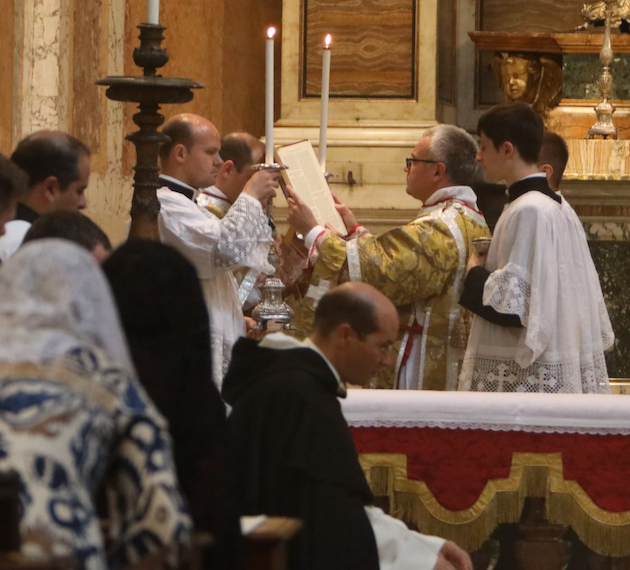
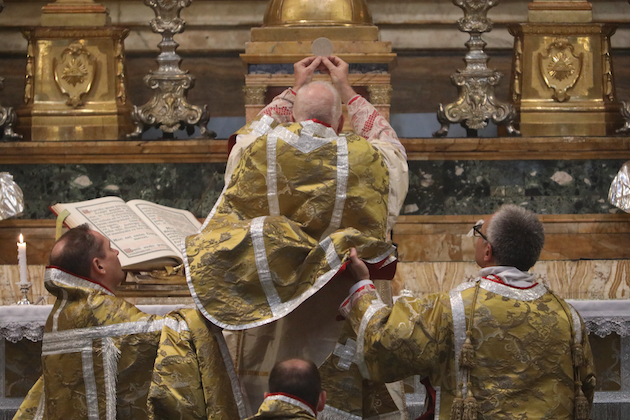
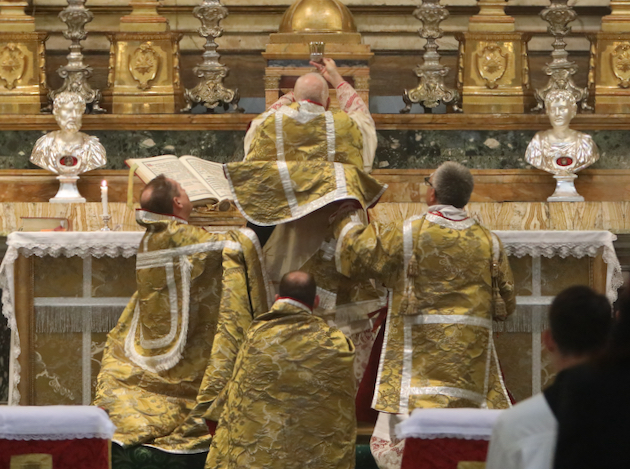
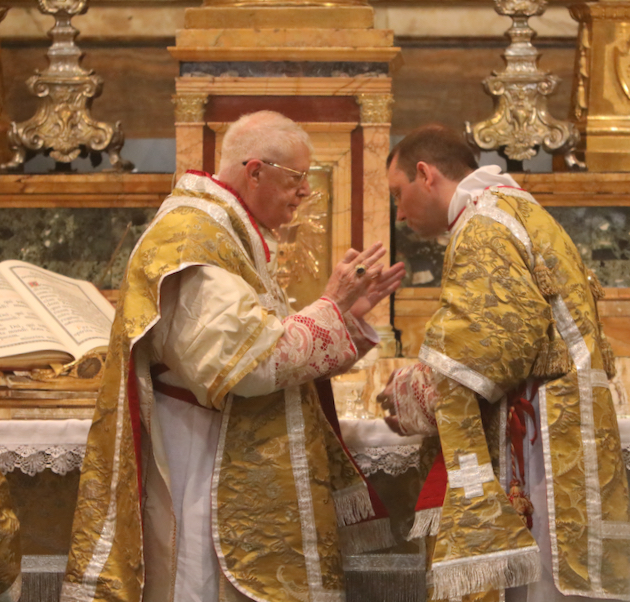
A Solemn Requiem Mass was celebrated today for the repose of the soul of Pope Benedict XVI at the Basilica of St. John the Evangelist in Stamford, CT. The celebrant was Fr. Cyprian La Pastina. The Deacon and homilist was Canon Joel Estrada, ICKSP.