30
Sep
28
Sep
Pope Benedict’s enemies have never relented. He remains for them the mortal enemy – in the past but also now. Does not his continued presence act in some way as a restraint – if not a very effective one – on Bergoglio? One apparent response of the clerical establishment was Frederic Martel’s In the Closet of the Vatican (2019), which features defamatory insinuations regarding Pope Benedict, Gänswein, Cardinal Burke and Cardinal Muller. The author seems to have enjoyed discrete Vatican cooperation in his “research” – up to a point.
In Benedict’s homeland of Germany, the situation is far worse. Earlier this year a massive study was released on clerical sexual abuse in the Archdiocese of Munich. Of course, the main focus and purpose of the study was Ratzinger’s tenure as Archbishop, and even his handling of one specific case, Fr. “H” (his real name can be found by searching English language media). Of course, Pope Benedict did himself no favors with his implausible responses, fashioned by his incompetent legal and public relations team. Probably the truth of the matter is that Ratzinger was doing the same as all his colleagues in the episcopacy. The reactions of the German media, both secular and Catholic, were hysterical, and it was even suggested that Pope Benedict might be sentenced to a life of “prayer and penitence.”
Now, a German court has initiated a procedure directing Pope Benedict, the Vatican, the Archdiocese of Munich and some others to submit written responses regarding a claim of one of the victims of Fr H. This abuse happened in the 1990’s but the victim alleges Ratzinger shares responsibility by introducing this priest into the Munich archdiocese in 1980. I do not hold myself out as an expert in German civil procedure, but several things must be emphasized immediately. First of all, this is a civil, not a criminal case. Second, the action taken was not at the initiative of the court but was a consequence of the filing by the civil claim by the alleged victim. Third, the court’s action seems to be like our practice of discovery. It is intended to ascertain if facts exist that would support the claim of the plaintiff and permit his case to go forward. Now what is interesting is that, under German law, the plaintiff apparently can pursue his case even if his substantive claim has been barred by the statute of limitations (by the passage of time). Under German law, a civil claim can be pursued simply to have a court reach a determination regarding the facts of a case even if no damages can be obtained.
The purpose of this claim is perhaps just to force the Catholic Church, and Pope Benedict himself, to respond “on the record” to the court’s inquiry. One response would be to assert the statute of limitations. But this might be embarrassing for Pope Benedict and the Catholic Church to do, because they might be seen as relying on a technicality of procedural law to avoid responsibility.
The court’s action, of course, once more aroused a storm of agitation against Pope Benedict in the German media – including those of the German Catholic Church. It is one thing for someone to bring a civil action against Pope Benedict; it is another to have the facts reviewed by a court pursuant to a kind of summons. Andrea Titz (sic!) is acting as the spokeswoman for the court having jurisdiction of this case. She is a judge and somewhat of a local celebrity in her own right, having been involved in a number of high-profile legal cases in the German state of Bavaria. These prominent forces in the media and the legal bureaucracy assure that this case will continue to generate adverse publicity and embarrassment for Pope Benedict.
Poor Pope Benedict! His enemies give him no respite. Like Cardinal Zen, he must experience even in his last years the truth that “the life of man upon earth is a warfare.” (Job 7:1)
On the entire legal situation, see this article (in German) in CORRECTIV.
On the nature of the court’s recent action (in the German Wikipedia): Feststellungsklage
On Andrea Titz: German Wikipedia
28
Sep
Sermon for the Feast of Saint Wenceslaus Sacred Heart, Georgetown, CT, 2022
Today is a national holiday in the Czech Republic in honor of their patron saint, St
Wenceslaus, whose feast we celebrate at this Mass here in Georgetown CT. St
Wenceslaus was born in Bohemia in 903 and died on September 28, 929. Most of
us know nothing about this time in middle Europe. The great saints Cyril and
Methodius were the missionaries to this part of Europe in which paganism
persisted. Wenceslaus’ grandfather became a Christian in this missionary effort
and Ludmilla his grandmother, of deep faith, became Wenceslaus’ teacher, not
only in matters of faith but also of culture, teaching him both Old Slavonic and
Latin.
Wenceslaus’ mother, Dragomir, supported pagan belief and tried to gain control of
the kingdom. She had Ludmilla strangled and civil war broke out. It was the
young Wenceslaus who emerged as the leader of Bohemia, and it became his task
to bring together the warring factions, to deal with the powerful rulers surrounding
him, and to bring to fruition the missionary effort of SS Cyril and Methodius by
leading by example as a Christian leader. His honesty, his realism in dealing with
those in power, and very importantly his attempt to reduce the oppression of the
peasants by the nobility: all this grounded in his Christian faith.
For religious and national motives, Wenceslaus was murdered by his twin brother,
Boleslaus on the feast of SS Cosmas and Damian as Wenceslaus was on his way to
Mass. Wenceslaus’ last words were: “May God forgive you, brother”. He was
hailed as a martyr and by his death did what he was unable to do while he was
living: he made Bohemia Christian.
We look in vain today for a leader whose Christian faith lies at the very heart of
what he says and does in the political sphere. We certainly cannot find such a man
or woman in Europe at this time when Europe is undergoing a rapid de-
Christianization. We cannot find such a person in our own country where
dechristianization is happening but where there seems to be still a sizable part of
the populace that calls itself Christian. And why we cannot find a Wenceslaus in
the United States is because of the American character that insists that religion is a
purely private matter and should have no bearing on one’s actions in the secular
sphere.
St. Wenceslaus is the symbol of what a truly Christian ruler looks like, whose
public actions come from his Christian faith. We all know the Christmas Carol
“Good King St Wenceslaus”, the words of which were written by John Mason
Neale, the great Anglo-Catholic priest in England in the second half of the 19 th
century. The carol is about what it means to be a good king. When seeing a poor
peasant struggling to carry wood in the cold of winter, he acts to help the peasant.
His page warns him that it is too cold, too dark, but the King tells him to follow in
his footsteps to help the peasant and the night will seem less dark and the cold less
cold. The carol ends with these words: “Therefore, Christian men, be sure, wealth
or rank possessing, ye who now will bless the poor, shall yourselves find blessing”.
We will honor St. Wenceslaus at our gathering after Mass by singing his carol
before our time of fellowship: a fitting thing to do after celebrating this Mass in
his honor.
26
Sep

(Above and below) Cardinal Zen during his visit to New York (February 15, 2020)
Please pray for Cardinal Zen, on trial now in Hong Kong. He was our guest in New York just 2 1/2 years ago.

26
Sep

Our annual pilgrimage to Auriesville, New York – this year, unavoidably, in advance of the official “Pilgrimage for the Restoration.” The weather was glorious, but very few visitors or pilgrims were about. Often, however, the grounds of the shrine are most impressive, the experience most spritual, when visited in silence. The shrine in the best condition I have seen in years – the current management is a vast improvement over the Jesuits.


26
Sep

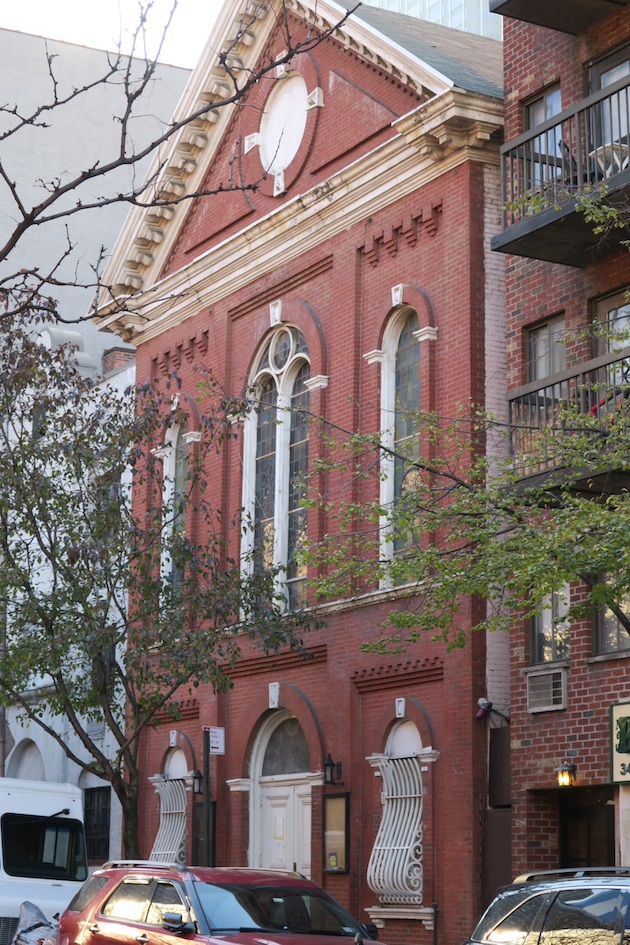
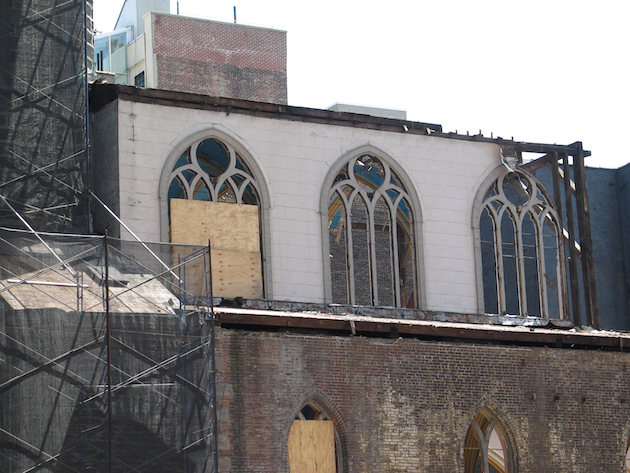
Formerly the Church of St. Thomas the Apostle, The Harlem Parish is now an entertaiment venue. Currently it’s the location for a flamenco show:
This passionate, traditional Spanish flamenco performance is heading to NYC this month starting Friday, September 9th, and it was just released that the show will take place at The Harlem Parish, located at 258 West 118th Street.
Over 100 years old, the Harlem Parish was built in 1897 and is one of the most grand spaces in NYC. It has hosted a number of events with well-known brands including Spotify, SoulCycle, and BET, and all events hosted at the Harlem Parish are catered by Harlem-based restaurants with 10% of all proceeds donated to Harlem-based organizations.
For more on the building see:
The Harlem Parish (with many more photos of the interior)
26
Sep
Andrea Picciotti-Bayer has just published a piece in the Wall Street Journal announcing the new Institute for Human Ecology (IHE) at Catholic University. She is a lawyer and the new institute’s director of strategy. The institute’s initial foray into major media was aggressive and confrontational: “Counterfeit Catholicism, Left and Right,” The Wall Street Journal, 9/23/2022.
Picciotti-Bayer adopts a pose beloved over the decades by the Catholic hierarchy, the Catholic administrative establishment and conservative Catholics in general: they declare themselves the golden mean between extremes of the left and right. On the one hand “prominent Catholic politicians” like Biden and Pelosi have “unequivocally abandoned the church is teaching on the dignity of human life.” On the right “a group of Catholic hardliners in the Academy and media have written off American institutions as hopelessly compromised.” She is referring to the integralists. According to Picciotti-Bayer, neither “offering” is distinctly Catholic. She asks: what are so-called “ordinary Catholics” to do? We need, she says, a framework for faith in public life that rejects both “secularism and sectarianism.”
This all sounds like a revival the First Things/ National Review/ Richard Neuhaus school of conservative Catholicism going back to the 1970s. More specifically it is a subgenre of conservative Catholicism which proposes to “solve the problems” of the world in politics, economics and culture by utilizing Catholic principles. This brand of “apologetics,” of course, dates back to well before Vatican II – one thinks of distributism. Of interest is the IHE linking to a publication The Lamp which (at least initially) was also an advocate of a conservative, centrist Catholicism.
How can we even begin to respond to all this? My basic observation is that Picciotti-Bayer’s enterprise is founded on ignoring reality. The two “extremes” within which the IHE seeks to locate itself are in no way equal. First, the adversaries on the left have controlling positions in government, the economy, the academy, the media and all other secular institutions in the United States. The enemy on the right is just a handful of intellectuals. Second, these same progressive tendencies also dominate the Catholic institutions. For have not Pope Francis and the Cardinal Archbishop of Washington gone out of their way to demonstrate their friendship with the aforementioned Pelosi and Biden? The integralists enjoy no such positions of power in the Church. The author refers favorably to Archbishop Gomez of Los Angeles, but hasn’t he been given – repeatedly – the cold shoulder by Pope Francis? Third, as a matter of principle I would not equate advocating or even imposing a regime of abortion – and all the other associated anti-Christian social policies of the West today – with the integralists’ visions of papal supremacy that exist only in some alternative universe.
There is talk in this article of “non-negotiable” positions. These seem to be not the Catholic faith as such, but the statements of Dignitatis Humanae on human freedom and various political objectives like strengthening the family. The author criticizes integralists for contending that contemporary American culture is actively corrosive to Catholic teaching, practice and virtue but is that not exactly what she herself says (quoting Archbishop Gomez) about “progressive ideologies” that are “profoundly atheistic”? And is not their (and her) assertion obviously correct? I have major differences of my own with the integralists’ proposed course of action, but not so much with their factual starting point. And I don’t think such issues of principle can be resolved by making dogmatic assertions about the values of American society. The adversarial relationship between Christianity and current American culture been not been eliminated by great victories within the existing system such the repeal of Roe v. Wade. I believe that event had a rather cool reception in the governing American establishment and in some quarters of the Church (such as the Vatican) as well.
The author writes that we must:
[R}efamiliarize ourselves with the works and voices that have helped form our nation. That includes such deep thinkers as Augustine and Aquinas. But it also includes profound Catholic witnesses who worked in healthcare…social services… and education...”
Now it is very helpful to be aware of such influences and contributions, but I think it would be a stretch to claim that the Catholic thinkers and “voices” the author lists “helped form our nation.” For in fact, for better or for worse, the United States was formed by other forces which although they may have had a remote Catholic ancestry, were, in the best case, merely indifferent to the Church.
Continuing these reflections, we note that the author does not cite the current pronouncements and actions of the Church, except for Dignitatis Humanae and Archbishop Gomez. There is a good reason for that: the actual practice of the Catholic Church in the last several decades has been an unending series of scandals, abuse of power, dishonesty, administrative incompetence, institutional decline and even outright criminality. All these ills have of course reached a high point under Pope Francis whose regime actively contradicts Picciotti-Bayer’s “non-negotiable” principles. The author, for example, mentions subsidiarity yet Francis has been the greatest violator of that principle. The author quotes approvingly “the Second Vatican Council’s mighty declaration on religious liberty,” that “man is obliged to follow his conscience in order that he may come to God.” Yet Pope Francis has launched a worldwide persecution of traditional Catholics (with very concrete consequences in the immediate vicinity of Catholic University).
Thus, the current state of the “really existing’ (as they say in German) Catholic Church in no way is a “role model” for secular society. Indeed, repeated interventions of the secular media and government (however corrupt they may be) have been necessary to straighten out the affairs of the Catholic Church – not the other way around. Any project to educate Catholics in America about their role in public life must start from this reality and acknowledge that, in both theory and practice, the institutional Church – and the majority of the remaining Catholic faithful as well – do not agree with the IHE’s principles.
On a more profound level, I see the IHE sharing with both the integralists and the progressives – both so forecefully criticized by Picciotti-Bayer – the same fundamental defect. All are primarily advocating courses of political and legal action, seeking to arrange the affairs of the world in the manner that appears best to them. But seems to me what the Catholic Church (and of the United States) needs is the rediscovery of the faith by the Catholic clergy and faithful. Once the faith is reborn, a political role and influence of the Church will naturally arise, because the Catholic faith is incarnational and social and necessarily has a political dimension. That rebirth comes about not through political action, but through prayer, reawakened spirituality, and above all the liturgy. And the first steps of such a spiritual renewal must be the purification of the Church, not secular society. You cannot advocate Catholic social policy to the world if there is no Catholic faith. Otherwise, I fear the IHE will become just one more establishment academic forum for conferences, colloquia and addresses, at peace with the World and the Church establishment but remote from the life of the faithful or of society.
23
Sep
In 2020, we reviewed the initial issue of The Lamp. At the time we applauded the editors’ intentions but felt that the result fell far short of their ambitions. There was too much verbiage about topics like gabbing with Jesuits over wine spritzers in Vienna and too little attention paid to the actual crises racking the Church. I am happy to say that based on some recent articles that can be found online, The Lamp is now beginning to honestly confront the concrete and emotional crises of our day. These are today, first and foremost, the outrageous actions of Pope Francis and his allies in the hierarchy, culminating in the persecution of traditional Catholics throughout the world.
The transformation of this magazine has not been total, of course. Father Ambrose Dobroszi does attempt to address the hot issue of the scope of papal authority but falls into the ultramontane rhetoric of several of the contributors to the first issue – and even gives it radical new expression:
Yet nonetheless, even the mistakes of the pope must be carried out…This is an uncomfortable truth, but it is clearly correct when we examine history…
We even see that papal mistakes do not necessarily detract from the holiness of the pope. I think all of us would rather the Church have taken a harsh punitive strategy earlier on in the abuse crisis, but Saint John Paul II’s decision to distrust accusations against clerics—an error in judgment—is not necessarily a sin. His evident holiness did not guarantee that he made all of the right decisions, nor did his mistakes—or even sins—prevent his canonization. Our Lord willed to construct the Church in such a way that this successor of Saint Peter could grievously misjudge cases of abuse, have the authority to definitively establish a strategy of dealing with abuse cases that has proved disastrous, all while being one of the most apparent and clear examples of sainthood in our times. The pope has the authority to be tragically wrong, whether he is holy or not, and the Church on earth must obey.
In other words, a pope may be a saint regardless of what he does, and the Church must obey him regardless of what he commands. Preposterous formulations like this will not raise the image of Catholicism among outsiders or fallen-away Catholics.
Several other contributions, however, confront directly the tragic and terrible losses caused by Traditionis Custodes and the subsequent banning of the traditional mass in various Catholic dioceses – especially Washington DC. Christopher McCaffrey writes of his parish of St. Francis de Sales and its history. Harry Scherer describes the final Latin Mass at St. Anthony of Padua:
What the archdiocese effectively said to the people of Saint Anthony was Your work is not wanted here… The Sunday traditional Latin mass at Saint Anthony’s was unique because it was primarily driven and coordinated by students at the Catholic University of America down the street…
Yes, the congregants were aware that the Mass was in some sense historic, an occasion they will recall to their grandchildren at a Sunday brunch after a Solemn High Mass decades from now. The sounds from the choir loft were majestic, the smell of incense intoxicating, and the fellowship of friends in worship re-assuring. But the moment was rooted in something deeper than the continuing history of the traditionalist movement, such as it is: the worship of Almighty God through the unbloody sacrifice of Calvary offered in a form of worship handed down to them by their ancestors. That the old women, solitary men and women, zealous students, and bright-eyed couples will no longer gather at Saint Anthony’s is a sorry shame. That the priest’s mellifluous voice will not pronounce the hallowed formulas of this ancient liturgy is cause for grief indeed. Those who came together for the “Final Latin Mass” did not come by their sorrows cheaply—they’re paying for their emotion. Until the next Votive Mass of Thanksgiving to the Most Holy Trinity is offered at Saint Anthony’s, they can rest assured that their rejection of decadent cynicism was their way of keeping to the narrow path.
Most impressively of all, Matthew Walther, the editor of The Lamp, raises explicitly an issue in the mind of so many: Why Benedict Should Speak. To the extent there is still some nimbus of papal status remining about him, it would seem incumbent upon him, regardless of his debility, to take some action, to say something. For Walther points out that Pope Francis and his minions are characterizing Summorum Pontificum in a way that directly contradicts Benedict’s own careful teaching on the subject – in other words, they are lying.
Which is why, with further restrictions upon the traditional Mass rumored for Ash Wednesday, I repeat my central contention that Benedict must speak about his intentions, and that he must do so unequivocally, without regard for the consequences of doing so. Such a clarification from him might not be enough to prevent the enemies of the old Mass from carrying out their plans. And it would certainly not have any obvious juridical force, even if it would expose the central premise of the other side as a preposterous fiction. But it would also be a moment of sublime clarity, and the last desperate fulfillment of that continuing paternal responsibility to which he has alluded.
In this way, The Lamp, perhaps compelled by circimstances, is now squarely facing the tragic and concrete situation of the Church today. Do I even need to mention the other storms raging in and outside of the Church such as the synodal path developments? There is so much to deal with – and so much of it is dismaying! It isn’t as pleasant as writing about a conservative Catholic fantasyland. But it has the merit of being real and true. And after all, it is out of such confrontations that good writing emerges.
21
Sep
I first encountered Daniel J. Mahoney when I reviewed his 2018 book The Idol of Our Age. There he expressed guarded criticism of Pope Francis but still felt the need to “balance” his negative comments. In an article written for National Review two years later Mahoney was far more direct in his characterization of Francis. Today Mahoney is speaking out loud. After cataloguing with prophetic urgency the Vatican’s misdeeds in theory and practice, he concludes:
Today, papalotry is not an option for faithful Catholics. To fundamentally “change the Church,” as Francis surely intends, is to undermine her authority and her very raison d’être. The Catholic faith is not the religion of humanity, and the Holy Spirit is not an agent of the Historical Process, no matter what some Catholic progressives think. As with the Arian crisis of the fourth century, when most bishops succumbed to heresy, the task of Catholics is to defend the truth unalloyed. We owe the papal office filial respect. But no pope is an oriental potentate. His “private judgment” cannot take precedence over the moral law, the apostolic inheritance, and the unchanging teachings of the Church. Today, alas, unthinking papalotry reinforces theological and moral subversion. Self-deception of this kind only lead to the abyss. At this critical moment, Catholics have an obligation to see things clearly.
Mahoney, Daniel J., The Church over the Abyss. (Americanmind.org 9/20/2022)
Now Daniel Mahoney has done significant scholarly work on the legacy of Aleksandr Solzhenitsyn for whom he professes great admiration. Pope Francis and Solzhenitsyn – these are mutually exclusive personalities:
“either he will hate the one, and love the other; or else he will hold to the one, and despise the other.”
Curious – I had just reacquainted myself with how another thinker, Thomas Molnar, had in 1980 been inspired by Solzhenitsyn (as opposed to any of the representatives of the official Catholic Church) in formulating his thoughts on the relationship of Church and State. Rod Dreher too has moved from the self-satisfied, quietist Benedict Option (2018) to a Solzhenitsyn-inspired assault on the current apocalyptic state of the West as exemplified by Live not by Lies: a Manual for Christian Dissidents (2020). That transformation includes increasingly savage attacks on Pope Francis – for whom, by the way, Dreher had initially expressed admiration. For Dreher’s current views see, for example, “Pope Francis, McCarrick and Maciel” (The American Conservative, 5/29/2022). The prophetic voice of the great Russian writer lives on!
20
Sep
This past Saturday, Sept. 17, between 250 and 300 Catholics prayerfully marched five miles from the Cathedral of St. Thomas More in Arlington, VA, to the Cathedral of St. Matthew the Apostle in Washington D.C. as part of the first-ever National Summorum Pontificum Pilgrimage for the Restoration of the Traditional Latin Mass. This march was organized in little over a month in response to the harsh restrictions to the Traditional Mass enacted in the the Dioceses of Washington and Arlington. The march was filled with young couples and families, parishioners of local parishioners as well as pilgrims who had come down from the New York area and from other states. Noah Peters, march organizer, gave a stirring speech on the steps of St. Matthew Cathedral. Excerpts of his speech and scenes from the march can be viewed on this video. See also our photos of the march below.