2
Jan
2
Jan
Sermon for the Feast of the Holy Name of Jesus 2022
by Father Richard Gennaro Cipolla
Some years ago a novel was published to great acclaim despite the difficulty of its thought and despite its taking place in a medieval monastery. The novel is The Name of the Rose by Umberto Eco. Its most famous line is the last line in the novel: Stat rosa pristina nomine, nomina nuda tenemus. The translation of this line is somewhat difficult, but it means something like this: “Yesterday’s rose stands only in name, we hold only empty names”. What this means is that there is no real connection between the name, the word we use, and what we are trying to refer to by that name. Names are in the end empty words. This is a terrible and false understanding of reality itself, and, tragically, is an understanding of reality that is all too common in our culture.
When we think of proper names, names of people, we associate that name with specific people we know. And we do not think in terms of that particular name having any significance beyond the particular person who bears that name. My parents debated what to name me at my birth. My father wanted to name me Gennaro in homage to my grandfather, Gennaro. My mother strongly resisted this on the grounds that I should have a “normal” American name so that I would fit in more with the American culture. My mother won that battle, and I was named Richard. There was no particular reason why she chose Richard. She just liked it.
Today’s feast of the Holy Name of Jesus has nothing to do with naming as an aesthetic or family choice. The name of the Child born in a stable in Bethlehem was named by God through a message of an angel to the Child’s mother nine months before his birth. Mary’s Fiat at the Annunciation embraced not only her willingness to do the Will of God in this most amazing and perplexing way. Her Fiat also embraced who this Child would be. The name of the Child and his very being were bound together in the reality of the Child’s very being—who He was and was to be as a child born into this world.
The name, “Jesus”, is the English equivalent of the Latin “Jesu”, which came from the Greek “Iēsous” a transliteration of the Hebrew “Yeshua”, an ancient Jewish name which means “Yahweh saves” or “is salvation”. We see in this the significance of the bestowal of the name Jesus on the Child born in Bethlehem. His name and who He is are inseparable. St. Paul writes in his Epistle to the Philippians: “that at the name of Jesus every knee should bow, of those in heaven, and of those on earth, and of those under the earth, and that every tongue should confess that Jesus Christ is Lord, to the glory of God the Father.” And ever since then the very name of Jesus has been understood and practiced as a form of prayer, so that the very sounding of his Holy Name invokes not only the power of God but most importantly the love of God for each of us and for all of mankind. So many saints have understood the power of the Holy Name of Jesus. Those that immediately come to mind are St. Bernard of Clairvaux, St. Bernadine of Siena, and St. Ignatius of Loyola.
We are still in Christmastide. Let us use this time to deepen our understanding of that Person who lies at the heart of our faith whose name is Jesus. In a few days we will celebrate the great feast of the Epiphany. The three Magi did not know the Child’s name whom they had traveled so long to see. But they knew who He was by the light of a star, and they knew that they were in the presence of the source of that Light, and in faith they prostrated themselves before the Child, because they knew by a miracle of faith that He came as the Savior of the world: He who saves—Jesus.
I close with an English translation of St Bernard of Clairvaux’s hymn, Jesu dulcis memoria, a most fitting meditation for the beginning of the year of our Lord Jesus, 2022.
Jesu, the very thought of Thee
With sweetness fills the breast;
But sweeter far Thy face to see,
And in Thy presence rest.
Nor voice can sing, nor heart can frame,
Nor can the mem’ry find
A sweeter sound than Thy blest name.
O Savior of mankind!
O hope of every contrite heart,
O joy of all the meek,
To those who fall how kind Thou art!
How good to those who seek.
All those who find Thee find a bliss
Nor tongue nor pen can show;
The love of Jesus, what it is,
None but His loved ones know.
Jesus, our only joy be Thou,
As Thou our prize will be:
Jesus, be Thou our glory now,
And through eternity.
Father Richard Gennaro Cipolla, Ph.D., D.Phil.(Oxon)
2
Jan

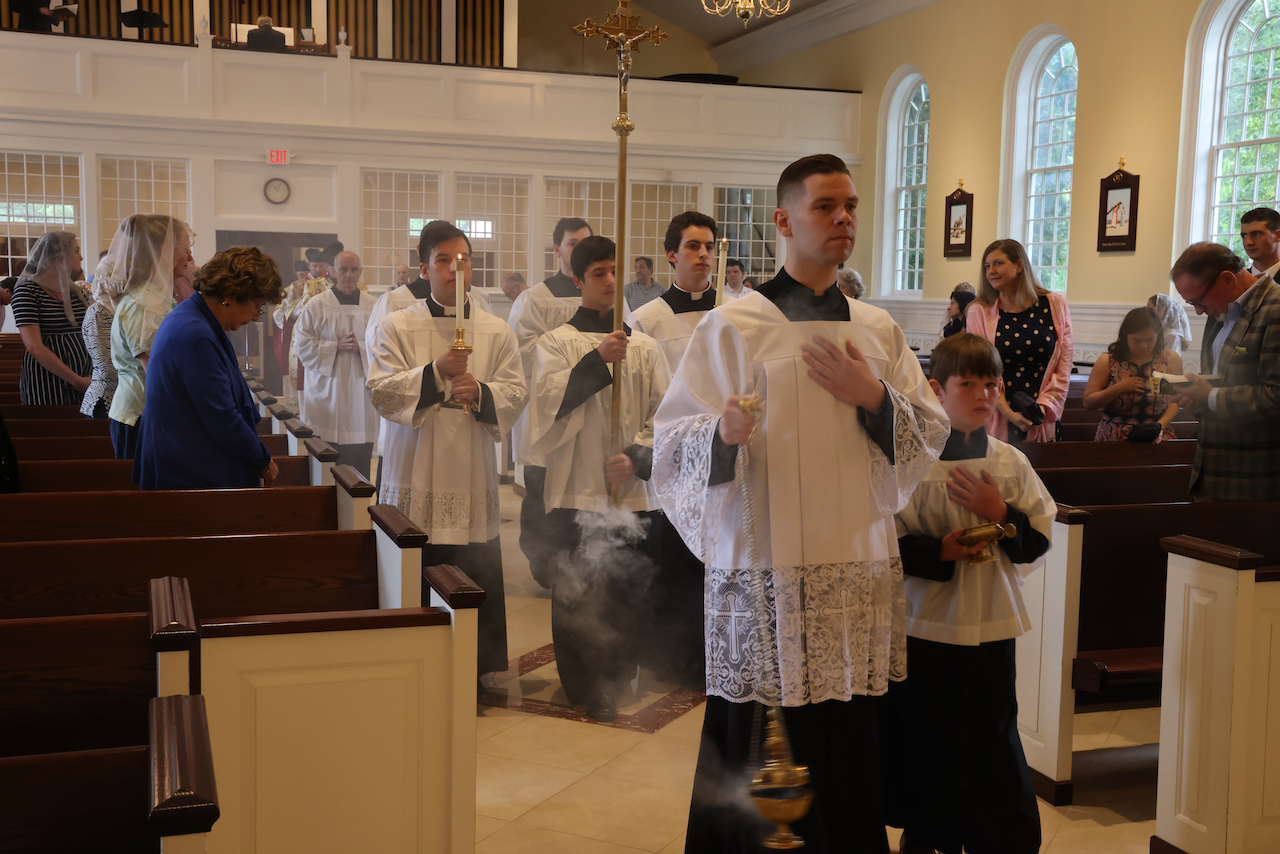
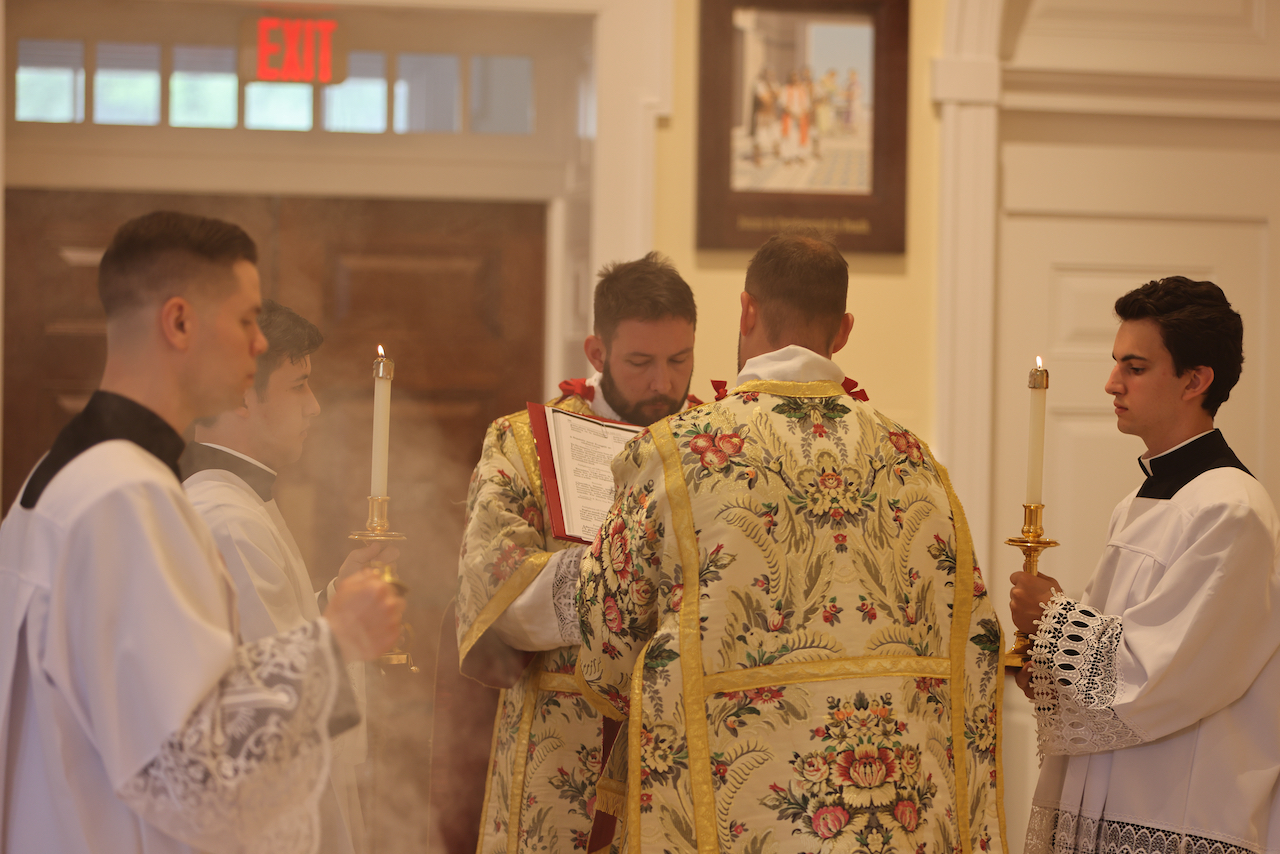
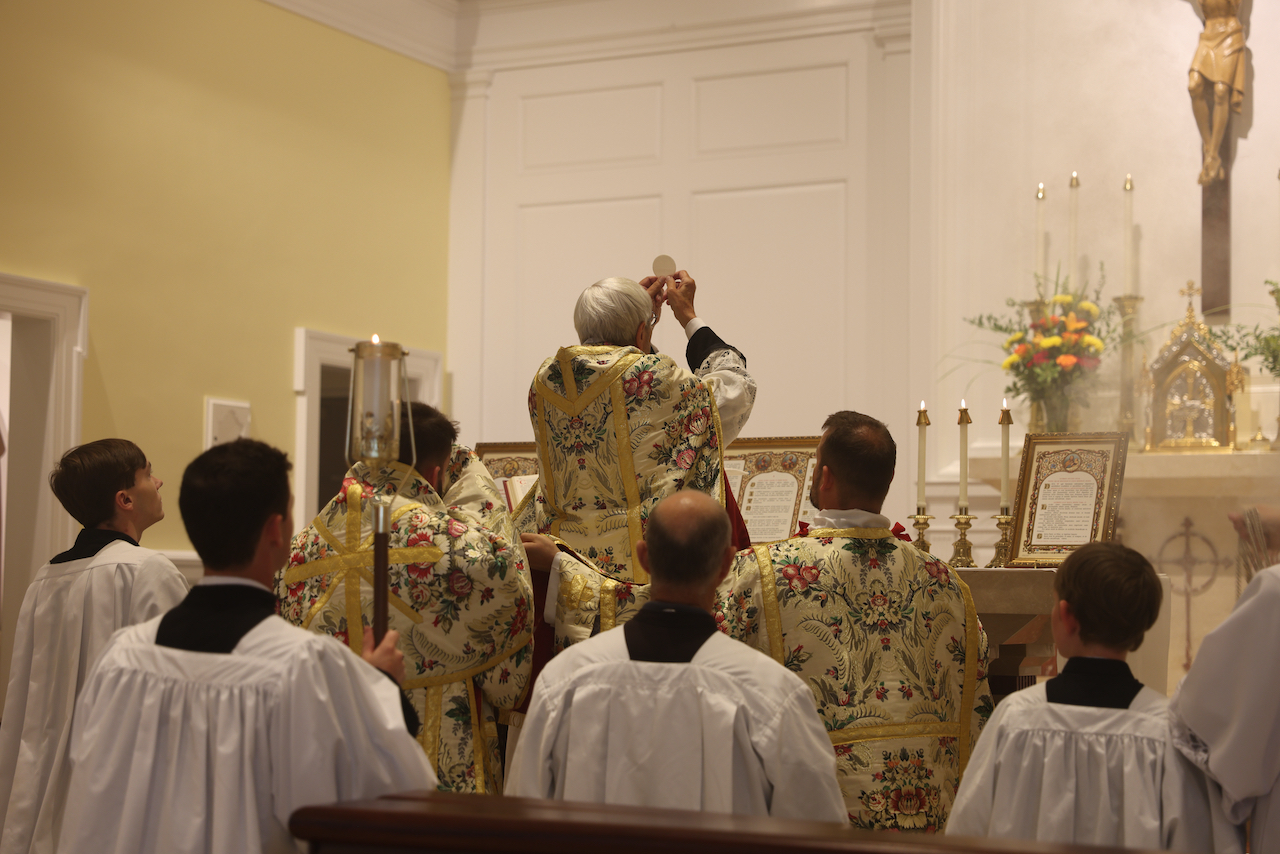
St. Mary’s Church, Nowalk, held its annual festive Christmas Coffee Hour after the 10 am traditional Mass today, including Christmas caroling.


“Please join us tomorrow, January 2nd, at 5:30 P.M. for our inaugural installment of ORGAN AT THE ORATORY. On the first Sunday of each month, a guest organist will offer a recital prior to Vespers. The first recitalist will be David Hughes, Organist & Choirmaster at St. Patrick’s Oratory. He will play a program of festive Christmas music by the great Johann Sebastian Bach; Bach’s mentor Dietrich Buxtehude, who was for many years the organist in Lübeck; and some colorful versets by the notable French classical composer Nicolas de Grigny. Vespers will be followed immediately at 6:00 P.M. by sung Vespers & Benediction for the Feast of the Most Holy Name of Jesus. The recital and Vespers are of course free and open to the public. Please invite your family and friends; this is a wonderful way to introduce them to the Church’s rich liturgical and musical patrimony, which we are so grateful has a home at St. Patrick’s.”
During the papacy of Pius IX the theory and, to a great extent, the practice of the modern ultramontane regime were perfected. This system did secure internal unity and stability, leading the Church through one of the most pivotal periods of world and European history. Yet the lead-up to the Second Vatican Council, the course of the Council itself and the implementation of its decisions revealed all too clearly the deficiencies of ultramontanism. The extreme centralized structures and absence of any real exchange of ideas in the Roman Catholic Church privileged the influence of “experts,” cliques and behind-the-scenes intrigue. At the pope’s command, the bishops, clergy and laity, unable to think for themselves, accepted blindly the destruction or relativization of that which they had only yesterday held sacred and immutable.
But the “Conciliar Church” itself bore the hallmarks of the ultramontane past that it affected to despise – provincialism, authoritarianism, pervasive bureaucracy and remoteness from the life of men and women today. The hundreds of pages of Conciliar decrees and the literary productions of the Conciliar champions (Rahner, Ratzinger, Kung, Schillebeeckx, etc.) made, outside of the clerical bureaucracy, little impression in the Church –- and none on the world outside it. Indeed, far from being an avenue for establishing new communication with the world and the laity, Vatican II – its interpretation and defense – became just one more burden on the Church establishment.
Within the Church itself, however, all the institutions so carefully built up since the 1830’s – the schools, seminaries, monasteries, religious congregations, hospitals, universities – experienced a more or less universal existential crisis. Entire national churches (e.g., the Netherlands, Quebec) collapsed virtually overnight, while most others in the developed world commenced a continuous decline of religious practice. Conflict within the ecclesiastical establishment itself broke into the open, as the Vatican and the Church’s dominant intellectual leadership fell out on a broad spectrum of issues.
It became increasingly apparent that the positions of the progressives were irreconcilable with Catholic doctrine and morality, at least as previously understood. The post-Conciliar popes up to Francis, however, could not face the consequences of either adopting the progressive agenda or condemning it. The result was a deadlock between the progressive institutions and the Vatican which lasted for the next 45 years. In the actual practice of ruling the Church the ultramontane papacy more and more assumed a merely administrative role. 1)
In the midst of the post-Conciliar conflicts over the faith, Catholic traditionalism was born. The new Conciliar model was manifestly not working; a return to – or preservation of – the past recommended itself. Contrary to what Pope Francis asserts, the attitudes of the traditionalists to the authority of the Council varied greatly – as did their understanding regarding ultramontanism. Clearly the establishment of the FSSPX and their consecration of bishops in 1988 were utterly contrary to the ultramontane system. By placing Catholic doctrine and tradition above obedience to authority, Archbishop Lefebvre in effect challenged ultramontanism’s foundational assumptions. I am not sure, however, that the FSSPX (and later the FSSP) fully grasped what was happening. I get the sense they adhered to a paradigm that all was perfect in the Church prior to Vatican II – that the Church’s afflictions were attributable to infiltrators and dissenters. And, after achieving reconciliation with the Vatican, the FSSP certainly labored to project an image of alignment with an authoritarian and infallible papacy.
To the traditionalists could be added the “conservatives” – which the progressive establishment hardly distinguishes from the traditionalists. From the late 1960’s onward they espoused a radical ultramontanism, understanding the progressives primarily as “dissenters” from authority. For the conservatives, just like their 19th century predecessors, the papacy is a defender of Christian morality in the secular world, and the omnipotent guardian of doctrinal purity within the church. This was often juxtaposed to the feebleness of the national hierarchies, which the conservatives usually viewed as ineffectual bureaucrats. Yet in fact, the papacy itself, not just the bishops of the local churches, was usually reluctant to be directly drawn into conflict with either the liberal forces in the Church or the governing powers of the Western secular world.
Pope Francis has attempted to revive progressive Conciliarism and make it final and irreversible. To do this, he has made the most extreme assertions of ultramontane authority in history. So far, his most salient “achievements” de jure in ruling the Church have been the attempted institutionalization of divorce within Catholicism and the launching of a campaign of repression of Catholic traditionalism. He has also adopted or tolerated the policy positions of the ruling secular powers on a broad range of issues – totally in harmony with the Catholic liberals. His actions are very often accompanied by intemperate language denouncing perceived adversaries – similar to the rhetorical style of many progressives. 2)
Yet, after 8 years, the pope’s actions still fall short of the demands of his progressive allies. Further papal initiatives – to introduce married and female clergy, to regularize homosexuality, to explore a “synodal” system of governance – have stalled. The hierarchs of the Catholic church remain, in general, extremely unwilling to criticize publicly Pope Francis. We do not fully know what is going on behind the scenes. Whatever its source, however, internal Church resistance has obviously slowed the progressive onslaught. Once again, in the eyes of the progressives, the stagnation of the post-Humanae Vitae Church has returned. In places like Germany they therefore feel empowered to take matters into their own hands – with, so far, a feeble public reaction from the Vatican.
We must remember, after all, that the Catholic Church rests on the voluntary adherence of the faithful throughout the world. National and family support for remaining Catholic continues to erode – even in Poland. In most places the Church also lacks the resources to offer the valuable patronage of an establishment (like that of the Church of England). In the aftermath of the Council the majority of the Catholic laity in the developed world have ceased to practice their faith. In some places many have gone further and declared their public exit from the Church (Germany) or become evangelical protestants (throughout Latin America and to some extent in the United States). Even the remaining practicing Catholics often have little understanding of Catholic doctrine; their adherence to the rules of the Faith regarding sexual morality is also limited.
Thus, just as after the French Revolution, the fundamental challenge to the Church – evangelizing the modern world – still remains outstanding, Now, however, the majority of the Catholic clergy and faithful stand in need of evangelization as well! Ultimately this is a spiritual problem – a crisis of faith. A spiritual challenge can only by addressed by spiritual answers. Such a need cannot be met by a return to ultramontane centralization, strong-arm tactics and publicity tricks. Let us think also of our duty of evangelization to non-Catholics and non-Christians. For those outside the Church, ultramontanism is like ”preaching to the choir” – absolutely incomprehensible. Endlessly reiterating Conciliar and progressive platitudes of the 1960’s and 70’s, that themselves are derived from prior secular ideologies, will have just as little success. These policies have been imposed for decades in one way or another and have failed.
In my opinion traditionalism is this answer, the real path of reform, the way out of the ultramontane/progressive dead end. That is because it rests not on the authority of the clergy or the support of the secular world, but on the individual commitment of the laity – not to some self-constructed world-view or to an image of the Church as it appeared in any one era, but to the fullness of Catholic tradition as it exists in every age. The traditionalists of the last twenty years or so – laity, priests and families – have become such because they experienced and then voluntarily lived the traditional mass. Thus, Catholic traditionalism fully respects the freedom of conscience of the individual believer and even presupposes it. It is not a sect, a cult, a “group” (Pope Francis) or an ideology but is a way of life and of faith that is freely available to all. Yet its practice so often works a total transformation of those who fully undertake to live according to its precepts. The traditional Catholic faith is thus the spiritual answer that believers and non-believers are secretly awaiting in this age of unbelief. It is now up to this who have lived it to make it available to the whole world.
31
Dec
31
Dec

The following churches will celebrate the traditional Mass for the Feast of the Epiphany on Thursday, January 6. Please inform us of Masses that are not on our schedule.
Connecticut
St. Mary Church, Norwalk, Low Mass 8 am; Solemn Mass 7 pm (Solemn Mass with the Proclamation of the Moveable Feasts of the Year, and Blessing of Chalk)
St. Pius X, Fairfield, Missa Cantata 5 pm
St. Emery Church, Fairfield, Solemn Mass 6 pm followed by blessing and distribution of chalk. (Wed. Jan 5 at 6 pm: Missa Cantata followed by blessing of Epiphny Water)
Sts. Cyril and Methodius Oratory, Bridgeport, Low Mass 7:45 am; Missa Cantata 6 pm followed by blessing of the chalk.
St. Patrick Oratory, Waterbury, Low Mass 8 am, High Mass 6 pm (Wed. Jan. 5 at 6 pm solemn blessing of the Epiphany Water)
St. Martha Church, Enfield, 7 pm (Wed. Jan 5 at 7 pm, blessing of the Epiphany Water)
New York
Church of the Holy Innocents, New York, Missa Cantata 6 pm (Wed. Jan. 5: Blessing of Epiphany Water follows the 6 pm Mass)
St. Vincent Ferrer, New York, Solemn Mass in the Dominican Rite, 7 pm
Church and Shrine of Our Lady of Mount Carmel, New York, NY, Solemn Mass 7 pm, distribution of Epiphany chalk following Mass.
Most Holy Redeemer, New York, Solemn Mass 7 pm, including blessing and distribution of chalk (Wed. Jan 5, blessing of Epiphany Water 6 pm)
St. Josaphat, Bayside, Queens, 7 pm
St. Paul the Apostle, Yonkers, 12 noon.
Annunciation Church, Crestwood, Missa Cantata 7 pm (On Wednesday Jan. 5 at 7 pm there will be the blessing of Epiphany water, chalk and incense)
Immaculate Conception, Sleepy Hollow, 7 pm
St. Rocco, Glen Cove, Long Island, Missa Cantata 7 pm
New Jersey
Our Lady of Sorrows, Jersey City, 5 pm
Shrine Chapel of the Blessed Sacrament, Raritan, Missa Cantata, 7 pm
St. Catherine Laboure, Middletown, 12 noon.
St. John the Baptist Church, Allentown, Solemn Mass 7:00p.m., blessing of chalk and Epiphany Water
30
Dec
30
Dec

The following churches have scheduled Traditional Masses on January 1 to celebrate the Octave of Christmas, the Circumcision of Our Lord. Please contact us with information about traditional Masses that are not on this schedule.
Connecticut
St. Mary Church, Norwalk, Solemn Mass 9 am.
St. Roch Church, Greenwich, 8 am.
Sts. Cyril and Methodius Oratory, Bridgeport, Low Mass 8:30 am; High Mass 10:15 am.
St. Stanislaus, New Haven, 2 pm
St. Patrick Church, Waterbury, Low Mass 8:30 am; HIgh Mass and Benediction, 10:30 am.
St. Marguerite Bourgeoys, Brookfield, Missa Canata, 12:30 pm
Christ the King Church, Ridgefield (SSPX), 8am low mass, 10am low mass
St. Martha Church, Enfield, 9 am
New York
Church of the Holy Innocents, New York, New Years Eve: Eucharistic Vigil of Reparation: Following the 4:00 P.M (Novus Ordo) Mass, the Most Blessed Sacrament will be exposed for adoration until 11:00 p.m. at which time the Te Deum will be sung in order to gain the plenary indulgence followed by Benediction, High Mass at 11:30 pm. New Years Day: Low Mass 9 am; High Mass 10:30 am.
Most Holy Redeemer, New York, 12 noon.
Church and Shrine of Our Lady of Mount Carmel, New York, NY, Missa Cantata 10:30 am
St. Agnes Church, New York, 10:00 am
Monastery of Our Lady of Mount Carmel and St. Joseph, Brooklyn, (Discalced Carmelite Nuns), 7 am.
St. Josaphat Church, Bayside, Queens, 10:30 am
St. Paul the Apostle, Yonkers, 12 noon
Annunciation Church, Crestwood, 11:15 am
Immaculate Conception, Sleepy Hollow, 2 pm
Holy Trinity, Poughkeepsie, 10:30 am
Sacred Heart, Esopus, 11 am
St Michael the Archangel Church, Farmingville (Long Island) (SSPX), 7am low mass, 9am high mass
New Jersey
Our Lady of Sorrows, Jersey City, 11 am.
Our Lady of Victories, Harrington Park, 9 am
St. Anthony of Padua Oratory, 1360 Pleasant Valley Way, W. Orange, 9 am, 11 am.
Our Lady of Fatima, Pequannock, 7 am, 9 am, 11 am, 1:30 pm
Corpus Christi Church, South Rivier, Solemn Mass, 12 pm
St. John the Baptist, Allentown, Solemn Mass 11 am
Blue Army Shrine, Asbury, “Join us Friday, Dec. 31 at 11 pm – Deo Gratias Service (Holy Hour), followed by midnight Mass (Jan. 1) in the Extraordinary Form, in honor of the Solemnity of Mary, Mother of God.”
29
Dec

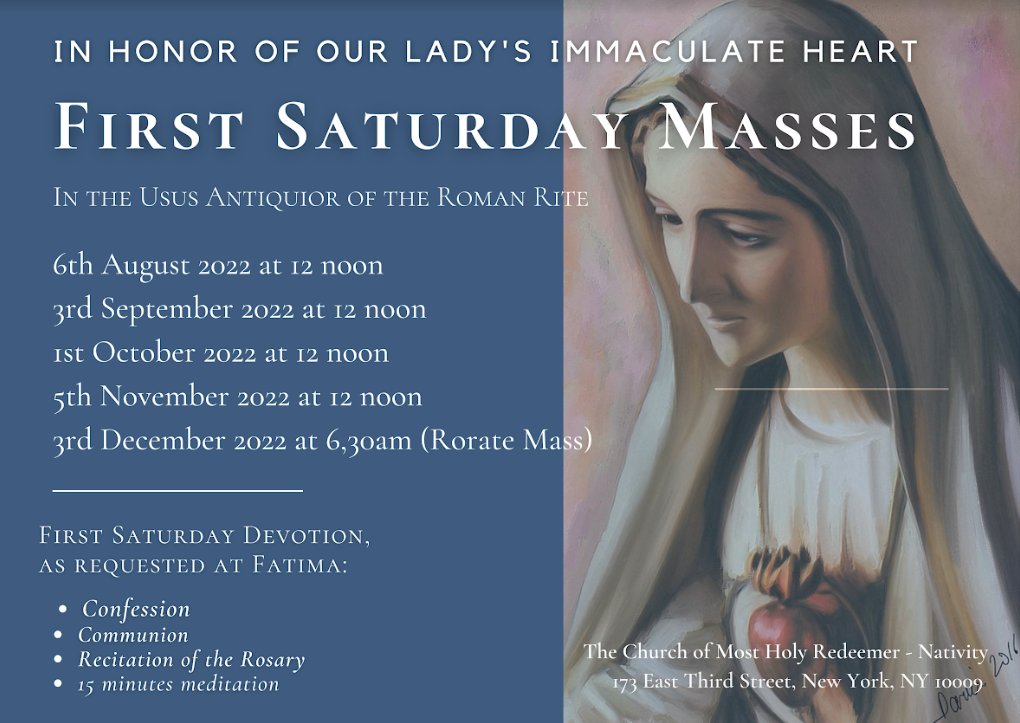
Below is the notice of the ritual in the current parish bulletin. N.B.: St. Mary’s, New Haven is NOT traditionalist.