25 May
2025
27 Apr
2025

This painting of a ruined abbey is dominated by a “Trinitarian” set of windows. A closer view reveals a statue of the Virgin Mary and a crucifix.
The beginnings of the 19th century saw a remarkable spiritual revival in Germany. It was represented by Catholics but also by Protestants. This movement – Romanticism – strove for a recovery of the sacred. Now around 1800 certain of the leading German romantics started to take a specifically Christian, even Catholic direction. It was one of the religious revivals (one also thinks of the Tractarians in England) that revived Christianity and the Catholic Church after the collapse of the 18th century.
One of foremost exemplars of Romanticism in the visual arts was Caspar David Friedrich. He is currently the subject of a splendid exhibition at the Metropolitan Museum of Art. Friedrich’s art emphasizes the less obvious, the mysterious, “the road less traveled.” In general landscapes predominate. There are many scenes of the twilight but also of the sunrise. In some paintings the symbolist movement of the end of the 19th century is foreshadowed. Other paintings remind the viewer even of 20th century abstract art. It’s a marked contrast with the dominant artistic tendency of art at that time: neo-classicism. In all respects it preserves a spiritual focus – a symbolic meaning almost always lies beneath the surface.
I cannot recommend the explantory materials provided on the exhibition which typify the attitudes that prevail in Germany today rather than clarifying what Friedrich himself intended. But for those who preserve a spiritual view of the world this exhibition is immensely rewarding.

More on the Exhibition:
Caspar David Friedrich:The Soul of Nature
(Exhibition runs through May 11)
27 Apr
2025

On Thursday, April 24, 2025, we attended the Higher Word Easter concert (“Rise Again’) at Old St. Patrick’s Cathedral. The 50+ member Higher Word orchestra and choir is an explicitly Catholic musical enterprise. The music for the evening was by Catholic composers and the introductions to each piece emphasized their links to the Faith. Old St. Patrick’s was filled for the occasion with an often festively attired crowd. I definitely felt my age – I would say the average age of the audience was in the mid-20’s. The concert was preceded and followed by social events (which I did not attend) which helps to explain the fancy dress of much of the crowd.

The musical offerings and accompanying explanations were on the short side, and very user-friendly. At times processions and dramatic light effects enhanced the event. The audience received the evening enthusiastically.
The spirit of Higher Word reminds me of what an earlier generation of young Catholics attempted to achieve in the City. In the 1980’s the Catholic Forum also tried to combine knowledge of Catholicism with opportunities for social mixing. However, instead of music, the Forum generally offered lectures by Catholic greats of the past – I can’t say that that was an equally attractive proposition. I recall that the Forum also organized more purely social events, but I don’t think any had remotely the success of last Thursday’s concert.

Perhaps a change of generation it also involved. For despite (or because of) the decrepitude of the Catholic Church establishment, a new generation is turning to the faith. The New York Post recently covered the phenomenon in New York City:
Why young People are Converting to Catholicism en Masse.
I have seen and have been told of the same developments elsewhere in and around New York. Is it because of the influence of podcasts and social media apostolates? Is it the shock of the sudden political change in the United States? Or a more significant spiritual transformation that’s underway?
For more on Higher Word see higherword.org.
2 Apr
2025
31 Mar
2025
27 Mar
2025
2 Mar
2025
26 Feb
2025

I recently attended vespers performed by the School of Sacred Music in New York City . It was part of their current series “Midwinter Light” (through March 3). Like several of their other performances, the evening was cosponsored by another organization active in the arts, in this case, an art gallery/Catholic arts collective:
“Arthouse2B is a multidisciplinary group of artists cultivating Catholic arts renewal in NYC. Our aim is to restore culture through restoring the heart of the artist.”
The music was beautifully sung in the acoustically and architecturally fitting surroundings of St George’s chapel (Episcopal). The vespers followed in general the Novus Ordo, but most of the texts were sung in Latin. The English translation of the texts provided in the handout, however, was not the Novus Ordo texts, but a much more poetic version. The vespers proceeded in a quasi-liturgical manner: lit candles were on the altar, the singers were vested in cassock and surplice, and singers and “congregation” followed rubrics of standing and sitting. As far as I could ascertain no ordained minister of any denomination was present.
I confess that the School of Sacred Music is in some respects still mysterious to me. They describe themselves as being “in the Catholic Tradition” and have sung in, for example, St Patrick’s Cathedral, Notre Dame Church (near Columbia University) and St. Joseph in the Village. Yet up till recently their main venue was the General Theological Seminary (Episcopal) in Chelsea. Indeed, last year they came close to leasing part of the seminary, but the deal was quashed when seven Anglican bishops objected. It seemed to them that such a “Roman Catholic” organization as the School of Sacred Music might be insufficiently attentive to LGBT inclusion.
But now the School has resumed its performances – but in an Episcopal chapel. I would have thought their use of the Novus Ordo would have opened the doors of one of the parishes of the New York Archdiocese. But perhaps in the current environment of the Roman Catholic Church the mere use of Latin raises too many issues.

24 Feb
2025

Yesterday afternoon, an audience was treated to a delightful concert given by talented young musicians from the Julliard School. This concert featured baroque string music of Italian and British composers in the British Isles. The musicians were Lydia Becker on baroque violin, Amanda Barenek on triple harp, and Nathan Frisco on baroque cello.
In talking with these musicians afterwards at the reception we found out about a new chamber ensemble in New York called The Higher Word Orchestra to which some of them are connected. From their website “We are a 30-member Catholic and Christian Orchestra that showcases the beauty of Catholicism through music, revealing the deep connection between faith and melody.” We hope to hear more about this promising young group soon.
27 Jan
2025
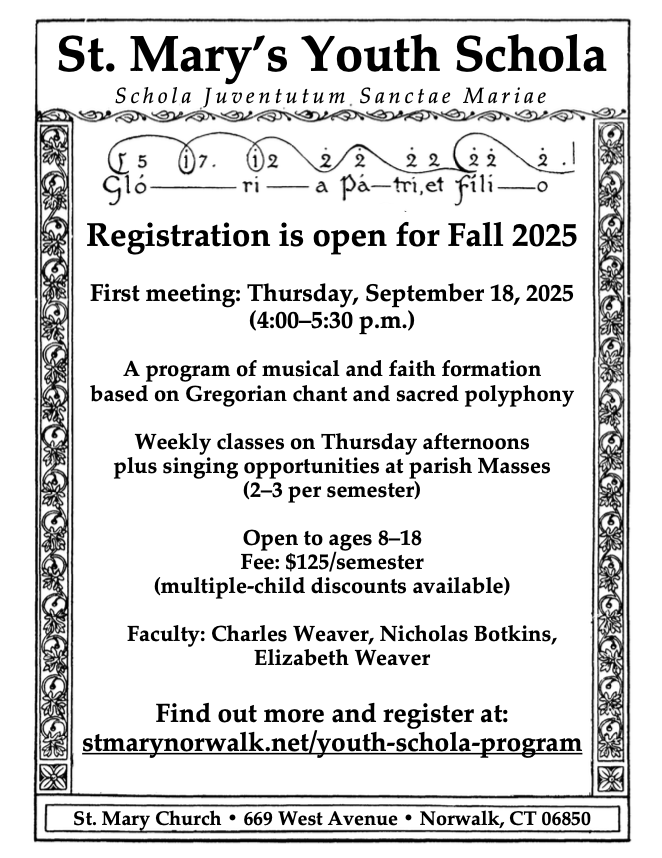
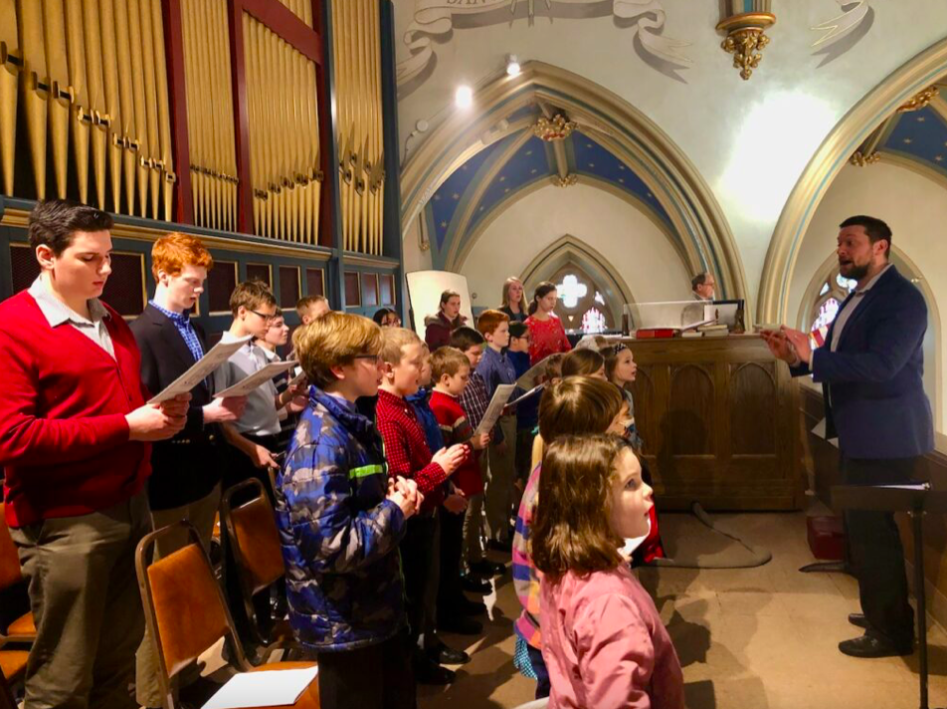
St. Mary’s Youth Schola Registration is open for Spring 2025
First meeting: Thursday, February 6, 2025 (4:00–5:30 p.m.)
A program of musical and faith formation based on Gregorian chant and sacred polyphony, with weekly classes on Thursday afternoons from 4:00–5:30 p.m., plus singing opportunities at parish Masses (2–4 per semester). Open to ages 8–18; young men with changed or changing voices are welcome!
Fee: $125/semester (multiple-child discounts available)
Faculty: Charles Weaver, Nicholas Botkins, Elizabeth Weaver
Find out more and register at: stmarynorwalk.net/youth-schola-program