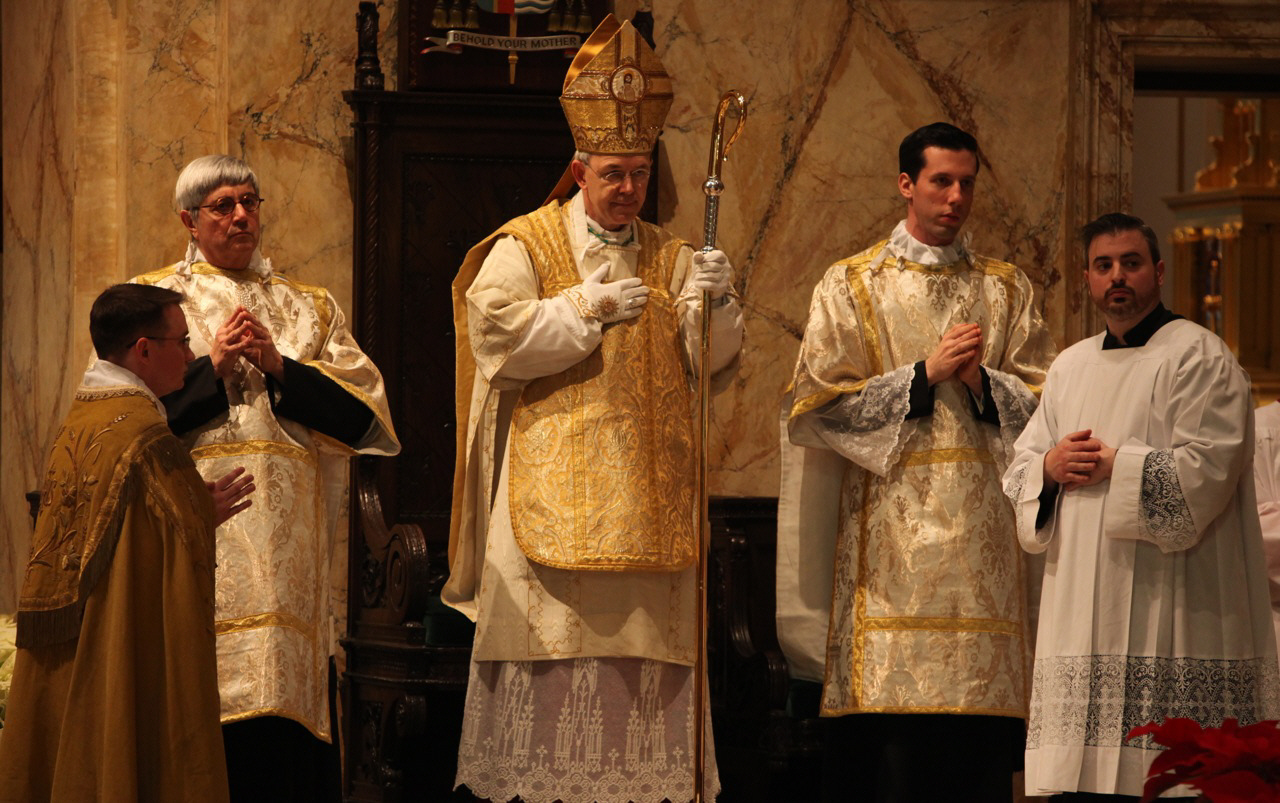
On September 9th the final program for this year’s Summorum Pontificum pilgrimage in Rome was released. As you probably have heard, the Vatican has formally refused permission for a final Mass in St. Peter’s. Instead, there will be “prayers.” Two hours later, a concluding liturgy will be celebrated at the high altar of St. Maria Maggiore. This decision is obviously a blow both for the pilgrimage and the traditionalist cause. For here Pope Leo reverses his own decision of last year to permit once again the celebration of a concluding Mass in St. Peter’s.
Why was this done? Pope Leo obviously has not the slightest knowledge of, or sympathy for, the traditional liturgy as such. That is evident from his statements on 8/26/2026 and those he permitted his subordinates to issue earlier this year. But clerics otherwise opposed or indifferent to the Traditional Mass have been open to recognizing the aspirations of those who are devoted to it. One thinks of cardinals like Bernardin in the past, or Zuppi today. But that is not the case with Pope Leo.
I suspect the difference is that Leo has no insight into the people of traditionalism: those who adhere to it and why they do so. As he himself admitted, for him personally the subject is remote. Undoubtedly far more important to Leo are the relationships with his immediate advisors and former colleagues: the pope’s so-called “inner circle,” the officials of the curia, the heads of the religious orders. To maintain their good will, Leo has taken pains to demonstrate his continuity with the policies of Francis (other than on limited administrative measures). This is evident from his continuous quoting of his predecessor, his praise of the main documents of the Bergoglio years and his retention in office of almost all the main figures of that regime.
It is certain that any advice these sources might give on a Traditional Mass in St. Peter’s would be negative. But what reasons could they cite for refusing a Mass? The decision regarding the Mass was conveyed in letter issued in August by the Substitute of the Secretary of State. I believe this letter still has not been published – although one news site has further details regarding its contents. Until those contents are fully disclosed, I would assume that similar to other decisions of Leo, the refusal was summary and uninformative.
Thus, we are left to rumors and leaks from anonymous “informed sources” to discover the reasoning behind the decision. These tell us that, in stark contrast to the public perception of the 2025 pilgrimage, Pope Leo had heard negative things concerning it. The “inner circle” and the others were disturbed that the pilgrimage had been used for “propaganda” and there had been a “perceived” “triumphant” or “gloating” tone – that “perception” had not been well received. 1)
I did not hear either during or after the 2025 pilgrimage “gloating” statements from those connected with the pilgrimage. The “triumph” was not in the media, but in the fact of the pilgrimage itself. What these statements from “informed sources” really mean is that the 2025 pilgrimage had made too favorable an impression on Catholics and even the secular media. Those in and outside of the Vatican who are fanatically opposed to the Traditional Latin Mass had seen one key element of their narrative – that only a small minority cares for the Traditional Mass – dramatically undermined. So, the pilgrimage had to be cut down to size. Of course, this is very similar to the attitude of the Vatican in regard to the Chartres Pilgrimage of Christendom. As the attendance at that pilgrimage has grown and grown in recent years the Vatican’s response (at least up to and including the 2024 pilgrimage)was hostile commentary and legal roadblocks.
Thus, thousands of Catholic pilgrims are denied a Mass because of the media impression their successful pilgrimage has created. The spiritual desires of those Catholics – the good of souls – plays no role at all; media manipulation and “perceptions” relevant to internal Catholic ideological struggles are everything
As to the pilgrimage itself, this determination is not the worst of results. I have no idea what the prayer service, if any, in St. Peter’s will be. And it will take quite an effort for pilgrims to get from St. Peter’s to St. Maria Maggiore in 1-2 hours. But St. Maria Maggiore is certainly a uniquely splendid location, And if the 2026 pilgrimage is as large as last year’s, St. Maria Maggiore is likely to be more appropriate, in terms of size, than a celebration before the throne of St. Peter within St. Peter’s basilica.
The greater problem created by this decision is the impact for the Church as a whole. It sends a signal that the traditionalist movement remains in official disfavor. Every bishop and priest of the world can restrict or abolish celebrations in the traditional rite, on the assumption that the Pope will do nothing about it. Just now in Toronto restrictions are being imposed pursuant to Traditiones Custodes (which after all remains on the books) primarily on two churches of the Toronto Oratory. These are highly successful apostolates but, as in the case of the Rome and Chartres pilgrimages, that means nothing.
Yet, the pilgrims who will come to Rome this October should not feel discouraged. Paradoxically, traditionalists should take comfort from the restrictions and humiliations imposed upon them by an increasingly shaky ecclesiastical authority. It has been through the efforts of the Summorum Pontificum pilgrims since 2012 that the Vatican has been forced to acknowledge the existence of Traditionalism even in Rome itself. Yes, more recently this response has been not an offer of dialogue, inclusion or even welcome, but suspicion, administrative harassment and prohibitions. But, as was already clear upon the issuance of Traditiones Custodes in 2021, this tactic is a loser’s game. The Council that was supposed to proclaim the Christian message more clearly to those both in and outside of the Church has manifestly failed to do so. To maintain the current regime, the Church has had to resort to techniques of media manipulation and authoritarian measures. In the long term such actions can only result in a further loss of credibility. The clergy and religious orders can be intimidated, bishops and clerical scholars silenced. But from its very beginnings the bedrock of Traditionalism has been the devoted laity. They will continue seeking out the celebration of the Traditional Mass, and all the other sacraments, produce online commentary, write and read books and yes, go on pilgrimages. How long this situation in which traditionalists find themselves will last – a kind of stalemate in a war of attrition – I cannot say. But if we keep the focus on preserving Catholic Tradition in its totality – above all in the celebration of the Mass – I am confident that happier days will come.
1. “Bishop Schneider to celebrate Summorum Pontificum TLM at St Mary Major after St Peter’s permission denied,” AdVaticanum (9/9/2026); Limbu, Niwa, Vatican letter leaves door open for Summorum Pontificum Mass to return to St Peter’s, AdVaticanum (9/10/2026). See also Pilgrimage Summorum Pontificum This Year, The Society of St Hugh of Cluny (8/4/2026) quoting Beltran, Edgar, “Is the Pope Maintaining a TLM ‘gray area’”? The Pillar (8/3/2026); Haynes, Michael, “Annual Latin Mass pilgrimage has Vatican Mass cancelled.” thecatholicherald.com (9/9/2026.