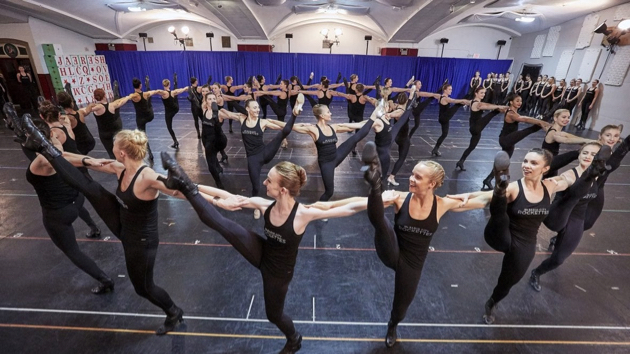
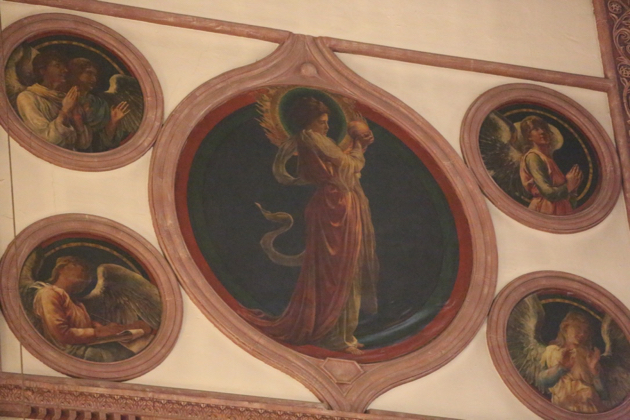
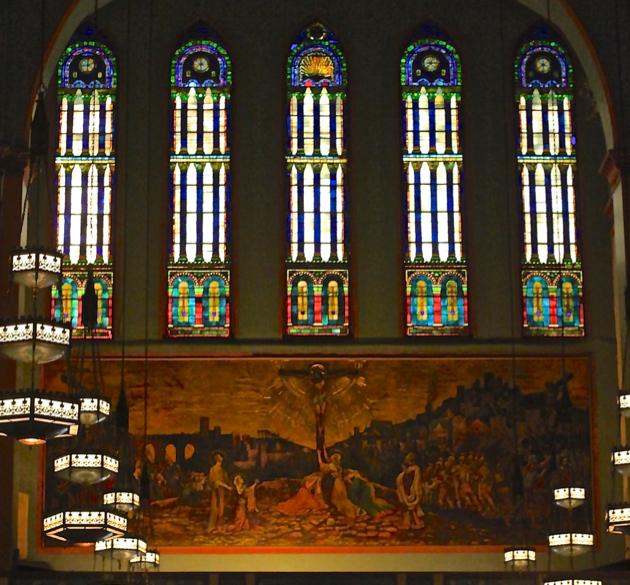
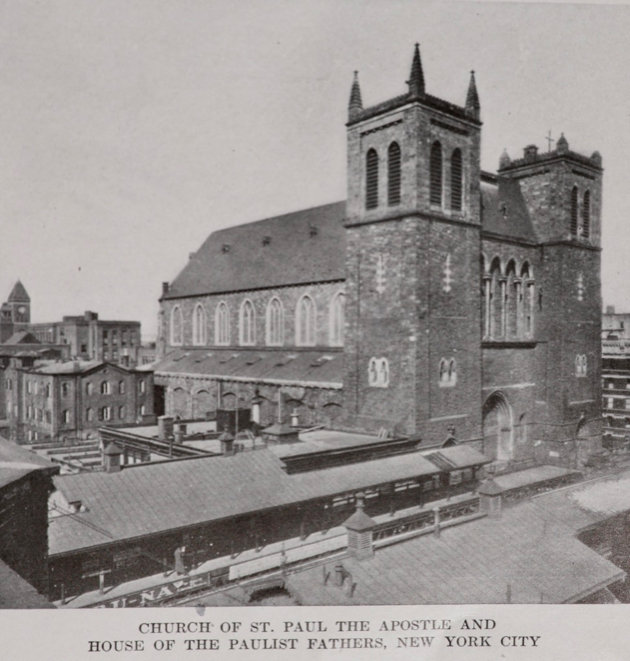
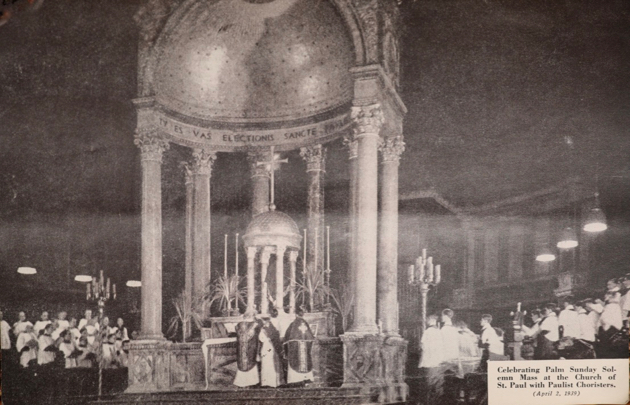
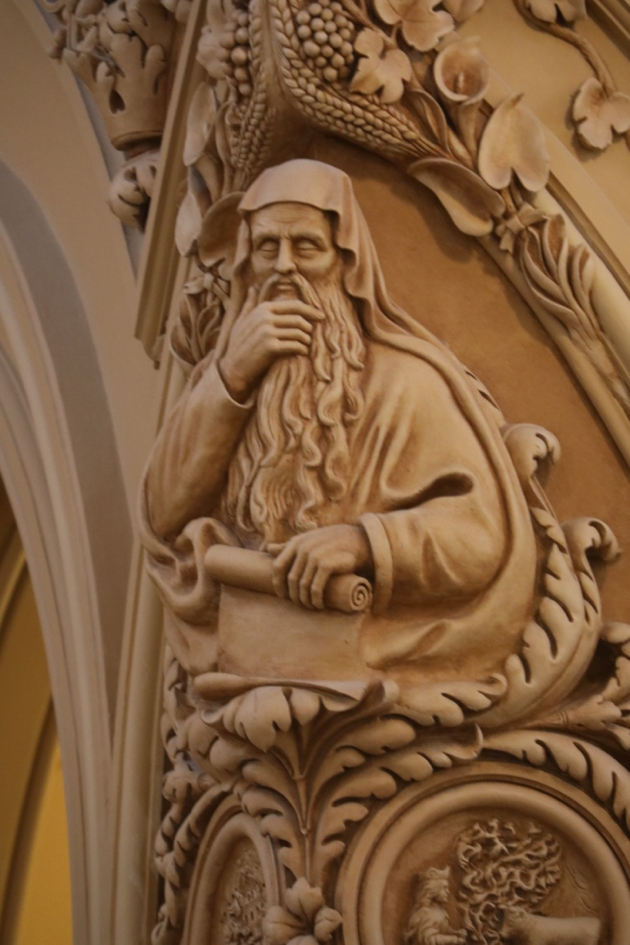
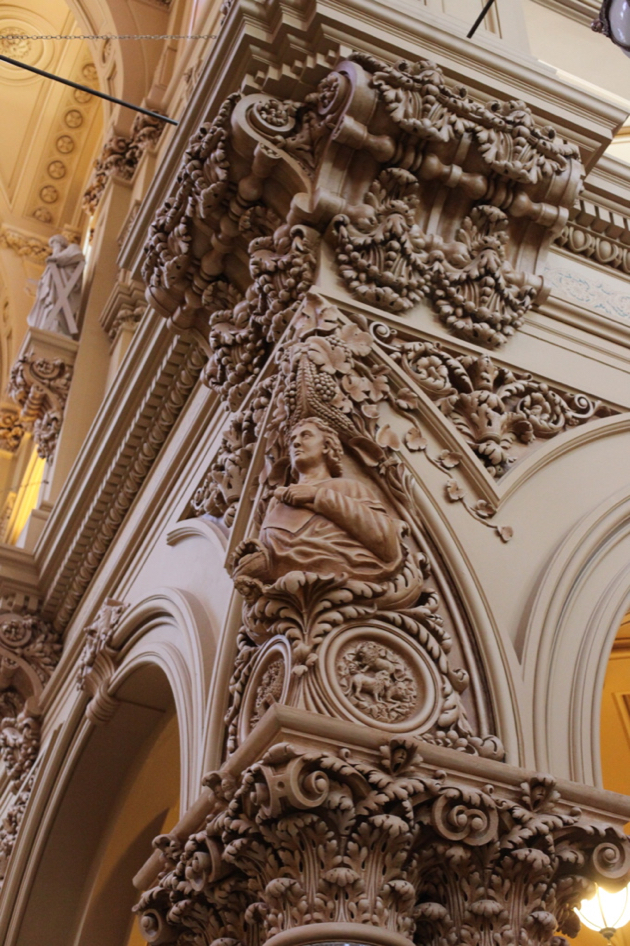
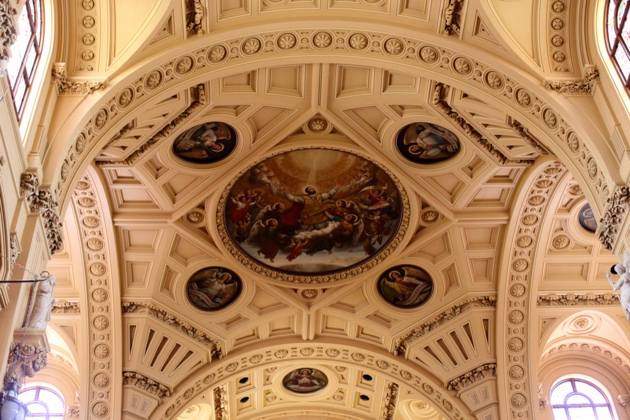
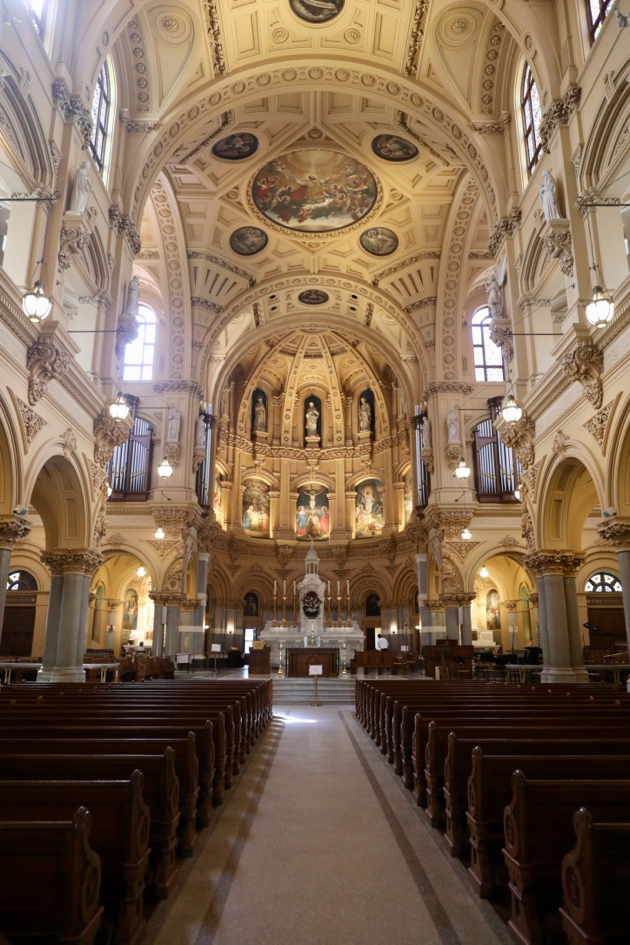
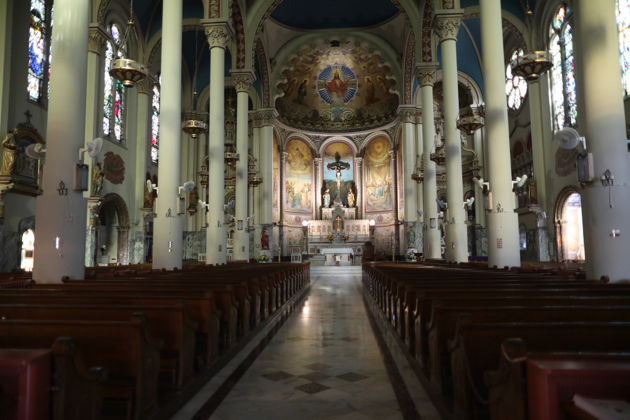
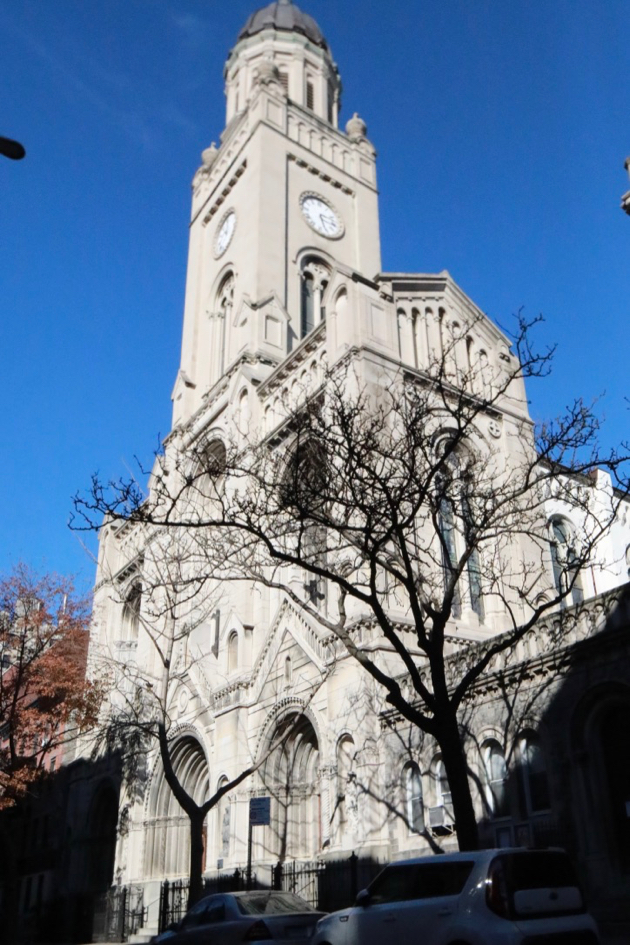
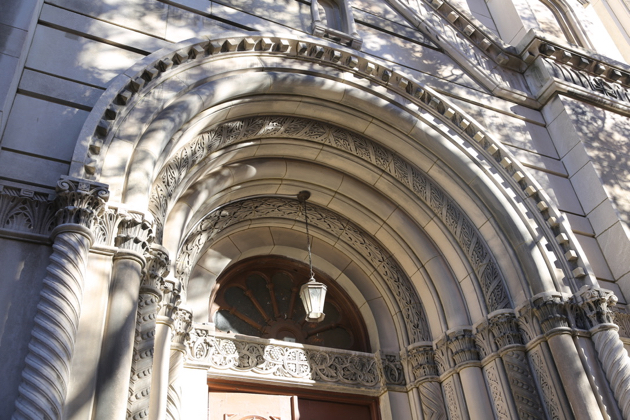
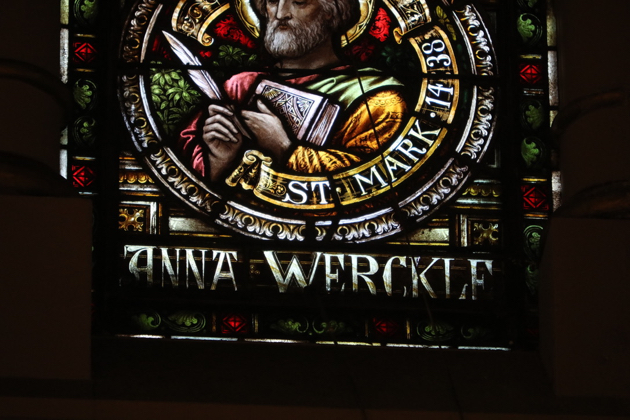
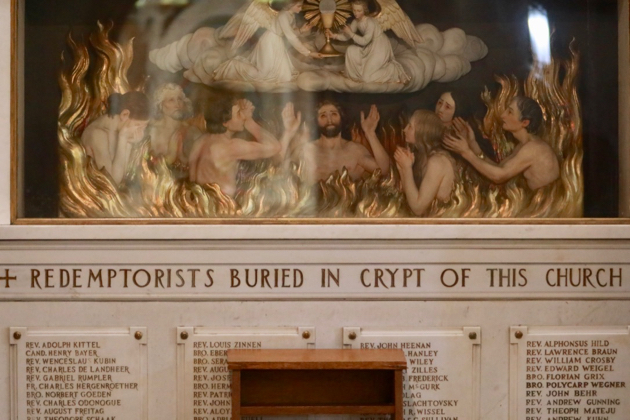
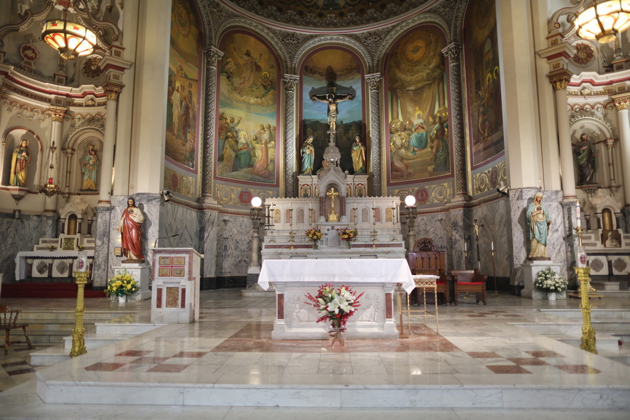
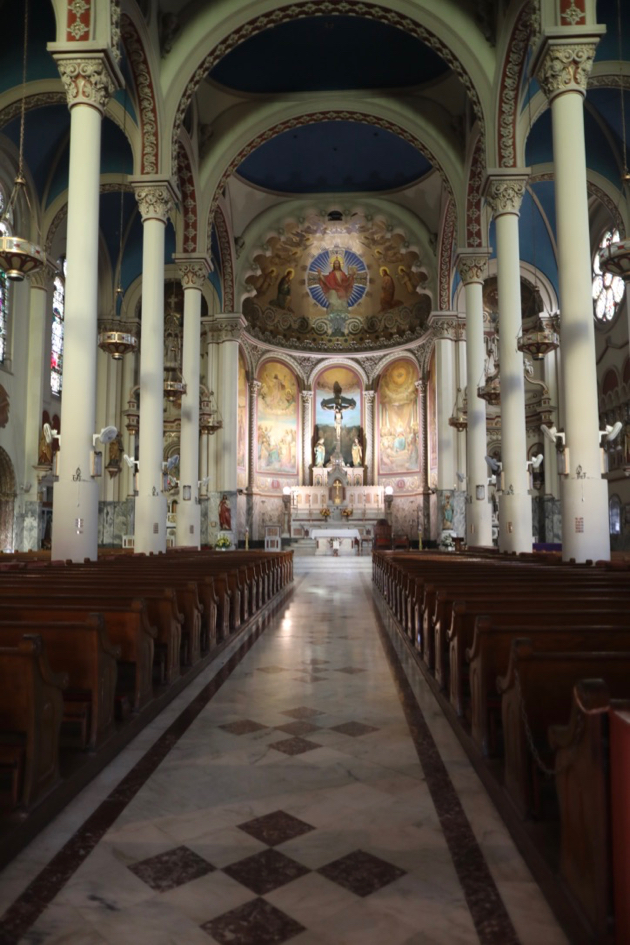
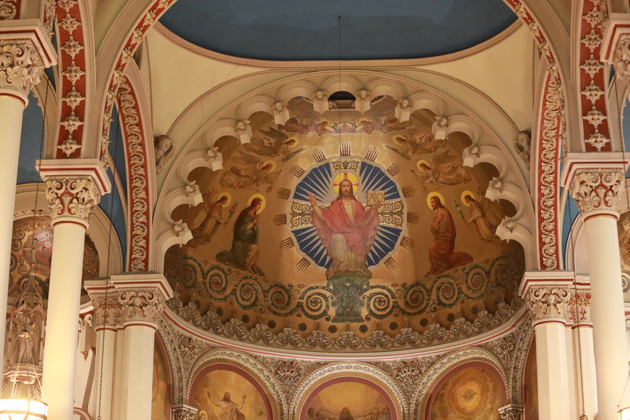
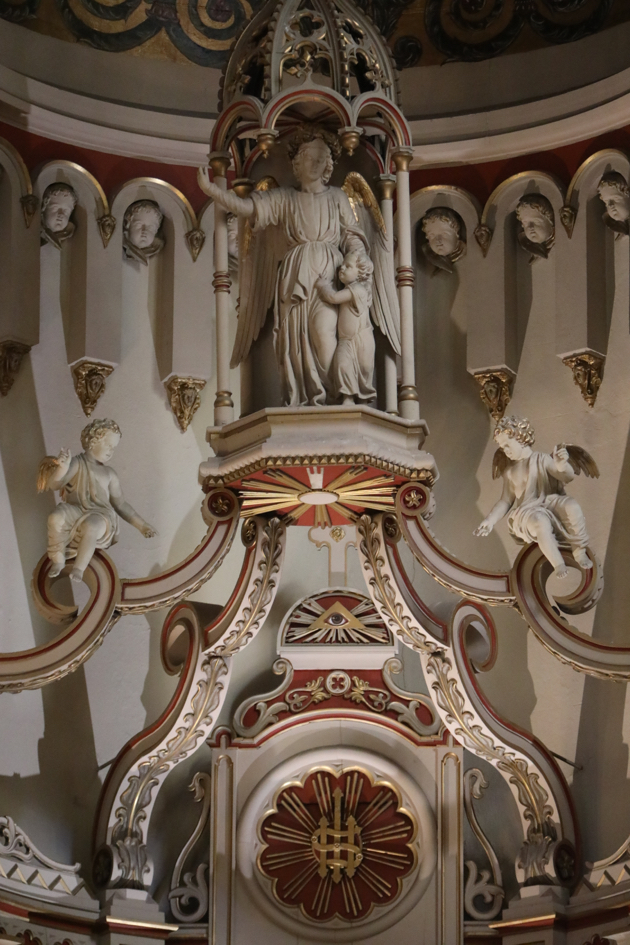
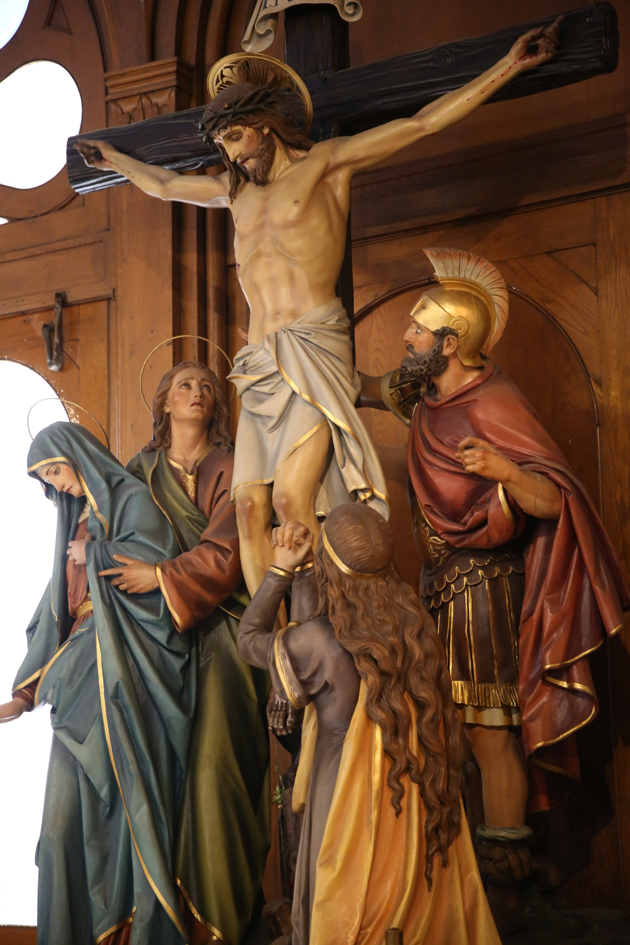
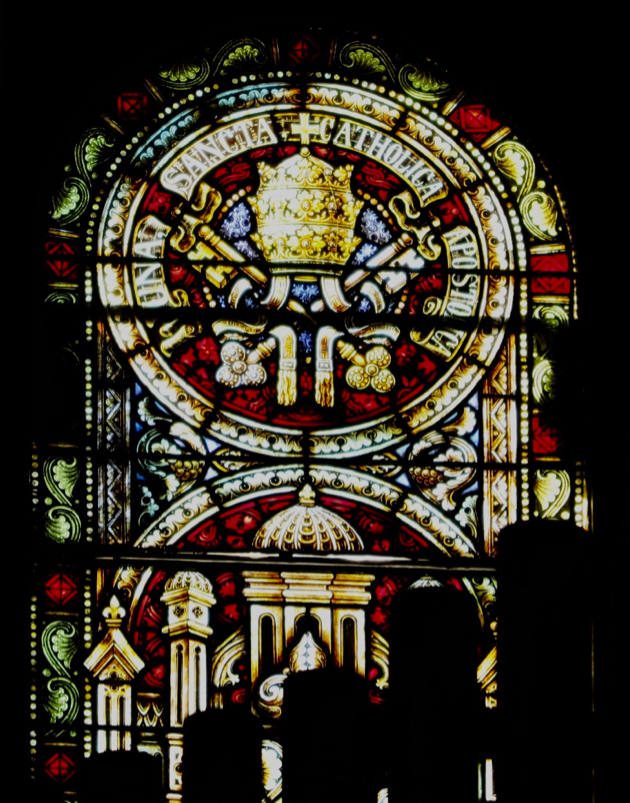
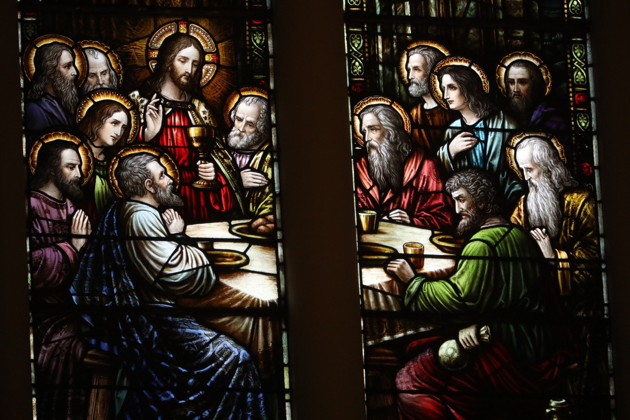
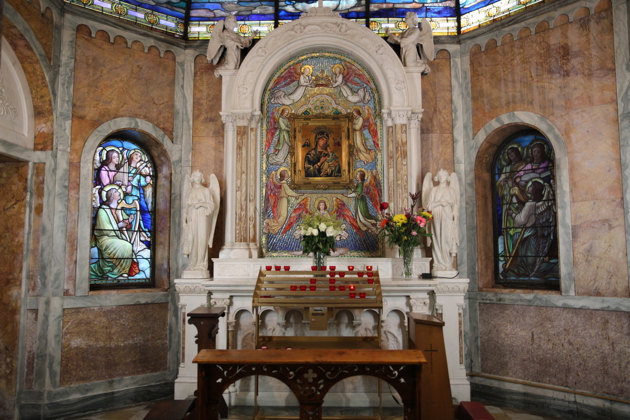
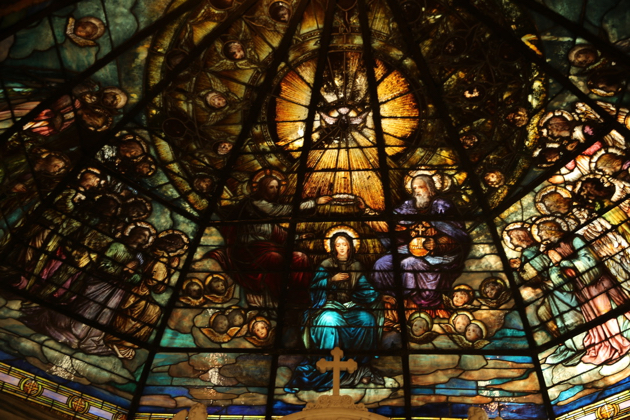
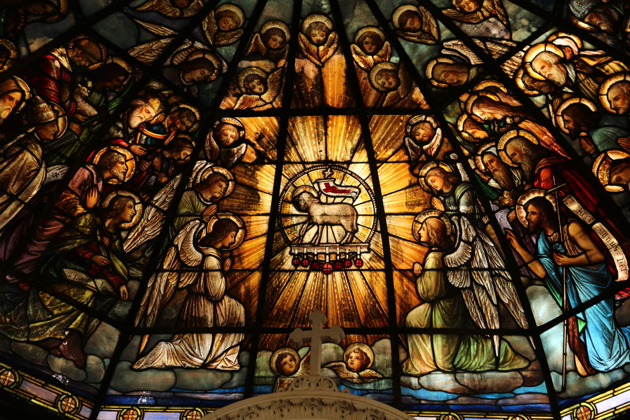
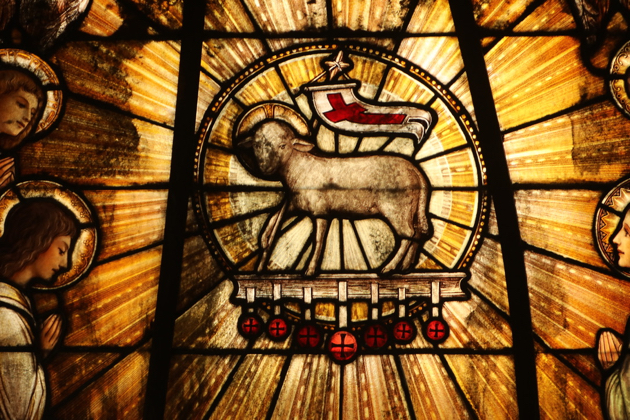
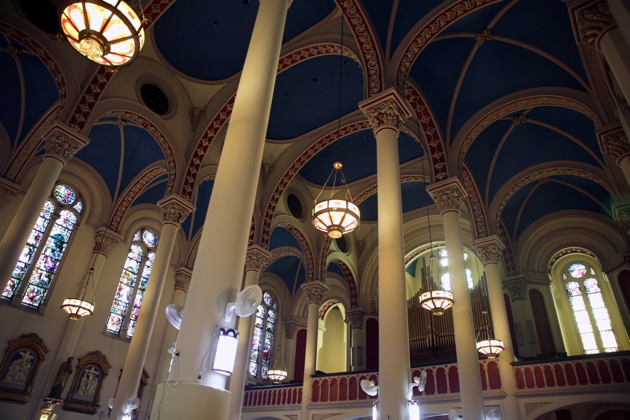
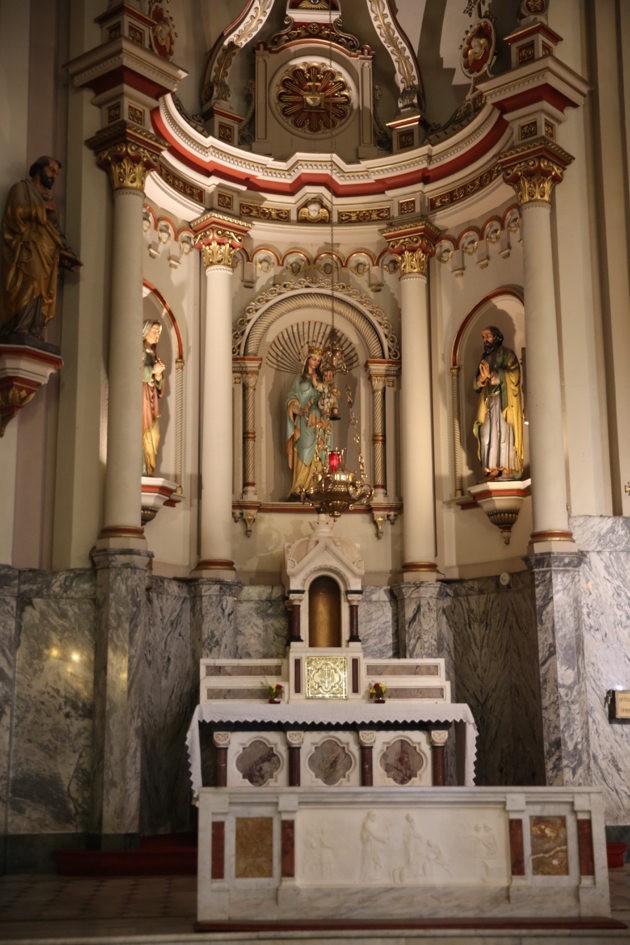
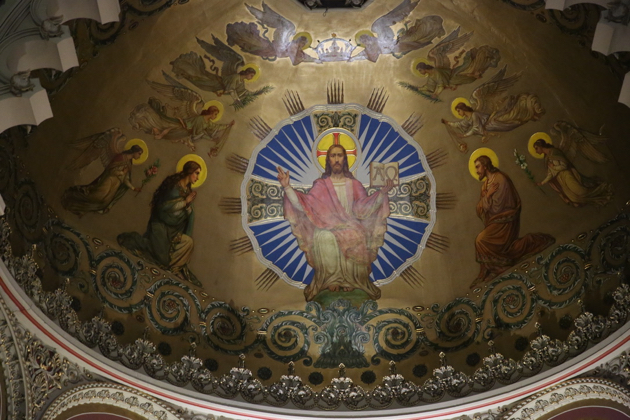
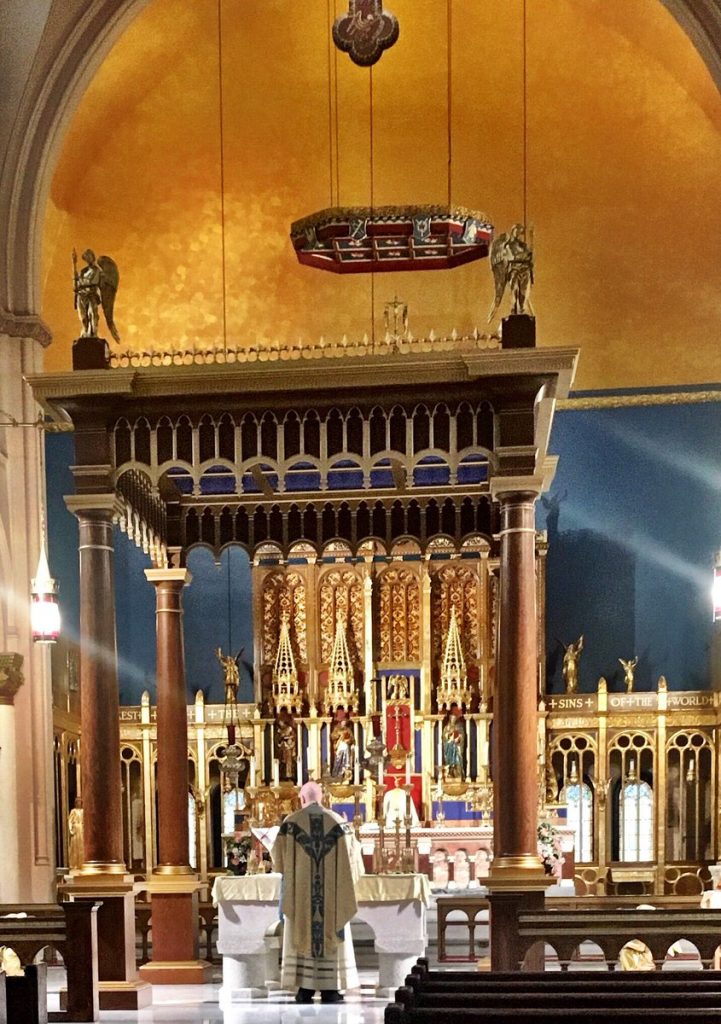
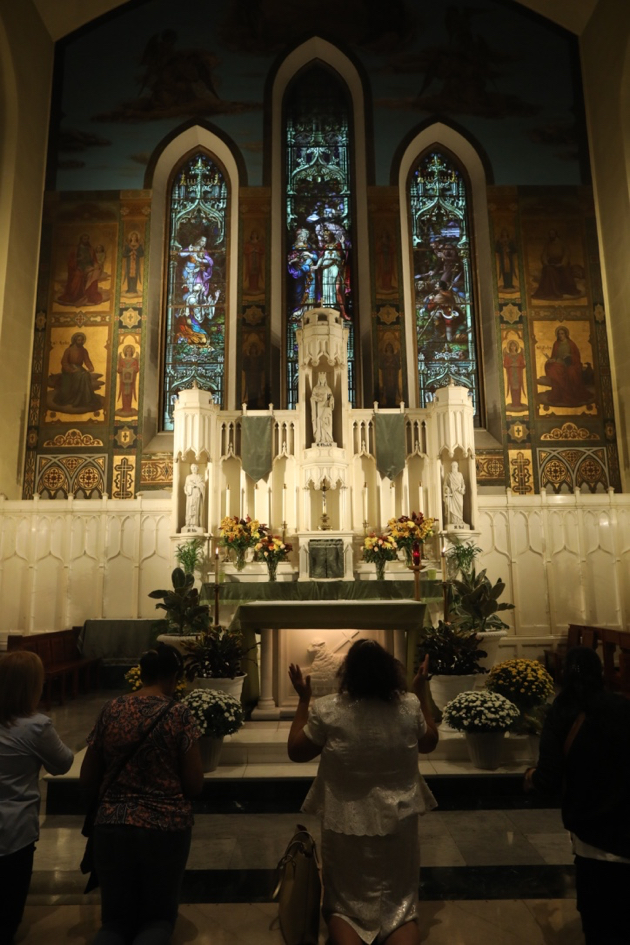
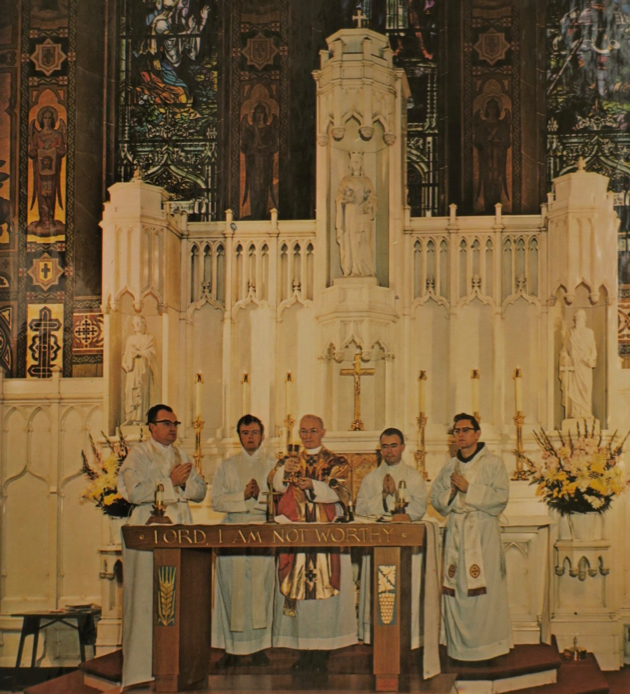
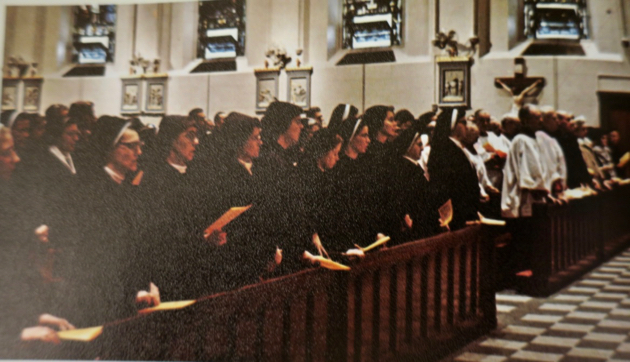
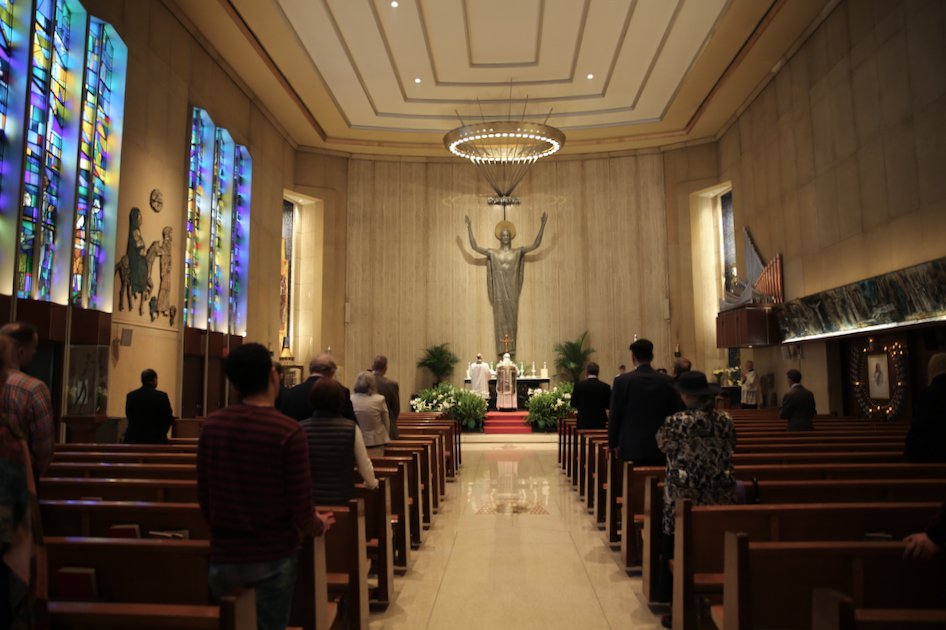
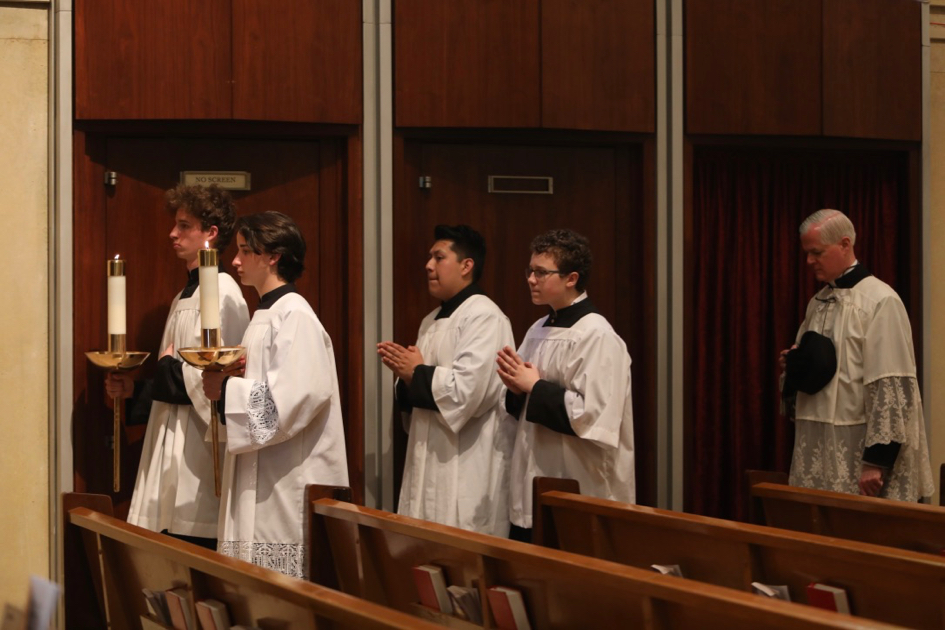
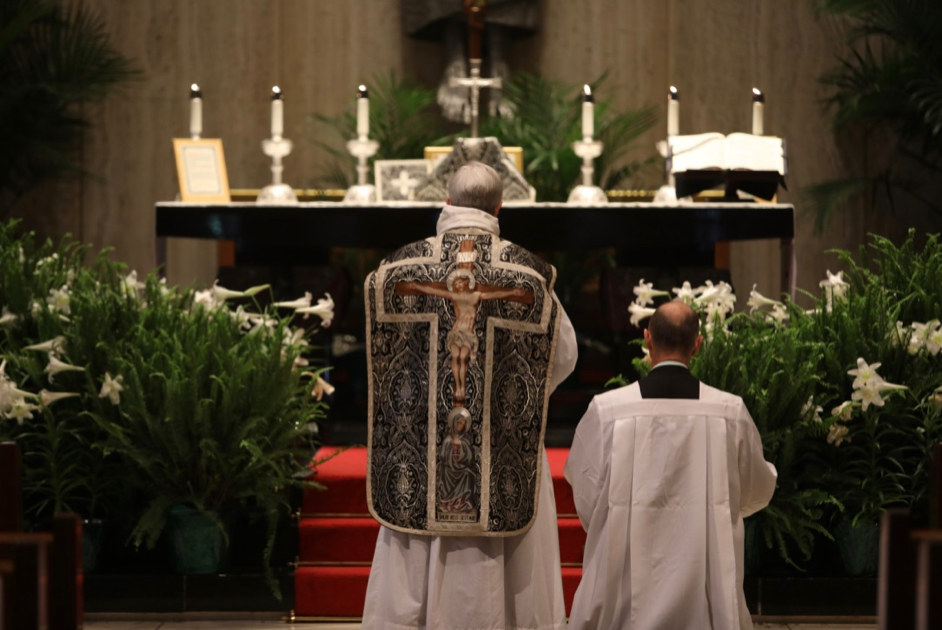
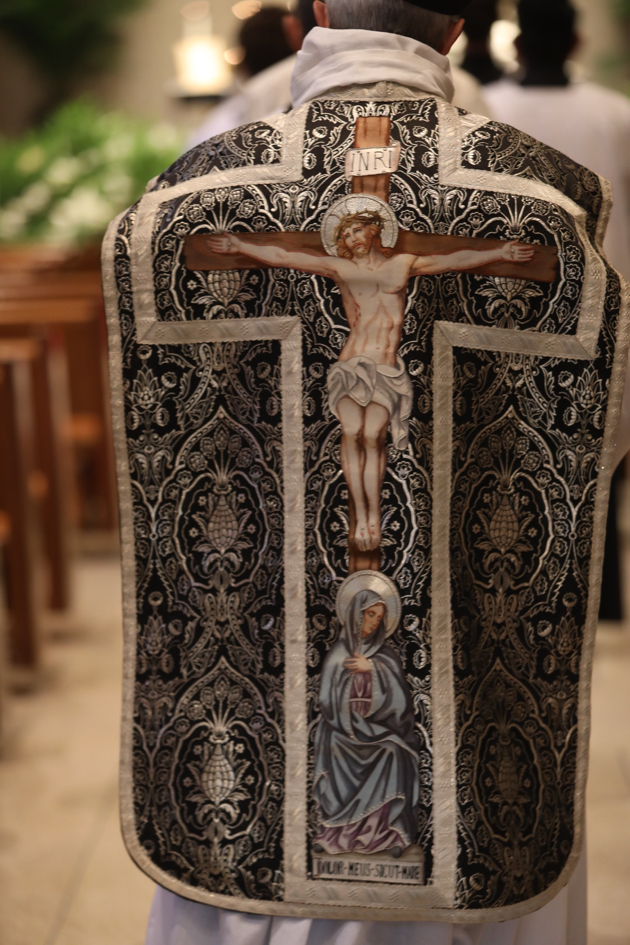
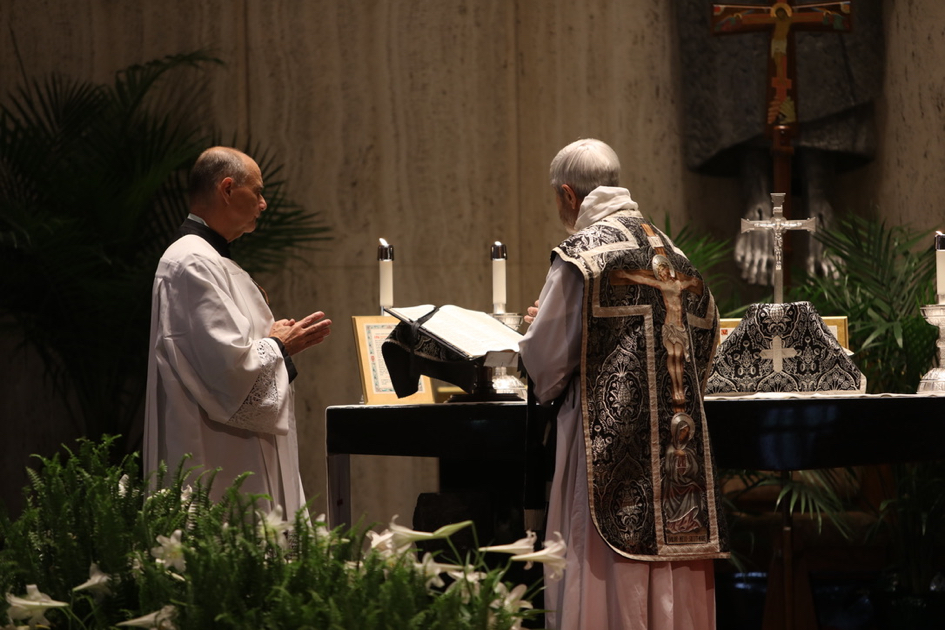
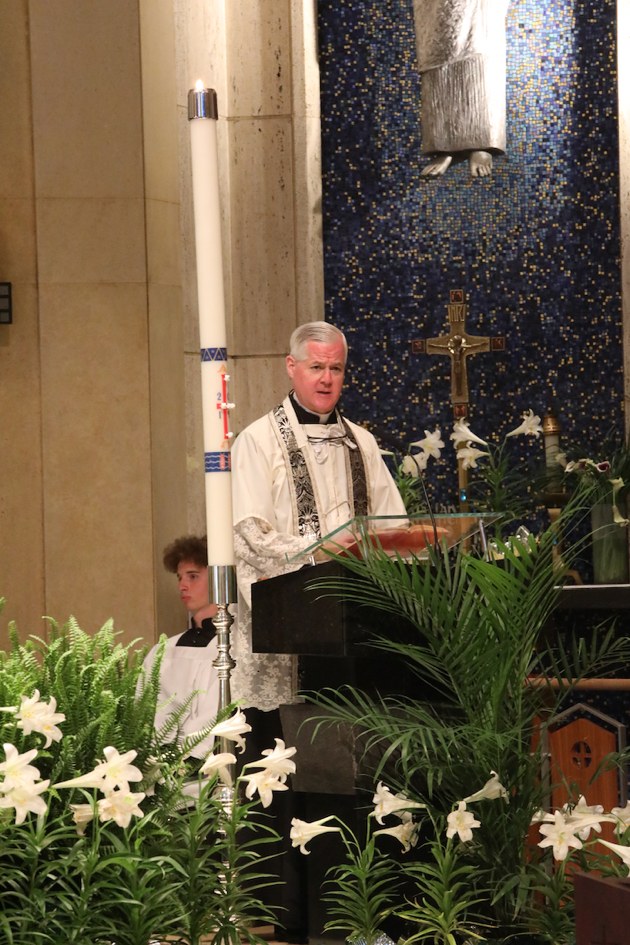
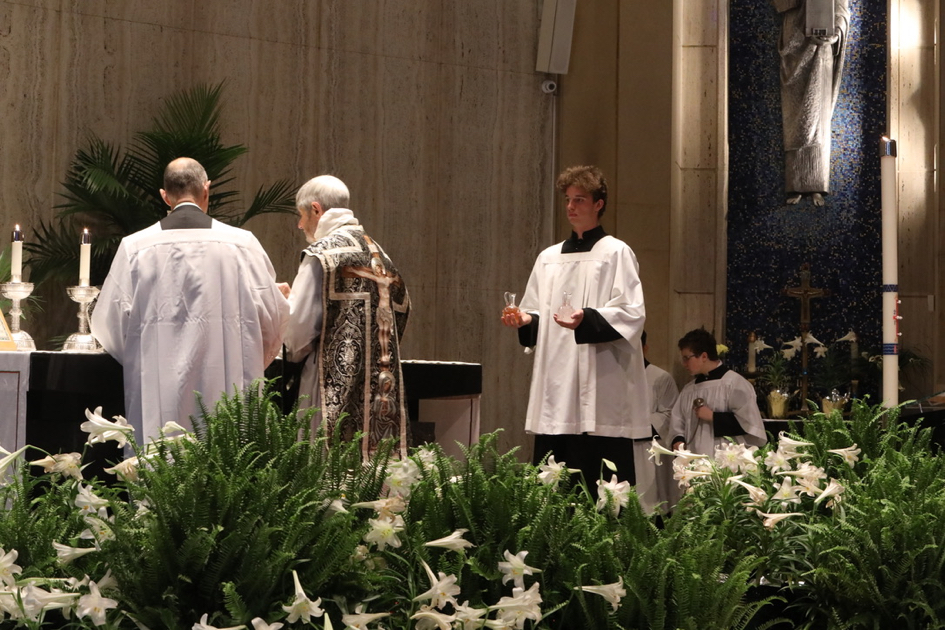
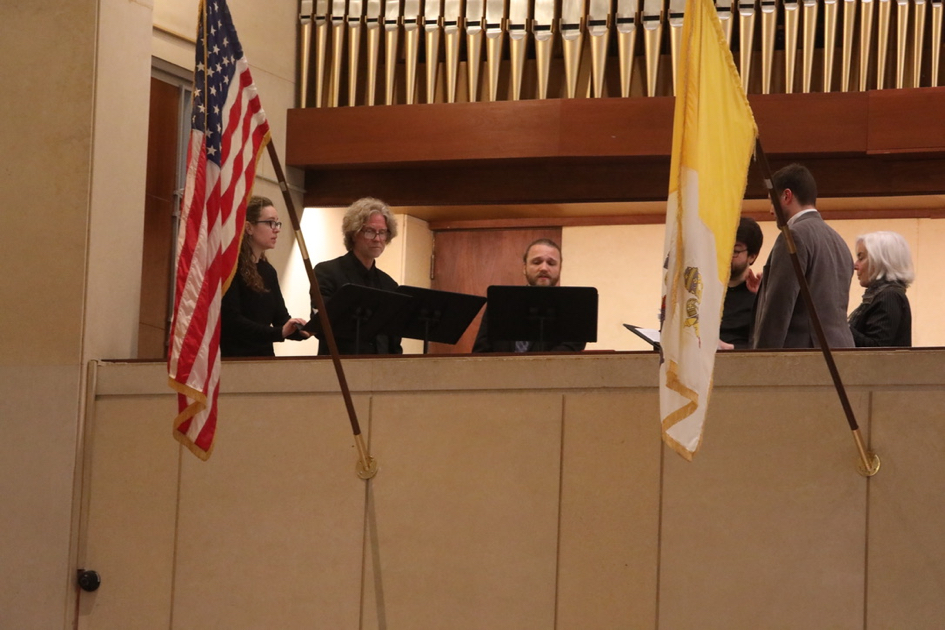
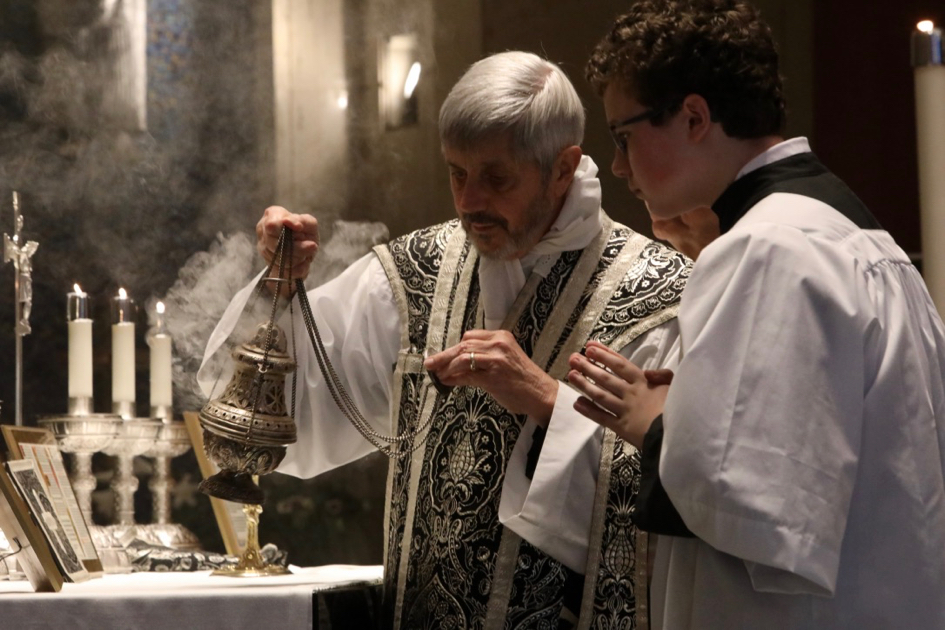
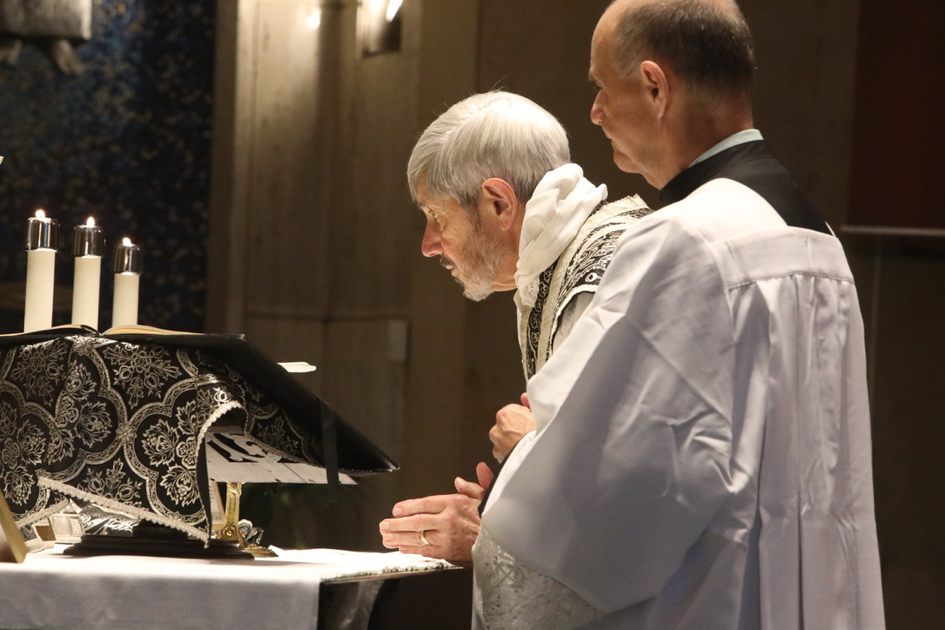
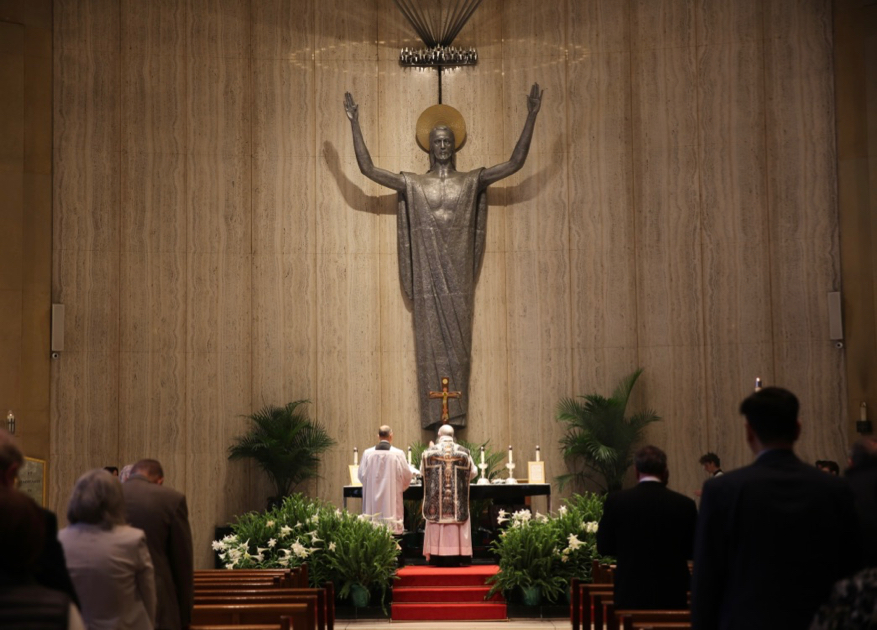
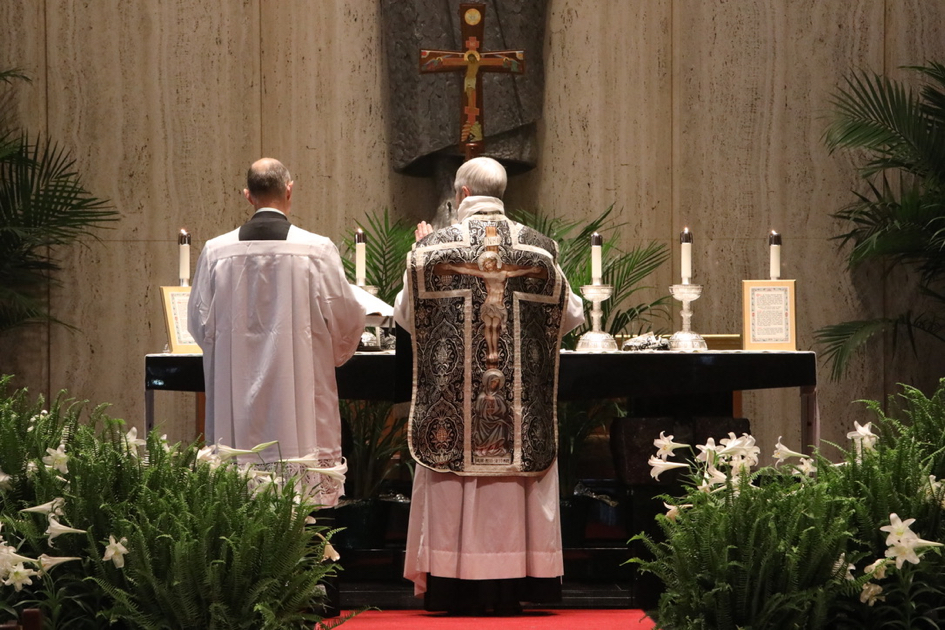
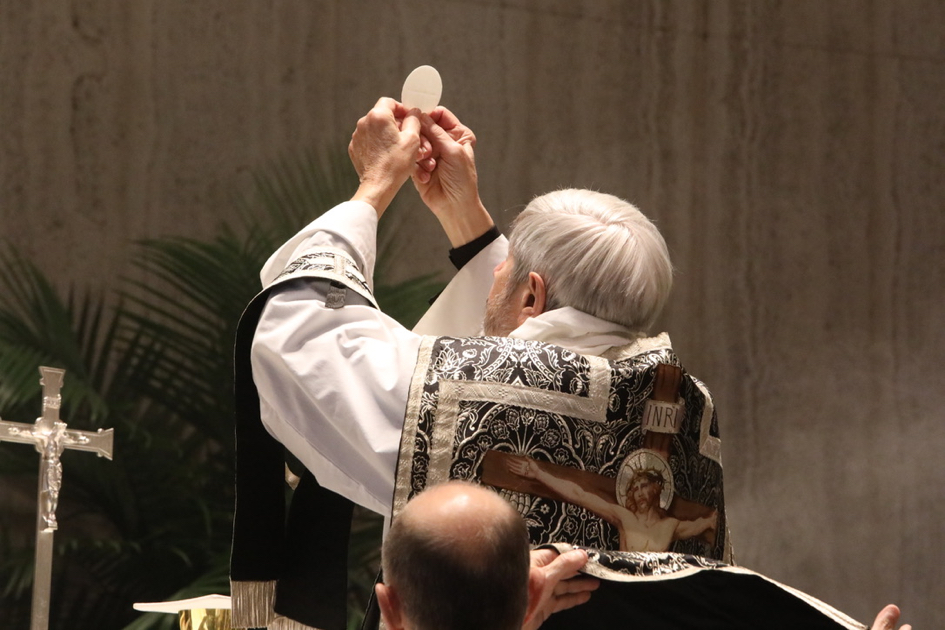
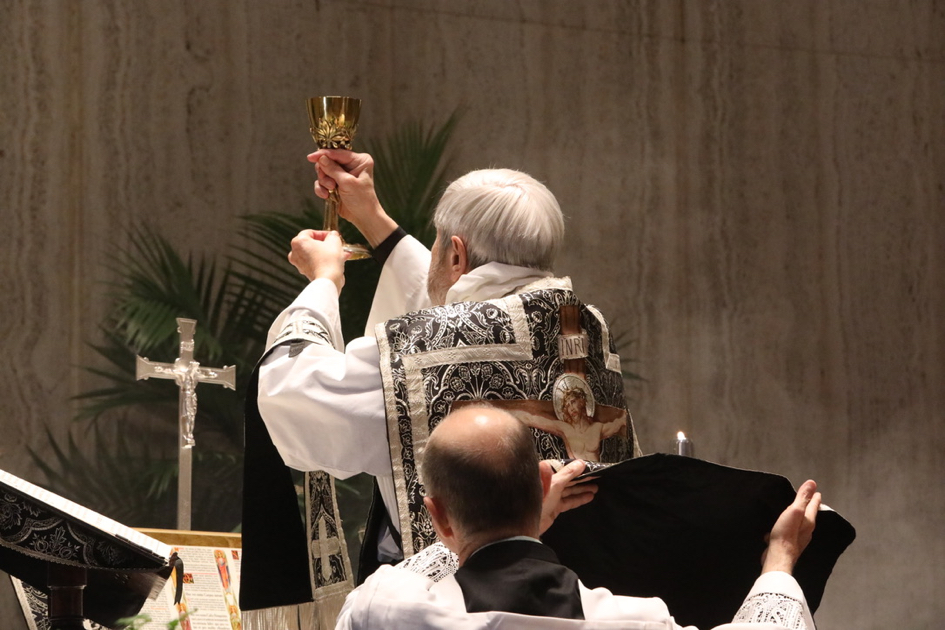
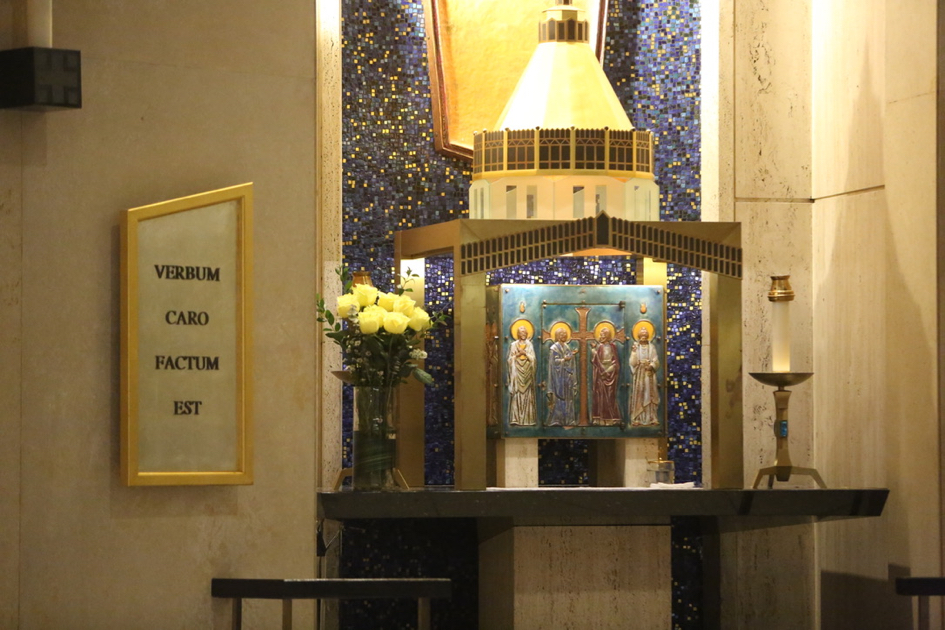
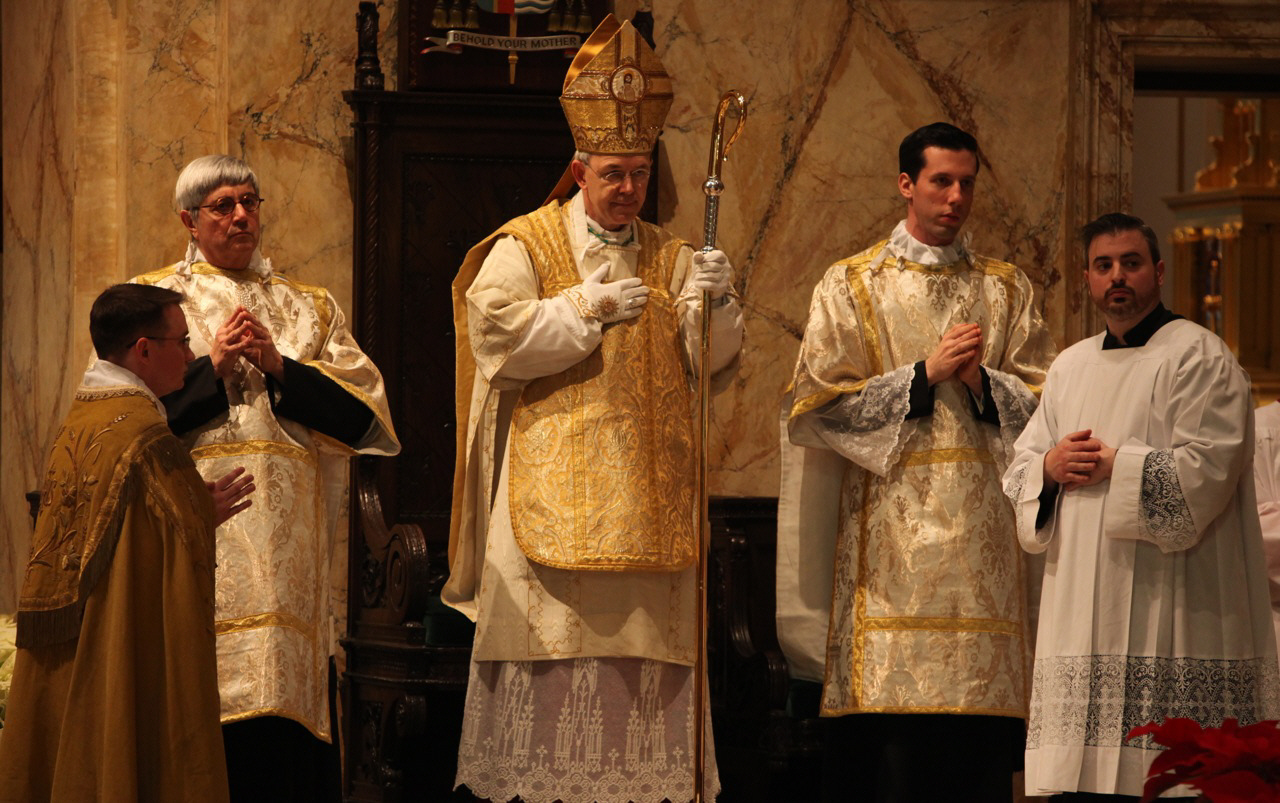
At St. Paul the Apostle church, New York. Note the folded chasubles and the large boys’ choir (for which the sanctuary was specifically designed).
(From The Church of St. Paul the Apostle, New York by Joseph I. Malloy, CSP (1939?))
9 Apr
2017
At St. Paul the Apostle church, New York. Note the folded chasubles and the large boys’ choir (for which the sanctuary was specifically designed).
(From The Church of St. Paul the Apostle, New York by Joseph I. Malloy, CSP (1939?))
9 Apr
2017

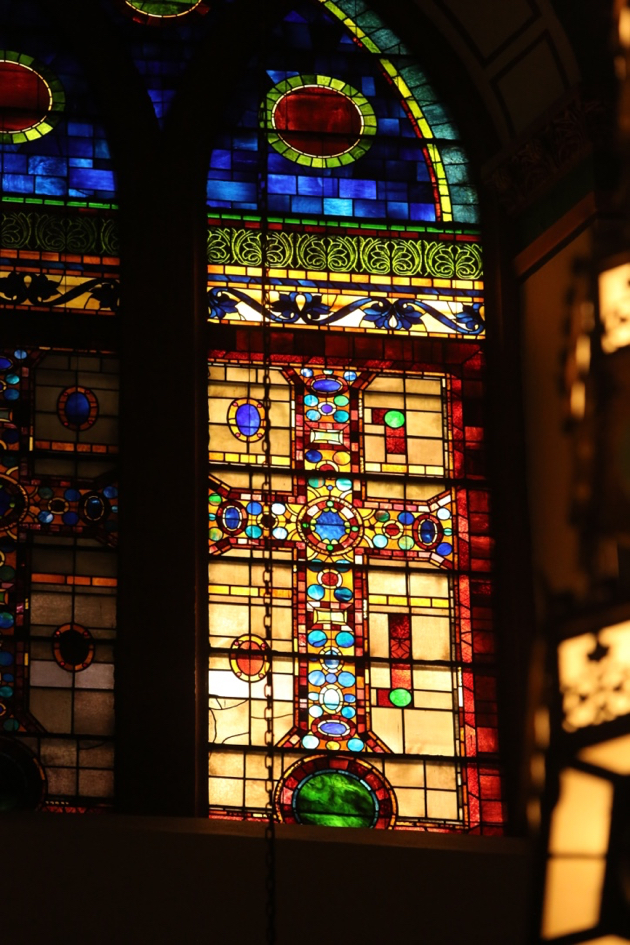
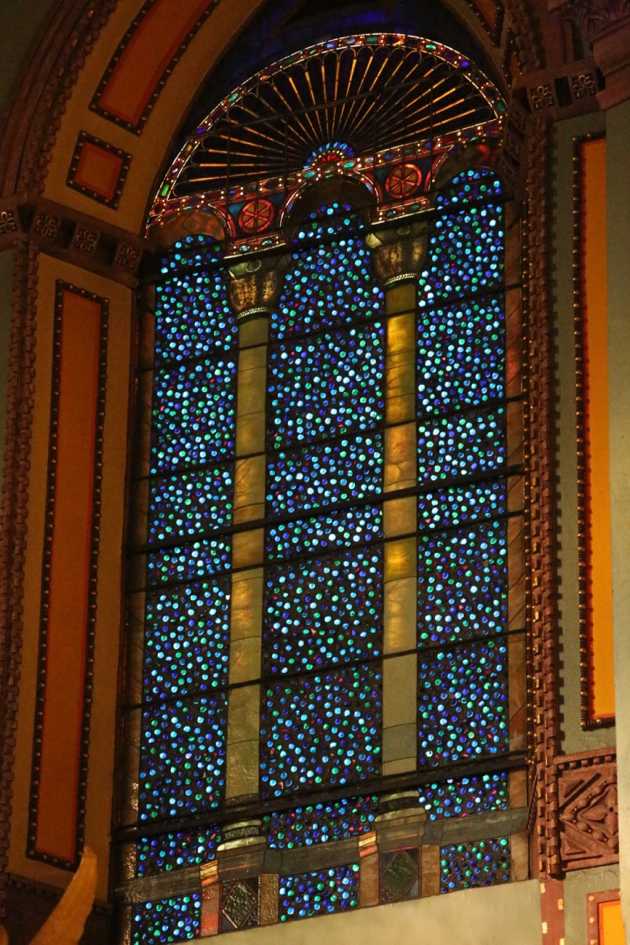
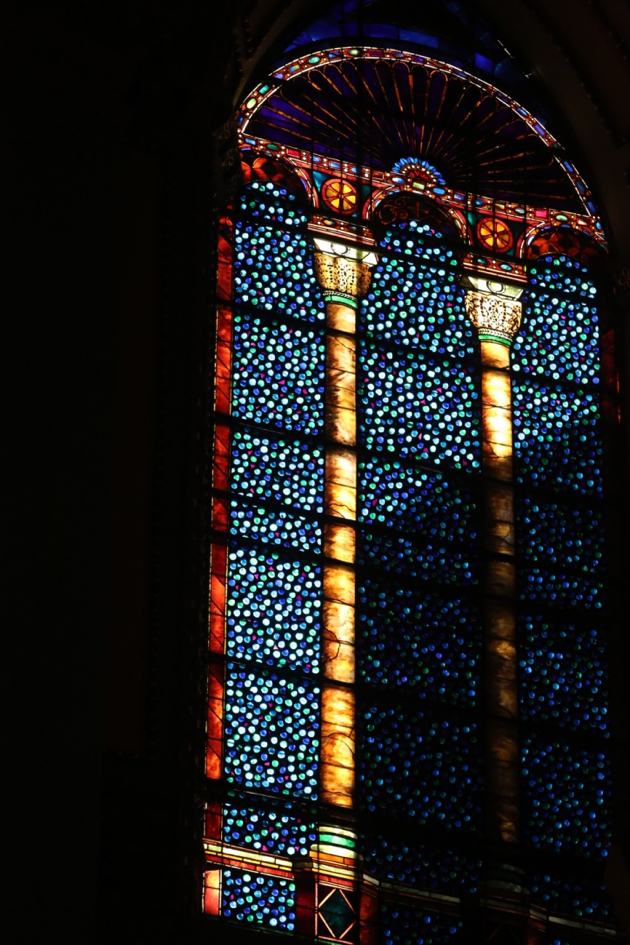
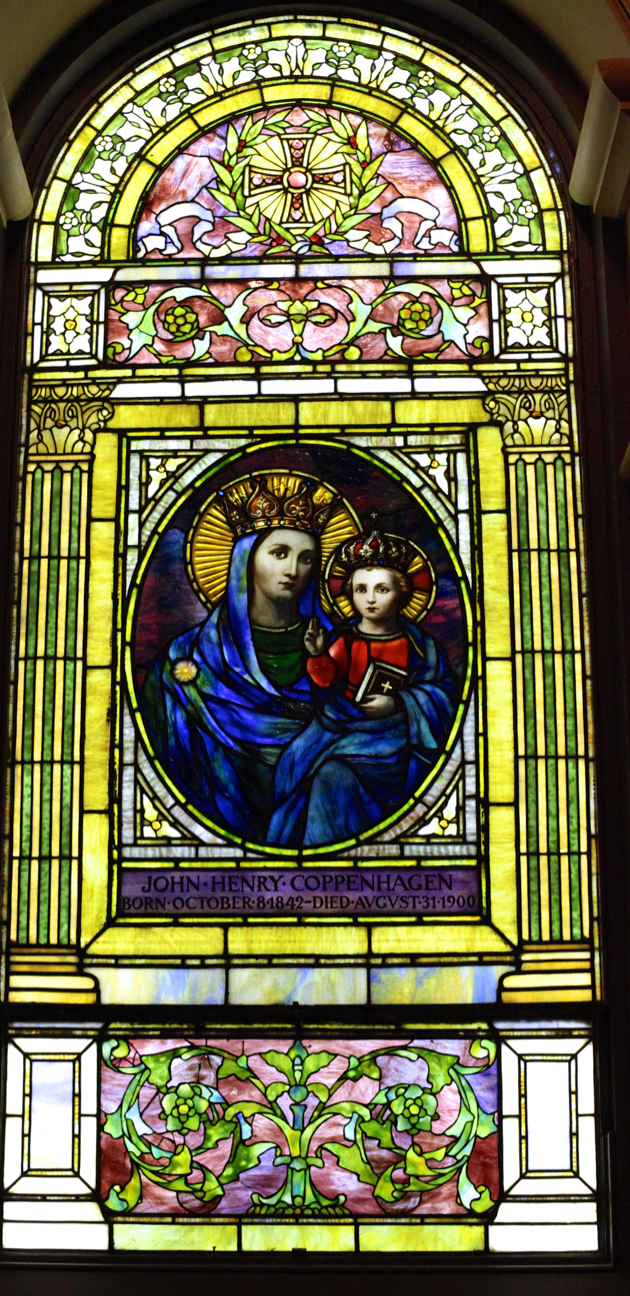
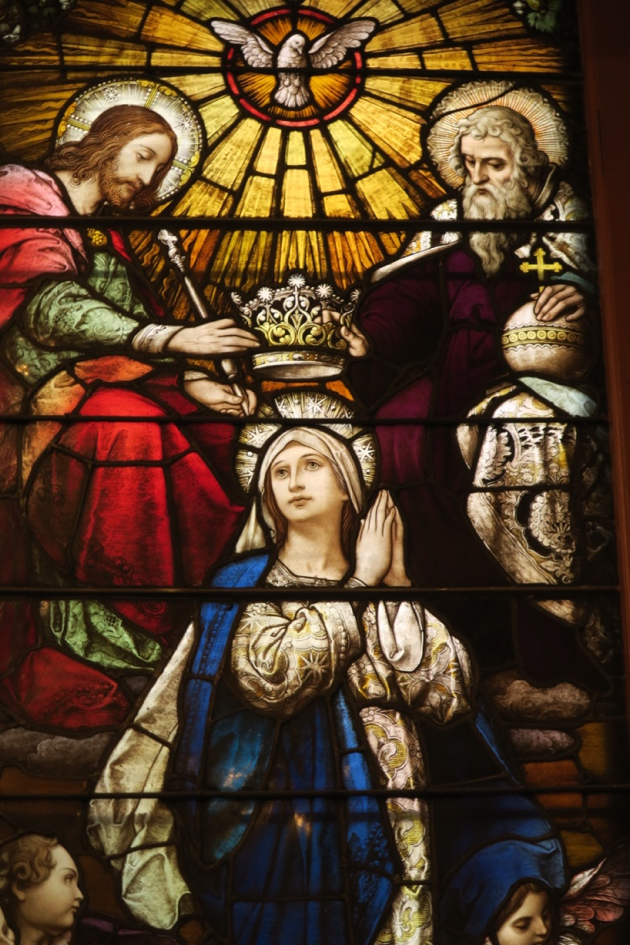
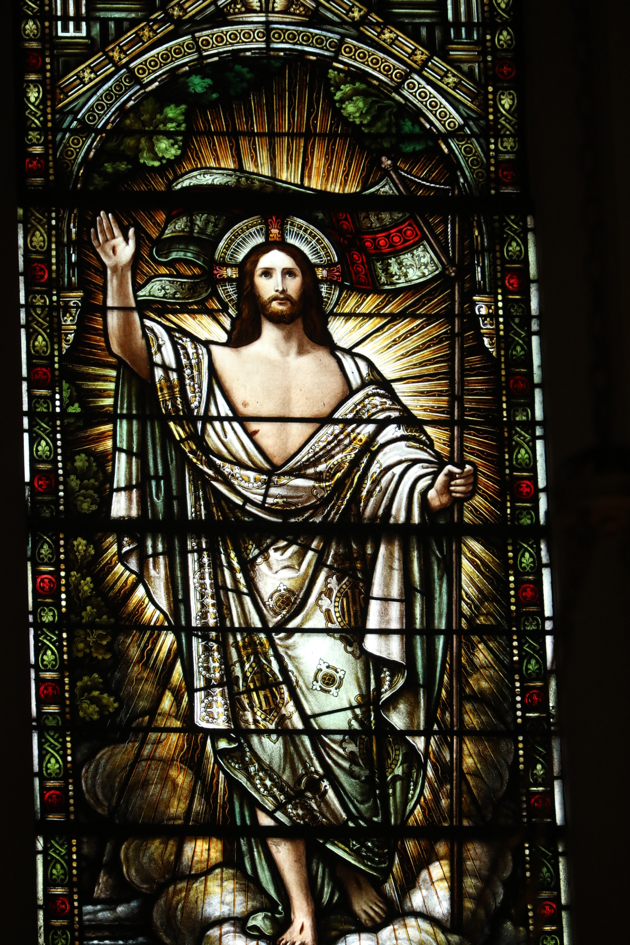
(Above) Stained glass window from the original Maronite parish church of St. Joseph in the chapel of St Joseph.
We have previously covered the story of St. Joseph’s: a nondescript modern chapel but heir to a long Arab-American tradition in this neighborhood as well as being the Archdiocesan “Catholic Memorial at Ground Zero.”
We now learn from the New York Post that the chapel (part of the parish of St. Peter) is in fact required to pay substantial rent for the space it occupies – a cost apparently borne by the Archdiocese – and, after recent massive rent increases, may close.
In the New York Post article there is not one word about the chapel’s alleged status as the Archdiocesan 9/11 shrine. Rather, resistance seems to be coming mainly from Arab-American groups concerned about the fate of what many years ago had been a Maronite church. So as the Roman Catholic presence in this neighborhood totters on the brink of extinction, not too far away the splendid new Greek Orthodox church of St Nicholas inches towards completion…
16 Mar
2017
St. Ignatius still presents a very handsome appearance to the visitor. The gold of the marvelously intact and well-maintained interior is festive but restrained. The statues, altars and stained glass are very fine and typical of the period – but, in general, do not rise above the level of the artwork of other, more ordinary parishes of that era. Only the magnificent metalwork of St. Ignatius consistently achieves an artistic result fully commensurate with the impressive cost. But, as we shall see, it is unfair to view each item of the decor in isolation.
(Above and below) Aspects of the decoration and furnishings of St Ignatius Loyola – trying to capture the spirit of a renaissance Roman basilica.
The lavish use of marble facing and the many mosaics are a distinctive feature of St. Ignatius Loyola church. Certainly the mosaics of the apse and of the Stations of the Cross are impressive and were very expensive to acquire. We have to admit, however, that mosaic work was perhaps the least successful branch of ecclesiastical art at that time. Compare, for example, the somewhat later mosaics in St. Francis of Assisi church near Penn Station, celebrated in their day but likewise not totally convincing.
(Above) Mosaics in the apse: (below) mosaic stations of the cross.
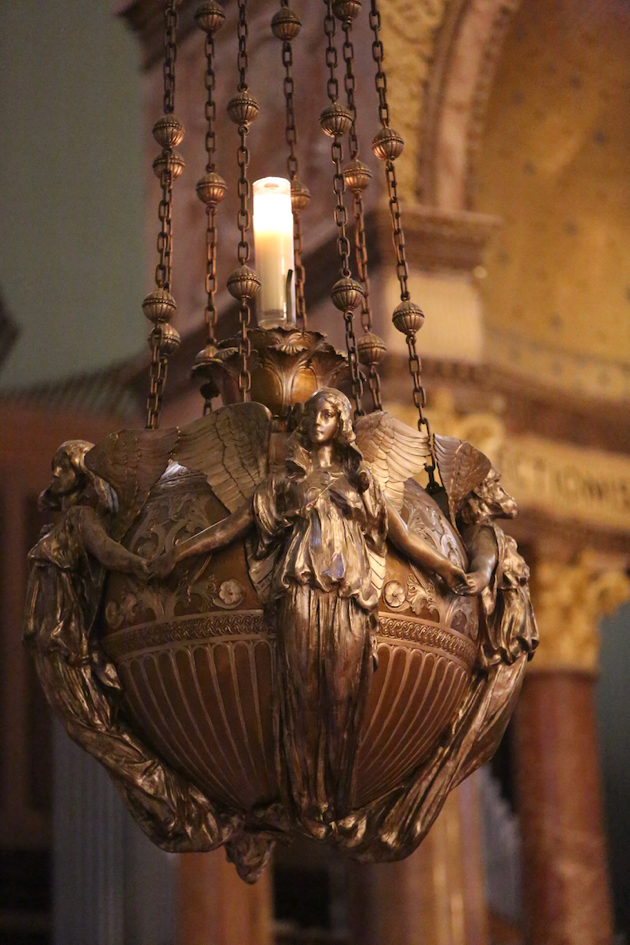
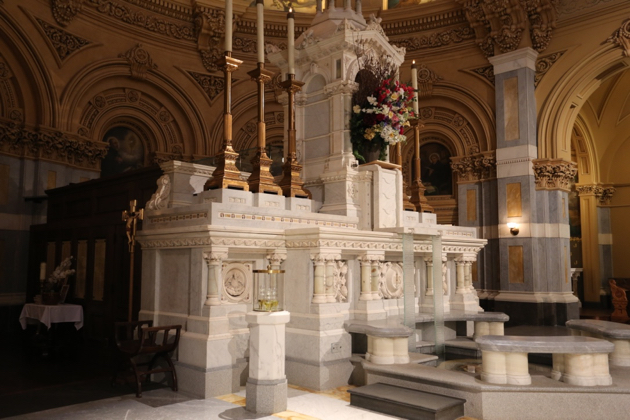
(Above and below) Magnificent metalwork in the sanctuary of the church.
(Below) the sanctuary lamp.
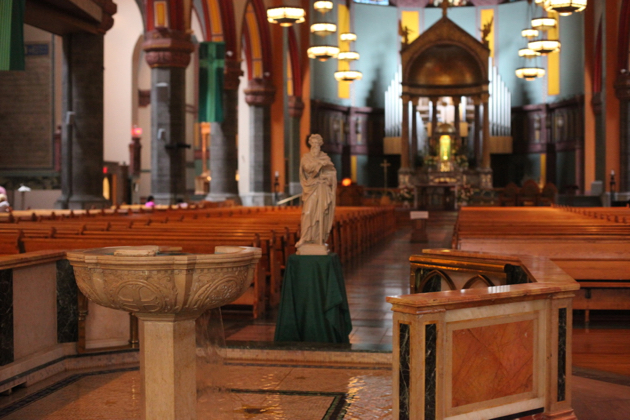
The real jewel of St. Ignatius Loyola, though, both in 1916 and today, is the world-class baptistery in the rear of the nave. Indeed, it was planned and completed before the decoration of the rest of the church, the decoration of which conformed to that of the baptistery. Designed as a monument to St John the Baptist, it was initiated by the devotion of one Jesuit Father to the Baptist and funded by an unknown donor. A circular confection of mosaics, marble, metalwork and stained glass, St. Ignatius’ baptistery is unique among New York Catholic churches. It incorporates the work of a number of artists, including Tiffany studios. 9)
Much of the decoration of the church dates from one campaign in 1910-13 by the then pastor, Fr. Hearn, to finish the interior. Mosaics(imported from Venice), frescoes, statues, colored marble, stained glass and altars were installed at that time. We see here the tendency in this, the “golden age” of New York ecclesiastical art, to integrate all decorative elements in one whole. In St. Ignatius Loyola, a model of that artistic understanding was already at hand – the baptistery. The effect is to recreate the appearance of a Roman basilica in Manhattan. 10) The more sophisticated artistic talent and greatly increased financial resources available to the New York Archdiocese after 1890 made possible the realization of such projects.
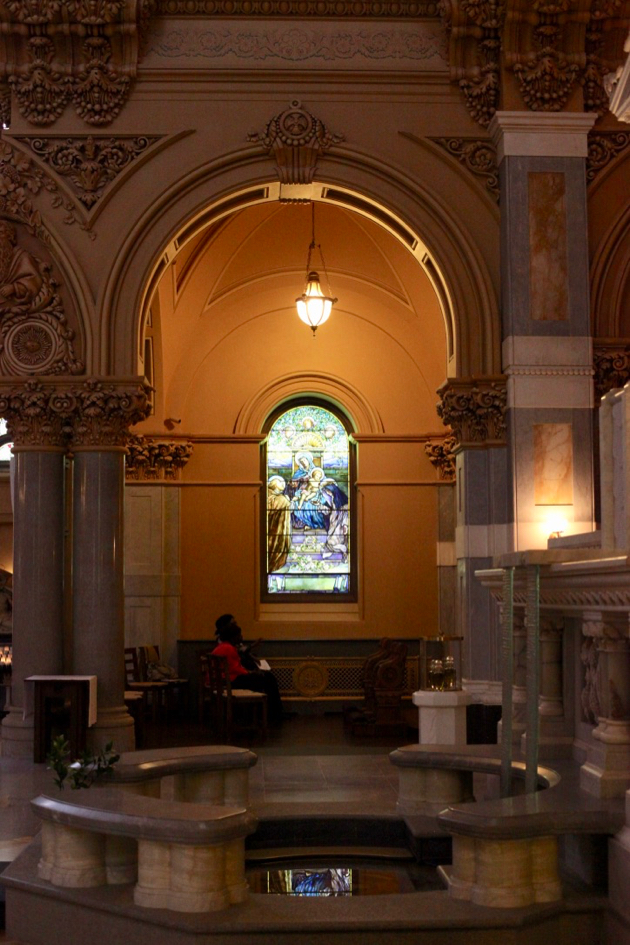
(Above and below) the Baptistery.
Now, in 2016 the Jesuits have celebrated yet another 50 years at St. Ignatius. There are far fewer Jesuits at the parish and its schools. But even if they are giving up apostolates from Auriesville, New York to Staten Island, the Jesuits will still retain a presence at St. Ignatius. Seen from the outside, the parish seems to have changed very little from 1966. The territory of the parish is still extraordinarily – and nowadays exclusively – wealthy. I would guess that the neighborhood is far less Christian, and that the Catholics living there are far more “international” than the Irish and German parishioners of yore. The parish boasts an impressive number of registered households; as in the case of the rest of the Archdiocese, however, those actually attending services are but a minority. Still, St. Ignatius parish still enjoys an income, mostly from collections, beyond the wildest dreams of most Catholic parishes.
The boys’ choir is gone – in return there are several “childrens’ choirs.” The day nursery, once a charity conducted by the sisters of Bon Secours to help working mothers, has been transformed into a lay-administered “highly selective” preschool for the wealthy (tuition: $24,300 for the full day program). 11) St Ignatius also hosts an ambitious and impressive musical “outreach” program – most unusual for Catholic parishes. Indeed, the alleged influence of the musical program became a point of discussion in the controversy over the renovation of the sanctuary in 2001-2002 (see below).
In recent decades St Ignatius Loyola parish settled into what could be described as a modern day Jesuit routine of catering to the rich while preaching a secular social gospel. Now ministry to the well to do is not without its dangers – both for the spiritual director and those he directs. That is especially so where, in contrast to 1916, the wealthy may bring to the table their own ideological baggage.
Let us mention a few recent highlights of parish history .
The funeral of Jacqueline Onassis (who was baptized at this parish but in more recent years had attended nearby St. Thomas More parish) in 1994 attracted an inordinate degree of media attention – and featured her “companion” reciting a secular poem. There has since been a series of “celebrity funerals” of individuals whose connection in some cases with the Catholic faith seems to me unclear.
In 2001 the Jesuits at last had decided to “renovate” the church – specifically, the sanctuary. Those of us familiar with the results of such plans at St. Francis Xavier, the other main Jesuit church in Manhattan, know what that likely would have meant. Yet, in a perhaps unique intervention by the Archdiocese to preserve a historic Catholic Church, Cardinal Egan in 2002 stopped the execution of this plan – specifically, the redesign and expansion of the sanctuary, including the removal of the communion rail. The pastor of St. Ignatius bellowed with rage:
(T)he sanctuary redesign is at the heart of what needs to be done. It would be a major compromise of our own integrity as a post-Vatican II community to spend over two million dollars refurbishing a Catholic Church and leave it as if the Council had never happened and the liturgy never reformed. (P)roceeding with a renovation without addressing liturgical needs would expose us to justifiable criticisms and even ridicule. It would be an embarrassment to the Society of Jesus to administer a Parish that had so glaringly turned its back on the liturgical movement inspired by Vatican II. 12)
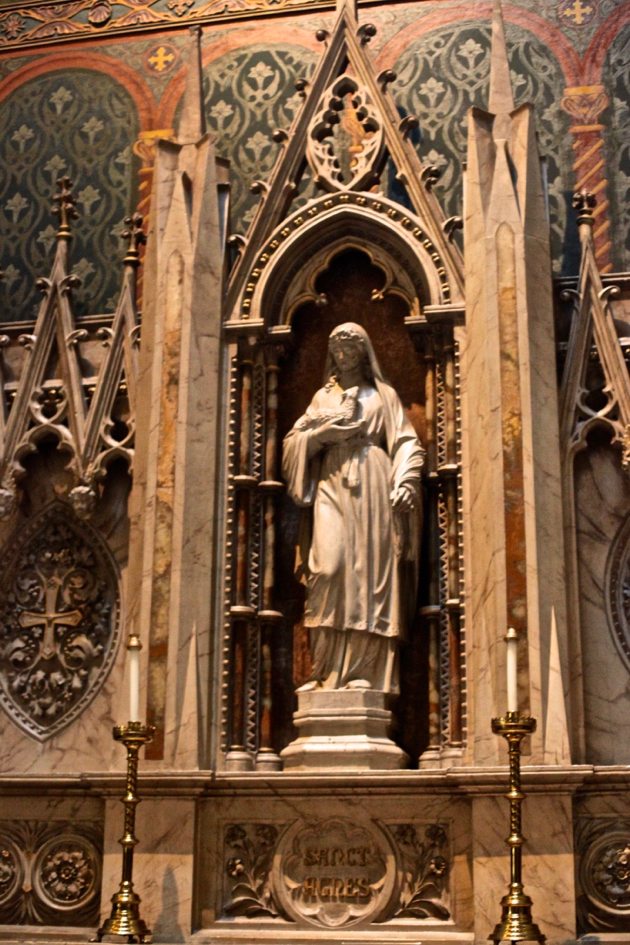
We have heard that certain parishioners of St Ignatius Loyola itself were active in achieving this result. Indeed, Cardinal Egan contended there were significant divisions within the parish, despite the claims of the pastor, Fr. Modrys, SJ, that support within the parish for the renovations had been “overwhelming.” A New York Times reporter, however, was able just in a cursory survey to identify “some difference of opinion” among parishioners. 13) We might add that only a few years earlier a Catholic church – St Agnes – had been rebuilt in Manhattan restoring a communion rail – “as if the Council had never happened and the liturgy never reformed.”
Finally, as part of the Making all Things New program, the Archdiocese in 2015 suddenly determined to fold the parish of St. Thomas More back into St. Ignatius Loyola, thus reversing the actions of Spellman in 1950. That step, however, was never carried out in the face of vehement opposition – this time from the parishioners of St. Thomas More.(Although the “cluster team,” including representatives of both churches, also unanimously rejected the proposed merger)
So, St. Ignatius Loyola parish remains standing in solitary splendor with its intact church and array of schools. It would seem that St. Ignatius has managed to continue the ambitious mission typical of so many New York City Catholic parishes of a bygone age. Naturally, the National Catholic Reporter in 2016 also acclaimed this parish. But we ask: does what is lived and taught today at St. Ignatius still resemble the doctrines professed there in the past? What exactly are the differences nowadays between St Ignatius Loyola and an upscale Episcopal parish of the City? This church, which of all Manhattan Catholic parishes has benefitted most from “demographic change,” may not have survived unscathed after all. For, as the German Catholic Church can testify, access to abundant financial resources is but one small aspect of the challenge of Christian mission.
PARISH WEBSITE (incuding a complete guide to the church)
.
16 Mar
2017
St. Ignatius Loyola and St. Lawrence O’Toole
980 Park Avenue
The austere gray neo-renaissance facade of the church of St. Ignatius Loyola blends well with the anonymous, uncompromising canyon walls formed by the apartment buildings of Park Avenue. It exudes the same reserved, off-putting attitude that once characterized the mainly Protestant economic elite of America. Inside the church, in contrast, we encounter a “Catholic” burst of color, mainly gold, covering the walls and ceilings of an interior in the Italian Renaissance style. Yet, on closer examination, this too lacks the decorative exuberance of many other Catholic churches of that era. Very expensive but cold marble and mosaics cover walls, baptistery and sanctuary. The magnificent golden metalwork of the railings, sanctuary lamps and pulpit gleams brightly. This is St. Ignatius, the main church of the Jesuits in New York City.
But this cold grandeur was not always so!
In 1851 a parish arose on the upmost fringes of New York City in what was at that time a distant village: Yorkville. That area included all the territory later considered part of the Upper East Side. 1854 a modest church on East 84th street was dedicated: “with the smoke of incense and the aspersion of holy water, the church was blessed under the invocation of St. Lawrence O‘Toole.” ( a 12th century bishop of Dublin). Archbishop Hughes preached, taking as his text Apoc. xxi 1-3: “and I saw a new heaven and new earth. … And I John saw the holy city, the New Jerusalem, coming down from heaven from God, prepared as a bride for her husband. And i heard a great voice from the throne saying: Behold the tabernacle of God with men, and he will dwell with them and they shall be his people; and God himself with them shall be their God.” 1)
(A little further, at Apoc. xxi 5, we read: “Behold I make all things new.” In 1854 the Archbishop of New York cited Revelations for building new churches – not closing them)
The Jesuits had been visiting the islands adjacent to Yorkville early on. The Jesuits came to exercise a ministry to these outcasts of the “periphery,” as the expression goes nowadays. First, there were the quarantined sick. (As one early Jesuit put it: other missionaries are like hunters who have to pursue their game, here the police drive the game to the missionary.) Second, and even more importantly, they took over the spiritual care of the home for “fallen women” in the care of the Good Shepherd sisters. Their duties at the convent included “confessions for the sisters, the Magdalenes, the penitents and the Perseverance class.” To reach the convent, the Jesuits had to travel north from their New York center at St. Francis Xavier in Chelsea far to the south. Given the transportation of the time the journey was very wearisome – so in 1866 the parish of St. Lawrence O’Toole was given to the Jesuits. 2) A former pastor of St. Ignatius has claimed that the Jesuits in fact “conspired” with the last Archdiocesan pastor of St Lawrence O’Toole – who had been a Jesuit and now returned to the order – to achieve this ‘takeover.” 3)
And then began an almost incredible change of circumstances. The center of New York wealth moved steadily northward along Fifth Avenue. Splendid mansions rose up along its length; the side streets and adjacent avenues flourished as well. St. Lawrence O’Toole parish, which had started as an outpost on the fringes of the city, by the 1890’s found itself in the midst of the wealthiest neighborhood in the United States, perhaps the world. Only the story of the surroundings of St. Patrick’s cathedral is comparable. The Jesuits of St. Lawrence O’Toole were active in the rapid buildup of Catholicism in Yorkville and what began to be called the Upper East Side – for example, they were directly involved in the organization of the German parish of St. Joseph.
A new church was required, reflecting the growing splendor and population of the neighborhood. At first, a Gothic style edifice was planned. Work was begun in 1884 but came to a halt in 1886. When it resumed in 1895, a new, grander design was adopted in the new style of that era: the classical/baroque/ renaissance idiom of the fashionable beaux-arts movement. The architects were Schickel & Ditmars (known at that time for executing numerous commissions for the Catholic Church, including Dunwoodie Seminary and the nearby churches of St. Joseph in Yorkville and St. Monica). The new church was dedicated in 1898 – the installation of the furnishings, mosaics and windows continued for years. In 1898, the upper church was dedicated to St Ignatius Loyola; the lower church to St. Lawrence O’Toole. Technically, since that year this parish has been under the joint patronage of these two saints. 4) Around St Ignatius church a whole complex gradually arose: a parochial school, a high school and associated structures. It was similar, in that regard, to many other parishes of that day – both those of the archdiocese and those of the religious orders – but on a more lavish scale.

(Above) The original church of St. Lawrence O’Toole (From Gilmary, The Catholic Churches of New York City(1878))
(Above) The transition from the buttresses of the original gothic plan of 1884-86 to the beaux-arts design of the completed church. (Below) The Roman beaux-arts grandeur of the facade. But two towers that were planned were never completed. Undoubtedly, as at St Vincent Ferrer, it was felt that any towers or spires would be dwarfed by the multi-story apartments rising up around these churches.
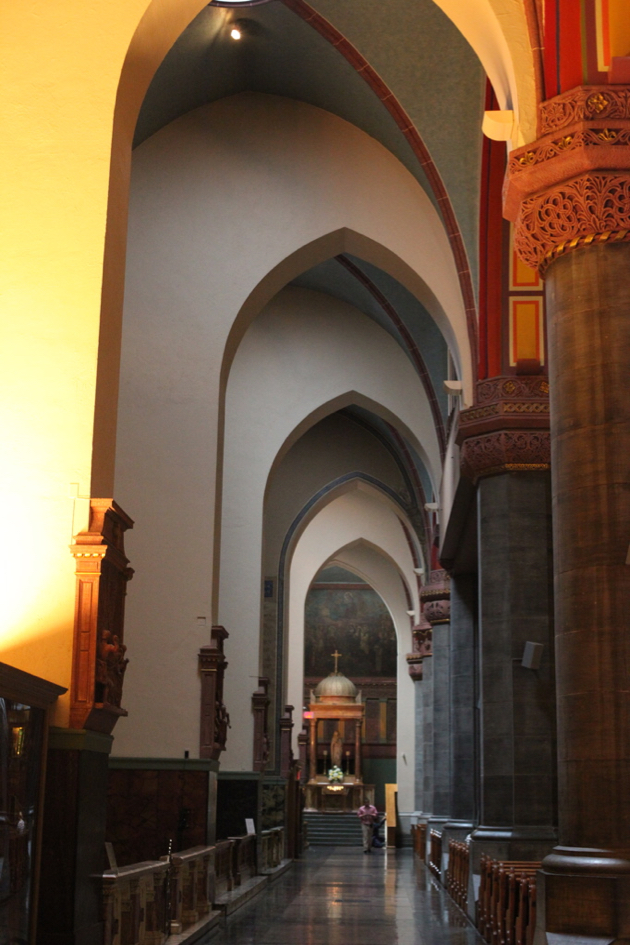
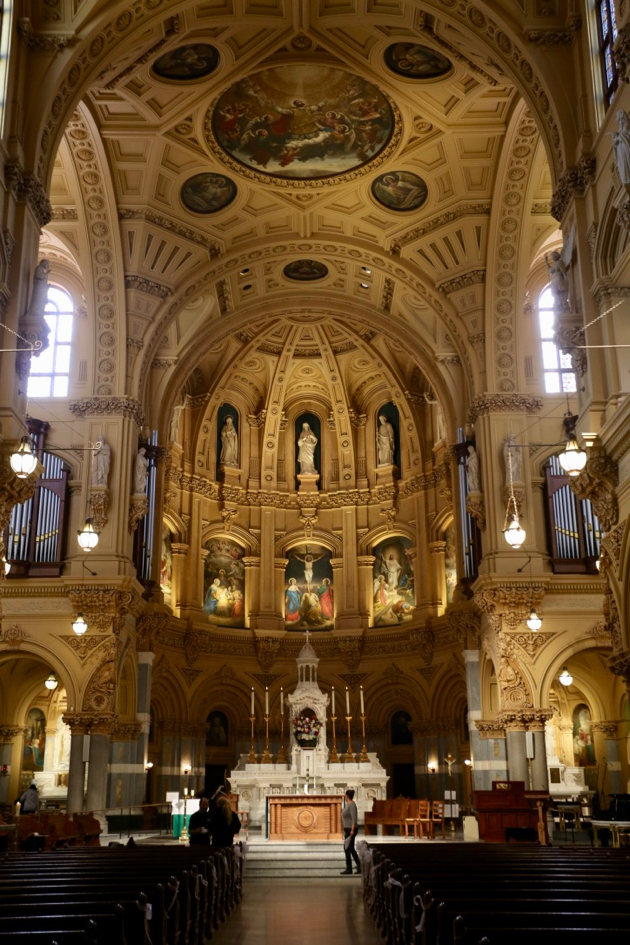
(Above) The nave and sanctuary and (below) a side aisle in Renaissance style.
(Above) St. ignatius Loyola; (below) St. Lawrence O’Toole. The two patron saints of the parish depicted in windows formerly in the lower church.
In 1906 the mixed choir of St Ignatius church was disbanded because of the Motu Proprio of Pius X on liturgical music. As a consequence in 1907 the boys’ choir was instituted. It soon attained citywide renown. (Similar developments took place at St Patrick’s Cathedral and St. Vincent Ferrer). 5)
Then came two special institutions.
Before World War I, St Ignatius Loyola parish straddled two worlds – that of the rich near Fifth Avenue, and across Park Avenue (and its railroad tunnel), that of the working class. In 1910 a day nursery was founded for the struggling working mothers of the parish. And then: “the sympathy of Mr. Nicholas Brady was enlisted in the work (of the day nursery) and, as he is accustomed to big things, his sympathy took on big proportions.” Brady (1878-1930) was a prominent businessman and Catholic philanthropist represented on the board of many American corporations. He purchased a new site at 240-42 East 84th street and in 1915 erected magnificent five-story building “fitted with every requisite for a day nursery.” It included originally an “exquisite” chapel. The only condition imposed by the donor was “that none shall be denied the use of its facilities on account of race, creed or color.” 6)
(Above and below) St. Ignatius Loyola’s day nursery.
Second, in 1914 Regis High School for boys opened its doors nearby. It had both high requirements for admission and free tuition – features it retains to this day. In fact, Regis High School is probably today what most New York Catholics think of when St Ignatius Loyola parish is mentioned. Not so well known, however, is that it too originated from a single donor’s initiative and generosity: Julia M Grant, widow of New York mayor and businessman Hugh J Grant. The family of Julia Grant continued supporting Regis financially for decades afterwards. This family involvement may partially account for the radically different course – regarding quality and finances – taken by Regis compared to most other Catholic schools of the area. 7)
In 1916 the Jesuits celebrated their first fifty years at St. Ignatius Loyola and St. Lawrence O’Toole. Henceforward the Jesuits’ mission became increasingly the polishing and perfecting of what had been created rather than the launching of new initiatives. The schools consolidated their reputations and acquired new facilities. The church received in the 1920’s magnificent new metalwork.
But, from the perspective of economic demographics, the luck of the Upper East Side Jesuits only increased. Through the 1920’s arose the endless wall of luxury apartment buildings that line Park Avenue. And, after the Second World War, what remained of old Yorkville “on the wrong side of the tracks” commenced its gradual transformation from working and middle class to a much higher income stratum. In fact, until the 1960’s the only fly in the ointment – other than negotiating the perils of the Great Depression – was the carve out of the new Archdiocesan parish of St. Thomas More in 1950. Cardinal Spellman undoubtedly wanted to share more directly in the Upper East Side glory!
And in 1966 the parish issued a slim follow-up volume to Dooley’s original parish history: The Jesuits in Yorkville 1866-1966. 8) It is a curious monument to a “Catholic milieu” which, within a few years, would utterly disappear. In this volume we still find talk of patriotism, anti-communism, sodalities, campaigns against pornography and conversions – and a photograph of a grand benediction in the presence of 20 copes. But we also read of ecumenism and aggiornamento, see a photograph of the mass celebrated “versus populum” and hear that attendance at the parochial school is declining.
The Old and the New. (Above) Forty hours devotion closing ceremony in 1966; (below) mass “facing the people” in the lower church.
(Both from The Jesuits in Yorkville 1866-1966).
At that time, the Jesuits stationed at the Upper East Side still engaged in a multitude of apostolates and ministries across New York City – including what had brought them to Yorkville in the first place: acting as chaplains to the island hospitals. (The Jesuits had had to give up their other early apostolate in the area, the chaplaincy of the convent of the Good Shepherd sisters, as early as 1892)
23 Jan
2017
The Archdiocesan headquarters – which includes the parish of St. John the Evangelist – may be up for sale:
While the building, which is more than 40 years old, is in need of repairs, its location, a block from the Sutton Place and the East River, between 55th and 56th streets, is in one of Manhattan’s most desirable neighborhoods.
The building’s owner is listed on city records as the Ecclesiastical Assistance Corp. The city’s Department of Finance estimates the market value of the property for fiscal year 2017-2018 at close to $112 million. The property is listed as tax exempt.
So, while in the last 15 years the New York Archdiocese has undergone two waves of parish closings(and even more drastic closings of schools) the Archdiocese was sitting on an office building worth over $100M.
The potential sale of the Catholic Center was first revealed in the National Catholic Reporter which published an extraordinary letter Pastores Dabo Vobis of Cardinal Dolan to his priests. It witnesses to deep tensions within the archdiocese. It seems the laity have become distinctly unenthusiastic about contributing to the archdiocese. And some of the priests are grumbling as well. There is no consideration whether the management of the archdiocese and its policies might be contributing to the dissatisfaction. Although we find references to “Dolan’s Folly” (the restoration of St Patrick’s cathedral),the closing of parishes and the 50% Archdiocesan “taxa” on “extraordinary income:”
“What causes some griping is our requirement that a parish receiving extraordinary income from such things as air rights, rental/lease/sale of buildings and property, or a big bequest, must give 50% of that to the “rich old archdiocese!” (A “custom” that arose under Cardinal Cooke.) “A majority of priests,” however, are of the opinion “that the ordinary expenses of the parish should be covered by the Sunday offerings, not by rental or endowment money…If a parish can’t cover its bills from the Sunday contributions of their people, because few go there anymore, that means we’re propping up museums with gravy income that should justly be spent elsewhere, and the parish should fold-up.”
Never have the actual driving factors of the Archdiocesan planning been expressed more clearly. And then there is an intriguing reference to “these parishes, mostly Manhattan ones, (that) “keep all this money to fix-up rectories, decorate churches, pay choirs and staffs”… .
I wonder what the Cardinal is thinking of?
Cardinal Dolan hammers on the need of the priests to “challenge” the laity to “sacrificial giving.” For if New Yorkers – those ingrates! – gave in the same percentages as in Dolan’s two former dioceses, the take of the Cardinal’s Appeal would have been nearly 3 times higher! And the archdiocese would be “sunk” without the contributions of those from NJ, Connecticut or Long Island – who do not live in it!
But:
To help correct this unfair and inaccurate perception of the archdiocese as some bloated, money-grabbing corporation, we are seriously looking into smaller quarters. 1011 needs repair, and it’s a good time to save the money and help with a new image by moving into smaller, simpler quarters.
11 Dec
2016

(Above) The cathedral (being renovated) against the background of one of the neighboring skyscrapers.
(Continued from part one)
If, prior to 1950, the never-ending process of embellishment and restoration had been a story of steady improvement, the post-Conciliar experience was anything but. Cardinal Cooke, for example, substituted statues of Mother Seton and Bishop John Neumann, in a grotesquely clashing style, for two of the Victorian-era side altars. Cardinal O’Connor went much further. He made significant changes, all under the rubric of “bringing the liturgy closer to the people” and making it “more visible.” A totally unnecessary “people’s altar” was inserted before the high altar, throwing the entire focus of the cathedral out of kilter. Bright lighting was installed, only demonstrating how little the Cardinal and his clergy knew about Gothic architecture. Finally, television screens were deployed around the nave. At some point in these years the two large altars in the transept were “repurposed” as a baptistery and shrine to Our Lady of Guadalupe. But despite all these painful mistakes, we can be grateful that, as a whole, St. Patrick’s was spared the post–Conciliar gutting inflicted on so many of its sister churches.
Cardinal O’Connor’s two successors retreated from some but not all of these mistakes. Among other repairs, Cardinal Egan substituted for the short-lived statue of John Neumann a new, more stylistically appropriate altar of Our Lady of Czestochowa. But the elements of this new altar had been seized from the magnificent church of St Thomas in Harlem, which the Cardinal had destroyed. We see here an unfortunate precedent: improvements to the cathedral begin to rely on the destruction of other Catholic churches.
We now come to the current restoration effort. Although the Cathedral has benefitted from more ongoing work than any other Catholic church in New York, Cardinal Dolan nevertheless felt inspired to commission a $171 million restoration. We have heard that the effort has left the Archdiocese very indebted indeed; we fear that the indebtedness will be financed out of the sale of other New York churches and their real estate.
What of the new restoration, now completed? Let me comment on the aesthetic impression, as opposed to the structural benefits. On the outside, the shining white church looks fine; one can now distinguish the different courses of stone. The results in the interior are more debatable. The bright, cleaned surfaces of the walls and ceiling, combined with the continued use of dazzling lighting, create a non-Gothic environment in which the stained glass, instead of illuminating the interior, recedes into the background.
And what of the life of the cathedral today? My knowledge of St. Patrick’s liturgical life in recent years admittedly has been restricted to the weekday afternoon services. The music, the preaching, the vestments and the ceremonial are dreadful; what kind of impression does this give to outsiders of the Catholic Church? For at all times a vast crowd of tourists circulates, vastly outnumbering the worshippers. A shop has been set up near the entrance for the convenience of all these guests. Innumerable stands for votive candles are placed around the church; they do remain popular. The candles thankfully are real, but for a number of years now their price has been doubled and their size cut in half. One thinks of J.K. Huysmans’s remarks about certain faithful “cheating God” with their (artificial) candles at Lourdes. What about the half-size ones here?
Fortunately the Eucharist is not the only sacrament celebrated at St Patrick’s; the sacrament of penance is one of the best options in town. But just be sure you arrive at the start of confession time – you will likely face a wait of a half hour or more!
So St. Patrick’s remains today more or less intact as a work of architecture. In contrast to almost every other Catholic church in Manhattan – except, perhaps, one or two commuter churches – it maintains a strong presence in the popular mind. In this age, these are real accomplishments. And in November 2016 even the Latin Mass returned to St Patrick’s for the first time since 1997. Does that herald a rebirth of liturgical and musical excellence? Will St. Patrick’s Cathedral no longer just seek out celebrity but aspire to the exercise of real spiritual leadership?
The side altars of the cathedral, (Above) The altar of the Holy Face (1891) which so impressed me as a child; (Below) An example of the famous “white marble” statuary beloved by the New York Irish.
(Above) This altar (erected after 1908) is a creation of Tiffany studios; (below) it was donated by the Bouvier family. Their descendant: Jackie O!
The stained glass of St Patrick’s has been created by artists not usually represented in New York Catholic churches and often depicts images that are unusual – even startling. The earliest (1879) glass came mainly from the Lorin studio in Chartres; of New York Catholic churches only St Jean Baptiste has a large set from this source. (Above) St. Henry Emperor of Germany warring against the “Slavonians” with saintly assistance. Cardinal Farley’s opinion in 1908: “It would do honor to the Louvre!”
(Above) The approval in 1725 of the constitution of the Christian Brothers (whose founder also has an altar in the cathedral).
(Above) A “dissolute monk” takes a shot at St Charles Borromeo, who is miraculously saved. (Below) St Charles Borromeo leads a procession among the plague victims of Milan – another favorite of Cardinal Farley. Windows donated by Lorenzo Delmonico – at that time the proprietor of the most famous restaurant in New York.
(Above) St Lawrence. (Below) Part of a window donated by James Renwick (who was not Catholic). The architect presents the plans of the cathedral to Archbishop Hughes. Disregarding normal notions of time, Cardinal McCloskey ( who built most of the cathedral) stands at his side, his hand on a diagram of that part of the cathedral’s plan which he altered . “James Renwick, Esq, New York” can be read on the portfolio propped against the desk. Lorin, the artist who created most of the original stained glass, can also be seen.
(Above and below) St Patrick’s features not one but two maiden saints being menaced – and then saved by divine intervention:(Above) St Susanna: (Below) St Agnes.
(Above) St Alphonsus Ligouri gives speech to a dumb man with a statue of the Madonna.
The installation of the much more sophisticated windows in the Lady Chapel by the noted English artist Paul Vincent Woodroffe lasted until 1932. (Above) A Bolshevik topples a cross.
Above him, the “goddess of liberty” of the French revolution sitting on the altar of Notre Dame cathedral
Sources:
(Anonymous) St. Patrick’s Cathedral, New York (West Chester, The New York Catholic Protectory Print (sic) 1879)
Farley, (Archbishop)John M., History of St. Patrick’s Cathedral (Society for the Propagation of the Faith, New York, 1908)
Carthy, Margaret, A Cathedral of Suitable Magnificence:St Patrick’s Cathedral New York (Michael Glazier Inc., Wilmington, 1984)(good on many of the parish activities of the Cathedral)
Basile, Salvatore, Fifth Avenue Famous: the Extraordinary Story of Music at St . Patrick’s Cathedral (Fordham University Press, New York 2010)
11 Dec
2016
(Above) The dazzling cleaned and restored facade of St Patrick’s.
St. Patrick’s Cathedral
Fifth Avenue.
Good Old Saint Pat’s!
What more can the chronicler of Manhattan Catholic churches possibly say about this most visited church in the United States? What can the photographer add to the each day’s new stock of pictures taken by the hordes of tourists, usually futilely firing their flash? For nearly everyone in the world has been to St. Patrick’s by now, or so it seems. We will only attempt to add a few comments to a well-known story.
My own memories go back to Cardinal Spellman’s era – to what now seems like a distant age. Thinking back to what I saw, I wonder at times if my memory is playing tricks now and then. Wasn’t there a life-size seated wax image of a pope in the vestibule of the cathedral – was it Pius XII? And nearby wasn’t there an American flag in a glass case – was it from the USS Arizona? For so many years, two favorite aunts of mine did duty behind the welcome desk at the entrance. After their death the cathedral hardly seemed the same to me. The welcome desk, too, seems empty most of the time nowadays. For in more recent years, the first welcome given the visitor is a search of any packages or bags being brought into the Cathedral. After an elderly usher was murdered in 1988, the visitor now is greeted by dark-suited professional ushers/guards. It seems that St. Patrick’s has moved high up on the potential hit list of terrorists.
Saint Patrick’s was begun under Archbishop Hughes in 1859. The Civil War interrupted the work, which was only finished in 1879. The spires came even later in 1888. But when the work was done, the Catholics of New York, who had started out from a single church in downtown New York, now had the most magnificent church building in the United States. To those like the historian John Gilmarty Shea, who had experienced the end of those beginning years , the transformation of Catholic fortunes seemed almost miraculous. And by the time it was finished, the cathedral also found itself on the poshest residential street of New York City!
These developments, of course, didn’t sit well with a certain segment of the Protestant New York; both the first 1879 guide to the cathedral and Cardinal Farley’s 1908 book on the history of the Cathedral felt compelled to devote extensive space to rebutting rumors (“believed by nine-tenths of the Protestant population”) that the land on which St. Patrick’s is located had been given to the Catholic Church by the City of New York for little or no consideration. A more effective Protestant response to St Patrick’s was the building of the Cathedral of St. John the Divine. Now some aspects of that structure are even finer than St. Patrick’s; however, St. John’s was never finished. Moreover, for all its grand dimensions, Catholic architecture and array of national chapels, St. John’s remained the church of a limited, restrictive denomination. And its location was and is out of the way and for some decades was downright dangerous as well. Whereas even if the vicinity of Saint Patrick’s has changed over time from residential to commercial, the neighborhood has always remained upscale and the very center of town.
Strangely, James Renwick’s St. Patrick’s Cathedral didn’t enjoy a good press among architectural critics until fairly recent times. Undoubtedly that it was Roman Catholic contributed to that assessment. For who seriously can deny the cathedral makes a handsome appearance on Fifth Avenue? Its intricate spires, pinnacles and tracery contrast effectively with the block-like rectangular forms of the high-rise giants that surround it. St. Patrick’s more than holds its own against these towers; indeed the facade of Rockefeller Center directly facing the Cathedral has been cleverly designed to subtly interact with the façade of St. Patrick’s.
And the interior of St. Patrick’s is even better: spacious, well balanced and harmonious. It has a kind of serene “classical” harmony that contrasts with the drastic, overpowering and startling perspectives of the buildings and plazas of the Center across the street. The deep blue clerestory windows of Charles Connick and the golden baldachin set exactly the right accents. The innumerable visitors each day seem to agree: all in all this is one of the most successful buildings in New York history!
The completion of the cathedral, however, was only the start of the story. For unlike many other New York Catholic churches, the work at St. Patrick’s has never ceased. It seems as if every Archbishop of New York wanted to add his own touches. The side altars, the Stations of the Cross, and many statues were added from the 1880’s through the early 1900’s. In 1901 the beautiful Lady Chapel, a high point of New York ecclesiastical architecture, was commenced; its decoration, especially the splendid windows of Paul Woodroffe, lasted until 1932. Cardinal Hayes added the grand organ in 1930 as part of a conscious and successful initiative to enhance the cathedral’s musical presence in the city.
Finally, Cardinal Spellman carried out a major redecoration and restoration program in the 1940’s. A new, more “liturgically correct” altar and a baldachin were installed in the sanctuary (part of the 1879 altar can be seen today in Fordham University chapel.) Massive bronze doors were provided for the facade. The Lady Chapel’s altar was redone. Most significantly, Charles Connick designed a series of magnificent clerestory stained glass windows and the facade rose window as well. St. Patrick’s had now matched some of the fine decorative details of its recent rival for the title of premiere Catholic church in New York City, St. Vincent Ferrer. This restoration was by far the most successful work of art and architecture Spellman completed during his long tenure.
We will pass over the long series of state visits, funerals and other events that took place here. We also will not review the lengthy story of the parish activity of the Cathedral. For St. Patrick’s was and is also a territorial parish with its own history of schools and other institutions.
(Above and below ) The cathedral under restoration. In the background, Rockefeller Center.
(Above) The cathedral bathed in light reflected from the neighboring Olympic Tower; (below) In turn, the cathedral’s image reflected in the tower’s glass wall.
(Above) The (unrestored) interior: (Below) the restored sanctuary.

(Above) The gallery organ of 1930; a key component of a deliberate strategy to enhance the cathedral’s music presence in New York. The new (1927) music director, Pietro Yon (the composer of “Gesu Bambino”) led the initiative.
(Above and below) The best aspects of Spellman’s renovations: the baldachin and the windows of Charles Connick (clerestory and rose).

(Above) The exterior of the Lady Chapel. The statue is an addition of Cardinal Cooke.
Post-1965 Restorations. (Above) An altar, taken from St. Thomas in Harlem, replacing a modernist statue of St John Neumann installed under Cardinal Cooke; ((below) the equally inappropriate statue of Elizabeth Seton still stands.

(Above) Votive candles – half size but twice the price!
(Above ) The mainly 19th century statuary in St. Patrick’s – almost all in the interior – earned great acclaim in its day. (Below) St Bernard – part of a unique series of the Doctors of the Church.
(Above) The Cardinals’ galeri hang once again from the ceiling – now in a side aisle of the ambulatory.
End of part one. See part two.
25 Nov
2016

(Above) The unprepossessing facade of St. Cyril’s (center).
St. Cyril
62 St. Mark’s Place
St. Mark’s Place, the “Fifth Avenue” of the East Village, features all kinds of businesses – more and often less reputable – operating out of storefronts and walk-ups in various states of disrepair. In the midst of this is St. Cyril’s church. It is one of that handful of Manhattan Roman Catholic parishes that never made the transition from the early years of poverty in basements, brownstones or tenements to a proper church or school (one also thinks of the old parish of Our Lady of Guadalupe or of St. Joseph in Battery Park City).
St Cyril’s parish was organized in 1916 at this location. It is the national church of the Slovenes. The patrons were St Cyril and Methodius. At some point this was shortened to St. Cyril – perhaps because of the existence of the parish of St. Cyril and Methodius of the Croats? (In Europe Croats and Slovenes are next-door neighbors but in New York City their churches are on opposite sides of town). St. Cyril has always been a Franciscan parish.
Now the Slovenes are one of the more obscure nationalities making up the Archdiocese of New York. They are a Slavic people inhabiting lands directly adjacent to Italy and Austria. The Slovenes were the first Slavic nation to convert to Christianity around 800 – in other words, well before the missionary endeavors of the patrons of this church, the “Apostles to the Slavs.” Over the centuries the Slovenes were almost fully integrated in the surrounding German culture of the Holy Roman, then of the Austrian Empire, yet always retained their own nationality. And after an interim period last century in Woodrow Wilson’s Yugoslavia Slovenia has been independent since 1991.
Most Slovenes who came to the United States migrated to areas with mining activity. But the small New York community is in part attributable to women skilled in weaving straw hats! Domžale (Domschale) is a town where the weaving of hats used to be a prominent industry. The women who did this work found their skills much in demand in the New York millenary industry of around 1910.
The visitor to a still functioning ethnic parish of this neighborhood would expect some kind of relic from a past age – perhaps decrepit but sheltering unusual images and paintings. Nothing prepares him for the surprise of encountering an ultra-modern interior in perfect condition! For the interior of St Cyril was entirely rebuilt in 1997. But for a few items – liked the stained glass windows of the patrons or of Frederic Baraga – all of the art of the church also was created at that time by Slovenian artists. Even the traditional image of the Madonna of Brezje (Pirkendorf) is a new copy from 1997. Indeed, St. Cyril may be the most successful modern interior of a New York Catholic church since St Catherine of Siena (1930). Even though its relative success is largely due to eschewing the grotesque faults of post 1950’s “modern” Catholic churches and to the unity of its décor.
The interior of St. Cyril’s: (above) lights out; (below) illuminated.

(Above) An old picture of the interior (from:The Church of St. Cyril: 100th Anniversary 1916-2016). The original furnishings seem to have disappeared before the installation of the Frederic Baraga window in 1986.
(Above and below) an inheritance from the past: the window of Saints Cyril and Methodius.
It is all very Central European – highly reminiscent of similar structures in Austria or Germany. On a recent visit, I noted the same to be true of the very small but well dressed congregation. My Slovenian is virtually nonexistent, but with my Rascher loden hunting jacket (designed in Germany, made in Poland) I felt I fit it in very well. But there is at least one significant difference between the New York Slovenes and their Teutonic neighbors back home: the friendly welcome the visitor receives at St. Cyril’s stands in greatest possible contrast to the suspicious, glaring eyes that usually greet the foreigner in Catholic churches of the German-speaking nations.

(Above) Our Lady “Help of Christians” of Brezje; the “Lourdes of Slovenia.”
(Above) Subject to correction by Slovenes, I believe this is a painting of Blessed Anton Martin Slomšek, 19th century bishop, author and advocate of Slovene culture. (Below) Window of Venerable Frederic Baraga, first Bishop of Marquette.
Things have not gone that well for the Church in the “old country” since independence. The percentage of Slovenes identifying themselves as Catholic has plummeted since 1991 to some 57.8 % in 2002 ( the date of – apparently – the last census which inquired as to religious belief). Even fewer believe in God.2) In 2013 the two archbishops of Slovenia resigned in a major financial scandal. 3)
Yet, even though this tiny parish celebrates only one mass – in Slovene – on Sunday, St Cyril’s soldiers on. Indeed, the parish’s 100th anniversary was celebrated in grand fashion in October of this year by the archbishop of Ljubljana, the largest city of Slovenia. The mass was followed by a dinner dance at he New York Athletic club at which Cardinal Dolan spoke. As is evident from their church, these Slovenes seem to dispose of financial resources – and ecclesiastical and political connections – far exceeding those of the average New York parish! I do hope they can keep this parish going – a testament to the true diversity that used to mark the Archdiocese of New York.
1) The facts in this article are largely taken from The Church of St. Cyril: 100th Anniversary 1916-2016 (Parish publication, 2016)
2) https://en.wikipedia.org/wiki/Religion_in_Slovenia
3) http://www.ncregister.com/daily-news/slovenias-two-archbishops-resign-over-billion-dollar-investment-collapse;
25 Nov
2016
St. Stanislaus
101 East 7th Street
Strolling east from Astor Place we enter the so-called “East Village” – actually the northern reaches of the Lower East Side. Now this is an area with “character. ” It seems – at least in appearance – to stubbornly resist the radical upgrading occurring almost everywhere else on the island of Manhattan. In recent decades the East Village has been better known for its drug scene and ancillary industries: tattoo parlors, “purveyors of Day-Glo paint” etc. 1) But there is much more here than just the alleged “counterculture.” The East Village abounds in curious buildings and relics left by earlier ages and earlier inhabitants: Germans, Irish, Jews, and Italians. Moreover, this neighborhood still shelters perhaps the only remaining presence of Christian and Catholic European ethnicity on Manhattan Island. Every year chips away at this remnant: Kurowicky’s Meats closed in 2007; Surma Ukrainian shop closed just this year after 98 years in business. But much of interest still remains.
Of these nations the Ukrainians of the Eastern rite are by far the most visible, with their splendid church of St George, built as recently as the early 1970’s, and their various restaurants and other institutions scattered over the neighborhood. Just over the northern border of this area we have on East 15th Street the church of St. Mary of the closely related Ruthenians. The Orthodox are also well represented, with St Nicholas of Myra church on Tompkins Square (Ruthenians) and the Orthodox cathedral of the Protection of the Holy Virgin on East 2nd street. I want to focus here, however, on Latin Catholics. I have described elsewhere in this series the “mainstream” parishes (originally Irish, German and Italian – later Hispanic) that existed (or until recent Archdiocesan actions, did exist) in the East Village. Here we will cover two ethnic holdouts.
St. Stanislaus is the surviving Polish national parish in Manhattan. Poles never acquired in the New York region the prominence they have in Chicago and elsewhere in the Midwest. And even then, one thinks of Greenpoint, Brooklyn or even Eastern Long Island, rather than Manhattan, as the major centers of Polish life in New York. But wherever they are, Poles have jealously defended their religion, language and culture. For them, the union of Faith and Nation is self-evident. And however abhorrent this formula is to the Conciliar Church, we cannot question its effectiveness – just ask the surviving leadership of the former Soviet Union.
This parish was founded in 1875; our main source for this early period tells a convoluted tale of ongoing strife among parishioners that was only resolved in the 1890’s. A saga more typical of the life of New York parishes in the first half of the 19th century before Archbishop Hughes took over! The current church was dedicated in 1901. By 1913 the church had 10,000 parishioners and a parochial school with 369 boys and 381 girls. Since 1986 this parish has been under the care of the Pauline Fathers.2)
The visitor enters through the doors of the plain façade into a dark vestibule or narthex. It abounds with older statues, icons and paintings – it serves as a veritable chapel. This is fortunate, since outside of Sundays – and presumably other mass times – the nave of the church is usually closed. There are also some curious things to read. An unexpectedly beautiful metal plaque from 1911 honors the pastor who really created the present parish in the time before the First World War. A later plaque commemorates the Requiem Mass celebrated here on July 2, 1909 for the famous actress Helena Modjeska. And then there is a poster in Polish pointing out the occult and satanic significance of certain medallions commonly worn by women today. I think to myself: I am going to like this place….

(Above and Below) Art in the vestibule:Our Lady of Czestochowa in a gold frame, an early naive painting of a christening.
(Above) Fine plaque commemorating Fr. John Strzelecki, who in essence refounded the parish after 1892 and built the present structures.
After the vestibule the nave of the church is somewhat of a disappointment. In its architecture and its dimensions, St. Stanislaus parish is a modest affair. It overflows with images and art from all the different ages of the parish’s life, but seems to have suffered from thoroughgoing modernizations in pre-conciliar times. (Judging from the form of the altar and the green stone sheathing, these restorations probably dates from sometime between the late 1920’s and the 1950’s – probably towards the latter part of that period). And since then, new devotions and shrines have been added continually: images and relics of Pope John Paul II and Fr. Jerzy Popiełuszko, a shrine of Divine Mercy, etc. It all leaves a mixed impression – a heterogeneous jumble of all kinds of artifacts and styles. It’s quite a contrast with the lavishly decorated, unrestored Polish parishes I have visited in Chicago, New Haven, Yonkers or Jersey City. Yet everything is in good order well maintained.
(Above) St. Stanislaus. The figure on the left is wearing armor of a 17th century Polish “winged hussar.” (Below) the wide variety of styles in this church is evident.
The masses seem to be plain but correct examples of he Novus Ordo. I don’t much appreciate, however, the large screen to the right of the altar upon which the words of the liturgy are projected. (Wasn’t the Novus Ordo intended to make the mass clear to the congregation?). As I prepare after mass to take pictures of some of the stained glass – which is not bad – suddenly all but two of the windows are plunged into darkness. But for those two windows, the stained glass is only visible because of artificial lighting on the outside…
(Above and below) Images and relics of Fr. Jerzy Popiełuszko and Pope John Paul II.
In contrast to most other Manhattan churches, this parish obviously still benefits from ongoing immigration. There are several masses celebrated in Polish and English on Sundays and weekdays; the parish still claims 900 registered parishioners. Numerous parish societies – many of them traditional activities and devotions – are still active, just like they did in the “good old days.” 3) On my recent visit the parish priest was announcing a dance social, a fundraising drive to repair the church’s steeple and news on the parish’s Polish school. So there seems to be continuing vitality. Moreover, the strong national commitment of this parish coexists with an apparent willingness to reach out to the broader community of Catholics and non-Catholics of the neighborhood. And even if the artistic expression of the new devotions are of uneven aesthetic quality, they nevertheless testify to an ongoing, vital Catholic life. St. Stanislaus parish is no museum!
1) An observation of the late Seymour Britchky
2) “St. Stanislaus Bishop & Martyr Roman Catholic Church” – Parish History (Parish brochure); The Catholic Church in the United States of America, Vol. 3 at 372-74. (New York, The Catholic Editing Company, 1914)
3) “St. Stanislaus Bishop & Martyr Roman Catholic Church” – Parish Life (Parish brochure)
21 Nov
2016
“Hotelier Jeffrey Dagowitz has snapped up three Chelsea properties for $50.4 million, including the Church of St. Vincent de Paul.
The Archdiocese of New York sold the three parcels — 123 West 23rd Street, 116 West 24th Street and 120 West 24th Street — to Dagowitz earlier this month, according to documents filed with the city on Monday. Together, the church-owned buildings span 32,600 square feet.”
The former French national parish of New York. Built in 1869, and the witness of many historic events. Closed by the Archdiocese after a heroic struggle over the years by parishioners – who in recent decades were mainly from Haiti and African French-speaking countries.
See our description of this church.