10 May
2021
10 May
2021
10 May
2021

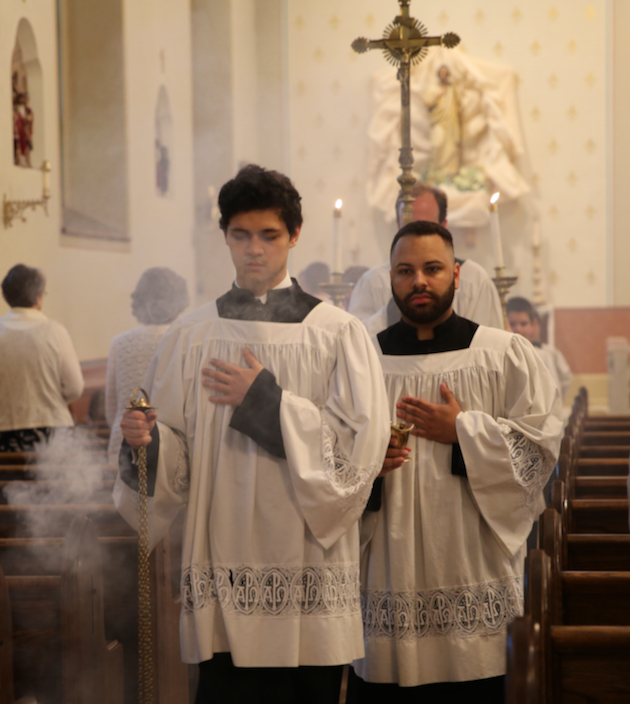
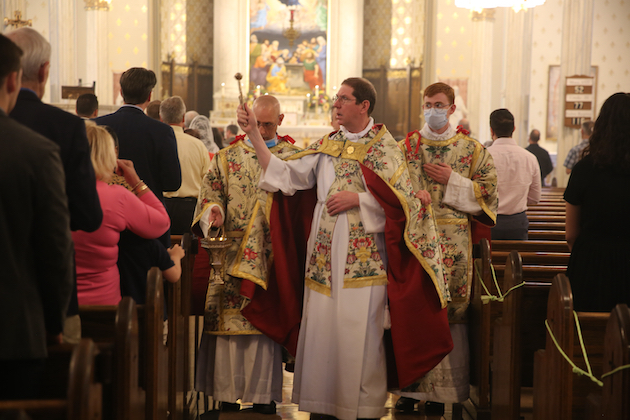
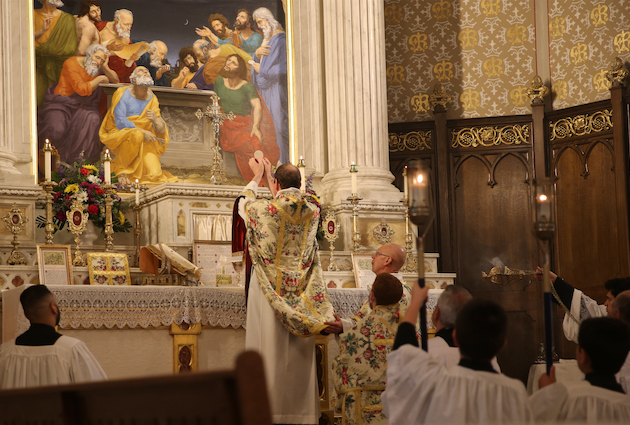
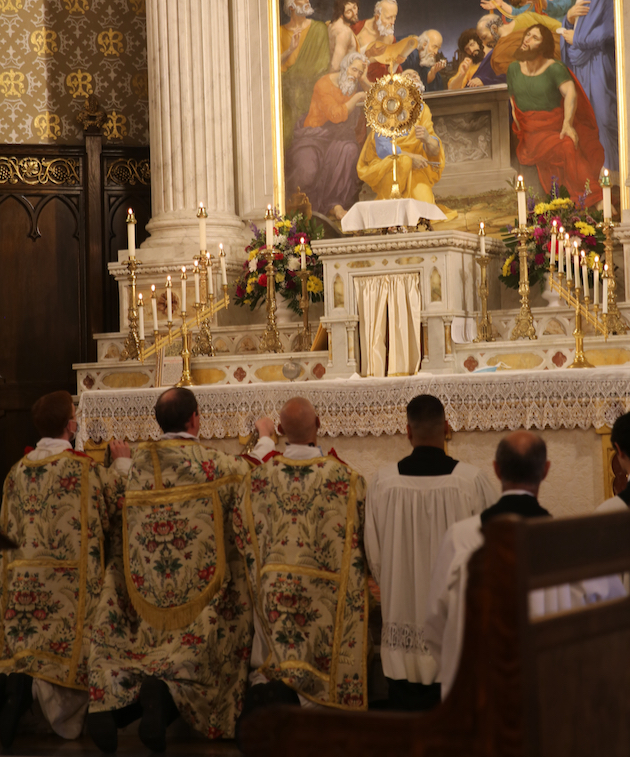
This Thursday, May 13, is the Feast of the Ascension of Our Lord, a holy day of obligation. The following churches will offer the traditional Mass. Please notify us if you know of a Mass in the area that is not on our schedule.
Connecticut
St. Mary Church, Norwalk, CT, 8 am low Mass, 7 pm Solemn Mass featuring Missa Ascendens Christus (Tomás Luís de Victoria).
Sts. Cyril and Methodius Oratory, Bridgeport, CT, 7:45 am low Mass, 6 pm Missa Cantata.
St. Pius X Church, Fairfield, CT, 7 pm, Solemn Mass. The pastor Fr. Kachuba is the celebrant.
St. Patrick Oratory, Waterbury, CT, 8 am, 6 pm.
St Joseph Church, Danbury, CT, 6 pm.
St. Stanislaus, New Haven, CT, 5:30 pm
Sacred Heart Church, Georgetown, CT will have a Missa Cantata for the Vigil of the Ascension on Wednesday, May 12 at 6:00 p.m.
St. Martha’s, Enfield, Ct. vigil Mass 7 p.m. on Wednesday May 12; Missa Cantata at 7 pm on Ascension Day.
New York
Church of the Holy Innocents, New York, NY, 8 am and 6 pm.
Our Lady of Mount Carmel,, New York, NY, 7 am low Mass, 7:45 am low Mass, 7 pm Missa Cantata, 8 pm candlelight rosary and procession. Confessions will be heard before and after Mass.
St. Josaphat Church, Bayside (Queens), NY, 7 am, 7:30 pm.
Notre Dame Church, New Hyde Park, NY. (Long Island), 7:30 pm Solemn Mass
St. Paul the Apostle, Yonkers, NY, 12 noon.
Immaculate Conception, Sleepy Hollow, NY, 7 pm.
St. Joseph Church, Middletown, NY, , 5 pm, Missa Cantata.
Sacred Heart Church, Esopus, NY, 11 am low Mass.
Holy Trinity Church, Poughkeepsie, NY, 7 pm Missa Cantata.
St. Mary Church, Ellenville, NY, 7 pm
New Jersey
Our Lady of Sorrows, 75 Claremont Ave, Jersey City, 5 pm.
St. Anthony of Padua Oratory, 1360 Pleasant Valley Way, West Orange, NJ, 9:00am and 7:00pm
Our Lady of Fatima Chapel, 32 West Franklin Ave, Pequannock, NJ, 7:00am, 9:00am, 12:00pm, 7:00pm
St. Anthony of Padua Church, 103 Gould Ave, North Caldwell, NJ, (SSPX), 10:00am and 7:30pm
4 May
2021
4 May
2021
1 May
2021
TLM Ablutions
By Father Donald Kloster
This article has been ruminating in my head for a few months now. Since the first week of March 2020, the virus has made the whole world a bit unreasonable. This past January 2021, I sat next to an epidemiologist during a dinner and we talked for about 45 minutes. He profusely complimented the Church and her wisdom of the ablutions before the faithful receive Holy Communion.
I’ve been working in hospitals and nursing homes as a Catholic priest or a seminarian for over 28 years now. I was a VA chaplain for 8 years in two VA hospitals in Texas. I was also full time at the trauma hospital in San Antonio, Texas as well as an emergency on call Catholic chaplain in several hospitals in San Antonio for 5 years. All told, I’ve visited patients in 21 different hospitals (2 countries and 5 states). I’ve also visited patients in 24 different nursing homes (3 countries and 4 states).
At no time before March 1, 2020 had I ever seen PPE (personal protection equipment) used against a virus. I do remember having to wear PPE at my time in the VA (2003-2011) against infectious bacteria and diseases. I also had to do it, on occasion, at several other hospitals. One had to wear the PPE in certain rooms. BUT, when you exited the room everything was thrown away including the mask, gloves, and gown. At no time did we ever wear the same PPE around more than one patient in more than one room. That was the protocol and still should be.
The big problem was that the veterans under precautions were allowed to leave their rooms, get on the elevator, and go outside for a smoke! That didn’t resonate with me then and that is why I suspect of all of the restrictions inflicted upon us now.
The Church has dealt with real plagues for almost 2 millennia now. Give or take a few years, plagues have come upon our populations in various places across the globe about every 50 years. Some were baby plagues and others wiped out significant percentages of our fellow man. Let us remember that the Spanish Flu killed 2% of the USA population from 1918-1920. Today, that would be about 6.6 million or 3.3 million USA deaths for 2 years. The Plague of Justinian (541-549) killed 25% of the world’s population or would be today’s equivalent of 10.3 million USA deaths every year for 8 years. The Black Death (1346-1353) killed 33% of the world’s population or would be today’s equivalent of 15.6 million USA deaths every year for 7 years.
In the Traditional Latin Mass, there are three required ablutions. The first ablution is with water in the sacristy before a priest vests. He prays, “Give virtue to my hands, O Lord, that being cleansed of all stain I might serve you with purity of mind and body.” The second ablution with water takes place at the offertory. “I will wash my hands among the innocent and will compass Thine altar, O Lord.” The third ablution is at the end of Holy Mass and uses wine (an antiseptic) as well as water over the fingers. “May Thy Body, O Lord, which I have received and Thy Blood which I have drunk cleave to my inmost parts.”
Before and during much of the Middle Ages, the faithful did not receive Holy Communion during Mass. Because of that historical fact, the wine ablutions would have ensured a type of quasi sterile hands of the priest when the faithful received the Blessed Sacrament. Then too, communion on the tongue was always largely the universal norm. As a priest of over 25 years, I can tell you that a priest inadvertently touches a lot of hands during Holy Communion in the hand while the faithful stand and almost never touches a tongue during Holy Communion on the tongue at the altar rail. The hands are a moving target and the tongue is a stationary one. Plus, how many things do people lick before receiving Holy Communion as opposed to how many things they have touched before receiving Holy Communion? Ah, the Church and her perennial wisdom!
In the Plague of 1576-1578 (it killed 5% of Milan in the first few months or would have killed the equivalent of 500,000 of present day New York City residents), which ravaged much of Northern Italy, St. Charles Borromeo often said Holy Mass on the steps of the Milan Cathedral (Duomo di Milano) and the people assisted at their windows or in the square at some distance from the portable altar. He did not cower in his Bishop’s palace. After Mass, he brought the sacraments into the people’s homes!
Since March, I have heard of many diligent priests giving the sacraments even to the Covid infected. This virus is not as bad as it has been presented. I would even argue that deaths from other categories are being coopted into the Covid death count thus propping up the numbers. The CDC admitted in late August 2020 that only about 6% (about 31,800 deaths in almost 12 months as of today 1 March 2021, which is the bottom end of a flu season) of the reported deaths were due to Covid alone. Most people do not know that in recent years, around 2.8 million USA residents die of all causes every single year. As long as that number stays constant relative to the yearly population increase (2019 population was 328 million and 2020 was 331 million), there is no reason for inordinate concern. The United Nations tracks the USA with a .08% average age of death increase for the past two years and predicts that will happen again in 2021 for the third year in a row. So, the average age of death in the USA for 2019 was 78.87. In 2020, it was 78.93. In 2021, they predict 78.99. Covid is not moving the death needle!
St. Charles Borromeo is quoted as saying, “I will do my duty to the utmost.” He also said, “Do not prefer a late death to a holy one.” Holy Mother Church has been a consistent practitioner in step with the science of the day. Her liturgy points us toward heaven and protects us against even earthly maladies.
Fr. Kloster
Diocese of Bridgeport
29 Apr
2021
28 Apr
2021
The 12:30 pm Sunday Traditional Mass is continuing under the new rector at St. Patrick’s Church in Bridgeport, CT (the Cathedral Parish).
27 Apr
2021
19 Apr
2021

(Above)Master of the Paris Bartholomeus Anglicus, Book of Hours Use of Paris, In Latin and French, Illuminated Manuscript on Vellum, Anjou or Le Mans, circa 1440s. CHRISTIE’S (Illustration: Artnews, 02/11/2021)
On April 23 you will get a chance to bid on a rare collection of manuscripts and early printed books at Christie’s, New York. I just had the pleasure of perusing this collection on a visit to Christie’s galleries. How precious to people of that age was the printed or written word! With what great care was it presented and preserved! The surprises are many – such as the first complete printed edition of Plato in any language (1484-85, in Latin translation). Most of this edition was printed by the Dominican nuns of San Jacobo di Ripoli, a Florentine convent!
But what probably will interest our readers most is the collection of books of hours – many magnificently illustrated. A book of hours was a medieval devotional book, which started as an abbreviation of the breviary but expanded to include much else beside. It was the most widely disseminated book of the later middle ages – in Latin but also in the vernacular. For the book of hours was not intended primarily for religious. Indeed, after the invention of printing, such volumes become acccessible to a fairly wide range of the population. Eamon Duffy has written an insightful and sympathetic account of late medieval prayer life, its origin, flourishing and end, based upon his study of books of hours and their annotations. (Marking the Hours: English People and their Prayers 1240-1570, Yale University Press, New York and London 2006)
It is amazing to walk past each of these beautifully displayed volumes, which admittedly represent a selection of the more luxurious books of hours. We are entranced by the jewel-like illuminations and the light flashing off the gilt pages. The book can be of incredibly small dimensions. The various liturgical “uses” represented show the diversity of the Roman rite at that time. Yet, as Duffy explains – somewhat contrary to a suggestion in the auction catologue – these books were not merely the status symbols of that time but afford us a glimpse into the private prayer life of the late medieval people.
You can review for yourself each volume in detail – or register to bid on the 23rd. Consult the Christie’s site:
(Estimates for the books of hours range from $30,000 to well over $1,000,000; the incunabula – books printed prior to 1501 – can be much more reasonable)