30 Oct
2020

23 Oct
2020

17 Oct
2020

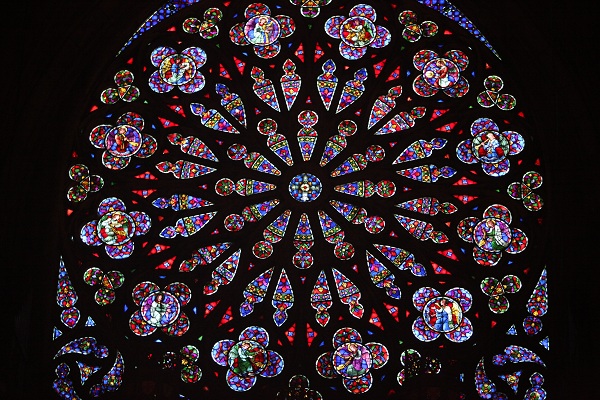
..above the choir loft of St. Lucy’s church, Newark, New Jersey. This church was built and decorated 1925 onwards. As is customary for the decoration of this corner of a church, King David and St.Cecilia are depicted. But in this window two others, both popes, find a place as well.

St. Gregory the Great, so strongly associated in Tradition with the development of the liturgy and of chant, sits on the left.

On the right is pope Pius X, the great champion of Gregorian chant in the early 20th century. The scroll he holds is not in chant notation, though.
8 Oct
2020

An award from the Federation of German Architects is bestowed upon this new church of the Archdiocese of Munich. Built from 2015 to 2018, the church of Blessed Father Rupert Mayer is thus entirely of the era of Francis. Yet it documents the continued fanatic commitment of the clerical establishment of the Catholic Church to the “eternal verities” of the 1960’s, regardless of all the talk and contrary aesthetic movements of the intervening years. And why not, if the secular world is so forthcoming with its recognition? For this is only the latest prize this structure has won. It’s only a shame there are so few faithful left in Germany to take advantage of it.
The media outlet of the Archdiocese of Munich provides a video (see below) of the dedication of the church by Cardinal Marx ( he of “Synodal Path” fame). Aside from giving you a more complete view of the building, it’s very instructive regarding the situation of the Church in Germany – even if you do not understand German. Note how many of the ministers (other than the priests) and of the congregation are female – such as the acolytes in their alternating green and red attire. And how so many of the adults, both male and female, have gray hair. The filmmakers carry out interviews of the congregation, asking “What do you think of the new church?” Naturally, only a pair of very old women unreservedly condemn the new architecture – every one else is accepting to enthusiastic. Cardinal Marx conducts the proceedings more or less as folklore ( like the knocking with the crozier on the church doors), somewhat like the funny hats and dirndls worn by certain of the laity. It’s all very, very sad.
It is stated in the video that this building cost 15 million Euro. Cardinal Marx is very pleased with it.
Katholisch.de: New Church Building in Poing receives architectural Award. (The video is embedded in this article)
3 Oct
2020

4 Sep
2020
Tonight: Please note that you need to register ahead of time. Call the parish office: 203-261-3676

27 Aug
2020
Which Canon Jean-Marie Moreau, ICKSP, has been building up in Sulphur, Louisiana. From Hurricane Laura.


20 Aug
2020

Polyphony has returned to St. Mary Church’s in Norwalk. Bishop Caggiano has granted permsion for a 4-voice schola. This Sunday, August 23, the Schola will sing William Byrd’s Mass for Four Voices at the 9:30 a.m. Solemn Mass.
Since the 9:30 a.m. Mass at St. Mary’s now regularly reaches its mandated capacity of 100 people, a Missa cantata (Extraordinary Form sung mass) will be added to the Sunday schedule at 11:30 a.m. Charles and Elizabeth Weaver will provide music at the 11:30 Mass this Sunday, August 23, including Ludovico Viadana’s Missa Dominicalis for solo voice with lute accompaniment.
Please call the church office at 203-866-5546 x 101 to make a reservation (as with all our weekend Masses).
18 Aug
2020

From the Rorate Caeli Twitter:
Re-read many years later, Fritz Fischer’s “Germany’s Aims in the First World War” (Griff nach der Weltmacht) seems even more convincing: it reads like a thriller, a very well-documented thriller. Highly recommended.
Griff nach der Weltmacht (The Bid for( or “Grasp after”) World Power) is one of the foundational works that sought to provide a theoretical/historical basis for the international order that emerged after World War II. It restated the thesis that the European calamities of the last century were exclusively attributable to a conspiracy of the evil Germans – a problem presumably solved by the establishment of American domination over Western Europe after 1945. To say that this analysis, as history, is questionable is the understatement of the century. What is interesting, however, is when (1961) and where (West Germany) The Bid for World Power appeared – at the start of Europe’s (and America’s) dramatic swing to the left. The historical vision of a clash between good (implicitly, the current establishment) and evil ( in this book, an earlier, no longer existing Germany) has endured until the present day – sometimes with shifting villains. So, on occasion the Poles and the Serbs have since found themselves also in the dock – much to their dismay.
The irony is, of course, that whatever its relevance may be to the origins and conduct of the First World War, just the title alone of The Bid for World Power exactly describes the course of United States policy, above all between 1939 and 1945. For it was in this period, after the abortive crusade of Wilson, that the United States definitively abandoned the status of a relatively “isolationist” power with limited foreign commitments in areas with real or imagined American economic interests (China; Latin America; the Panama Canal; the Philippines) to seek a condominium over the entire world shared with the Soviet Union. And even when that dream collapsed in the Cold War, the United States still found itself in possession of a vast world empire in all but name.
Against this backdrop, why a site that has so constantly and admirably championed Christian Europe – even the Habsburg Empire – would find The Bid for World Power “convincing,” without any reservations, escapes me. What will Rorate Caeli provide a blurb for next, Theodor W. Adorno’s Authoritarian Personality?
13 Aug
2020

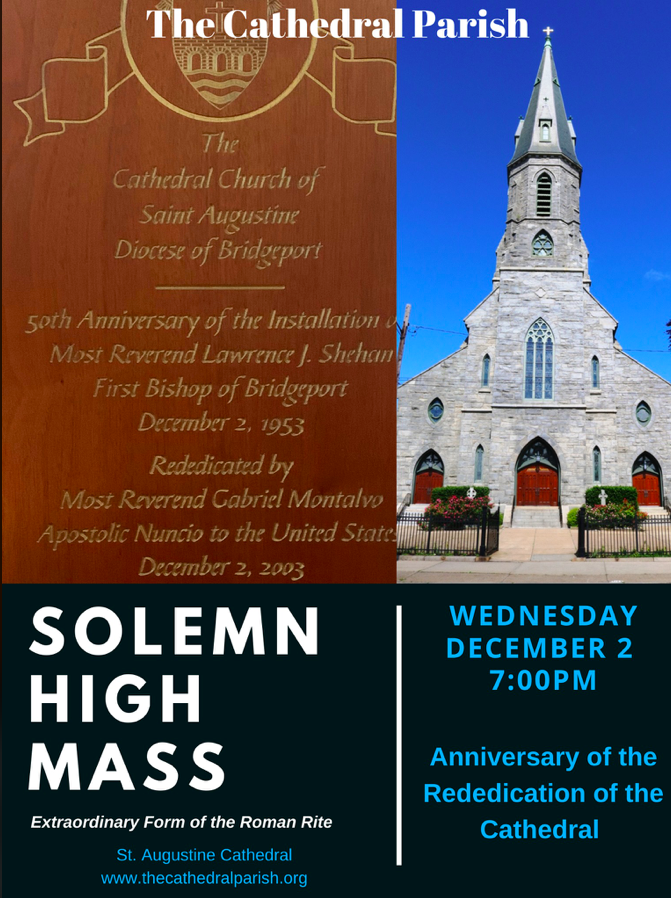
Good news: The Cathedral Parish in Bridgeport, CT now has the Latin Mass on the schedule 7 days a week, including 3 sung Masses a week:
Monday through Friday at 7 am at St. Patrick Church: Low Mass – Monday, Tuesday, Wednesday, Friday; Sung Mass – Thursday
Saturday, 9 am at St. Augustine Cathedral, Sung Mass
Sunday, 12:30 pm at St. Patrick Church, Sung Mass.