10 Mar
2016
1 Mar
2016
Showing what can be achieved with prayer and determination:
SHRINE OF CHRIST THE KING TO BE STABILIZED
Archdiocese Deeds Building and Property to the Institute of Christ the King Sovereign Priest
CHICAGO, IL (February 28, 2016) – The Archdiocese of Chicago today announced that it has deeded the Shrine of Christ the King in Woodlawn and the land on which it stands to the Institute of Christ the King Sovereign Priest. The members of the apostolic institute have confirmed that they have received sufficient funds for the immediate stabilization of the historic Shrine building, ravaged by fire in October, 2015, and determined to be in hazardous condition. The Institute has committed itself to promptly remedying the dangerous condition created by the fire and then following through with the full restoration of the building.
“We express our deep gratitude to all the individuals and organizations whose most generous and timely donations helped bring us to this moment. We are mindful of the dangerous condition of the Shrine and will begin stabilization immediately with funds already collected,” said Reverend Canon Matthew L. Talarico, Provincial Superior for the Institute in the United States. “We are grateful to the Archdiocese for its partnership throughout our ministry in Woodlawn, especially during this difficult time. Since the day of the fire the collaboration with the Archdiocese has been remarkable: frequent communication, hard work and prayer.”
In thanksgiving for this agreement and in celebration of God’s blessings, the Institute has invited the public to a festive Mass on March 19, the Feast of St. Joseph, at 10:00am in the Shrine’s current Mass location, the gymnasium of First Presbyterian church (6400 S. Kimbark Ave.). Afterwards, all are welcome for a St. Joseph Table luncheon reception with refreshments at 12:00 noon in the church hall of the same building. For more information on this event, contact: Rev. Canon Matthew Talarico at 773-363-7409, ext. 4, or at canon.talarico@institute-christ-king.org.
The Archdiocese of Chicago is supportive of the Institute’s efforts to maintain its presence in the Woodlawn community and continue its ministry there. The Archdiocese wishes the Institute every success.
29 Feb
2016
A significant article by Christian Browne that appeared in Crisis Magazine a few days ago. The author addresses the promise and current predicament of the Traditional Mass squarely:
“For, in order for the Traditionalist movement to realize its aims, the “Extraordinary Form” of SP must become less out-of-the-ordinary. While it is true (and wonderful) that the number of places in which the Tridentine Mass is regularly offered has grown markedly since the promulgation of SP, it is a fact that the vast majority of parishes provide Mass-going Catholics with no access or exposure to the ancient rite. The Extraordinary Form remains relegated to specific churches at limited times or to usage on special occasions.”
We should add that, as in the Indult days, in many churches the continuance of these celebrations in the “Extraordinary Form” remains de facto subject to the arbitrary discretion of the pastor. In our area just consider St. John’s (Stamford) or Our Saviour’s (New York).
I do not totally agree with the rather restrictive reading of Summorum Pontificum (“SP”) given by the author. And I can’t agree at all with this historical/sociological analysis:
Thus, SP has created a church within the Church, where the small but fervent band attached the traditional Mass adheres to a different calendar, often hears different readings than those proclaimed at the Novus Ordo and, in general, experiences significantly different liturgical norms and practices.
This “church within a Church” situation is not optimal. It can lead to a kind of separatism among those attached to the old rite who, perhaps unintentionally, come to look down upon the masses at the Novus Ordo parishes where parishioners are subjected to ugly vestments and “Here I am Lord.” Traditionalists can become cut off from the life of their local parishes, too, because they often must travel to specially designated churches on Sundays in order to hear the Tridentine liturgy.
… The divide is rarely noticed, but it is serious, for it is contrary to the very nature of the Church, the first mark of which is its “oneness”—Ecclesia una est.
SP did not create a church within a church, that was created by the Vatican and the Catholic hierarchy by decades of, first, outright persecution of Traditionalists and subsequently by “ghettoizing” them under the Indult regime. Traditionalists may be “looking down” on the Novus Ordo – but their attitude does not compare at all to the contempt they themselves are still widely subject to throughout the establishment Church. And in fact SP has greatly alleviated these animosities on all sides. Finally the author seems to be still a prisoner of his “Roman Catholic” legacy in that he is more concerned about preserving some imaginary monolithic unity within the Church than with upholding the truth and true worship. It’s an attitude under which Eastern Rite Catholics have long suffered.
But we can wholeheartedly agree with the author’s recommendations on the steps which must be taken:
Therefore, building upon the gift of SP, Traditionalism should now seek greater integration of those attached to the traditional Mass into ordinary parish life. The way to do so is obvious, yet fraught: to bring the traditional Mass into the regular practice of as many parishes as possible, particularly on Sundays. Indeed, SP expressly allows “one” celebration of the traditional Mass on a Sunday or feast day in a local church (SP Art. 5, Sec.2).
Now, again, working within the framework erected by SP, this spread of the traditional Mass into the usual roster of masses in a typical parish would have to commence with the laity—the “stable group of Faithful” desirous of such a Mass. In order to encourage the creation of such groups, we should enlist the aid of the many diocesan-level and regional Latin Mass organizations that have already successfully sponsored traditional Masses at designated locations. These groups could solicit interest in, and assist with, the creation of parish-level arms designed to make the request for the traditional Mass mandated by SP.
Mr. Browne thus looks to the evangelical action of the laity as the driving force behind the continued growth of the Traditional Mass. So strangely enough,it is the resistance to the “Mass of the Council” that will realize the alleged conciliar goal of “empowering the laity!” And has it not been the aim of our Society since 2007 to foster the expansion of the celebration of the Traditional Mass to many new churches and parishes?
An article well worth reading!
7 Feb
2016
The following churches will offer a traditional Mass for Ash Wednesday, Feb. 10
St. Mary Norwalk, Solemn Mass, 5:30
Antiphon at the blessing of ashes: Exaudi nos, Domine (plainsong, mode vii)
Motet at the imposition of ashes: Immutemur / Juxta vestibulum (Cristóbal de Morales, c.1500-1553)
Responsory at the imposition of ashes: Emendemus in melius (plainsong, mode ii)
Missa Deus Genitor alme (Vatican Gradual, Mass XVIII)
Gregorian Mass of Ash Wednesday: Misereris omnium
Motet at the Offertory: Tribulationes civitatum (prima pars) (William Byrd, 1540-1623)
Motet at the Communion: Timor et hebetudo mentis (Tribulationes, secunda & tertia pares) (Byrd)
St. Stanislaus Church, New Haven, Low Mass, 5:00 pm
Holy Apostles College and Seminary, Cromwell, CT, 9:30 am,
Immaculate Conception Church, Sleepy Hollow, NY, Low Mass, 5 pm
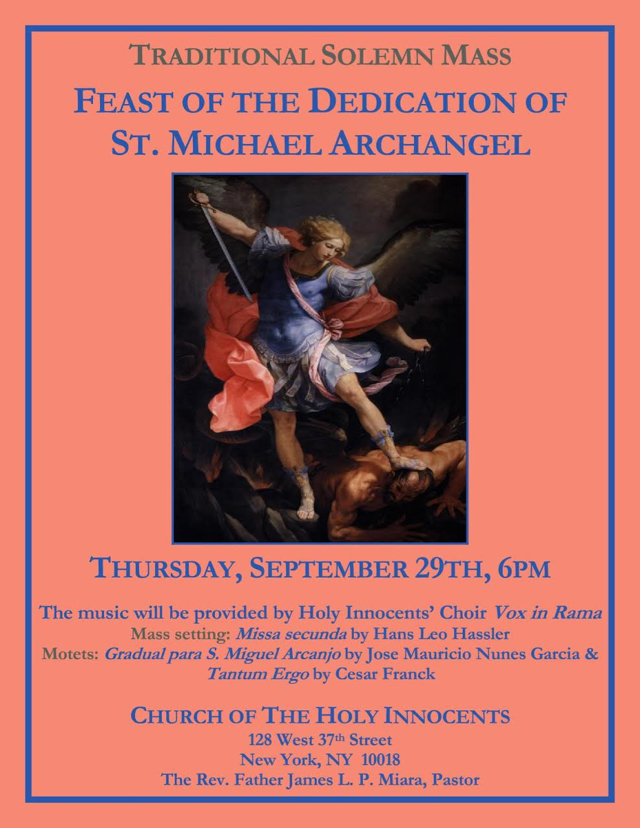
Church of the Holy Innocents, New York, NY, 8 am, 6 pm
Our Lady of Mt. Carmel, Newark, NJ, Solemn Mass, 7 pm
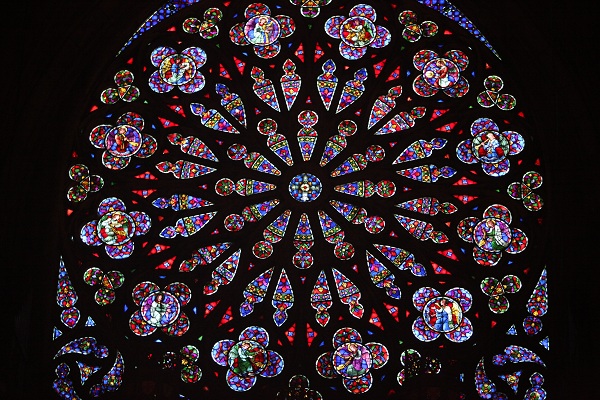
The stained glass window is in Most Holy Redeemer Church, Manhattan
28 Jan
2016
We received the following schedule of special Masses at Holy Innocents Church, Manhattan. All are according to the extraordinary form.
On Tuesday, February 2, 2016 is the Feast of the Presentation (Purification of the Blessed Virgin Mary). On that day, the Church of the Holy Innocents will have a Solemn Mass at 6 PM. On Tuesday, February 2, 2016 is the Feast of the Presentation (Purification of the Blessed Virgin Mary). On that day, the Church of the Holy Innocents will have a Solemn Mass at 6 PM. Parishioners are encouraged to bring their own (beeswax) candles to be blessed and to take home for their devotional use (please, label your candles in order to make it easier to return them to the appropriate owners).
On the first Sunday of February, the Church of the Holy Innocents celebrates the 115th Anniversary of its solemn consecration.
This year, that same Sunday is Quinquagesima Sunday, but being that the Anniversary of Consecration is a First Class Feast, the Mass on that Sunday (February 7) at 10:30 AM will be the Mass for the Consecration of a Church (Terribilis est locus iste).
On Wednesday, February 3, Holy Innocents will observe the traditional blessing of the throats after the 6 PM Mass for the Feast of St. Blaise.
This year Ash Wednesday falls on Wednesday, February 10. On that day, we normally have two traditional Masses (one at 8 AM and one 6 PM).
Every year on Ash Wednesday, as many as 10,000 people visit the Church of the Holy Innocents and the Church Hall. The Church Hall will be open from 6:30 AM until 6:00 PM for the distribution of ashes. Many volunteers are needed to help in the Hall on Ash Wednesday. If you would like to help/volunteer, please contact Eddy ejtm83@aol.com.
The photo was taken last year during Lent at Holy Innocents, the pastor Fr. Leonard Villa, celebrant
8 Jan
2016
Bishop Caggiano will preach at Mass in the Extraordinary Form at St Mary Church in Greenwich on Sunday, January 10th at 2 in the afternoon.
28 Dec
2015
It’s still time for an end-of-year donation to the Society of St Hugh of Cluny! It is only because of our generous members that we are able to sponsor traditional liturgies, promote the Catholic musical heritage and organize conferences involving leading speakers – often from outside the United States. In 2016 we intend to do much more even than this year – but we need your help.
This month we have moved into the 21st century and have added a Paypal button with which donations can be made. It can be found to the right side of the screen.
Donations to the Society of St Hugh of Cluny (a 501 (c) (3) organization) are deductible as provided by law.
St. Hugh of Cluny was a major sponsor of the Sacra Liturgia Conference in June.
21 Dec
2015
From last year’s midnight Mass
If you haven’t been to Christmas Solemn Midnight Mass at St. Mary’s Church, Norwalk, this might be the time to start going. Plans are in the works for the St. Mary Schola Cantorum to sing Mozart’s Mass in C Major (K. 258, “Piccolomini”). The choir, under the direction of David Hughes will be joined by a string orchestra. Elizabeth Weaver will sing the Laudate Dominum from Mozart’s Vesperae solennes de confessore, K. 339.
There will also be a Solemn Mass for Christmas Day at 9:30 am featuring Victoria’s Missa O Magnum Mysterium.
There is plenty of parking in the church lot behind the church and in a large bank lot across the street.
Here is a full schedule:
Christmas Eve:
11 pm Rosary by the creche
11:20 pm Orchestral Prelude: Christmas Concerto (Concerto grosso in G minor, Op. 6, No. 8) (Arcangelo Corelli, 1683-1713)
11:30 pm Christmas Carols
Carol: What Child Is This (Greensleves)
Carol: O Holy Night (Cantique de Noël)
Carol: O Little Town of Bethlehem (St. Louis)
Carol: God Rest Ye Merry, Gentlemen
Carol: Tu scendi dalle stelle (St. Alfonso Maria de’ Liguori, 1696-1787)
Carol: Lo, How a Rose E’er Blooming (Es is ein’ Ros’ entsprungen)
Carol: De Virgine Maria (Carl Rütti, b.1949)
Carol: Silent Night (Stille Nacht)
Prelude: Desseins éternels (from La Nativité du Seigneur) (Olivier Messiaen, 1908-1992)
The Solemn Proclamation of Christmas
Hymn at the Procession: Adeste Fideles (John Francis Wade, arr. David Willcocks, 1919-2015)
Hymn at the Procession: Hark! The Herald Angels Sing (Mendelssohn, arr. Willcocks)
12:00 Solemn Midnight Mass
Mass in C Major (K. 258, “Piccolomini”) (Wolfgang Amadeus Mozart, 1756-1791)
Gregorian Mass of Christmas Midnight: Dominus dixit
Motet at the Offertory: Laudate Dominum (from Vesperae solennes de confessore, K. 339) (Mozart)
Motet at the Communion: Verbum caro factum est (John Sheppard, c.1515-1558)
Postlude: In dulci jubilo (BWV 729) Johann Sebastian Bach, 1685-1750)
Postlude: Fugue in A Major (BWV 536/2) (Bach)
Christmas Day, 9:30 am, Solemn Mass
Prelude: Puer natus in Bethlehem (BWV 603) (Johann Sebastian Bach, 1685-1750)
Hymn at the Procession: O Come, All Ye Faithful (Adeste Fideles, arr. David Willcocks, 1919-2015)
Missa O magnum mysterium (Tomás Luis de Victoria, 1548-1611)
Gregorian Mass of Christmas Day: Puer natus est
Gradual: Viderunt omnes (Pérotin, fl. c. 1200)
Motet at the Offertory: Verbum caro factum est (John Sheppard, c.1515-1558)
Motet at the Communion: O magnum mysterium (Victoria)
Postlude: In dulci jubilo (BWV 729) Johann Sebastian Bach, 1685-1750)
Postlude: Fugue in A Major (BWV 536/2) (Bach)
15 Dec
2015
“To sum it up, the relentless and organized revolutionary assault has finally reached the United States as the embodiment of the pre-1789 political order, and the Church, as the embodiment of the transcendental order. Our civilization will no doubt come to an end the day the Catholic Church and the United States join the revolution.“(My emphasis)
(Thomas Molnar, The Counter-Revolution at 202 (Funk & Wagnalls, New York, 1969))
Francis and Obama?
15 Dec
2015
A new edition of Traditionalist magazine is available, featuring articles by Roget McCaffrey, Bishop Athanius Schneider, Martin Mosebach, Maureen Mullarkey Fr. Richard Cipolla and many others. For a free download, go to
http://www.booksforcatholics.com/pdf/The_Traditionalist_2016_Special_Edition.pdf