10
Aug
I was fascinated to read the recently published Report in Paix Liturgique on the “epic” of Traditionalism in the United States. And not just because of the complementary reference therein to my own series on the history of Catholic Traditionalism! It’s always useful to get an outsider’s view of one’s own world – even though one may not agree with all his conclusions. The French believe, for example, that The Trouble with Harry is Alfred Hitchcock’s greatest film. It isn’t, but by understanding their logic one learns a lot about Hitchcock and his movies. On the other hand, Michel Houellebecq’s short book on H.P. Lovecraft is the best criticism of that American author published so far anywhere.
The Paix Liturgique Report, in eight installments, is attributed to the late Daniel Hamiche and is largely structured as an interview between him and the publication. It deals primarily with the present and benefits from “field work”: surveys on the current views of American Catholics. In certain areas the Report provides unique information – such as the installment on the sedevacantists and the independent priests. Given its French audience, the Report of necessity needs to set its discussion of Traditionalism in the wider framework of American Catholicism, both past and present. The Report accordingly starts with a brief historical review of American Catholicism from the 16thcentury to Vatican II. Actually, I have more critical comments on certain factual statements and judgments in this installment as opposed to the content of later chapters dealing with Traditionalism itself.
For example, we read that “only two colonies, Maryland… and Rhode Island (which practiced a “blind welcome” that is, without religious exclusion) had a Catholic population….” Rhode Island was actually militantly anti-Catholic. Perhaps the author really means Pennsylvania, the second British colony with a significant Catholic population, which just before the American Revolution was far more tolerant of Catholics than the original Catholic home of Maryland. Katherine Drexel was not a convert. Elizabeth Seton founded the Sisters of Charity in the United States, not just those of New York (that designation relates to a split later in the 19th century).
As one might expect, the Report describes with justifiable pride the major contribution of French Bishops in the early years of the US : some dioceses – New Orleans, Bardstown/Louisville, Vincennes/Indianapolis – were largely or totally in their hand, while Boston, New York and Baltimore each had at least one French prelate. However, although I haven’t attempted to make a complete tally, I am not totally sure that French bishops were a “majority” of the U.S. episcopate in the first half of the 19th century.
Of more substance are some nuances that I don’t think the author got exactly right. The domination of Irish Catholicism from 1830 onward is not attributable to the sudden appearance of the Irish: they always had been a strong component of American Catholicism from the founding of the United States. Rather, it was the radically increased number of the Irish (and also the German ) immigrants in the decades preceding the Civil War that by 1860 transformed the Catholic Church in America from an exotic fringe to a significant presence at least in most urban areas. The author also seems to think that the status of Catholics as a “closed society” prior to the Second Vatican Council is attributable to the multiplication of ethnic parishes. That was hardly the case – the alleged Catholic pre-Conciliar “ghetto” was typified by the mainstream “American-Irish” parishes, not Italian or Polish national churches.
Finally we note with some humor (and perplexity) our author’s assertion that:
“One hears now and then that American Catholics are more pious and practicing (compared to those of Western Europe) … . It’s hardly astonishing that 25% of baptized Catholics attend Mass every Sunday and of the remaining 75% a good proportion attends Protestant services, depending on the region.”
Perhaps this level of religious practice is acceptable, even admirable, compared to France or Germany – it is absolutely catastrophic, however, for the Catholic Church in America and for its finances. And the author attributes even these statistics primarily to the social pressure of an allegedly Protestant society. Now, as indicated in the very quote above, the Report is well aware of the “regional” differences in the United States. I am not sure though, that the author fully appreciates how radical those differences can be. For example, whatever the situation in “Trump country” may be, NO conformist pressure supporting religious practice exists in any of the places that control the secular power in the United States: New York City, Los Angeles, Washington D.C, Chicago, Silicon Valley/San Francisco, the suburbs of all these places, almost all of higher education – to name only the most prominent examples. Indeed, in this stratum of American society the public hostility to Christianity of any kind is strong and growing ever stronger. Like many European Traditionalists, Paix Liturgique is perhaps a bit too enthusiastic about the American scene.
The chapter of the Report on independent priests and sedevacantism is a unique contribution and fills a gap in my own essay. I would, however, wish to see the support for the author‘s estimate of the number of independent priests: it seems extraordinarily high to me. At least today in and around New York they are (perhaps with one exception) hardly found at all. The significant presence of various sedevacantist sects(as well as other FSSPX offshoots) is duly noted, as is the fact that such movements seem more numerous in America than elsewhere. But, if we consider sedevacantism to be the flip side of extreme ultramontanism, does not the Irish, papalist heritage of the “American Catholic Church” explain this phenomenon?
I would also highlight the installments of the Report on Traditionalism in the religious life, particularly that of the female religious. He also deals with the Society of St John Cantius at some length. Yet in his enumeration of “Traditional priests,” he considers the FSSPX, the FSSP and the ICRSS – who celebrate the Traditional Mass exclusively – to be the sole “traditionalist” clergy of the United States. I have noticed this attitude in other European publications.
Now I have attended celebrations of the Traditional Mass since 1988. Except in the very last year, almost all my experiences were with diocesan priests or members of “mainstream” religious orders who celebrated both the Traditional Mass and the Novus Ordo. Thus this essay very much underestimates the actual scale of Traditionalist activity. Of course the author is aware that there are a great many celebrations of the Traditional Mass in addition to those of the above orders and dedicated Traditionalist “chapels” (his term) and that many diocesan priests are involved. The author rightly points out the remarkable number of diocesan priests that have received training in the Traditional rite. He seems to think, however, that the activities of the diocesan priests are a kind of underground. That has not been the case for many years – Traditionalism in many places has become a normal aspect of American Catholic life.
Indeed, our author is heartened by his surveys that indicate that 72,7% of practicing Catholics find the simultaneous practice of both the Novus Ordo and the Traditional Mass pursuant to Summorum Pontificum “normal” and that 41.5% of these Catholics could well see themselves attending the Traditional Mass if it were offered at their parish. That’s impressive testimony to how, in the United States at least, the Traditional Mass has joined the mainstream of the Church as a significant and beneficial force. It is precisely for this reason, of course, that Pope Francis has now determined to destroy Catholic Traditionalism. What will be the result of his campaign in the United States? The facts set forth in this essay, demonstrating the growing strength and acceptance of Traditionalism among the laity, priests and religious, give me some confidence that it will survive the trials that are to come.

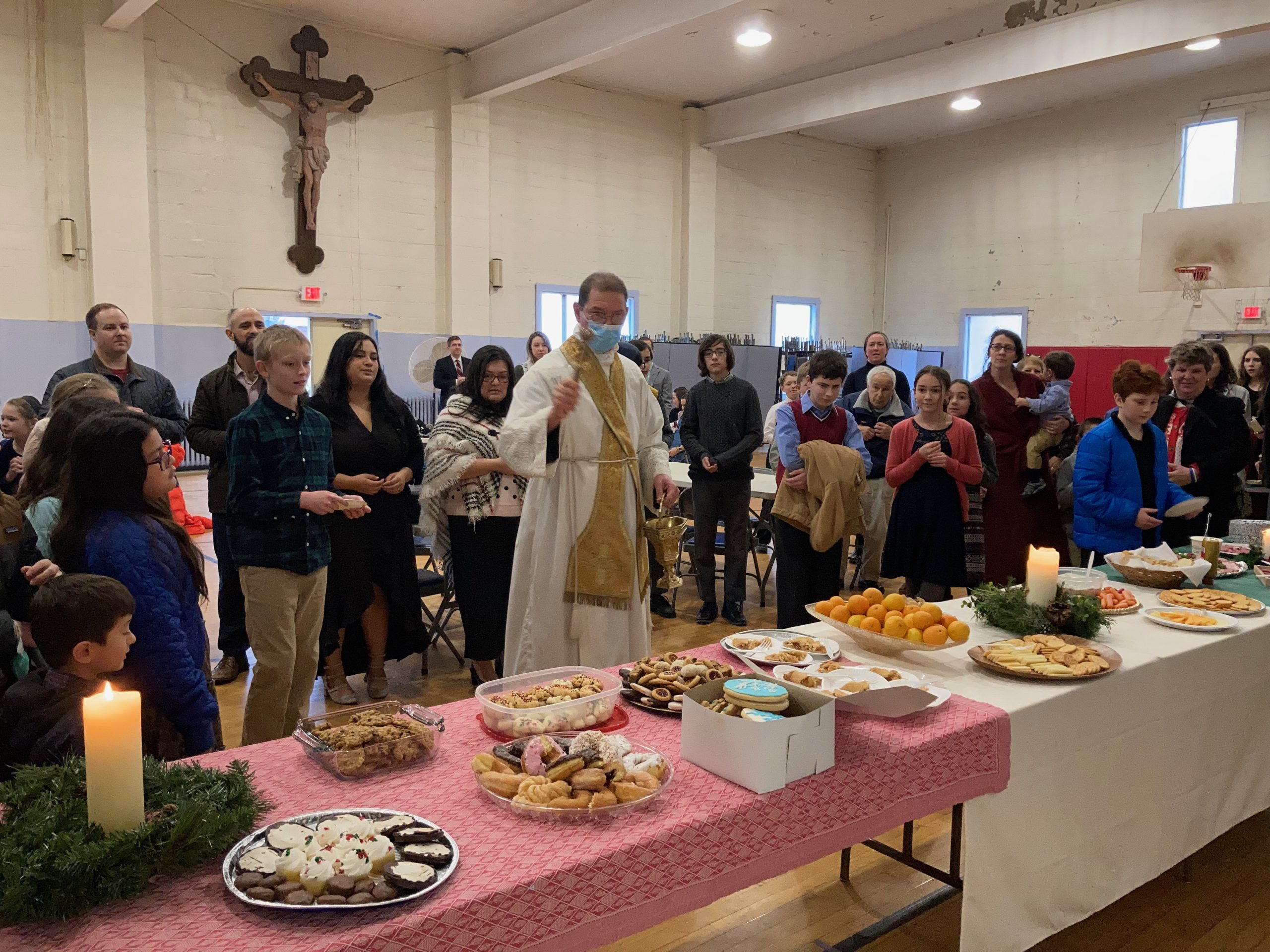
There is now a weekly Sunday Missa Cantata at St. Emery Church in Fairfield, CT at 12:30 pm. Fr. Peter Lenox is the celebrant. A lavish coffee hour follows the Mass in the church hall downstairs.


Historic photographs above from the website of Holy Family/St. Emery parish.
4
Aug

One hundred Catholics gathered this afternoon at St. Mary’s Church, Norwalk, CT to pray the Rosary for Bishop Caggiano and priests who say the traditional Mass. Bishop Caggiano was meeting during that time with his priests to discuss the Motu Proprio Traditionis Custodes. Reports of the meeting have been positive.
1
Aug
Sermon for August 1
by Fr. Richard Cipolla
From the 7th chapter of St Paul’s Epistle to the Romans: “I do not understand my own actions. For I do not what I want to do, but I do the very thing I hate…So then it is no longer I that do it, but sin which dwells within me…I can will what is right, but I cannot do it.”
Modern science for the most part still depends on experimentation to explain physical reality. The scientific method: observe, propose a theory to explain your observations, then perform experiments that will test the theory. If the results of the experiments match what the theory predicts, then the theory has a grounding in the truth of the nature of physical reality. If the results are not congruent with the theory, then you propose a new theory, think up and perform experiments, and see if the results are predicted by the theory.
Many years ago Einstein proposed what is known as the General Theory of Relativity. Observations based on that theory for nearly a century have indicated that Einstein’s theory has merit. One of his predictions was that there should be a faint echo of the beginning of the universe in background radiation. After a difficult and long search, using instruments of the highest sensitivity the fluctuations in the background radiation were not that long ago observed, and most physicists believe that this confirmed not only Einstein’s theory but also confirmed that the universe most probably began with what is now known as the Big Bang, an explosion of inconceivable energy that formed and is still forming the universe in which we live. And let us remember that the originator of the Big Bang theory was a Belgian Catholic priest, Monsignor Georges LeMaître. Yes. One can be a great and imaginative scientist and at the same time be a Catholic priest who believes the creation account in the book of Genesis.
In St. Paul’s Epistle to the Romans, he speaks of the relationship between the Law, sin, and Christ. In the passage I began this sermon with, he states in a bold and clear way the human condition vis a vis sin: Man’s inability to do what is right even when he knows what is right. In the First Letter to the Corinthians, St. Paul uses the history of the Jews in the Old Testament as experimental evidence, where the experiment is living a life, where the chosen people of God over and over again refuse to honor the sacred Covenant and to do what they know is right. This experimental evidence that is observation of facts is not confined to Jewish history. It includes all of human history, which is a history of man’s sinning in every possible sphere of existence. St. Paul loves lists, and his various lists of individual sins leave little out. His theology of the Cross of Jesus Christ is based on man who is in a fallen state and who is in terrible need of redemption. Paul’s words: “For since by man came death”. This is a wonderful summary of the meaning of the Fall of man. Without a need for redemption the Cross is unfathomable.
St. John Henry Newman, in a passage from the Apologia pro Vita Sua, presents the evidence for the theory of Original Sin. I dare not summarize his words but will offer them to you as he wrote them:
To consider the world in its length and breadth, its various history, the many races of man, their starts, their fortunes, their mutual alienation,
their conflicts…the greatness and littleness of man, his far-reaching
aims, his short duration…the prevalence and intensity of sin, the
pervading idolatries, the corruptions, the dreary hopeless irreligion—
all this is a vision to dizzy and appall: and inflicts upon the mind a
profound mystery, which is absolutely beyond human solution. What
shall be said to this heart-piercing, reason-bewildering fact? I can
only answer that either there is no creator, or this living society of
man is in a true sense discarded from his presence…if there is a God,
since there is a God, the human race is implicated in some terrible
aboriginal calamity. It is out of joint with the purpose of its creator.
This is a fact, a fact as true as the fact of its existence: and thus the
Doctrine of what is theologically called original sin becomes to me
almost as certain as that the world exists, and as the existence of God.
“Some terrible original calamity”. But the fact is that we live in a world, in a culture that not only denies the fallen state of man but also denies the very concept of sin. Modern and now post-modern man look at the evidence of the reprehensible behavior of man, which behavior they would admit, and posit a theory of their own to explain this terrible behavior, whether it be war, or pillage of some nature, or terrorism, or mass murders, or whatever captures the public’s eye on any given day. Their theory is that man is capable in overcoming this terrible behavior on his own, if only everyone were better educated, if everyone let go of any moral judgment on someone’s behavior, if only everyone would stop buying guns, if everyone came from the enlightened areas of the Northeast or the West Coast, if only everyone were dedicated to the value of organic kale, if only everyone underwent the moral lobotomy that characterizes the leaders of this world. Then all the bad stuff would stop. History would be changed into a series of glorious happenings that would explode into the apotheosis of the omega point.
All of this, mind you, in a culture that defends the reprehensibility of epidemic pornography that is destroying the deep meaning of human sexuality not only among young people but also in marriages, a culture that is also determined to cancel the fact and meaning of the objectivity of sex itself, doing so by canceling the word sex itself and inventing a completely new meaning for the word gender, allowing that word to be used in promoting an understanding of human sexuality that denies objectivity and revels in ever increasing modes of radical subjectivity.
And so when our politicians are confronted with the atrocities that afflict our culture and the deep sadness that follows, especially those that seem contradictory such as the killing of unarmed black people and the killing of policeman doing their duty, they do not rend their expensive clothing and put on the symbolic clothing of sackcloth and ashes. All they do is to posture and look serious in press interviews and say quasi pious things like that they hope for a time when hatred and killing and all social problems will end. But there is not a shred of evidence that these words of vague hope have any foundation in human nature.
There is no experimental evidence that man will come of age on his own, that his deep tendency to do the wrong thing can be eliminated by education in the right school or by espousing cheerful liberal principles. Government is necessary and must be supported. But government can never solve moral problems. Especially a government that denies the evidence of original sin and the need for redemption. Repent! Repent and believe the Gospel! This assertion, this shout, must be heard, but not as if it is only part of a wild Flannery O’Connor evangelical laced story of the deep South, nor in some sort of super traditional Catholic way that denies the reality of the world in which we live by looking to a mythical past, but in that way that will look at the evidence, will look at the data of experience that is human history, and will examine all of this in the light of the two possibilities: either that man is perfectible on his own as he matures, or that man is in the grip of sin and death that are the results of the Fall, and that the only antidote to this poison is the love and mercy of God seen and experienced in the person of Jesus Christ. This process of thinking about the situation of mankind and making a decision about what needs to be done, should not happen in some sort of deep existential agony and angst, nor in a professional think tank, nor on social media, least of all in a prestigious university, but, perhaps shockingly to many, rather here, within the beauty of this Traditional Roman Mass, at whose heart is Sacrifice and therefore joy. And perhaps, later on, a conversation over a glass of good wine.
30
Jul
Urgent: your prayers are needed as Bishop Caggiano of Bridgeport explores how he will address Traditionis Custodes in the Diocese of Bridgeport!

Please come and join us for a recitation of the Holy Rosary before Our Lord in the Blessed Sacrament this Wednesday, August 4th, at 1:30 pm at St. Mary’s Church in Norwalk, CT, downstairs chapel. We will be praying that God will guide our bishop in addressing Traditionis Custodes… and that the traditional Mass, a great treasure of the Church, will continue to flourish in our diocese.
Our group Rosary is taking place at the same time Bishop Caggiano is meeting with his priests to discuss how he will address Traditionis Custodes. Let us fill St. Mary’s!
Intentions of the Rosary:
• For Bishop Frank Caggiano of the Diocese of Bridgeport, that God will aid him as he addresses Traditionis Custodes
• For all priests in the diocese who celebrate the Traditional Mass
• For Pope Francis, that he will come to value the Traditional Mass as a great treasure to the Church
• That the Traditional Mass will continue to flourish in this diocese
Please join us next Wednesday, and help us get the word out. We would like to see the chapel at St. Mary overflowing with support and prayers.
If you cannot be with us or if you live in another diocese, we ask you to join us in prayer wherever you are. Ask the intercession of Our Lady and our patron, St. Hugh of Cluny.
By the way, Bishop Caggiano expressed his views on Traditionis Custodes on Veritas Catholic Radio. You can listen at this link: https://www.podbean.com/media/share/pb-4ee5a-109ec7e?utm_campaign=w_share_ep&utm_medium=dlink&utm_source=w_share

28
Jul
Charles Weaver, director of music at St. Mary’s Church, Norwalk, is offering two camps for young singers.
Basilica of St. John the Evangelist, Stamford
August 2 – 6 9:00 am – 3:00 pm
“I will sing with my spirit, but I will also sing with my understanding” (1 Corinthians 14:15).
The Basilica’s Chorister program is intended to offer young musicians the opportunity to share in the musical tradition of the Church as part of their formation as Christian men and women. All aspects of the chorister program, from the stunning location of the Basilica, to the deportment expected of the students, and especially the music they sing, are designed to instill in them a desire to cherish beauty and a recognition that this beauty is most surely found in the life of the Church. The choristers learn that participation in beauty requires dedication and hard work. They gain confidence and the ability to work cooperatively on a team.
The cost of the CHOIR CAMP is $100 which offsets the cost of materials, t-shirts, and guest faculty. Nick Botkins, Director Charles Weaver. Please register ASAP at this link
St. Mary Church, Norwalk
St. Mary’s has a proud tradition of chant camp for children stretching back to 2008. After two years’ hiatus, we are very glad to be able to offer it again to young people in our parish and beyond.

For more information and to register: https://www.stmarynorwalk.net/chantcamp/
28
Jul
27
Jul
Support the Feast of St. Rocco at the Church of St. Rocco in Glen Cove, Long Island. Solemn Traditional Mass will be celebrated this Saturday, July 31 at 4 pm. Low traditional Mass will be celebrated on Sundy, Aug. 1 at 7:30 am.
From the organizers: “Many other religious events, including a big procession of St Rocco, patron against plagues and contagious diseases, and the most amazing food and great rides and games. The Canons Regular of St Augustine have done so much for the Latin Mass community, homeschoolers, and all the Catholics in the Glen Cove area and beyond.
“The feast is a huge piece of St Rocco’s financial survival. It had to be canceled last year because of covid so the parish took a huge economic hit. There are many great food booths but the high point is in the church hall, where the dedicated and highly gifted Italian nonnas (grandmas) have been cooking homemade Italian foods of many sorts for weeks, freezing them to be ready for the great feast. There is indoor seating for meals or take out. Unbelievably well worth the trip alone. Please share this widely and encourage friends, family and neighbors to go. “


27
Jul
If you are in the New Jersey area on the First Tuesday of August, August 3rd, consider attending the Holy Mass of Reparation which will be celebrated by a newly ordained priest, Father Gregory Zannetti.
St. Mary of Mount Virgin Catholic Church 190 Sandford StreetNew Brunswick NJ 08901
Corner of Sandford St. & Remsen Ave., New Brunswick, NJ 08901
(732) 545-5090