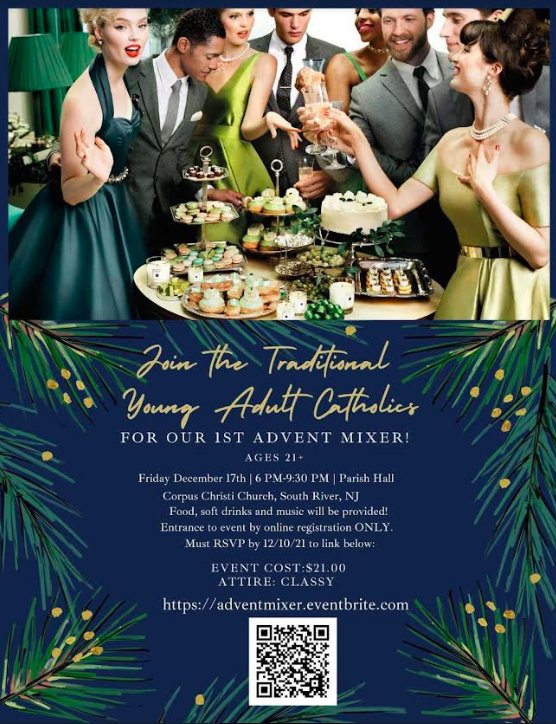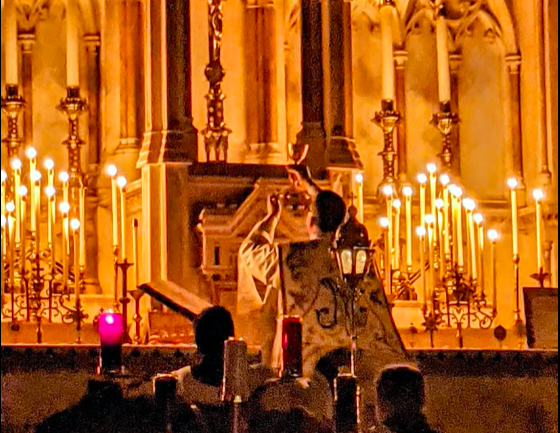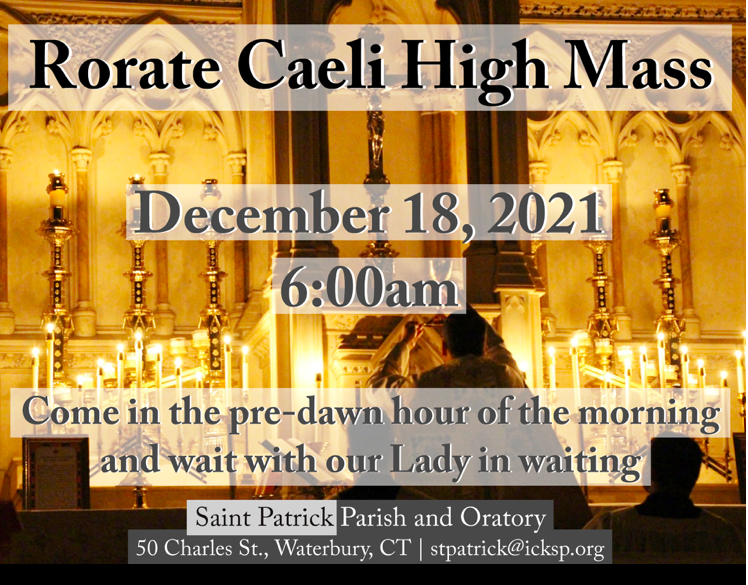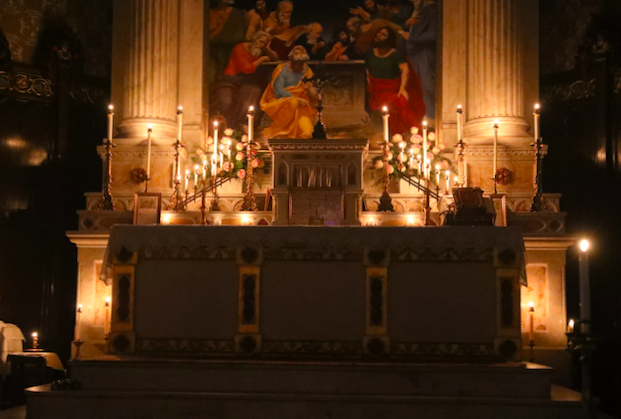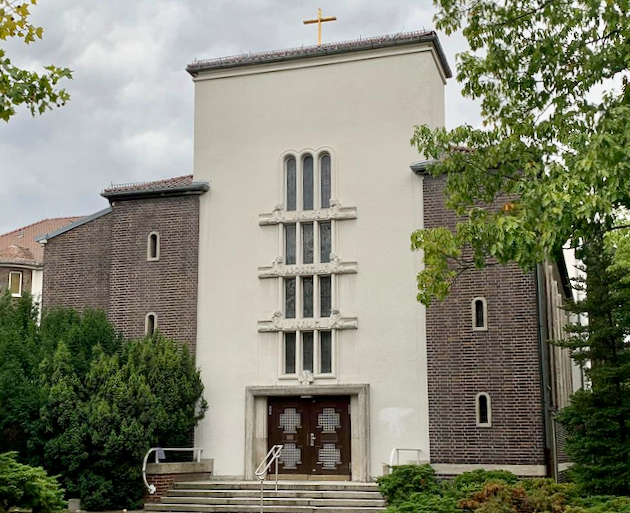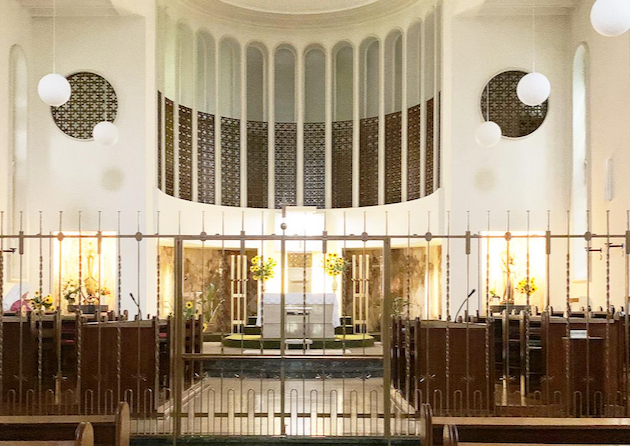
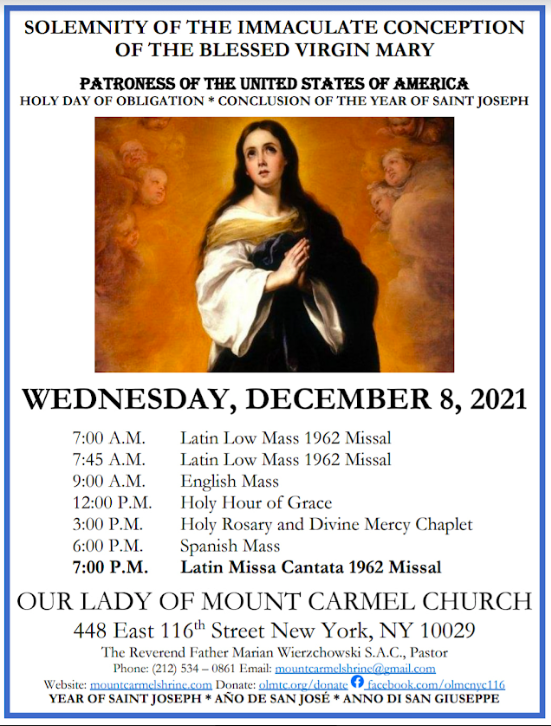
A traditional Mass will be celebrated for the Feast of Our Lady of the Rosary this Thursday, October 7 at Our Lady of Sorrows in Jersey City at 5 pm.
4
Oct

by Father Richard Gennaro Cipolla.
Each age has its own distortion of God, what people imagine Him to be. This present age, at least in these United States among Catholics, is tempted to romanticize God, make Him warm and fuzzy, and in that way really neutralize His presence in one’s personal life. It is almost a Catholic way of secularizing God. God has become the product of the community, a predicatable pet—yes, still a powerful pet, someone beyond the sunset, but still in His box, and that box we keep him in is called the community. Those many passages in the Old Testament that speak of the wildness of God, of the unpredictability of God, of the God who is a jealous God, the God who is the judge of all, the God who displays wrath. Any of these attributes of God that we find unpleasant or threatening to our religious complacency and happiness are denied, and we say: Oh, that is not MY God!” Or, “We have out -grown that picture of God. All that stuff is the God of the Old Testament. The New Testament God is very different, much more likable, more lovable. Jesus’ God is quite different: a God of mercy, of compassion, of love.”
What nonsense! As if the God of the Old Testament is not a God of compassion, mercy and love who deals with his chosen People as a true Father; as if the God of Jesus is not the God who led his people out of slavery, as well the God who struck down those who dared to touch the sacred Ark! The time after the Second Vatican Council was marked by an iconoclasm not seen since the Protestant Reformation, when saints were carried out of churches and put into dumpsters, for these men and women who knew God intimately, who were seized by God as He is, no longer had a place in a protestantized Church of “Jesus and me and no one else.” The passion of the Saints, their erratic and strange behavior, their refusal to conform to the world, their refusal to be normal as the world defines that word, those men and women who are witnesses of what it means to be seized by the living God and to be transformed so radically that the world falls away as dross and the only desire one has is to love the God who burning love lives in one’s heart: these men and women are hard to take.
After that period of iconoclasm we decided that we could allow the saints back into our churches, but only after they have been tamed. And so we find ourselves with a St. Francis who decorates bird baths, a St. Francis who is emasculated and turned into some sort of cross between Johnny Appleseed and Mr. Rogers. What happened to the real man who threw himself into the thorn bushes to control his lust, who pummeled his body with fasting and physical penance, who went up onto that mountain and in prayer received the Stigmata, the wounds of Christ that bled and pained him for the rest of his life until his death, those wounds that are the mark of the God of infinite love? This St. Francis, the real man of the twelfth century, reminds us all too really of what happens when we not only take God seriously but also when we allow Him to live in us, when we give over our will to Him.
From Adrienne von Speyr:
I saw St. Francis at first in his old age, at prayer and sickly, of an indescribable cheerfulness and purity and humility. Everything in him, everything that constituted his life, all his difficulties, are now transfigured and have become translucent. And this happened through prayer. The things that occupy him no longer contain anything at all that is purely personal, not a trace of annoyance or injury or resentment for the unjust things inflicted on him. God alone is left, as well as perfect service in the indescribable happiness of one who serves and in uninterrupted contemplation.
Father Richard Gennaro Cipolla

External Solemnity of the Dedication of the Basilica of St. Michael the Archangel
From the Alleluia for the Feast of Saint Michael the Archangel:
Holy Archangel Michael, defend us in battle: that we may not perish in the dreadful judgment. Alleluia.
Michaelmass; just the sound of the word evokes images, thoughts, echoes. The first time I ever heard the term was when I arrived in Oxford as a student now many years ago and was told that in a few days the Michaelmas Term would begin. I was charmed and delighted to think that a university would name its terms in specifically Christian terms: Michaelmas, Hilary and Trinity, the three terms of the academic year. But this was part of the paradox of a place like Oxford where the cloud of secularism has penetrated the very stones of which the colleges are built and still the term Michaelmas is used, a term that evokes a time, a time when Catholic culture infused the life of a university. And there are Michaelmas daisies, something like our mums, flowers that herald the time of autumn, of falling leaves, but also of the fall towards winter, the time of quiet and cold, of remembering, of hoping, the time when the light fades fast, but also the time when the celebration of the true Light that came into the world is taken up with such fervor in a world that denies the Light. One could go on further about what Michaelmas meant in the time of Catholic culture. But this would not be good to do, for nostalgia is deadly to true religion.
We must remember, or rather call to remembrance, on this Solemnity, the feast of the warrior angel, “he who is like God”, he who leads the charge against the forces of evil, he, who with the heavenly host still fight that war, even if silently, silently at least from our point of view. This is the time to remember that there is a war—no, not the wars that constantly rage in the world and have no end. We live in the time of in -between, the time of the Church on earth, of the not -yet, of the incomplete, the time when the real effects of the Cross and Resurrection of Christ are transforming the creation bit by bit, inevitably, but whose consummation is not yet, not yet. And even if we do not see the angels waging this war in our behalf. we do see around us the signs of what this war is about. The war is against those real and powerful forces in the world that not only deny the truth of the living God but also militate against that truth in so many ways. This is surely a religious war but it is a spiritual war. It is not a matter of jihad. It is much more subtle and dangerous. For the forces of the religion of secularism, a secularism that tolerates religious faith only in a closed off individualistic way, does not so much as to deny the existence of God but rather to banish Him from the discourse of the world. These forces are determined to conquer, and if one looks with realistic eyes, they have won important cultural battles that have weakened the real presence of the Christian faith in today’s culture.
All this image of war. Can this be congruent with the religion of peace? Of course it can and it must. Jesus said: “ I did not come to bring peace but a sword.” Conflict is part of being a follower of Jesus Christ, part of what it means to be a Christian. To deny this is to deny the Gospel and Church history. Charles Williams, a strange literary figure, Anglican by persuasion, says something in his idiosyncratic history of the Church to the effect that when the dogma of infallibility of the Pope was defined in that famous thunderstorm in Rome in 1870 by Blessed Pio Nono: he says that the Church regained her manhood. A wonderful phrase: her manhood. For what we are talking about here is virtus, a Latin word that is often translated as “virtue” and thereby made harmless by the virus of moralism. But the root meaning of this word virtus is vir, the man as hero. On the feast of the Warrior Angel, the Prince of the heavenly host, we remember, or we should remember, that we are all called as Christians to show courage, which is the second meaning of virtus, we are all called to be men and women of virtue, which is the third meaning of virtus: all three meanings bound to each other, all necessary for the task of the evangelization of the world.
To be a Christian is not for wimps, is not for religious couch potatoes who confuse Christian faith with Brady Bunch Catholicism. No. What is called for today is manly men who are faithful husbands and fathers. What is called for today are manly men who are faithful priests who have the courage to make the Cross of Christ as the center of their lives. What is called for today are women who have the true virtus of Mary, the Mother of God, of St. Catherine of Siena, of St. Teresa of Avila, of St. Birgitta, of Mother Cabrini.
Oxford spires are beautiful. Daises are lovely. But they have little to do with the saint we celebrate at this Mass today, Saint Michael, the Archangel, who is fighting the battle against the prince of darkness on our behalf. And for this we are grateful and for this we sing his praises. But we must remember that it is we, you and I, who must also join this battle, a battle that will be won by the love of God for us shone in the Cross of Jesus Christ. And the first step is what we do here today. In this Mass we remember and commemorate and there is made present that event that is the sign of the sure outcome of the triumph of God: the battle that was fought on the Tree of Life. And every time Mass is offered we strike a blow in the words: Hoc est enim corpus meum. These words make the powers of the world tremble, for these words do what they say, are what they say, and by their transformative power advance the battle for goodness, truth and beauty every time they are said. For they make present from eternity in this our time the love of the infinite God who loved us so much that he gave his only begotten Son to die so that we may live.
St. Michael the Archangel, pray for us.
Father Richard Gennaro Cipolla
27
Sep
27
Sep
A Solemn Mass for the Feast of St. Michael will be celebrated on Wednesday, September 29th at 7:30 pm at Notre Dame Church, New Hyde Park, NY.
27
Sep

In the infamous (for Traditionalists) diocese of Dijon, France, a new abbot for a monastery of the Cistercians of the strict observance(Trappists):
Messe du Saint-Esprit au jour de l’élection du nouvel Abbé de Cîteaux
An aging community of monks amid buildings and furnishings of surpassing ugliness(see link above ). Such a contrast with the simple yet beautiful architecture of the early Cistercians.
25
Sep
…from the pastor of St. Mary’s parish, Providence, RI. (FSSP)
– I’ve been asked more than once about whether we should pursue another project, given the hostility of not just the pope but many prelates, clergy, religious and laity to the Vetus Ordo. Could the pope just suppress the FSSP? Yes. And if he did, the bishop of Providence would be left trying to provide for your needs, which would be a daunting task for him. The worst-case scenario would be that we are ordered to leave the diocese and the parish would be closed. Could this happen? Yes. If it did, I’ve already made up my mind what I’m not going to do. I won’t go independent (I’ve seen way too much schism in that department), nor will I join the SSPX (as if they’d have me). I would instead retire, get a small house with my meager savings and hit the road in some area such as this one, going around celebrating Mass at people’s houses, all underground of course, keeping the Mass alive and waiting for better times.
– As a Society of Apostolic Life, we are very much working on each possibility and are planning how to fight like junkyard dogs, if needed. But more than anything, we trust our Lord 100% that He knew what He is doing when He permitted the Motu Proprio of this pope. Our Lord told us that there is only One Whom we should fear. And it isn’t the pope or some cardinal with a chip on his shoulder about tradition.
– By now you’ve heard about the grave restriction of our work in Mexico. It is not 100%, and maybe we can hang on down there for better times, but better times may not be coming. To be honest, I have a feeling that this is the end of our work in Mexico. We will lose many battles, I think.
– Fraternity priests will be meeting in Nebraska from October 25-29 for a recollection and an ordination. Both Fr. Truong and I will be attending. We need to stand solid and united not just for our society, but also for the faithful we serve. Zoom meetings cannot accomplish this. So, we may not have Masses available for you during that week. Please understand that this might be the last meeting we have together as a Society.
20
Sep
A Missa Cantata will be offered on Tuesday, September 21, 6:00 p.m. for the feast of Saint Matthew at St. Augustine Church, 30 Caputo Road, North Branford., CT. Father Robert L. Turner will be the celebrant and homilist.
Music: Josquin de Prez’s Missa “Hercules Dux Ferrariae,” and motets by Tallis and Palestrina – in addition to the proper chants.
19
Sep
Join us for a day-trip to Lancaster, PA for a Pontifical Mass and young adult social event organized by Juventutem NYC and Philadelphia.
RSVP: https://juventutemnyc.com/events

To entice you to attend this trip, we offer photos from the Iuventutem pilgrimage that took place on September 11 to the Holy Mountain, Graymoor, NY. Photos courtesty of Iuventutem NYC. https://www.juventutemnyc.com/events