24
Dec
21
Dec

By Father Richard Gennaro Cipolla
The feast of St. Thomas the Apostle has been kept on this day, December 21 from at least the ninth century. It was moved to July 3, the day mentioned by St. Jerome as the date of his martyrdom in India, by those who revised the calendar after the Second Vatican Council. They did this so that his feast would not interrupt the major ferial days of Advent leading to Christmas. They wanted to tidy things up, calendar wise. They considered the feast of St. Thomas in later Advent out of place. Their liturgical rationalism made them blind to the wonderful interruption of late Advent made possible by the feast of this apostle.
Today’s Gospel is the famous Gospel of “doubting Thomas”. This Gospel is heard also on the Sunday after Easter, Low Sunday. Heard on Low Sunday it makes sense as the continuing narrative of Jesus’ resurrection and appearances to the disciples. But it also makes sense in a discontinuous way today, four days before the celebration of the birth of Christ. The celebration of Christmas makes sense only if one believes that the baby in the manger is the Incarnate Lord, the God-man, who came to save the world from sin and eternal death. In an increasingly secularized world, this is either deliberately erased by a celebration of general good feeling and bonhomie. Or it is forgotten by Christians whose faith has been watered down lest they be uncomfortable in thinking about the real link between the wood of the manger and the wood of the Cross.
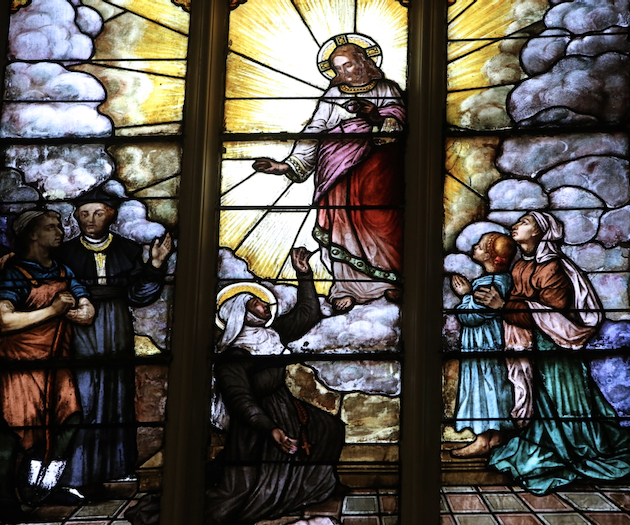
It is precisely today’s Gospel that makes us remember the full meaning of the great feast which we are about to celebrate. Thomas is not present when the Lord appears to his disciple in the Upper Room where they have locked themselves in in fear that they might be next to be killed. When they tell Thomas that they have seen the Lord, he says: “Except I shall see in His hands the print of the nails, and put my finger into the place of the nails, and put my hand into His side, I will not believe.” Of course!– seeing is believing.
The next day when Jesus appears again, Thomas is there, and the Resurrected Lord challenges Thomas to faith: “Peace be to you. Then He saith to Thomas: Put in thy finger hither, and see My hands, and bring hither thy hand, and put it into My side; and be not faithless, but believing. Thomas answered and said to Him: ‘ My Lord, and my God.’ Jesus saith to him: Because thou hast seen Me, Thomas, thou hast believed: blessed are they that have not seen, and have believed.” St. Thomas’ words are the words of faith: “My Lord and my God!”. There have been very many paintings depicting this scene with Thomas touching Jesus’ wounds. But the Gospel clearly does not mention at all this act of touching, for the question at hand is seeing and believing. That is clear from Jesus words that follow St. Thomas profession of faith: “Because thou hast seen Me, Thomas, thou hast believed: blessed are they that have not seen, and have believed. “
Those words: they describe you and me, we who have not seen and believe, and that is the essence of faith. That is why this feast is a wonderful jolt in late Advent, for it reminds us of who the baby born in the manger is and therefore reminds us of what faith in Christ means not only in general or doctrinally, but personally, for you and me.
This year, a year of sorrow and woe, a year that challenges our faith, when on Christmas we place the bambino into the manger in the creche in our homes, and when we gaze at the Sacred Host at the elevation at Holy Mass, let us utter those words of St. Thomas: “My Lord and my God!”
Father Richard Gennaro Cipolla
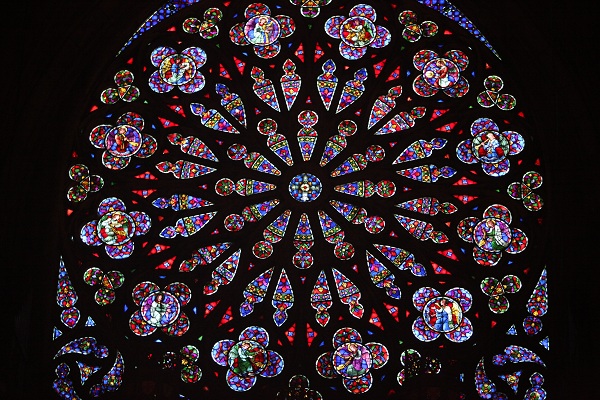
(Window from Harrisburg Cathedral, Pennsylvania)
21
Dec

For all fans of Sigrid Undset’s medieval novels, a beautiful photographic essay by Micah Mattix on the wooden churches of Norway – in The American Conservative.
19
Dec

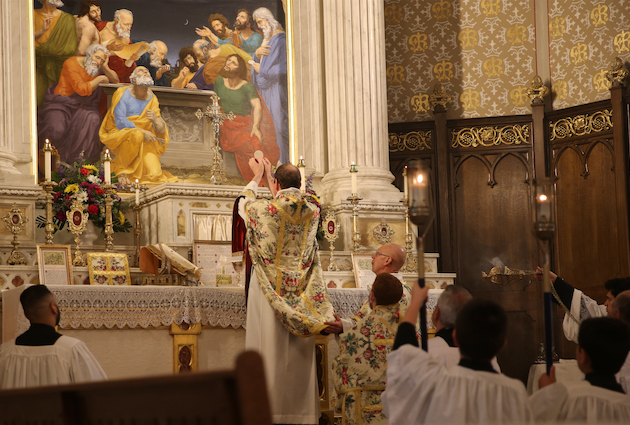
At 6 am, Father John Ringley offered a solemn Rorate Mass at St. Mary’s Norwalk, CT. Deacon Stephen Genovese served as deacon and Mr. John Pia was sub-deacon.


17
Dec

As this calamitous year approaches its end, we would like to recall briefly several of those who died in the last 12 months. Their lives illustrate the amazing possibilities of Traditional Christian life in the radically secular city that is New York. One of these people was Archdeacon John DeMeis.
One fine day in the early 1980’s, when I was attending NYU law school, I had wandered over to the northern reaches of Mulberry Street. In those years that neighborhood was semi-deserted even in the middle of the day and featured mainly garages and “social clubs.” I passed by an open door on the ground floor of a small building next to old St. Patrick’s church and peered in. Someone inside noticed me and invited me inside – it turned out to be a Byzantine church: St. Michaels’ Russian Catholic chapel! And the man extending the invitation was John DeMeis. From that day on, for many years, I regularly attended St. Michael’s. But for John’s welcome, I never would have thought of entering there. I owed to him my main experiences of the Eastern liturgy – at that time, in the pre-indult days, the only fully satisfactory alternative for those seeking Traditional Christian worship. Wasn’t John’s welcoming gesture a real, if modest, example of that “evangelizing” that is so endlessly discussed nowadays ?
John DeMeis, a retired transit cop, had deep connections with both the Eastern rite and one of the most obscure and unusual Catholic parishes of Manhattan. Our Lady of Grace chapel, a storefront church on Stanton Street, was the spiritual home in New York City of the Italo-Albanians. This people had migrated to southern Italy and Sicily in the 15th century, fleeing Turkish oppression. In their new home they preserved the Byzantine rite, celebrated in Greek, but stayed in communion with Rome. Quite a few of them after 1870 joined the mass emigration from Southern Italy to the New World.
Our Lady of Grace chapel was founded in 1906 by Fr. Ciro Pinnola, an Italo-Albanian priest from near Palermo (another source says the foundation was in 1904). He was married, a practice that was beeing repressed in in the other Catholic Byzantine communities in the U.S. In 1909, the chapel’s congregation numbered 400.
Regrettably, when Fr. Pinnola died in 1946, the parish ended as well. But John DeMeis and others labored to keep its memory alive. Even today, the Our Lady of Grace Italo-Greek Catholic Mission and Society preserves the memory of this community. John DeMeis was devoted to this society – he later became its archivist and historian. The society (“OLOGS”!) publishes a newsletter for the Italo-Albanian community several times a year and sponsors events as well.
After 1990 I moved out of New York and returned to St Michael’s only now and then, on special occasions. In fact, I don’t think I ever saw John DeMeis ever again in person after that year. Tragically, St. Michael’s Russian Catholic chapel, once a significant initiative of the Archdiocese of New York, was evicted in 2019 from the home they had occupied since 1936. The space is currently occupied by a souvenir shop. The community, however, has continued – for the last two years they have been hosted by the parish of St. Vincent Ferrer and St. Catherine of Siena(at St. Catherine’s).
I had the impression that John had moved on as well – deepening more and more his commitment to Eastern or Greek Catholicism. He was ordained deacon in 1990 and archdeacon in 1997. For many years he served as a chaplain to the police department.
John DeMeis died on August 19th of this year at the age of 90. He is survived by his beloved wife Rita and their children and grandchildren. May Archdeacon John’s memory be eternal!
(Photo courtesy of Kristina DeMeis)

Dear Friends, We wish you a blessed Christmastide! We submit this listing of traditional Masses for Christmas.
Please bear in mind that for some of these churches you need to register ahead of time. So call the church first to check. We’re sorry that this is the case. One pastor told us not to post his schedule of Masses because the faithful need to pick up tickets ahead of time.
We can’t bear to think of people being turned away from Mass at Christmas (or any time). We will use the present circumstances to reflect on Mary and Joseph’s arrival in Bethlehem, only to find all of the inns full.
As always, we rely on our readers to contact us with information about traditional Masses in the area.
Christmas, December 25
Connecticut
St. Mary Church, Norwalk, CT, Christmas Eve: 11:30 pm Christmas Carols, 12:00 Solemn Midnight Mass; Christmas Day: 9:30 am Solemn Mass, 11:15, Missa Cantata. Please contact the church to register.
Sts. Cyril and Methodius Oratory, Bridgeport, CT, Midnight Mass, 8:30 am, 10:15 am. Please contact the church to register.
St. Patrick Church, Bridgeport, CT, Missa Cantata, 12:30 pm. Go to the Cathedral Parish to register.
St Joseph Church, Danbury, CT, Solemn Midnight Mass, Fr. Matthew Clark, celebrant, Christmas Carols at 11:30 pm; Christmas Day, 11:30 am. Please contact the church to register.
St Martha, Enfield,CT, Midnight, High Mass; Christmas Day 11:00 am Low Mass
St. Stanislaus Church, New Haven, CT, Missa Cantata, 2 pm.
New York
Holy Innocents Church, New York, NY, Sung Midnight Mass, preceded by exposition of the Blessed Sacrament at 10 pm ending with Benediction at 11:30 pm, procession to the manger and blessing of the crib at 11:45 pm; Low Mass at Dawn, 9 am; Sung Mass at 10:30 am.
Our Lady of Mount Carmel, New York, NY, Solemn Midnight Mass, Christmas Day, Missa Cantata 10:30 am.
St. Agnes Church, New York, NY, 9 am.
St. Vincent Ferrer, New York, NY, Midnight Sung Mass, Dominican Rite.
St. Josaphat Church, Bayside (Queens), NY, Midnight Mass, Christmas Day, 9:30 am.
St. Rocco Church, Glen Cove, NY (Long Island), Midnight; 11:30 am.
St. Matthew Church, Dix Hills, NY (Long Island), 12:30 pm
St. Rosalie, Hampton Bays, NY (Long Island), 12:45 pm.
St. Michael Church (SSPX), Farmingville, NY. (Long Island), Midnight, 9 am.
St. Paul the Apostle Church, Yonkers, Missa Cantata, 10 am, no need to register
Immaculate Conception, Sleepy Hollow, NY, 2 pm Missa Cantata. (only one Mass today)
St. Patrick Church, Newburgh, NY, 3 pm.
New Jersey
St. Paul the Apostle Church, Jersey City, Christmas Day, 2 pm Missa Cantata, Fr. John Perricone, celebrant; 1:45 Prelude of Sacred Music. (Please note that at this time, according to the pastor’s directive, Holy Communion will not be distributed in the traditional manner, on the tongue. The faithful are asked to make a spiritual communion.)
Our Lady of Victories, 150 Harriot Ave, Harrington Park, NJ, 9:00 pm – Latin Mass (web site does not indicate if Mass is low or sung)
St. Anthony of Padua Oratory, 1360 Pleasant Valley Way, W. Orange, 11:00 pm – First Mass of Christmas, Missa Cantata (no carols beforehand); Christmas Day, 9:00 am – Low Mass, 11:00 am – Low Mass
Octave of Christmas, January 1
Connecticut
St. Mary Church, Norwalk, CT, 9:30 am, Solemn Mass, 11:15 am, Missa Cantata
St. Stanislaus Church, New Haven, CT, Low Mass, 2 pm
St. Joseph Church, Danbury, CT, Missa Cantata, 11:30 am
Sacred Heart, Georgetown, NY, 6 pm Missa Cantata
New York
Holy Innocents Church, New York, NY, New Year’s Eve Dec. 31, 11:30 pm; Jan. 1, low Mass 9 am; Missa Cantata 10:30 am.
St. Agnes Church, New York, NY, 10:30 am
Immaculate Conception, Sleepy Hollow, NY, 2 pm Low Mass (only one Mass today)
New Jersey
St. Paul the Apostle, Jersey City, 2 pm.
Epiphany, January 6
St. Paul the Apostle, Jersey City, 7 pm
Just keep in mind.. . . you may have to register ahead of time.


15
Dec

Roman Catholic Sacred Architecture in New York County: Manifestations of Faith, Glory, Change and Decline in the Early 21st Century
By Paul R. Peters
2020
As our readers probably know, we have long been following the history of the Catholic churches of New York City. Recently I was fortunate to receive and read the work of another researcher in the same area. Paul R. Peters has written and self-published Roman Catholic Sacred Architecture in New York County: Manifestations of Faith, Glory, Change and Decline in the Early 21st Century (2020). In it, he covers the great majority of the Catholic parish churches of Manhattan island. (Non-New Yorkers need to know that New York County is synonymous with Manhattan plus Marble Hill in the Bronx.)
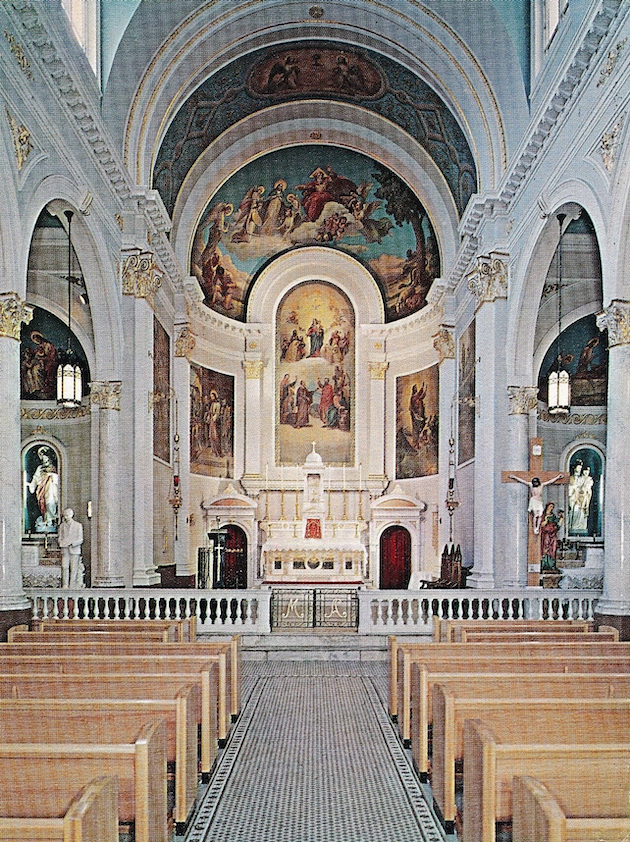
Peter’s book is one of select few on this subject. Thomas J. Shelley’s Bicentennial History of the Archdiocese of New York of course also covers all the parishes of Manhattan. Then, there is Rene S. James’ The Roman Catholic Churches of Manhattan (2007, also self-published). Finally, the grandfather of all such studies – and still the best – is John Gilmary Shea’s 1878 book on New York City Catholic churches. In Sacred Architecture Peters gives us several photographs and a brief description of each of the churches in New York. Many of the photographs are his own, taken from 2003 onwards, but he has supplemented these with well-chosen examples from local archives or from other sources. See, for example, this book’s beautiful cover photograph of the interior of the now-closed All Saints parish in Harlem, taken when that church was relatively new. Another example is the striking image of the interior of Old St. Patrick’s Cathedral.
Our author has put together this book with a specific purpose in mind. Peters documents through photographs the status, before and after the Council, of each of these churches. This focuses, in particular, on the chancel or sanctuary of each church and a melancholy review of the damage that was done after the Council. In most cases this involved moving the altar forward, eliminating or reducing the communion rail, and placing a new altar at the center of the church on a platform projecting into the nave (what Peters calls a “build-out.”) It also usually was accompanied by the gross simplification or outright destruction of the former decorative program of the church which so often had featured gothic altars, stencils, paintings and statuary. Peters is rightfully indignant at this desecration, carried out supposedly to “break down barriers” between the celebration of the Mass and the people. They of course largely departed, which is why parish after parish after parish is closing. This book is a visual chronicle of the devastation.
Those churches were indeed fortunate where the post-Conciliar updating was limited to placing a table between the grand high altar and the communion rail, leaving all else intact. New York, however, has the good luck to have more than handful of these, in which the Conciliar wave of destruction of art was halted by the parish’s poverty or the resistance of the donors’ families.
Peters’ book obviously has great appeal for the connoisseur of New York churches. He has here pictures of the interiors of churches with which I was familiar but never got around to photographing before their destruction – such as St. Ann’s or the Sacred Hearts of Jesus and Mary. I should especially emphasize his discussion of the once glorious Church of Saint Thomas in Harlem – an equally colorful and wildly decorated counterpart to Our Lady of Good Counsel. It was shut down and destroyed by Cardinal Egan. Our author also has located intriguing photographs of the original 19th century churches of the parishes like St. Andrew and Immaculate Conception which later acquired grand new buildings.
To describe some 100 churches and their constantly changing appearance is a formidable task – I appreciate the magnitude of the effort and don’t want to seem critical. For a second edition, however, I would suggest more systematically providing, where possible, dates for the photographs and for the narrative. For as the author himself tells us, it is not so simple as “before the Council” and “after the Council.” In some parishes, ( e.g. St. Stephen’s, St. Agnes) major changes – and in some cases major damage – was done prior to the Council. In other cases, post-Conciliar ravages have been partially repaired (Our Lady of Pompeii, Our Lady of Sorrows).
Despite the vast terrain Peters covers, I have only been able to identify a very few instances where he is outright wrong – such as his description of the combination of the parishes of St. Emeric and St. Bridget (Brigid). But even there we are grateful to him for pointing out the dedication (in fact at St. Emeric, not St. Brigid) of a chapel to Cardinal Egan (while he was still alive)! This book’s list of churches may be comprehensive but it is not exhaustive – one prominent church missing is the shrine of St. Frances Cabrini in Washington Heights. I would also dissent from the author’s aesthetic judgment in certain cases (like the renovation of St. Francis Xavier church).
All in all this is a great book for enthusiasts of ecclesiastical architecture or New York City history. And also a sobering work for those Traditionalists who want to experience the bitter feeling of seeing the details of so much that has been senselessly destroyed. Highly recommended!
15
Dec
Sacred Heart R.C. Church (Clifton, NJ) will be offering a Rorate Mass (Extraordinary Form) at 6:00a.m. on Saturday, December 19, 2020. This is the first time the Advent Devotion will be celebrated at the Parish. The Church is located at 145 Randolph Avenue, Clifton, NJ 07011. Ample parking may be found behind the school building next door. Pray to Jesus through Mary!
14
Dec

St. Mary Church in Norwalk, CT will have a Rorate Mass on Saturday, Dec. 19 at 6 am.
To attend, you must register ahead of time by calling the rectory: (203) 866-5546.
And in Danbury, CT: