13
Jan
8
Jan
Sermon for the Feast of the Epiphany
given by Father Richard Gennaro Cipolla
Church of the Most Holy Redeemer, New York City
6 January 2020
From the Gospel of St. Matthew: “We have observed his star at its rising and have come to pay him homage.”
There in that verse is the credo of science, or better still, the credo of the scientist, what makes science go, what makes it relevant, what makes it real. And these words come from the scientists of Jesus’ time, the Magi, the Wise Men. Of course, they have little to do with that experimental science that has become since the Enlightenment what science now is, that dispassionate observation of a phenomenon followed by analysis and formation of a theory. Most scientists today would be offended by being put into the same category as the Magi, but that is their problem, for they have lost the focus of science.
The root of the word science comes from the Latin verb, scio, which means to know, and thus knowledge is at the heart of science, the scientist wants to know. But modern science has forgotten, with some important exceptions like Einstein, that knowledge is not an end in itself. Nor is knowledge limited to the physical world. Nor is the quest for knowledge a dispassionate enterprise, as if objectivity defines science. There can be no doubt that the modern scientific method has resulted in a great increase in knowledge about the universe the physical world, both on a macro and an atomic scale. There can be no doubt that modern science has contributed greatly to a higher quality of life for so many people. There can be no doubt that modern science has been successful in fighting disease and finding cures and in increasing the ordinary life span of men and women.
But scientists have forgotten with increasingly disastrous results, the relationship between knowledge and wisdom, and the ultimate goal that is truth. A science that believes its own myth of total objectivity, which narrowly and prejudicially limits reality to a narrow band on the whole spectrum and that confuses facts with truth, produces baleful results. This results in a world in which morality is relativized and banished to the arcane sphere of religious systems, a world in which the fragility and wonder of being human is bludgeoned by doctors dreaming of the brave new world of designer embryos.
“We have observed his star at its rising and have come to pay him homage”. There is the statement of a true scientist. Unlike the nervous machinations of Herod, who resents the intrusion of the supernatural into his petty life, the Magi take a more cosmic, a more all-encompassing view of things. They do not limit reality, these magoi from the East, these strange men that come from “pagan” lands. They show a docility, an openness and readiness to obey the truth that we saw twelve days ago in our Christmas celebration in the persons of Mary and Joseph. We saw and we came. There it is. There is a wonderful directness, a linear speed leading without hesitation from insight to action: they saw the King’s star and immediately came to adore him. In these “pagans” we see a perfect unity between patient science and moral justice that is an example for all Christians, and especially for those of us who call ourselves scientists. The scientist who really seeks truth is a wise man who when he finds the truth does not hesitate to subject himself to that truth. When one encounters truth, when God gives us the grace to encounter truth, the only possible response is to give oneself to that truth. And this act of giving oneself to truth, this encounter with truth, this demands worship and adoration.
This for me is why I know that Catholic faith to be true and why the Catholic Church is the Church founded by Jesus Christ. This is because at the heart of the practice of the Catholic faith is not figuring out what biblical passages mean by pseudo-scientific rationalism. It is not fiery sermons. It is in fact never words. It is worship, it is adoration. What goes on here in the Mass, what goes on in the chanting of the daily Office in monasteries, what goes on when the Holy Eucharist is adored: this is the goal of science. For this is the response to that encounter with the infinite truth of God in the living person of Jesus Christ, this person who is not outside of the subject of scientific inquiry in the physical world but rather is the very center of the physical world. That is what we forget, we Christians who are so in awe of the scientist who performs his brand of magic by forcing us to live in a petty and narrow band of reality. We forget the shocking claim that God became flesh, and therefore that all science, all seeking after knowledge must and does lead to the Word through whom all was created and who took flesh and was born of a Virgin.
We can hear the outcry to all of this from those who would bind us all by the shackles of the self-named Enlightenment. They say: You are mixing up science and religion. And by this what they mean is that we are mixing up reality with wishful thinking. So many Christians cower under this attack from the so called scientific, rational world, a world that includes not only many scientists but also the world typified by the “liberal” media that pride themselves on being beacons of sense and sensibility and tolerance and having a sure sense of what the future should look like. How many Catholics are embarrassed by their religion and try so hard to fit in better to what everyone else seems to think and act? How many Catholics, when faced with the American steamroller of secularism, willingly lie down in its path and come up again as two dimensional caricatures of the Catholic faith, the dimensions of which are infinite? How many Christian clergy spend time in their Epiphany sermon explaining the star as a myth of which the Magi are the lead actors, as just a good story that has a moral lesson, and in so doing close for the people the meaning and wonder of the Epiphany? The Child born in a stable in humility and weakness is already present in the constellation of the stars by his splendor and glory. “The heavens declare the glory of God and the firmament showeth his handiwork”. Either that is true or it is not. Christ is always a cause of rejoicing for the wise and a cause of consternation and fear for the obstinately foolish. Listen to the answer of the Wise Men to Herod that the liturgy sings in the antiphon on the Magnificat in Epiphanytide: “Interrogabat Magos Herodes: Herod questioned the Magi: What sign did you see about the king who has been born? We saw a dazzling star, whose splendor illumines the world.” Whose splendor illumines the world. This light cannot be holed up in a box, even in a religious box. It cannot be extinguished by the lies and darkness of the world of anxious Herods. For it is the light of God.
So we come here, we come together in a world that is defined by the advances and limitations of modern science. But we come here, you and I, as true scientists, scientists as defined the Magi, the Wise Men. Graham Greene said once: “I do not believe in God. I touch God, I eat God.” We by the grace of God know the Truth, and we come here to embrace that Truth, to subject ourselves to that Truth, by this act of worship and adoration. Oh how important to this world are places like this church where true science flourishes, where worship and adoration are the constant responses to truth! Just as the monasteries were vital to keeping the light alive in the dark days of the barbarian invasions after the fall of the Roman empire, so in our time when the barbarians of secularism threaten to plunge us once again into darkness, places like this where the Traditional Roman Mass is celebrated in all of its solemn beauty, the supreme act of worship and adoration, places like this church are precisely where the light of the star of Bethlehem will be seen and where the glory of the Lord will illumine the darkness of the night.
Angels and archangels may have gathered there,
Cherubim and Seraphim thronged the air.
But only his Mother in her maiden bliss
Worshipped the beloved with a kiss.
What can I give him, poor as I am?
If I were a shepherd I would bring a lamb.
If I were a wise man, I would do my part;
Yet what I can I give Him, give Him my heart.
(Christina Rossetti)
7
Jan
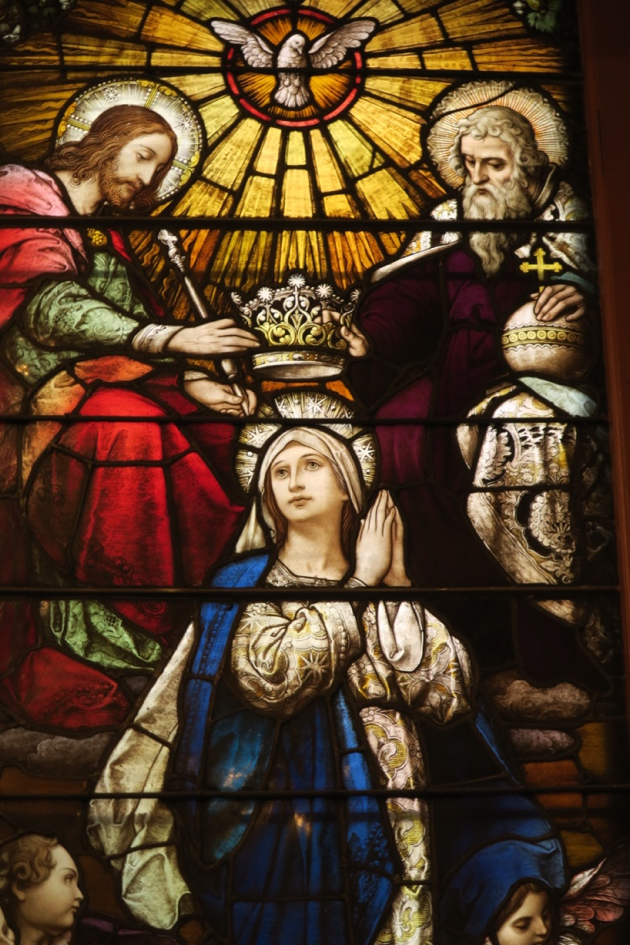
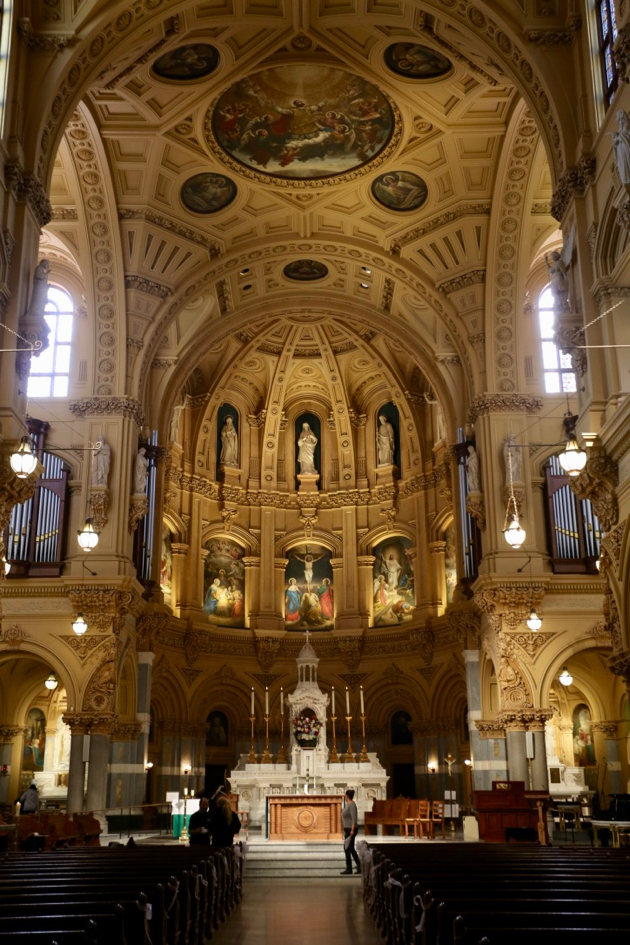
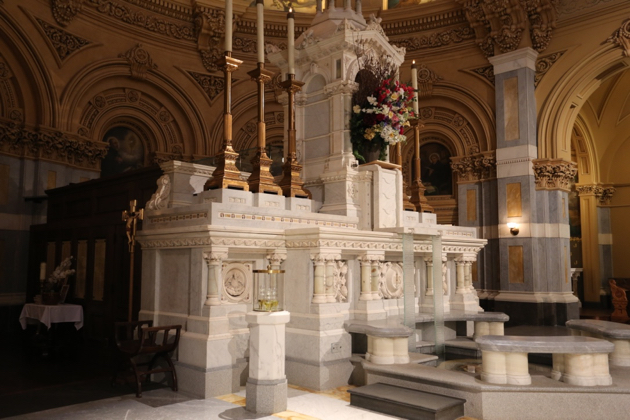
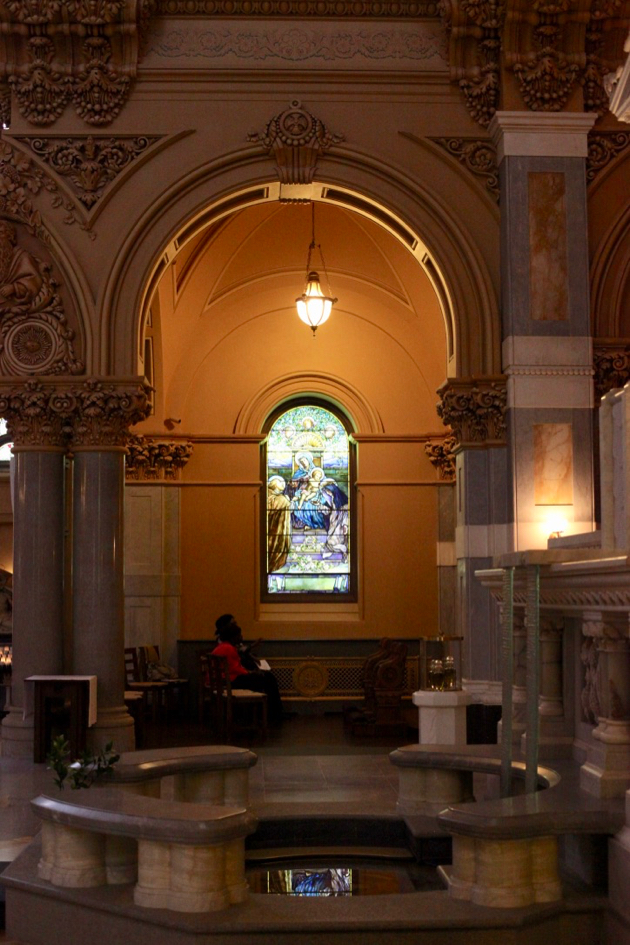
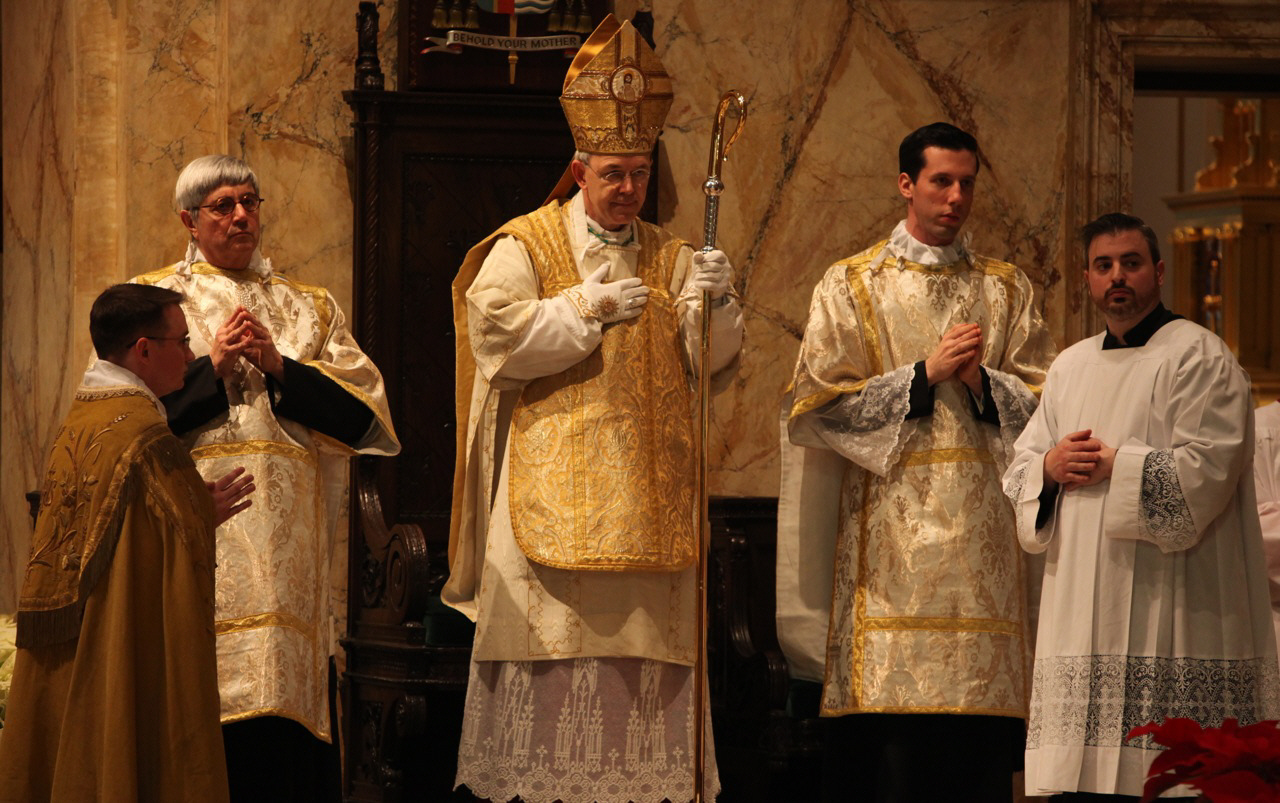
Photos from last night’s Solemn Mass for the Feast of the Epiphany at Church of the Most Holy Redeemer in New York. Father Richard Cipolla was the celebrant. Fr. William Elder, pastor of Most Holy Redeemer, served as deacon. The church was splendidly decorated for a festive celebration of the 12th Day of Christmas.
Above and below: Fr. Cipolla blesses and distributes the chalk for Epiphany.
5
Jan
3
Jan
To see this exhibition on Emperor Maximilian – his armor and his art – at the Metropolitan Museum:
The Last Knight: The Art, Armor, and Ambition of Maximilian I
We recently have resumed our series of posts covering the deeds and relics of the Holy Roman Empire of the German Nation. Emperor Maximilian I was one of its most extraordinary leaders. Warrior, patron of the arts, far-seeing politician yet upholder of chivalric virtues, he personified the somewhat fantastic character of the Holy Roman Empire in its last few centuries. Yet Maximilian was was able to accomplish great political achievements – not for himself, but for his descendants. He rescued the Burgundian-Netherlandish state from annihilation by France. He saw his grandson, Charles ascend the thrones of Spain, Burgundy-Netherlands and the Holy Roman Empire – becoming the mightiest European monarch in centuries. He laid the foundations for the union of the Bohemian and Hungarian crowns with the ancestral Habsburg domains, the essence of the future Austrian empire. Yet he himself often wandered about, bereft of resources and on the brink of bankruptcy.
In his age he was one of the greatest patrons of the craft of the armorer and of German art. A champion of knighthood, he was deeply involved in the development of artillery and infantry. He utilized the new printed media to promote his persona – including the monumental assembly of woodcuts known as the Triumphal Arch. He was a great collector of medieval German literature.
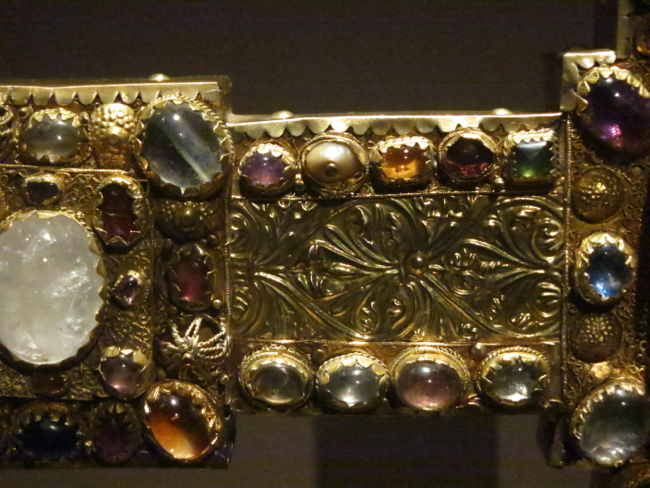
(above) Gauntlets of Maxmilian I
Plate armor was tailor-made for wealthier clients. (Above) Parade armor, commissioned by Maximilian for Charles V as an adolescent. (Below) Armor, intended for combat use, made for Maximilian I as a young man.
Finally, of course, like every emperor pf the Holy Roman Empire, Maximilian was a religious figure. We find images of saints and of the Virgin on various armors in this exhibition. The last work commissioned by him is his own portrait on his deathbed. Graphically realistic, stripped of all the accoutrements of grandeur, it is a gripping acknowledgment that we shall all return to dust.
The fantastic “Triumphal Arch,” covering an entire wall and assembled out of prints by many of the leading German artists of Maximilian’s day.
2
Jan
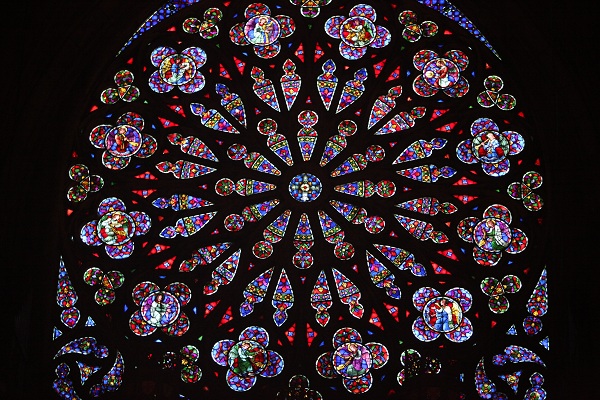
This beautiful relief is in Notre Dame Cathedral in Paris.
This Monday, January 6th, is the Feast of the Epiphany. The following churches will offer the traditional Mass:
St. Mary Church, Norwalk, CT, 8 am Low Mass, 6 pm Solemn Mass, Fr. Matthew Clark celebrant
Sts. Cyril and Methodius Oratory, 7:45 am, 6 pm.
St. Patrick Parish and Oratory, Waterbury, CT, 8 am low Mass.
St. Francis Church, New Britain, CT, 6:15 Missa Cantata.
Church of the Most Holy Redeemer, New York, NY, 6 pm Solemn Mass, Fr. Richard Cipolla celebrant.
Church of the Holy Innocents, New York, NY, 6 pm Missa Cantata.
Our Lady of Mount Carmel, New York, NY, 7 pm Solemn Mass.
Brooklyn Carmelite Monastery, 8:30 am Missa Cantata.
St. Josaphat Church, Bayside (Queens) , NY, 7:30 pm
St. Paul the Apostle Church, Yonkers, NY, 12 noon
Our Lady of the Way Chapel, Culinary Institute of NY, Hyde Park, NY, 10 am
St. Joseph Church, Middletown, NY, 7 pm Solemn Mass
Assumption Church, Jersey City, 7 pm Missa Cantata.
Our Lady of Fatima Chapel, Pequannock, NJ, 7 am, 8 am
30
Dec
The double-headed eagle of the Holy Roman Empire adorns a well-known restaurant in the Kaiserstuhl area of Baden, Germany: up to 1806 part of the Holy Roman Empire (and Austria)
The Holy Roman Empire: A Short History
By Barbara Stollberg-Rilinger
Translated by Yair Mintzker
Princeton University Press
Princeton, 2018
Some years ago, I attended a conference of lawyers in Salzburg. I was walking through the streets of that magical city with a professor from an American law school, who marveled at the great architecture surrounding us. I informed him there was a reason for this: Salzburg in the past had been not a provincial Austrian city. but the capital of a substantial principality of the Holy Roman Empire. That fascinated him: “the Holy Roman Empire…. the Holy Roman Empire….” he kept saying to himself as we continued our walk.
Yes, it is a mysterious entity, this Holy Roman Empire, which existed in one form or another between 800/962 and 1806. Throughout most of this time it was closely linked with Germany- only for a period in the 13th century did the center of gravity shift to Italy.
Barbara Stollberg-Rilinger has written, as the title indicates, a “short history” of the Holy Roman Empire – actually only of its last three centuries. 1) It covers the period ca. 1490 to 1806 – when the Empire had been “repurposed” as a German national kingdom. But this transformation was never complete. Central Europe never become another France or United Kingdom. This history it is more a constitutional or structural history – Prof. Stollberg-Rilinger emphasizes less what the Empire actually did.
But these last three centuries of the Empire, even if a period of weakness compared to the Empire‘s medieval golden years, was still an era of real political accomplishments. The Holy Roman Empire was directly involved in all the major events of Europe; its diffuse structure enabled the Protestant Reformation to take root. But, paradoxically, this same lack of unity enabled Catholicism to survive in Germany – especially in the imperial or Austrian lands that had remained Catholic. From roughly 1480 to 1720 the Empire led the defense of the West against the Ottoman Turks, a struggle in which the German lands – not Poland – did the overwhelming share of the fighting. These wars culminated in the recovery of all of Hungary for Christendom.
The Empire’s political complexity and religious antagonisms led to the catastrophe of the Thirty Years War. Yet from the low point of 1648 – the end of that struggle – the Empire recovered to lead the defense against France in the West, Sweden in the North and the Ottoman Turks in the East. By 1718 German princes occupied the thrones of Great Britain, Hungary and Poland. Denmark had become essentially a German state, and Sweden had its German possessions reduced to a fraction of their former size. It was a remarkable restoration! But soon thereafter came the conflict between Prussia and Austria, each of which disposed of resources dwarfing those of the Empire of which they were largely a part. Finally, the Empire collapsed under the blows of the French revolutionary armies and of Napoleon.
The Empire’s legacy in art, culture and architecture is overwhelming. “Take Germany’s best years(1660-1760)” as Ezra Pound put it. Why is Prague today such an incomparable gem?- not because it is the capital of a third-rate Central European state, but because it served on several occasions as the de facto capital of the Holy Roman Empire. The same, of course, can be said of Vienna – only here the legacy of the Empire in obscured by 19th century construction. Beyond the imperial capitals, there are the architectural masterpieces of all the bewildering variety of the former estates of the Empire: the imperial abbeys ( e.g., Ottobeuren); the imperial cities (Rothenburg and Regensburg); and the prince-bishoprics (Bamberg and the above-mentioned Salzburg). And the achievements of these last imperial ages were not confined to architecture and the visual arts but embraced music, philosophy and, especially towards the end of this era, literature.
The study of the Holy Roman Empire takes on added significance in the light of the recent “Catholic Integralism” discussion. For the “Holy” Roman Empire is by definition characterized by a union of the temporal and the sacred. It is a Catholic Empire. This did not necessarily earn it the approbation of 19th century and later ultramontanes. For the Empire was anything but a passive tool in the hands of the papacy. For example, in the period covered by Prof. Stollberg-Rilinger, Emperor Charles V, after sacking Rome in 1527, was instrumental in convening the Council of Trent against significant opposition in the Vatican. The Council assembled in Trent, a city, although not German-speaking, of the Empire. This religious dimension of the Empire, in my view, does not receive a totally adequate treatment in this book.
Although brief, this book may be relatively challenging for the American reader. It seems to presuppose a fairly good knowledge of German and Central European history, culture and geography – even if it does explain where Silesia is located or who Goethe is (presumably these are additions by the translator). With that reservation, The Holy Roman Empire: a Short History is a useful handbook enabling the reader to put in the proper political framework what are otherwise apparently unconnected religious, artistic and cultural developments. So, I notice it is offered for sale at the current exhibition Maximilian: the Last Knight at the Metropolitan Museum.
Regrettably the two forewords to this book are typical of present-day academia in Germany and the United States. Prof. Stollberg-Rilinger worries that the methodology of her book could be interpreted as a “political move,” which is understandable given that her own foreword is largely devoted to the discussion of post–19th century ideological issues. Then there is the foreword of the translator. Yair Mintzker describes the book as targeting a “broad audience” then devotes paragraphs to an exposition of the interrelationships among academics currently working in the field of the Holy Roman Empire. Having translated a book often concerned with details of terminology, he refers to the “Austrian Empress Maria Theresa.” And of course, like every American professor, he must utilize a discussion of the most remote topic to launch an attack on Trump. “Almost all Americans ” he informs us, “accept as legitimate the election of Donald J. Trump.” How gracious of them to accept incontrovertible facts! You see, this was the product of of a series of “fictions” that the outcome of elections represents the will of the people. Prof. Mintzker’s understanding of the purpose and workings of the United States constitution is decidedly limited.
But these things are of our time. I would hope the reader of The Holy Roman Empire: A Short History would be inspired by it to delve more deeply into a fascinating polity and its culture!
The imperial eagle in Colmar, Alsace (up to 1635 part of the Empire)
29
Dec
Midnight Mass at Holy Innocents Church, Manhattan. Photos courtesy of Arrys Ortanez.
Our Lady of Refuge Church, Bronx, NY. Photos courtesy of Joanne O’Beirne
Midnight Mass at St. Josaphat Church, Bayside, NY. Photos courtesy of Julie Collorafi.

Christmas Day Mass at Our Lady of Mount Carmel, New York. Father Christopher Salvatori, celebrant.
Midnight Mass at Sts. Cyril and Methodius Oratory, Bridgeport, CT. Photos from Sts. Cyril and Methodius Facebook page.
Christmas Day Mass at St.Patrick’s Church, Newburgh, NY. Photo from AdaltareDei Facebook page.
By Father Richard Gennaro Cipolla
Just when one thinks that one has read all of the mindless and harmful stuff that Catholic clergy have written or spoken, that assumption is shattered, this time by a truly offensive homily given by Father Michael Mullaney, the President of Saint Patrick’s College, Maynooth, Ireland, a section of which homily was published on Rorate Caeli a short while ago.
The homily was preached at the annual Christmas Carol Service at Maynooth, in the presence, we may suppose, of other clergy, seminarians and laity. The topic of the homily is the sin of racism in contemporary Western society. That racism is a sin according to Catholic teaching there is no doubt. The Catholic Catechism is quite clear on this:
The equality of men rests essentially on their dignity as persons and the rights that flow from it. “Every from of social or cultural discrimination in fundamental personal rights of the grounds of sex, race, color, social conditions, language, or religion must be curbed and eradicated as incompatible with God’s design.”(CCC no. 1935)
There are many statements in Church documents of all types that confirm the sinfulness of racism. Would that Father Mullaney used one of these texts as the foundation for his homily. Instead he uses the story in the Gospel of St. Mark about Jesus’ encounter with the Syro-Phoenician woman who wanted him to cure her daughter who was very sick. The following is Father Mullaney’s use of this encounter as an example of how everyone can commit the sin of racism.
Even Jesus had to confront his ingrained prejudices; indeed, even racism. The Gospels recount his stunning and unique encounter with a Syro-Phoenician woman desperately seeking a cure for her sick daughter. The disciples dismiss her as she was considered racially inferior. Surprisingly, Jesus sharply rejects her appeal. His mission is to the Jews only; his tribe; the children of God. When the woman insists, Jesus dismisses her again– calling her shockingly a ‘dog’ – a racial slur. The woman doesn’t challenge his insult. Like so many victims in history, she has internalized her inferiority. But her repartee: “Even the dogs under the table eat the children’s crumbs” is the only recorded encounter that left Jesus speechless. If we truly celebrate the mystery of the Incarnation, of God who takes human flesh, it should not surprise us that Jesus could not have avoided the effects of the prejudices that had shaped his human and cultural identity from childhood.
We do not know what Jesus thought in that moment. But the Syro-Phoenician woman dislocates Jesus from his narrow tribal suppositions and prejudices about the ‘other’ represented by her. She ceases to be an ‘outsider’. God’s heart could not be closed to her. She too is one of the children of God. Physical healing is given not only to her daughter but ultimately the deeper wounds of isolation, marginalization and discrimination become central to Jesus’ healing and liberating ministry in the Gospel. In this transformative encounter Jesus demonstrates that regardless of how unwittingly and unknowingly we are part of the problem, we can choose to reject racism and hostility to the ‘other’, the stranger, in ourselves and in our world, committing ourselves to the slow, hard work of transformation.
The whole passage is so wrong-headed that one hardly knows where to begin to react to these words in a homily delivered by a priest who is helping to train seminarians to become good priests. Let us begin with the observation that Father Mullaney believes that in this encounter between Jesus and the woman that Jesus is acting like a racist, that is, his comments to her are racist. If this be true, then Jesus is sinning against this woman. It is obvious that this contradicts the dogma of the sinlessness of Jesus, “he who knew no sin” (2 Cor. 5:21), which is an integral part of the Church’s understanding of the Incarnation itself. But Father Mullaney has his own understanding of the Incarnation: “if we truly celebrate the mystery of the Incarnation, of God who takes human flesh, it should not surprise us that Jesus could not have avoided the effects of the prejudices that had shaped his human an cultural identity from childhood.” Does this imply that he learned these prejudices that are racist from his mother and father? Did his mother, the Virgin Mary, gratia plena, whose sinlessness is also a part of Church teaching, teach him to be a racist and consider people other than Jews “dogs”? If Father Mullaney believes this, he should read up on the heretical kenotic doctrines of liberal Protestantism that have been condemned many times by the Church. More fundamentally, he should also read up on the context of this passage in the Gospel of St. Mark.
Father Mullaney begins the next paragraph of the sermon with this statement:
“We do not know what Jesus thought in that moment” Thanks be to God for the preacher’s admission that he could not see into the mind of Jesus at the moment! But he has already claimed to know that Jesus harbored racist attitudes towards this woman. And in the next sentences he credits the woman with “dislocating Jesus from his narrow tribal suppositions and prejudices about the ‘other’ represented by her.” In this way, by her persistence the woman pricks Jesus conscience, and he feels guilty, and from that feeling of guilt is converted from his racist attitudes to a more enlightened moral understanding. This event marks a “conversion experience” for the man Jesus.
Is this the same Jesus who recounted the parable of the Good Samaritan? Is this the Jesus who reprimands Peter for cutting off the Roman soldier’s ear, this man the symbol of Roman oppression of the Jews? Is this the Jesus who speaks to the Samaritan woman at the well and brings her to faith? Is this the Jesus who said: “The Second (Commandment) is this: Love your neighbor as yourself.”? Is this the Jesus who gave the Great Commission to the Apostles to “go and make disciples of allnations”? And finally: Is this the Jesus who died on the Cross not only for his own people, the Jews, but for the whole world?
I have long thought that most heresies are attempts to make the Incarnation easier to understand and accept, to make the inherent contradiction that is at the heart of the person of Jesus Christ as true God and true man, two natures in one person—to make this contradiction go away. This was at the heart of Arianism, of Nestorianism, of the complex Gnostic systems, of those Protestant sects who at the Reformation and beyond rejected the divinity of Christ, of those in our own time who in their own way deny the radical nature of the Catholic doctrine of the Incarnation, including the many Catholics who deny the Real Presence of Christ in the Eucharist.
I wish I could take Father Mullaney’s homily with a sense of irony that he would preach this in preparation for the feast of Christmas. For irony allows us to distance ourselves from things that are truly bad. Irony allows us to refuse to engage with the distortion of truth when we see it or hear it or read it. I wish I could distance myself from what this priest said in this homily and say with a wry and knowing sardonic smile: “And this guy is preparing priests!”. But I cannot. The only thing I can do is to be sad, pray for him, and hope that his bishop will chastise him and correct him, and that he will never again shamelessly disfigure a Carol Service celebrating the birth of the God-man who alone can be the Savior of the whole world.