
19
Aug

The Heresy of Formlessness
The Roman Liturgy and its Enemy
By Martin Mosebach
Foreword by Robert Spaemann
Translated by Graham Harrison
Revised and Expanded Edition
(Angelico Press, Brooklyn, N.Y. 2018)
This year we welcome a new edition of a book that is, for the Catholic Traditionalist, one of the most basic books of all. Since 2002, The Heresy of Formlessness has remained the best introductory text to Catholic Traditionalism. It provides the substantive reasons for adhering to the Old Rite. Instead of the usual Roman Catholic focus on legal questions of validity and authority, this book takes as its starting point how the Mass – Traditional, “Novus Ordo” and Eastern – is experienced today. For Mosebach combines a novelist’s gift of depiction with great knowledge – both practical and theoretical – of the liturgy in all its forms.
This new edition is a revision of the previous 2006 translation published by Ignatius Press, augmented by six essays, some of which have been published (and translated) before. Jettisoned is Fr Fessio’s unique foreword which criticized the very book it was introducing. But much has changed since 2002 when The Heresy of Formlessness first appeared in German! In those years, the Traditional liturgy – especially in Germany – was very much an underground phenomenon, the province of “outsiders.” Today, especially in the United States in the wake of Summorum Pontificum, the Traditional Mass can be encountered more or less frequently – often celebrated with great ceremony and splendor.
This edition has a new, important foreword by Robert Spaemann – to whom the book is dedicated. Spaemann outlines for us the German context of The Heresy of Formlessness. In Germany, the opposition of the clergy to the Traditional Liturgy remains fierce and unbroken to the present day. Moreover, the spirit of progressivism has maintained absolute, quasi-totalitarian dominance In Germany for decades now. Spaemann illustrates this with examples of the Novus Ordo liturgies he has experienced everywhere. Given such a closed, asphyxiating environment, in 2002 Mosebach’s book broke all the taboos. Mosebach opened a discussion on the liturgy that the establishment has not been able to silence since.
I don’t see the need to say anything more on the main thrust of this book beyond what I wrote in my original 2003 review. The new essays in this edition are gems. Consider “Why the Holy Mass must be Sung.” Mosebach starts from the soft fluttering of flights of starlings over Rome, proceeds to considerations on the participation of angels in the liturgy, then draws on the Byzantine liturgy to illustrate how the congregation “represents” the angels – who sing – all leading to and supporting the conclusion that the primary form of the Mass is the sung liturgy! Or “The Last Gospel” where Mosebach argues that its appearance at the end of the mass in the 13th century coincided with the perfection of Eucharistic devotion in the Corpus Christ liturgy of St Thomas Aquinas. This Eucharistic devotion created a renewed focus the Incarnation – it was thus fitting that St John’s Gospel should be read at the end of every mass, where Christ has appeared again. Moreover:
“Those who are committed to the Last Gospel will not agree, either, with the widely accepted custom of permitting the congregation to sing a hymn while this Gospel is being read. It makes sense for the acolytes to take their places at the foot of the altar during the reading of the Last Gospel in the same way that the Gospel of the day does. As a text that is constantly being read and that many people know by heart, the prologue of St John can be read (un)self-consciously sotto voce while the members of the congregation follow it in their missals. The aim of the prologue is contemplation, the retrospective beholding of a lived reality. At the end of Mass there should be an appropriate silence, as during the confession of sin at its beginning.”
Here we see Mosebach drawing out the meaning of details that even in current celebrations of the Traditional Liturgy are often given summary treatment. But, at the same time, does this discussion not show how far we have come from the days when an indifferently celebrated Low Mass was the best we could hope for? For nowadays in most places the goal is not just survival of the Roman liturgy but to make it as perfect as our poor human efforts can achieve. Let us not delude ourselves: even in the United States the Traditional liturgy remains suspect to the establishment, an anxiously monitored phenomenon. And I do not have to review for the readers of this blog developments elsewhere. But despite all these shadows, we can affirm that what Martin Mosebach in The Heresy of Formlessness celebrated, predicted and advocated as a lone voice in 2002 has to a not inconsiderable extent been realized. Those who have not read this book owe it to themselves to do so!
Published in Book Reviews, Martin Mosebach | no comment
This afternoon St. Mary’s Church, Norwalk, celebrated its patronal feast of the Assumption with a solemn Mass, a procession in the church and a celebratory parish dinner. Fr. John Ringley, who has arrived this summer as the new pastor, was the celebrant.


Published in Photos | no comment
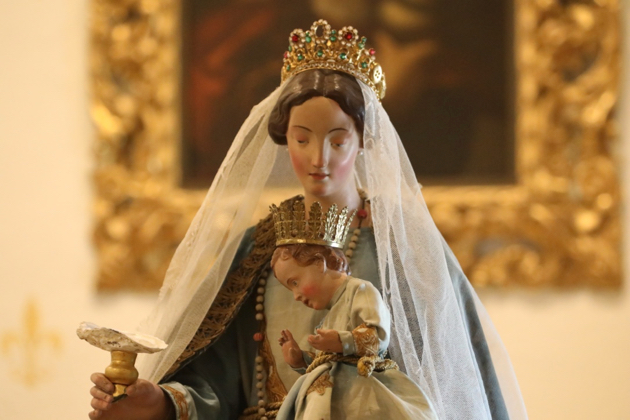
St. Mary Church, Norwalk, CT, will celebrate the Assumption of Mary this Saturday, August 18th at 4 pm with a solemn Mass, then a parish picnic immediately following Mass. The church will provide hamburgers and hot dogs. Please bring a dessert or side dish to share.
Published in Events, Masses | no comment
15
Aug
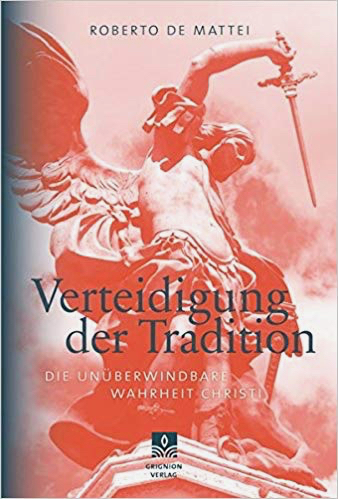
Verteidigung der Tradition: Die unüberwindbare Wahrheit Christi.
(In Defense of Tradition: The Invincible Truth of Christ)
By Roberto de Mattei (German translation by Wolfram Schrems)
Foreword by Martin Mosebach
2017 Sankt Grignion Verlag, Altötting
(Original Italian edition, 2011)
The current age of the Church is of unmatched doctrinal confusion. Every dogma, every rule of morality is directly challenged by those within the church. And those claiming supreme teaching authority are exacerbating the confusion. Pope Francis has formally taught doctrines hardly reconcilable with the prior course of Catholic teaching. He has also confirmed, “with magisterial authority” the practices (presumably liturgical) of the Second Vatican Council. And then there is the series of canonizations of the heroes of Catholic modernity. This has left Catholics – particularly those who imagined themselves papal loyalists – in an increasingly dire situation. Professor Roberto de Mattei in this slim volume offers intellectual assistance.
The first half of In Defense of Tradition is a review of pre-conciliar church history. Critical moments are highlighted in which the institutional church and specifically the papacy initially failed to stand up to political and theological challenges. These existential crises finally were surmounted or contained only by the joint action of all members of the Church: the ordinary laity, the doctors of the church, the councils, the episcopate, the new religious orders, the papacy – and, we should not forget, the secular rulers. In the course of these conflicts issues such as the possibility of papal heresy and the duty to correct hierarchs and even popes were freely discussed and acknowledged.
We may wonder about the purpose of the first half of this book. Is it addressed to those few remaining true blue Catholics (like Opus Dei soldiers?) who conceive of church history as one triumphant progress under the day-to-day direction of an always infallible papacy? For I would expect that readers interested in a book like this (and who perhaps have read previous works of de Mattei and Mosebach) would be familiar with most of these historical facts. Rather, I think this historical outline “lays the foundation” for the specific discussion of tradition in the second half of this book. For it shows that exclusive concentration on the actions and pronouncements of the hierarchy and the papacy is an inadequate historical and theological basis for understanding the Church and its history. Yes, the Church and the papacy did endure these assaults in the past. But what then was the principle that enabled the Church to survive?
Now the most significant part is de Mattei’s theological exposition of the meaning of tradition in the second half of his book. For it was though faithfulness to tradition that the prior crises of the Church were overcome. What is tradition? It is the deposit of faith handed down from Christ to the Church. Indeed, for the first decades of her existence, the Church had to rely exclusively on tradition – the first scriptures were only gradually being written. This tradition is the true “rule of faith” made manifest in many ways over the course of history but above all in the liturgy.
Relying on extensive theological literature, de Mattei in particular takes pains to distinguish tradition from the Church’s teaching authority or magisterium (itself a very late concept to develop). The magisterium is not a “source” of truth or creator of tradition, but rather an authority or “function” bestowed upon the Church.
De Mattei clearly expounds and defines the sources of theological truth, the meaning of “Church” and the meaning of magisterium. He warns against the concept of a free-floating magisterium as the ultimate criterion of truth. Outside of the “solemn magisterium” the so-called “ordinary magisterium” can acquire a character of infallibility only when it is in harmony with tradition. De Mattei also takes issue with the notion of “hermeneutics” as the key to discerning tradition. For that concept introduces a “subjective” element which shifts the focus from objective tradition to the interpreting subject.
This precious second half of In Defense of Tradition provides the Catholic reader with the clearest and most succinct exposition of these issues of which I know.
Marin Mosebach has contributed a forceful introduction to the German translation of de Mattei’s book. For there has been a very significant shift in the ecclesiastical context since 2011, the year of this book’s original publication. At that time, the author did have to define and justify tradition against the claims of the Second Vatican Council and its implementors. But he also had to defend the authority of Pope Benedict XVI against a renewed tide of anti-papal rage fostered by the Catholic progressives and specifically by the Catholic church in Germany. Today, under Bergoglio, we have both the greatest rupture with Catholic doctrine and practice since the 1960’s combined with unlimited assertions of the scope of the magisterium.
Mosebach brings out some points more explicitly than in the original text, e.g.,
“After the First Vatican Council a papalist theology arose that greatly exceeded the definition of the papal office in Catholic tradition. The consciousness of the strict anchoring of the pope in tradition faded – the excesses of the political claims of the medieval popes found their equivalent in the exaggeration of their spiritual authority in the 19th and 20th centuries. It could appear to the naive believer that infallibility extended to every imaginable aspect of life and that the plenary authority of the pope permitted even the abolition of tradition. As this then actually occurred at a most sensitive spot – I am referring to the liturgical reform of Pope Paul VI – the first doubts arose regarding this theology…”
Mosebach then provides a frank discussion of the reign of Francis, in which it often appears that the pope is less concerned about transmitting what is specifically Catholic than in following the agenda of the mass media. Mosebach states:
Roberto de Mattei wants to show his readers how to remain a Catholic loyal to the pope without as a consequence becoming deaf and blind.
In Defense of Tradition answers a real need. This brief handbook and guide will serve well in this time of crisis. Evidence of the interest in this text was the presentation of this book on July 9 at a well-attended conference in Munich with both de Mattei and Mosebach (among others) speaking. Fortunately, we understand an English translation will be forthcoming shortly.
(Translations are mine for which I ask the reader’s forbearance)
Published in Book Reviews, Martin Mosebach | no comment
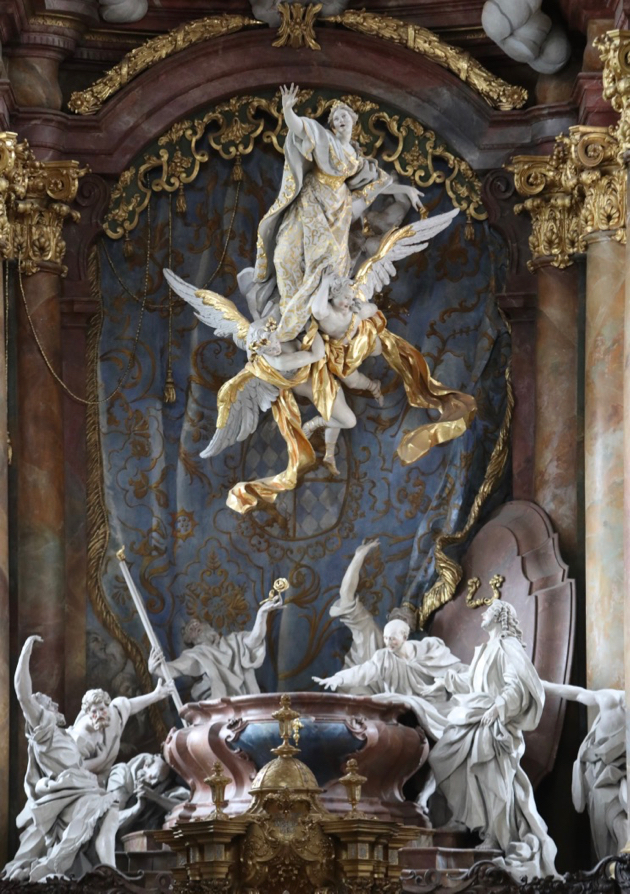
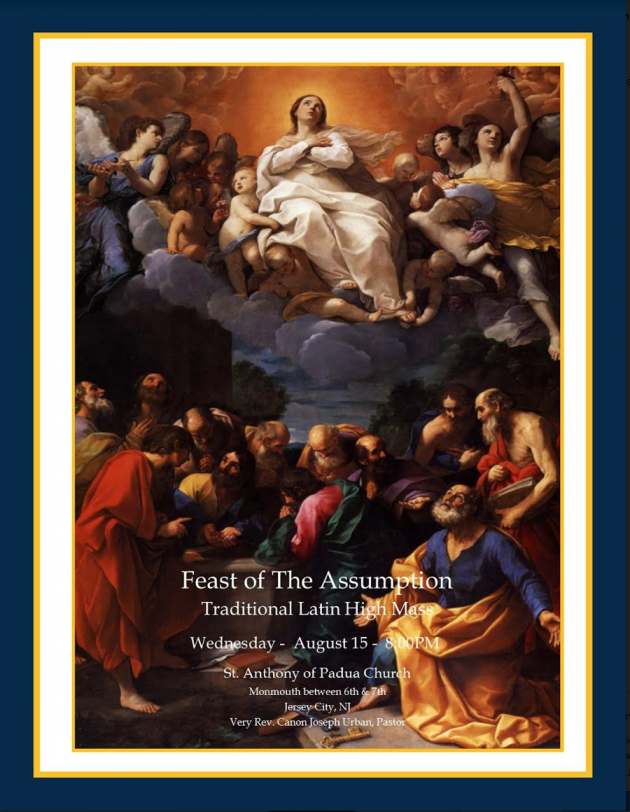
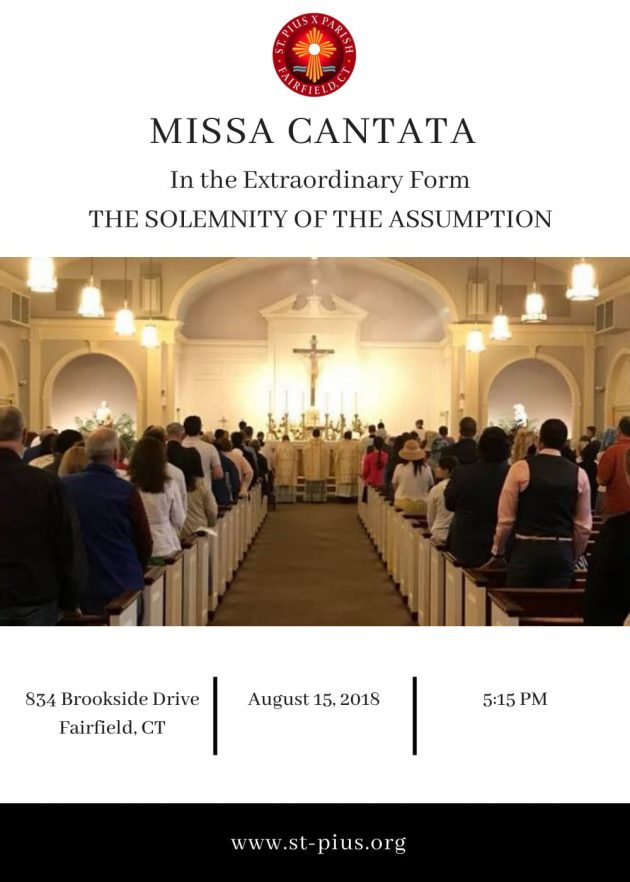
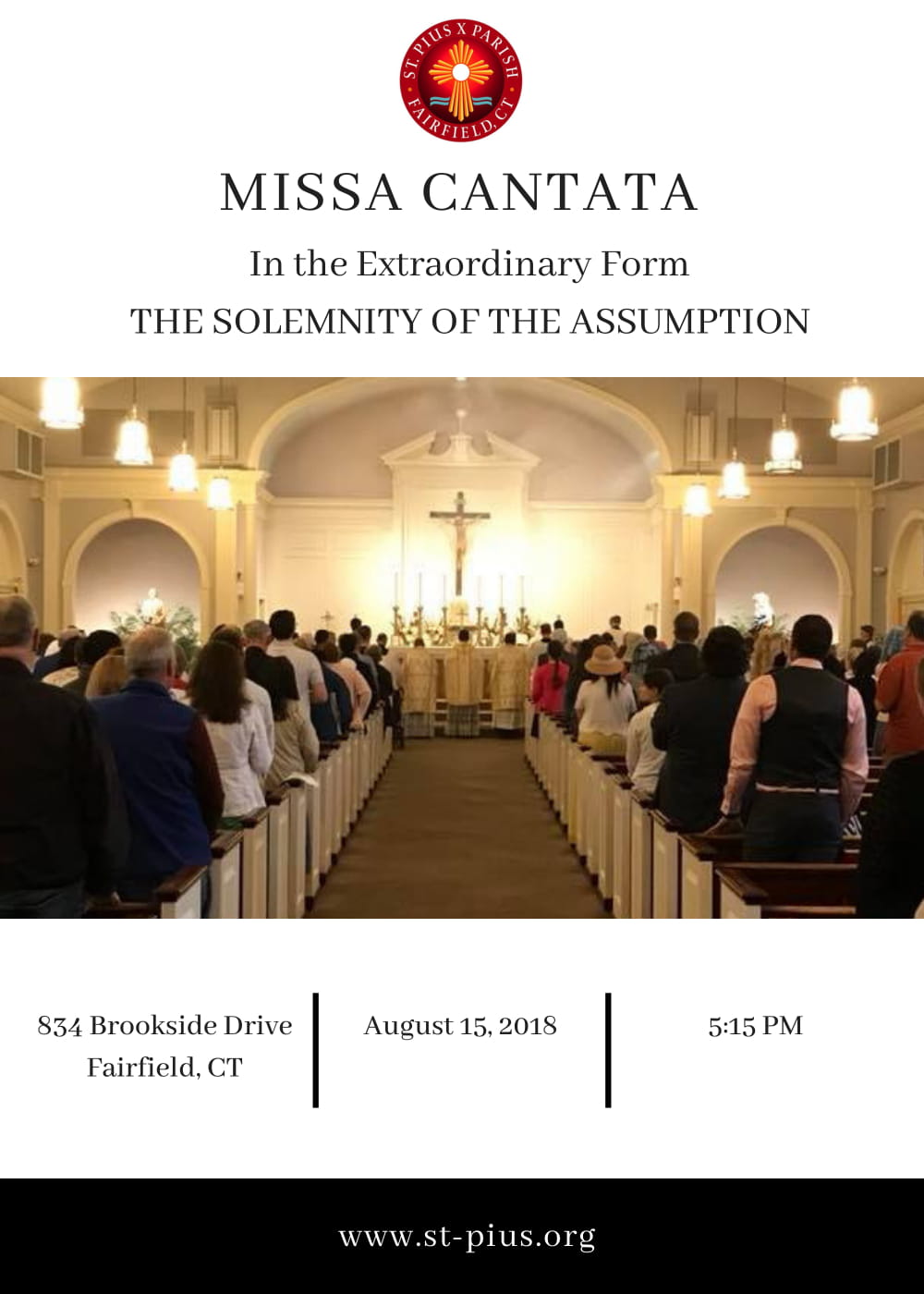
Tomorrow, August 15, is the solemnity of the Assumption of the Blessed Virgin Mary, a holy day of obligation. The following churches will offer Traditional Masses. Our photo is the high altar piece in Rohr Abbey in Germany (Niederbayern), sculpture by Egid Asam.
St. Pius X Church, 834 Brookside Dr., Fairfield, CT, 5:15 pm, Missa Cantata
St. Mary Church, Norwalk, CT, 7:30 am, Low Mass; 5:30 pm, Missa Cantata
St. Stanislaus Church, New Haven, CT, Low Mass, 5:30 pm
Sts. Cyril and Methodius, Bridgeport, CT, 7:45 Low Mass, 6 pm, High Mass
St. Martha Church, Enfield, CT, 7:00 PM
Church of the Holy Innocents, New York, Low Mass 8 am, Missa Cantata, 6 pm
Pontifical Shrine of Our Lady of Mount Carmel, New York, Low Mass 7:45 am, Solemn Mass 7:30 pm, after Mass all are invited to the altar rail for the blessing of herbs, fruits and flowers. All are welcome to bring herbs, fruits and flowers to be blessed for use in the domestic church, your houses.
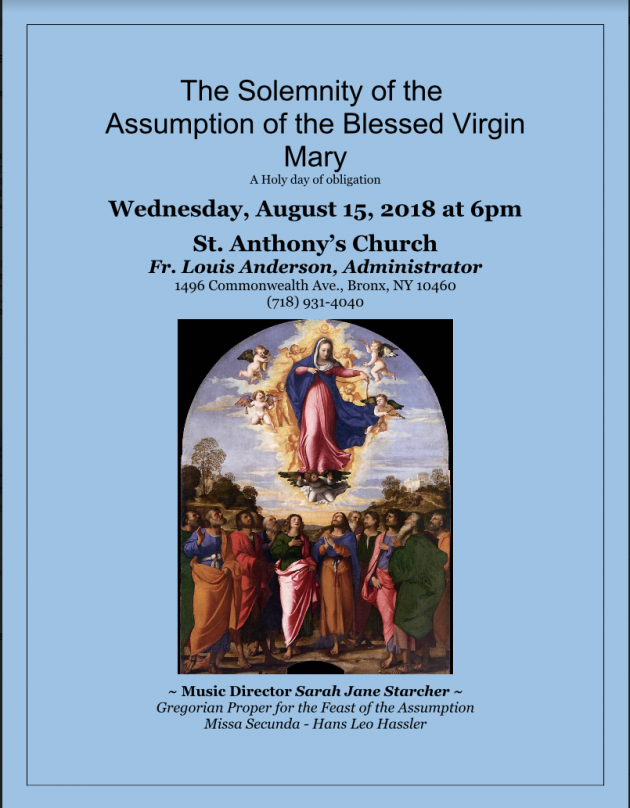
St. Anthony Church, 1496 Commonwealth Ave, Bronx, NY, Missa Cantata, 6 pm
Immaculate Conception Church, Sleepy Hollow, NY, 7 pm, Low Mass
St. Matthew Church, Dix Hills, NY (Long Island) 10:15 am, Missa Cantata
St. Anthony of Padua Church, Jersey City, NJ, Missa Cantata, 8 pm
Our Lady of Fatima, Pequannock, NJ – 7 AM, noon, 7 PM
Published in Uncategorized | 1 comment
13
Aug
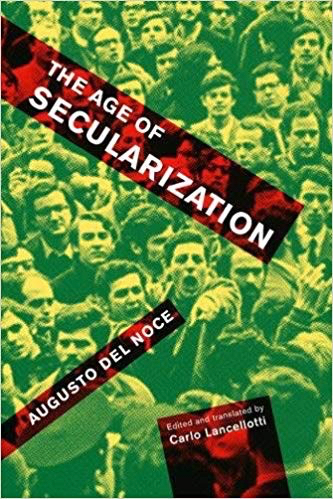
The Age of Secularization
By Augusto del Noce
Edited and translated by Carlo Lancellotti
(McGill-Queen’s University Press Montreal 2017)
At times we have to turn away from the current dramatic situation in Catholicism: the ever-increasing radicalism of Bergoglio and his associates and allies accompanied by the continuing spread, at a lower level, of traditionalist countercurrents in liturgy and morality. To understand what is going on now we have to get to the philosophical and historical roots of the current crisis. It is a grave weakness particularly of Americans to want immediate action in the absence of a solid intellectual foundation. Over the next several weeks I’d like to review some recently published or republished books that, in my judgment, help to provide that basis.
Augusto del Noce was a distinguished Catholic philosopher whose works, thanks to the sterling efforts of Professor Carlo Lancellotti of the City University of New York, are only now appearing in English translation. The Age of Secularization, prompted especially by the tumultuous years of the 1960s, was published in Italy in 1970 and our translation appeared in 2017! But we can think of many other key Catholic authors who remain largely or totally untranslated in English: Roberto de Mattei, Martin Mosebach, Gómez Dávila, etc. The Catholic traditionalist still has to be a polyglot if he wants to discover the breadth of Catholic thought.
Augusto del Noce resolutely champions the primacy of philosophical reflection. In conformity with the classical tradition, it is philosophy that provides the necessary means to understanding current society and events. In these respects, as in many others, del Noce will remind the reader of the late Thomas Molnar. Indeed, Professor de Mattei informs me that on at least one occasion they both appeared together at a conference. And The Age of Secularization is more directly reminiscent of several works of Molnar published around the same time (e.g., Ecumenism or New Reformation aka Dialogues and Ideologues, 1968) The intellectual background and approach of the two authors differ though. Thomas Molnar operates in the French and general European intellectual world and favors a lengthy historical analysis of any topic. Del Noce is more focused on the 19th and 20th centuries and lives within the Italian philosophical tradition. He devotes much time to Italian history and national favorites such as Croce, Gentile and Rosmini. I don’t think the intellectual context of the author, however, is a barrier to the non-Italian reader – Prof. Lancellotti’s excellent footnotes help greatly. And del Noce also draws on and analyzes St. Thomas, St Augustine, Simone Weil and various Marxists as well.
Now del Noce seeks to situate the events of the postwar period in their spiritual and intellectual context. And were not the 1960’s the period of most profound social and moral change? We note – surprisingly or not – that for this task del Noce does not feel the need to cite the texts of the Second Vatican Council and more recent Papal pronouncements (except for a tangential and actually critical reference to Gaudium et Spes). That would seem odd for a “Catholic” philosopher – given that the fathers of the Council claimed for themselves the ability to read “the signs of the times.” But then del Noce’s assessment of modernity does not agree at all with the Conciliar optimism. Indeed, much of The Age of Secularization is a critique of progressive Catholicism – Teilhardian or otherwise -which del Noce’s identifies with a renewal of the Modernism condemned by Pope Pius X.
Del Noce identifies Western secular society – the society of well-being, or the “technological” or “affluent” society – as the dominant force today and the absolute antithesis of religion. For it utterly denies the very possibility of a religious dimension. In that regard it surpasses Marxism as a foe of Christianity. For that ideology, although inherently atheistic, retains an inverted religious element in dialectical materialism.
Del Noce describes the “age of secularization” in these words: We started from the ideals of universal liberation, and it seems the world is moving towards the organization of oligarchies and sociocratic castes like have never been seen before. The words freedom, democracy and justice are untouchable, and rights are constantly declared, but this does not alter the fact that actual reality is marching towards a synthesis of all the forms of despotism that ever appeared in history.
Del Noce’s perspectives are original and creative. For example, the post-World War II era should be seen as not a crisis of faith, but a crisis of the secular alternatives to faith: “philosophical” secularism, fascism, Nazism and communism. One would think that this crisis should open the door once again to the transcendent. In del Noce’s view, the student protests of 1968 were in their origin an understandable uprising against the dehumanizing affluent society. Tragically, though, these movements were imbued from the start with anarchistic, totalitarian and libertine elements so that the revolts ended up reinforcing, rather than abolishing, the affluent society.
Del Noce addresses the issues of “Christian democracy” – the author acknowledges a tension between the two concepts – especially as practiced in Italy after World War II. This period of Christian democratic hegemony saw the greatest decline in Christian moral values – not in favor of Marxism but hedonism and eroticism. Del Noce still advocates the notion of a “Catholic” party – against Catholic progressives who were condemning it- but on the basis of a radical reinvestigation of its own principles. But then del Noce is not one to offer “solutions” or a political program. He stakes out for himself a unique political stance: liberal (in the European sense), Maritainian, but not as these terms were commonly understood in 1970. I do have here one criticism of Prof. Lancellotti’s otherwise outstanding work as editor and translator. In the chapter dealing most directly with question of Christian democracy the translator had deleted a number of passages in which del Noce turned his attention to concrete political issues of his day. Admittedly these paragraphs would require footnotes to explain exactly what was going on in those years – but also might enable us to get a better sense of del Noce’s judgment as a political actor.
Finally, let me quote del Noce who (apparently relying on Max Scheler) defines the characteristics that distinguish the “traditional” idea of man (which “achieved its fullness in Christian thought”) from the “instrumentalist” understanding of the current age:
(A) man possesses in himself an agent whose essence is divine, which every nature does not contain subjectively;
(b) this agent and the power that eternally shapes and organizes the world are in their principle one and the same – hence reason’s aptitude at knowing the world;
(c) as logos and human reason, this agent is capable of exercising power and realizing its own ideal content, without any intervention by the inclinations and sensations that men and animals share in common – that is in history itself there is a priority of ideal causality.
A bit challenging? – perhaps. But it summarizes del Noce’s unshakeable conviction of the primacy of the spiritual, of contemplation and of philosophical reflection. I can only mention in this review a few of the innumerable insights of del Noce. The Age of Secularization is essential reading for anyone who wants to find out what is driving developments, not just in 1970, but now. And, perhaps, also find insights and principles that provide a foundation for Catholic spiritual survival.
Published in Book Reviews | no comment
Churches of New York
Holy Roman Empire
Website Highlights
Archives
[powr-hit-counter label="2775648"]