4
May
1
May
The Met has an extraordinary new exhibition of the painting of colonial Mexico – particularly of the 18th century. We forget how important Mexico and Mexico City were in the 18th century – when the former British colonies of North America were just getting organized. Did not St Peter, the first Catholic church in New York, obtain from Mexico a example of such painting, a crucifixion still present there today? It was before this image that Elizabeth Seton prayed. And moving from the visual arts to music, over the last six months St Mary Parish in Norwalk and the Society of St Hugh of Cluny have sponsored masses with orchestral religious music from 18th century Mexico.
The artists of that time worked within the conventions established by the Baroque masters of Europe but localized the dress and landscapes, added a more emotional and extravagant note and mixed in exotic color as well. The exhibition covers religious art – often large format images intended for churches – genre scenes, portraits and unique allegorical images.
Need we add that Mexico in that century was an exclusively Catholic world? The religious dimension is dominant throughout this exhibition.
(Above) A somewhat perplexing allegory of the Spanish empire.
(Above) A nun upon the taking of her vows; she carries a “badge” that also constituted a unique genre of Mexican painting (below).
Saints. (Above) St Rosalia in procession against the plague in Palermo. (Below) St Rose of Lima with a fine portrait of a donor.
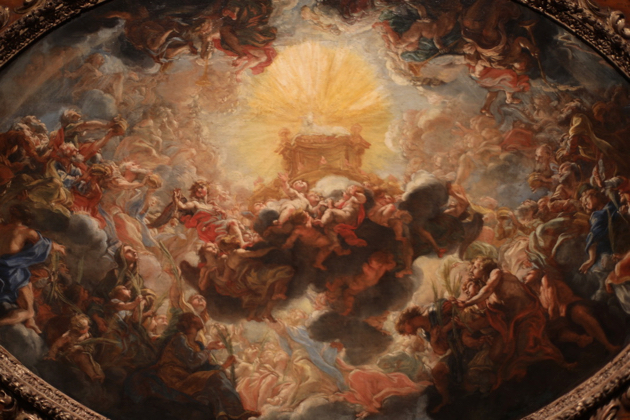
(Above) Unusually, a rather restrained version of St Lucy – with no eyeballs in the dish she holds. (Below) A striking, unusual double portrait of a bishop and a high chancery official.
Dramatic, emotionally charged images often characterize Mexican art of this period. (Above) the death of St. Francis Xavier; (below) the recovery of the body of St. John Nepomucene (Nepomuk).
For more details on the exhibition see HERE.
1
May
From Ireland comes a “Strategic Plan” for the Irish Association of the Knights of Malta – incorporating views undoubtedly intended to please in Rome. It envisions the complete transformation of the Order of Malta into a secular charitable organization:
Also, it is vital that our Association should not be perceived as a haven for excessive religiosity, misogyny, puritanism or foppery. We need to emphasise that we are a pragmatic Christian-Humanitarian association of ladies and gentlemen who enjoy life and continue the tradition of nine centuries of impartial compassion and charitable service to the sick and the poor.
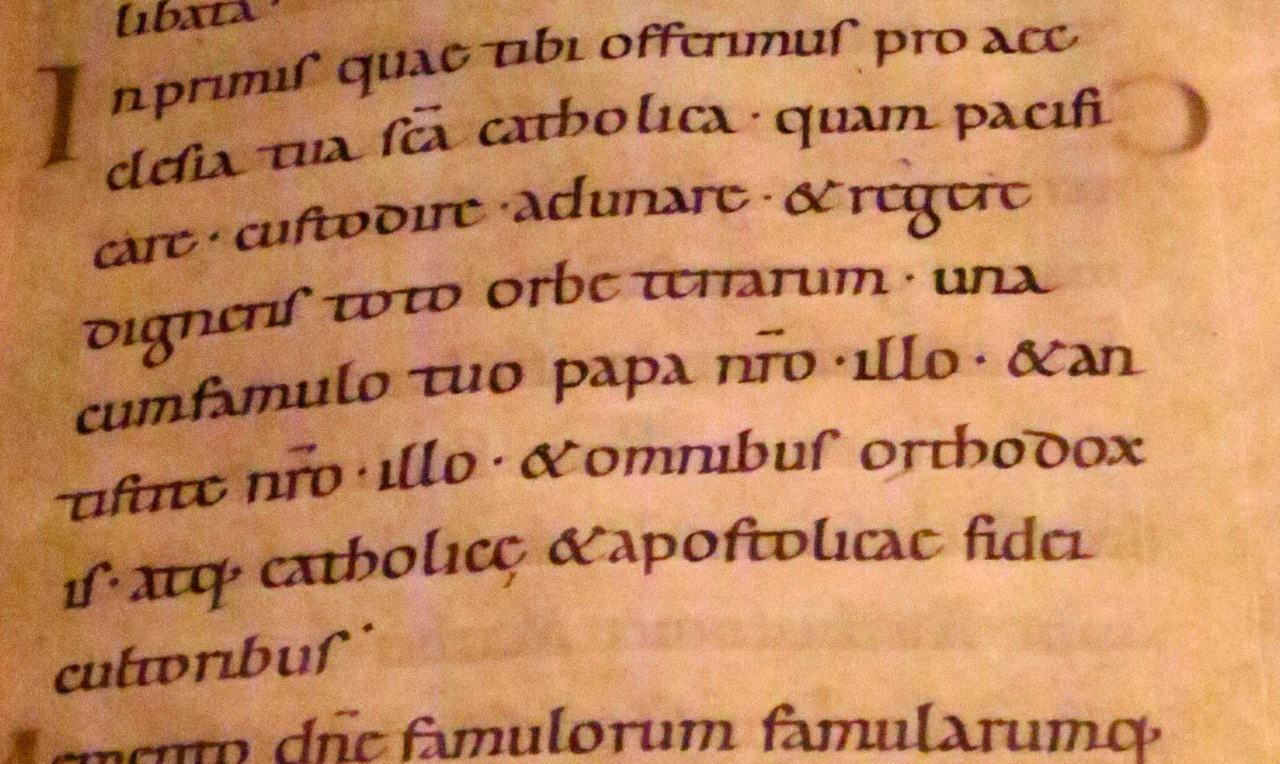
But the readers of this blog may be more interested in the liturgical aspects of the “Strategic Plan” :
The Novus Ordo Missae of Pope Paul VI (1970), is the form of the Holy Mass that most Catholics know and understand. Therefore, it is the responsibility of the Council and the chaplains to ensure that members and aspirants can fully and meaningfully participate in the Masses and other liturgies for the Association.
At least in Ireland, the experimentation by the Knights in recent years with the Traditional Mass will officially come to an end.
1
May
Plans are underway to open a new Catholic high school in Stamford, CT, the Cardinal Kung Academy, offering a classical curriculum.
The school is scheduled to open this fall. Three years of Latin will be required. Technology such as i-pads and cell-phones will be prohibited
1
May
30
Apr
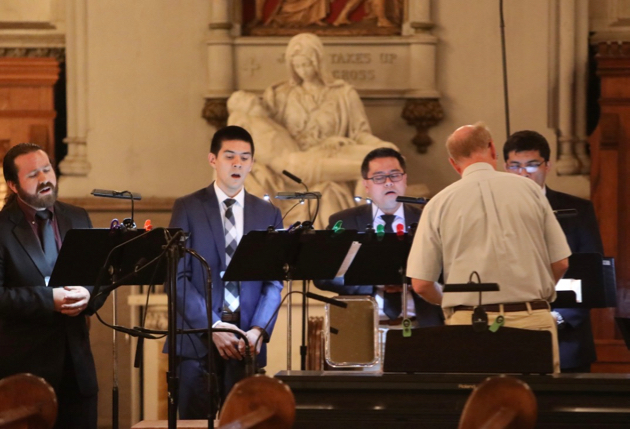
St. Mary’s Church, Norwalk, CT, will be presenting the third and final installment of the Rosary Concert Series, dedicated to the Glorious Mysteries, on Sunday, May 6, 2018 at 3:00 p.m. at St. Mary’s Church, 669 West Avenue in Norwalk, Connecticut.
The program for “The Glorious Mysteries” is drawn from a collection of violin sonatas by Austrian composer Heinrich Ignaz Franz von Biber (1644–1704), which are usually referred to as the “Rosary Sonatas” or the “Mystery Sonatas.” The collection contains fifteen sonatas, each of which is a meditation on one of the fifteen mysteries of the Rosary (presumably intended for performance at special rosary processions in Salzburg). Each sonata has not only a distinct character, but its own distinct re-tuning of the violin strings, or scordatura, allowing for unusual resonances on the instrument. The scordatura tunings and the technical difficulty of these pieces made them some of the most virtuosic violin compositions of their time. This concert will feature the final set (Sonatas XI-XV), which combine sacred reverence with joyful dances, reflecting the scenes of life, renewal and transcendence found in the Glorious Mysteries.
The soloist for this concert will be baroque violinist Leah Gale Nelson, who has performed the Mystery Sonatas widely for over a decade and has also recorded the complete collection for Lyrichord Discs. Nelson is particularly known for her refined and artistic interpretations of baroque and classical music. She is based in New York City and has performed throughout North America and Europe. Her artist website can be found at www.leahgalenelson.com. Nelson will be accompanied by Dongsok Shin on chamber organ and Daniel Swenberg on theorbo. Both artists are featured on Nelson’s recording of the Biber sonatas, and are sought-after continuo players based in the New York metro area. Patricia Ann Neely (violone) will also join the players for Sonata XII, The Ascension.
The concert will be performed in St. Mary’s Church at 3:00 p.m. Admission is free of charge, though donations will be gratefully accepted. All proceeds will benefit the sacred music program at St. Mary’s and make more concerts possible in the future. A light reception in the church hall (school building) will follow the concert.
Solemn Vespers & Benediction will also be held in the church at 5:00 p.m. (as it is on the first Sunday of every month) after the concert and reception.
29
Apr
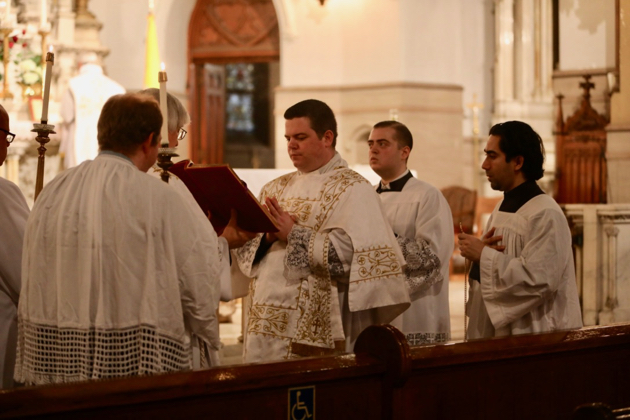
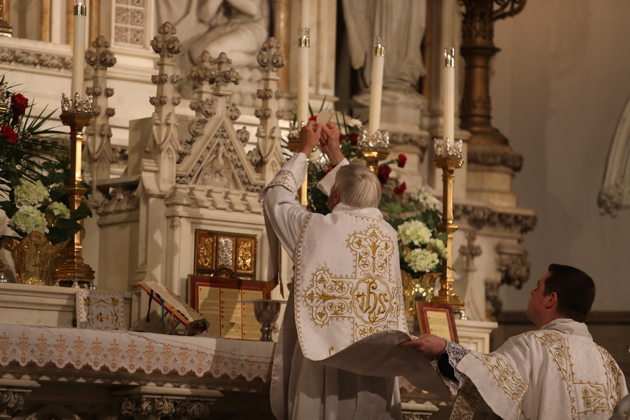
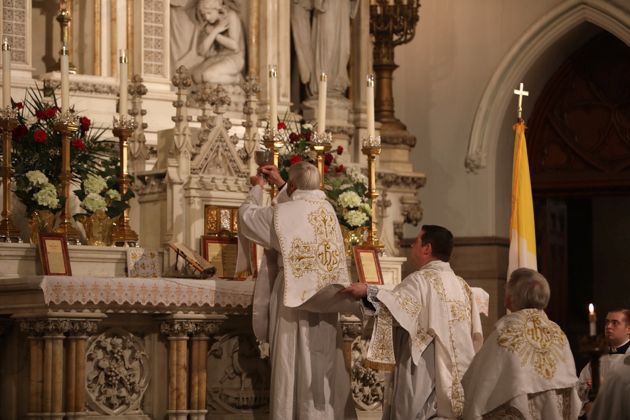
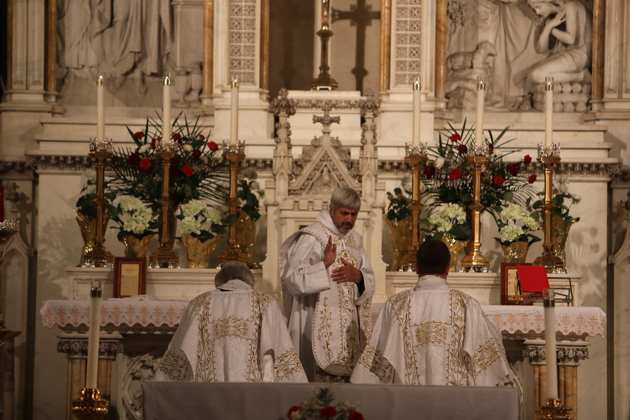
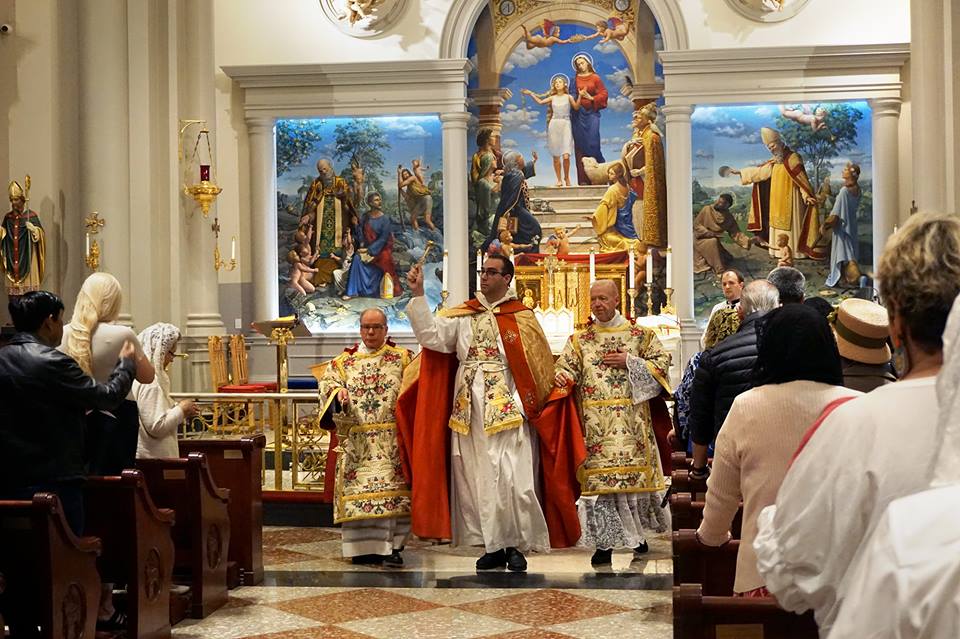
This Tuesday, May 1, St. Mary Church in Greenwich, CT, will offer a traditional Mass for the Feast of St. Joseph the Worker at 7:30 pm.
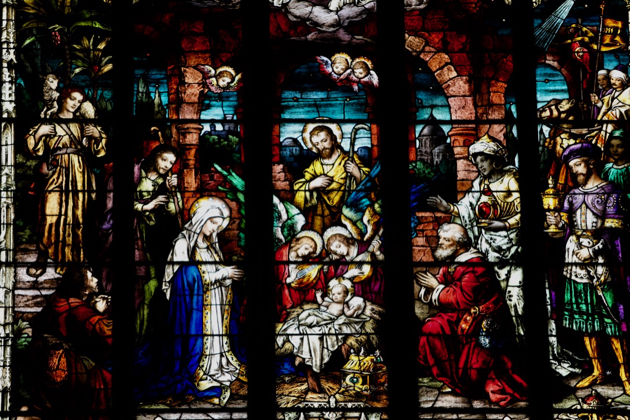
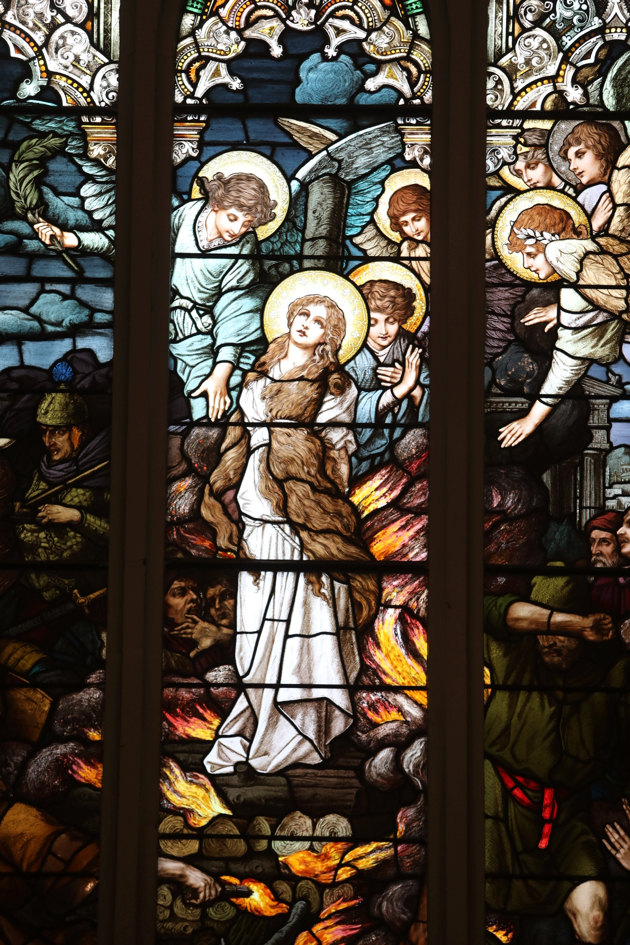
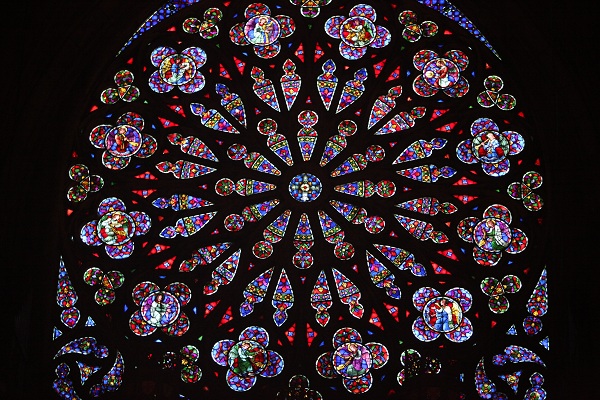
Stained glass window in St. John Nepomucene Church, New York.
26
Apr
26
Apr
Don’t miss the final lecture of this season’s Art of the Beautiful lecture series! Fr. Innocent Smith, O.P., presents“How Can I Keep From Singing? Active and Contemplative Participation in the Liturgy.”
The lecture takes place this Saturday, April 28, 7:30 PM, at the Catholic Center at New York University (238 Thompson St., just south of Washington Square Park). A reception and sung Compline will follow.
Admission for Sustaining Members: FREE
Suggested donation for non-members: $10
For more than a century, the Church has repeatedly insisted on the importance of cultivating active participation in the liturgy. In practice, some modes of advancing this goal leave little room for a “contemplative” mode of participation. In this talk, Fr. Innocent will describe the need for both active and contemplative participation, focusing on the realm of music in the liturgy. Through a careful balance of vocal and auditory participation, members of the Church can more effectively join their minds as well as their voices to the Heavenly Liturgy.
Fr. Innocent Smith, O.P., is a Dominican Friar of the Province of St. Joseph. Born in California and raised in Indiana, he attend St. Gregory’s Academy and the University of Notre Dame before entering the Order of Preachers in 2008. He received an S.T.L. in 2015 at the Dominican House of Studies in Washington, D.C., writing a thesis on the liturgical theology of Thomas Aquinas. At present he is assigned to the Priory of St. Vincent Ferrer in New York City, where he serves as parochial vicar at the Parish of St. Vincent Ferrer and St. Catherine of Siena.
24
Apr

(above) St Benedict the Moor in happier times.
St. Benedict the Moor
342 West 53rd Street.
One day in 2014, I stopped by the curious, unpretentious church of St Benedict the Moor. In several prior visits I had never gained access to the main church (weekday masses were held in the rectory chapel). But on this day, I found the church open and filled with a large congregation! The Blessed Sacrament was exposed in a monstrance upon the altar; the people were singing and praying the rosary. Someone mumbled to me something about a “parish festival.” I decided it was high time for me to come back on some Sunday when the church would be less crowded, take some pictures and write something about this time-honored legacy of past evangelical effort and sacrifice – the first church for blacks in the Northern states!
But when I returned – the following Sunday, I believe – the church was closed and locked the rectory of the Franciscans abandoned (the priests had moved to New Jersey), all religious services discontinued.
Had I actually attended the final celebration of the life of this parish?
St Benedict the Moor has an extraordinary history quite in contrast with its resolutely pedestrian un-Catholic appearance. For this parish was founded as a first mission to the blacks of the New York Archdiocese and beyond. It owes its origin to a bequest by Fr Thomas Farrell, the renowned rector of St Joseph (Greenwich Village – at that time most New York blacks lived in or around the Village). The equally well-known Fr. Richard L. Burtsell was the founder and first pastor in 1883. The first home of the new “mission church to the colored people”– a then out-of-fashion neoclassical temple – later served as the first church of Our Lady of Pompeii. St Benedict the Moor actually had no territorial boundaries but included all the black population of New York and even of the Newark and Brooklyn dioceses as well.
In 1898 the church we see today on West 53rd street was acquired from a German Protestant congregation. For by 1900 the center of gravity of the New York City black population had moved north to the West 50’s. We read, however, that in fact whites made up a large part of the congregation throughout this period – and provided much of the financing. The surroundings of the parish’s new home were indeed not stylish – in those days an elevated rail line ran down West 53rd street.
In its early years this mission generated an extraordinary amount of commentary – often hostile – from the New York and national press and the Protestant establishment. Was it not a nefarious plot to establish a papist fifth column in a new section of the population? Nor can we say that this mission met with understanding and enthusiasm among all quarters of the Catholic population. Yet through the 1930’s a handful of dedicated (Irish) priests dedicated themselves with heroic devotion to the mission of St Benedict the Moor: Fathers John F. Burke (the second pastor, who in 1907 became leader of the national Catholic mission to blacks in the United States), Thomas O’Keefe and Timothy Shanley. In the course of time an orphanage, a school (which St Katherine Drexel visited in 1924) and a convent of sisters were added to the parish.

(Above) This neoclassical temple was the original home of St Benedict’s parish – and later of Our Lady of Pompeii.
(Above) The festive liturgy for the Golden Jubilee of the parish, 1933.
In 1933 a grand Solemn Mass was the highlight of the parish’s fiftieth anniversary. Yet in a few short years difficulties came to a head. The blacks of New York, the target group of this mission, had for the last thirty years been relocating uptown once again – to Harlem. If whites worshipped at St Benedict’s, Catholic blacks could and did worship in their local territorial parishes, in Harlem or elsewhere. Finally, the relentless transformation of the immediate Hell’s Kitchen neighborhood into a heavily commercial zone hurt the local parishes, including St Benedict the Moor. By the late 1930’s it had been reduced to a chapel of the nearby parish of Sacred Heart, with only Sunday masses being offered.
But in those days Catholics did not so easily give up their consecrated churches, regardless of “demographic change.” Was there not an infinite number of evangelical works still to be accomplished? After the Second World War it was now the Spanish- speaking peoples – particularly the Puerto Ricans – who started to flock to New York. Cardinal Spellman’s advancement of the Spanish-speaking apostolate has been regrettably forgotten nowadays. Yet due to him, St Benedict the Moor was “repurposed” as a Spanish-speaking mission parish, in the care of the Third order Regular Franciscans. This too was commemorated by a splendid liturgy in February 1954. So, St Benedict the Moor’s mission of evangelization continued for many more decades. By the 1980’s, however, except for parishes mostly in the Yorkville/Upper East Side area, almost every parish on the island of Manhattan had a large “Hispanic” population.
The rededication of the parish to the Hispanic apostolate in 1954.(Above)Cardinal Spellman in procession. (Below) The liturgy celebrated on this occasion – which was also reported in the New York Times among other places.
(Above) Mass with Cardinal O’Connor in 1984.
(Above) The new rectory was dedicated in 1967 – it stretched the resources of this small parish.
The layout of the church of St Benedict the Moor, built in 1869 as a severely Protestant hall, would strike most as unusual for a Catholic parish. Upon entering, the visitor encountered downstairs a large bookstore. To get to the actual church one had to ascend a staircase. The church regrettably was locked on weekdays – a not infrequent phenomenon in Manhattan. The visitor could get only a glimpse through glass doors of a simple, obscurely lit interior adorned with some statues and stained-glass windows (the decor of the sanctuary apparently dates from a 1950’s restoration).
(Above) The interior of the church – reached by a flight of stairs. (Below) Part of a large window or Our Lady of Guadalupe added in this parish’s “Hispanic” era.
(Above and below) The forlorn church of St Benedict the Moor as seen in more recent months.
St Benedict the Moor made its way on to Cardinal Egan’s hit list in 2007. Yet the outcry was such that Cardinal had to back down. It is eloquent testimony to the accelerating decline of Roman Catholic sensibility in New York that in 2014 St Benedict could be shuttered summarily – even outside of the normal “Making all Things New” process – with nary a peep from anyone. St Benedict’s has now (2017) been made available for sale or other uses; some (secular) opposition to the loss of the church is now stirring in the Hell’s Kitchen neighborhood.
St Benedict, while it still stands, testifies to earlier generations that acknowledged and took up the burden of evangelization in this gigantic metropolis. Like so many other seemingly minor New York parishes, in its heyday it attracted citywide and even national attention with a mission that extended far beyond the parish’s immediate neighborhood. But the significance of the summary closure of this church is not just the tragic loss of an inheritance of the past. It’s a most eloquent symbol of the extinction of the spirit of Catholic mission in the New York Archdiocese.
(Above) Behind an iron grate the relic of a former devotion.
(Above) The statue of Our Lady, located in a niche obove the rectory door, has been removed.
See generally, Coll, Fr. George, A Pioneer Church (1993); O’Brian, Michael J., St Benedict the Moor: Mission Church of the Colored People (1933)