22
Jul
16
Jul
Décadence: Vie et mort du judéo-christianisme
(Decadence: the Life and Death of Judeo-Christianity)
By Michel Onfray
(Flammarion 2017)
In Decadence, Michael Onfray seeks to set forth a “philosophy of history” outlining the origins and end of Christendom (or Judeo-Christianity, as he calls it). Onfray is the French equivalent of the representatives of “New Atheism” in the English-speaking world. For his guiding lights, our author draws on on Nietzsche, the ancient epicureans, and the atheist writers of the enlightenment and of the 19th century. For example, Onfray lists as a primary source for much of this history Francis (sic) Gibbons ’ Decline and Fall of the Roman Empire. Onfray’s style is colorful, if at times a bit ranting and not free of errors. His analysis is not so much a detailed review of historical facts but usually presents a discussion of one or more representative texts from each topic he covers.
The first half of the book – covering developments from the time of Christ until the 16th century – describes the birth and flourishing of “Judeo-Christianity.” You have heard the substance of these chapters often before: “Christ” was a fiction, St Paul was a neurotic who hated the body and women, Christianity was invented by Constantine to cement his rule and adopted by the masses seeking relief from their suffering state. From these beginnings the Church promoted violence, war and hatred of the body, persecuted Jews, witches and women, massacred native peoples in the Americas etc. In a later period, Fascism and specifically Hitler appear as a creation of Pius XII (the triumphant proof? Mein Kampf was not put on the index of prohibited books) It is all very familiar and moreover seems to recycle material from Onfray’s other books (notably his magnum opus Atheologie).
In the second half of his work, the author narrates the post medieval period of “Exhaustion.” The edifice of Christendom started to wobble when certain enlightened individuals started to read certain non–theistic texts from antiquity, to understand science and to think for themselves.
Based on what you have read so far of his views you would expect Onfray to be a celebrity honored by The Guardian, the New York Times and Le Monde, and to be a regular speaker on the French broadcast media and the BBC. Indeed, his books have been best sellers in France and elsewhere in Europe. But in the final post-1789 sections of his work “Senescence” and “Decay” Onfray departs from the establishment’s “politically correct” narrative. His view of the French Revolution and its campaigns of extermination is decidedly unfavorable. Nor does he admire Marxism and the innumerable massacres it brought about. As the story moves into a time of which the author has direct experience his criticism intensifies. He doesn’t think much of structuralism, Freudianism and other fads of the French intelligentsia. The same is true of the cult of “contemporary art.” The result of these ideologies is a European incapacity to either recognize reality or to defend itself. Onfray is particularly harsh on the intellectuals’ current love affair with Islam: he spends many pages recounting the misdeeds of the “religion of peace.” But like Houellebecq, he contrasts Islam’s vitality with the senescent nihilism of contemporary Europe.
The chapter entitled “Christian De-Christianization: the Imminent Paraclete of Vatican II” will be of particular interest to the Traditional Catholic. For Onfray views Vatican II as a major contributor to the current nihilist crisis – particularly by its changes to the liturgy. For example:
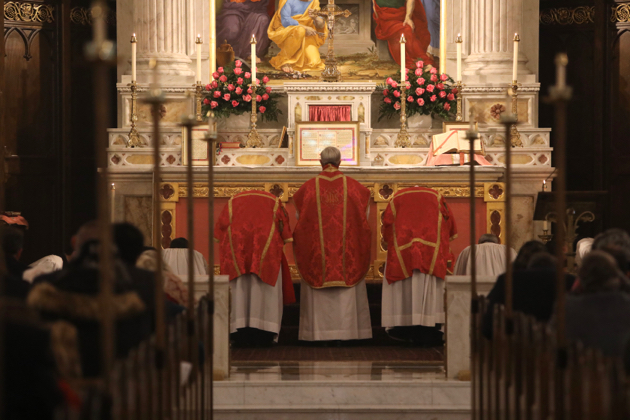
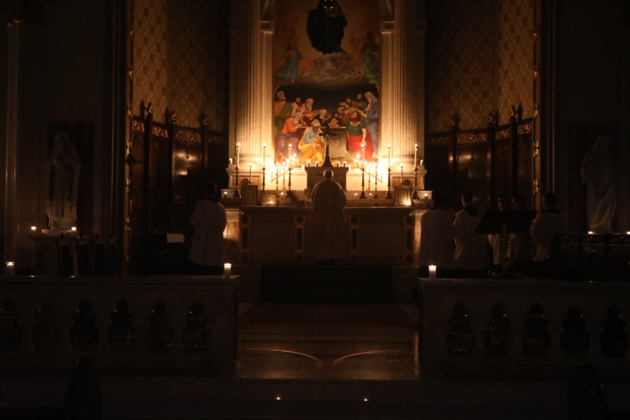
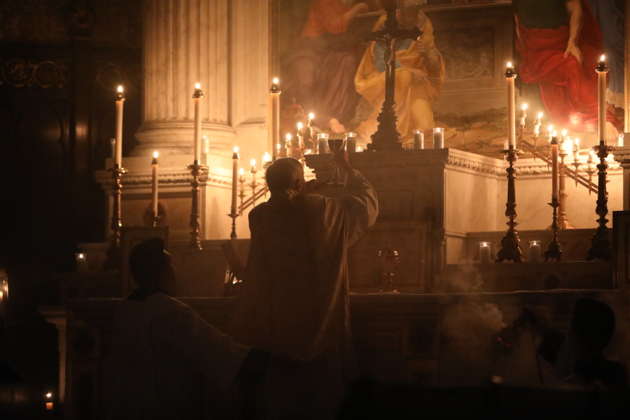
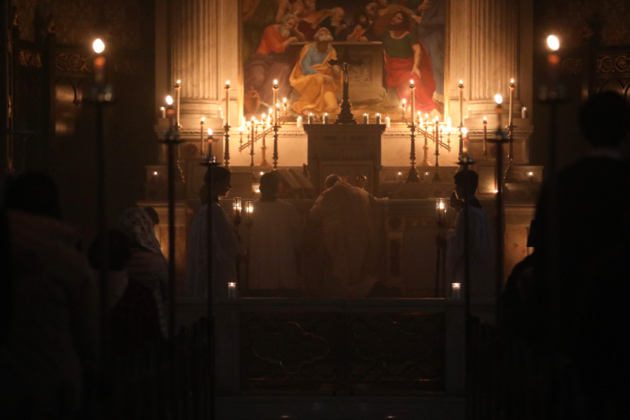
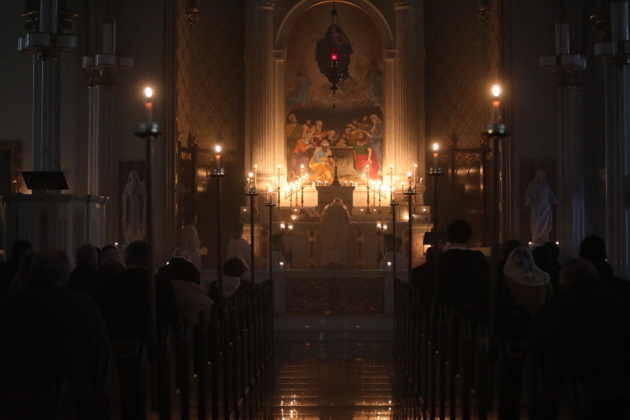
“This destruction of the sacred, this massacre of transcendence, this trivial descent on earth by the Divinity culminated in the new “stage design” of the mass. For centuries the tabernacle, which contains the Holy Ghost, had been set on the altar, which stands at the end of the sanctuary. There the priest celebrated the mass before this sacred object. The celebrant, clothed in priestly vestments, had his back to the faithful because he was facing the Sacred, in the presence of the Divine, gazing at the Holy Spirit, in direct contact with the Divinity, in the sight of the consecrated host and thus of the real presence of the Body of Christ. This location proves to be eminently symbolic because it is the place of the rising sun, in other words, the direction from which Christ will come at the final judgment. …
The liturgical changes of Vatican II abolished this arrangement in favor of a new set design: an altar is built in the choir between the sanctuary where the Holy Spirit is found and the nave where the mass of the faithful prays. This time the priest turns his back to the tabernacle, thus to the rising sun, thus to the second coming of God and thus to God himself – all in in order to face the people which from now on can look at him face to face. Certainly the priest is closer to his flock but that is at the price of a greater distance from God. Of the realm of the symbolic and of allegory it’s terrible: in order to bring people closer to God Vatican II realized exactly the opposite.” (page 517)
These views accord with conclusions previously reached by numerous other observers – both Catholic Traditionalists and secular. We have covered many of them in this blog. Onfray renders us a real service by detailing for us the incompatibility of Christianity with the ”modern world. ”
The civilization of rock and of comic books, of movies and television, of nightclubs and of nicotine addiction, of the birth control pill and of divorce, of alcohol and narcotics, of the refrigerator and of the automobile, of the atomic bomb and of the Cold War, of free love and of leisure, of money and of objects, advances while crushing everything in its path. Vatican II couldn’t do anything about it. It even seems that, having wanted to be a remedy, the Council exacerbated the disease. By making God a pal to slap on the back, 1) of the priest a buddy to be invited to share a vacation, of symbolism an old fashioned thing to be abolished, of the mystery of transcendence a banal immanence, of the mass a show imitating the layout of a television broadcast, of ritual an affair drawing indiscriminately on the success of popular hits or on the naive art of the craziest believers, of the message of Christ a simple labor union tract, of the soutane a theatrical costume, of other religions spiritualties as valid as that of Christianity, the Church precipitated the movement forward which proclaimed its own fall. (page 518)
Yes, Onfray’s view of the modern world is a dim one. The key prophets of the current age turned out to be not Rousseau, Marx or Tocqueville but Orwell and Huxley. He describes the incomplete cathedral of Sagrada Familia in Barcelona as the symbol of the end of Christendom – the Christian equivalent of Chernobyl, the ruin of the contemporary technological age. The modern age cannot finish even this one church after a century. For Onfray it is the summit of irony that it was Pope Benedict XVI who consecrated this “ruin of Christianity”.
“La Sagrada Familia remains a ruin and the Pope who consecrated it has resigned. Rome is no more (even) in Rome.” (page 21)
Yes, we can agree with Onfray that historical Christendom is well and truly dead! But where I would beg to differ from him is this: I see Christianity continuing in a thousand places. Whatever the public profile and political influence of the institutional Church may be, Christianity continues. And whatever buffooneries are taking place in Rome right now, the real Rome continues in the celebration of the Traditional Mass.
(The translations are mine for which I request the reader’s forbearance.)
14
Jul
Traditional Masses for the Feast of St. Ann, Wednesday, July 26
Church of the Holy Innocents, New York: The solemn Novena to St. Anne is taking place at the Church of the Holy Innocents every day from Monday, July 17 through Tuesday, July 25, 2017. The Novena will include: the 6PM traditional Sung Masses (including Saturday and Sunday), beautiful novena prayers, and a candlelight procession inside the church. St. Anne candles will be available in the back of the church.
All petition slips will eventually be taken to the Shrine of St. Anne-de-Beaupre in Quebec, Canada.
St. Paul Church, Yonkers, NY, Missa Cantata for Feast of St. Ann, 12 noon, July 26.
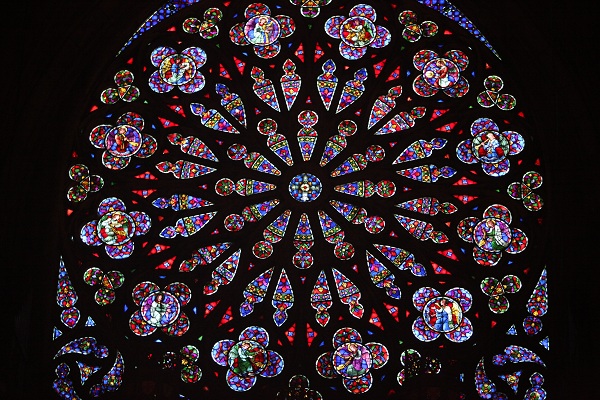
The stained glass window is in All Saints Church in Manhattan. Last month Cardinal Dolan issued a decree to relegate this church to secular use.
12
Jul
A brand new traditional Latin Mass has begun at Our Lady of Lourdes in Gales Ferry, CT. The Mass is offered each Sunday at 2 p.m. Currently it is a Low Mass, but they hope to begin at least an occasional Missa Cantata.
Gales Ferry is just north of New London.
N.B.: There is also a Sunday Traditional Mass at 12 noon at Holy Apostles Seminary in Cromwell, CT, high Mass during the academic year, low Mass during the summer.
12
Jul
A reader reports:
“There is a new daily traditional Latin Mass in the Archdiocese of New York. It is at the Pontifical Shrine of Our Lady of Mt. Carmel: daily Mass at 7:45 am Monday thru Saturday. There is a 10:30 sung Mass on Sundays. The weekday Mass is offered in a chapel on premises, but the Pallottine fathers would happily move the Mass to the main Church if attendance warrants it.”
On Sunday, July 9, at the Pontifical Shrine of Our Lady of Mount Carmel in Manhattan, Divine Liturgy according to the Rite of Alexandria (Egyptian Coptic Catholic) was be celebrated.
The Celebrant was Abouna Francis Fayez from the Coptic Catholic Church of the Resurrection in Brooklyn. There was beautiful chanting throughout the liturgy. After the liturgy, there was the blessing of the sick.
This liturgy at Our Lady Mt. Carmel is a part of the Pallottine tradition of presenting Eastern Catholic liturgies.
Special thanks to Diana Yuan for sending this photo and providing a report.
10
Jul

A window in St Veronica’s showing the patron saint of the Parish.
As we just wrote, Archdiocesan information on the subject of church closings is never complete or reliable. We now read that the beautiful church of St Veronica on Christopher Street will now be celebrating its last mass on July 23. It had received a reprieve in the process leading up to Making all Things New. But apparently neither that, nor the efforts of the Ecuadorian community (for which it served as a home) nor its alleged status as a “shrine to the victims of AIDS” could save it. The exterior is landmarked.
The Archdiocese places the onus on the pastor St Bernard’s / Our Lady of Guadalupe:
“The parish was merged a decade ago with Our Lady of Guadalupe parish and the pastor of Our Lady of Guadalupe has decided that the church is no longer needed for Mass and sacraments on a regular basis,” Joseph Zwilling, spokesman for the Archdiocese of New York, said.
Undoubtedly he, like all the other pastors of churches recently “relegated to profane use,” sent Cardinal Dolan the (same?) letter requesting the closing of a “superfluous ” church….

“378 Broome Street”(source: Ariel Property Advisors New York)
Meanwhile, no sooner do we hear that the Church of Most Holy Crucifix is to be “relegated to profane use” than we read the “three story structure” is already under contract:
Investment Highlights
Ariel Property Advisors presents 378 Broome Street, a 25.75’ wide mixed-use conversion or development opportunity located in the heart of Little Italy between Mulberry and Mott Streets.
378 Broome Street currently consists of a three-story, 6,107 square foot structure that houses a sanctuary with high-ceilings on the ground floor and residential space on the 2nd and 3rd floors. The property will be delivered vacant, providing a unique opportunity for owner-users to capitalize on the neighborhood’s retail potential. Located in the Special Little Italy District, C6-2G zoning allows up to 10,730* buildable square feet, as-of-right, making it a rare ground-up development site in Lower Manhattan. br>
Situated in an area that is popular with both local residents and visiting tourists, 378 Broome Street is surrounded by many restaurants, hotels, shopping and cultural amenities. The 6, J and Z subway lines are all a short walk away, providing easy access to the rest of Manhattan and the outer boroughs.
Offering a prime retail location and development upside, 378 Broome Street presents owner-users, investors and developers with an outstanding opportunity to invest in Lower Manhattan.
This church, in its most recent incarnation as the “Chapel of San Lorenzo Ruiz” – a mass celebrated in December 2015:
The Filipinos, like the Ecuadorians, will have to find a new home. Both communities have had extensive experience with that in Manhattan.
Thanks to our local (anonymous) sources….
10
Jul
Saint Mary Church in Greenwich will celebrate a Votive Mass of the Precious Blood in the Extraordinary Form on Friday, July 14th at 7:30 in the evening. On Wednesday, July 26th at 7:30 in the evening Mass will be celebrated for the Feast of Saint Ann.
Mass will be celebrated in the lower Church as the upper Church is currently being painted.
Our Lady of Mount Carmel over the main altar in Our Lady of Mount Carmel Pontifical Shrine, New York
Our Lady of Mount Carmel in Newark
Our Lady of Mount Carmel Church, 259 Oliver Street, Newark:
There will be a Solemn High Latin Mass on Saturday July 15th at 5pm followed by a Procession through the Streets of the Ironbound on the occasion of the 127th Annual Feast of Our Lady of Mount CarmelRev. Msgr. Joseph F. Ambrosio will be the Celebrant and Homilist
Rev. Mr. Trevor Fernandes from the Diocese of Toldeo, Ohio will be the Deacon
Mr. Damian Zablocki, a seminarian from the Archdiocese of New Orleans will be the Subdeacon.
Andres Giraldo will be the Master of Ceremonies.
The street festival opens Wednesday July 12th and closes Sunday July 16th from 6:00pm-11pm.
Pontifical Shrine of Our Lady of Our Lady of Mount Carmel, 116 E. 116th Street, New York
Saturday, July 15: Traditional Latin Vespers of the Little Office of Our Lady, 7:30 pm; Candle Light Procession, 9 pm; Rosary and Litany, 11 pm;
Sunday July 16: Solemn Midnight Mass in Extraordinary Form.
6 AM – Low Mass; 7 AM – Low Mass
Grand Procession, 11:15 am
7 PM – Low Mass
International Food Festival, 8 am -8 pm
Saturday July 22, Traditional Latin Mass Pilgrimage, 11 am
10
Jul
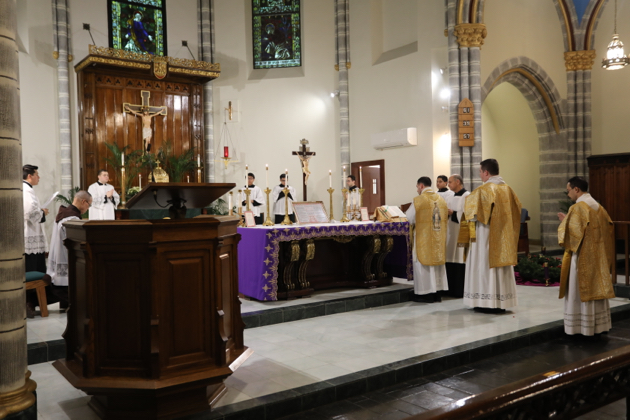
For those travelling in Massachusetts, Mary Immaculate of Lourdes is a good church to know about. We visited this church yesterday for the 10:30 am Sunday Traditional Mass. Well-attended, with an altar boy count to rival St. Mary’s Norwalk, and a choir that skillfully performed all of the ordinaries of the Palestrina Missa Sine Nomine (including the Credo). Close to the Massachusetts Pike and I-95—we’ll remember this church for our next trip.
The bulletin says this about the parish: “A canonically open parish of the Archdiocese of Boston, which has a Traditional Latin Masss apostolate. Both the ordinary form of the Roman Rite and the extraordinary form are celebrated here with the blessing of His Eminence Sean Cardinal O’Malley.” The church also offers daily Traditional Masses.
It’s a beautiful Roman-style church with exquisite stained glass windows.
Many windows are copies of familiar paintings—here is Raphael’s Sistine Madonna
.

St. Elizabeth of Hungary with the church itself in the background.
St. Agnes
The maker of the windows, from Munich