11
Nov
9
Nov
8
Nov
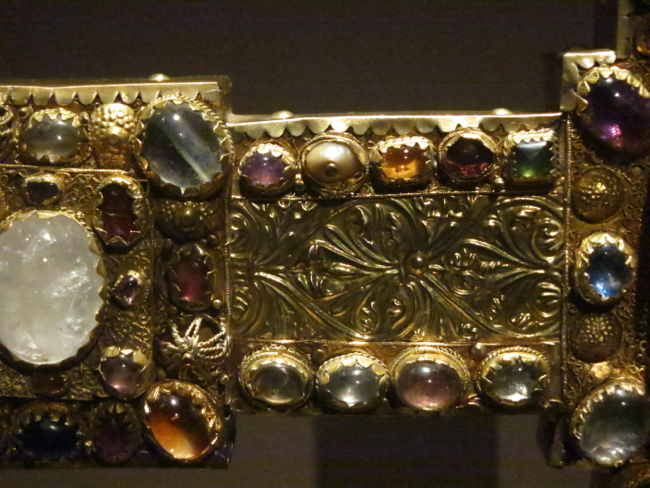
The Costume Institute of the Metropolitan Museum of Art has announced a major exhibit planned for 2018 which examines how fashions have been inspired by Catholic iconography and style. It will feature a large collection of garments and accessories on loan from the Vatican. The show is entitled “Heavenly Bodies: Fashion and the Catholic Imagination.” The New York Times reported on it today see link.
Mr. Andrew Bolten, curator of the exhibit, admitted that it could be a provocative exhibit. But he said that he has “consulted with representatives from different Catholic groups including Cardinal Timothy M. Dolan.” So I guess we can assume that all will be in the best of taste.
We will at any rate look forward to viewing the collection that is being brought over from the Vatican.
7
Nov
Regina Pacis Academy, an independent Catholic K-8 school in Norwalk, CT, will be holding an open house this Sunday, November 12 from 1 pm to 6 pm. The school is located on the grounds of St. Mary Church at 8 Leonard Street. Students have the opportunity to attend traditional Low Mass every morning at the church.
Interested parents may also contact Mrs. Kim Quatela, the school principal to schedule a tour or learn more. The school website: https://www.reginapacisacademy.com
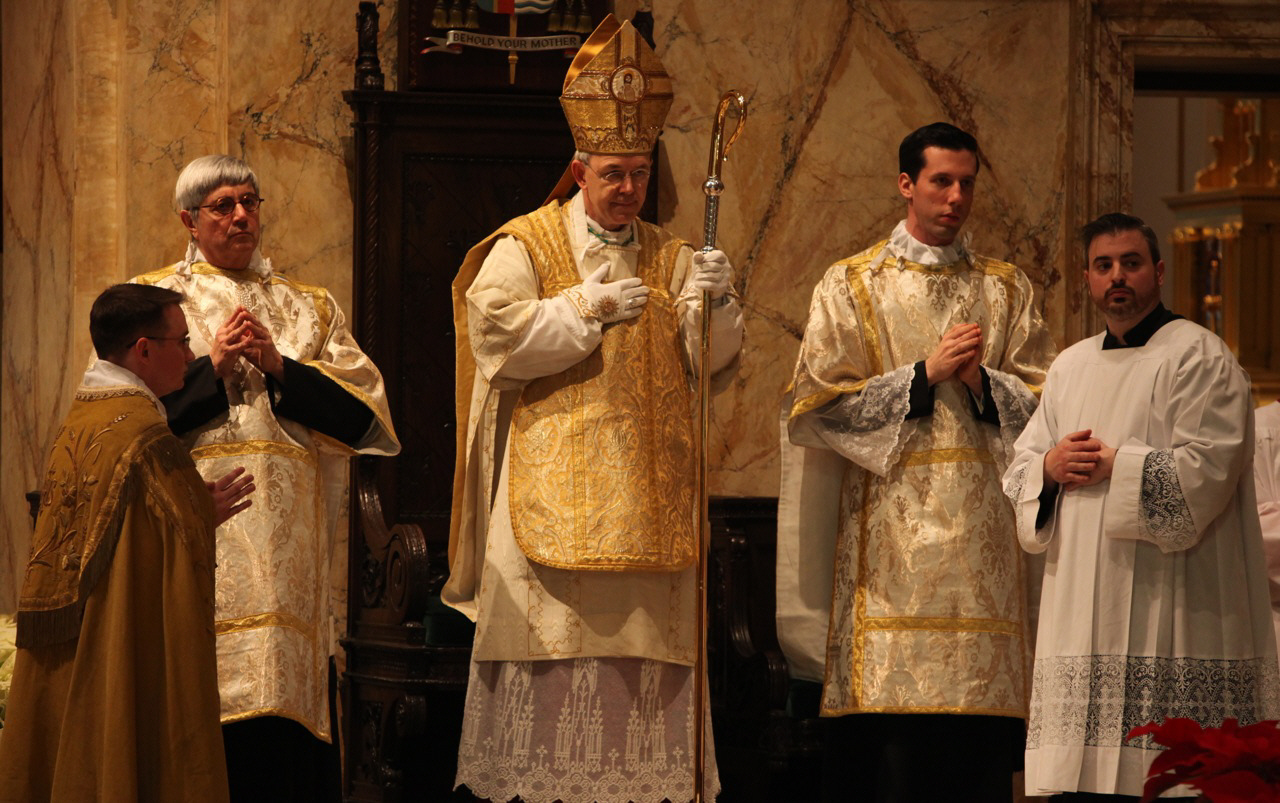
Third and fourth graders perform at the recent visit of Bishop Athanasius Schneider to the school
7
Nov
The Metropolitan Catholic Chorale under the direction of Dr. Jennifer Donelson, will sing the Palestrina Missa Veni Sponsa Christi, motets by Howells and Palestrina, and the propers of the Mass in Gregorian chant.
6
Nov
5
Nov
A votive Mass for the Dead will be offered on Tuesday, November 14 at 7:00 p.m. at Saint Stanislaus Church, New Haven for those enrolled in the St. Gregory Society Purgatorial Society.
You can enroll your loved ones in the SGS Purgatorial Society. An enrollment for one name is $35.00 and for each additional name $10.00, for one year.
For this Mass, previously enrolled Purgatorial Society members need to be enrolled again for the coming year..
The enrollment form is accessible here: http://saint-gregory.org/purgatorial-society/
Those enrolled in the SGS Purgatorial Society are remembered at the Altar on this annual Mass, and each First Friday Mass and the spiritual benefits throughout the year.
1
Nov
The 7:45 low Mass today for the Feast of All Saints at Our Lady of Mount Carmel Church in Harlem, New York, Father Christopher Salvatore, celebrant. There is a 7:00 Solemn Mass this evening, and tomorrow a 7:45 am low Mass, and 7 pm Solemn Requiem Mass. This photo was submitted by Diana Yuan.
30
Oct
One of the great tragedies of New York today is the lack of “characters.” I mean by that not “eccentrics,” but unique men and women of education, taste and intelligence, the pleasure of whose acquaintance lingers indelibly in the memory. Such distinctive individuals are always rarities – we would nevertheless expect to encounter them, if anywhere, in our great cities: London, Paris and America’s own supreme metropolis, New York. Yet the culture of New York in recent decades has evolved into a regimented and all-encompassing ideological uniformity, vulgarity, ignorance and rudeness. There remain, fortunately, a handful of exceptions. One such gentleman is Arcadi R. Nebolsine, who celebrated his 85th birthday this month.
Once you see and hear Arcadi Nebolsine you do not easily forget him. He speaks with a cultured accent – a kind of British- flavored American – all his own. One hardly notices his eighty-five years. He is a most pleasant conversationalist, drawing on a seemingly infinite pool of knowledge. He can discourse on the Roman sojourn of Nikolai Gogol (a favorite author of his) and on all aspects of English literature (in the twentieth century, ranging from the Catholics Chesterton/ Belloc to the moderns Ezra Pound/T.S. Elliot). Moreover, he is man who also can supply on short notice, if necessary, the piano accompaniment for a Haydn cello concerto.
Mr. Nebolsine is of a distinguished Russian family and has always been a proud member of the Russian Orthodox Church and the community of noble Russian exiles from Communism. He was born in Switzerland and grew up on Long Island – his parish there celebrates this year the 75th anniversary of its founding. His education included study at Oxford and Columbia. In regard to Oxford, he only regrets having had but limited contact with C.S. Lewis during his stay there in the early 1950’s. Although he held a number of teaching positions on this side of the Atlantic, Mr. Nebolsine, like his old friend Thomas Molnar, enjoyed after the fall of communism greater acclaim in his European spiritual home – in Arcadi Nebolsine’s case, Russia – than he ever experienced in the United States.
While a devoted son of the Orthodox Church, Mr. Nebolsine has always taken a great interest in the Roman Catholic Church. Indeed, his knowledge and appreciation of the Latin Church far exceeds that of most of his co-religionists – and that of most Roman Catholics as well. He shared early on many of the concerns of the Catholic Traditionalist movement about the direction the Church was taking after Vatican II. Almost annual visits to Portugal have given him over the years a great appreciation of Catholic culture – and of Fatima and its message.
How can I best summarize Mr. Nebolsine’s many insights and passions? We perhaps can start with his great adversary: poshlost. A key concept in Russian literature, it can be defined as a syndrome of smugness, dishonesty, banality, ugliness, obscenity and vulgarity. You can get an “ideogram” (Ezra Pound’s terminology) of it today by perusing MSNBC and other internet media, casting a glance at the magazines offered for sale next to supermarket check-out counters or, as indicated above, just by strolling around midtown New York. Mr. Nebolsine recognizes poshlost as a defining characteristic of the culture of modernity; the offspring of the French and subsequent revolutions. At Columbia, Mr. Nebolsine wrote his PhD thesis on this concept. His thought can be viewed as an attempt to mobilize all spiritual forces against it.
Mr. Nebolsine has set forth his ideas in a series of curious and unique books and essays, e.g., On Silver, On Gold, The Metaphysics of the Beautiful (all unfortunately available only in Russian). In these works he unites philosophy, literary criticism, liturgical studies, art history and questions of cultural, environmental and architectural preservation. For example, he describes and explains the silver ornaments on black velvet found on the vestments for the Requiem Mass in the context of the writings of the Catholic mystics and Novalis’s poetry of the night.
Arcadi Nebolsine has not only critiqued poshlost but has always actively combatted it by his engagement in all kinds of causes. Early on, he fought for the preservation of ethnic Catholic churches in Pittsburgh threatened with closure by one of the first Catholic “downsizings.” He has argued against the excessive, destructive restorations of churches, paintings and sculptures (including the Sistine chapel) and has made the case for the revival of classical architecture (only a few know that Russia has one of the largest collections of neoclassical architecture in the world). For decades he has led a “Society for the Preservation of Russian Cultural Monuments and Landscapes.” In that capacity, he continues to fight against misguided post-Soviet Union developments in St Petersburg – for example, the erection of skyscrapers in this most beautiful of Russian cities. More recently, he has been trying to find a formula – of his own making – to reconcile the Orthodox and Catholic Churches.
Isn’t this all quixotic, you may ask? To some extent, that may be. Yet in 1985, Mr. Nebolsine already was concerned about the need to avoid a self-righteous reaction (by “lace curtain Russians”) in Russia itself against the hapless regime conformists after the fall of the Soviet Union – at a time when the Kremlinologists of Harvard and Princeton still assured everyone the Soviet Union would be with us for all time. Speaking of the 1980’s, Mr. Nebolsine at that time was not at all a fan of the policies of John Paul II. Are we not now experiencing their less attractive fruits? And, thanks in part to Mr. Nebolsine’s efforts, the movement for historical preservation in Russia has become a potent force both in and outside of St Petersburg.
To emphasize further the unexpectedly explosive potential of the seemingly benign artistic and cultural concerns pursued by Mr. Nebolsine, consider the career of a man he reveres greatly, Dmitry S. Likhachov (1906-1999). After a few years, ending in 1929, of imprisonment in a Bolshevik concentration camp, Likhachov became a supreme authority on Russian culture in all its aspects – from ancient Russian literature to the wooden churches of Northern Russia. Given the officially espoused nationalist line during and after Stalin, it was very difficult for the communist authorities to take further action against so prominent an exponent of Russian culture. Yet one could hardly avoid seeing behind Likhachov’s evocation of the glories of past Russian artistic achievements – without disguising their Christian foundations – a not-so-subtle critique of the regime and its ideology. “It is beauty that will save the world” – this challenge from Dostoevsky was indeed taken up by Likhachov in the Soviet Union. Likhachov’s use of cultural rediscovery to undermine a monstrous regime of ugliness and stupidity may be unique in its explicitness. Those Catholics who sense the transformative power of beauty and want to reawaken its presence in the Roman Catholic Church (currently under a regime, like that of the Soviet Union, that explicitly rejects it) would do well to study the example of Likhachov and his followers!
So I congratulate Mr. Nebolsine on his 85th birthday and wish him many more years. Inevitably, he has suffered in recent years – he has been assailed by heath problems and has had to mourn the loss of like-minded friends who were dear to him: Thomas Molnar, Helmut Rückriegel. But I am sure Arcadi Nebolsine has the satisfaction of seeing, both here and in Russia, how so many others from more recent generations have rediscovered the ideals he himself has advocated for so many years.