10
Mar
10
Mar
Difficile est saturam non scribere. (Juvenal, sat. 1,30)
In February Cardinal Turkson paid a – rather low profile – visit here to preach the environmental Gospel of Pope Francis. First, to Molloy College on Long Island.
Thank you for the invitation to introduce the Encyclical, and then to reflect on “Catholics, Capitalism and Climate” with the help of Fr James Martin as moderator and three distinguished panellists Meghan Clark, R.R. Reno, and Erin Lothes. (my emphasis)
Today, we must discover the “fundamental and astounding” steps we need to take to address global warming, environmental and social degradation, or else face cataclysms like the more frequent and higher coastal floods that are predicted here in New York.
And later, he travelled to Philly and spoke at Villanova University. There he offered, as part of a”Lenten Reflection,” a Bergoglian “better translation” of the corporal and spiritual works of mercy:
You may remember the Works of Mercy from catechism, or they may have slipped your mind, and I hope you have found them printed in this evening’s program. “They are still valid, still current… they remain the basis for self-examination,” says Pope Francis. “Perhaps some aspects could be better ‘translated’” for our situation, our society. It is just such a “better translation”, inspired by
Laudato si’, that I would like to share with you this evening. 8) Let me read the Works to you slowly.
First, here are the 7 corporal ones:
1. to feed the hungry; especially those who suffer from poverty and drought.
2. to give drink to the thirsty; especially those who lack clean, abundant water.
3. to clothe the naked; especially those exposed to the cold of winter and the sting of indifference.
4. to give shelter to the homeless; especially victims of war, storms, and rising seas.
5. to care for the sick; especially those who have been poisoned by the wastes of our industries.
6. to ransom the captive; especially those oppressed by cruel economic and political systems, or from addictions to the pleasures of the world.
7. to protect the dignity of the human person, especially in reverently burying the dead.
And here is an additional 8th:
8. to care for our common home.
Now, here are the 7 spiritual ones, again with the same additional 8th:
1. to teach those who do not see how their lifestyles harm others.
2. to offer hope to those who despair for the future of loved ones or the future of the world.
3. to admonish those who sin against neighbor, the natural order, or the laws of nature.
4. to patiently bear the sufferings inflicted by gluttony and greed.
5. to willingly forgive offences committed against humanity and the goodness of creation.
6. to comfort those afflicted by corruption, by changes to our climate, and by unwholesome desires.
7. to desire always to pray for the living and the dead and future generations.
And again here is the additional 8th:
8. to care for our common home.
8) Written by Bill Patenaude for the Global Catholic Climate Movement (Cardinal Turkson’s note)
(Thanks to Catholic World News)
8
Mar
6
Mar
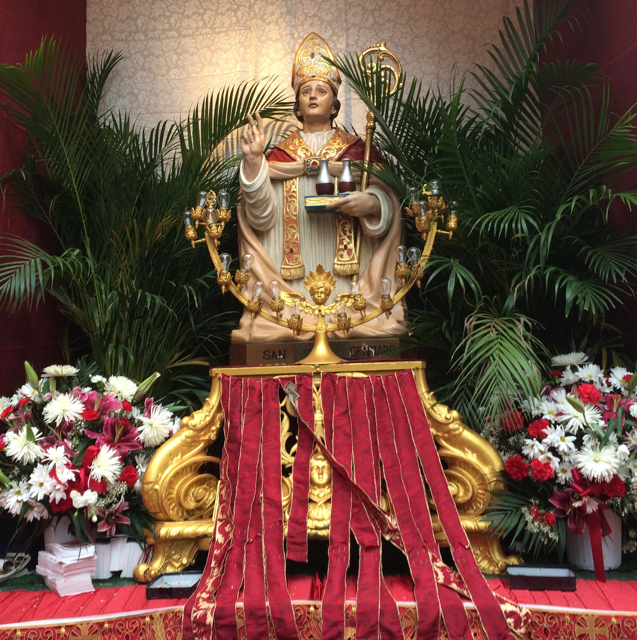
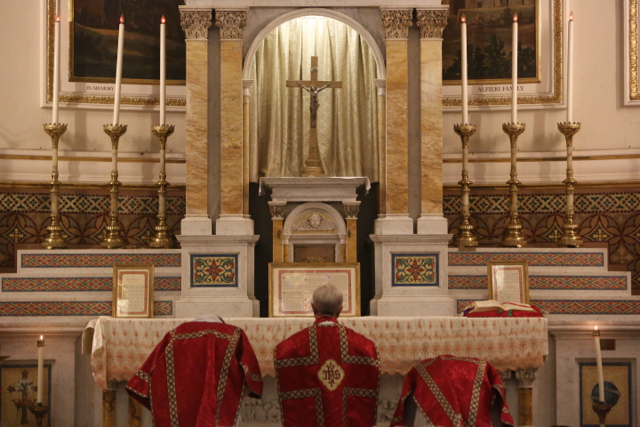
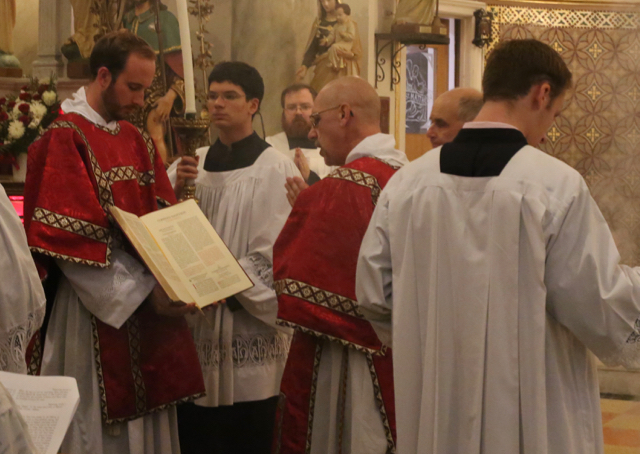
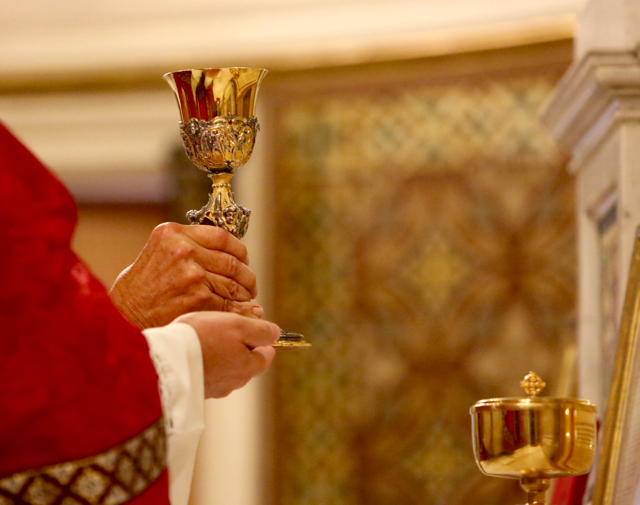
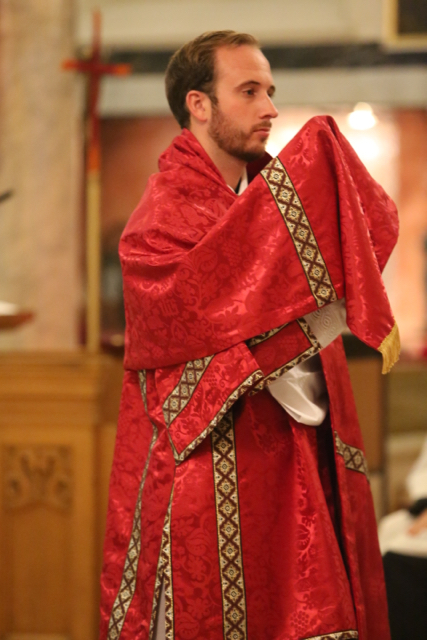
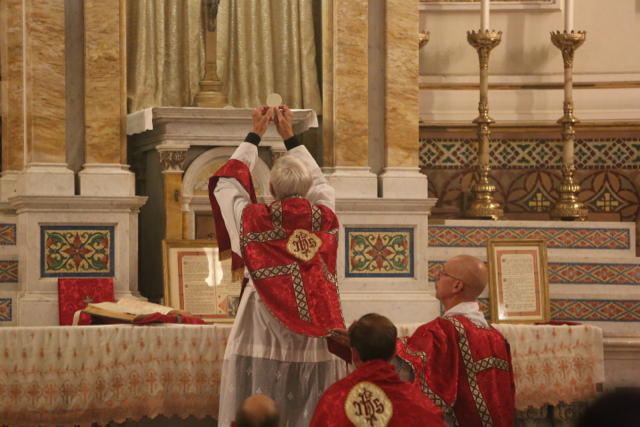
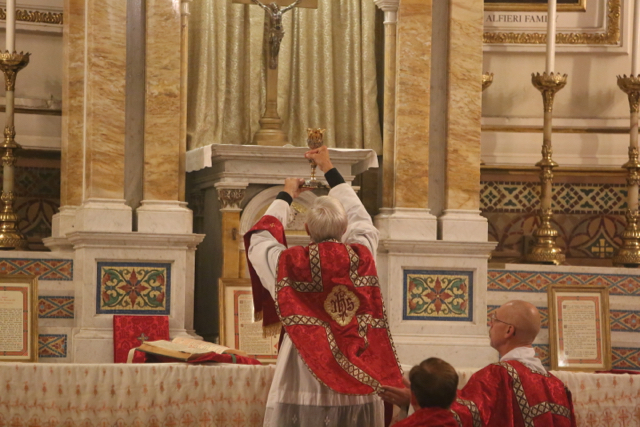
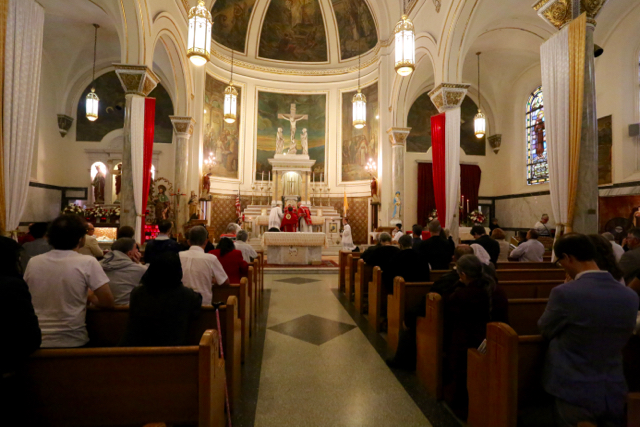
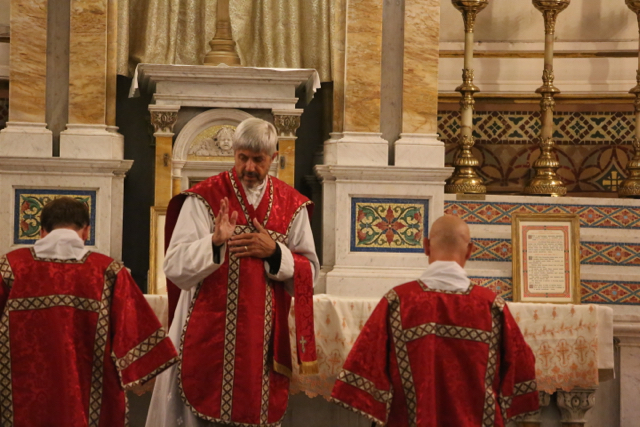
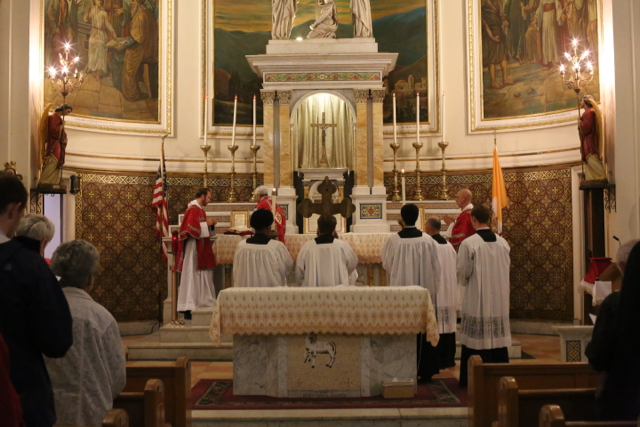
With flowers, the playing of the organ and rose vestments (from England). As well as a magnificent performance of a Michael Haydn mass by the student schola.
Followed in the evening by Vespers, Benediction and the start of the Lenten Mission of the parish.
6
Mar
5
Mar
1
Mar
Showing what can be achieved with prayer and determination:
SHRINE OF CHRIST THE KING TO BE STABILIZED
Archdiocese Deeds Building and Property to the Institute of Christ the King Sovereign Priest
CHICAGO, IL (February 28, 2016) – The Archdiocese of Chicago today announced that it has deeded the Shrine of Christ the King in Woodlawn and the land on which it stands to the Institute of Christ the King Sovereign Priest. The members of the apostolic institute have confirmed that they have received sufficient funds for the immediate stabilization of the historic Shrine building, ravaged by fire in October, 2015, and determined to be in hazardous condition. The Institute has committed itself to promptly remedying the dangerous condition created by the fire and then following through with the full restoration of the building.
“We express our deep gratitude to all the individuals and organizations whose most generous and timely donations helped bring us to this moment. We are mindful of the dangerous condition of the Shrine and will begin stabilization immediately with funds already collected,” said Reverend Canon Matthew L. Talarico, Provincial Superior for the Institute in the United States. “We are grateful to the Archdiocese for its partnership throughout our ministry in Woodlawn, especially during this difficult time. Since the day of the fire the collaboration with the Archdiocese has been remarkable: frequent communication, hard work and prayer.”
In thanksgiving for this agreement and in celebration of God’s blessings, the Institute has invited the public to a festive Mass on March 19, the Feast of St. Joseph, at 10:00am in the Shrine’s current Mass location, the gymnasium of First Presbyterian church (6400 S. Kimbark Ave.). Afterwards, all are welcome for a St. Joseph Table luncheon reception with refreshments at 12:00 noon in the church hall of the same building. For more information on this event, contact: Rev. Canon Matthew Talarico at 773-363-7409, ext. 4, or at canon.talarico@institute-christ-king.org.
The Archdiocese of Chicago is supportive of the Institute’s efforts to maintain its presence in the Woodlawn community and continue its ministry there. The Archdiocese wishes the Institute every success.
A significant article by Christian Browne that appeared in Crisis Magazine a few days ago. The author addresses the promise and current predicament of the Traditional Mass squarely:
“For, in order for the Traditionalist movement to realize its aims, the “Extraordinary Form” of SP must become less out-of-the-ordinary. While it is true (and wonderful) that the number of places in which the Tridentine Mass is regularly offered has grown markedly since the promulgation of SP, it is a fact that the vast majority of parishes provide Mass-going Catholics with no access or exposure to the ancient rite. The Extraordinary Form remains relegated to specific churches at limited times or to usage on special occasions.”
We should add that, as in the Indult days, in many churches the continuance of these celebrations in the “Extraordinary Form” remains de facto subject to the arbitrary discretion of the pastor. In our area just consider St. John’s (Stamford) or Our Saviour’s (New York).
I do not totally agree with the rather restrictive reading of Summorum Pontificum (“SP”) given by the author. And I can’t agree at all with this historical/sociological analysis:
Thus, SP has created a church within the Church, where the small but fervent band attached the traditional Mass adheres to a different calendar, often hears different readings than those proclaimed at the Novus Ordo and, in general, experiences significantly different liturgical norms and practices.
This “church within a Church” situation is not optimal. It can lead to a kind of separatism among those attached to the old rite who, perhaps unintentionally, come to look down upon the masses at the Novus Ordo parishes where parishioners are subjected to ugly vestments and “Here I am Lord.” Traditionalists can become cut off from the life of their local parishes, too, because they often must travel to specially designated churches on Sundays in order to hear the Tridentine liturgy.
… The divide is rarely noticed, but it is serious, for it is contrary to the very nature of the Church, the first mark of which is its “oneness”—Ecclesia una est.
SP did not create a church within a church, that was created by the Vatican and the Catholic hierarchy by decades of, first, outright persecution of Traditionalists and subsequently by “ghettoizing” them under the Indult regime. Traditionalists may be “looking down” on the Novus Ordo – but their attitude does not compare at all to the contempt they themselves are still widely subject to throughout the establishment Church. And in fact SP has greatly alleviated these animosities on all sides. Finally the author seems to be still a prisoner of his “Roman Catholic” legacy in that he is more concerned about preserving some imaginary monolithic unity within the Church than with upholding the truth and true worship. It’s an attitude under which Eastern Rite Catholics have long suffered.
But we can wholeheartedly agree with the author’s recommendations on the steps which must be taken:
Therefore, building upon the gift of SP, Traditionalism should now seek greater integration of those attached to the traditional Mass into ordinary parish life. The way to do so is obvious, yet fraught: to bring the traditional Mass into the regular practice of as many parishes as possible, particularly on Sundays. Indeed, SP expressly allows “one” celebration of the traditional Mass on a Sunday or feast day in a local church (SP Art. 5, Sec.2).
Now, again, working within the framework erected by SP, this spread of the traditional Mass into the usual roster of masses in a typical parish would have to commence with the laity—the “stable group of Faithful” desirous of such a Mass. In order to encourage the creation of such groups, we should enlist the aid of the many diocesan-level and regional Latin Mass organizations that have already successfully sponsored traditional Masses at designated locations. These groups could solicit interest in, and assist with, the creation of parish-level arms designed to make the request for the traditional Mass mandated by SP.
Mr. Browne thus looks to the evangelical action of the laity as the driving force behind the continued growth of the Traditional Mass. So strangely enough,it is the resistance to the “Mass of the Council” that will realize the alleged conciliar goal of “empowering the laity!” And has it not been the aim of our Society since 2007 to foster the expansion of the celebration of the Traditional Mass to many new churches and parishes?
An article well worth reading!
29
Feb
The next Mass in the Extraordinary Form at St. Mary, Greenwich, will be a Missa Cantata for Tuesday of Passiontide on March 15th at 7:30 PM
Saint Mary Church
178 Greenwich Avenue
Greenwich, Connecticut 06830
26
Feb
Deliciae meae esse cum filiis hominum
The Lower East Side of Manhattan, to this day, has one of the largest concentrations of public housing in the United States. Concerning the ethnographic composition of the denizens, many hail from that Emerald Isle of the Caribbean, Puerto Rico. Zeroing in on one particular Boricua household one fine evening a few decades back, we spy the youngest teenaged progeny attempting to casually exit the domicile. A self-described “jibara” (roughly equivalent to “bumpkin”), the sharp-sensed mother halts the smooth stride with, “¿Y, a donde va’?” To which the chief of the parish altar boys unequivocally, veraciously and sincerely responded in conveniently gender-neutral English: “I’m going out to visit a friend.”
Excerpts from Instructions on the Visits to the Blessed Sacrament
Our holy faith teaches us, and we are bound to believe, that in the consecrated Host, Jesus Christ is really present under the species of bread. But we must also understand that He is present on our altars as on a throne of love and mercy, to dispense graces and there to show us the love which He bears us, by being pleased to dwell night and day hidden in the midst of us.
We can thus understand what Our Lord said of old by His prophet, that His delight is to be with the children of men (Prov. 8, 31); since He is unable to tear Himself from them even when they abandon and despise Him. This also shows us how agreeable all those souls are to the heart of Jesus who frequently visit Him, and remain in His company in the churches in which He is, under the sacramental species. He desired St. Mary Magdalene of Pazzi to visit Him in the Most Blessed Sacrament thirty-three times a day; and this beloved spouse of His faithfully obeyed Him, and in all her visits to the altar approached it as near as she possibly could, as we read in her life.
There it was also that St Francis Xavier found refreshment in the midst of his many labors in India; for he employed his days in toiling for souls, and his nights in the presence of the Most Blessed Sacrament. St. John Francis Regis did the same thing; and sometimes finding the church closed, he endeavored to satisfy his longings by remaining on his knees outside the door, exposed to the rain and cold, that at least at a distance he might attend upon his comforter concealed under the sacramental species.
You will find that all the saints were enamored of this most sweet devotion; since, indeed, it is impossible to find on earth a more precious gem, or a treasure more worthy of all our love, than Jesus in the Most Holy Sacrament. Certainly amongst all devotions, after that of receiving the sacraments, that of adoring Jesus in the Blessed Sacrament holds the first place, is the most pleasing to God, and the most useful to ourselves. Do not then, O devout soul, refuse to begin this devotion; and forsaking the conversation of men, dwell each day, from this time forward, for at least half or quarter of an hour, in some church, in the presence of Jesus Christ, under the sacramental species. o taste and see, that the Lord is good. (Ps. 33, 9.) Only try this devotion, and by experience you will see the great benefit that you will derive from it. Be assured that the time you will thus spend with devotion before this most divine Sacrament will be the most profitable to you in life, and the source of your greatest consolation in death and in eternity.
You must also be aware, that in a quarter of an hour’s prayer, spent in the presence of the Blessed Sacrament, you will perhaps gain more than in all the other spiritual exercises of the day. It is true, that in every place God graciously hears the petitions of those who pray to Him, having promised to do so: Ask, and you shall receive (John 16, 24); yet the disciple tells us that Jesus dispenses His graces in greater abundance to those who visit Him in the Most Holy Sacrament.
Oh, how sweet a joy it is to remain with faith and tender devotion before an altar, and converse familiarly with Jesus Christ, Who is there for the express purpose of listening to and graciously hearing those who pray to Him; to ask His pardon for the displeasures which we have caused Him: to represent our wants to Him, as a friend does to a friend in whom he places all his confidence; to ask Him for His graces, for His love, and for His kingdom; but above all, oh, what a heaven is it there to remain making acts of love towards that Lord Who is on the very altar praying to the Eternal Father for us, and is there burning with love for us. Indeed, that love it is which detains Him there, thus hidden and unknown, and when He is even despised by ungrateful souls! But why should we say more? “Taste and see.”
Without missing a beat, Mom asks “So, who is she?”
Mr. Screwtape