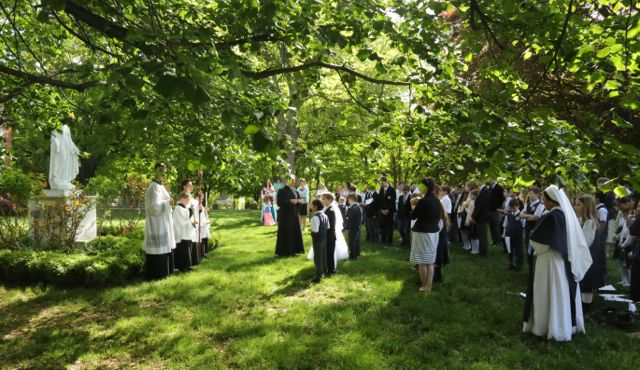
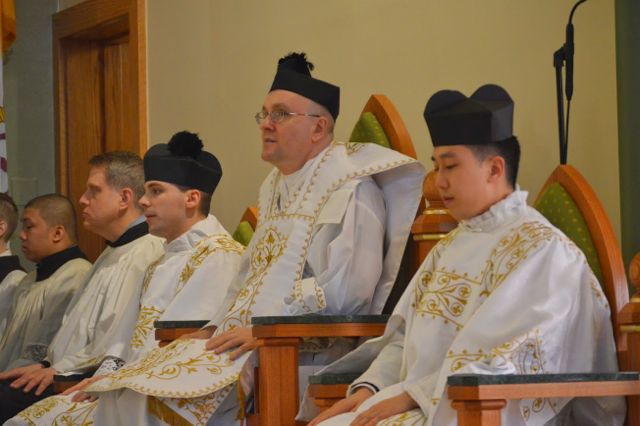
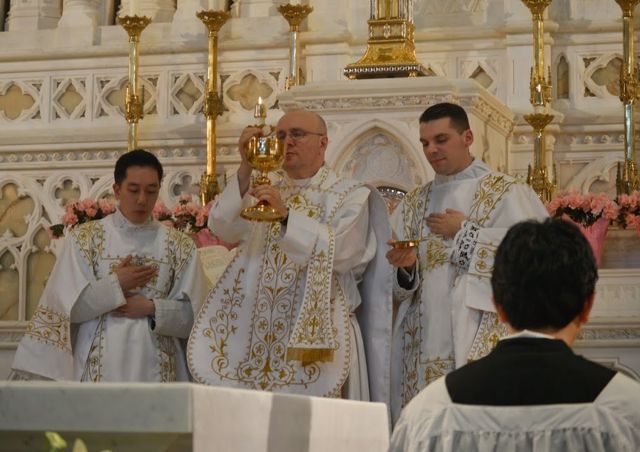
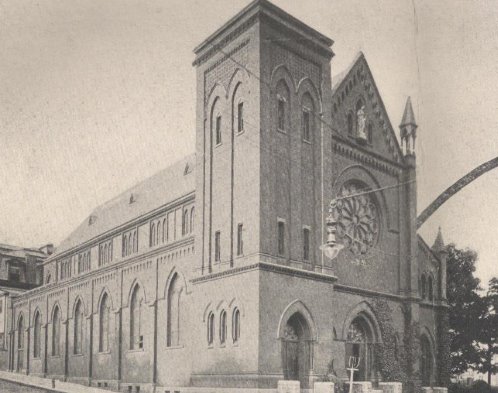
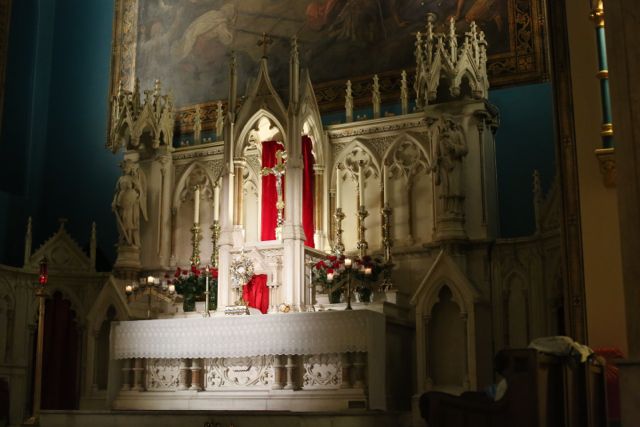
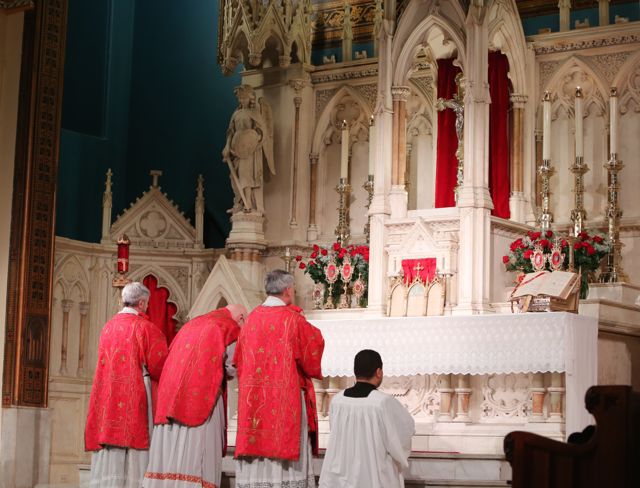
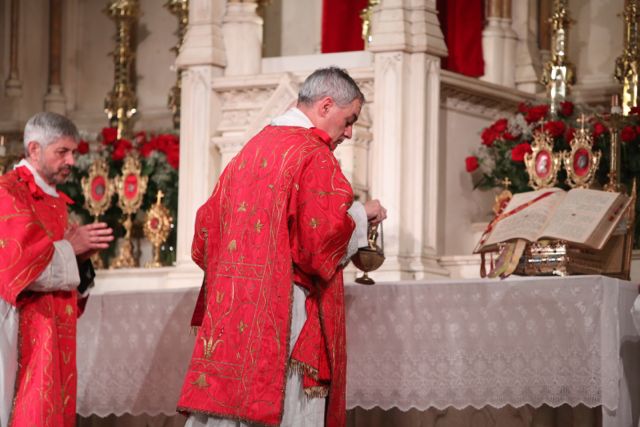
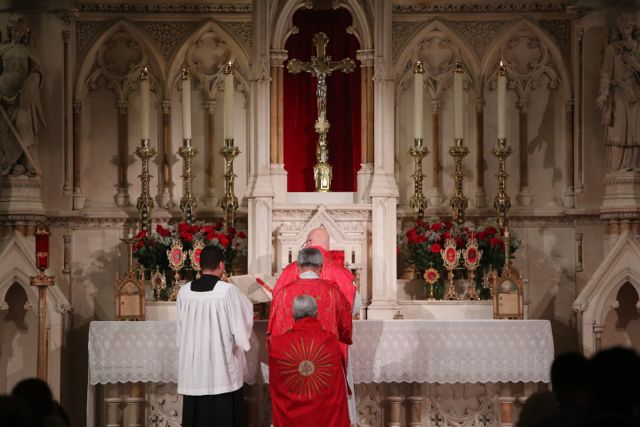
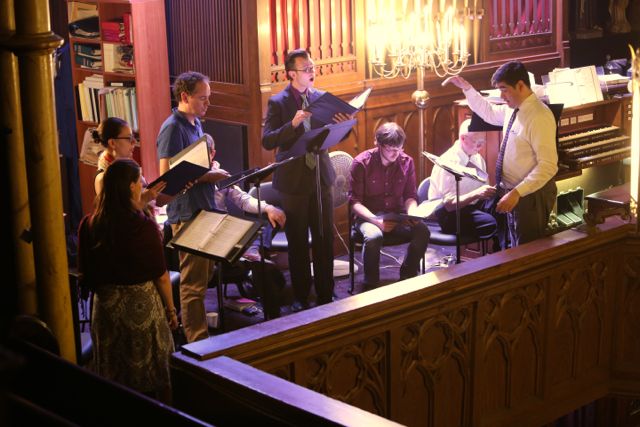
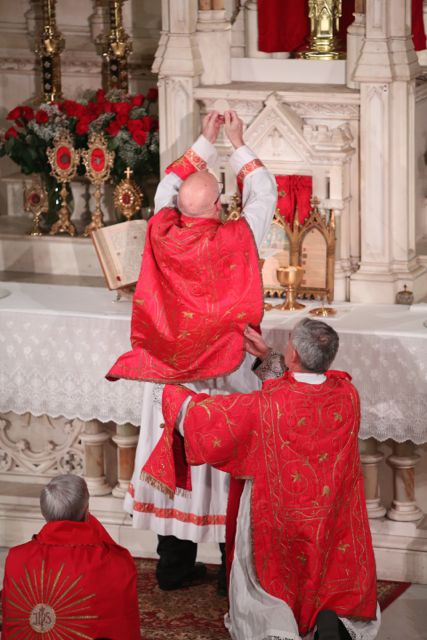
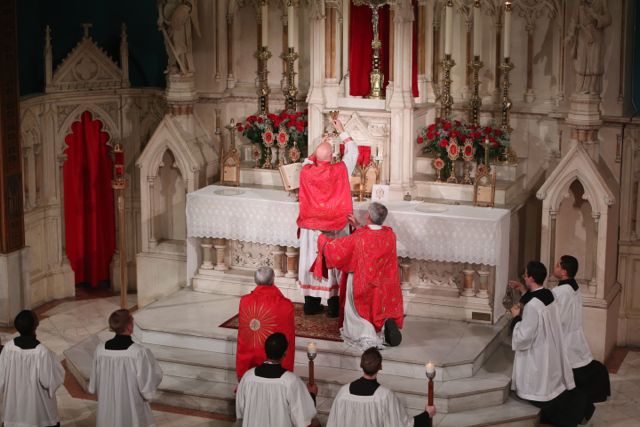
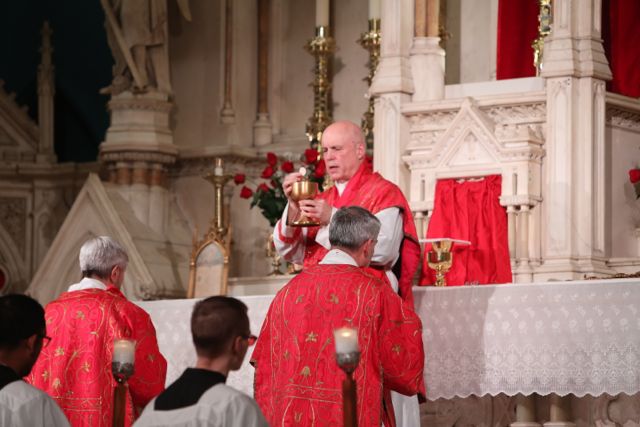
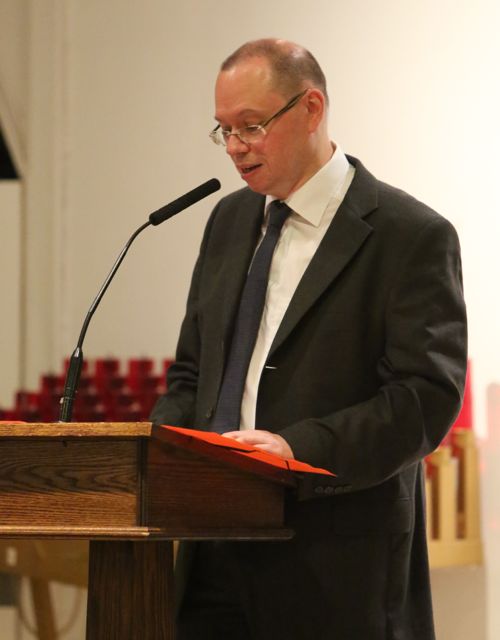
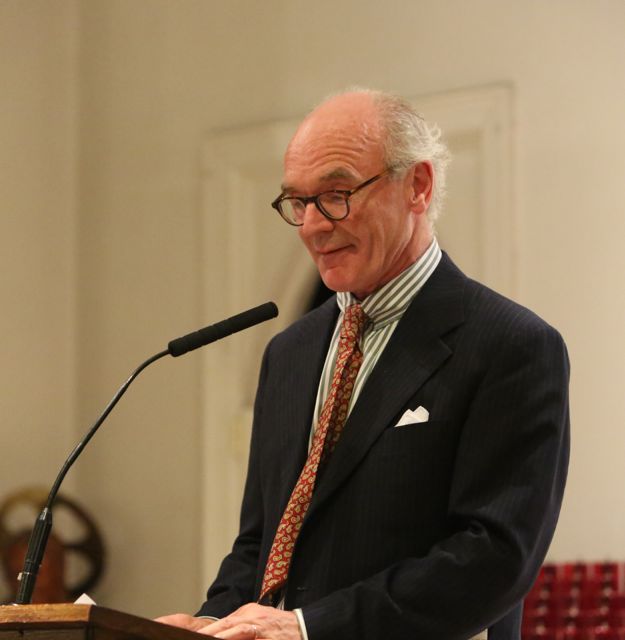
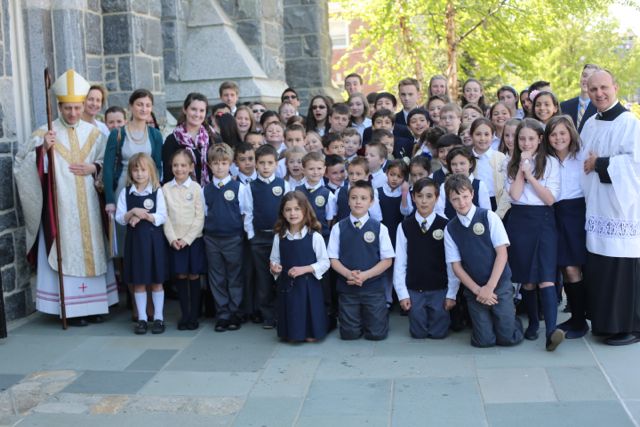
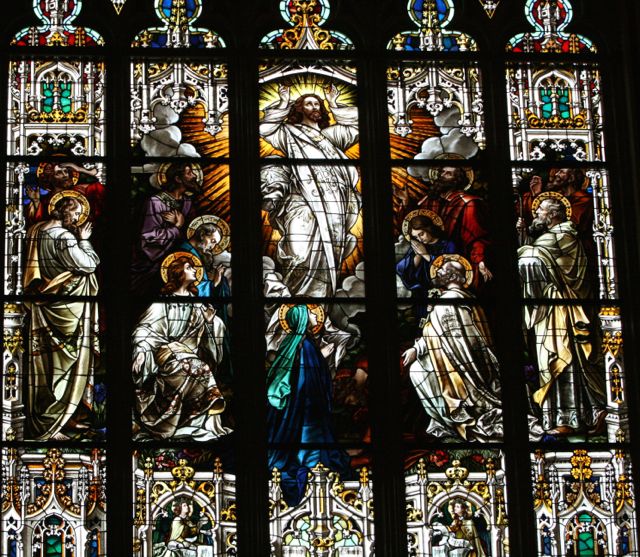
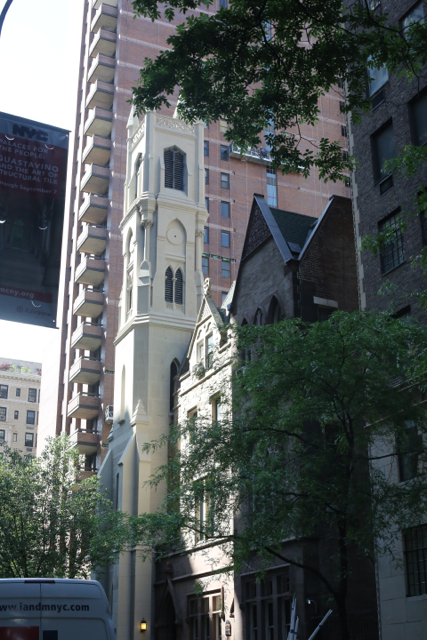
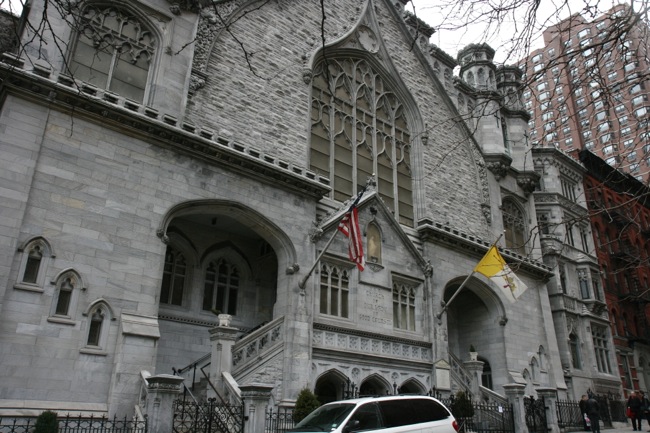
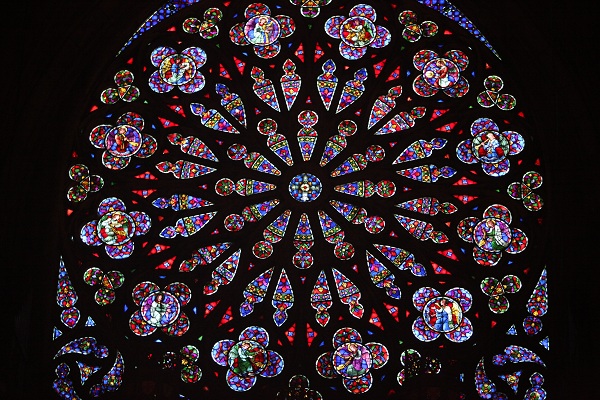
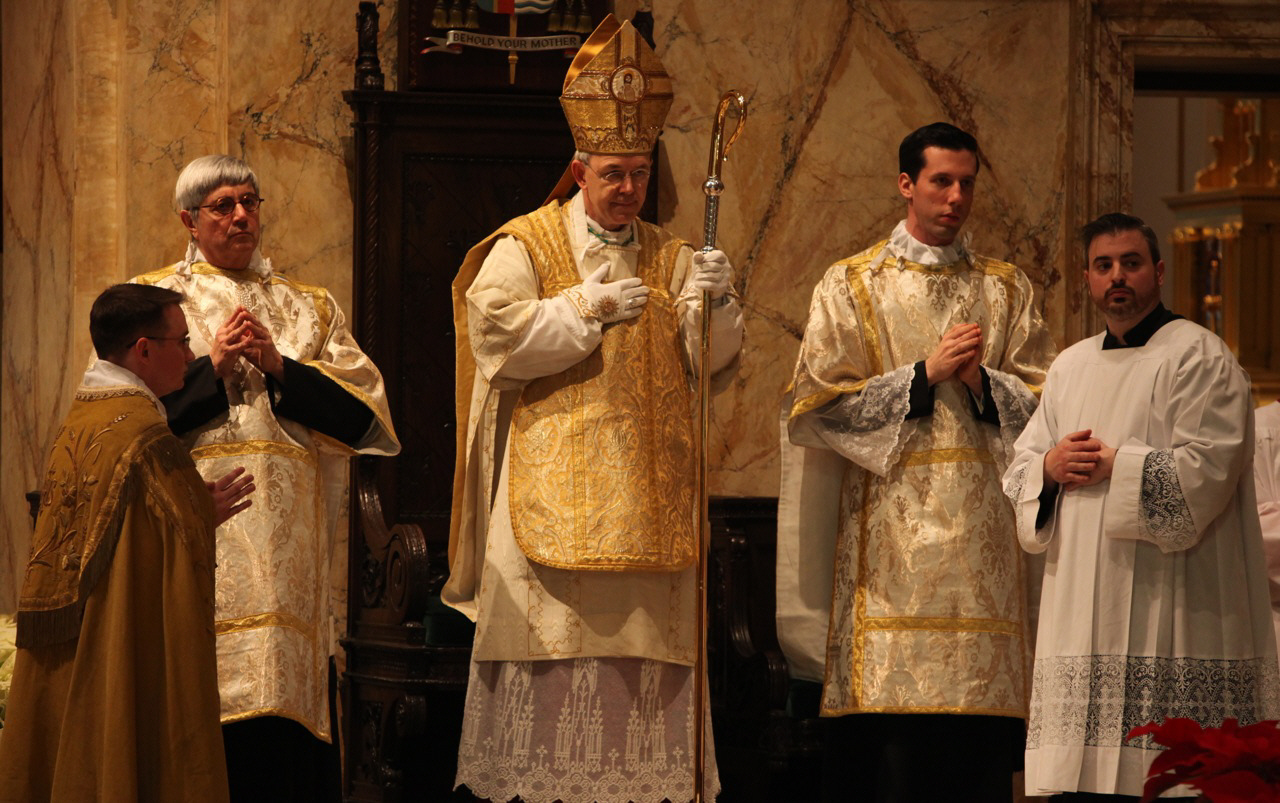
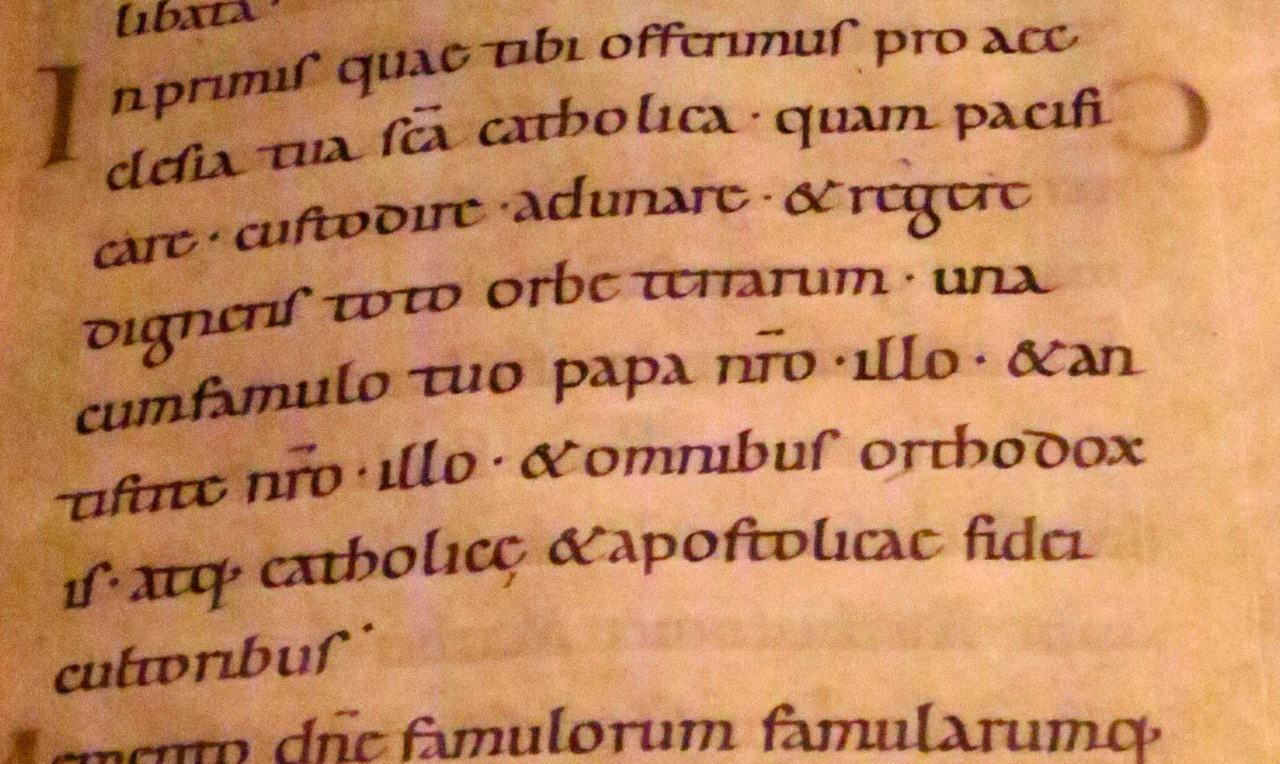
Some photos from the Mass for the Feast of Our Lady of Guadalupe, which was celebrated last Sunday at St. Mary’s Church, Norwalk.
12
Dec
Some photos from the Mass for the Feast of Our Lady of Guadalupe, which was celebrated last Sunday at St. Mary’s Church, Norwalk.
11
Dec
Winter in Wien – or at least late autumn in Vienna – a somber time of gray skies, chill winds and frequent drizzle. The dismal weather and the falling leaves prompt thoughts of death, of the end of things – so different from the frequent brilliantly clear, joyous days of Fall in the Northeast United States leading up to Thanksgiving. Yet the lights that begin to appear in early November at the Christmas markets scattered all over Vienna make all the stronger impression contrasted with the increasing gloom. You can get a real sense here why Christmas took on such extraordinary importance in the German lands.
Winter in Wien is the title of the last book written by Reinhold Schneider, a leader of the “Catholic Literary Renaissance “ in Germany. Written in 1957-58, it is a diary of a lengthy stay by the author in Vienna, at a time when the raw memories of the catastrophe of World War II and the fears of potential apocalypse of atomic war were very much alive. Winter in Wien is a dark, even despairing work, deeply pessimistic about the future of Man. Vienna, a place where the great course of European history seemed to have come to a final end, naturally lent itself to reflections on the last times. And Reinhold Schneider – like most authors of the Catholic literary Renaissance – was naturally a man fascinated by the extremes of human behavior– sacrificial resistance, heroic stances, dramatic conversions. He had written a memorable novella on Bishop Bartolome de las Casas; he had published underground essays of theological consolation during the National Socialist regime. In the bleak pages of Winter in Wien Schneider meditated on the end of civilizations and of history.
Yet, unless my memory is playing tricks on me, the most profound insight of this book lay elsewhere. Schneider was visiting a shop when a ridiculous toy – something like a jack-in-the box – caught his attention. And this cheap object suddenly was an epiphany for him. Yes, Schneider now knew that he indeed was in apocalyptic times. But our author had been entirely mistaken about the nature of the threat to the West. It was not Nazi or communist persecution or annihilation in an atomic holocaust. Rather, it was modern consumer culture with its the ludicrous products like that silly toy that were burying Western civilization. A burial ritual that reached its consummation in the “opening of the windows” to “modernity” by the Catholic Church only a few years afterwards. As another, perhaps more insightful author had written decades earlier:
“This is the way the world ends, not with a bang but with a whimper.”
Today, decades of EU prosperity have transformed Vienna into one of the minor outposts of the New World Order. The slovenly, casual dress of almost everyone is striking; you get the sense that 1970’s American fashion has been elevated into a uniform here. One evening, one of the main TV channels shows a film on the great poet Trakl, graphically depicting an improbable love affair with his sister; there followed a movie on the saga of an aging prostitute (a transvestite? – I didn’t watch long enough to find out.). A Volksoper production of Puccini’s Turandot has all the singers dressed as insects.

(Above) The baroque Mariahilf church reflected on one of the stores of Vienna’s main shopping street.
It’s all a strange contrast with ball dresses on display in the windows. They testify to the continuance (for tourism’s sake?) of social rituals whose purpose disappeared ages ago. Indeed, almost everything of interest here belongs to the past; the magnificent Habsburg art collections, the oversized buildings on the Ringstrasse, the many magnificent baroque churches, the musical life in the opera houses, churches and concert halls. Western Europe as whole is living off the legacy of an earlier age but nowhere can this be sensed as strongly as in Vienna. The Austrian Republic and the European Union have created nothing here.

(Above) The University – and the Jesuits’ – church, with the new and old altars.
Neither has the Conciliar Church, whose ravages are nowhere greater than in Austria. 50 years ago 90% of the population of Vienna – even if never a hotbed of the faith in recent generations – still identified themselves as Catholic. Today it is 40%. Religious practice is far less than what that percentage implies. In a magnificent baroque church one encounters only one or two visitors at any one time – half of them tourists. Sunday masses of the churches of the center of town are frequented mainly for the music. Again, one encounters the trappings of the past –the magnificent architecture, the masses of Mozart, Haydn and Bruckner, the splendid vestments – in a new environment entirely foreign to the culture that created them.
(Above and Below) the Votivkirche.
Perhaps the grandiose “Votivkirche” (Votive Church) on the Ringstrasse is more illustrative of the current spiritual situation of Austria than the perfectly maintained baroque churches of the older part of town. This grand neo-Gothic church was built in the second half of the nineteenth century in thanksgiving for Franz Josef escaping an assassination attempt. It had dedications from the Imperial family and from the nations that made up the Austrian Empire. Even at the time of its creation, however, there was criticism from “liberals” (in the original sense of the term) for whom the Votivkirche was a relic – if magnificent- of a faith that had vanished:
Already before me did a poet call you, the newest of cathedrals, “the Church without God.”
And truly so:
Perhaps, since you could be seen in your much-praised beauty,
Has hardly one heart throbbed within you in true faith,
Has hardly one knee bent in true devotion.
And so you tower,
Even if filled each day with the sound of organ and with clouds of incense,
With your flying buttresses
And your openwork spires,
Like a stone anachronism
Upwards out of the faithless present…
(Ferdinand von Saar)
The Votivkirche also had important connections with the Austrian military. All around the church are commemorative plaques and monuments – the legacy of two terrible world wars. And after World War II, the republic of Austria smeared its partisan political messages on the windows and walls of this church.

(Above) This plaque commemorates not soldiers in one of the two world wars but militiamen fighting a leftist uprising in 1934 – and perhaps others who died fighting a National Socialist coup attempt.

(Above) In the Votivkirche. (Below) The magnificent old main altar.

(Above) The renaissance grave (moved from a destroyed church in Vienna) of Count Nicholas von Salm, the heroic commander during the first siege of Vienna by the Turks in 1529.
But the post-war years have not been kind to the Votivkirche. In contrast to the baroque churches of Austria, nineteenth century neo-gothic architecture was held in contempt. Signs of neglect are everywhere, and the scaffolding outside the church serves as a welcome billboard leased out by the Archdiocese of Vienna. The congregation of this church, still sizable in 1950, has also dwindled away. Now it is the seat of an apostolate to foreigners in Vienna, led by “Father Joe” (naturally not an Austrian).

(above) An “evening for women” on “the question of offices in the Catholic Church” while the men discuss God and the world.

(above) “Father Joe”; (below) “The Cistercian monks of Heiligenkreuz monastery and Timna Brauer sing together to the One God.”
Truly, it seems that European culture has reached its end here! And yet, despite it all, there are still people kneeling and candles constantly lit before the images at the entrance to St. Stephen’s cathedral. The Christmas and Advent markets found everywhere are (still) called just that – not “holiday” or “seasonal” markets. One finds here and there signs of devotion to Blessed Karl of Austria. And in some less touristy, more out of the way cafes we find pictures of Emperor Franz Josef and Dr. Karl Lueger….
Finally, on our recent visit we experienced the wonderful solemn mass celebrated by Cardinal Burke. The magnificent Karlskirche of Fischer von Erlach was standing room only during the entire lengthy service. Several gentlemen stood about in uniforms reminiscent of the Empire. Families with sometimes noisy children attended without being greeted by angry glares or scolding (as is usual in the German-speaking world). Perhaps the Catholic culture of Austria is not totally a thing of the past, perhaps that which was confidently declared dead even in Franz Josef’s time can spring miraculously back to life. And the only place to start is a return to the fullness – in theology, morality and ritual – of the faith that made this culture possible in the first place

(Above)Solemn pontifical Mass with Cardinal Burke.

(Above) “Immaculate Virgin, intercede for Austria!” This shrine from 1936 in an ancient church is qualified as a relic of a prior time by a modern explanatory plaque.
10
Dec
10
Dec
From June 1-4, 2015, an international conference on liturgical formation in light of the new evangelization will be held in New York, under the title:
SACRA LITURGIA USA 2015
CULMEN ET FONS VITÆ ET MISSIONIS ECCLESIÆ
Continuing the initiative of Sacra Liturgia 2013, organized by Bishop Dominique Rey (Fréjus-Toulon, France) in Rome, this conference seeks to support the Church’s saving evangelistic and catechetical mission, as well as the continued revitalization of the liturgical life of the Church, especially in the United States.
The sacred liturgy plays a central, vital role in the new evangelization, attracting souls to the heart of Christ and His Church. For the baptized, the sacred liturgy resides at the heart of the Christian faith and life — indeed it is the “source and summit of the life and mission of the Church.” As Bishop Rey stated at the opening of the 2013 conference in Rome, “The sacred liturgy is not a hobby for specialists. It is central to all our endeavors as disciples of Jesus Christ. This profound reality cannot be overemphasized. We must recognize the primacy of grace in our Christian life and work, and we must respect the reality that in this life the optimal encounter with Christ is in the Sacred Liturgy.”
The conference brings together a wide range of renowned international speakers including Raymond Cardinal Burke; Archbishop Salvatore Cordileone (San Francisco); Dom Phillip Anderson, OSB (Abbot of Clear Creek Monastery); and Dom Alcuin Reid (Monastère Saint-Benoît, Diocese of Fréjus-Toulon, France); among others. See the appendix for a complete list of speakers and topics.
Topics addressed at the conference will range from broad subjects like the relationship between liturgy and culture, Catholic identity, youth, the arts, and Catholic education to specific questions like the mid-20th-century changes to Holy Week and the post-Vatican-II reform of the calendar and lectionary. Lectures will take place at the Kaye Playhouse at Hunter College (68th Street between Park and Lexington Avenues) which is conveniently located at a subway stop.
The conference lectures will be augmented by working sessions for those in Catholic higher education. Sponsored by The Cardinal Newman Society, the sessions will facilitate a conversation about renewing the liturgical life of Catholic colleges and universities to support the intellectual and moral formation of students and faculty in the Faith.
At the heart of the conference are the liturgical celebrations. There will be Solemn Vespers in the usus antiquior, a Sung Mass in the Dominican rite, and Solemn Pontifical Masses in the usus recentior and usus antiquior. The Solemn Pontifical Mass in the usus antiquior on the feast of Corpus Christi, celebrated on Thursday, June 4th, will be followed by a Eucharistic procession in the streets of New York. Liturgies will be held at the Church of Saint Catherine of Siena (411 E 68th Street), a beautiful Dominican parish on the Upper East Side.
With the prestigious lineup of speakers, as well as the beautiful liturgies planned, those attending the conference will come away with a rich experience of the intellectual heritage and liturgical life of the Catholic faith. The serious intellectual inquiry into the sacred liturgy will prove fruitful for both academics and laymen alike. Attendees will meet Catholics from all over the world, and be afforded the opportunity to build good working relationships with others of those seeking to deepen their love of Christ through the Church’s liturgy, and to continue their work for liturgical renewal.
Approximately 300 participants are expected. Registrations for the whole conference will open on January 1, 2015, and part-time registrations will be possible beginning at Easter. More information about registration, affordable housing, and locations is available at the conference website: www.sacraliturgiausa.org/
The conference is being organized by Rev. Richard Cipolla, Ph.D., D. Phil (Oxon.) and Jennifer Donelson, D.M.A. Media inquiries may be made to contact@sacraliturgiausa.org.
The organizers are grateful to His Eminence Timothy Cardinal Dolan for his kind permission to hold this conference in the Archdiocese of New York, as well as the gracious welcome of the Dominican friars and staff at Saint Catherine of Siena Church. This event could not take place without the generous support of the conference sponsors: the Knights of Columbus, The Cardinal Newman Society, de Montfort Music, Regina Magazine, Granda, Cantica Nova Publications, the Society of St. Hugh of Cluny, and the Church of Saint Catherine of Siena.
10
Dec
10
Dec
Thursday, December 11, 7 pm, Advent Evening of Recollection, featuring Rev. John Perricone, St. Anthony of Padua Church, Monmouth St., Betweeon 6th and 7th, Jersey City, NJ.
Friday December 12, 7 pm, Advent Lessons and Carols, St. Mary Church, Norwalk
The St. Mary’s Choir, El Coro Hispano de Santa María, The St. Mary’s Student Schola,The Regina Pacis Academy Schola.
Chants of Advent, choral motets, & congregational hymns will culminate in Adoration Benediction of Our Lord in the Most Blessed Sacrament. A festive reception will follow.
Saturday December 13, 6:30 am, Rorate Mass, St. Mary Church, Greenwich, information
Saturday, December 13,10 am, Chapel of Santa Febronia at 557 5th Street, Hoboken, N.J., Sung Mass in honor of St. Lucy, information
Sunday, December 14, 3:30 pm, Vox in Rama, A Program of Sacred Christmas Music, Church of Holy Innocents, New York, NY, Solemn Vespers and Benediction, Sacred Music from Around the World
Thursday, December 18, 7 pm, Advent Evening of Recollection, Catholic Artists Society, The Catholic Center at NYU, 238 Thompson Street, New York
8
Dec
Evening Missa Cantata at Holy Innocents parish in New York on the Feast of of the Immaculate Conception. Father George Rutler is the celebrant.
8
Dec
On Saturday, December 13th at 10:00 a.m. there will be a Traditional Latin High Mass sung in honor of the feast of St. Lucy, at the Chapel of Santa Febronia at 557 5th Street, Hoboken, N.J., where her statue is venerated.
The Santa Febronia Chapel was founded in 1927 by immigrants from Patti, Sicily to honor their patroness the Virgin Martyr Saint Febronia and the Madonna of Tindari. The chapel, still the private property of the society, is one of the most important Sicilian American as well as Catholic heritage sites in the country due to its very unique history. The chapel both in its interior and exterior have been unchanged from its founding and its faux marble niched altar is a brilliant work of immigrant folk craftsmanship. The statues of Santa Febronia and Our Lady of Tindari are simply stunning.
This will be the first Traditional Mass held at the chapel since the Second Vatican Council. Proceeds from the collection will be used to restore the chapel basement destroyed by Hurricane Sandy.
5
Dec
The Sisters of the Divine Compassion suddenly have put their White Plains campus – on the National Registrar of Historic Places – on the market. Endangered are an elementary school, a high school and the beautiful Chapel of Divine Compassion. In the chapel is the tomb of the founder of this order, Msgr. Thomas Preston, a priest of the Archdiocese of New York. His famous parish in New York, St. Ann’s, has already been destroyed – will he now lose the chapel that was his final resting place as well? The foundreess is buried in the chapel as well.
Alumnae and others are organizing to save as much as they can. They have the benefit of a video, prepared by the Sisters of the Divine Compassion themselves last year to assist in fundraising!
For more information on the – so far unavailing – campaign to save the Good Counsel Academy (the high school) and chapel see HERE.
5
Dec