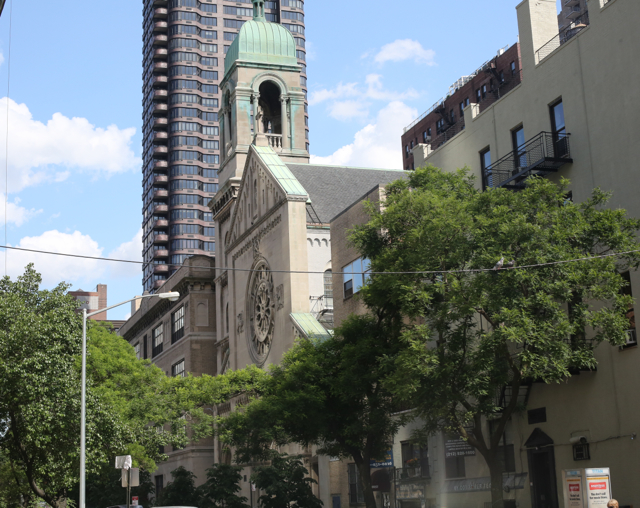
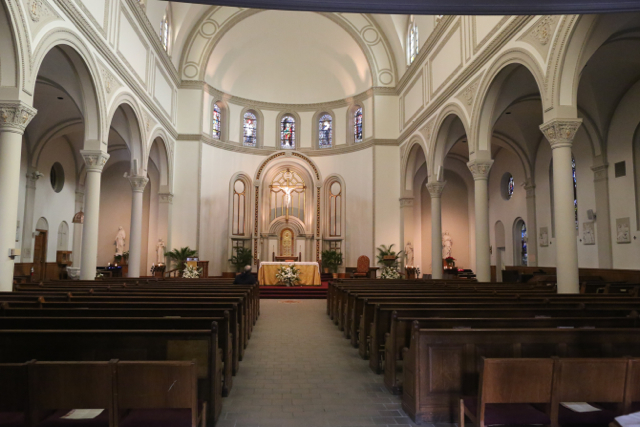
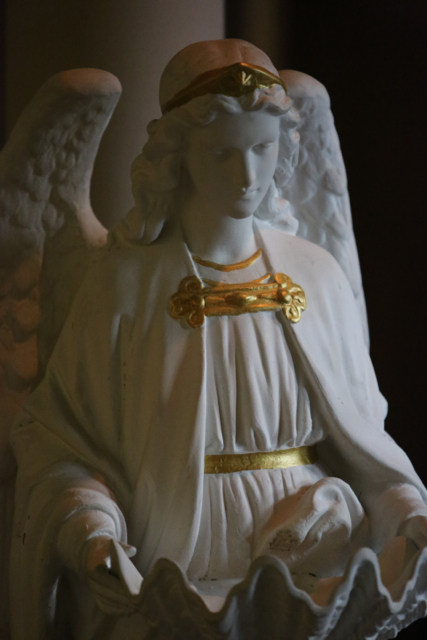
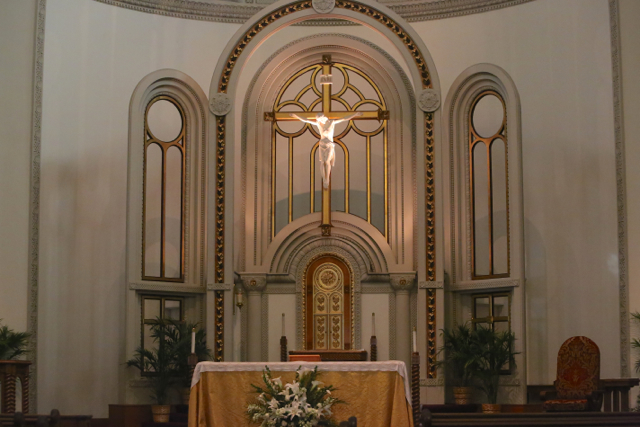
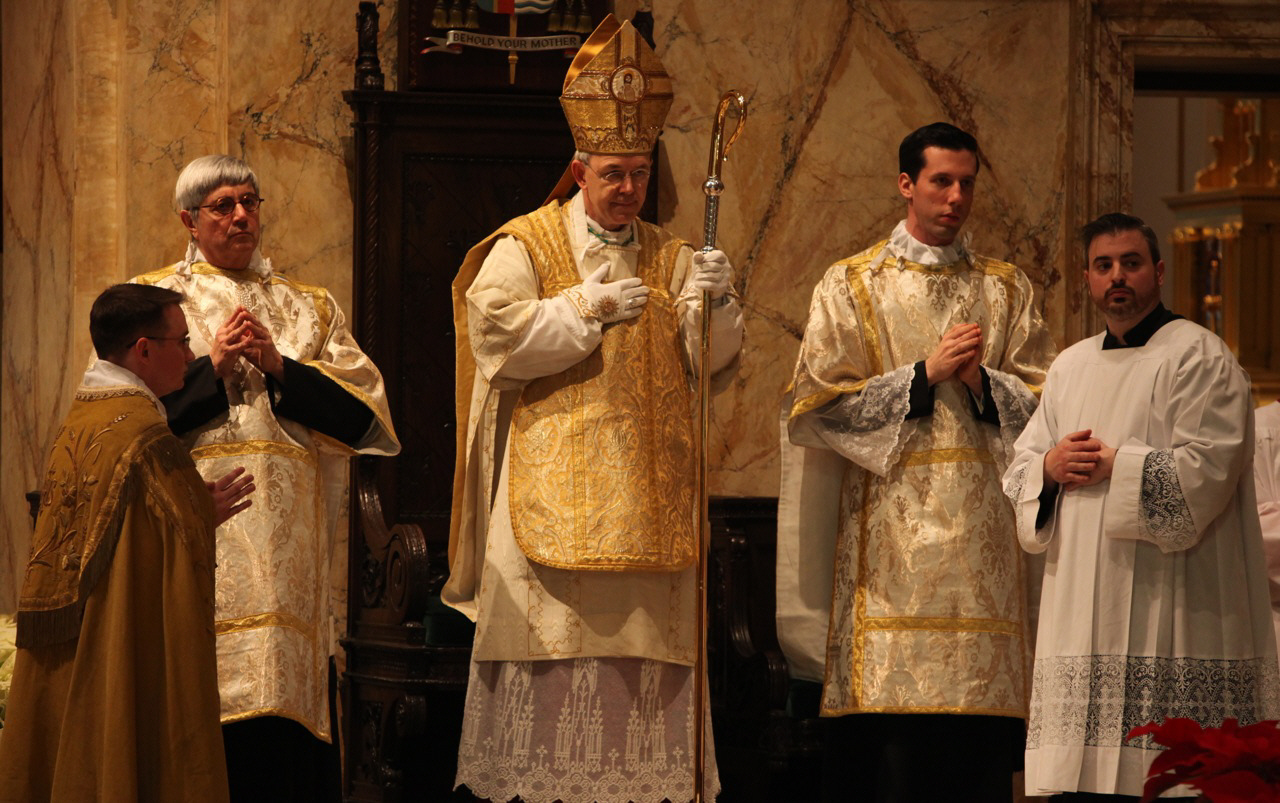
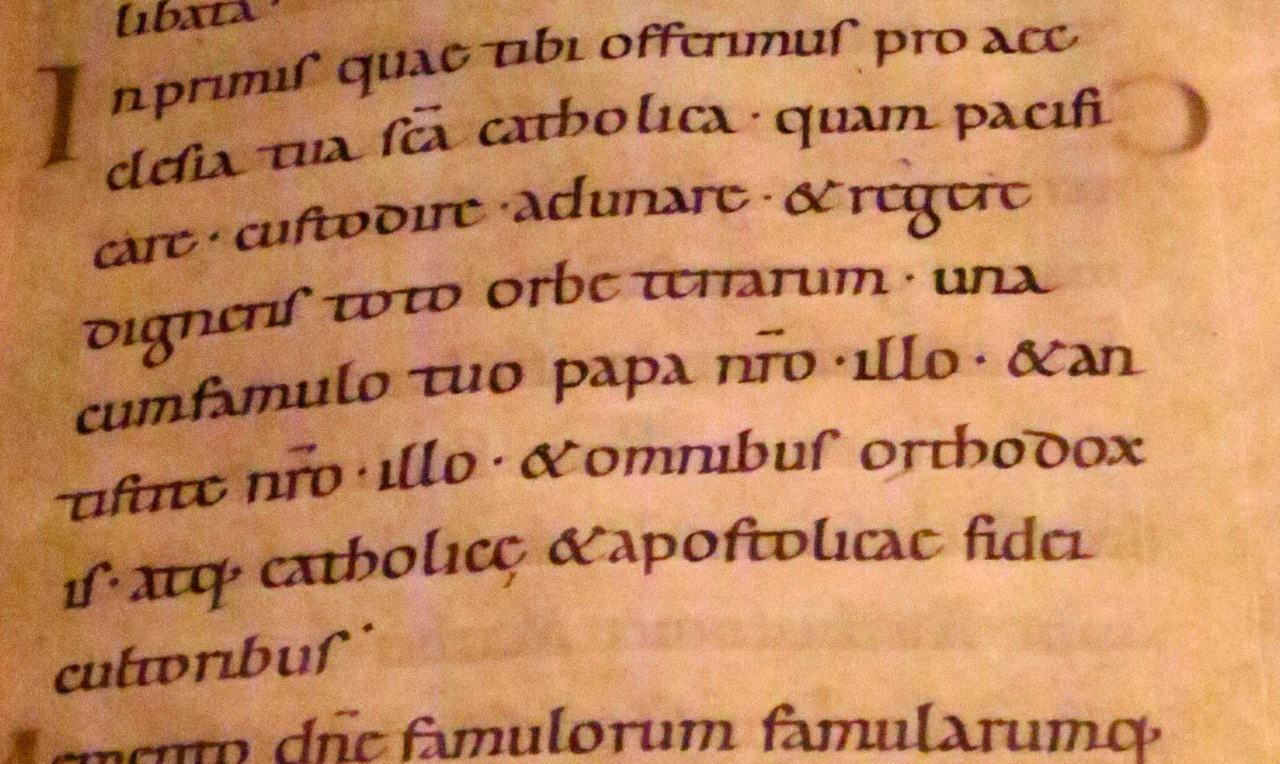
Nice post from a while back on “ Catholic Churches in Crisis.“
16
Jun
Nice post from a while back on “ Catholic Churches in Crisis.“
16
Jun
THURSDAY, JUNE 19
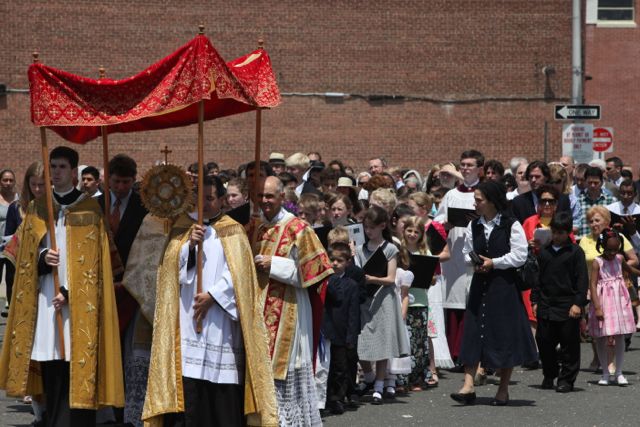
St. Gabriel Church, Stamford CT, Solemn Mass, 7:30 pm. Outdoor Eucharistic Procession and Benediction after Mass.
Light refreshments to follow in Parish Meeting Room.
Holy Innocents Church, Manhattan, Solemn Mass, 6 pm, followed by an outdoor procession.
SUNDAY, JUNE 22
St. Mary Church, Norwalk, CT, Solemn Mass, 9:30 am. Outdoor Eucharistic Procession around the neighborhood and Benediction follow the Mass. Festive coffee hour follows in Msgr. Haius Hall.
St. Stanislaus Church, New Haven, CT, High Mass, 2 pm, followed by a Eucharistic procession in the church.
Immaculate Conception Church, Sleepy Hollow, NY, 3 pm, Missa Cantata with outdoor procession — celebrant will be Fr. Daniel D’Alliessi.
Our Lady of Peace Church in Brooklyn, 9:15 AM with an outdoor procession
15
Jun
So says Sister Patricia Anastasio, a member of the Archdiocesan Advisory Group:
“a difficult time” for the Archdiocese and its parishes and parishioners, as final recommendations are considered and made. ..”I know people love their parishes,” she said. “Each parish is the heart of the church in the Archdiocese. People love their parishes and identify with their parishes.”1)
Strange, this feeling of foreboding. For elsewhere (such as in the rest of the above article) we hear that everyone’s on board and in agreement, that all participants are in raptures of prayer, that the planning is considerate and perfect…yet we also are given to understand in the same article that it’s going to be difficult, that protests and petitions have started, and that the subjects of parish closings and the use of funds from closed churches are in the forefront. There seems to be here two parallel tracks – or better, two parallel worlds. On a visit today to several churches I detected concerned murmuring about what will happen next.
Some people, though, received happy news well in advance:
“CORPUS CHRISTI TOWN HALL MEETING, April 27, 2014
Cortpus Christi will not be closed or consolidated with another parish. We will collaborate with neighboring parishes as part of Cluster 18, Upper West Side, Manhattan.” 2)
In the same issue of Catholic New York cited above we read about what is becoming almost a monthly ritual in the greater New York area:
“The Sisters of the Divine Compassion are exploring the sale of all or a portion of their 16-acre Good Counsel campus in White Plains. The decision comes after a 10-year strategic planning process and two-year review of the property, located at 52 N. Broadway. The campus features 12 buildings comprising a total of 162,180 square feet. The buildings include the order’s motherhouse, the Good Counsel Academy elementary and high schools, a counseling center and the Chapel of the Divine Compassion. The sisters have retained the real estate and investment firm CBRE Group Inc. to market the property.” 3)
The decision seems to leave the high school and elementary school conducted by the sisters with a combined total of 560 students up in the air – although the order has restated its commitment to these schools (while planning to sell their buildings with no immediate plan for substitute locations). The order had sold its college in the 1970s to Pace University Law school.
There is no comment from the Archdiocese.
At stake is the sisters’ beautiful chapel containing the tomb of their founder. Fr. Thomas Preston, convert, chancellor and vicar general of the New York archdiocese, Pastor of St. Ann’s, minister to both the rich and the poor, enemy of incipient modernism and patron of the arts. His beautiful parish church, St. Ann’s, was destroyed some ten years ago. His monument there, stripped of its dedication, now adorns Cardinal Egan’s residence at the former church of the Sacred Hearts of Jesus and Mary. What will now become of his tomb?
As to “Making all Things New,” things are moving fast. On a visit today to St Benedict the Moor(on the “hit list” since at least 2007) I found the church locked and the information regarding masses removed. The order that had care of this church had removed suddenly to Jersey City just a short while ago ago. This, after I had visited this church during what I was told was a “parish retreat” featuring exposition of the Blessed Sacrament (and a full congregation for such small church) just 3 or 4 weeks ago…..
1) Catholic New York, June 12, 2014, at 1; Woods, John and Chicoine, Christie L. “Recommendations for ‘Making all Things New’ Due Soon” (this article is apparently not online)
2) http://www.corpus-christi-nyc.org/making-all-things-new/
3) http://cny.org/stories/Sisters-of-the-Divine-Compassion-Explore-Sale-of-Their-White-Plains-Campus,11165. See also: http://www.divinecompassion.org/news/sisters-of-the-divine-compassion-retain-real-estate-firm
14
Jun
St. Joseph (in Yorkville)
404 East 87th Street
East 87th Street in New York on a bright afternoon in early summer. It all seems a subdued and almost idyllic corner of the city: trees, mothers with strollers, and relatively fewer high-rise apartments that usual. The modest stone façade of a church and its tower still stand out picturesquely among such human-scaled surroundings.it is St. Joseph in Yorkville, one of the last survivors of that former vast Central European neighborhood.
By the time of my parent’s generation the center of German-American activity in New York had shifted to East 86th Street. Except for Luchow’s restaurant, Kleindeutschland downtown had been forgotten. By the early 1980’s the German flavor of even this new center of Yorkville had almost disappeared. Only a few restaurants, food stores and churches still remained. By 2014 almost all of this in turn has vanished. Except for some churches, the traces of the Slovaks, Hungarians and Czechs had disappeared as well. The last decade has seen a great revival of German bars and restaurants in New York. Some of these are a recreation of the original almost eerie in their exactitude and detail. One can order today a “halver Hahn” from Cologne on Rivington Street or drink Andechs beer from a Bavarian monastery in “Alphabet City.” But none of this has anything to do anymore with Yorkville or German immigrant culture.
The Church of St. Joseph was founded in 1873 almost as a mission to the Germans who had begun settling in this neighborhood. An attraction for German Catholics in this area was the chapel of nearby German orphanage – also called St. Joseph’s – in the care of the Redemptorists. Architectural remnants of that chapel can still be found today. 1) St. Joseph’s parish, dedicated by Cardinal McCloskey in 1874, was one of the last in a splendid chain of German-American parishes that once dotted Manhattan: Most Holy Redeemer, St. Nicholas, St. John the Baptist, etc. Few know that is was originally in the care of the Jesuits from St. Lawrence O’Toole (St. Ignatius Loyola) parish. Indeed, the same architect, William Schickel (from Germany himself), built both churches. St Joseph opened its school in 1880. In 1888 the Jesuits handed over the parish to the Archdiocese; in 1895 the present church was completed. 2)
We have little to report of the subsequent history of this parish. After World War II the German character of the neighborhood disappeared and St. Joseph’s became just one more parish of the Archdiocese. By the 1980’s the German ethnicity of St. Joseph’s had been reduced to one German mass on Sunday. By 2014 there was one German mass a month – with the homily, petitions and announcements in English. Yet St. Joseph’s still claims to be the “German national parish of the Archdiocese of New York.” 3) This loss of identity, however, was counterbalanced at least in part by the post war “gentrification” of the Yorkville. An originally working and middle class area was gradually transformed into an appendage of the wealthy “Upper East Side.”
After the council the interior of St. Joseph’s was subjected to one of the most horrific renovations in New York. As the parish history puts it:
“In the period immediately following the Council, many of the church’s elaborate furnishings, some of them dating from an earlier renovation in the 1950’s, were discarded in the name of liturgical and architectural simplicity. A sense of architectural and decorative tentativeness prevailed until the early 1990’s, when the church finally assumed its present appearance, which successfully combines simplicity and refinement.”4)
While I cannot share the aesthetic judgment of the last sentence, all can agree that the present interior of the church is an improvement over the wasteland of the early 1980’s. Need I mention the quality of the liturgy of that time was entirely in harmony with the post-conciliar décor? So St. Joseph is one of those post-post-conciliar Manhattan churches, like Sacred Heart, St. John the Evangelist or Our Lady of Sorrows, where a subsequent generation has tried to correct the “sins of the fathers” – without attempting a full restoration.
St Joseph’s does have the distinction of being one of the few American parish churches to have been honored by the visit of a pope – Benedict XVI in 2008 (Holy Family, “the Church of the United Nations,” is another in New York). The parish was selected “because the pope was German” but the event was an ecumenical service having little or nothing to do with New York’s Catholic or German heritage. 5)
St. Joseph’s does make a fine impression on the street with its pretty Romanesque façade straight out of Lombardy. In the 1920’s its tower was completed and a fine new school building constructed. That school is still very much in operation – a rarity in New York! For, as we have said, the neighborhood of St Joseph’s has remained more intact than most in Manhattan. Not entirely so – East 86th Street has always been remarkably sleazy considering the wealth of its surroundings and, just as in the 1980’s, the drug traffic rears its head now and then on the surrounding streets. 6)
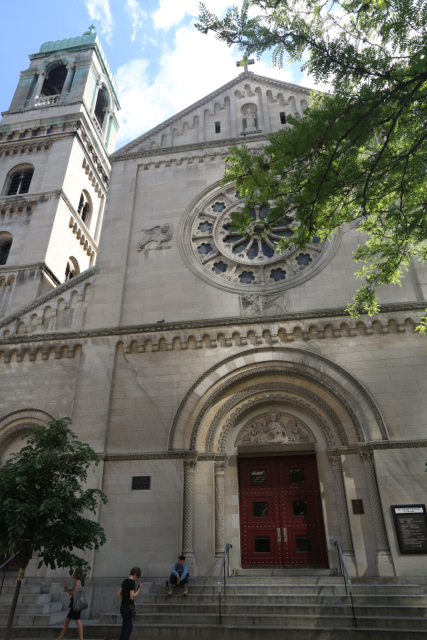
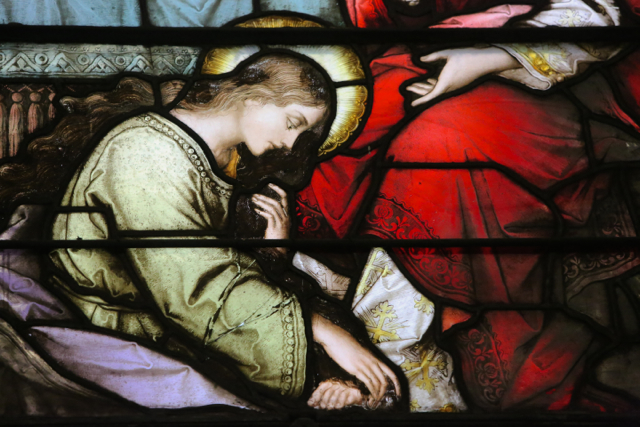
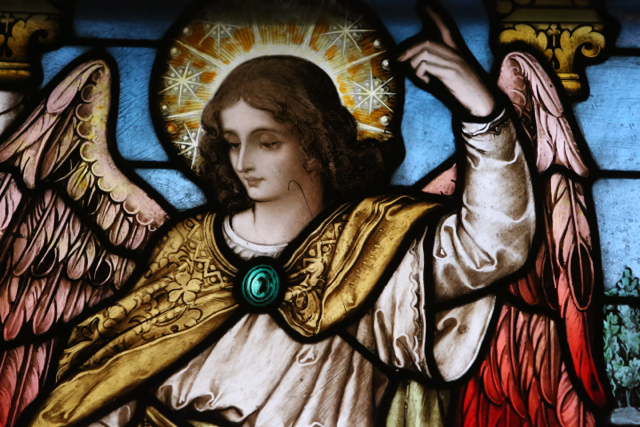
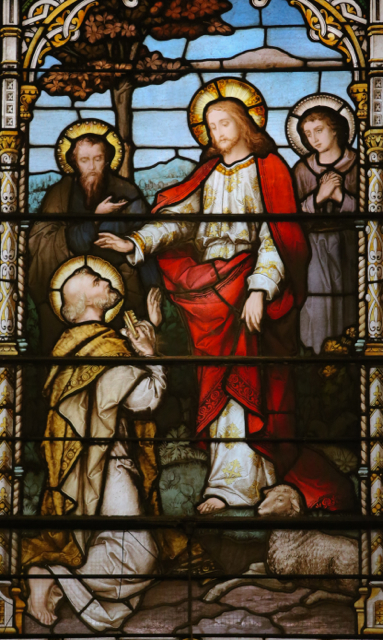
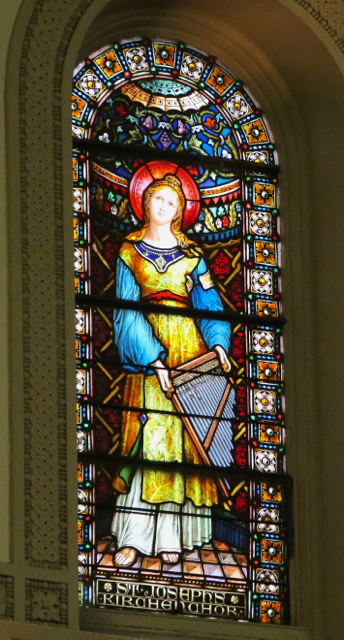
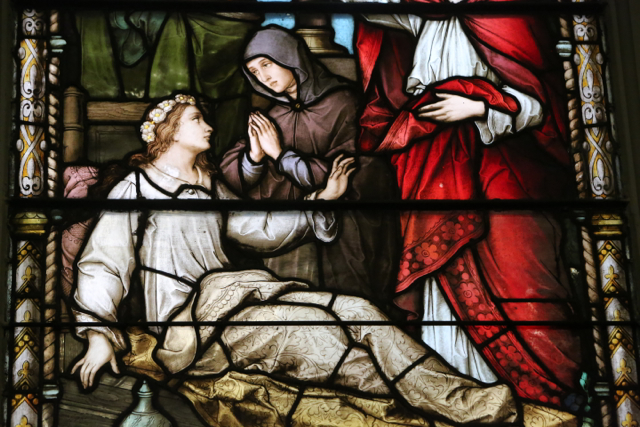
Inside, the generic “Renaissance” architecture is typical of many churches built a that time – one thinks of St Francis of Assisi, Our Lady of Esperanza or St Ignatius Loyola. Regrettably the furnishings fell victim to the post-conciliar iconoclastic rage – the current “reredos” of Romanesque arches is a poor substitute. But in the darkened interior are still found statues and candles before them. More importantly, the church is open outside of mass times, and there are a few souls praying. The only significant decorative survivals of the past are the windows, probably from Munich. They are not the greatest example of this genre in New York by a long shot: rather small in scale and with images more doll-like than usual. Nevertheless, they are pretty and typical of the era.
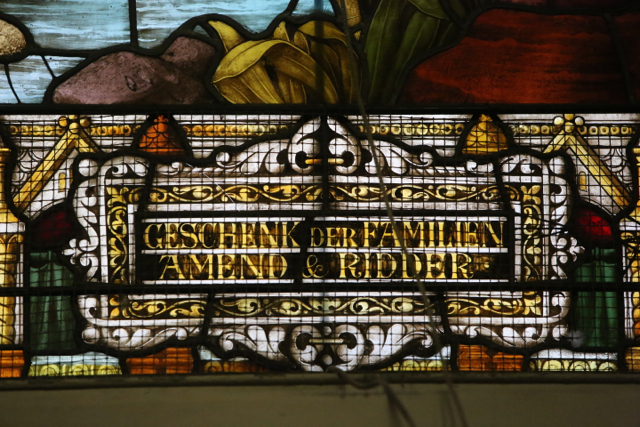
(Above) Contributed by the “St.Josephs Kirchenchor”; (below) “Kinder der St. Josephs Schule.”
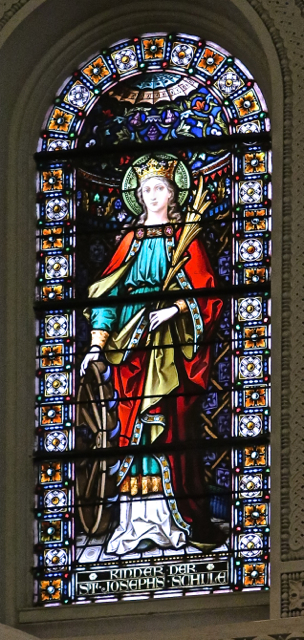
(Above and below) This window of the raising to life of a dead girl was contributed by the family of a doctor.
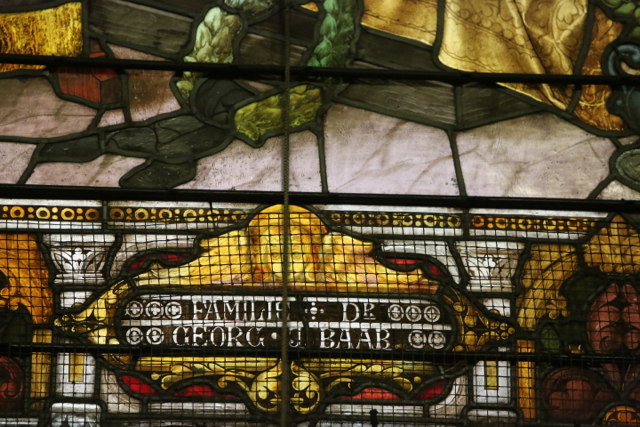
We read their German dedications with not a little melancholy. A nation that played such a critical role in the New York of the 19th century seems to have vanished from the earth! All that remains is some lettering on windows dating from before the First World War. But what of the Catholic religion itself? St. Joseph’s parish itself indeed has survived in better shape than most – despite the loss of its original ethnic character and the wounds inflicted by its own clergy. But does not this church, with its jumbled, uncertain interior, reflect, to use a felicitous term from the parish’s history, the “tentativeness” of the entire post-conciliar situation – including, nowadays, the very existence of many parishes in this city?
1) Dunlap, David W., From Abyssinian to Zion: A Guide to Manhattan’s Houses of Worship at 220(Columbia University Press, New York 2004)
2) The Catholic Church in the United States of America, Vol. 3 at 342 (Catholic Editing Company, New York 1914)
3) http://www.stjosephsyorkville.org/germandeutchetra.html (also in German!)
4) http://www.stjosephsyorkville.org/history1.html
5) http://www.stjosephsyorkville.org/history1.html
6) http://www.nytimes.com/2013/06/19/nyregion/manhattan-pastor-faces-up-to-drug-dealers-with-prayer-and-a-petition.html?_r=0,
13
Jun
5. The Era of Pope Francis and an Epilogue; 2013 -?
One again the Traditionalist scene in the United States was rocked by an event from across the seas. Pope Benedict, who had done so much for the cause of Catholic Tradition – without fully embracing it himself – abdicated. It was clear from the start that his successor, Francis, would be a man of entirely different character – had he not been pushed as the main alternative to Benedict in 2005? But what few – aside from a key group of initiates – realized was that Francis was a genuine progressive in the line of cardinals Bernardin or Martini. What had been inconceivable in 1978 or 2005 had taken place: the left wing of the Church had captured its highest position.
If we consider the situation only in America, this development, while unexpected, was not at all totally surprising. For the Church’s progressive wing had not been idle in the years we have followed the twists and turns of Traditionalism. They remained in total control of most religious orders and Catholic institutions of higher education. The Catholic press and the Church bureaucracy were in their hand. And they retained vocal supporters among the hierarchy: Mahoney, Bernardin or Weakland.
Beyond maintaining their position in the ecclesiastical sphere, the Catholic left forged powerful links with the forces of civil society. They developed valuable ties with secular educational establishment. The liberal media (that is, almost all the media) turned to their agitators for “authoritative” commentary on things Catholic; the Catholic hierarchy (including the Vatican) also turned to the National Catholic Reporter as a preferred media outlet. And a new field of activity for the progressives was the overt alliance with the Democratic Party and specifically the Obama administration, counteracting “pro-life” initiatives in and outside of the Church. American Catholic progressivism was a movement that John Paul II and Benedict might attempt to restrain but could hardly discipline, let alone dislodge.
Pope Francis immediately launched a systematic campaign both of accommodation with Western secular civil society and of outreach to the Catholic left. Certainly in rhetoric it is a return to the 1960s, covered in the first installment of this essay. Instead of increasingly respectful treatment Traditionalists now heard themselves denounced by Pope Francis in coarse and contemptuous language. More concretely, at Francis’s direction, the Vatican launched a campaign of annihilation against the Franciscan Friars of the Immaculate – a bi-ritual order with a growing Traditionalist commitment. One of the main initial penalties imposed was the de facto abolition of Summorum Pontifcium for these friars. But these actions had little resonance in the United States, given the friars’ limited presence here.
The forces of the American “Conservative Catholics” had very little time to rejoice, however. For Francis and his acolytes immediately moved, in word and deed, even more forcefully against the holiest principles of the conservatives. Francis and his team denounced capitalist economic principles. They called into question or mocked pro-life activity of all kinds. And as one of his most significant new ecclesiastical initiatives, Pope Francis launched a “discussion” clearly aiming at changing the rules of the Church regarding divorce. This last move struck the weakest link in the conservatives’ stance on life issues. For divorce is an unambiguous conflict between the teaching of the Church and one of the nonnegotiable principles of American civil society.
What was the impact of these dramatic developments? We have seen that in the 1960’s the reforms of the Council had been virtually unopposed. The reaction to the current attempted restoration of the 1960’s has been far more complex. True, among the clergy open rebellion is nonexistent. Yet by 2014 a lively Catholic samizdat – the Internet – had arisen. News was rapidly disseminated and critical commentary offered. The Traditionalist Catholic of 2014 had an infinitely better idea of what was going on in the Church – both in and outside of the United States – than his predecessor of fifty years ago. And his experience of 50 years of working around the structures of the “official Church” had immunized him against the progressive revival.
There is above all this remarkable fact: in the first year of Francis the Traditionalist cause in America has actually strengthened. True, certain masses sponsored by “fair-weather friends” have been canceled. But other masses and apostolates have taken their places. Certain prelates have taken the opportunity to settle scores with a movement they always disdained. But others have maintained and even expanded the Traditionalist presence. Traditional masses are still spreading to new locations with full official support. The successful modus vivendi of traditional Catholicism with the Church establishment, inaugurated by Summorum Pontificum, has largely continued. For Traditionalists. the loss of papal support has not produced an existential crisis or a rush to “preemptive obedience” (as the Germans call it).
The situation of the conservative Catholics is much more critical. For Pope Francis has radically challenged their core beliefs on the nature of the papacy, on “life issues” and on the economy. Only a minority (of which George Weigel is representative) attempts to uphold the ultramontane cause in its purity, seeking to prove that Francis is no different than Benedict, John Paul II or Paul VI. Other leading spokesmen have lapsed into silence or have vehemently criticized the utterances of the pope’s inner circle (but not those of Francis himself). Predictably, those who have most directly criticized Francis himself have done so for his statements on capitalism and Israel. We do observe, however, that the pro-life movement is continuing in its accustomed course unconcerned about whether they are “obsessing” or not.
We do not know what the future will bring. We do not know what will happen if Francis extends in some way the actions he has taken against the Franciscan Friars of the Immaculate to the whole Church. We also have to consider the long-term effect of the endless stream of statements from the Vatican and of potential episcopal appointments as well. My personal view is that Francis’s actions on other fronts (such as on divorce) are likely to precipitate such a crisis in the Church that the relationship with Traditionalists will remain in the background. It would be just as plausible, however, that a Vatican that suffers a reverse on these other issues would respond by retaliating against ”enemies” – of which Traditionalists would be the easiest and safest targets.
Epilogue
So a movement that first arose out of the religious chaos of the post-conciliar years finds itself established as a fixed, if mostly marginal part of the United States Catholic scene. In a way, Pope Francis should be happy with the Traditionalists; their only method of survival and of evangelization has been by means of example. Without the institutional support of the hierarchy, the Catholic educational system or the religious orders, the Traditionalists built a network for themselves. It is growing not receding. In many, if not most places, a working relationship has been established with the institutional Church. And leadership has been handed over to a new generation of clergy, religious and laity. It is a success envied by Traditionalists in most other parts of the world.
Yet there is also a palpable feeling of dissatisfaction. Traditionalists remain the one group of the Roman Catholic Church that can be officially persecuted. The Vatican has assumed once again a position of open hostility. It seems after so many years and so much effort Traditionalists remain on the outside.
Part of the discontent is the pain of honestly facing the reality of the “Conciliar Church”; the dire predictions of the Traditionalists have only been proved so terribly true. This is a Church where the knowledge of religion among the mass of Catholics borders on the nonexistent; where the practice of the overwhelming majority in key areas of morality is hardly distinct from that of the surrounding population. A Church whose hierarchy seems “obsessed” only with material, secular issues and with arranging their comfortable accommodation with the world. A Church where the pope, the Vatican and the bulk of the hierarchy are able to isolate themselves in a fantasy world free both from the obligation of dealing with reality and from accountability for their actions. A Church that expressly rejects the rational and the beautiful, patronizing instead cretinous “movements.” A Church that is on the path to extinction in the developed world.
The unavoidable issue is that, in view of such facts and given its principles, Traditionalism cannot remain the province of a nostalgic few, of a “remnant” or of an elite following a “counsel of perfection.” Traditionalism can be nothing else than how it was described in the subtitle of Latin Mass magazine: a “movement for Catholic reform.” Not a call back to some past which never existed but a rediscovery and reliving, in all its neglected richness and completeness, of the Tradition of the Church. Living completely the liturgical life of the church is necessarily inseparable from adhering to Christian morality and accepting Christian theology.
There is more than enough to do in rebuilding the Church, but isn’t it also clear that Catholic Traditionalism also has important consequences for the life of the Catholic in the world and in this country? Certainly our secular adversaries think so – that is why Pope Benedict faced opposition not just from within the Church but from sovereign states and from Western civil society in general. It is very important to powerful secular forces in the Western world that the progress of the Traditionalist cause be stopped – the Latin mass is a political issue!
What is the next step for the Traditionalists confronted by both the great promise of their movement and the catastrophic situation of the Church today? There have been many heroic laymen and priests in the American Traditionalist movement; there have been many intrepid writers, journalists and, today, bloggers. And there has been an ever-increasing focus on the liturgy in all its perfection. But I believe to get to the next step, to move to being a genuine reform for the whole Church, the Traditionalist movement needs to acquire what ancient Ireland is reputed to have had when it set out to re-evangelize the West: saints and scholars. Let us take that in reverse order.
Scholars are easiest to develop and train. They need to acquire the tools of scholarship in their various fields without becoming a part of the secular academic establishment, which is lethal. Scholars can preserve and present to clergy and laity the riches of Catholic history, philosophy and theology. They can deal squarely with the unpleasant truths of the past and the present, which Catholics make a habit of ignoring. They will counter the normal Catholic response when confronted by difficulties of all kinds: the flight to the irrational, the blind submission to the world or ecclesiastical authorities.
Saints – that is another matter. The crisis of the Church and 16th-century was result in large part through a new generation of Saints. When, in the 1520s, things were at their bleakest, a soldier, Ignatius Loyola, was reading a book of saints while recovering from a war wound. A little while later John Fisher and Thomas More stood virtually alone against the conformism of the hierarchy of an entire kingdom. Later there were many more: like the mystics Teresa of Avila and John of the Cross, the great Archbishop of Milan, Charles Borromeo or the apostle of Rome Saint Philip Neri. But saints cannot be “produced” – they can only be given to us.
Is my vision – scholarship and sanctity added to liturgical perfection – not unlike the Benedictine reform of the 6th century onwards? Does not American Traditionalism need more focus on contemplation as opposed to action? I do believe so! But I would also expect that the Traditionalist movement, which has overcome so many difficulties and challenges to reach where it stands today, will enjoy the necessary divine support to continue and perfect its mission – if we only ask and pray for it.
12
Jun

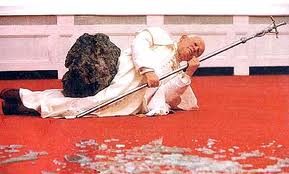
“La Nona Ora” by Maurizio Cattelan aka “John Paul II hit by a Meteorite.”
Now on view in France, at Rennes, courtesy of the Archbishop of Rennes.
“The Archbishop of Rennes Pierre d’Ornellas explained in a press conference that the show: “will trace the pontificate of the Pope through a selection of press images and strong words.”
In parallel to the exhibition, La Nona Ora (the Ninth Hour), a 1999 piece by Maurizio Cattelan will be hosted at the museum of fine arts. The artwork, which belongs to billionaire and chairman of Stade Rennais FC, François Pinault, is a wax sculpture of the pope as if he has just been struck by a meteorite. The sculpture is displayed on a red carpet strewn with broken glass.
“My Pinault didn’t immediately answer my loan request,” continued the archbishop. “He won’t be present for the opening, but will come and see La Nona Ora at the museum.” SOURCE
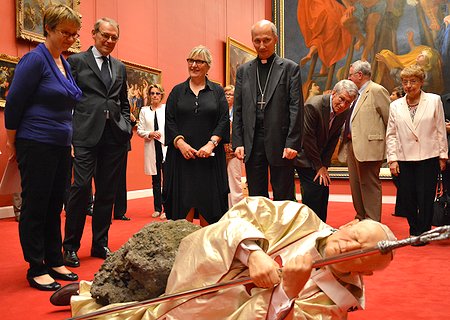
The Archbishop views the opening of the exhibit.
SOURCE
Thanks to Le Forum Catholique.
SOLEMN HIGH MASS
FOR THE FEAST OF CORPUS CHRISTI
Thursday June 19th at 7:30 in the evening
Celebrated in Latin according to the
Extraordinary Form of the Roman Rite.
Outdoor Eucharistic Procession and Benediction after Mass.
Light refreshments to follow in
Parish Meeting Room
Church of Saint Gabriel
914 Newfield Avenue, Stamford, Connecticut
10
Jun
Fr. Justin Wylie is a priest of the Archdiocese of Johannesburg, South Africa, who, until very recently, had been on assignment in New York City as attaché to the Holy See’s Permanent Observer Mission to the United Nations. He has become an extremely popular preacher in New York and was a frequent celebrant of the Mass in the Extraordinary Form at both the Church of St. Agnes (three times a month) and the Church of the Holy Innocents (one time a month) in Manhattan. (Fr. Wylie was the celebrant at Holy Innocents on several of our visits to the church, including this one). As first reported here in Rorate, the Church of the Holy Innocents has now been placed on a preliminary list of churches in Manhattan targeted for closing by the Archdiocese.
On Sunday, May 18, 2014, Fr. Wylie preached a sermon at Holy Innocents on charity and, in particular, on the urgent need for the Archdiocese to send true and sympathic shepherds to serve (and guide) those who attend the Extraordinary From of the Mass in the Archdiocese. Shortly thereafter copies of the text of Fr. Wylie’s sermon began to appear all over the internet – not in Rorate.
It would appear that Fr. Wylie has not survived the publication of the text of his sermon unscathed. The following does not seem to be in dispute: just days after his sermon was widely publicized on the internet, Fr. Wylie was obliged to withdraw from all of his commitments to celebrate Mass in the Extraordinary Form in the Archdiocese (and, apparently, from all public ministry in the Archdiocese of New York). It seems also that both the Holy See’s UN Permanent Observer Mission and the Archdiocese of Johannesburg received letters about the sermon from the Archdiocese of New York; Fr. Wylie no longer works for the Holy See UN Mission and he will soon be returning to South Africa.
10
Jun
There will be a Gregorian chant tutorial learning the basics of the Church’s chant in Branford, CT on Wednesday June 18 at 7 pm. This event is sponsored by the St. Gregory Society. The tutorial will take place at the Monastery of the Glorious Cross, 61 Burban Drive, Branford (next to St Elizabeth Church). There is a small fee of $20 (scholarship available). The text will be the Parish Book of Chant (CMAA, 2nd); if you have the Liber Cantualis, please bring that text, too.
An RSVP is required by June 14. Space is limited. Please send your RSVP and direct all questions to the St. Gregory Society: saintgregorysociety@gmail.com.