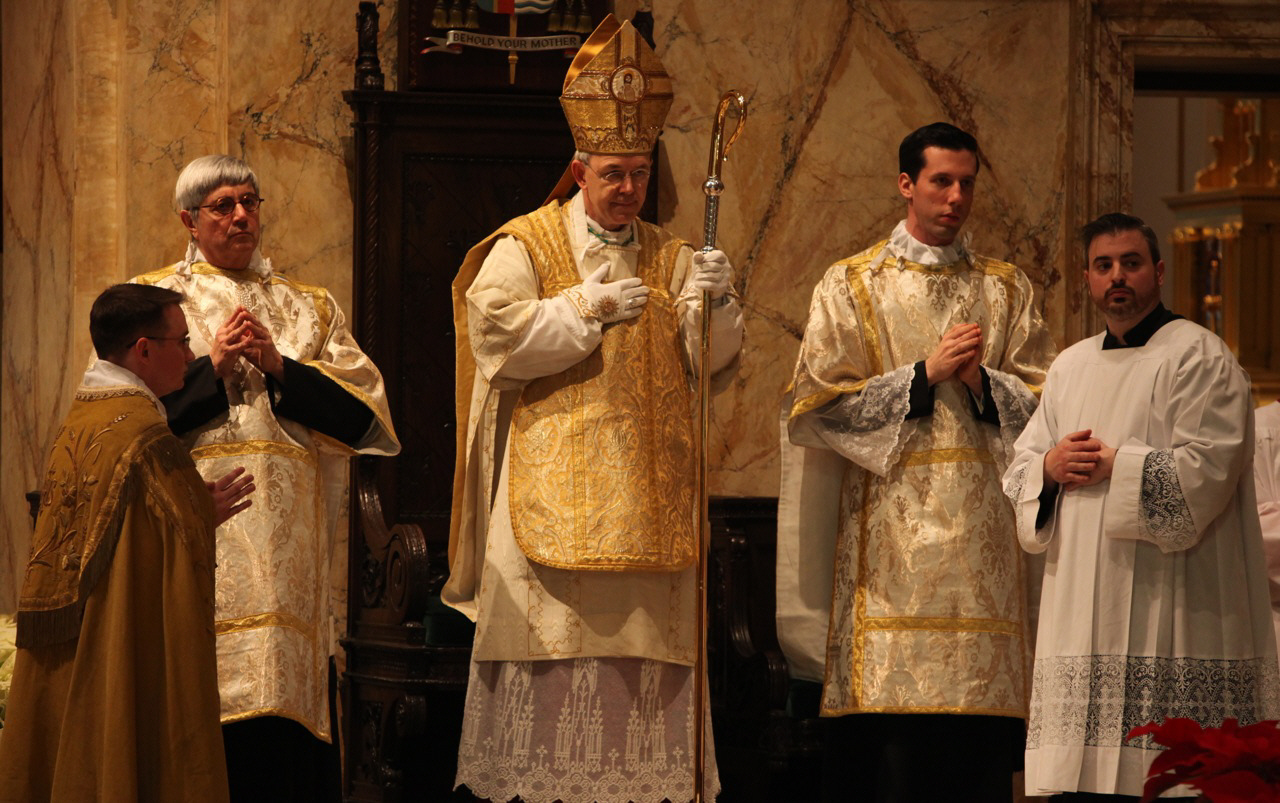
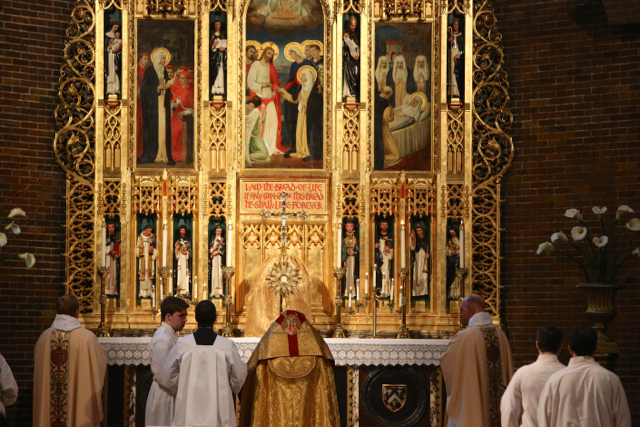
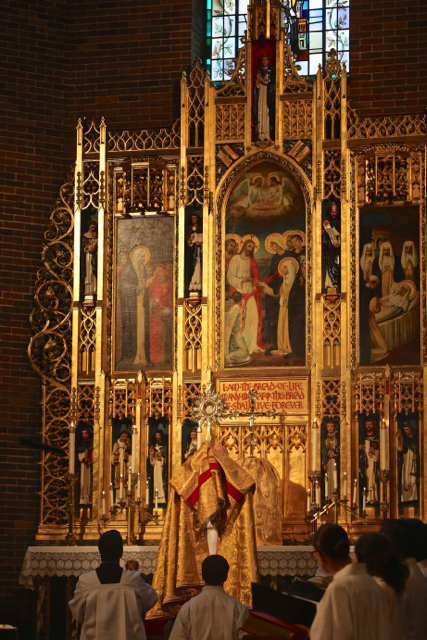
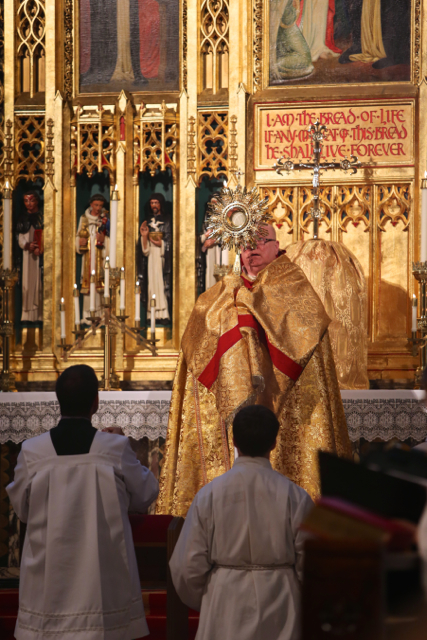
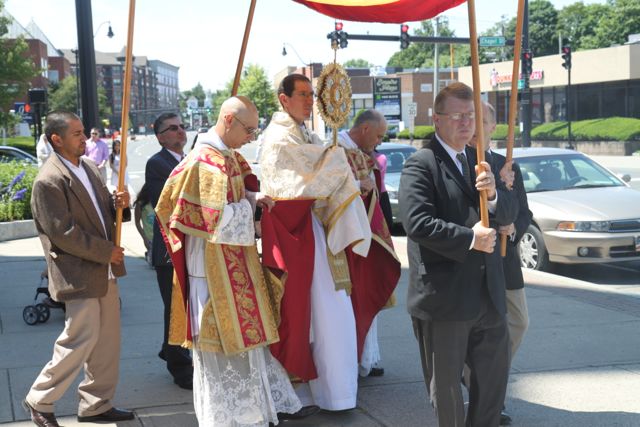
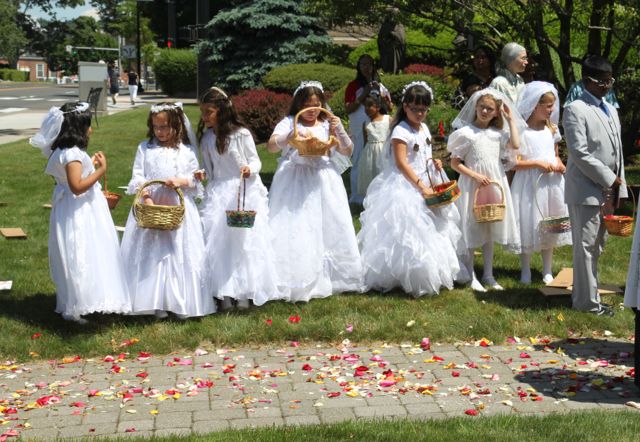
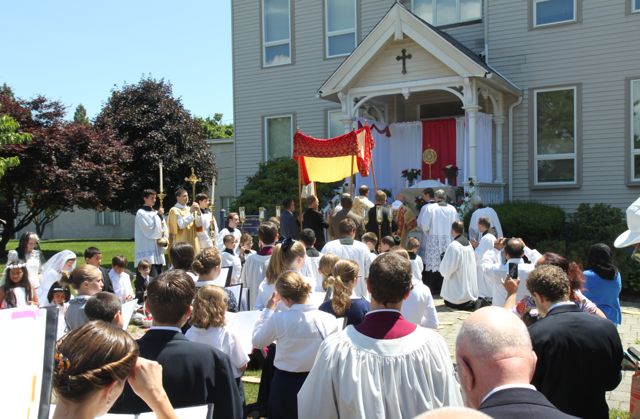
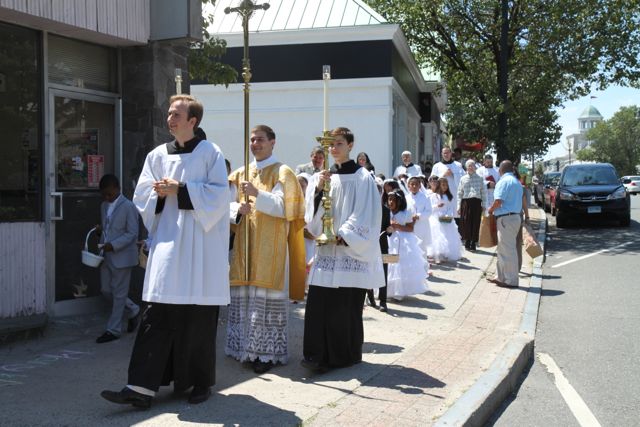
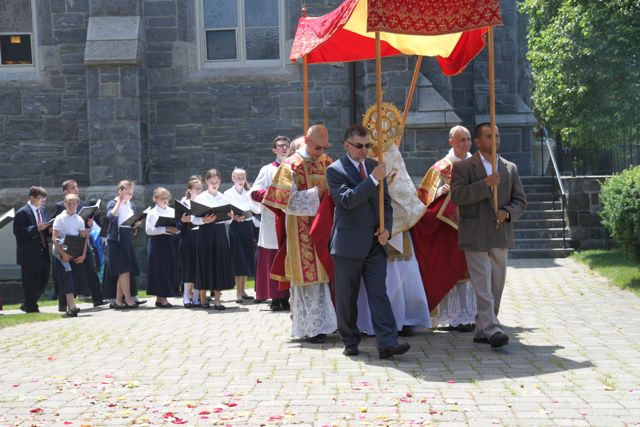
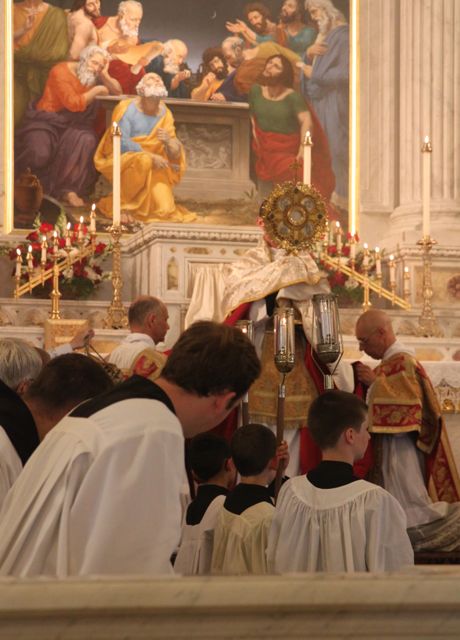
The Corpus Christi Procession of the Church of the Holy Innocents took place last Thursday evening. Our thanks for Eddy Toribio for sending us the link to these photos on the website Traditional Catholicism.
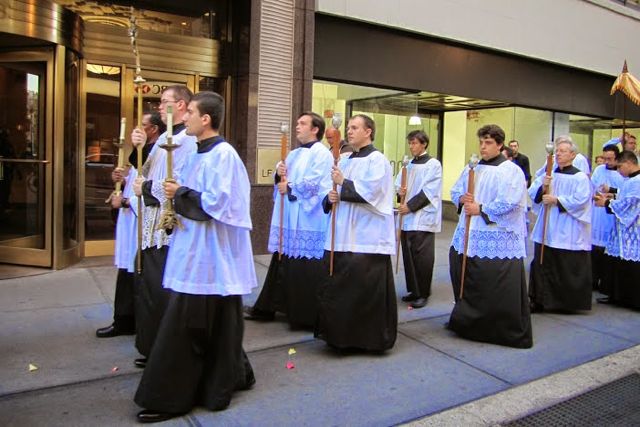
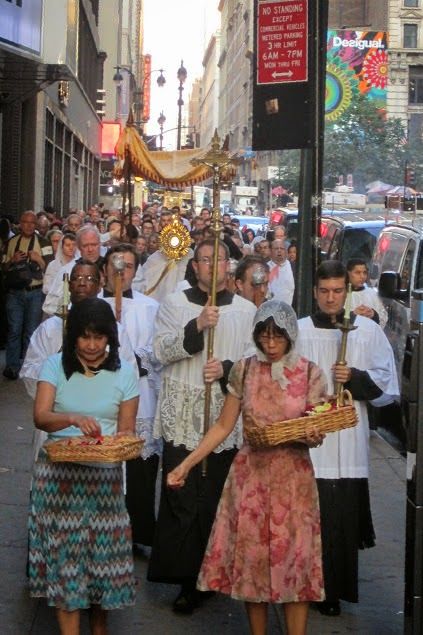
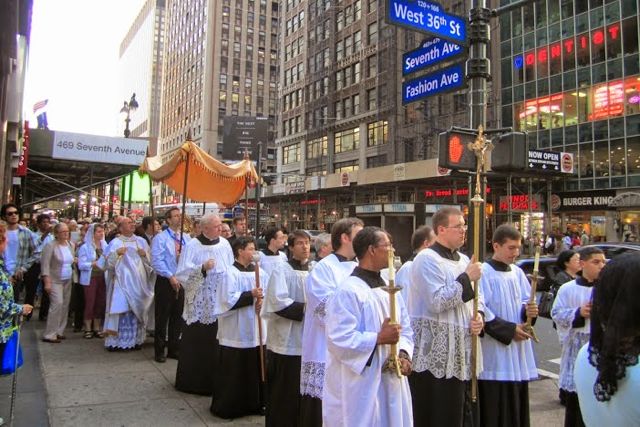
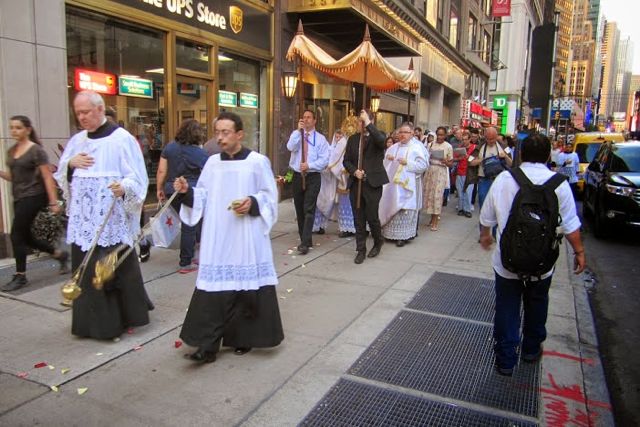
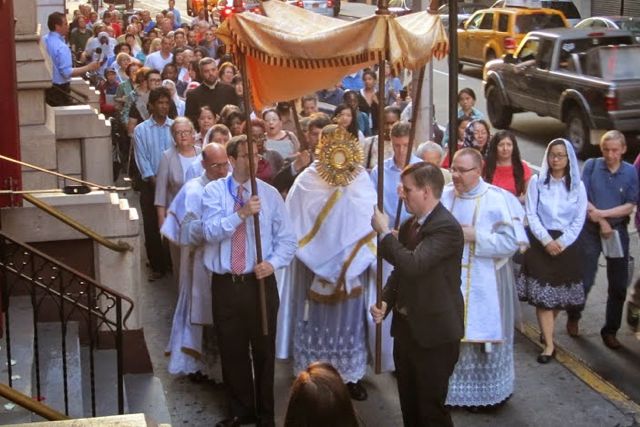
The Corpus Christi Procession of the Church of the Holy Innocents took place last Thursday evening. Our thanks for Eddy Toribio for sending us the link to these photos on the website Traditional Catholicism.
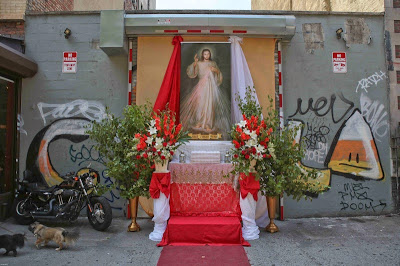
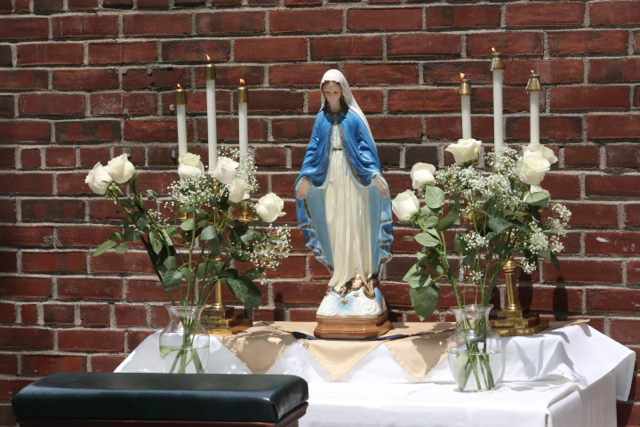
(above and below) Altars and decorations for the Corpus Christi procession of St. Stanislaus church (Polish). SOURCE
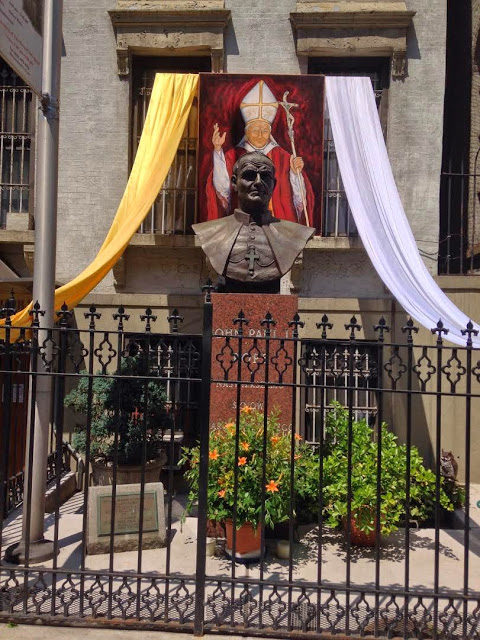
(Thanks to Manuel Albino)
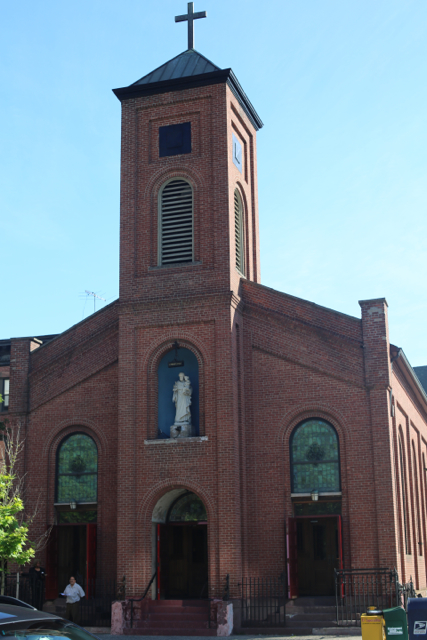
St. Joseph (of the Holy Family)
405 West 125th Street (Corner of 125th Street and Morningside Ave)
West 125th Street in Harlem is still a sorrowful sight. The gentrification sweeping every part of the city has up till now largely bypassed the main street of Harlem. Nondescript chain stores and boarded-up storefronts are still the rule. Toward the far west though, at the corner of Morningside Avenue, a modestly sized Catholic church appears. Made of red brick, stark and severe, it would look more at home in some small community up the Hudson River, in the far northern reaches of the Archdiocese. This is the parish of St. Joseph (of the Holy Family).
Now this church looks like it might belong in some quasi-rural setting because when it was built this part of Manhattan island was indeed such a village: Manhattanville. And St. Joseph, built in 1860, is one of the oldest Catholic church buildings still existing in New York City. The sobriquet “of the Holy Family” is necessary because there are at least 4 other Catholic churches dedicated to St. Joseph in Manhattan alone (the oldest and best known is St. Joseph (Greenwich Village)). And why, we ask, is there another much larger Catholic church, Annunciation, just 6 blocks to the north on Morningside/Convent Avenue? The unexpected answer is that St. Joseph’s was founded as a German national parish. (Another part of the answer is that the original location of Annunciation parish was elsewhere).
Manhattanville, like much of the far north of Manhattan, was originally covered by country estates. By 1850 it had developed as a transportation and industrial area. Irish and then Germans moved in. Annunciation parish, founded in 1852, served the Irish; St. Joseph’s was the German church. In 1871, St. Joseph’s was expanded by a bulbous addition serving as a transept/sanctuary (The venerable Church of St. Mary’s, far to the south, underwent a similar alteration at about the same time). 1)
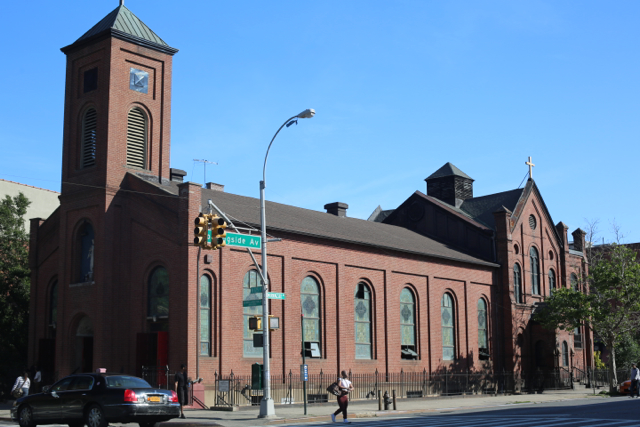
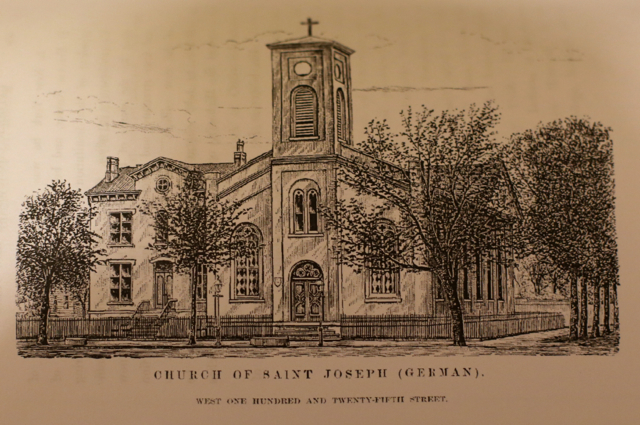
(Above) St. Joseph’s today and (below) as it appeared in 1878 ( From Shea,The Catholic Churches of New York City)
St. Josephs’ (and Annunciation) prospered with Manhattanville itself. Early on, noteworthy Catholic educational institutions had already established themselves in this neighborhood : the Academy of the “Ladies of the Sacred Heart” (later Manhattanville college – after which Convent Avenue is named)) and then what later was called Manhattan College under the direction of the Christian Brothers. Indeed the “Ladies” had supported the founding of St. Joseph’s, making available to the Germans a chapel on their “extensive and beautiful grounds” before the completion of the church in 1860. After 1904 the subway extended its reach to these far northern streets. The crowning touch was the building of the neo-Gothic campus of the City College of New York in 1905-07. 2)
The two Catholic parishes also prospered. After an initial period of instability, Fr. Anthony Kessler, a native of Germany who had previously been a curate at the old German church of St. Nicholas, took over the parish in 1865. He guided St. Joseph’s as pastor for 33 years – until his tragic death by drowning in a shipwreck. He supervised the above-mentioned expansion of the church in 1871. Under his successor, the enrollment in its school increased from 345 in 1898 to 1011 in 1914. Undoubtedly one reason the church itself was never rebuilt was the need – as at St. Columba – to invest resources in the school. Fr. Huntman, Fr. Kessler’s successor, was also a German native, but by 1914 2 of his 3 curates were Irish – indicating St. Joseph’s already was losing its ethnic character. 3)
Alas, these glory days were not to last. Nearer the Hudson, Manhattanville started developing into a nondescript commercial area. From 1920 onwards, Harlem gradually engulfed the neighborhood from the East. In the course of time the very memory of a separate Manhattanville disappeared and the area became just “West Harlem.” Manhattan College moved out in 1922. In 1952 Manhattanville college – undoubtedly motivated in part by the rapidly deteriorating security situation – in turn decamped to Westchester. City College took over its campus – and within a few years commenced its own descent to academic irrelevance. During this period, the original Catholic population of Manhattanville undoubtedly departed as well. 4)
The neighborhood became one of the most crime and drug-ridden in New York. Yet St. Joseph’s struggled on, serving its new black and later Hispanic congregation. Testifying to the situation in this neighborhood is the shelter run by the Missionaries of Charity in the former convent of St. Joseph’s parish. The Archdiocese closed this parish’s school in 2011 (along with two other Manhattan parochial schools in poor neighborhoods).
Nowadays this ancient church remains as an amazing survivor from a remote past. In the interior, the visitor beholds only a simple decoration of windows with pictorial inserts and painted roundels and frescoes – a decorative scheme very similar to that of the contemporaneous church of Our Lady of Sorrows on the Lower East Side (likewise a German parish in an area that later grew very poor indeed) but without that parish’s architectural distinction. Other than a couple of fine statues virtually all traces of the original German ethnicity have disappeared. Proceeding to where the church widens out into the “new” 1871 sanctuary, one is disappointed to find absolutely no trace of the original furnishings – a horrifying clean sweep of everything took place at some point in the past.
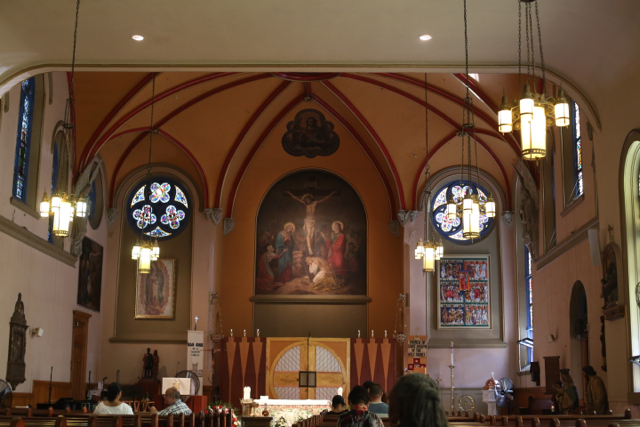
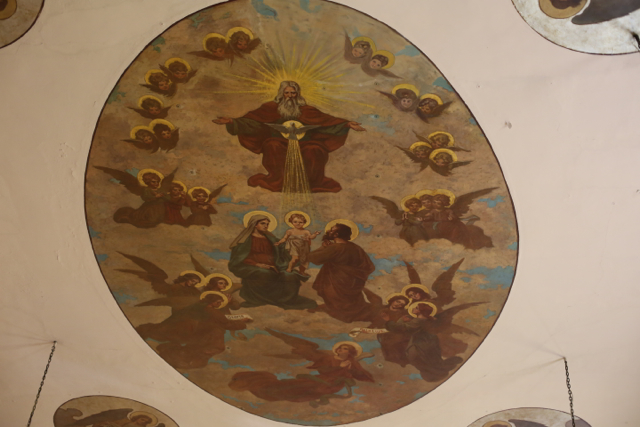
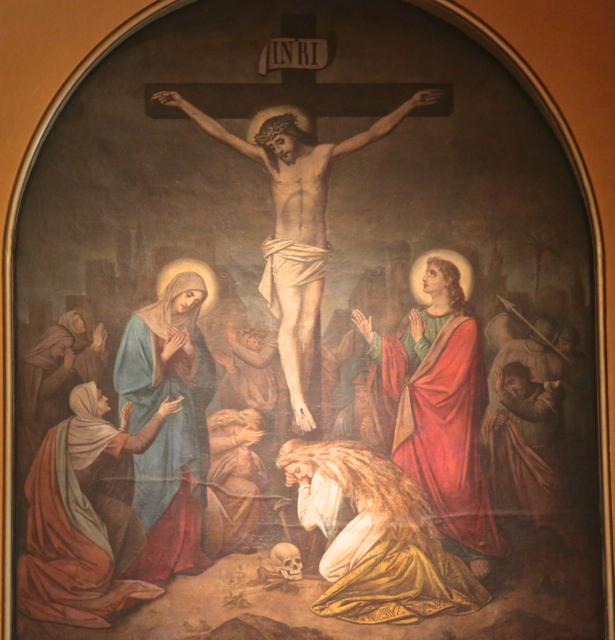
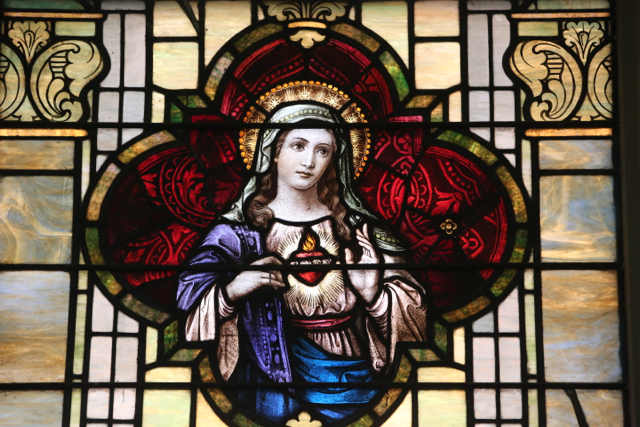
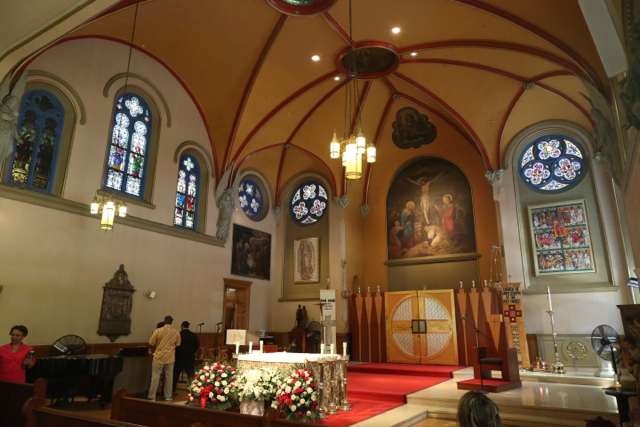
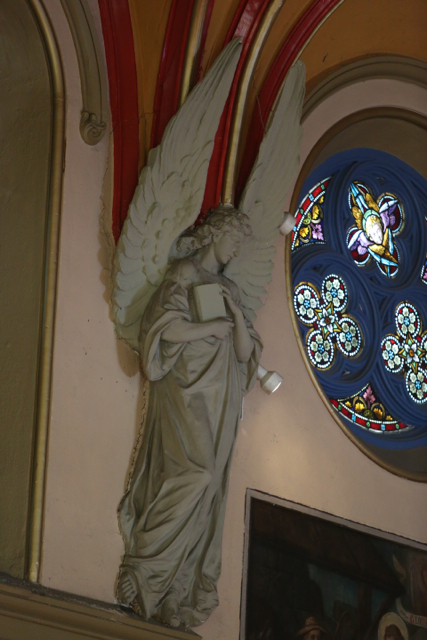
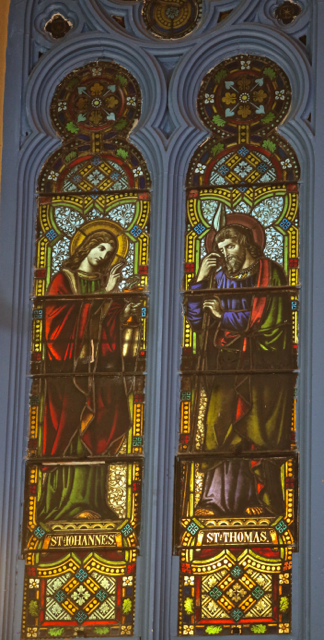
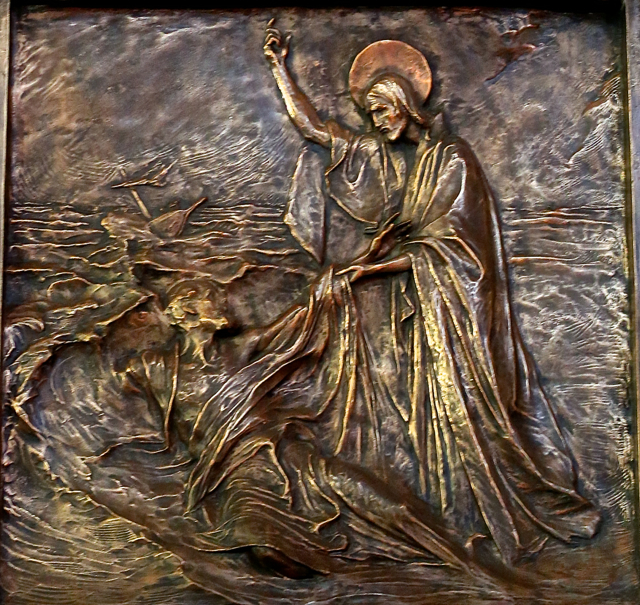
Yet no historic Manhattan church is without its unique treasures. In the transept/sanctuary we see a couple of nice windows and some unusual angels appearing to serve as supports for the vaulting of the ceiling. And then a remarkable discovery awaits the visitor: on the west wall is a marvelous plaque commemorating this church’s pastor of 33 years who drowned in 1898. The moving composition shows Christ drawing the drowning priest out of the waters. Karl Bitter, an Austrian who was one of the leading sculptors of New York before 1914, executed it in 1900. We would rather expect such a fine work in the church of St Paul the Apostle – or in the Metropolitan Museum of Art. It is magnificent monument to an age of irremovable rectors where a pastor could expect to live his whole life at his parish. What a contrast with the 6-year tenure of today – making of the pastor a temporary functionary!
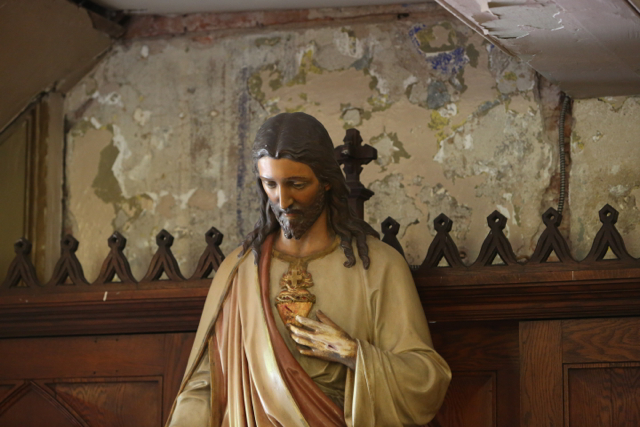
(Above) A statue of Christ against a damaged wall.
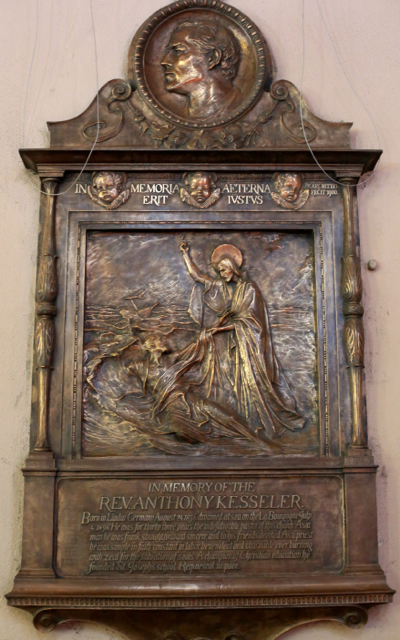
(Above and Below) The memorial to Fr. Anthony Kessler by Karl Bitter.
Nowadays the big draw of this parish is its Sunday 10 AM Gospel Mass. For this mass the obscure parish of St. Joseph’s seems to attract more foreign tourists than any Catholic church in New York with the exception of St. Patrick’s – the mass must be listed in guidebooks. It certainly “packs them in” with enthusiastic applause after every “number.” While I appreciate the dedication of a very poor parish it may be permitted to a Traditionalist to inquire regarding the relation of all this to Catholic worship. I also would suggest that any Traditionalist, finding himself accused of “aestheticism” (that he is attracted more by a “performance” than by worship), send his critic up to hear the main liturgy at St. Joseph’s. The other masses at this church, however, also seem to be fairly well attended.
St. Joseph’s has weathered the most challenging times to come down to us intact (except for its sanctuary and school!). What, however, will “Making all Things New“ bring? It indeed would be a shame to lose such an ancient church preserved to us by the sacrifices over so many years of so many who have had so little. 5)
1) Shea, John Gilmary, The Catholic Churches of New York City at 462-464 (Lawrence G. Goulding &Co., New York 1878)
2) http://en.wikipedia.org/wiki/Manhattanville,_Manhattan
3) The Catholic Church in the United States of America, Vol. 3 at 342 – 343 (Catholic Editing Company, New York 1914)
4) http://en.wikipedia.org/wiki/Manhattanville,_Manhattan
5) The parish website: http://www.stjosephoftheholyfamily.org

22
Jun
When we last encountered Amy Welborn on the net some ten years ago she was one of the “Bravest of the Brave” in defense of the liturgical status quo (along with Mark Shea, George Weigel etc.). Now, on a trip to Charleston, she visited Stella Maris parish:
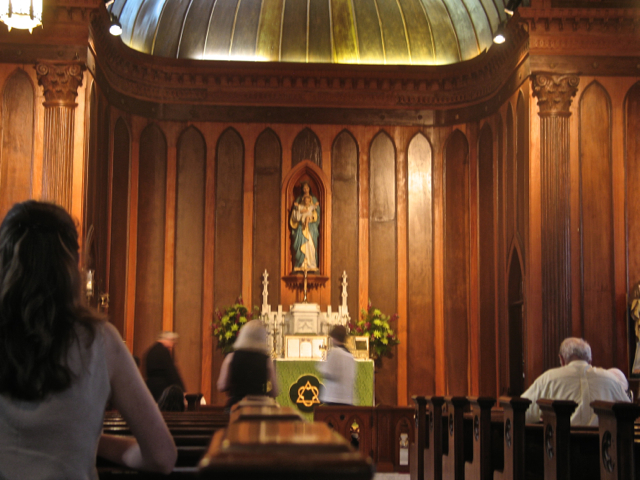
“Now, please note, if you can – the church seems to be mostly in its original state, which means that this is the original altar, with no extra altar stuck in the sanctuary.
Yes, Mass was celebrated ad orientem. It was mostly in English (except for the Gloria in Latin), and no Propers, but with decent hymnody and some Bach from the hard-working choir and organist. The homily was quite good, centered on the concepts of exitus and reditus as an way of talking about the Ascension and mission.
And can I repeat? Mass was celebrated ad orientem. The Leonine Prayers were recited after Mass. The homily was theologically substantive and evangelical. There were no self-referential extemporaneous goings-on. The place was packed. The congregation was attentive, reverent and vocal.
Everyone survived and the earth continued to revolve (I think).”
Source: CHARLOTTE WAS BOTH
What also needs to be mentioned, however, is that later in the day on Sunday a Traditional Mass has been celebrated at Stella Maris for many years now:
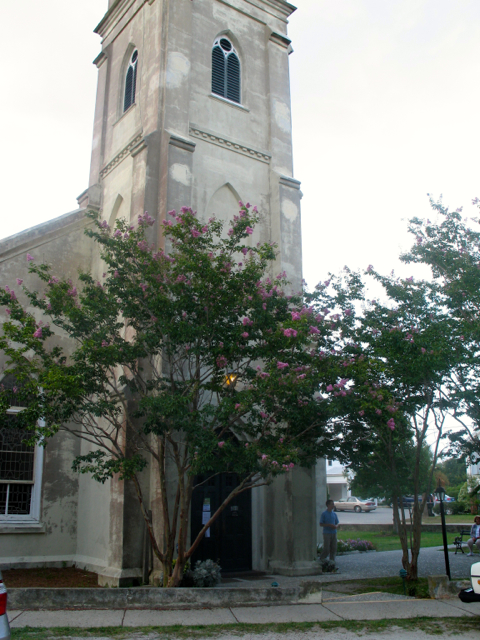
(Above and below)Pictures from 2006
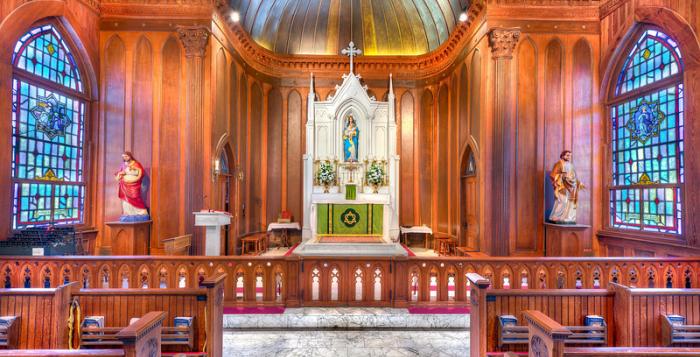
(Above) A photo of the sanctuary today from the parish’s website. Please note that in fact the altar has been beautifully restored at some time after 2006.
Judging by Amy Welborn’s remarks, the concept of “mutual enrichment” of the “two forms of the Roman rite” may be working more effectively than anyone could have imagined.
22
Jun
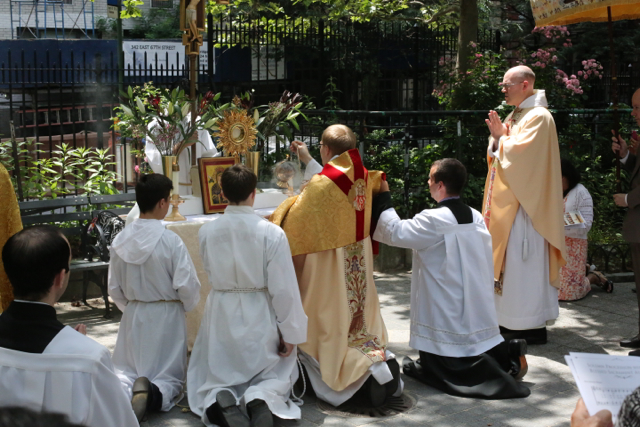
On this same beautiful Sunday, several hundred process from the church of St. Catherine of Siena through the streets of New York. The Corpus Christi procession was preceded by mass – Novus Ordo, but employing more Latin and traditional music of all kinds than I ever heard before the early 1980’s and itself preceded by a clear exposition of the nature and advantages of celebration ad orientem.
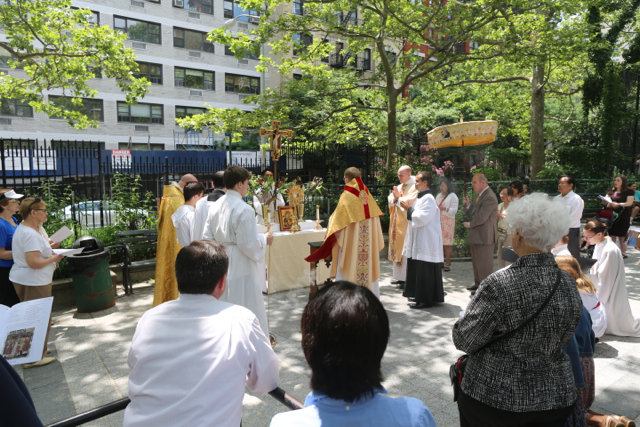
(Above and below) The first altar is in busy St Catherine’s park – named after the nearby church. 1)
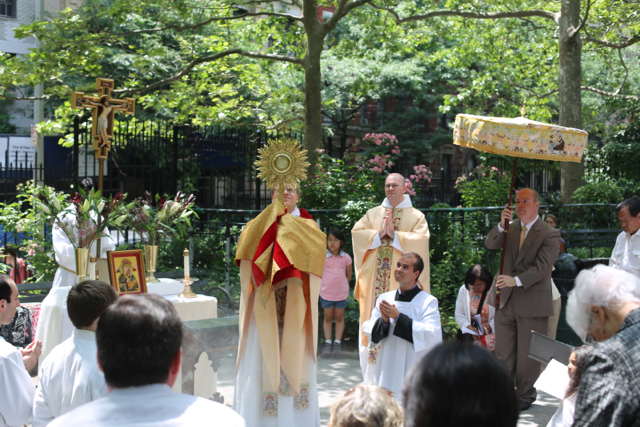
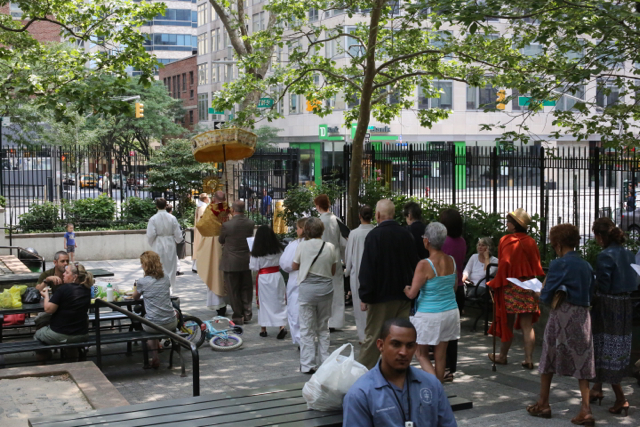
In contrast to Norwalk, the processsion encounters along the way numerous bystanders and motorists – mostly friendly if somewhat mystified. (“Do you do this every Sunday?” someone asks.)
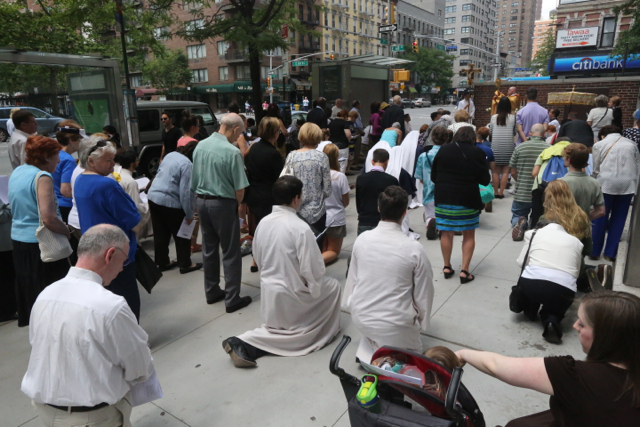
(Above and below) The second altar set up before one of the hospitals of the neighborhood (Sloane Kettering, I believe).
1) For an account of some extraordinary details of this extremely busy park, allegedly borrowed from St. Maria sopra Minerva, see HERE.
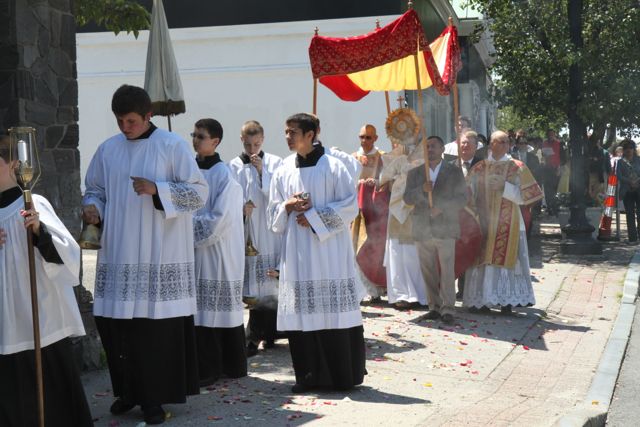
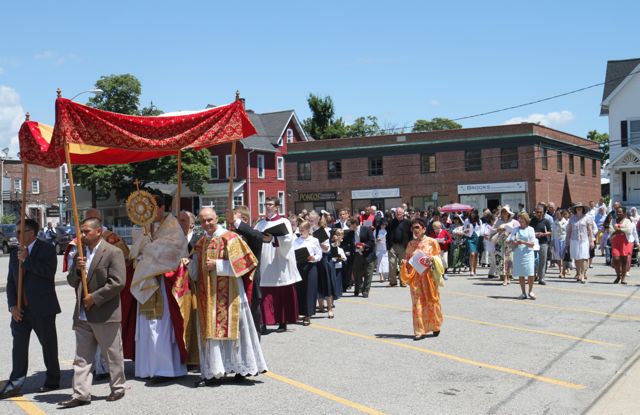
Today was a beautiful sunny day for the celebration of the feast of Corpus Christi at St. Mary Church, Nowalk. Solemn Mass featured Palestrina’s “Missa Lauda Sion.” A procession around the neighborhood and Benediction followed. Fr. John Ringley was the celebrant. Parishioners said farewell to him during the festive reception which followed. He will be moving to his new post at rector of the Cathedral of St. Augustine.
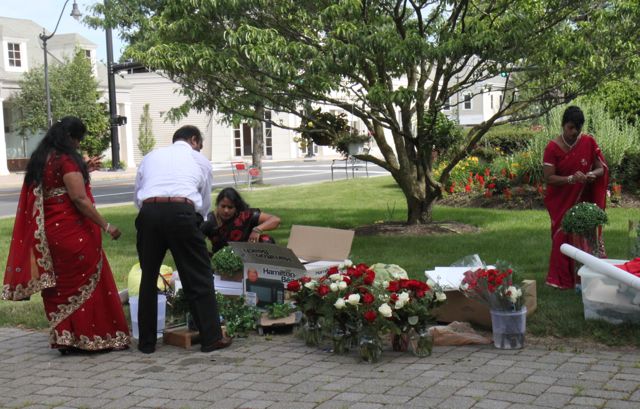
Members of the St. Mary’s Church Indian community prepare to decorate one the the three altars of repose.
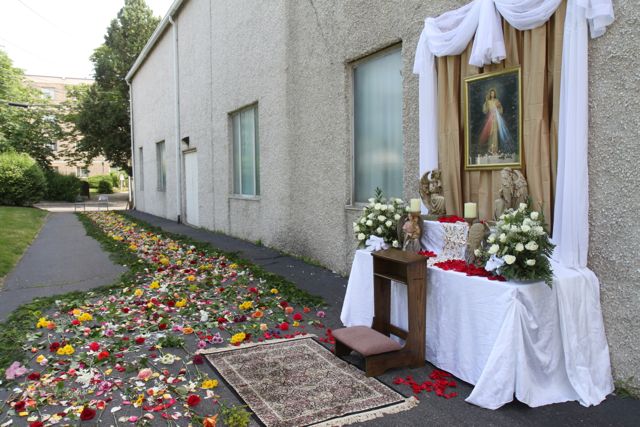
The altar of repose decorated by Mexicans of the parish, included a lavish pathway strewn with flowers for Our Lord in the Eucharist.
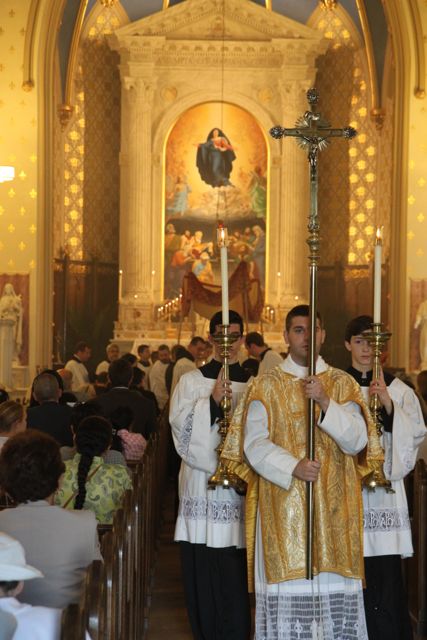
The procession prepares to exit the church after Mass
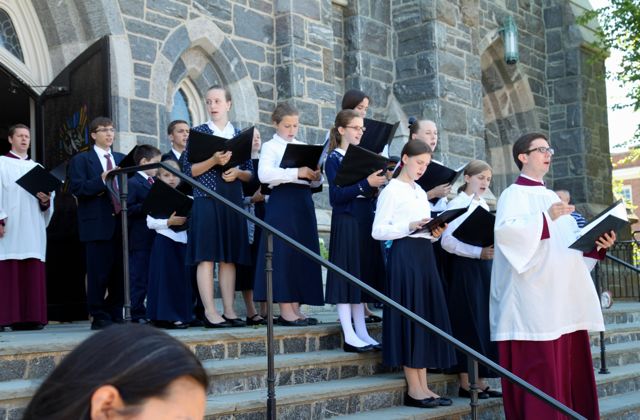
David Hughes leading the children’s Schola Cantorum
At the first altar of repose, decorated by Indians of the parish
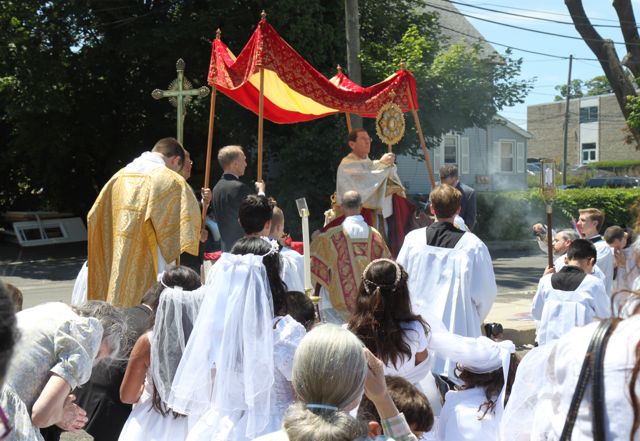
At the second altar of repose, decorated by Filipinos of the parish
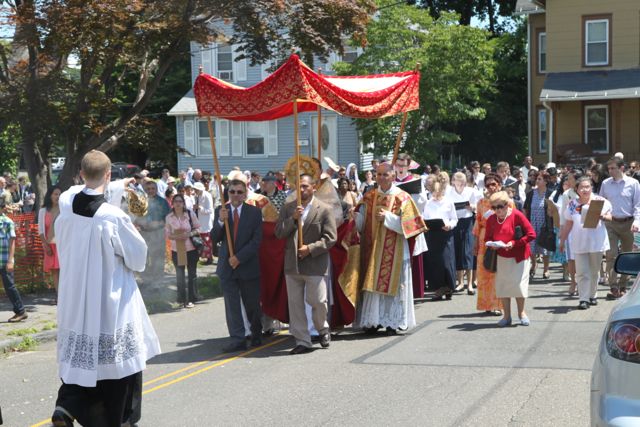
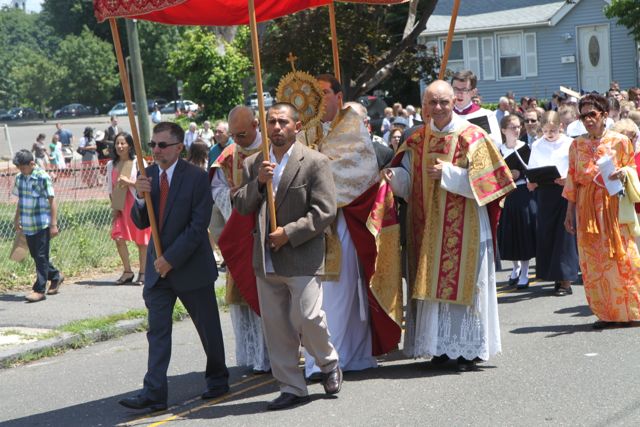
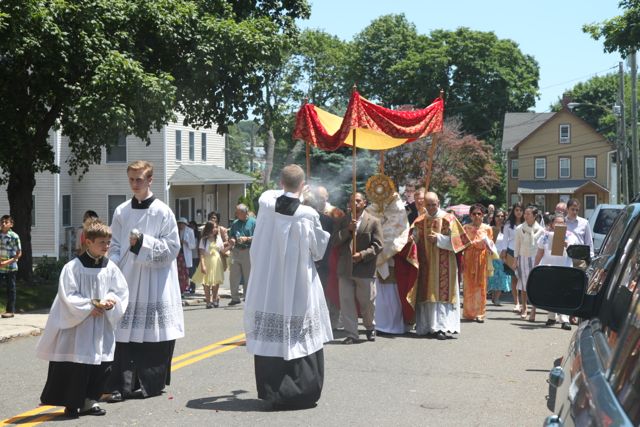
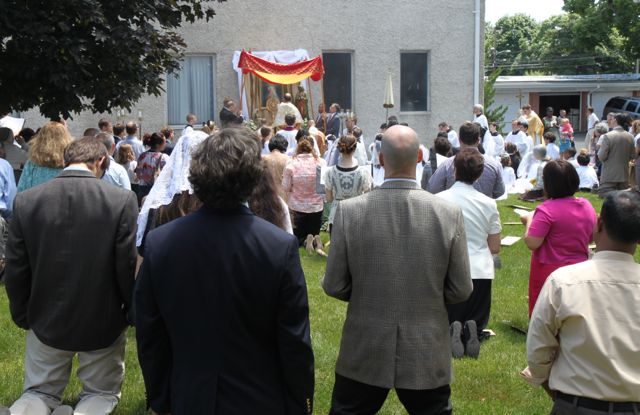
At the third altar of repose, decorated by Mexicans of the parish
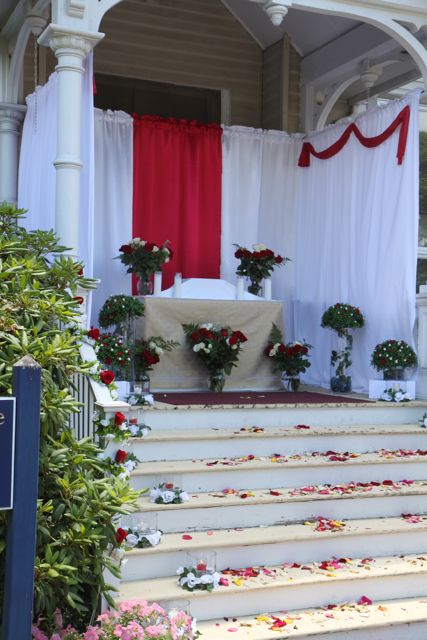
Benediction
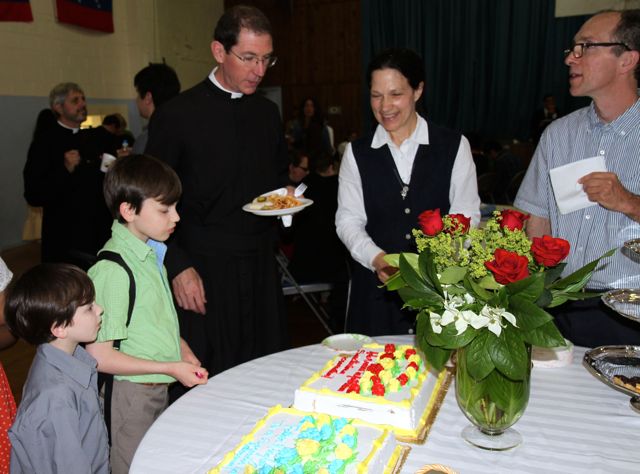
Parishioners say good-bye to Father Ringley, who will be the new rector at St. Augustine Cathedral.
Dom Alcuin Reid, noted author and liturgist, will present a talk this weekend at two locations.
Friday, June 20th at 7:30 PM at the Church of St. Mary in Norwalk, Connecticut.
Sunday,June 22nd at 2:30 pm at the Church of the Holy Innocents in Manhattan (37th Street between Broadway and 7th Avenue) following Solemn Vespers and Benediction .
His talk is entitled “Elements of the New Liturgical Movement.” Fr. Richard Cipolla will introduce Dom Reid.
Dom Reid is a monk of the Monastère Saint Benoit in the Diocese of Fréjus-Toulon in France. As Joseph Cardinal Ratzinger, Pope Benedict XVI wrote the preface for Dom Reid’s influential book on the history of the Liturgical Movement up to the reforms of Pope Pius XII, The Organic Development of the Liturgy. Dom Reid’s new book is entitled Sacred Liturgy.

17
Jun
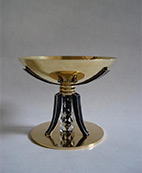
An exhibit in France of the artworks produced in the abbey of Saint Wandrille from 1930-1950 – especially in vestments and gold- and silversmiths’ work. It was an attempt to use the Art Deco idiom in religious art – like some of the contemporary work by Hildreth Meiere in the United States. A fantastic catalogue!

Chalice 1940
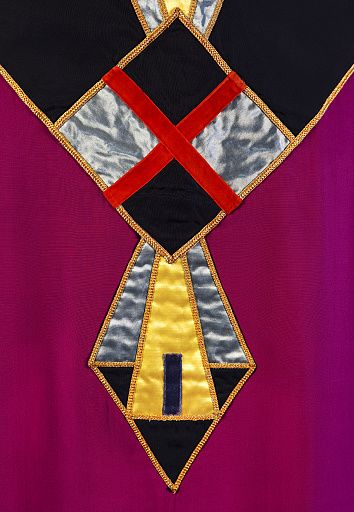
Detail of cope, 1937
These photos are from the Abbaye Saint-Wandrille website: http://st-wandrille.com/index.php?option=com_content&view=article&id=88
From the catalogue:
The first thirty years of the twentieth century were marked by a spectacular rise in conversions among intellectuals and artists. The best known is that of Claudel but there were others who would contribute to giving a particular impetus to sacred art, such as those of Henri Charlier, Max Jacob, Pierre Reverdy, Alex Rzewuski and finally Jacques Maritain. These were caught in a dilemma between a world of unbelief and anti-Christianity with which they nevertheless maintained ties and the Roman Church, which multiplied its warnings. Paul Claudel fought for the beautiful and manifested his alarm regarding the future of a religion, which would cut itself off from the tradition and the art, upon which its rites had been founded. The question of the beauty of rite thus was full of meaning for man and the writer shared this preoccupation. According to Pie Régamey, ”his intervention in the realm of Christian art is without a doubt the most decisive which took place between the two world wars.” He stigmatized the “ugly” gestures of devotion and didn’t hesitate to write: “For those who dare to look at them, modern churches have the interest and the pathos of a burdened confession. Their ugliness is the external manifestation of all our sins and defects.” 1)
I wonder what Claudel would think now?
1) “Les Arts Liturgiques de 1920 à 1960: Contexte Intellectual et Religieux” by Bernard Bethod at 15.