11
Oct
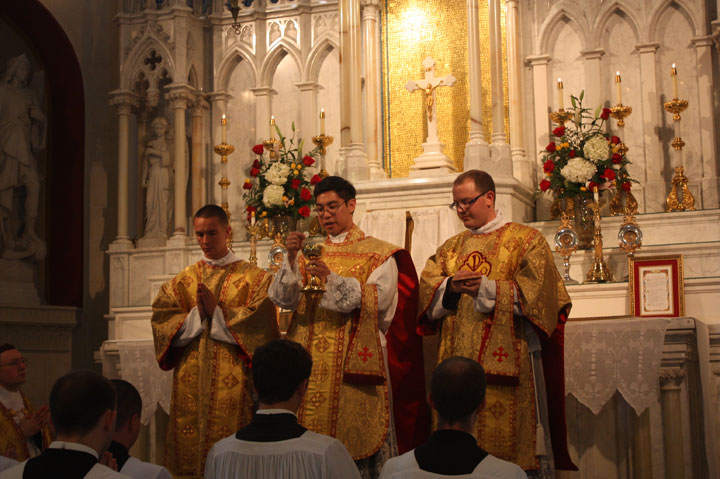
A Solemn High Mass in the Extraordinary Form will be celebrated at historic St Anne’s Church in Fall River, Massachusetts, on Sunday, October 20 at 6:30 PM (Mass of the 22nd Sunday After Pentecost). The choral music and chants will be sung by the Northern Rhode Island Schola Sanctæ Ceciliæ, and seminarians from St John’s Seminary in Boston will serve. Dedicated in 1906, the Romanesque church stands at the corner of South Main and Middle Streets. Brother (now Saint) André Bessette of Montreal occasionally worshiped here when in town visiting relatives and benefactors. The magnificent Casavant organ, installed in 1963, greatly enhances the grandeur of the liturgical celebrations.
Also at St Anne’s, in the lower church, on Friday, October 18, the renowned liturgical scholar Dom Alcuin Reid will give a talk on maintaining a healthy spiritual diet by mining the riches of the Sacred Liturgy. Vespers for the Feast of St Luke will immediately follow.
10
Oct
October 14 – 20, 2013
Church of the Holy Name of Jesus
99 Camp Street, Providence, R.I. 02906-1799
Download the flyer for the Week of Prayer & Devotion
Series on the Liturgy
Monday through Thursday, October 14 – 17, 6:00 p.m.
Presented by Fr. Joseph D. Santos Jr.
Topics: A Brief History of the Liturgy, The Family of Liturgies of the Catholic Church, The Mass of the Catechumens, The Mass of the Faithful.
45-minute presentation followed by a 15-minute Q & A period. In the Lady Chapel.
Mass in the Rite of Braga
Friday, October 18, 5:30 p.m.
A brief talk on inculturation in the Liturgy according to Sacrosanctum Concilium, the Document on the Liturgy from Vatican II, as manifest in the history and peculiarities of the Rite of Braga.
Then, at 6:00 p.m., Low Mass in the Rite of Braga will be celebrated in the presence of His Excellency D. Teodoro de Faria, Bishop Emeritus of Funchal (Madeira).
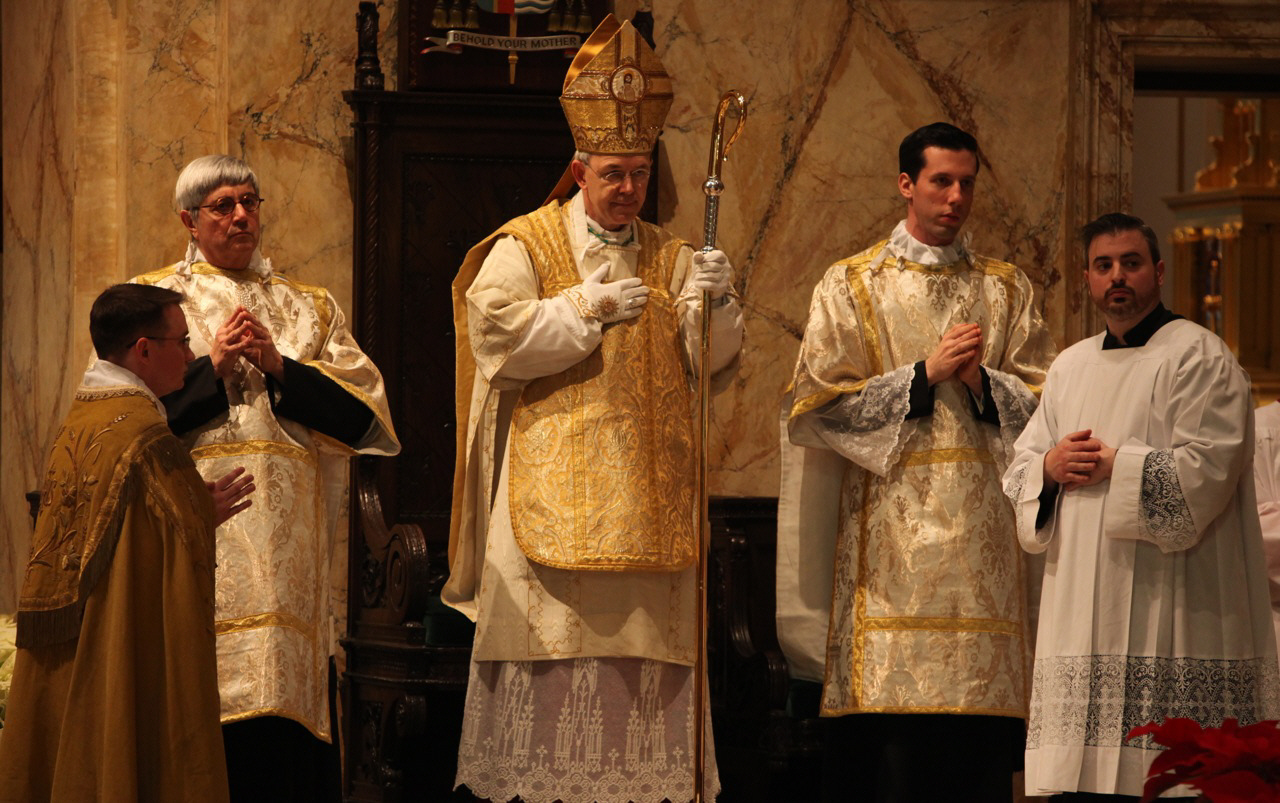
Pontifical Mass in the Extraordinary Form
Saturday, October 19, 11:00 a.m.
Celebrant: His Excellency D. Teodoro de Faria
Sermon: Prayer for the Canonization of Blessed Karl of Austria-Hungary, one of the few leaders who worked to promote peace before, during and after World War I. For his efforts, he was rewarded by the fascists with forced abdication and exile.
Conference on the Blessed Sacrament and Ceremony of the Silver Rose
Sunday the 20th of October at 3:00 PM
“How is Jesus Present in the Eucharist?”
Presented by Raymond de Souza, Director, Office of Evangelization, Diocese of Winona, MN.
The service concludes with Benediction of the Blessed Sacrament.
For more information, please phone the parish rectory at (401) 272- 4515.
9
Oct
We applaud Beverly Stevens on her current issue of Regina magazine covering “The Secret Catholic Insider’s Guide to America,” with many excellent articles and photos (readers of this blog will recognize some ).
9
Oct
This Saturday evening will take place the continuation of The Art of the Beautiful lecture series co-sponsored by the Catholic Artists Society and the Thomistic Institute. As usual, the event will take place at the NYU Catholic Center located at 238 Thompson Street in Manhattan starting at 7:30 p.m., with a reception and sung compline following at 8:30 p.m. and 9:30 p.m., respectively.
Please come for all or part of the evening, and attendance is free but space will be limited.
Father Peter John Cameron, OP – the editor of Magnificat and founder of Blackfriars Repertory Theatre – will be speaking on The Responsibility of the Artist. Father Peter John is a playwright and holds an MFA from the Catholic University of America.
9
Oct
Two introductory classes by David Hughes
St. Mary’s Parish Center
Sunday, 6 October 2013, 7:00 P.M.
What is chant? What is polyphony?
Sunday, 20 October 2013, 7:00 P.M.
What are propers? How do you choose what to sing?
The Church has called sacred music “a treasure of inestimable value, greater even than that of any other art.” But why is this so? What does it mean to say that it forms “an integral part of the solemn liturgy”? Come find out!
David Hughes will offer two classes on sacred music on two Sundays in October. These introductory classes will include examples drawn from a wide variety of repertoire. Each class is an hour long, with time at the end for discussion. Bring a friend, and bring questions you’ve wanted to ask about the music you hear on Sundays!
Note: We apologize that we did not post this notice in time for you to attend the first talk. We encourage you to attend the second talk.
9
Oct
The St. Cecilia Society of St. Mary Church will present its annual benefit concert in honor of St. Cecilia on Sunday, 3 November 2013 at 4:00 p.m. The St. Mary’s Schola Cantorum, under the direction of David Hughes, will sing a program of sacred music written specifically in honor of St. Cecilia.
A festive reception will follow the concert. General admission is $25, and $15 for students & seniors; all proceeds go to support the work of The St. Cecilia Society, which promotes the music program at St. Mary’s Church. For more information, please e-mail music@stmarynorwalk.net, or call the parish office at 203-866-5546.
3
Oct

First mass of Father DeGuzman on June 2, 2013.
Fr. Joseph DeGuzman, FSSP, newly ordained (June 1, 2013) priest of the Priestly Fraternity of St. Peter, will celebrate the Sunday Mass at the Church of the Holy Innocents this Sunday, October 6th, at 10:30 AM.
Fr. DeGuzman will give his First Blessing after Mass at the Communion Rail to all those who wish to receive it.
(courtesy of info@sacredheartconfraternity.org )
2
Oct
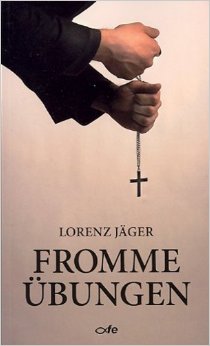
Fromme Übungen
By Lorenz Jäger
(Fe-medienverlags GmbH, Kisslegg, 1st edition, 2013)
The distinguished German scholar, author and journalist Lorenz Jäger has provided us with a sequel to his 2010 collection of essays “Essential Things.” (He is indeed a busy man – between the publication dates of these two works Jäger also published another collection of essays and an autobiography) Like its predecessor, “Pious Exercises” collects succinct essays on matters spiritual that have mainly appeared in the Frankfurter Allgemeine Sonntagszeitung. This new book arranges the essays according to the structure of the Nicene/Apostles’ Creed.
The starting point of these essays is scripture, liturgy or even some current development in pop culture. From this basis, Jäger develops reflections that are profoundly Catholic, but stated in a way accessible to a much broader, “Christian” readership. Jäger speaks to all his countrymen, not just that tiny minority that consults the Catholic media. That is entirely beneficial, for the clear, concrete prose of Jäger avoids the vacuous, sanctimonious cant of “official” German Catholicism. Moreover, despite all his evident learning, Jäger also steers clear of the pretentious excesses encountered in the “culture” sections of German newspapers. Jäger also generally avoids intra-Catholic debates and ecclesiastical politics – he seeks to address issues more permanent and fundamental.
These “Pious Exercises,“ however, are by no means mere exhortations, a random assemblage of spiritual platitudes. The reader discovers at every turn unexpected insights, new juxtapositions of scripture or liturgy with the phenomena of contemporary life. And Jäger does not at all shrink back from the controversial, even the outrageous.
In “Where Mitt Romney Prays and Celebrates” (liturgically, that is – SC) Jäger tell us how he found the Book of Mormon in a dresser in his room at the Marriott hotel in Stamford (He was visiting Stamford CT to speak at a conference of our St Hugh of Cluny Society!). That was courtesy of the Marriott family, of course. His perusal of that work – and its strange illustrations – sets the stage for a series of interrelated reflections upon both the doctrine of American “exceptionalism” presupposed by the Mormon faith and the bizarre aesthetics of that religion. Regarding Mormon “temples”:
“One thinks of imaginary castles in Disney’s films of fairy tales, only transposed subtly into the eerie and the forbidding – just as if H.P. Lovecraft or H. R. Giger (the artist responsible for the design of Alien – SC) had dabbled in the works of the Brothers Grimm as source material. Or as if Peter Jackson had let himself be inspired (by these temples) for his bizarre, streamlined towers in his filming of Tolkien’s Lord of the Rings.” (at p. 154)
After these not very complementary reflections upon Mormonism and its artistic achievements, Jäger examines the candidacy of Mitt Romney and his repeated utterances in favor of that same American “exceptionalism” found in the Book of Mormon: the identification of the United States and salvation history. Jäger thereby demonstrates that doctrines are important, that the faith of Mitt Romney is indeed a cause of concern – for the curious tenets of the Mormon faith produce highly dubious fruit both in art and politics.
The essay on Mitt Romney and Mormonism is found in the section of “Pious Exercises” entitled ”And in the One, Holy Catholic and Apostolic Church.” In this part of his book Jäger deals more than is his wont with specific issues and crises of contemporary Catholicism. So we learn that the current almost hysterical debate over celibacy in the ”German Catholic Church” was prefigured in the 19th century by the “German Catholic” movement, which led straight out of the Church to a liberal masonic religion. In “The Figure and Reason” Jäger contrasts the role of Reason in the Orthodox and Catholic churches starting of course not from theory but from the Orthodox prayer book. Our author has reservations about this role of reason in the West – for didn’t it offer a chink in the armor through which abuses could pour into the Church to a much greater extent – especially liturgically – than in the East?
Finally there is the wonderful, poetic essay on the role of candles. Here Jäger unites reflections on Hegel, Advent, the end of the calendar year and the function of candles in the liturgy: is not the lighting of a candle at the consecration returning to the Catholic Church? Hegel saw the gothic cathedral, by filtering out and transforming the daylight, as creating an interior “other day” of contemplation by the light of candles; is not Christ that “other day” – that comes to us at the end of Advent – and preeminently at each Mass?
There are obviously rare treasures in “Pious Exercises” and I would wholeheartedly recommend this volume. Like its predecessor, however, “Pious Exercises” has not yet found an English translator. By now there is a whole world of literature – in German, French and Italian – that would be of great value to the friends of Tradition in the English-speaking world yet remains untranslated. Perhaps one day the enterprising publisher will be found…
1
Oct

(Centro Maria – St. Ambrose parish)
We have seen that the roster of New York City parishes has not been static. In earlier ages however, when a particular parish found that its congregation had vanished or that it was in the path of the construction of a bridge, tunnel, road or housing developments alternate uses and alternate sites were sought. The most common instance of the former is the redeployment of a parish – whether originally “ethnic” or not – as a new national parish. The reverse development is also not infrequent: St. Jean Baptiste, for example, was originally an ethnic (French Canadian) parish that became a “general-purpose” parish (if I may employ such a term).
A curious subset of such redeployments is the transformation of a parish into a religious institution. There is the instance of the mysterious, once socially prominent parish of St Leo on East 28th Street, carved out of St Stephen’s parish in 1880 (for political reasons relating to Fr. McGlynn, pastor of the latter church?). 1) In 1909, after the death of its first and only pastor, the parish was folded back into St Stephen’s. In 1910 the church and rectory of St. Leo’s were given to an order of nuns (Sisters of Mary Reparatrix) fleeing the anticlerical laws in France. In 1984 the convent was closed and the buildings razed. 2)
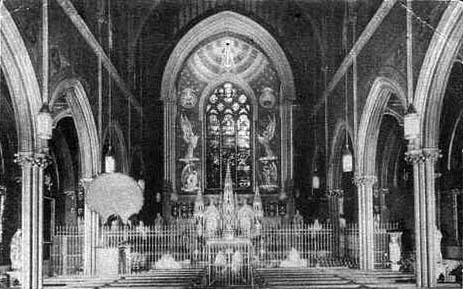
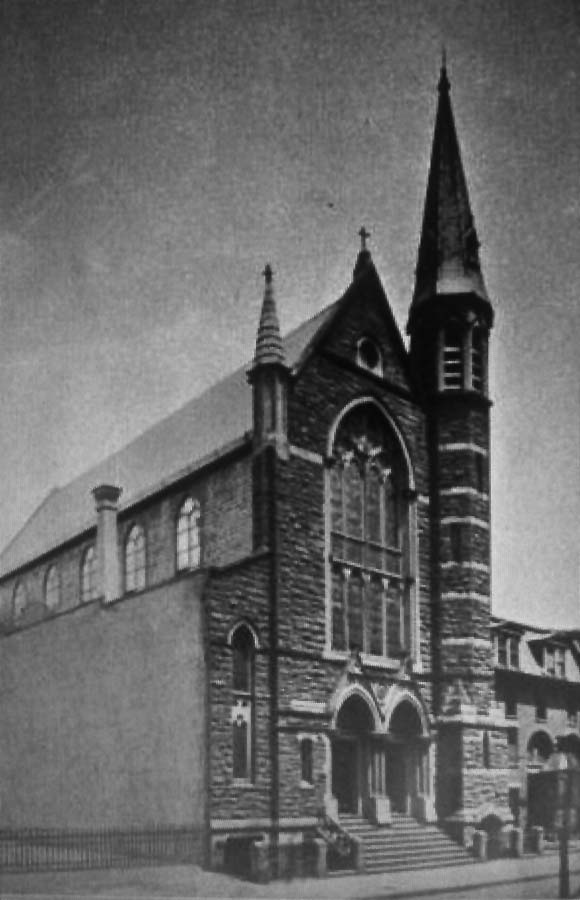
The interior(above) and exterior(below) of St. Leo parish. 3)
Many years later yet another parish was founded not too far to the north of the old site of St. Leo’s – Our Saviour’s.
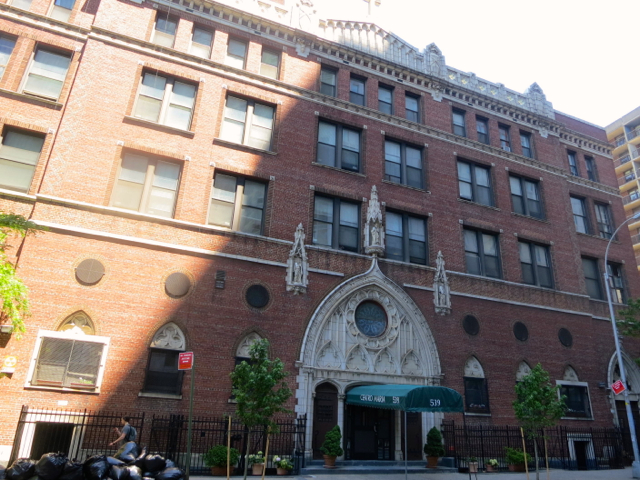
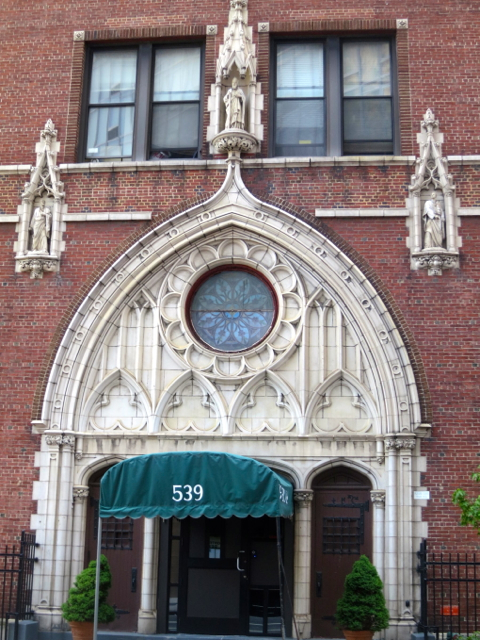
But a similar example survives to the present day: “Centro Maria” formerly the parish of St Ambrose. This parish, located at 539 West 54th street, was established in 1897 in the heart of Hell’s Kitchen. Its current edifice was begun in 1911. This church is also remarkable because the structure is a combined church, rectory and school. We have seen that parishes not infrequently built their school before attempting a magnificent church (for example, St. Gregory the Great in New York). In other cases, however, a multipurpose building was contemplated from the beginning (for example, St Stephen of Hungary in Yorkville). And so it was with St. Ambrose. The church, rectory and school were all contained within in the same rectangular structure. 4)
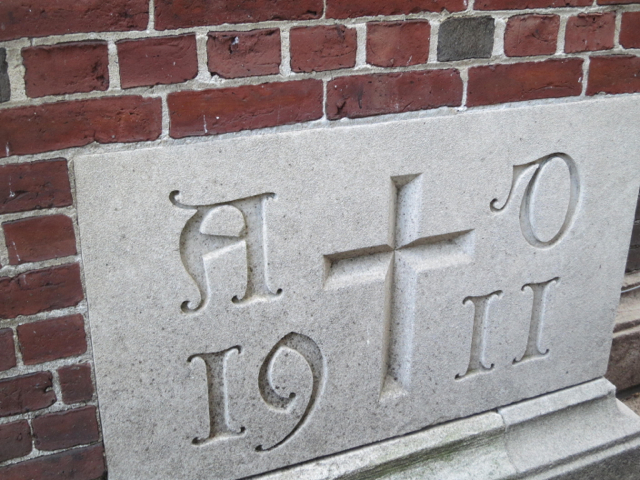
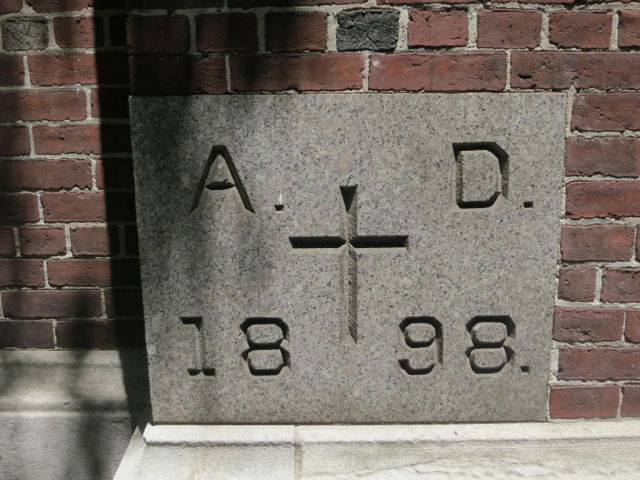
The two cornerstones of the buildings of old St. Ambrose parish (above and below)
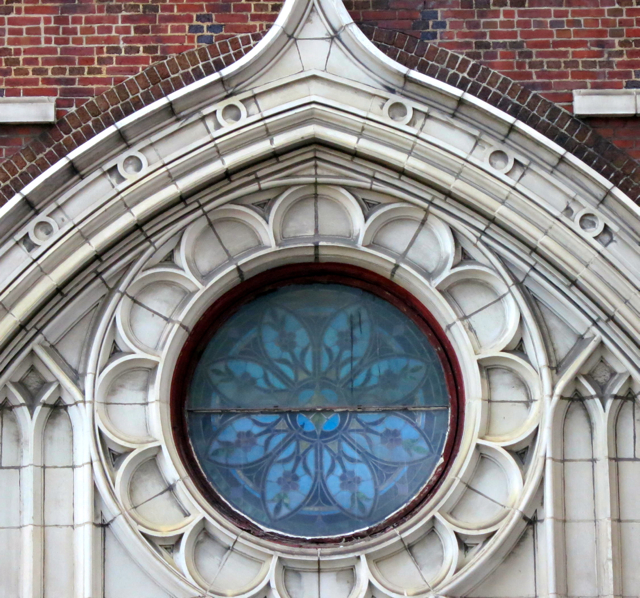
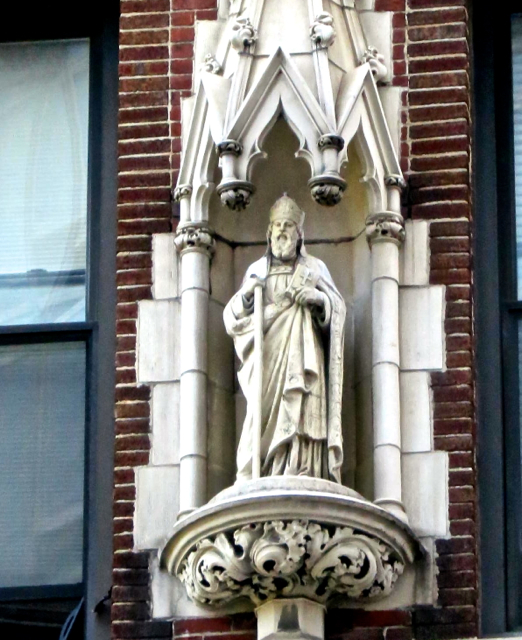
The whole edifice still makes a handsome appearance on West 54th Street with its impressive late Gothic arch and small statue of St Ambrose. I cannot say anything about the state of the interior, however, for the nuns refuse to allow visitors (well, at least this visitor) to the chapel – the former parish church.
When the present parish complex was being completed, St. Ambrose seemed to be relatively large parish of over 3500 with a flourishing parochial school. 5) But by the late thirties all that had changed. St Ambrose fell under the administration of Sacred Heart parish. How did this come about? It seems a strange turn of events at that the time for a parish that did not serve some small ethnic group or had (apparently) not been undermined by transportation projects in its neighborhood. We suspect that the rapid and complete commercialization of the far west side of Manhattan was the culprit. Shortly thereafter, in 1938, St Ambrose was closed and converted into a home for young women studying or working in New York. As Centro Maria, it retains that function even today under the administration of the Sisters of Mary Immaculate. So while the parish was lost, the Catholic identity and dedication of the edifice was preserved. It is a better fate than many of St. Ambrose’s sister parishes have endured.
1.http://en.wikipedia.org/wiki/St._Leo’s_Church_(New_York_City)
2. The Catholic Church in the United States of America, Vol 3 at 343 (Catholic Editing Company, New York 1914)
3. http://www.nycago.org/Organs/NYC/html/MaryReparatrix.html
4. The Catholic Church, Op.cit at 311.
5. id.