Courtesy of Regina magazine.
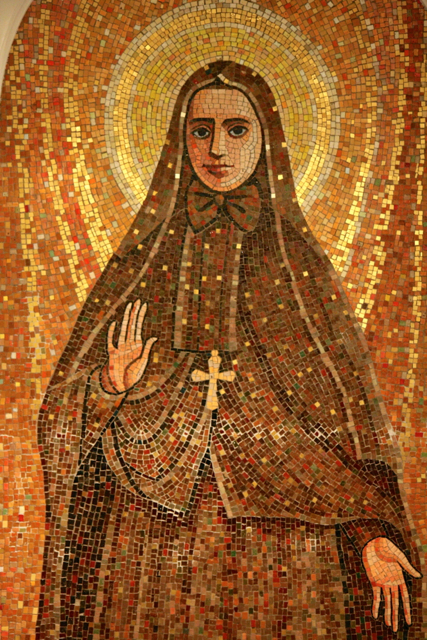
On Saturday, October 19, our Society will sponsor its second annual pilgrimage to the Shrine of St. Frances Cabrini in Washington Heights, New York. A Solemn High Mass will be celebrated at 10 AM. The celebrant will be Fr. Richard Cipolla of St. Mary’s Church, Norwalk, CT. The St. Mary’s Schola Cantorum under the direction of David Hughes will provide the music.
This year we return once more to the shrine of St. Frances Cabrini, to implore her intercession in these troubled times. She is a great saint of the Italian people – but also the first saint who was an American citizen. She is a great patron of immigrants for whom she labored for so many years. And she is one of the Saints and Blessed of this city – where she first arrived in the United States and where her body now rests. But most of all, we supporters of the Traditional mass have special reason to ask her assistance as we enter an uncertain era. Times such as ours make us aware – if we had ever forgotten it – of the need of absolute trust in God’s providence and the intercession of the saints. I would hope that as many of you as possible can make it to the shrine on this Saturday!
Bus transportation from Norwalk, CT: For those of you who will be travelling from Connecticut, there will be a bus leaving from St. Mary Church, Norwalk at 8:00 am and returning at 2:00 pm. The cost is $25. Bring a bag lunch; the bus group will be eating lunch at the shrine. To take the bus, you must reserve ahead of time by calling St. Mary’s rectory at 203-866-5546.
Published in Masses | no comment

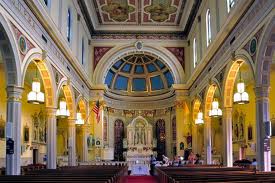
There will be a 9 a.m. Extraordinary Form Mass at St. Sebastian in Middletown on Friday October 4th.
From the parish website: “We are happy to welcome you to this wonderful community with a beautiful baroque church, the only one in Connecticut.”
UPDATE: This mass will be continued for all subsequent First Fridays (Courtesy of Fr. James Thaikoottathil, pastor)
Published in Masses | no comment
A Traditional High Mass is celebrated every Sunday at 7:30 AM at St. Peter’s in Hartford. It is sung entirely in chant. The propers, including graduals, tracts, and alleluias, are sung in the full gregorian chant and are never abbreviated.
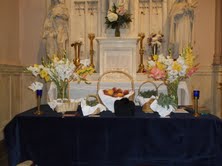
(A picture of the blue velvet covered table at the altar of the Blessed Virgin Mary. This was the traditional blessing of first fruits, herbs and flowers for the feast of the Assumption.)
Two upcoming items of interest:
First, on Wednesday evenings at 6 PM during the month of October there will be a candlelight rosary procession through the streets of Hartford, lasting about 30 minutes. The Fatima Ave will be sung between the decades as well as the Gloria Patris. The simple Salve Regina will also be sung at the end. The candlelight procession will begin and end at the grotto shrine to the Blessed Virgin Mary in the parking lot behind the church. A gregorian chant class of one hour will follow the procession for those interested.
Second, there will be a Requiem high mass on All Souls Day at 2pm with absolution at the catafalque.
( Courtesy of Stanley Swetz
Published in Masses | 2 comments
All Masses are Traditional Latin Masses unless otherwise indicated.
Thursday, 17 October, 5:30 PM
Pontifical Mass & Conference, Mary Immaculate of Lourdes Church,
Newton, MA
Friday, 18 October, 6:30 PM
Pontifical Mass, Holy Name of Jesus Church,
Providence, RI
Saturday, 19 October, 11:00 AM
Pontifical Mass, Holy Name of Jesus Church,
Providence, RI
Sunday, 20 October, 2:00 PM
Pontifical Mass, Dinner & Conference, St. Titus Church,
Aliquippa, PA
Monday, 21 October, 7:30 PM (Feast Day of Blessed Karl of Austria)
Pontifical Mass & Reception, St. Mary Mother of God Church,
Washington, DC
Tuesday, 22 October, 6:00 PM
Mass, Reception & Conference, John Paul II Shrine,
Washington, DC
Wednesday, 23 October, 7:00 PM
Pontifical Mass & Conference, Mater Ecclesiae Church,
Berlin, NJ
Friday, 25 October, 8:00 AM
Pontifical Mass, Carmel of Jesus, Mary, and Joseph,
Elysburg, PA
Saturday, 26 October, 5:30 PM
Novus Ordo (in Portuguese), Our Lady of Fatima Church,
Elizabeth, NJ
Sunday, 27 October, 11:00 AM
Pontifical Mass & Conference, St. Anthony of Padua Oratory,
West Orange, NJ
Monday, 28 October, 6:00 PM
Pontifical Mass & Conference, Church of the Holy Innocents,
Manhattan, NY
Celebrant of Pontifical Masses:
His Excellency, Don Teodoro de Faria
Bishop Emeritus of Funchal, Madeira Islands, Portugal
Bishop Emeritus of Funchal, Madeira Islands, Portugal
Conference Speaker:
Ricardo Dumont dos Santos
Portugal Delegate of the Emperor Karl League of Prayers
These Masses and conferences were arranged and coordinated by the followingTraditional Knights of Columbus councils:
Regina Coeli Council 423, Manhattan, NY
Potomac Council 433, Washington, DC
Woodlawn Council 2161, Aliquippa, PA
Agnus Dei Council 12361, Manhattan, NY
Mater Ecclesiae Council 12833, Berlin, NJ
Additional support provided by:
The Paulus Institute for the Propagation of Sacred Liturgy
The Pittsburgh Latin Mass Community, Inc. (PLMC)

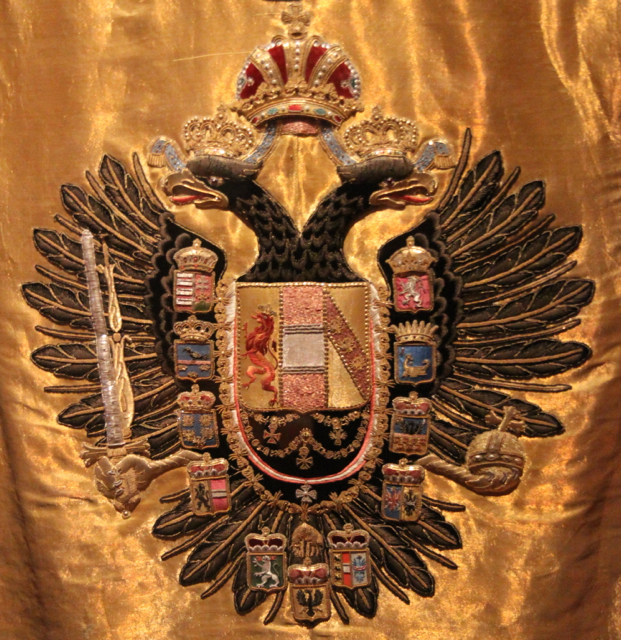
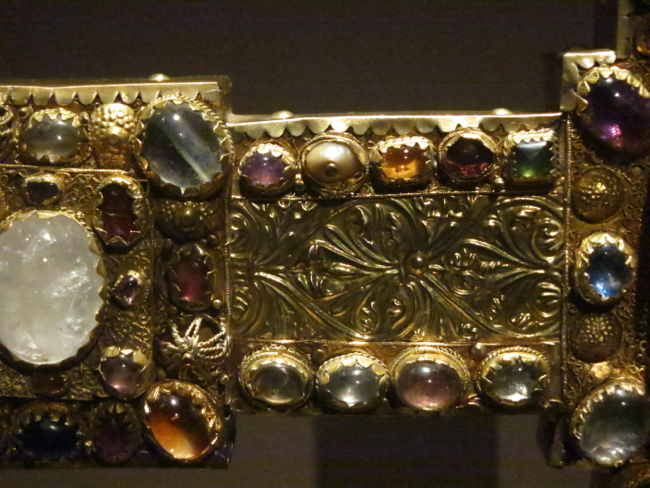
(The crown of the Austrian Empire)
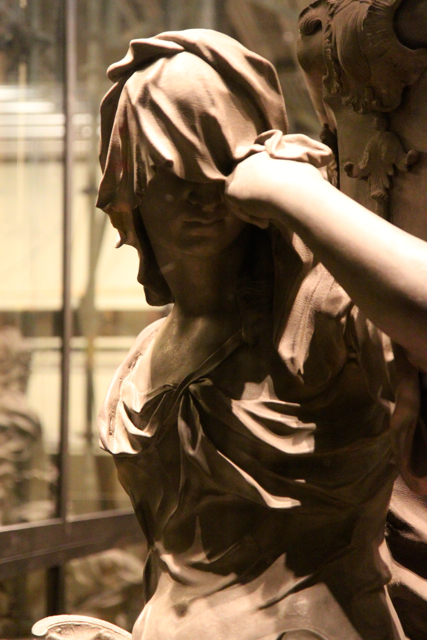
(Mourning figure from the Habsburg crypt, Vienna. Charles, however, is not buried there but where he died in exile, Madeira)
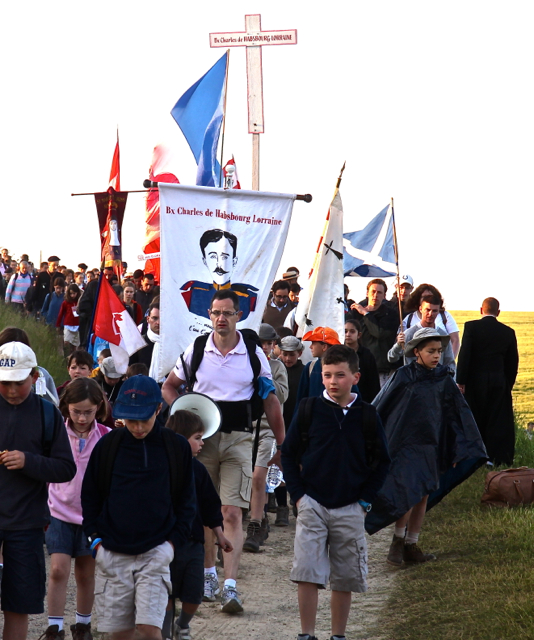
On the Chartres Pilgrimage, 2012. The French point out: Charles of Habsburg-Lorraine)
Published in Events, Masses | no comment
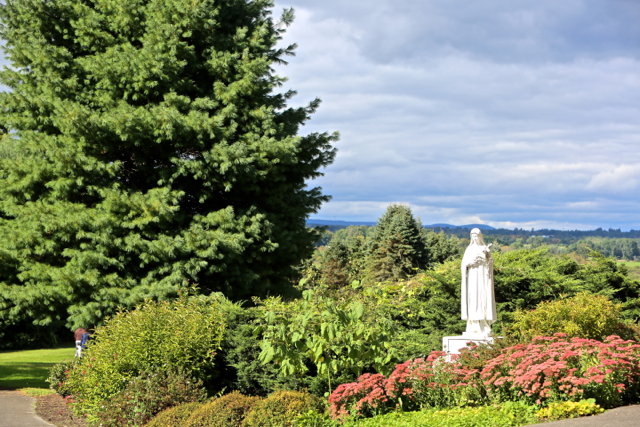
The eighteenth ”Pilgrimage for the Restoration” concluded Sunday at the Shrine of the North American Martyrs in Auriesville. It was a chilly early autumn day in upstate New York – the overcast sky gray and somber. Only now and then did patches of sunlight provide relief from the prevailing bleakness. This weather must have been challenging for those pilgrims who had made the three-day march.
Compared to its beginnings this pilgrimage has assumed an altogether smaller scale. Back in those earlier days most of the pilgrims – representing a broad spectrum of Catholic life, attached themselves on the final day to a small core group who had completed a lengthy trek through the upstate country. Several thousand people would assemble in the circular pilgrimage church. The ceremony, music and preaching were of a very high order. Whatever the weather, a warm and festive atmosphere prevailed. That spirit continued after the final liturgy when the pilgrims joined together to picnic on the shrine grounds or in the shrine’s dining hall.
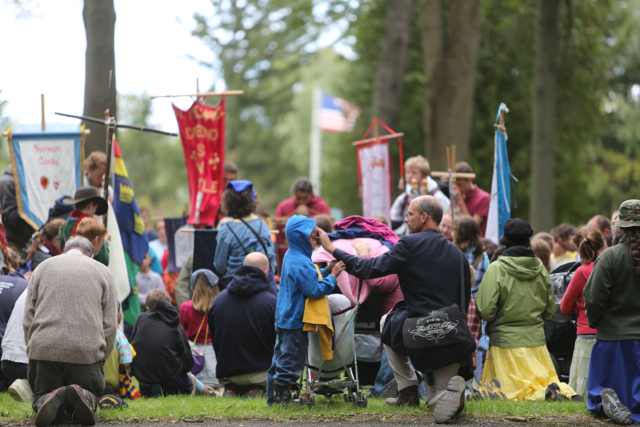
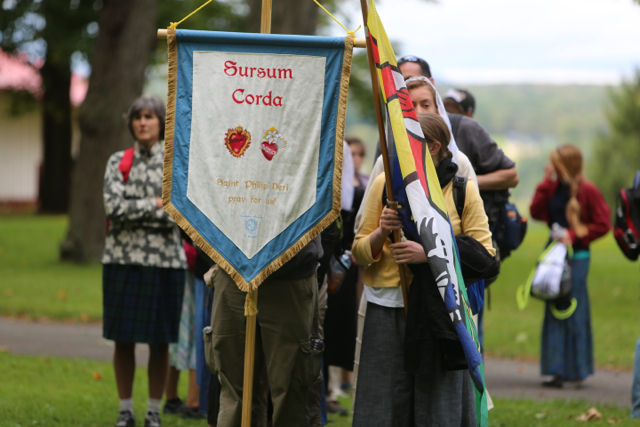
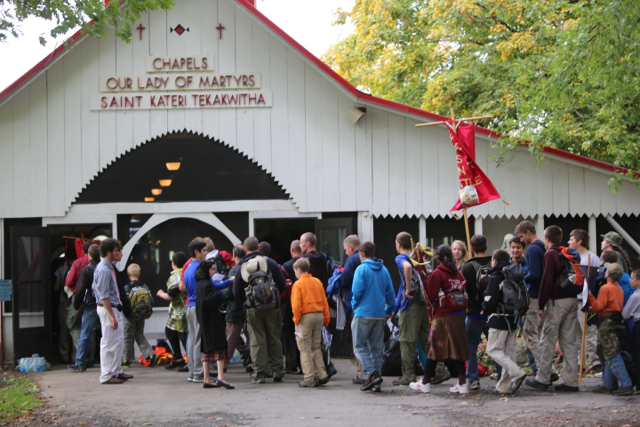
All that has changed. Thanks to a number of recent changes to the day of the week, timing and organization of the pilgrimage, a much reduced – if more focused – group now makes up the pilgrimage march. I would guess only 200 – 250 participated. The program of the concluding day of the pilgrimage has also been drastically simplified. There is no longer the initial assembly at the Kateri shrine in Fonda (even though she was recently canonized!). The pilgrimage is no longer concluded by a solemn high mass but by a Missa Cantata (advertised as ”solemn holy mass” in the program). That mass no longer takes place in the great pilgrimage church but in the old 1894 Martyrs shrine – and even there many more could have been squeezed in. Since the pilgrimage now ends on Sunday, there is no longer a final, beautiful and quiet low mass the day after. The homily this year focused on personal and Marian piety in contrast to the former wide-ranging sermons, dealing not just with the piety of the faithful Christian but also with the great issues of the day in the life of the Church and of the country – the social and liturgical dimension of Catholicism. On September 22 of this year, due in part to the weather, the time of day (late in the afternoon) and the undoubted weariness of the pilgrims a more restrained mood prevailed. I myself could not stay, but I doubt that given the lateness of the day (the mass concluded after 5:30) and the growing darkness that the announced “agape” of the pilgrims recreated the festive spirit of prior days. Looking at this year’s pilgrimage, an outside observer would get the impression of a small, perhaps exclusive devotional group – not of a broad movement seeking the restoration of Church and society (as the Pilgrimage’s website still proclaims). Finally, apart from the pilgrimage, even the shrine itself seems to be a little worse for the wear – despite having a new saint.
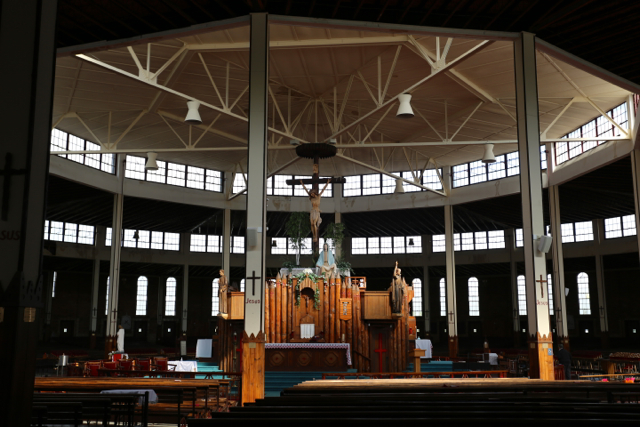
The concluding mass of the pilgrimage no longer takes place in the huge main church of the shrine but in the 1894 martyr’s chapel (below). Of course the Victorian chapel has immensely greater “character” and appropriateness for the landscape compared to the circa 1930 circular monstrosity. It is, however, open to the elements.
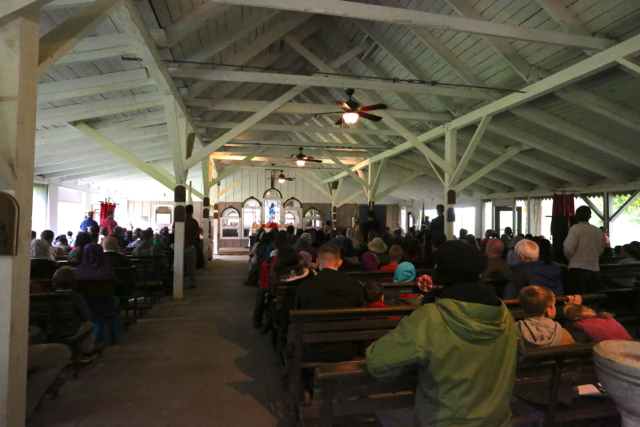
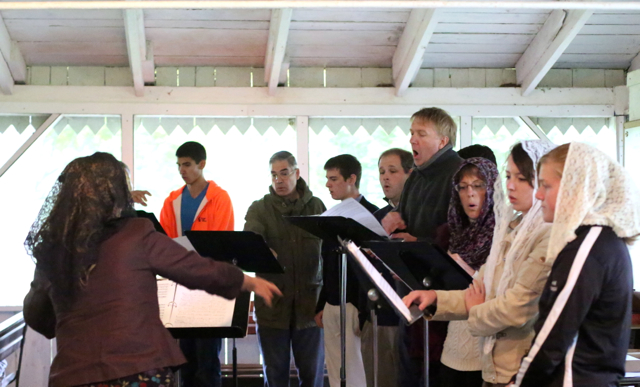
And yet… the landscape surrounding the shrine is as magnificent as ever – especially under the glowering Autumn sky. The sight of several hundred pilgrims who have undertaken such an arduous journey and have completed it in prayer and good order is heartening. The ceremony of the liturgy, if abbreviated, was complete and dignified. Especially the music was of a very high order ( I do not have the details of the two groups of performers; a group of nuns and novices sang the propers while a second mixed choir sang very impressively settings of the mass, hymns and motets.)
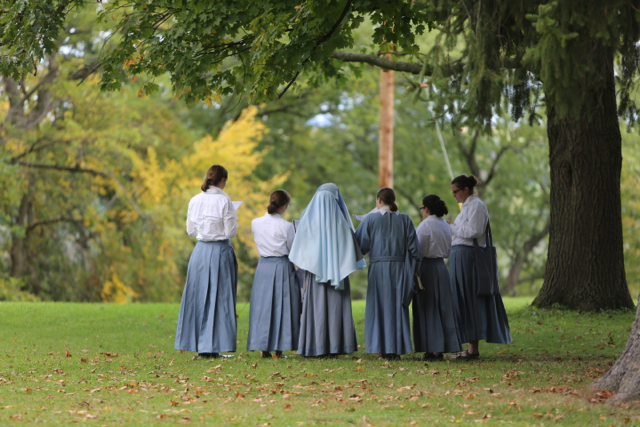
(above) Schola of nuns rehearsing.
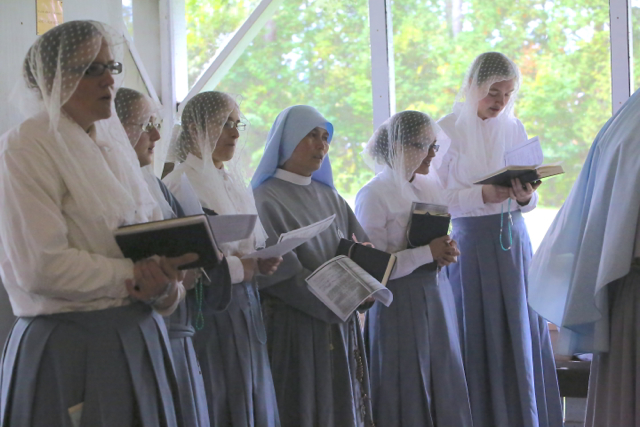
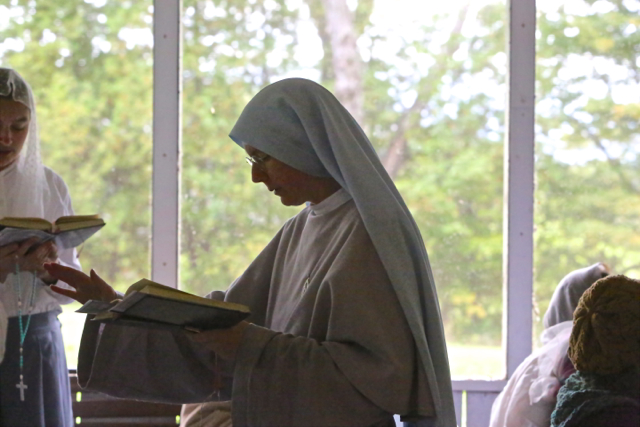
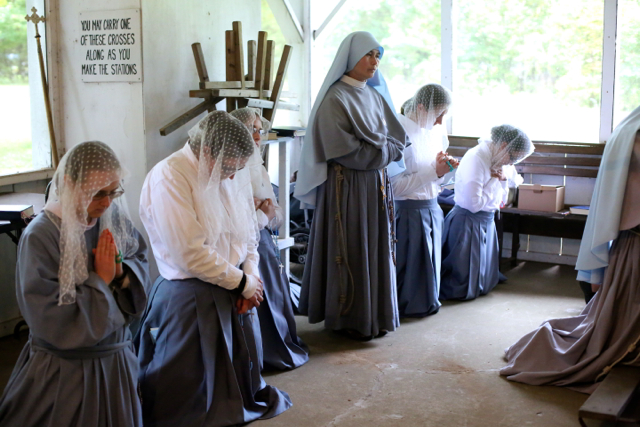
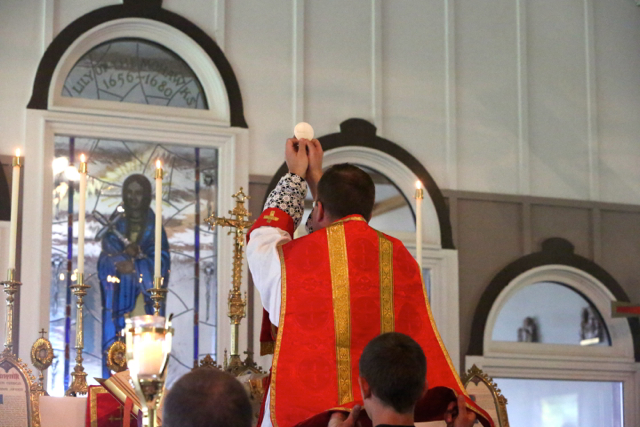
(Above and below) A priest of the Institute of Christ, Sovereign King celebrated the mass. (Perhaps a reader can supply his name and that of the preacher of the homily).
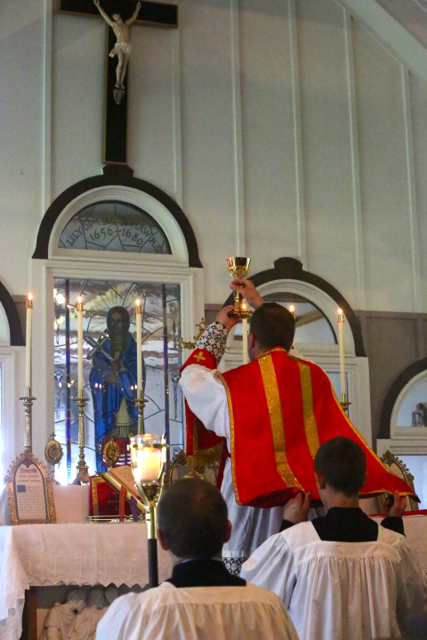
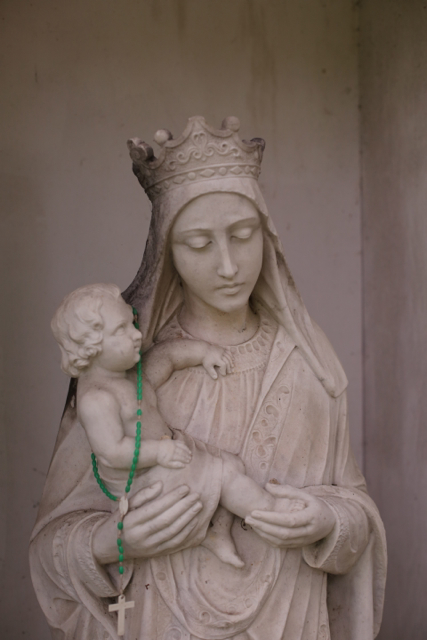
A handful gathered in the face of the growing darkness and cold of Autumn – was this year’s pilgrimage perhaps a metaphor for the situation of the Traditionalist movement in the Church today? Has the earlier elan that prevailed even in the reign of John Paul II dissipated? But does not the continuing sacrifice of the few witness to the indestructible hope of restoration – regardless of the prevailing headwinds? Whatever the weather, to speak with Shelley: “if Winter comes, can Spring be far behind?”
UPDATE:
— The celebrant of holy Mass Sunday was First-Chaplain, Canon Andreas Hellmann, of the Institute of Christ the King Sovereign Priest.
— The priest who gave the sermon was Father James Doran, OMV, who is the Chaplain of the Company of St. René Goupil, an apostolate founded in 1998 to care for the needs of the pilgrims.
— The sisters who comprised one of the choirs Sunday are Franciscans of the Immaculata, from Bedford, Mass.
— The schola that sang polyphonic Sunday is the parish choir of St. Michael the Archangel in Scranton, directed by Mrs. Eileen Marie Hanisch.
(From the Pilgrimage Director, Mr. Greg Lloyd.)
Published in Events, Masses | 3 comments
Churches of New York
Holy Roman Empire
Website Highlights
Archives
[powr-hit-counter label="2775648"]