I have been meaning for a long time (two years to be precise!) to provide an updated report on where we think the Church stands and what the Society of St. Hugh of Cluny intends to do in the upcoming year. That task kept being deferred. But I think I now owe you are an accounting of where we are today. I am especially thinking of our loyal supporters and contributors.
By now traditionalist Catholics have suffered over 3 1/2 years of persecution. They have been segregated from the rest of Catholics, regulated and restricted. Their Masses are arbitrarily suppressed. They are routinely denounced by various spokesman of the official Church – including of course Pope Francis himself, who not only calls them enemies of the Holy Spirit but also mentally ill. In individual dioceses, orders and parishes the Church establishment continues its attack – sometimes coordinated by the papal nuncios. Throughout this campaign of annihilation, the hierarchy, the Catholic religious orders and the Catholic educational institutions have absolutely refused any “dialogue” with traditionalists. Often the Church does not deign even to publish the actions it takes against the traditionalists. It is entirely an exercise in brute force. The war against Traditionalism has become a core initiative of the papacy of Pope Francis.
If we consider only the clergy, the persecution to a significant extent has been effective. Priests have abandoned the celebration of the traditional mass; traditional parishes or masses of long standing have been abolished or displaced without resistance. Yet many traditional masses continue to be celebrated openly. And many others have “gone underground” or at least do not call attention to themselves. These traditionalist activities have attracted favorable media attention – even, here and there, (by mistake?) in the diocesan press.
Now of course we were aware of the reports last year concerning a more definitive prohibition of the traditional mass being prepared by Pope Francis. We did not engage in that discussion, above all because we have no special knowledge of the facts in Rome. Based on prior disclosures, we believe that ideas or drafts for such a prohibition have existed and have been circulated at the Vatican for months and even years now. Whether such a measure will be adopted will depend on the sudden and arbitrary decision of the Pope. He has decided up till now not to proceed further down the path of persecution, but that is no guarantee he will not reverse himself tomorrow. Given how the Church is governed, there is little point in speculating on this subject.
Furthermore, I think such speculations highlight one of the worst aspects of the Roman Catholic Church today: the exclusive focus on the Pope and his entourage. On blogs and online media, we read more about opaque personnel moves in the Vatican, the opinions of Francis’s favorites and the day-to-day utterances of Pope Francis than we do about the faith, canon law or the principles of morality. I see no reason to contribute to such abuses.
The Twilight of the Conciliar Church.
We find ourselves in a late stage of the regime of the Catholic Church that was established starting with the Second Vatican Council in 1962. We’ve already discussed in the past the most fundamental principles of this system. First, ultramontanism: the concentration of all governance and spiritual authority in the papacy, combined with an understanding of the rest of the Church as a ministerial bureaucracy under Vatican control. Second, Vatican II: not any specific text of the Council, but the general principle of openness to the world (that is, the political, social and cultural regime dominating the western world by the 1960s). This was associated with a revolutionary rejection of the Catholic liturgy, morality and culture as they existed prior to1962.
Under Pope Francis these two cornerstones of the post-Conciliar Catholic culture have fused and have been pushed to a new extreme. At least within the Church bureaucracy, the only rule of law, morality and liturgy is the arbitrary will of Francis as expressed at any one time. The Pope contradicts not only the decisions of his predecessors but even his own rulings of the immediate past. The Pope removes or protects prelates or clerics without any explanation or accountability. He and his Vatican directly manage the affairs of individual priests and parishes.
As to the Council, the decisions and utterances of Francis, the synodal path of Germany and the “Synod on Synodality” embracing the whole Church have reaffirmed the Church’s commitment to an ongoing, open-ended series of changes in doctrine, liturgy and morality. The substance of the Church’s message at least at the highest levels has been reduced to a copy of the secular agenda of the quasi-totalitarian culture of the liberal West. (At least as it existed prior to Trump’s election!)
But the roots of the present situation predate Francis. In 1962 a new culture of conflict was introduced into the Catholic Church. In the movement for updating (aggiornamento), a party was established in the Church that demanded immediate and complete accommodation to the world of today and its morality. It was opposed to a second tendency or faction which wanted to restrict the Conciliar innovations to certain discrete areas while leaving basic Christian moral rules and the basics of Catholic theology intact. ( A third group, that dissented from the decisions of the Council, was excluded from the conversation.)
Thus, with the Council, a struggle broke out within the governing and teaching institutions of the Church itself. Progressives were pitted against those who wanted to “conserve” earlier rules and structures of authority (or at least go slow on innovations). By its very nature, no resolution of this conflict was possible. For given the hostility of the modern world to the Catholic faith – an animosity that only continued to grow – achieving the progressive ideal could only mean the liquidation of the Catholic Church. A substantial part of the establishment was unwilling to do exactly that. The result of this conflict, drawn out decade after decade, has been chaos and lawlessness within the Church
Pope Francis has embraced this conflict and has aggressively confronted, in word and deed, the entire spectrum of enemies of Catholic progressivism – Conservative, traditionalist and middle-of-the-road. They range from individuals posting on social media, alternative Catholic news sites, individual bishops and even cardinals. And, after Fiducia Supplicans, even an entire continent joined. We cannot say that the Pope has succeeded in eliminating them.
For the reach of the Pope’s authority and the progressive cause to which it is wed today have definite limits. First, the very nature of the regime of Francis entails a high degree of confusion and incompetence. No effective leadership structures have been established, rather, doctrinal concessions to progressive demands have been made and individual adversaries have been targeted, demoted or destroyed. But the chaos which Francis seeks to create functions as a barrier to any consolidation of his regime.
Second, Francis depends on the goodwill of the secular media and of the Catholic progressives. It is they that create a favorable or at least neutral public image for Francis throughout the world. It is they that make sure the glaring faults of his regime are buried or at least minimized. For these services a price must be paid: continued progress on the accommodation of the Church with the secular world of today. Given this dependence on external and internal allies, the regime of Francis is only a limited totalitarianism.
Third, the Church is dependent on the laity to provide both funding and congregations. In today’s society, the Catholic Church is unable to compel anyone by penal sanctions to either participate in or contribute to the Church. Even in Germany lay participation is ultimately voluntary. Here too the Francis regime feeds on itself – under any empirically quantifiable measure the Catholic Church is in drastic decline: the level of religious participation and understanding of Catholic doctrine among the laity, the number of priests and religious, the number of parishes etc. And this is especially so in the “advanced” nations of the West which have long served as the model for the Conciliar Church. These trends have already required drastic reductions of parishes, schools and religious foundations in places like Germany, the United States and the Netherlands. Even the merging of dioceses has commenced. More losses will inevitably follow.
Regardless of what is officially claimed, the rites of the Conciliar Church, as they are celebrated in the vast majority of locations, have been ineffective in retaining people in the Church, let alone finding new members. The mind-numbing banality and uniformity of the Novus Ordo and its music are in no way an attraction but a deterrent.
How is the Church establishment addressing these crises?
Pope Benedict’s response was increased tolerance of the Traditional Mass and encouragement of traditional elements in the Novus Ordo. Both initiatives have been expressly rejected by Francis. More recently the Church has deployed, often outside of the liturgy, selected practices and forms of a prior era. Relics of saints brought from Europe are being paraded around dioceses in the United States. A new jubilee year in Rome with the appropriate indulgences has been proclaimed. And, of course, there is the “eucharistic revival” – the attempt to revitalize eucharistic piety or just the awareness of what the Eucharist represents. Tabernacles are being returned to the center of churches. Monstrances are prominently displayed as a new kind of Catholic “icon.” Eucharistic processions – in the United States until very recently exclusively the province of conservative and traditionalist Catholics – are now conducted with great fanfare. And, last year, a grand (and expensive) eucharistic conference was held in Indianapolis.
A second official response to religious collapse is to foster the charismatic movement. So, last year’s eucharistic conference was also accompanied by charismatic services and performances. Charismatic meetings and encounters are held regularly.
But how effective will be these initiatives? The establishment may be fostering eucharistic processions and rites – but at the same time Cardinal Cupich, who is held out to be great friend of the Pope, continues to call into question all these practices. Thus, the underlying conflicts within the Church, such as those on the nature of the Eucharist, remain unresolved – the “new conservatism” is more a matter of appearance.
As for the charismatic renewal, its presence remains limited. Its close connection with evangelical Protestantism is problematic in a country, like the United States, where in many places the evangelicals a strong force (and competitor). For example, I would see the development of charismatic ministries as prompting the departure of as many Hispanic Catholics as it wins or retains. The charismatics’ encouragement of unrestrained emotionalism is hardly propitious, in the context of the numerous occasions of Catholic faith leaders abusing their spiritual authority over gullible followers.
Thus, the culture of the Conciliar Church will continue. Conflict, lawlessness and pervasive dishonesty are its hallmarks. It is any wonder that we increasingly read of apocalyptic expectations? That the question of whether and to what extent Francis is pope no longer is reserved to an eccentric fringe but is ever more widely discussed. That more and more appeals to divine intervention are being made?
Misunderstandings and Weaknesses of the Traditionalists.
Obviously, these times have been traumatic for traditionalists. Based on a total misinterpretation of what had happened within the Church after Vatican II, most of them previously viewed themselves as defenders of the papacy – at least as it was defined in 1870. To have such an exalted notion of the Pope and then to be denounced and persecuted by him “with magisterial authority” is obviously a severe blow. Many bishops and priests who had been favorable to the traditionalist movement, quickly became indifferent or even turned into persecutors after Traditionis Custodes.
Traditionalists had very much underestimated the continuing commitment to Vatican II and its implementing decrees among the clergy, the religious and their lay acolytes. 1962-65 indeed had unleashed an authentically revolutionary movement. Admittedly, that elan largely had dissipated by the time of Francis. Many of the first wave of participants had died or left the Church. Yet in the institutional Church the dream remained of a grand opening to a superior modern world, and concurrently, of the need for a violent rejection of traditional Catholic culture in all its aspects. This was no mere intellectual exercise – adhering vocally to “the Council” offered career opportunities in Catholic education, media and administration.
During the era of Summorum Pontificum I can testify to numerous encounters with the clergy and Catholic religious who showed a continuing violent hostility to the traditional mass and the culture associated with it. This hostility was also shared by that minority of the laity that had associated themselves with these priests and religious. For, given the dearth of vocations to the religious life and to the priesthood, many of the Catholic institutions – parishes, schools, colleges and dioceses – are in fact run today by lay bureaucrats who have been nurtured in the attitudes of the makers of the 1960’s revolution.
To expect that this culture would change because of Pope Benedict’s motu proprio was extremely naive. The implementation of Summorum Pontificum was very uneven: in some parishes and dioceses near miraculous results were achieved. In others there was no real change from the situation after 1988 in which the Traditional Mass was permitted as a matter of episcopal grace under severe restrictions.
The Traditionalists’ dilemma also reflected a continued misunderstanding of the constitution of the Church – in particular its de facto organizational form as a modern bureaucracy, imposing rules from the top and demanding obedience. Traditionalists underestimated the continuing effectiveness of papal power within such a bureaucracy. They had been misled by the ineffectual attempts of Popes Paul VI, John Paul, and Benedict to restrain the progressive Catholics. They didn’t consider that those progressive forces occupied key positions of power in the Catholic Church and had important relationships with the secular forces, above all the media. They also didn’t fully appreciate that the three popes above mentioned agreed in varying degrees with aspects of the progressive ideology.
Traditionalists, on the other hand, had no such allies. They have virtually no representation in the mainstream Catholic religious orders and educational institutions. The secular political world and its media often view them as reactionary political adversaries. So, when Pope Francis launched his persecution, there was limited public resistance. Regardless of what his liturgical, moral, and theological convictions might be, it is very difficult for a Catholic priest or bishop to publicly stand up to the policies of Francis.
The Traditionalist Movement Continues
Yet, the traditionalists have carried on. The Ecclesia Dei congregations are still functioning and still training and ordaining seminarians. The traditionalist masses continue, sometimes, as in a dimly remembered past, on a clandestine or unannounced basis. Alternative forms of Catholic liturgy such as vesper services have been proliferating. And should we fail to mention the courageous support given to the traditionalist cause by individual bishops and cardinals throughout the world? This support is not just in words but by direct participation in traditional liturgies.
Among the laity, the current generation of traditionalists has come to its convictions as a product of personal spiritual development, through the conscious participation in the traditional liturgy. Their faith is the product of conscious choice not conformity to some outside culture.
In finding and developing their faith they enjoy a whole range of supports that did not exist in the 60’s and 70’s. A host of Catholic sites, blogs and podcasts provide contemporaneous coverage of news in the Church. These sources also provide access to orthodox Catholic spirituality. It is true that, especially for the more narrowly defined traditionalist world, many of the best sources are still not to be found in English but in the French, Italian, German and Spanish languages. To become an informed traditionalist, it’s a great advantage to be a polyglot too!
Accompanying this this is a veritable avalanche of new books – now available in English – on Traditionalism and related movements. They include detailed analyses of the Mass, music and rites of the Church. Noted scholars have given personal witness of their commitment to Catholic Tradition. Even the history of Catholic traditionalism has by now acquired its own literature. Most of these works have appeared since 2020. The contrast with the meager intellectual support the establishment has been able to drum up in favor of Traditionis Custodes is remarkable.
A whole spectrum of special events now exists in which the traditionalist can participate: pilgrimages, retreats and conferences of every kind. Recall how the overflowing 2024 pilgrimage to Chartres made such a strong impression on the secular world and stunned the Church. Instead of rejoicing in the success, the immediate reaction of the ecclesiastical authorities was to discuss banning the pilgrimage from the cathedrals in Paris and Chartres! But that is a restriction the pilgrimage has lived with before. In the United States, similar if smaller pilgrimages are scheduled this year for Auriesville, New York and Clear Creek, Oklahoma.
Thus, the era of Traditionis Custodes, if a time of sorrow and tragedy for so many, is at the same time an era of growing understanding of the cause for which traditionalists fight. Resources unknown to their forbears are available to them. These aids, in addition to the goad of persecution, permit a far clearer understanding of what it means to be a traditionalist. The position of traditionalists today is thus very different from that which prevailed between 1965 and 1978 – the previous highwater mark of the ecclesiastical assault on the traditions of the Church.
What is Catholic Traditionalism?
Traditionalism is not primarily an esthetic movement. For decades traditionalists celebrated the mass of their forefathers without the aid of beautiful music, splendid vestments or churches. Traditionalists have developed important and growing links with “right-wing” political movements – yet political engagement has played a subordinate role in traditionalist life. In this regard, the contrast is remarkable with the “Conservative Catholics” of the United States and even more so with the relentlessly secular political orientation of the progressive Catholics (and Pope Francis). Similarly, traditionalism by now has no connection with nostalgia – if it ever had any! Traditionalism is not attached to any one period or era of the past – neither the age of Pius XII nor the Middle Ages – in contrast to the exclusive focus of the Conciliar Church on the modern world of Western Europe and the United States.
Rather, traditionalism is a movement for the recovery of the Catholic faith lived through the ages and concretely experienced in liturgy, in morality and in theology. It is a vision that sees the faith as encompassing and transforming all aspects of human life – yet it does not proceed from politics or “Catholic social doctrine” nor does it primarily rely on the techniques of publicity, agitation or argumentation. Rather, it grows through offering the experience of the dignified and complete celebration of the Traditional Mass and other liturgical functions. This is not an individual quest, but takes place in congregations, orders, parishes and communities. In the so-called ”secular age,” traditionalism retains a holy hope for the recovery of the Church and of the sacred. Traditionalists understand that now they can only be a minority movement, but their ambition is to transform the entire Church.
The Role of the Society of Saint Hugh of Cluny
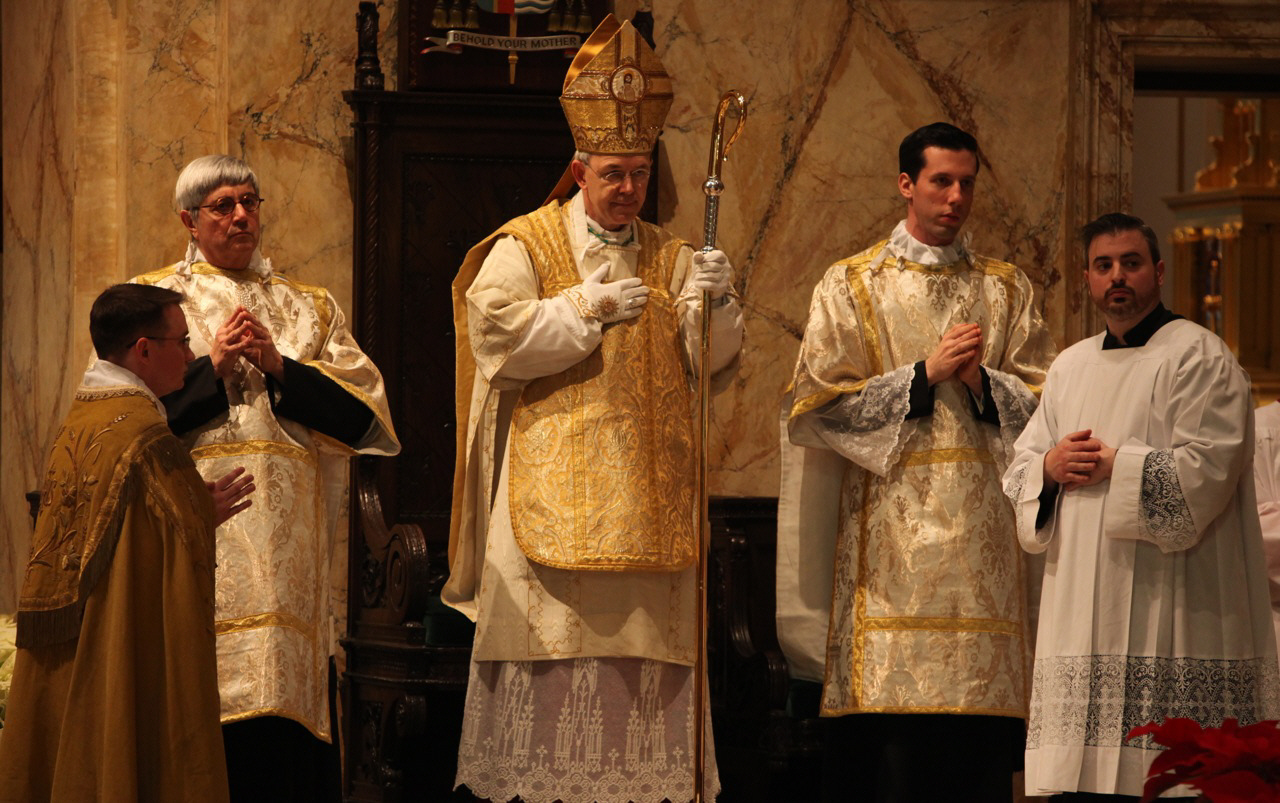
What is the role of this Society in the present day? Let me first summarize our activities in 2023 and 2024. As you can see, the Society sponsors a blog which seems to be widely read. We have sponsored a whole series of solemn masses, usually in connection with a classical Catholic school in Connecticut. We have acquired and made available additional vestments for the dignified celebration of the Traditional Mass at local parishes. We have helped to sponsor in New York and Princeton solemn vespers with outstanding music and magnificent ceremonial. We have sponsored very well received lectures by John Lamont and Marie Meaney. The Society has joined the CISP (the “International Coetus Summorum Pontificum”), and since 2021 the Society has been represented each year at the Summorum Pontificum pilgrimage in Rome (not at the expense of the Society!)
We thank all those who contribute to support these efforts. Much more could be done and perhaps we should more actively seek out donors. The main constraint on the Society’s mission, however, have always been not the lack of funding but the lack of personnel. In 2023, for example, we tried to organize a large-scale conference in Connecticut. In the world of Traditionis Custodes, finding a venue is challenging. And bringing off our usual format of combining lectures with the celebration of a traditional liturgy is even more so. Several key speakers could not in the end attend. With all these complexities, by the time a suitable venue was found it was too late to proceed with the conference. I suspect with more (human) resources devoted to the project some kind of resolution could have been achieved.
Going forward, we envisage continuing the path set forth above. The Society will sponsor more conferences and liturgies. Our primary area of activity will remain in and around the greater New York area. We of course welcome suggestions from readers as to projects and events the Society should support. With this in mind, we look forward to continuing our successful activity in the course of 2025.