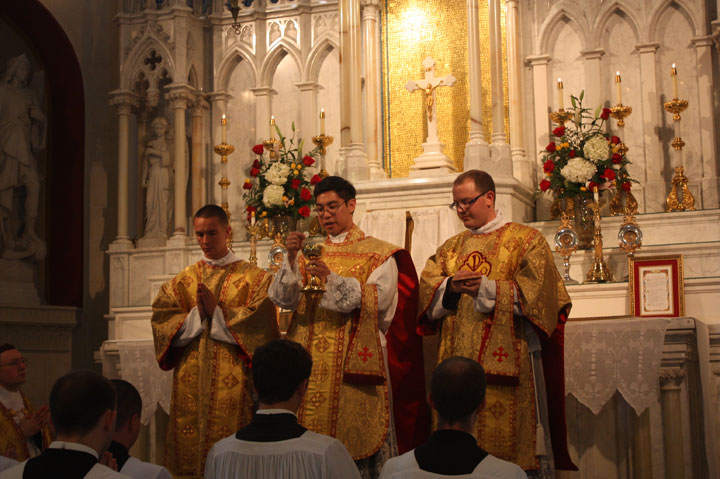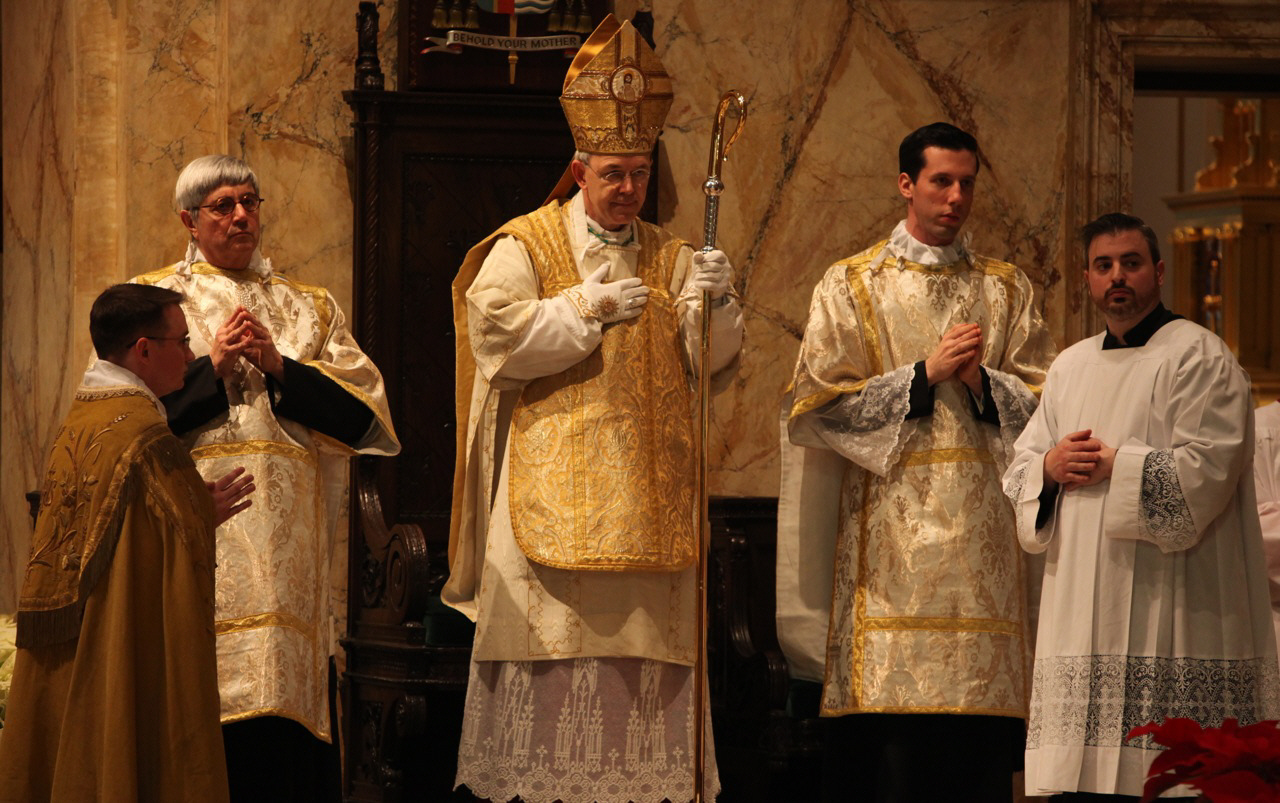
Solemn High Mass at St. Gabriel Church, Stamford , CT for the
Feast of the Immaculate Heart of Mary
Thursday, Aug 22 at 7:30 PM
Reception to follow in the Parish Meeting Room
16
Aug
Solemn High Mass at St. Gabriel Church, Stamford , CT for the
Feast of the Immaculate Heart of Mary
Thursday, Aug 22 at 7:30 PM
Reception to follow in the Parish Meeting Room
16
Aug
CHRIST AMONG THE MEDIEVAL MENDICANTS
Friday August 23, 2013
8:30am-6:30pm FREE ADMISSION (suggested donation $8)
Please Register http://christ.eventbrite.com/
Room 9204 Graduate Center City University of New York 365 5th Avenue
Christ Among the Medieval Mendicants commemorates the 750th anniversary of the establishment of Corpus Christi as a universal feast day (1264) and the 750th anniversary of the Barcelona Disputation between Dominican Friar Paul Christian and Rabbi Moses Nachmanides (1263). 2013 is also (arguably) the 750th anniversary of St. Thomas Aquinas’ composing the Summa Contra Gentiles, as well as the Office and Hymns of Corpus Christi. His Dominican superior, St. Raymond of Peñafort, is said to have been the inspiration for both the SCG and Disputation. Various experts will present on Eucharist and Evangelization.
8:30 Registration/8:45 Welcome
9:00-10:00 Barbara Walters, PhD (CUNY, Kingsborough)
“The BNF 1143 Office for the Feast of Corpus Christi: Making the Implicit Explicit”
10:00-11:00 Rev. Joseph Koterski, SJ, STD, PhD (Fordham University)
“Expressing Theological Concepts in Popular Devotion: Skill in Aquinas’s Corpus Christi Hymns”
11:15-12:15 “The Disputation” (film featuring Christopher Lee)
12:15-1:15 lunch on your own
1:15-2:15 Robert Chazan, PhD (New York University)
“The New Christian Missionizing & the Mendicants”
2:15-3:15 Edmund Mazza, PhD (Azusa Pacific University)
“Not Everybody Loves Raymond: Dominicans & Jews, Sin & Tolerance”
3:30-4:30 Lori Pieper, PhD, OSF (Tau Cross Books and Media)
“Conversion, Dialogue, or Dhimmitude? St. Francis, the Sultan, & Relations with Islam”
The Morgan Library & Museum* 225 Madison Avenue (at 36th Street)
5:15-6:30 Roger Wieck (Curator, Medieval Collection)
“The Sacred Bleeding Host of Dijon”
“Illuminating Faith: The Eucharist in Medieval Life and Art” http://www.themorgan.org/exhibitions/exhibition.asp?id=73
*Free Admission for Registered Conference Participants. Open late. Refreshments available for purchase.
Note from the organizers: We conclude the day with sacred music sung by members of several scholae. Time and place TBD.
16
Aug
The Feast of the Assumption at Holy Innocents parish, New York, now under new management: Fr. George Rutler (the celebrant of yesterday evening’s liturgy).
Above, the restored Brumidi painting; below, the innumerable votive candles and this church.
Above and below: the gospel.
Fr. Rutler preaching: the relation of the Life of Mary and the Assumption to pressing “life issues” of the present day.
A large congregation was present this Thursday evening.
Holy Innocents – one of the most splendid Victorian interiors remaining in New York.
5
Aug
There will be a Solemn Requiem Mass at 7:30pm tonight (Monday August 5th) at St. Mary Church, Norwalk, for the repose of the soul of Fr. Kevin Fitzpatrick. This marks the fifth anniversary of his untimely death. Oremus pro eo.
2
Aug
(From: Le Forum Catholique)
2
Aug
Connecticut:
St. Gabriel, Stamford: Low Mass with Organ at 12 noon
St Stanislaus Church, New Haven.Low Mass at 5:30pm
St. Mary, Norwalk: Solemn Mass at 5:30 pm
New York:
Immaculate Conception, Sleepy Hollow: Low Mass at 5 pm
Holy Innocents, New York: Low Mass at 8:30 am; Solemn Mass at 6 pm (Fr. George Rutler, the new administrator of Holy Innocents, will celebrate that Mass).
1
Aug

Demolition of Mary Help of Christians begins (Photo from Ginsburg’s old apartment by Daniel Maurer)
No sooner had we reported on the impending fate of Mary Help of Christians in New York than the scaffolding goes up to implement the razing of the church.
One very unlikely source, however, was impressed by the role of this parish in a very tough time for this neighborhood. According to Daniel Maurer:
I imagine that view – and the cheap rent, of course – was part of what kept Ginsberg on the block during its darkest days. In “Notebook: 1983-1984,” he wrote about summer on East 12th: “the heat smog humidity stench and sulfur color of sky and street dust gave me to think I was living in Hell City – the inhabitants violently inclined to each other on my street.”
He described a heroin shop, a cigarette smuggling storehouse, a stolen car ring, and an abandoned garage from which someone shot him in the arm with a BB gun. But in the middle of the block’s madness was Mary Help of Christians, where “Sunday mornings a crowd dress’t in white and fresh lace Sunday pants and hats goes up & down the church’s front steps into the big wooden doors.”
Looks Like It’s Time to Give Up Allen Ginsberg’s Old Apartment
For another report see here (with pictures).
More photos from today: how to demolish a church.

The end of the school (from the rear).

The statue of Our Lady is already gone.

As in many New York churches only the facade was “finished” in stone.

A view you could never have had from the building of the church until now: the rectory has already been torn down.
1
Aug
Jean Madiran, perhaps the most esteemed leader of French Traditional Catholicism, died yesterday at 93 years of age. As is always the case in France, his ideas on things ecclesiastical were linked with strongly held political positions – he was an ancient disciple of Charles Maurras! Yet this is not weakness, but strength – the awareness of the political dimension of the faith, of the importance of not just Christianity, but Christendom.
His requiem will be celebrated Monday at the chapel of Notre-Dame des Armees in Versailles by the Abbot of Sainte-Madeleine du Barroux
(Thanks to Le Forum Catholique)
1
Aug
From Ross Douthat in the New York Times…
E.g., regarding Francis’ message of “forgiveness” for his first, scandalous appointee:
“Christianity and Catholicism insist that no sin is is beyond forgiveness, and that true repentance washes away even the worst stain. But for people in positions of ecclesiastical authority, the obligation to forgive and forget is complicated by the obligation to protect the faithful and satisfy the demands of justice … and too often, far too often, the theology of forgiveness was invoked by authority figures in Catholicism as a justification for returning priests to ministry, for hoping that pathologies could be cured in the confessional, and then for refusing to do the appropriate thing when confronted with the consequences of these decisions and resign. …But the danger facing the church in the future is not an exact replay of the sex abuse scandal. Rather, it’s a perpetuation of a model of church governance in which any scandal — sexual, financial, you name it — is met with forgiveness but not with penance, with apologies but not accountability.”
31
Jul
Once upon a time, that impeccably influential institution, the Brompton Oratory, held a liturgical congress which would be crowned by the special celebration of a Solemn High Mass.
Into the sublime sacristy enter the sacred ministers: an Italian Jesuit, an American Jesuit, and a Jesuit scholastic.
Busy polishing a thurible, the surly sexton stops, looks up and mutters, “Eh, what’s this, a joke?”
In the appendix to the perennially potent, reliably resourceful Roman Ritual many a religious congregation, institute and order have graciously shared with the secular clergy some of their most beautifully bountiful blessings. While not generally lauded for their acumen in liturgical praxis, the sons of Ignatius have bestowed to the august treasury a modest contribution.
BLESSING OF WATER IN HONOR OF ST. IGNATIUS, CONFESSOR
P: Our help is in the name of the Lord.
R: Who made heaven and earth.
P: Blessed be the name of the Lord.
R: Both now and forevermore.
P: Lord, heed my prayer.
R: And let my cry be heard by you.
P: The Lord be with you.
R: And with your spirit.
Let us pray. Holy Lord, almighty Father, everlasting God, who, in pouring out the grace of your blessing on the bodies of the sick, encompass your creatures with your generous love; hearken as we call on your holy name, and by the prayers of Blessed Ignatius, your confessor, free your servants from illness and restore them to health, and then hasten their convalescence by your sure hand, strengthen them by your might, shield them by your power, and give them back in full vigor to your holy Church; through Christ our Lord. Amen. (He then immerses a medal or a reliquary of St. Ignatius in the water, and holds it so until the following prayer is concluded) Lord, bless this water, that it be a saving remedy for men; and grant that, by the prayers of Blessed Ignatius, whose medal [or relics] is [are] now immersed in it, all who will drink this water may have health in body and protection in soul; through Christ our Lord. Amen.
As befits the respectable reputation of the Society of Jesus, the preceding prayer is a pragmatic paragon of pithy practical prose. But if extraordinary pulchritudinous poesy is paramount it is best to remember the old sacristan’s proverb: “A good Jesuit liturgy is one where no one gets hurt….especially the celebrant!”
Mr. Screwtape