SOLEMN HIGH MASS
FOR THE FEAST OF SAINT ALOYSIUS
Friday June 21st at 7:30 in the evening
Celebrated in Latin according to the
Extraordinary Form of the Roman Rite.
Veneration of the Relic of Saint Aloysius.
Light refreshments to follow in
Parish Meeting Room
Church of Saint Gabriel
914 Newfield Avenue, Stamford, Connecticut
18
Jun
Published in Masses | no comment
16
Jun
Fr. George Rutler has been transferred to St Michael’s parish on West 34th street. He will also become the “administrator” of Holy Innocents ( well known to the Manhattan Traditional Mass community). In turn the pastor of St Stephen’s church – Fr. Robert Robbins, who had only held that position since last October – will take over the pastorate of Our Saviour’s church – while remaining “administrator” of St Stephen’s. Obviously there is a story here – is this the prelude to further parish consolidation in the Murray hill area? Affected by this reshuffling of pastors are four of the most beautiful parish churches in New york.
See the Archdiocesan announcements.
See Father Rutler’s column in Our Saviour’s bulletin.
Fr Rutler has done magnificent work in the Archdiocese – and as pastor of Our Saviour’s during the last twelve years. He provided much needed support for Our Society’s initial efforts – who can forget the first Solemn high mass in New York pursuant to Summorum Pontificum celebrated at Our Saviour’s in 2007? We wish Fr. Rutler well in his new parish (both of them). I have a feeling many people will be making the pilgrimage to Hell’s Kitchen in the coming years….
Published in Events | 3 comments
14
Jun
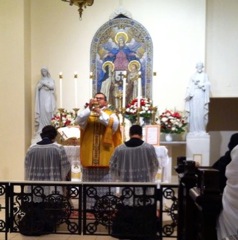
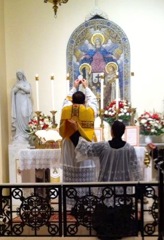
On Friday, June 7, The Student Schola of St. Mary Church, Norwalk, sang at a Missa cantata in honor of the feast of the Sacred Heart at the Carmelite convent in Brooklyn (341 Highland Boulevard). Fr. Michael Barone was the celebrant; Mr. David Hughes directed the music. Here are a few images of that mass and of the church.
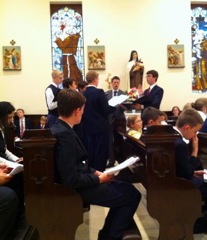
The student schola.
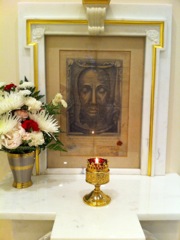
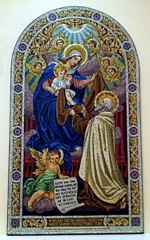
St. Simon Stock and the scapular.
(Photos courtesy of Roberto Barrientos)
Published in Masses | no comment
13
Jun
Chant Workshop in Mystic, CT
Posted by Stuart ChessmanJune 23-28 (Sun-Fri)
Five Days of Gregorian Chant & Liturgical Music
Ender’s Island Retreat House, Mystic, CT
Teacher: Dr. William Tortolano
Let the Chapel of Our Lady of the Assumption’s serene beauty infuse your spirit as you study Gregorian modes, neumes and more, plus the chant in English and chant’s role in Liturgy. We will explore a practical, worshipping approach to a singing church. Five days will give an in-depth study of the repertoire, music in Latin and English. A relaxed, spiritual, musical five days. If there are any questions, please call Dr. Tortolano (Home: 802-899-3564).
Fee: $699 Commuter Rates Available. Please Call Office For Details.
https://www.endersisland.com/sacred-art/five-days-gregorian-chant-liturgical-music
Published in Events | no comment
13
Jun
Sung Dominican Rite Requiem Mass
The Church of the Holy Innocents, Fr. Thomas Kallumady, Pastor
Saturday, June 15, 2013 at 1PM
Fr. Austin Dominic Litke O.P, NYU Catholic Center Chaplain will be the celebrant.
There will be absolution at the catafalque following the mass.
The Mass will be the Gregorian Chant Setting for Requiems.
The Mass will be offered for Fr. Robert Fitzsimmons OP (RIP) who was, for many years, a regular celebrant of the weekly Saturday Una Voce Mass at the Church of St. Anne.
Fr. Fitzsimmons began celebrating the Dominican Rite at the Church of St. Anne shortly after the Una Voce Mass began there in 1988 and continued generously doing so for many years, even after the Mass moved to the Church of Our Lady of Good Counsel when St. Anne was closed.
In recalling him, David Lane of Una Voce echoed sentiments recorded in Fr. Fitzsimmons’ obituary:
“Father Fitzsimmons was known as a kind and gentle priest, well-beloved by those who experienced his pastoral care over the years.”
Published in Masses | no comment
9
Jun
THROUGH 129 YEARS HARLEM HONORS ITS BLESSED MOTHER
Processions, Novenas, and Prayers to Honor Our Lady of Mount Carmel, with 2nd Annual Special
Traditional Latin Pilgrimage on July 20
The Shrine Church of Our Lady Of Mount Carmel, located at 448 East 116th street in Manhattan has announced plans for its 129th Feast in honor of its patron Madonna. It has long been the largest sponsored religious procession in New York City, including its 2nd Annual Traditional Tridentine Latin Pilgrimage on July 20.
Drawing thousands of pilgrims to the feet of the Blessed Mother, the feast, originally created by Italian immigrants, now unites Catholics of all racial, economic and social classes in their love and devotion to Mary. I
The Vatican itself has specially recognized the Mt. Carmel Shrine. In 1904, Pope St. Pius X, following the approval of Pope Leo XIII who had just passed on, ordered that the image of the Madonna be given the right to wear a golden crown. This was done in recognition of the graces received, and prayers answered at the Shrine. This privilege, known as “incoronation”, is an extremely rare one in Catholicism, and has been granted to only five Marian images outside of Europe. Indulgences were also attached for visits to the Shrine during the Feast.
Events of the 2013 Latin Pilgrimage
Traditional Latin Pilgrimage July 20 at 9:30 AM
10:15AM Entrance of Pilgrims on knees
10:30AM Second entrance of Pilgrims
11:00AM Solemn Mass
1:30PM History of Shrine/ Spiritual Talk
2:00PM Rosary, followed by Investiture of Scapular/Indulgence Prayers/Benediction
Confessions available as needed
Additional Events of interest to the traditional community of the 2013 Feast, a week before pilgrimage
Traditional Latin Vespers July 15 at 7:30PM
Candlelight Procession July 15 at 9PM
Rosary and Litany July 15 at 11:00PM
Solemn Extraordinary Rite Midnight between July 15 and 16
Midnight Mass of
Our Lady
Latin (Tridentine) Mass July 16 at 9AM
Ample street parking is available. Enclosed parking at the Costco Complex
1/2 block from church. First Ave limited bus to 116th street, or 6 train to 116, walk east to Pleasant Ave
If you need more information, please call (212) 534-0681
Published in Masses | no comment
7
Jun
There will be a Solemn Mass for the Feast of the Sacred Heart at 6 pm tonight at the Church of the Holy Innocents, Manahttan. Fr. Stephen Fields, SJ, Associate Professor of Theology at Georgetown University will be the celebrant. Immediately after the Mass, the monthly all-night First Friday vigil will begin with exposition of the Blessed Sacrament.
Published in Masses | no comment
7
Jun
In the collect of the Mass for the feast of the Most Sacred Heart of Jesus we pray: “O God, Who in the Heart of Your Son, wounded by our sins, mercifully lavish upon us the infinite riches of love, grant, we beseech You, that as we offer Him the faithful service of our devotion, we may also show forth fitting reparation.” In that spirit a precariously pious little altar boy penned a pithy poetic prayer.
A Soliloquy Before a Sanctuary Lamp
Closed are my eyes, joined are my hands
Listening for the beating of the Sacred Heart
Faith seeking understanding
Returning love for Love
Kneeling before the silent tabernacle
Devotion burning like a sanctuary lamp
Belief in the Real Presence brings me here
Though I may nod during my vigil
Comforted by the Divine Prisoner
Returning love for Love
Kneeling before the silent tabernacle
Devotion burning like a sanctuary lamp
In the quiet I hear my name, like a sunbeam through the rain
Human comforts are naught; human frailty abounds
But in the tabernacle Thou art there to ease the pain
Never permit me to be separated from Thee.
Mr. Screwtape
You’re waiting for the punch line, that’s right.
Here it is: The preceding piety was inspired not by neither Aquinas nor Alacoque but rather by Susanna Hoffs and The Bangles.
That yardstick ruler is getting a little too close for comfort….
Published in Essays, Mr. Screwtape | no comment
6
Jun
Since the election of Pope Francis the drumbeat of comment – now euphoric in regard to the future, now critical in regard to the immediately preceding papacy – from the progressive Catholics has steadily increased. What was spoken of behind closed doors before is now said out loud. For these forces feel empowered by Pope Francis. Perhaps he could be the man will erase the policies of Pope Benedict – and of John Paul II as well – and return the Catholic world to the chaotic experimentation in liturgy and morality of the 1960’s and 70’s? On his part Pope Francis is doing very little to restrain these voices who grow ever louder.
In the most recent example, Cardinal Lehmann of Mainz, leader of the German progressive episcopate, spoke out against the expansion of the Traditional liturgy in the “Tridentine rite” at a German Eucharistic conference in Cologne. In an interview with the Koelner Stadt-Anzeiger the Cardinal stated:”I have the impression that the whole enthusiasm for Latin has a lot to do with prestige and the pretenses of a supposed cultural elite.” After giving a tendentious account of the recent history of the “extraordinary Form,” Lehmann claimed the increased availability of the Traditional mass has not been matched by increased demand. Lehmann is of the view that “a more intensive juxtaposition of both liturgical forms is not meaningful today – also because it has not grown from below.”
It is good that Catholics hear what the “princes of the Church” think when they feel empowered to speak out loud. “It has not grown from below” when the entire impetus for the Traditional Mass has come from the laity and committed priests wholly outside the power structures of the Catholic Church. “Demand has not grown” when Lehmann and his cronies have done everything in their power first to block Summorum Pontificum and then to discourage those wishing to make use of it. “Pretenses of a supposed cultural elite” when the Vatican and German episcopate spend fortunes trying to ingratiate themselve with the practitioners of “modern art.”
One point of Lehmann’s struck me and confirmed one of the missions that this Society has developed – although it was not its original purpose at all. We do publish a lot of photographs of traditional services – both of those we sponsor and those supported by others. It establishes a pictorial record of what has gone on in this area as Summorum Pontificum has been implemented. Now if, God forbid, gentlemen like Lehmann gain the upper hand here, their first claim will be that nothing ever happened – that no one attended the traditional mass when it was available. Pictures “worth a thousand words” will make that more difficult than usual to sustain.
(thanks to Kath.net)
Published in Uncategorized | 3 comments
The Student Schola of St. Mary Church, Norwalk will be singing a Missa cantata at the Carmelite convent in Brooklyn for the feast of the Sacred Heart this Friday at 11:30 a.m. Fr. Michael Barone is the celebrant. The monastery is at 341 Highland Boulevard, just off the Jackie Robinson Parkway.
Carmelite Monastery, Brooklyn, New York
Music for the Feast of the Most Sacred Heart of Jesus
(Missale Romanum of 1962)
Gregorian Mass of the Sacred Heart: Cogitationes
Kyrie Rector cosmi pie (plainsong, mode ii)
Gloria: Missa cum jubilo (Vatican Gradual, Mass IX)
Hymn at the Offertory: Jesu dulcis memoria (Palestrina)
Sanctus & Agnus Dei: Missa Pater cuncta (Mass XII)
Marian antiphon: Salve Regina (plainsong, mode i)
Published in Masses, Uncategorized | no comment
Contact us
Register
- Registration is easy: send an e-mail to contact@sthughofcluny.org.
In addition to your e-mail address, you
may include your mailing addresss
and telephone number. We will add you
to the Society's contact list.
Search
Categories
- 2011 Conference on Summorum Pontifcum (5)
- Book Reviews (110)
- Catholic Traditionalism in the United States (27)
- Chartres pIlgrimage (17)
- Essays (181)
- Events (704)
- Film Review (7)
- Making all Things New (45)
- Martin Mosebach (35)
- Masses (1,387)
- Mr. Screwtape (46)
- Obituaries (20)
- On the Trail of the Holy Roman Empire (27)
- Photos (360)
- Pilgrimage Summorum Pontificum 2021 (7)
- Pilgrimage Summorum Pontificum 2022 (6)
- Pilgrimage Summorum Pontificum 2023 (4)
- Sermons (79)
- St. Mary's Holy Week 2019 (10)
- St. Mary's Holy Week 2022 (7)
- St. Mary's Holy Week 2023 (7)
- St. Mary's Holy Week 2024 (6)
- St. Mary's Holy Week 2025 (7)
- St. Mary's Holy Week 2026 (11)
- Summorum Pontificum Pilgrimage 2024 (2)
- Summorum Pontificum Pilgrimage 2025 (7)
- Summorum Pontificum Pilgrimage 2026 (1)
- The Churches of New York (219)
- Traditionis Custodes (57)
- Uncategorized (1,413)
- Website Highlights (17)
Churches of New York
Holy Roman Empire
Website Highlights
Archives
Support the Society of St. Hugh of Cluny
[powr-hit-counter label="2775648"]