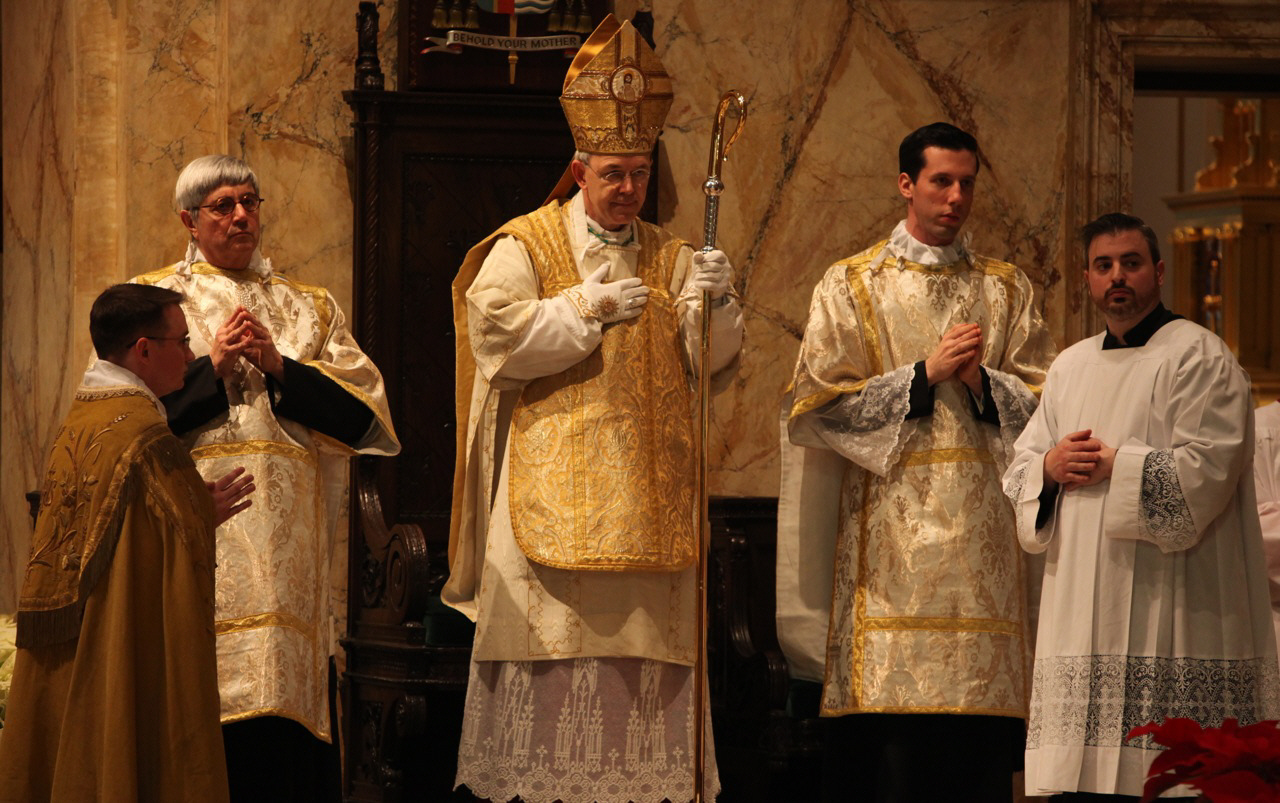
We will be sponsoring a mass ( with chant and polyphony) on Saturday, September 22 at 10 AM at the Shrine of St. Frances Xavier Cabrini at 701 Fort Washington Ave, New York.
5
Sep
Published in Masses | no comment
5
Sep
Once upon a childhood, on a Fourteenth Street haunted by the grimy ghosts of its glorious Gilded Age past, there was a wonderful little bakery shop called Valencia. They made absolutely yummy cakes that were to die for. Literally if you were a diabetic. The pineapple flavored filling layered in between soft sweet sponge cake was gosh gooey good. The fabulous frosting was pure super saccharine sugar. To a poor kid in the tumultuous tenements of the crime ridden New York of yore there couldn’t be enough birthdays to celebrate.
Liturgically the Church, in both Latin West and Greek East, recognizes only three births in the natural order: that of Our Lord, that of his Precursor, and (the subject of this e-pistle) that of his most Blessed Mother. The date, September 8, was chosen as the octave day after the former Byzantine Civil New Year which was marked on the first of September. (For those of you who are counting it is the year 7521, computed as it is “from the creation of the world”.) Although Mary’s birth was celebrated on various dates throughout the centuries, September 8 predominated. The feast celebrating Mary’s Immaculate Conception, December 8, (a liturgy instituted later) was set to correspond to nine months before Mary’s birth. By the seventh century the liturgy was also celebrated in Rome where it had been introduced by monks from the Byzantine East. (The transmigration of monastics was in part occasioned by, how shall we say it politically correctly, the theological transformation in an obscure corner of the Empire.) From there, it spread throughout the West, and by the thirteenth century the liturgy had developed to a solemnity with a major octave and a solemn vigil which prescribed a day of fasting. Pope Sergius I (687-701) established a procession (known as a litania) from the Roman Forum to St. Mary Major for the feast. During the reform of Saint Pius X at the dawn of the twentieth century, the octave was simplified, and in 1955 the octave was abolished during the (in)famous reform undertaken under the authority of Venerable Pius XII.
(As a piously personal aside, this feast also marks the natal day of a terrific treasure that one has singularly solitary responsibility for nurturing therefore one beseeches your gentle generosity in simply offering some pithy prayers to the guiding glance of the Divine Providence of the ever serene Trinity as she blows out the candles. Although effective effigies of past Presidents would not necessarily be unwelcomed.)
So what are you waiting for? Even though greedy gentrification forced reluctant relocation to the bucolic Bronx, the sinfully super sweet cakes are still made by Valencia Bakery: http://valenciacake.com/
Mr. Screwtape
Published in Mr. Screwtape | no comment
4
Sep
Punk Catholicism
Posted by Stuart ChessmanDas Katholische Abenteuer: Eine Provokation
By Matthias Matussek
Deutsche Verlags-Anstalt
2011 2nd Edition
Rabaukenkatholizismus – punk Catholicism – is the curious epithet hurled at Matthias Matussek and the FSSPX in an editorial by one of the greats of the Frankfurter Allgemeine Zeitung, the leading paper of Germany. It is intended to stigmatize an aggressive and militant Catholicism, one more concerned with defending the Church and making the case for Christianity than with maintaining decorum and “civility” (a buzz word in the US these days). Now it would seem an unlikely insult, and an unlikely association, for Matthias Matussek, reporter, editor and commentator for the oh-so-progressive Der Spiegel magazine. For, as all those remotely familiar with German popular culture know, the editorial approach of Der Spiegel to Christianity and specifically to Catholicism for fifty years and more has been clear and consistent: F—ck you!
Yet in this most unlikely of environments – both that of this specific magazine and of modern German popular “culture” in general – a new apologist for Catholicism has arisen. In Das katholische Abenteuer Matussek presents his writings on faith, Catholicism and the spiritual. At first glance he seems to be a rather familiar type to the American reader: the conservative Catholic defender, a line starting in the 1970’s with Monsignor George A. Kelly’s Battle for the American Church, continuing with George Weigel, Deal Hudson and Fr. Richard Neuhaus and represented at the present day by Bill Donohue or, on the net, Mark Shea. Like them, Matussek battles for the popes and rebuts the attacks of the day against the Church. Especially in Germany there is much to do for a paladin of the Church. For years now the German media have been filled with carefully stoked rage against Pope Benedict, the “authoritarian” Church, priestly celibacy, the male priesthood etc. “Dissident” groups of laity and clergy (actually, members in good standing of the institutional Catholic Church) have joined in the fray. The response of the German episcopacy is as usual feeble and apologetic – extending offers of dialogue and even, at times, covert support. The response of the Vatican is only marginally more forceful.
Matussek will have none of this. He exalts John Paul II and Pope Benedict as modern day pillars of the faith. He wades into the storm surrounding celibacy conjured up by the media from the scandals of child molestation that have also hit Germany. He defends the Church against the wilder charges of “pedophilia.” The author, however, has little good to say about the German hierarchy and its minions – an episcopacy that Matussek, quoting Archbishop Dyba, describes as engaging in “Mephistophilian” maneuvers. Going beyond the defensive, he advances arguments for the Catholic faith and for Christian morality. In so doing he witnesses to his own background and religious experiences. But it is his aggressive, even bellicose advocacy on specific issues that has earned Matussek the honorable title of “hooligan” of the faith on the side of the FSSPX (the ultimate outcasts of the German Catholic Church and of German political life). This is so even though Matussek’s ideas differ from theirs in most respects. For the media expects from Catholic representatives in Germany only nebulous, non-specific, pseudo-academic discourse – nothing that names names or challenges to specific action.
Matussek fills out his book with interviews with a variety of generally non-Catholic and non-believing authors in search of the presence of the “religious” in modern life. There is talk of Kierkegaard and Meister Eckhart, of Nietzsche and Marx. Similarly, Matussek includes essays on his encounters with popular religious movements and leaders outside the Western European paradigm; in Harlem, among Orthodox Jews, in Latin America etc. The author is evidently on a quest for intellectual openness to religion and an active faith he evidently does not find among the bureaucrats of the German Catholic Church or in the official “movements” of Catholicism.
It would seem that Matthias Matussek’s work should be receiving accolades on this side of the Atlantic from the Weigel/Hudson/ Shea crowd. And shouldn’t Fr. Fessio’s Ignatius Press be pushing a translation of the “conservative” equivalent of Martin Mosebach’s Heresy of Formlessness? One never knows, but I suspect this may be unlikely for several reasons. First, there is the question of style. Matthias Matussek is so immersed in the world of contemporary German culture, politics and entertainment – his comments are of such a topical nature – that copious footnotes would be required to convey the author’s meaning to the American reader. Second, the author’s theological opinions do show a certain vagueness. For example, Matussek evidently believes that universal salvation is Catholic doctrine. In another paragraph he writes of the destructive influence of St Augustine’s “theology of terror.” And while he was living in New York, he and his family would sometimes “go to mass” on Sunday with the Baptists in Harlem. Not that these views are original or aggressively advocated – they are typical of the ideas the Catholic “man in the street” in Germany might pick up from the German Church – but are perhaps surprising coming from a Catholic advocate.
But third – and most important – Matussek emphatically disagrees with the “Neocon” view of the United States as the promised land of Christianity. He does agree that religious belief has a far greater vitality here than in Germany – but he has come to view American religion as a sinister, fanatical force – advocating domestic violence, foreign wars and Matussek’s bête noir, capitalism. Entirely in this spirit, Matussek associates the pro-lifers and fundamentalists he describes with terrorism, or insinuates that Sarah Palin incited or approved the assassination attempt on Gabrielle Giffords. In these essays the Catholic provocateur Matussek still remains close to the party line of Der Spiegel.
Now the Catholic Traditionalist, while rejecting many of the author’s specific characterizations and assertions, might be more tolerant than the “neocons” of the general views of Matussek. The identification of much of American fundamentalism with US and Israeli interventionist policies is scandalous. And capitalism indeed is becoming an ever more dubious force as it spins increasingly out of control. But moving beyond these controversies, a Traditionalist will find a wealth of insight scattered here and there throughout this book. In one interview, for example, Matussek and Rüdiger Safranski touch on the intriguing idea that the ”virtual” worlds created by the media and video games are displacing more and more the “religious imagination.” Matussek has fine passages taking up the plight of Christians in the Moslem world and waging a spirited, sarcastic battle with those who want to avoid any criticism of the “religion of peace.” In one unusual essay on the “End of the World,” Matussek evokes a real sense of doom: the capitalist world as we know it may be coming to an end just as did the world of Soviet communism 20 years before.
On a positive note, Matussek tells the moving story of his youth, his family and especially of his father. It is almost a hymn to the intact Catholic pre-conciliar world. Our author has found in the clergy of the German Church at least one hero: the late Archbishop Dyba of Fulda. The author records for our benefit a number of pungent utterances and observations of this isolated Catholic leader who broke ranks with the rest of the German hierarchy to help end the German Catholic Church’s practice of tacitly facilitating abortions.
I don’t think I need to rehearse some of the criticisms that could be made of Das katholische Abenteuer from the Traditionalist perspective. They should be obvious to most of the readers of this blog – I only need mention the author’s idiosyncratic theological and liturgical ideas. Let me conclude however, by remarking on what I like best in Matthias Matussek’s book: the well-chosen, almost Chestertonian title: The Catholic Adventure. For in this day and age Catholicism truly is a great adventure, a dare and a modern quest for the Holy Grail. I would hope that Matthias Matussek continues his explorations. He will find that a more vital, fuller expression of faith exists not just on other continents or in other religions, but in the quiet following by devoted Catholic congregations of Catholic Tradition in liturgy, theology and morality.
Published in Book Reviews | no comment
2
Sep
Day of Recollection Given by Fr. Cipolla: “Teaching Beauty at Schools”
On the Feast of Our Lady of Sorrows, Saturday, September 15 from 10 am to 3 pm, Father Richard Cipolla of St. Mary’s Church will offer a day of recollection at the Convent of St. Birgitta, Darien, CT, 4 Runkenhage Rd., Darien. The topic will be “Teaching Beauty at Schools.” All are welcome. Cost is $15. Includes 3 meditations, Extraordinary Form Mass, opportunity for Confession and Adoration of the Blessed Sacrament. A potluck lunch will be offered. For more information or to register, please call Jacqueline Juhasz of St.Mary Church 203-866-7429 x 112 by Tuesday, September 11.
Teen Catechism
Father Markey will be teaching his popular catechism class for high school teenagers 5:30 to 8 pm one Thursday a month in the St.Mary’s church hall. The dates are September 6, Oct.4, Nov. 8, and Dec. 6. Sessions are free and open to all high school students. Please RSVP the religious ed office by Thursday morning: 203-866-7429 x 112.
Solemn Vespers in the Extraordinary Form
Solemn Vespers will be celebrated on Sunday, September 16 at 5 pm, followed by a presentation by artist Leonard Porter at 6 pm on the centerpiece of the church renovation, his oil painting ot the Assumption of the Blessed Virgin Mary for the central reredos of the church.
A Day with Mary
On Saturday, Sept. 22 at 10 am, the Franciscan Friars of the Immaculate will offer a Day with Mary at St. Mary’s Church. The all-day event will include celebration of the Extraordinary Form Mass
Published in Events | no comment
2
Sep
The 17th annual Pilgrimage for Restoration, sponsored by the National Coalition of Clergy and Laity, is scheduled for Friday-Sunday, September 28-30, 2012.
Join fellow pilgrims in penance & in hope on the way to Our Lady’s Shrine of the North American Martyrs, Auriesville NY. All liturgical rites are in the extraordinary form. Come for one day or 3, walk 6 miles or 60. Transportation for weary pilgrims provided every step of the way … through the scenic, autumn Adirondacks region. Also, a ‘Modified Pilgrimage’ for parents with young children, and for seniors.
For more info, or to register:link
Register by September 4 and receive a discount.
Pilgrimage for Restoration
National Coalition of Clergy & Laity
621 Jordan Circle, Whitehall PA 18052-7119 USA
610/435-2634
Published in Events | no comment
31
Aug
Solemn High Mass for the Feast of the Exaltation of the Holy Cross
Friday, Sept 14th at 7:30 in the evening
Saint Gabriel Church
914 Newfield Ave
Stamford, CT 06905
Byrd’s Mass for Three Voices and Gregorian Propers
Refreshments to follow in the Parish Meeting Room.
Published in Masses | no comment
30
Aug
(It seems our correspondent Mr. Screwtape is a few days late with this posting. Perhaps researching this contribution in the Kneipen of the East Village and the Lower East Side proved too strenuous: Burp Castle, Lorelei, Zum Schneider etc.)
Down one of the side streets of the quaint Manhattan neighborhood one grew up in formerly known as Kleindeutschland and now referred to as the East Village is an interesting drinking establishment which claims to be “operated by the Brewist Monks since 1022 A.D.” called “Burp Castle”.
Saint Augustine of Hippo, illustrious Doctor of the Church, has the added notable notoriety of being classified the patron saint of brewers. (How about the Saint of Suds? or the Apostle of Ale? Okay please put down that very heavy stein.) Among the particularly pious the following may serve as an adequate explanation of this dubious distinction: “St. Augustine of Hippo is the patron of brewers because of his conversion from a former life of loose living, which included parties, entertainment, and worldly ambitions. His complete turnaround and conversion has been an inspiration to many who struggle with a particular vice or habit they long to break.” Perhaps a more properly historical outlook may be summarized thusly: “Centuries ago beer was the daily drink of the people, both because plain water was often polluted and due to beer’s inexpensive, nourishing qualities. Monks brewed beer for themselves as a safe source of hearty sustenance. Monk’s meals were frugal at best, particularly during fast periods. However, consumption of liquids did not break the fast. Without widespread hotel chains, monasteries served as inns for travelers who shared the monk’s provisions, especially their robust, sustaining beers. Eventually, the monks were able to also sell their beers at pubs called klosterschenken, and a flourishing trade developed.” Being one of the oldest monastic rules in the Church and followed by many religious houses in the Middle Ages (especially in Germany) the Rule of Saint Augustine may have contributed to the one-time wayward son of Saint Monica achieving an amusing avocation as Bishop of brewers.
But as a serious scholar it is indubitably incumbent upon one to piously pursue this religious research. >BURP!<
Mr. Screwtape
Published in Mr. Screwtape | no comment
28
Aug
A Sung Requiem with absolution at the catafalque, according to the 1962 liturgical books, will be celebrated at 11am on Saturday, 1 September 2012, in New York City.
The Requiem will take place at Our Lady of Good Counsel Church, E. 90th Street between 3rd and 2nd Avenues in Manhattan. The Mass will be offered by Fr. Justin Wylie, a priest of the Holy See’s mission to the United Nations. Fr. Wylie, a noted preacher, will give a sermon after the absolution. Fr. Wylie is a regular celebrant of the Traditional Latin Mass in local New York churches.
(The Church of Our Lady of Good Counsel is conveniently served by the 4-5-6 subway trains at the E. 86th Street station. The church is also close to the 15, 86, 98, 101, 102, and 103 bus lines.)
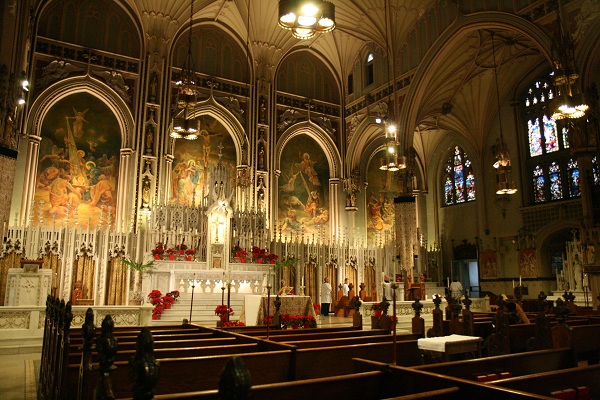
Thomas H. Poole designed the Church of Our Lady of Good Counsel, which was completed in 1892. Its stone exterior is notable for crenellated coping and turrets. Inside, the ornate and spacious interior is decorated with lacy gothic details, galleries on three sides, and beautiful stained glass windows.
Published in Masses | no comment
28
Aug
The Catholic Artists Society announces its second annual Mass for Artists. A Solemn Mass will be offered at the Church of Our Saviour in Manhattan at 2pm on Sunday, September 30th. Father Joseph Koterski, SJ will be the celebrant, with choral music by a professional choir, led by James Wetzel. Afterwards, there will be a reception in the undercroft of the church.
Published in Masses | no comment
23
Aug
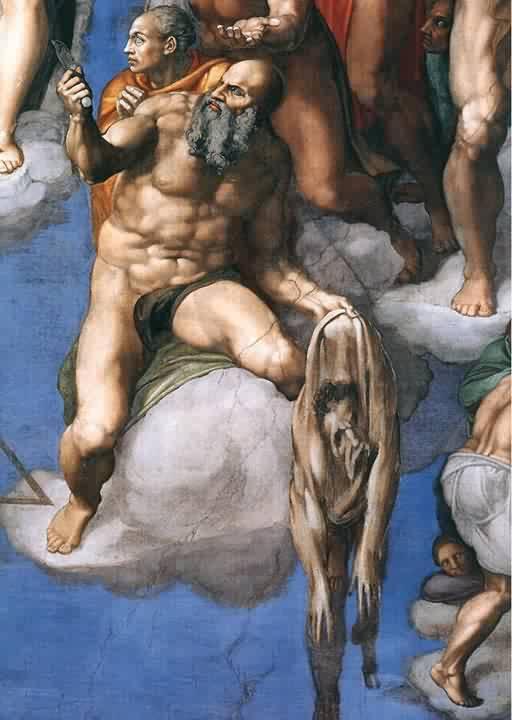
THERE WILL BE A SOLEMN MASS FOR THE FEAST OF ST. BARTHOLEMEW, APOSTLE AND MARTYR, TOMORROW, FRIDAY, AUGUST 24TH, AT 6 PM AT THE CHURCH OF THE HOLY INNOCENTS IN MANHATTAN.
Published in Masses | no comment
Contact us
Register
- Registration is easy: send an e-mail to contact@sthughofcluny.org.
In addition to your e-mail address, you
may include your mailing addresss
and telephone number. We will add you
to the Society's contact list.
Search
Categories
- 2011 Conference on Summorum Pontifcum (5)
- Book Reviews (102)
- Catholic Traditionalism in the United States (27)
- Chartres pIlgrimage (17)
- Essays (179)
- Events (687)
- Film Review (7)
- Making all Things New (44)
- Martin Mosebach (35)
- Masses (1,369)
- Mr. Screwtape (46)
- Obituaries (19)
- On the Trail of the Holy Roman Empire (25)
- Photos (351)
- Pilgrimage Summorum Pontificum 2021 (7)
- Pilgrimage Summorum Pontificum 2022 (6)
- Pilgrimage Summorum Pontificum 2023 (4)
- Sermons (79)
- St. Mary's Holy Week 2019 (10)
- St. Mary's Holy Week 2022 (7)
- St. Mary's Holy Week 2023 (7)
- St. Mary's Holy Week 2024 (6)
- St. Mary's Holy Week 2025 (7)
- St. Mary's Holy Week 2026 (8)
- Summorum Pontificum Pilgrimage 2024 (2)
- Summorum Pontificum Pilgrimage 2025 (7)
- The Churches of New York (202)
- Traditionis Custodes (53)
- Uncategorized (1,398)
- Website Highlights (15)
Churches of New York
Holy Roman Empire
Website Highlights
Archives
Support the Society of St. Hugh of Cluny
[powr-hit-counter label="2775648"]