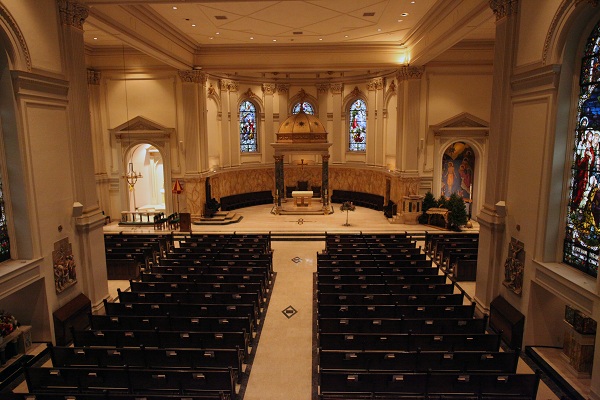
St. Stephen’s Church, New York
Lob der Lourdes-Madonna
From Der Ultramontane (Sankt Ulrichsverlag, Augsburg 2012)
I saw the Lourdes Madonna for the first time in the house of a winemaker of the Rheingau when I was a small boy. While my parents tasted wine below in the kitchen, the daughter of the house, who was my age, showed me the rooms in the upper story. The bedroom of her parents lay there in solemn, cool stiffness. The feather-beds were amply stuffed and hard as if they were filled with cement. The pillows had a sharp crack in the middle, which divided them into two stiff huge ears. There she stood on the dresser opposite the bed like an ice princess amid the austerity of these surroundings. Nevertheless, she was oddly vivacious with her small, delicately made-up, pretty face. My mother laughed ironically as I told her about the statue which seemed so beautiful to me: she said she was a “dresser saint.”
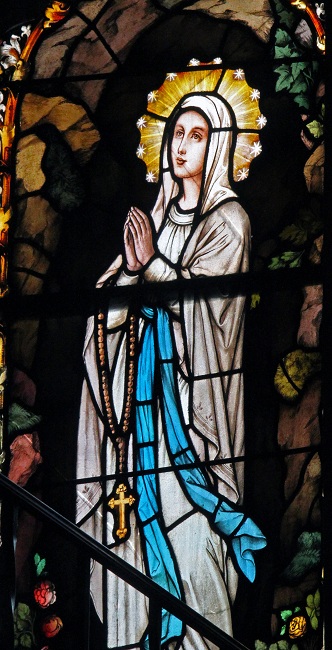
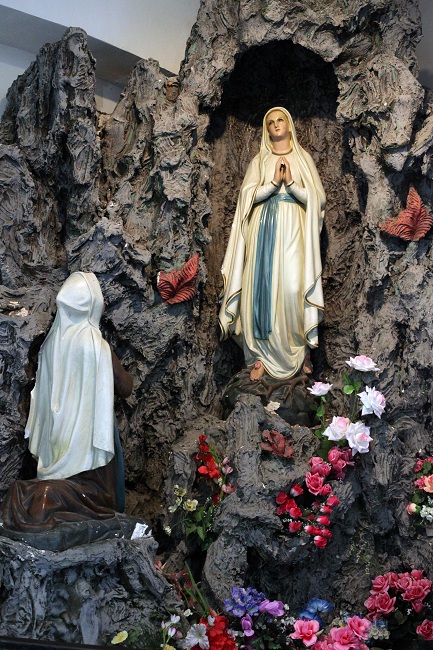
I soon saw, however, the next Madonna of Lourdes in another location. She was somewhat bigger than the one in the rural bedroom. Then I saw another which was very small—scarcely larger than a chess piece. However, she always had the same inclination of the head and the same flowing folds of the white garment, which was neither a dress nor an ancient tunic. It certainly was not something which one could have taken off at all, but had grown together with the body. I learned that each individual Madonna of Lourdes that I encountered was an emissary of a great Marian nation that had settled all over the world. Her body had singular proportions: the legs had to be exceedingly long as if sketched by William Blake or Füssli; the upper body was flat and no feminine swelling could be seen. The face was childlike, with a polished, noble forehead and Raphaelesque symmetry—I suppose a little bit too symmetrical, because everyone knows that even the most beautiful faces are never that symmetrical. The blue sash waved lightly and the folds of the garment were pressed against the body as if by a current of air. These features gave her figure the quality of motion, with the result that she seemed to float towards the observer. Even though one indeed saw feet in little slippers under the hem of her skirt, the statue really resembled those Japanese ladies in waiting, who conceal their feet and walk on the hems of their kimonos. Even though all the statues which I saw were painted with thick oil colors like a carousel horse, it was obvious what material was used to make them: plaster. Very often they were a little bit chipped—and thus the white, dry and grainy plaster would peek out from underneath the paint.
In the ancient churches of France, which had been pillaged during the Revolution and, more often poorly than properly, restored in the 19th century, a small plaster nation could always be found placed against the walls and intended to replace the smashed gothic statues. There was St. Louis, the Curé of Ars, the Maid of Orléans, and of course the Madonna of Lourdes. Here she had company into which she could fit. But in the German Baroque churches with their preserved, splendid decorations or in the modern cement churches she was an alien. She was generally installed with a little embarrassment in a small side chapel near the entrance. The people, however, didn’t seem to notice the embarrassment—usually too many candles burned before her. Plaster was not the only material used. There was also a clay Lady of Lourdes and a glass one used as a container for water from Lourdes. In this case, the stopper was shaped into a crown.
In the hallways of monasteries half-wilted Usambara violets and a grateful cactus bloomed at her feet. Yet her real home was an artificial grotto, related to the Baroque sea-shell grotto of princely palaces. For Our Lady of Lourdes had appeared to the little shepherdess Bernadette like an ancient spring nymph in a grotto. This now has been re-erected out of pumice-stone in many locations — landscape architecture fit for an electric railway. Everywhere there were grottoes of Lourdes, not only in the Vatican next to Renaissance Palazzetti, but also in the center of wild and violent metropolises: in Cairo and New York; in Seoul and Bogotà. Usually they could be found in churchyards where the incessant honking of the stream of traffic sounded somewhat softer: a natural collage before skyscraper walls. And before these caves there always stood a few people even when the church was closed. Red carnations in cellophane bags were attached to the fence which surrounded the grotto, and candles also burned here as the people gazed into the darkness of the hollow where, high above, the white-varnished statue stood like a Catholic Queen Louise of Prussia. 1) The big, blue mantle of the classical image of Mary had shrunk to the light-blue sash. The sash was like that blue ribbon which adorned the white diapers of baby girls before the American pink ribbon replaced it. Why I asked myself, hadn’t Our Lady of Lourdes already appeared a few hundred years earlier to the greatest of all religious painters, Fra Angelico the Florentine? What would Fra Angelico have been able to make from this white flowing, blue-girded dress—can one not see it before his eyes? However, she came later, really already in our era, because her mission here was different. In any case she apparently did not intend to become a work of art.
The ironic laughter of my mother back then had told me: in our milieu, among educated, art-loving, scholarly people, the Lady of Lourdes was not taken seriously. It was kitsch. Kitsch has been a beloved word, one that is nothing short of necessary in aesthetic judgments. It is not a very old word since it first appeared around 1860—didn’t kitsch exist before then? Was there nothing in the 18th century poorly imitated, tasteless, soullessly epigonous, dishonest or untruthful? Perhaps all those things existed, but there was no kitsch. The idea of kitsch presupposes the final end of the assurance of taste in handiwork, that is to say an inherited instinct of taste, that is able to divine from a material, familiar from time immemorial, the laws of correct proportion that reside therein. Industrial production, no longer bound to any laws of the material, has become supreme. However, man himself is slower than the technological development. In his dreams and his standards he remains, really even to this day, rooted in the preindustrial millennia stretching back into gray antiquity. He lulls himself with seductive ideas: is the departure from the traditional conception of beauty, from the proportions that grew organically from the material, really so final after all? Can’t one adroitly combine the advantages of the old era with those of the new? And produce beauty in the old sense of the word or even art with the machine—does it have to be per se so inimical to beauty? And do it with much less trouble and greater perfection? And for so many more people than previously, when art, in wrongful exclusivity, was reserved only for the few? Thus began the mass-produced pressings, castings, and dieings of Lady of Lourdes statues—and by no means not just of them.
It is truly an experience to encounter for the first time such a Marian herd in one of the thousand religious-goods stores of Lourdes: a cloned nation of devout worshippers, in sizes ranging from two meters to two centimeters. My experience consisted not just of a mild case of the creeps at the sight, but also in the insight that this abundance of Madonnas does not detract from the vision of the Madonna. On the contrary, doesn’t Our Lady in the Catholic world appear to us in duplicate? Aren’t all the various black Madonnas and those of Guadeloupe, of La Salette, of Altoetting, of Kevelaer and of Pilar, and of Pompeii and of Loreto always different and always the same? In contrast, in my visit to a grand sculptural workshop in Carrara, I had the chance to see the David of Michelangelo in its original size twelve times, one standing after another. It was an order of an American Hotel chain. This destroyed Michelangelo’s David for me and he still has not yet recovered from this cruel treatment. One sees that “kitsch” is a complicated subject. It is a symptom of many things, even of societal anguish.
The bourgeois social climber—and who isn’t one—fears kitsch because he could be seen exposed in his lack of taste—our impoverished and minimalistic interiors speak also of the anxiety that through greater opulence, if possible, we could fall into the kitsch trap and find ourselves convicted by the petty bourgeoisie arbiters of taste. That of course can’t happen to someone in his empty room. But kitsch is strong and in our world survives even the strictest preventative measures. We have long since recognized austere kitsch, sour kitsch, Green kitsch, the kitsch of concern and the kitsch of authenticity. Each of these variants is much more difficult to detect and requires a considerably more polished sense of taste to order to discover than the Madonna of Lourdes in her defenseles, naïve innocence. The Madonna of Lourdes does not defend herself but she can offer protection: Cordelia Spaemann, the deceased wife of the philosopher Robert Spaemann, said that the devotional kitsch of the pilgrimage destinations, with the Madonna of Lourdes leading the way, is the bulwark, with which the blasé aesthetes (she speaks of the “riffraff of aesthetes”) can be kept far from the sanctuary.
Let us therefore push aside with due roughness the whole question of kitsch in regard to the Madonna of Lourdes and see directly the plain fact that there has not been one single artistic or handmade creation in the entire twentieth century, which was as clear, universally understood, capable of crossing national and cultural boundaries, functional in the liturgical sense and identifiably Catholic as the Madonna of Lourdes. Her anonymous creator possessed the same form-endowing genius as the creator of Mickey Mouse or the designer of the Coca-Cola logo. Wherever the Madonna of Lourdes stands there is the Catholic Church. In view of her power of self-assertion—and how sweet is this power!—every judgment of taste concerning her shrinks to mere unimportant personal opinions of beauty and ugliness.
At the beginning of the second millennium, the Latin Church disengaged from the tradition of images of the ancient Church—at first gradually but then ever faster and more emphatically. It is worth recapitulating once more the steps of this way in a few words. One has accustomed himself to see this path as a great liberation from the prison of prescriptions and limitations; one has frankly celebrated the development of religious art as the history of progress. In the beginning was the icon, and the icon was governed by strict laws. The icon fixed strictly the appearance of the saints, above all that of the Panhagia and of the Redeemer, in rigid, irreversible rules and prevented every subjective interpretation. The icon thoroughly renounced the sense of space and plasticity of representation long-since attained by Hellenistic painting and strove for two-dimensionality. The coloring of the icon was similarly rigidly established. What the colors of Christ and Mary were; what colors befit the world of the Old and New Testaments; which drapery corresponded to which representation in what situation; what attendants, props and symbols might appear or, rather, had to appear were removed from the personal decision of the painter just like the prayers he had to recite while rubbing the colors or applying the layers of paint on the wooden panel. These icons were not just the pious decoration of a church, but sure signs of the Godly presence of the same rank as the consecrated hosts in the tabernacle. This two-dimensionality was not artistic incapacity, but a sign that the represented figure no longer belonged to the sphere of the carnal world but, through the window of the borders of the icon, looked out from eternity into the earthly world.
Let us set aside the question why the Latin Church left the community of pictorial tradition with the Greek Church—it is enough to say that She did and struck out on the path of a great, exciting adventure that led painting to ever new triumphs. Whether that was also an advantage for the liturgical image is another question. Everyone knows the steps of this liberation: Giotto’s conquest of a new kind of corporeality initiated a process through which over the centuries all phases of each contemporary transformation of biblical figures and biblical themes had to quickly pass. The artists at times change into self-willed theologians, who make their personal interpretations of the Passion of Christ the foundation of their pictures. They become storytellers who also do not shy away from the anecdotal. They take the biblical material as a bare pretext for ever more brilliant painting. They become theater or even opera directors who fashionably stage the stations of the life of Jesus. They sublimate or trivialize the lives of the saints and let them take place on stages of clouds or in the pits of cellars. And after all of that had been tried and the so-called emancipation from the church lawgiver had finally and completely taken place, the official rupture finally came: Western art took leave from her hitherto most generous and most patient Maecenas and turned to other missions. An intimidated and bewildered Church remained, who, unawares, saw Herself pushed away from the aesthetic mainstream of the time and found Herself banished to the remainders of the art business, pale reflections of the changing contemporary fashions.
That the special Western path of religious art has ended, that the liberation of Church art and its deliverance to individualism and subjectivism has led over centuries of corresponding development to a fundamental separation of Church and art has still not yet been properly received by the upper levels of the hierarchy, the pontifical councils for art and similar reverend institutions. However, it has been received for a long time by the faithful. Without the need to issue catchwords and slogans, a change of the veneration of images took place which one could label as “reiconization.” The multi-national people of the Catholic Church has turned to holy pictures, which are not works of art and do not want to be such. Goethe didn’t know how right he was when he wrote in “Roman Elegies” in sneering undertones: “Miraculous paintings are mostly only bad works of art.” Idols are plainly not works of art, and when they are, like the big icons of Byzantium and Russia, they are like them only incidentally. The Orthodox would probably refrain from calling the Lourdes Madonna an icon because for them, the fact that it is a statue stands in the way. The Orthodox rely upon the Old Testament prohibition of pictures—precisely of Simulacra, the plastic representation of gods. However in the nontechnical sense, one may still call the Lourdes Madonna an icon, the icon of the West, created by an anonymous hand, establishing a new standard, a perennial vision, in her capacity as a mass-produced article, radically nonindividualistic, absolutely nonsubjective. She is as far distant from the grand old art of Europe as she is from the art of the twentieth century. For tenured art critics of the 19th century she was art for servant girls, for West European experts of liturgy of the 20th century she is only fit for Poles and Africans. That is a good sign for her ability to live on.
We have called the Lourdes Madonna an icon because of her appeal which can’t be compared to any other work of art made for a church in the twentieth century. The Lourdes Madonna has a justified claim to the honorable title of icon, however, for even more profound and important reasons. In two respects, from her very origin, she corresponds to the highest demands made on true icons. A true icon seeks the ideal of immutability, the pushing back of opportune, personal, and ingeniously inspired things. This does not represent an oriental, anti-individualistic disposition, of an almost Egyptian rigidity, but is intimately linked to the origin of Christian painting and its special requirements. Before the very beginning of Christian veneration of images and painting stands the gigantic, already-mentioned hurdle: that prohibition of pictures of the Old Testament, declared in the second commandment—not simply a prescription of worship, which pertained to the time, but a law spoken by God Himself. For the early Christians, who came from the Jews in no small part, the commandment possessed all the greater obviousness, when the religion of the heathens, in its superabundance of statues of gods, was plainly a religion of images. We know that even Christianity was bound to become a religion of pictures, but it needed an authorization thereto, that could not have been spoken by men — God Himself had to annul that prohibition of pictures, and He really had annulled it. St. Paul had first pronounced that Jesus Christ was “God’s picture.” The God who became flesh permitted that human visual perception could possess His image. That was indeed only one aspect of His multifarious self-offering to man.
And yet the fear would have been insuperable to paint the man Jesus just like the unique, beautiful mummy-portraits of Faiyum created in near-by Egypt during His lifetime, if there hadn’t been a picture of Jesus, that didn’t originate from human hand and remained as testimony to the time on earth of the redeemer. I am speaking of that canvas, which Goethe in “West-östlichen Diwan” calls “the cloth of clothes upon which the likeness of the Lord impressed itself.” This shadowy impression, this mysterious picture, which was created not by artistic methods, without a brush and colors, without a portrait-staging, stands at the beginning of all Christian painting. This cloth of cloths is the foundation for the typus (normative image – translator) of Christ, which was conserved for hundreds of years, until Michelangelo broke free from it in an act of violence. Here lies the basis for the strict form of the icon: the icon is based on a likeness established by God himself — who would dare to lay hands on it? The notion remained alive in the Christian East that a liturgical picture, a picture for the service of God, always should be one created by God Himself and received, not made, by man. Here one recognizes icons of special dignity, which, according to tradition, are not painted by the hand of man—they are known as “acheiropoetos” and they radiate out to many icons, created by nameless painters, which really also had to be “acheiropoetos” and which in every case were painted according to the example of such pictures.
Is it not amazing how closely the Lourdes Madonna corresponds to this view of the Christian image — this product of industry, that at first appears to stand in the sharpest possible contrast to the venerable pictures of early Christianity? It depends not on artistic invention but on the vision of a saint, who described how that “white Lady” (as she said) approached her in a cave, so as to introduce herself (in the dialect of the Pyrenees) as an “Immaculate Conception.” Not, it is to be noted, as the immaculately conceived one, but the abstract concept in human form, as the incarnation of the word. And following the description given by the shepherdess, a modeler in a religious-goods factory or perhaps even several such men, whose names with high probability no one any longer can discover, created this statue as the “vera icon,” as the true image of the appearance, which since has been produced hundreds of thousands of times. She is truly “acheiropoetos” with her nonindividual features, like a doll, similar to every man and no man, as befits the first human of the new creation, the perfect new Eve. Who dares to maintain that we deserve something better?
Martin Mosebach
(Translated by Stuart J. Chessman. Translation by kind permission of Martin Mosebach)
1 A queen of Prussia, born in 1776 and who died in 1810. A revered figure often depicted in neo-classical attire. (Translator’s note))
St. John Nepomocene, New York






![photo[1]](https://sthughofcluny.org/wp-content/uploads/2012/12/photo11.jpg)